The Curse of Skeleton Munroe

Category: reformed

  • MINOR SUPER-VILLAIN 404: THE AVENGER

    (More Fun Comics 074, 1941)

    Another day, another Avenger. This Avenger is a disgruntled scientist named Mortimer Crandall who is seeking revenge on his old bosses for firing him because of his wacky scientific theories that, you guessed it, turned out to be correct. He uses his working technology to kidnap the men responsible in preparation for their murders.
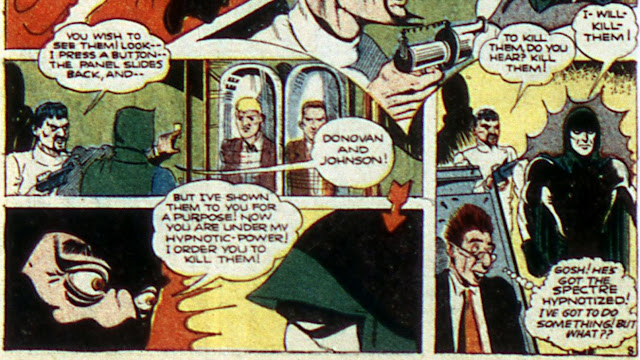
    This Avenger also demonstrates a flair for comic-book style hypnosis sufficient to place the Spectre himself under his power, which is impressive even in the Golden Age, before the whole “the Spectre is literally an angel” thing.

    The Avenger ultimately fails in his bid to exact revenge and instead is given that most rare of choices for a Spectre foe: the chance to reform (with a little help from the mystic radiations of the Nebula of Truth, of course). Is it because he had genuinely been wronged? Because he had not yet taken a life? Or is the Spectre just a capricious guy? Regardless, the Avenger will venge no more.

    This issue also marks the first appearance of Spectre sidekick Percival Popp, the Super Cop and I find myself in a familiar place: here is a charming oddball character that I like, being treated like an unbearable pain by all the other characters that I like. It’s one of the more annoying literary dynamics! Hope it doesn’t stick around!

  • MINOR SUPER-VILLAIN 366: THE SCAVENGERS

    (Military Comics 005, 1941) 

    The Scavengers are an interesting bunch, but all of the most interesting things about them are implied rather than stated. As seen above, they show up to loot and murder in the aftermath of WWII battles. The fact that they all look the same, like little rat-men, is probably meant to be a metaphorical signifier of their moral degradation but I like the implication that this is what happens to battlefield looters, like the the transformation of a ghoul or other cannibal. This of course means that there could be Scavengers throughout human history – fun!

    The Scavengers don’t actually get to do much scavenging in-story, sadly. Instead, they are captured by the Nazis and enlisted in their capacity as weird little creeps to dispose of the Blackhawks. And they do pretty well at it! Their downfall comes due to the interference of the excellently-named femme fatale Red Laura, who somewhat predictably falls for Blackhawk’s nobility and shirtlessness.

    Despite having a heroic last stand, pictured above, Red Laura actually manages to survive the issue. One hopes that she was a bit more picky about who she worked for going forward, because I am inordinately fond of her. It’s just such a good name!

    In conclusion, the Scavengers should be BRUNG BACK. Not only did they not all die at the end of the adventure (as the Blackhawks are about as likely to punch out as to shoot an opponent) but the idea of them cropping up in the aftermath of war throughout history is very cool! We need more types of human monster who wear their spiritual corruption on the outside, if only for greater variety in D&D.

  • MAD AND CRIMINAL SCIENTIST ROUND-UP 001

    Like costumed villains, there are a lot of scientists out there doing crimes involving superscience but just missing the levels of interest, ambition or scale to graduate to true super-villain status. Sometimes this is because of poor planning or lack of vision and others just have the misfortune to run into a protagonist while still in the initial stages of their venture. And don’t they deserve a forum just as much as the generic costumed villains we all love?

    Julius Korn: 

    Our first science fiend is Julius Korn, who takes over a lighthouse with his crew of misfits in order to use his ray machine to sink passing ships. It’s unclear just why he does this – is it a weapons test, a piracy scheme, fifth column activity or plain sadism? – but he is thwarted by sea rover Dusty Dane and his pal Big Mike Cardigan and ends his days like so many other comic book scientists: exploding along with his invention. (Feature Comics 048, 1941)

    the Professor: 

    The Professor here operated a scheme whereby he used a magnetic engine killing ray to bring down mail planes in Arizona’s Painted Desert. As befits a scientist operating in cowboy territory, he was willing to get his hands a bit dirtier than your typical effete science-man, but even that wasn’t enough to save him from the Fargo Kid. (Feature Comics 051, 1941)

    Unnamed Scientist: 

    This unnamed fellow went to the trouble of developing anti-Flash technology – specifically, glasses with rotating lenses that allow him to see fast-moving objects – to protect his kidnap gang rather than, say, moving to another city (or marketing his glasses somewhere, natch) (Flash Comics v1 001, 1940)

    (Trophy Room bonus: the Flash keeps the glasses)

    Dr Jennings: 

    This here’s Dr Jennings, who works in a research lab with Jay “the Flash” Garrick and kidnaps a lot of people to live out his dream of establishing a colony on Mars but then is betrayed by his venture capitalist partner Enzil who just wants to establish himself as a Martian tyrant in a story that feels oddly prescient somehow? Anyhow the Flash is more focused on rehabilitation than your average Golden Age hero and so Jennings is allowed to go back to his old life after Enzil is vaporized by spider-aliens. (Flash Comics v1 024, 1941)

  • MINOR SUPER-VILLAIN 074: DR TOGG

    (Adventure Comics 057, 1940)

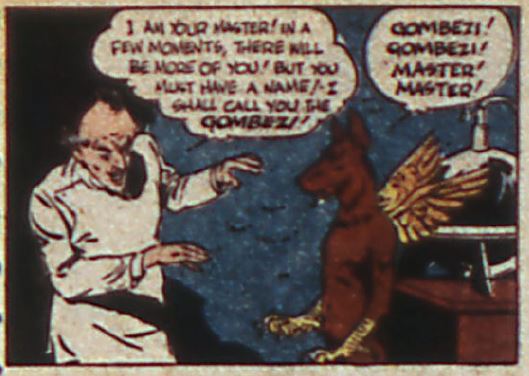
    Yet another Hourman science-villain. Dr Togg was really into hybridizing dogs and buzzards in various fun ways. Such a cool guy was he, in fact, that he was brought back as an ancillary character in the 90s Hourman series, himself mutated into a partial dog/buzzard in a retconned final encounter with Hourman before he was sent to prison.

    Thinking about him (and fellow Hourman foe Iker in about 50 entries or so), has made me realize just how much I love the concept of the reformed mad scientist with their struggles to comprehend scientific ethics and their weird little mutations and leftover minions. A few recent Marvel series have featured the concept but I would still consider it to be underutilized.

    There’s our guy.


  • MINOR SUPER-VILLAIN 074: DR TOGG

    (Adventure Comics 057, 1940)

    Yet another Hourman science-villain. Dr Togg was really into hybridizing dogs and buzzards in various fun ways. Such a cool guy was he, in fact, that he was brought back as an ancillary character in the 90s Hourman series, himself mutated into a partial dog/buzzard in a retconned final encounter with Hourman before he was sent to prison.

    Thinking about him (and fellow Hourman foe Iker in about 50 entries or so), has made me realize just how much I love the concept of the reformed mad scientist with their struggles to comprehend scientific ethics and their weird little mutations and leftover minions. A few recent Marvel series have featured the concept but I would still consider it to be underutilized.

    There’s our guy.


  • MINOR SUPER-VILLAIN 036: SETAP

    (Action v1 017, 1939)

    Setap is fun because she’s one of the few old lady super-villains who actually is an old lady, rather than a gangster in drag. She’s also pretty happy about her plan to steal youth from one of Zatara’s pals, until he reverses the process and blows up her city.

    Setap is also an early example of a reformed villain, as she shows up a few issues later (presumably after stealing youth off someone else, as she is young again) and enlists Zatara’s help in finding her ancestral home, Atlantis

  • MINOR SUPER-VILLAIN 036: SETAP

    (Action v1 017, 1939)

    Setap is fun because she’s one of the few old lady super-villains who actually is an old lady, rather than a gangster in drag. She’s also pretty happy about her plan to steal youth from one of Zatara’s pals, until he reverses the process and blows up her city.

    Setap is also an early example of a reformed villain, as she shows up a few issues later (presumably after stealing youth off someone else, as she is young again) and enlists Zatara’s help in finding her ancestral home, Atlantis

  • MINOR SUPER-VILLAIN 019: THE TIGRESS

    MINOR SUPER-VILLAIN 019: THE TIGRESS

    (Action Comics v1 001, 1938)

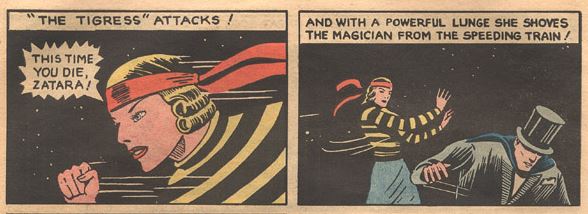
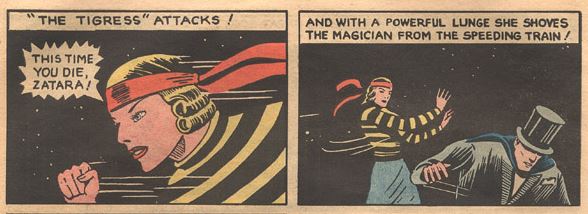
    The Tigress was both Zatara’s first foe and his only real recurring villain, showing up a dozen times over 3 years. She acted in the role of what was occasionally called a “friendly enemy”: a villain of the opposite gender who the hero has a soft spot for, implicitly or explicitly because they’re horny for them. A Catwoman situation, in other words.

    Like Catwoman and Batman, the Tigress occasionally teamed up with Zatara against a worse foe, and Zatara frequently let her escape at the end of a case out of horny sentimentality. Unlike Catwoman, the Tigress was absolutely a multiple murderer, running armed robbery, assassination and extortion rings at various times as well as acting as lieutenant for several other super-villains such as the Mad Lama.

    Ultimately, Zatara caught the Tigress for the last time and seemingly persuaded her to reform. Whether it stuck or not, she never appeared in a comic book again.