The Curse of Skeleton Munroe

Category: Temerson

  • CATALOGUE OF WOUNDS 013

    If I see a wound, I catalogue it.

    Camilla, Queen of the Lost Empire:

    Shot in the back with an arrow. (Jungle Comics 019, 1941)

    Captain Flag:

    Nearly dies of the Black Hand’s horrible hand disease. (Blue Ribbon Comics 016, 1941)

    the Cat-Man:

    Stabbed in the chest, to death (he gets better). (Crash Comics Adventures 004, 1940)

    Killed by a blood-freezing ray. He gets better again. (Crash Comics Adventures 005, 1940)

    Dynamo:

    Dynamo gets his skull creased by a bullet in the classic fashion. (Science Comics 005, 1940)

    the Green Mask:

    Michael Shelby is shot in the chest, prompting pal Professor Lascomb to stick him in the machine that turns him into the Green Mask. (Green Mask v1 001 1940)

    Domino the Miracle Boy:

    Later in the same issue, the boy known only as Don gets seriously exploded and must also be placed in the machine. (Green Mask v1 001, 1940)

    Kaänga: 

    Not even being an off-brand Tarzan can save you from being shot in the left shoulder,, as Kaänga learns here. (Jungle Comics 010, 1940)

    the Mask:

    District Attorney Colby is blinded by acid as part of his journey to becoming the Mask. (Exciting Comics 001, 1940)

    Tabu, Wizard of the Jungle:

    Tabu is shot in the right shoulder by this jerk. (Jungle Comics 019, 1941)

    Just one issue later, Tabu is speared in the right arm by a different jerk. (Jungle Comics 020, 1941)

  • MEDIA IN COMICS 007

    We’ve got some real early media for you today, so get ready for the crustiest scans of microfiche you ever saw.

    Movies:

    Steve Rogers and Bucky almost get to the movies to see a flick called Million Dollar Robbery before being interrupted by a real, if smaller-scale, robbery. BONUS: a classic case of real movies stars barely obfuscated by having their first names swapped, in Humphrey Raft and George Bogart, aka George Raft and Humphrey Bogart. (Captain America Comics 004, 1941)

    Hired to look into dirty dealings on the Stupendous Films lot, Slam Bradley and Shorty Morgan go undercover as stunt doubles. The comedy film that Shorty works on is never named, but Slam briefly works on a film called Jungle Man. (Detective Comics v1 004, 1937)

    Larry Steele’s own investigations into a series of high-profile kidnappings take him to the set of Too Much Money, a movie we never learn anything about. (Detective Comics v1 005, 1937)

    It’s just barely possible to make out that this movie that the Radio Squad boys watch is called The Fighting Cop. A bit on the nose, boys! (More Fun Comics 038, 1938)

    Music:

    Detective Bruce Nelson investigates a series of murders committed on stage while each victim was singing the same song. That song was originally called “The Night is Blue,” but is now known as “The Song of Death.” (Detective Comics 020, 1938)

    In Action Comics 006, a grifter named Nick Williams falsifies some contracts and begins licensing Superman’s name all over town, and one of the results of this is a song! Specifically, a big band tune called “You’re a Superman!”

    I wouldn’t call it the greatest song ever written (no song should include the word “resistless,” for example), but it’s not entirely terrible. (Action Comics v1 006, 1938)

    Newspaper Columns:

    Written by Paul Revere Sr, ultra-patriot and father to comic book adventure kid Paul Revere Jr, “America Awake!” is one of those exciting titles that works for an anti-Nazi column in 1941 and also potentially for a pro-Nazi one in the present. (Banner Comics 003, 1941)

    Jay Garson Jr, aka the Ragman, wrote his “Crime Does Not Pay” column right up until someone tried to kill him for it and he was forced to fake his own death. And then kept on writing it for a while afterward, seemingly mostly in order to give his old editor a hard time. (Cat-Man Comics 001, 1941)

    Radio Shows:

    In addition to “You’re a Superman!” Nick Wilson’s Superman-licensing deals included a Superman radio show, meaning that the DC Universe had one a full two years before we did.

    Wilson also mentions having sold movie and comic book rights, but as he is beaten up and forced to stop his scheme by the real Superman not long after this conversation it’s likely that those never saw the light of day. (Action Comics v1 006, 1938)

    Theatre:

    Slam Bradley and Shorty Morgan investigate the crimes of the Broadway Bandit by getting jobs on Broadway, specifically as tap dancers in a production called Love on Ice that despite its name seems to be a variety show rather than anything with a discernible plot. (Detective Comics v1 016, 1938)

    Renick’s Frolics, the show in which “The Song of Death” appears, is another of these variety productions. (Detective Comics v1 020, 1938)

    We learn nothing about Darkest Dawn other than the fact that someone is trying to kill the lead actress and Nadir, Master of Magic, is on the case. (New Adventure Comics 028, 1938)

  • MEDIA IN COMICS 007

    We’ve got some real early media for you today, so get ready for the crustiest scans of microfiche you ever saw.

    Movies:

    Steve Rogers and Bucky almost get to the movies to see a flick called Million Dollar Robbery before being interrupted by a real, if smaller-scale, robbery. BONUS: a classic case of real movies stars barely obfuscated by having their first names swapped, in Humphrey Raft and George Bogart, aka George Raft and Humphrey Bogart. (Captain America Comics 004, 1941)

    Hired to look into dirty dealings on the Stupendous Films lot, Slam Bradley and Shorty Morgan go undercover as stunt doubles. The comedy film that Shorty works on is never named, but Slam briefly works on a film called Jungle Man. (Detective Comics v1 004, 1937)

    Larry Steele’s own investigations into a series of high-profile kidnappings take him to the set of Too Much Money, a movie we never learn anything about. (Detective Comics v1 005, 1937)

    It’s just barely possible to make out that this movie that the Radio Squad boys watch is called The Fighting Cop. A bit on the nose, boys! (More Fun Comics 038, 1938)

    Music:

    Detective Bruce Nelson investigates a series of murders committed on stage while each victim was singing the same song. That song was originally called “The Night is Blue,” but is now known as “The Song of Death.” (Detective Comics 020, 1938)

    In Action Comics 006, a grifter named Nick Williams falsifies some contracts and begins licensing Superman’s name all over town, and one of the results of this is a song! Specifically, a big band tune called “You’re a Superman!”

    I wouldn’t call it the greatest song ever written (no song should include the word “resistless,” for example), but it’s not entirely terrible. (Action Comics v1 006, 1938)

    Newspaper Columns:

    Written by Paul Revere Sr, ultra-patriot and father to comic book adventure kid Paul Revere Jr, “America Awake!” is one of those exciting titles that works for an anti-Nazi column in 1941 and also potentially for a pro-Nazi one in the present. (Banner Comics 003, 1941)

    Jay Garson Jr, aka the Ragman, wrote his “Crime Does Not Pay” column right up until someone tried to kill him for it and he was forced to fake his own death. And then kept on writing it for a while afterward, seemingly mostly in order to give his old editor a hard time. (Cat-Man Comics 001, 1941)

    Radio Shows:

    In addition to “You’re a Superman!” Nick Wilson’s Superman-licensing deals included a Superman radio show, meaning that the DC Universe had one a full two years before we did.

    Wilson also mentions having sold movie and comic book rights, but as he is beaten up and forced to stop his scheme by the real Superman not long after this conversation it’s likely that those never saw the light of day. (Action Comics v1 006, 1938)

    Theatre:

    Slam Bradley and Shorty Morgan investigate the crimes of the Broadway Bandit by getting jobs on Broadway, specifically as tap dancers in a production called Love on Ice that despite its name seems to be a variety show rather than anything with a discernible plot. (Detective Comics v1 016, 1938)

    Renick’s Frolics, the show in which “The Song of Death” appears, is another of these variety productions. (Detective Comics v1 020, 1938)

    We learn nothing about Darkest Dawn other than the fact that someone is trying to kill the lead actress and Nadir, Master of Magic, is on the case. (New Adventure Comics 028, 1938)

  • ALIENS AND SO FORTH ROUND-UP 048

    Gosh! How alien they are!

    Frog-Men:

    These two Frog-Men cause trouble for Sub Saunders when they steal his ship for a little joyriding/ piracy session. They are undone by the fact that neither of them know how to drive, and are ultimately head-konked into submission after crash landing. What this tells us about Frog-Man society is unclear – if this were a Star Wars then the Frog-Men would end up being a race of car thieves, of course, but most societies don’t work like that. (Fantastic Comics 021, 1941)

    Martians:

    Today’s selection of Martians is going to include some classic design elements! First we have this species represented by the very helpful Darek. Darek is based on the old Speculative Evolution version of a Martian, with spindly limbs due to the lower gravity and huge ears and lungs to aid in hearing and breathing in a thin atmosphere. As a bonus, he’s also from a Mars that is covered in some classic canals, and has a hint of an interesting culture and mythology thanks to some early Jack Kirby writing. And of course he is green. A true classic Martian in many ways. (Crash Comics Adventures 003, 1940)

    Martians:

    These Martians aren’t quite as cool as the previous ones, but the ruddy tint to their skin is a real classic design element for aliens from the Red Planet. I also appreciate that they look a bit like Space Elves wearing little green hats. If “Space Smith” was still being created by Fletcher Hanks when they appeared I might speculate that they were of the same species as the Brain, but I can’t in good conscience do so now. Besides, even Hanks’ version of Mars supports multiple humanoid species.

    As a bonus, these Martians help Space Smith and Dianna defeat an attempted invasion of the Solar System by an extrasolar group called the Generals of Capella. We never actually learn much about these guys due to the fact that they attack with the aid of remote controlled meteors called “sandblasts,” but when has that ever mattered: they’re going on the list. (Fantastic Comics 009, 1940) 

    Martians:

    For our final Classic Martian Design Element, we have these warlike Martians dressed in futuristic Roman gear! The connection between the planet Mars and the god Mars has dramatically extended the reach of the brush-topped helmet in fiction over the years, and given us countless Martian aggressors to boot.

    These particular Martians are hell-bent on claiming the interior of one of the Living Planet Monsters as their own, for some reason, and the fact that they attack the human colonists who are already there is especially egregious because they don’t actually want to be there, they just got eaten. This unreasonable aggression is enough to make Saber, the Spy Fighter (there to rescue the Earth colonists) use his mega-powers to grow enormous and turf the entire Mars contingent out into the void of space. (Fight Comics 010, 1940)

  • PROBLEMATIC ROUND-UP 007

    Damn their problematic hides!

    Rango: 

    A former Vaudeville magician who employs a magical gem and some rubberoid mask blackface to establish himself as medicine man/bandit chief in Africa, Rango aka Harrigan is ultimately unmasked by Yarko the Great. (Wonderworld Comics 015, 1940) 

    Unnamed Witch Doctor: 

    This unnamed Haitian witch doctor has a very unusual scheme: blind entire American cities with a floating vision of some of his men and then loot those same cities of all of their diamonds. Why diamonds specifically? No clue. He is also notable for giving Zambini the Miracle Man a harder time than Satan himself, before eventually being killed, just like Satan himself. (Zip Comics 005, 1940)

    War Hatchet: 

    Fascist spies striking at the US by inciting Native American tribes to violence is unfortunately going to crop up more than a couple of times as we make our way through the comics of the Forties (and I reckon that the same plot will be recycled with Commie spies in the Fifties and Sixties, alas). This time, the plot is spearheaded by a fellow who calls himself War Hatchet, a European ex-pat turned bandit chief who has returned to the fold to do some espionage work for the dear old unnamed fatherland. 

    As is often the case, War Hatchet makes an okay argument for the colonized to rise up against their oppressors, only with a bunch of murder appended and the unspoken coda that there will be new oppressors later on. Spy Smasher not only stabs him to death but chucks him into a fire afterward. (Spy Smasher 001, 1941)

    the Yellow Horde: 

    The Yellow Horde is a gang of guys in cool looking yellow suits who break into defense plants and shoot poison gas balls everywhere. They turn out to be Chinese, and while the name is arguably in reference to the cool suits I just can’t bring myself to trust 1940s America not to get a little bit of racism in for fun.

    The Yellow Horde’s boss turns out to be an unnamed costumed Nazi who is pretending to be Chinese but also forcing the Horde into doing his bidding. why both? Who knows. Ultimately he gets beaten up by the Hood. (Cat-Man Comics 005, 1941)

  • PROBLEMATIC ROUND-UP 007

    Damn their problematic hides!

    Rango: 

    A former Vaudeville magician who employs a magical gem and some rubberoid mask blackface to establish himself as medicine man/bandit chief in Africa, Rango aka Harrigan is ultimately unmasked by Yarko the Great. (Wonderworld Comics 015, 1940) 

    Unnamed Witch Doctor: 

    This unnamed Haitian witch doctor has a very unusual scheme: blind entire American cities with a floating vision of some of his men and then loot those same cities of all of their diamonds. Why diamonds specifically? No clue. He is also notable for giving Zambini the Miracle Man a harder time than Satan himself, before eventually being killed, just like Satan himself. (Zip Comics 005, 1940)

    War Hatchet: 

    Fascist spies striking at the US by inciting Native American tribes to violence is unfortunately going to crop up more than a couple of times as we make our way through the comics of the Forties (and I reckon that the same plot will be recycled with Commie spies in the Fifties and Sixties, alas). This time, the plot is spearheaded by a fellow who calls himself War Hatchet, a European ex-pat turned bandit chief who has returned to the fold to do some espionage work for the dear old unnamed fatherland. 

    As is often the case, War Hatchet makes an okay argument for the colonized to rise up against their oppressors, only with a bunch of murder appended and the unspoken coda that there will be new oppressors later on. Spy Smasher not only stabs him to death but chucks him into a fire afterward. (Spy Smasher 001, 1941)

    the Yellow Horde: 

    The Yellow Horde is a gang of guys in cool looking yellow suits who break into defense plants and shoot poison gas balls everywhere. They turn out to be Chinese, and while the name is arguably in reference to the cool suits I just can’t bring myself to trust 1940s America not to get a little bit of racism in for fun.

    The Yellow Horde’s boss turns out to be an unnamed costumed Nazi who is pretending to be Chinese but also forcing the Horde into doing his bidding. why both? Who knows. Ultimately he gets beaten up by the Hood. (Cat-Man Comics 005, 1941)

  • REAL PERSON ROUND-UP 021

    REAL PERSON ROUND-UP 021

    They just love putting real folks and versions of real folks in comics and I just love finding them and putting them on my blog. 

    Adolf Hitler:

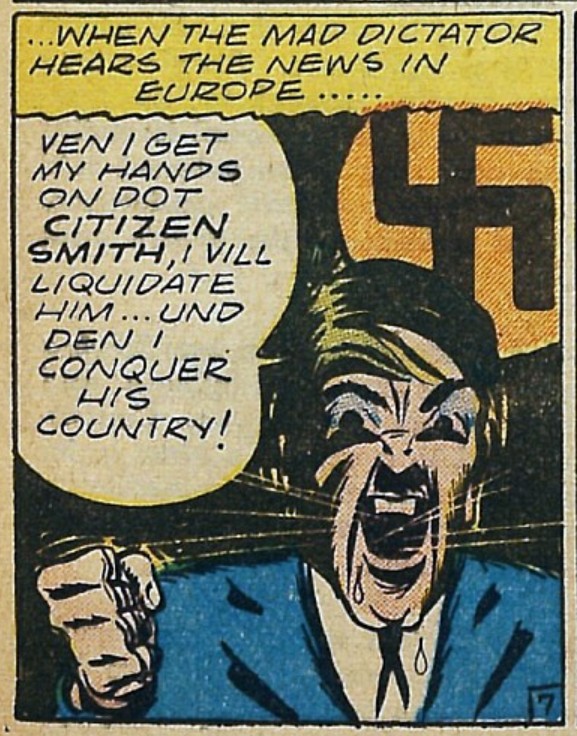
    An in-all-but-name version of Hitler gets mad at Citizen Smith for foiling his plans and plots. (Captain Fearless Comics 002, 1941)

    Gang boss and Deacon foe Duke Adare’s little toothbrush mustache is what initially drew my attention, even though that wasn’t nearly as glaring a signpost of a character being a Hitler stand-in in the 1940s. As the story wore on it became clear that my instincts were correct, as Adare used overwhelming military force to overwhelm the lawmen of Midland City and loot its treasury. And then of course you get to the end of the story, where they’re referring to him as a “would-be Crime Fuehrer”. (Cat-Man Comics 005, 1941)

    Minor appearances: 

    Captain Fearless Comics 001, 1941 

    Al Capone: 

    Lou Pacone, gang boss and murderer of the Secret Circle’s father, is yet another example of Al Capone’s name being remixed to give someone a gangstery sounding moniker. (Choice Comics 001, 1941)

    Axis & Allied Figures: 

    “America’s Air Army” was an extremely patriotic feature that was essentially US Army Air Force fan fiction about what would happen if and when the United States entered WWII, published just before they did. It’s the tale of the US forces (with a little help from the Brits) curb stomping the Axis for about half an hour before we get this little scene, with Hitler surrendering while Goering, Walther von Brauchitch (recently relieved of duty when this comic was published), Cordell Hull (I think) and Churchill observe. (Air Fighters v1 001, 1941) 

    FDR: 

    The President gets kidnapped by Dr Sivana! And Rescued by Captain Marvel! (Whiz Comics 014, 1941)

    Minor Appearances: Captain Aero Comics 001, 1941

    Lord Haw-Haw: 

    In his final Golden Age adventure, the Arrow aka intelligence agent Ralph Payne heads into Germany to apprehend the traitorous broadcaster “Lord Hawford.” (The Arrow 003, 1941) 

    Manuel Prado Ugarteche: 

    Lance O’Casey and his pal Dan’l Doom wash up on the shores of Peru and get mixed up in a scheme to overthrow the country by the wicked El Tigre. They foil him and restore power to the rightful president, Alfredo Blanco, who is extremely not Manuel Prado Ugarteche, the Peruvian president in our version of 1941. (Whiz Comics 015, 1941)

    Rudolph Hess: 

    “Deputy-Dictator Brinker” lands in a farmer’s field near Washington in what is certainly a reference to Hess’ flight to Scotland but is in fact revealed to be part of a plan to invade the US. The whole thing is nearly undone by the fact that the FBI doesn’t even bother to check on this seeming defection and just tells the poor farmer to deal with it. (Captain Fearless Comics 002, 1941)

    Sherlock Holmes:

    Dr Miracle is on the trail of a mystery, and who better to help than the summoned spirit of Sherlock Holmes Herlock Sholmes? Per the conceit of the story I guess this means that Sholmes was a real living guy at some point. (Champ Comics 012, 1941)

    Unknown Dancers: 

    Yet again we have an example of “this seems like a reference to something but I can’t find specifics,” in this case a dance team known as Velox & Costanza. The concept of a duo performing cultural dances from exotic locales crops up now and then as entertainment in comics but I’m never sure if the references to them are general or specific, and brief fads in live entertainment are among the trickiest things to casually research on the internet – it’s more of a “comb through several years’ worth of newspapers” kind of thing. (Whiz Comics 023, 1941)

    Walter Winchell: 

    As an example of why I include the Unknown entries in these round-ups: I had Walter Chinwell here listed as “Unknown Reporter” for something like two weeks before I came across Walter Winchell’s name in a list of 1940s radio announcers. And Winchell is someone I had already heard of! (Silver Streak Comics 008, 1941) 

  • CATALOGUE OF WOUNDS 004

    More wounds for the wound god!

    American Ace:

    Minor Marvel adventure hero Parry Wade, aka the American Ace, is riddled through the torso and crashes his plane after a dogfight. He gets better. (Marvel Mystery Comics v1 003, 1940)

    Black X:

    Shot in the left shoulder by agents of Vlamir Koran, then nearly dies of exposure while seeking aid. (Smash Comics 001, 1939)

    Black X’s aide Batu gets shot in the left shoulder on his next mission, while Black X himself gets his skull creased by a bullet. (Smash Comics 002, 1939)

    Finally, Black X gets his right arm broken by a guy named Taneo. (Smash Comics 005, 1939)

    Clip Carson:

    Shot in the left shoulder by the dastardly Mister K. (More Fun Comics 068, 1941)

    the Devil’s Dagger: 

    The Devil’s Dagger’s aide Pat Gleason is shot in the right leg by the dastardly Mr H. (Master Comics 015, 1941)

    Jim Dolan: 

    Two-fisted magazine editor Jim Dolan is not only thrown off a bridge to drown but machine gunned on the way down. Thankfully they only get his left shoulder. (Wow Comics 002, 1941)

    Ka-Zar:

    The Golden Age Ka-Zar is covered in shallow cuts as torture. (Marvel Mystery Comics v1 005, 1940)

    A few issues later he gets shot in the (left? side by an unscrupulous hunter. (Marvel Mystery Comics v1 011, 1940)

    And a few issues after that, the same unscrupulous hunter shoots him in the (left?) arm. (Marvel Mystery Comics v1 016, 1941)

    Tiny: 

    The Ragman’s sidekick Tiny is shot in the right arm by a Nazi. (Cat-Man Comics 005, 1941)

  • CATALOGUE OF WOUNDS 004

    More wounds for the wound god!

    American Ace:

    Minor Marvel adventure hero Parry Wade, aka the American Ace, is riddled through the torso and crashes his plane after a dogfight. He gets better. (Marvel Mystery Comics v1 003, 1940)

    Black X:

    Shot in the left shoulder by agents of Vlamir Koran, then nearly dies of exposure while seeking aid. (Smash Comics 001, 1939)

    Black X’s aide Batu gets shot in the left shoulder on his next mission, while Black X himself gets his skull creased by a bullet. (Smash Comics 002, 1939)

    Finally, Black X gets his right arm broken by a guy named Taneo. (Smash Comics 005, 1939)

    Clip Carson:

    Shot in the left shoulder by the dastardly Mister K. (More Fun Comics 068, 1941)

    the Devil’s Dagger: 

    The Devil’s Dagger’s aide Pat Gleason is shot in the right leg by the dastardly Mr H. (Master Comics 015, 1941)

    Jim Dolan: 

    Two-fisted magazine editor Jim Dolan is not only thrown off a bridge to drown but machine gunned on the way down. Thankfully they only get his left shoulder. (Wow Comics 002, 1941)

    Ka-Zar:

    The Golden Age Ka-Zar is covered in shallow cuts as torture. (Marvel Mystery Comics v1 005, 1940)

    A few issues later he gets shot in the (left? side by an unscrupulous hunter. (Marvel Mystery Comics v1 011, 1940)

    And a few issues after that, the same unscrupulous hunter shoots him in the (left?) arm. (Marvel Mystery Comics v1 016, 1941)

    Tiny: 

    The Ragman’s sidekick Tiny is shot in the right arm by a Nazi. (Cat-Man Comics 005, 1941)

  • GENERIC COSTUMED VILLAIN ROUND-UP 037

    For the first time in a very long time: the generic costumed villains all have costumes! 

    Unnamed Costumed Gang: 

    This unnamed gang has gone to a heckuva lot of trouble to steal the Kalaka Emerald from millionaire Byron Nelson: they’ve dug out a secret lair under his weird mesa-top home, murdered several of his guests in order to create terror and of course dressed up like the background characters in a costume party scene, presumably also in order to create terror.

    Sadly for them, they have failed to reckon with two important facts: 1) that Nelson has already stolen his own gem in order to do a little insurance fraud and 2) that he has hired adventurer Lance Rand to protect the emerald and throw a bit of suspicion off of himself. Rand cleans up the costumed crew with ease, and bags Nelson to boot. (Cat-Man Comics 003, 1941)

    Puggsy Sloane: 

    When famed gorilla Monstro escapes from the Jenks Bros. Circus, the unnamed city is gripped with terror. And the terror is seemingly justified, as citizen after citizen is murdered by an ape and the police are unable to prevent it despite expending all of their manpower in order to do so. Lance Rand is once again on the case, however, and thanks to a tip-off that Monstro is in fact harmless from the circus owner is able to piece together the fact that it is not the gorilla doing the murders but gorilla-suited gang boss Puggsy Sloane. Why is he doing so? Why, to stretch the police force to the limit and distract them from all of the robbing that his gang was getting up to, of course. (Cat-Man Comics 004, 1941)

    Categorized in: Accessories (Style (Gorilla Costume)) 

    Dr Carl Resdale: 

    Dr Resdale, a famous plastic surgeon, has been operating a face-changing service for criminals out of the old disused family manor for the last twenty years and NOW the rest of the family is looking to use the manor and he has to scare them off by sneaking around in a mask and getting up to spookiness. And not only does he have to keep his young relatives from living in his place of work but he must conceal the fact that he killed his own brother in the manor twenty years before (this is why it’s disused). 

    Fear not for the younger Resdales, because Dr Miracle is on the case, the villain is soon deprived of his low-effort mask.  (Champion Comics 012, 1941)

    Brady: 

    A masked killer working for a gambling syndicate active in the Florida horse tracks, Brady’s signature weapon is a club with a horse shoe nailed to it to simulate a deadly horse kick to his victims’ heads. While a neat little murder weapon, this isn’t quite enough to help him when he comes up against Johnny Fox. (Champ Comics 015, 1941)

    Categorized in: Accessories (Weapons (Clubs))