The Curse of Skeleton Munroe

Category: police taunter

  • MINOR SUPER-VILLAIN 918: THE BLACK PANTHER

    (Cat-Man Comics 004, 1941)

    The district attorney of Central City, the NYC clone that the Pied Piper inhabits, has been murdered by what the authorities can only conceive of as a beast! The city is in a real tizzy, especially once Police Commissioner Gurry receives a note informing him that he will be the next victim (and the cute little signature on this note is why I am calling this villain the Black Panther when it is not used elsewhere in the story – if we can’t go by what he calls himself then what’s the point?).

    True to his word, the Black Panther shows up at the Commissioner’s office at 10:30, and sics his small-b, small-p black panther on him (I know it looks white in the above panel but trust me). It is only the timely intervention of the Pied Piper that saves the day.

    Though the initial attempt failed, the Black Panther is nothing if not persistent and tries again once the commissioner gets home – I guess the police assumed that the scheduled 10:30 murder was some sort of hard and fast rule that the villain was going to stick to and so they all knocked off for the day once it didn’t happen. It’s all groovy though, because the Pied Piper is still on the case and his magic flute has a “panther-killing” setting. And his fist has a “villain-punching” setting that comes in handy when the Black Panther makes a third attempt on the Commissioner’s life sans pet.

    Once unmasked, the Black Panther turns out to be newspaper editor Purt Mason, and Purt Mason is revealed in turn to be gangster Razor Harris, who spent some time in South Africa while establishing his new identity (and acquiring a panther pal) and came back for revenge on the men who put him away. The Black Panther was a revenge killer the whole time!

    REVENGE KILLER SCORE: 1/2

    Categorized in: Animals (Panthers), Colours (Black), Murder (Revenge Killers)

  • MINOR SUPER-VILLAIN 868: THE HOOD

    (Wonderworld Comics 019, 1940)

    The Hood, a mysterious figure (who leaves a note with an unfortunately cut-off symbol that I can only assume/hope is a hood-and-crossbones) is terrorizing an unnamed city with a series of murders – eight in one week! 

    Going by the old wisdom that the murderer always returns to the scene of the crime, the Flame waits at the site of the latest murder and is rewarded when the Hood does just that. He is however unsuccessful in capturing the fiend due to the twin facts that a) the Hood thought to bring some guys along with him and b) an unfortunate woman happens by just in time to be taken hostage. 

    The Flame and the never-named woman are taken prisoner and spend some time escaping while the Hood lines up his next victim, a store owner who lives near the Sea Clock mentioned in his taunting note. This is when we finally get some inkling of the Hood’s motivations: far from being an ordinary homicidal maniac, he is instead forcing his victims to sign over their property to him before murdering them.

    (I would just like to take a second here to roast the Unnamed City authorities for the sheer amount of consternation they evince at the notion of a “sea clock” when they live in a town that has such a large clock tower located on its waterfront)

    The Hood is finally unmasked and turns out to be the Unnamed City Mayor’s personal secretary, Jenkins, who the Flame had held in deep suspicion for the entire issue for using the word “extraordinary” to describe the killer. This sort of thing is always highlighted when it pays off, but how many times does a crime go unsolved because of such unwarranted suspicion of a person with a weird vocabulary or a tendency for malapropisms, hmm?

  • MINOR SUPER-VILLAIN 868: THE HOOD

    (Wonderworld Comics 019, 1940)

    The Hood, a mysterious figure (who leaves a note with an unfortunately cut-off symbol that I can only assume/hope is a hood-and-crossbones) is terrorizing an unnamed city with a series of murders – eight in one week! 

    Going by the old wisdom that the murderer always returns to the scene of the crime, the Flame waits at the site of the latest murder and is rewarded when the Hood does just that. He is however unsuccessful in capturing the fiend due to the twin facts that a) the Hood thought to bring some guys along with him and b) an unfortunate woman happens by just in time to be taken hostage. 

    The Flame and the never-named woman are taken prisoner and spend some time escaping while the Hood lines up his next victim, a store owner who lives near the Sea Clock mentioned in his taunting note. This is when we finally get some inkling of the Hood’s motivations: far from being an ordinary homicidal maniac, he is instead forcing his victims to sign over their property to him before murdering them.

    (I would just like to take a second here to roast the Unnamed City authorities for the sheer amount of consternation they evince at the notion of a “sea clock” when they live in a town that has such a large clock tower located on its waterfront)

    The Hood is finally unmasked and turns out to be the Unnamed City Mayor’s personal secretary, Jenkins, who the Flame had held in deep suspicion for the entire issue for using the word “extraordinary” to describe the killer. This sort of thing is always highlighted when it pays off, but how many times does a crime go unsolved because of such unwarranted suspicion of a person with a weird vocabulary or a tendency for malapropisms, hmm?

  • MINOR SUPER-VILLAIN 837: THE SKULL

    (Top-Notch Comics 009, 1940)


    The Skull is the recurring foe of the Golden Age Black Hood, and as is common for such characters he is a kind of generalist super-villain willing to dabble in everything from theft to kidnapping to espionage to murder as circumstances dictate. He even indulges in a little housebreaking on occasion, and it is while doing so that he is interrupted by police officer Kip Burland, who he frames for the crime and then eventually attempts to have murdered when he refuses to give up on proving himself innocent. 

    This of course is the origin of the Black Hood, as Burland recovers and trains under the tutelage of one of the Skulls other victims. Accidentally creating your own nemesis is one of the occupational hazards of being a successful super criminal, after all, and the Skull is so successful as he kind of did it twice, as Kip Burland’s mentor is a different lawman who the Skull framed and ruined who swore revenge on him but then took too long preparing and had to be content with weaponizing another to do the deed.

    By the time that Kip Burland is prepared to go into action as the Black Hood, the Skull has devised the first of what I now recognize as his signature: an overcomplicated scheme. Specifically, he has targeted the debut/masquerade ball being held for wealthy socialite Barbara Sutton, and has not only informed all of the guests that they must show up in their best jewelry so that he can steal it but has also announced his plans in the papers. I think that the intent is to ensure compliance through fear, but it really seems like he’s just introducing ways that his scheme can go wrong.

    The Skull’s instructions are clear: he will steal the jewels off of the guests during the party and they are to keep quiet about it. None of them manage this, and each victim ends up being killed via a blowgun dart tipped with a poison that turns the human head all green and corpsey. Plus – and this is hard to see but trust me – the dart leaves a little skull-shaped mark at the point of contact.

    The Black Hood eventually works out how the Skull is doing all this: he has disguised himself as hostess Mrs Sutton and has been shooting the darts out of a blowgun shaped like a cigarette holder. One dunk in an oversized decorative vase later, the case is solved!

    (also please note that the Black Hood is in attendance in costume as himself. It still counts even if this is his first public appearance in costume) 

    After the Black Hood turns the Skull in to the police at the end of his first costumed adventure, his ally the Hermit predicts that they will be unable to hold him, and what do you know but he’s right. The Skull dramatically breaks jail and immediately puts another overly complicated scheme into action. Major Quentin Duff has invented the unspecified-but-presumably-valuable Iota Ray, and the Skull wants it, but is not prepared to do anything so simple as to steal the plans. Instead, he implements a simple three-part plan:

    Step One: ambush Major Duff at his house and murder him just after he hands the Iota Ray plans over to Mrs Duff for safekeeping. 

    Step Two: While Mrs Duff and Barbara Sutton are taking the plans from Washington DC via train, kidnap Duff and gaslight Sutton into believing that she was never there. This requires at least a half-dozen confederates as well as an appearance by the Skull as a Dr van Luks, a backward name so annoying that I audibly groaned when I worked it out.

    Step Three: Once the plan falls apart, just try to murder everyone and take the plans off of Mrs Duff’s body. Please note that this step was an option from the start, and that the theft could have been committed using the Major’s gruesome murder as cover.

    As 1940 draws to a close, the Skull is left shaking his fist after a speeding train as the Black Hood escapes with the plans. We will see him again in 1941!

    SKULL SCORE: A very generous 2/5, considering that this particular Skull isn’t actually missing any facial features. The combination of his emaciated face, sunken eyes and perpetual rictus goes a long way nonetheless. Plus he’s green.

  • MINOR SUPER-VILLAIN 814: SARKU

    (The Spirit Section, 25 August, 1940)

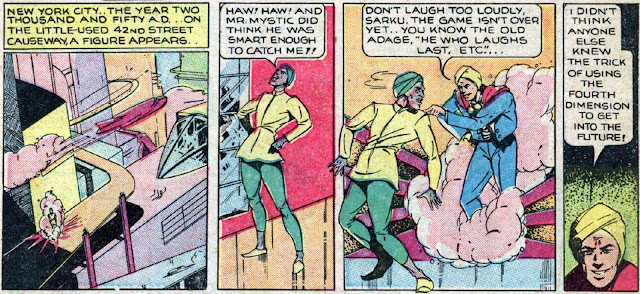
    I’ve mentioned before that the foes faced by magical Golden Age super-heroes break down into roughly three types: 1) regular crooks who are there to be clowned upon, 2) legitimate threats with equivalent magical power of their own and 3) crooks with a little magical power, who provide a Iof a challenge but are ultimately also clowned upon. Sarku is the third type, and has set out, fresh out of prison, to get revenge on those who put him there. Also, like all magic users in “Mr Mystic,” Sarku has an innate resistance to magic that makes even low-level practicioners more of a challenge to Our Hero than they would be to a Zatara or a Yarko.

    By the time Mr Mystic has been brought in on the case, Sarku has already murdered the (police?) Commissioner of the unnamed Indian city he was incarcerated in and escaped via some handy teleportation magic. Though Mystic interrupts his attempt on the life of the French Consul, Sarku escapes again, this time into the far future world of 2050 AD.

    (just what had prevented him from time travelling or indeed merely teleporting out of his prison cell over the ten years of his incarceration is not elaborated upon. Perhaps he only just got the knack)

    Sarku does a bit of premature gloating before learning that Mr Mystic can also travel through time, and the two are quickly engaged in a high-speed rocket chase to the Moon. 

    Mystic ends up shooting Sarku down as they approach the Moon’s surface, and he makes the grim choice to pop his corpse into a handy corpse container (originally intended for the evocatively-named by alas never-seen “Moon King’s mummy”) as a sort of general warning to all would-be murderers who might be wandering around on the Moon. That’s it for Sarku!

    But perhaps I spoke too soon! Sarku is back in the next “Mr Mystic” installment, and though we don’t get to see any mummies, we are treated to a Moon King, as a not-so-dead Sarku is brought before Tan Tan, King of the Moon by his subjects. It turns out that he wasn’t quite dead when Mr Mystic shoved him in that tube, which is great for him now but horrifying in retrospect.

    Tan Tan turns out to have a weird crush on the (to him) historical figure of Elena, former Mr Mystic villain and current Mr Mystic fiance (stay tuned for her entry), and trades Sarku a space fleet for her.

    Sarku’s attempt to get revenge on the entire population of Earth for a 1930-1940 AD prison sentence that almost nobody in 2050 AD would have been alive at the same time as, let alone had anything to do with, is foiled once again by Mr Mystic, who leaves nothing to chance this time as he socks Sarku out the spaceship’s hatch and into the void of space (Tan Tan, by contrast gets a mere sock in the jaw for his creepy Elena-napping. The perks of royalty, eh?).

    REVENGE KILLER SCORE: 1/2+

  • MINOR SUPER-VILLAIN 810: MR MIDNIGHT

    (The Spirit, “Mr Midnight”, 14 July, 1940)

    Mr Midnight is your classic police taunter, a crook who not only thinks that they have the wherewithal to pull off the perfect crime but is so confident that they decide to tip off the cops to their plans. In this specific instance, the villain is a dapper blue-skinned fellow who has not only informed the police but the Spirit as well, and further has declared that he will commit his murder in the very office of Police Commissioner Dolan. And he does it! Ellison Wright, Midnight’s erstwhile blackmailer, dutifully shows up and drops dead at the stroke of midnight, and since Happy O’Day, the coroner, declares the death as due to heart failure, Mr Midnight walks right on out the door afterward.

    This is where your “perfect crime” criminals often make their mistake, because while the fact that it can’t actually be proven that Mr Midnight killed Wright might keep the police off of his back, the Spirit is a vigilante, and doesn’t exactly have to worry about things like “the letter of the law” or “evidence” or “not showing up in someone’s house unexpectedly”. He just has the fact that Midnight said that he was going to commit murder to go off of, plus the knowledge that Happy O’Day just loves to call any unexplained death heart failure – not a month and a half earlier he said that Denny “the Spirit” Colt had died of heart failure, after all.

    Indeed, Mr Midnight is almost comically eager to confess that he did it. Midnight, aka John Caliban, was once a stage heartthrob whose life was ruined when he fell in love with a married woman. Blackmailed into poverty by Ellison Wright and turned blue seemingly incidentally by a cosmetics mishap, Caliban murders first his lover and then Wright. 

    What was Caliban’s next move going to be? Impossible to say now, because though he almost gets away when he beans the Spirit with his human skull prop and sets his house on fire, Midnight is captured and dragged back to police headquarters, only to take the ultimate way out via his own poisoned fingernails. A shame – a dapper blue guy would have made a fine addition to any rogue’s gallery.

  • MINOR SUPER-VILLAIN 690: VULCAN

    (Pep Comics 006, 1940)

    A man working in a London steam plant dies by falling into an industrial furnace. A horrible thing to happen! Why am I showing you this horrible thing?

    I am showing it to you because it is not in fact a horrible accident but a horrible murder, and we know that because the murderer left a horrible little bit of doggerel in order to crow about what he did, and he signed it “Vulcan.”

    Our old pal Inspector Bentley of Scotland Yard is brought in on this case, and it’s a lucky day for him because there are only four possible suspects: the four men who were in the immediate area when John Baker was killed, including his father, his brothers Rex and Bob and his romantic rival Barney Reyman. Like I said: lucky for Inspector Bentley because I’m beginning to suspect that he isn’t a particularly astute detective when he doesn’t have a guy in a rubber mask to hit with his cane.

    Am I saying this because Bentley’s only idea is to have everyone go back to where they were when the murder took place with the foreman standing in for his son and Pa Baker is basically instantly murdered too? Kind of, but it’s more of an observation that his investigations are a bit brute force. For instance, once this second member of the Baker clan is bumped off, Bentley arranges for another one to stand in front of the open furnace.

    Did Bentley know what he was doing? Was he calling Bob Baker’s bluff in order to force him to confess by dodging the deathtrap he had set up for his family members (a button-activated swinging pipe, fyi)? It’s possible, but I personally think that the “Vulcan = hatred for father and brothers” clue is some bullshit. Does Vulcan have more than his share of family drama? Absolutely, but no more than any other Greco-Roman god and frankly I would peg a guy named Vulcan as a potential matricide, if anything.

    So was he right or just trying to winnow down the suspect list a bit? Inspector Bentley will never tell.

  • MINOR SUPER-VILLAIN 441: MAGOG

    (Mystery Men Comics 022, 1941)

    Magog clearly has some big plans – he repeatedly sends taunting notes to the police and announces his criminal debut by blowing up a playground full of children – but he is almost immediately baited into the open by a fake newspaper and dies in a struggle with the Blue Beetle so we will never know what they were.

  • MINOR SUPER-VILLAIN 347: TRIPLE THREAT

    (Master Comics 012, 1941)

    Triple Threat is in actuality a fellow named Theron who believes that due to his own scientific genius he is above such things as “regular jobs” and “not murdering and robbing at whim” and so develops an armoured multi-environment vehicle – also called Triple Threat, as is often the case with super vehicle types – with which to enact his plans.

    The obvious thing to lead with here is that great name: Triple Threat. Some cursory research seems to indicate that in the early 20th Century the term was used to refer to a person etc who could fill three different roles in sports, war etc (I even saw it used to refer to a breed of cow that was useful for meat, dairy and as a work animal). The more narrow entertainment-focused definition that is mostly used today seems to have gained prominence in the mid 20th Century, which is a shame, as it would have been a real fun time if Theron wasn’t just flying around in a land/air/sea vehicle but also singing, dancing and acting.

    That said, there is a real flair for the dramatic in ol’ Triple Threat. He’s your classic police taunter style of criminal genius, never missing an opportunity to fire up his radio and sling some mud at Sergeant Kent and the rest of the boys over at police HQ.

    It’s this kind of bravado that ultimately proves to be Triple Threat’s downfall, in fact: after escaping an initial encounter with Bulletman, he makes an attempt to eliminate top cop Sergeant Kent and in the subsequent fracas ends up smashing his own vehicle to pieces on Bulletman’s pointy head. A true loss to the community of folks like me who like to read comics about real jerks. On the positive side, Bulletman is knocked out in this collision, which leads to Susan Kent finally learning his secret identity, which then leads to her becoming Bulletgirl, by far the best of the half-dozen or so members of the Bullet-family.

  • MINOR SUPER-VILLAIN 236: THE SNOW-KING

    (Flash Comics v1 005, 1940)

    A simple concept, but an endearing one: the Snow-King is a famous spy who only works during the winter, hence the name. He’s possibly French (at least, he says “au revoir” a lot) and definitely cocky – he is so sure of success pulls the classic move of calling up the authorities to warn them of his next escapade.

    Eventually, crack government agent Cliff Cornwall is brought in on the case and works out just why the Snow-King is a cold-weather spy: he relies on the central heating units of the buildings he burgles to disperse sleeping gas throughout them. That solved, he is quickly caught.

    Love an arrogantly confident villain; love a suit accessorized with a cape; love the Snow-King. Should be BRUNG BACK as a legacy spy some day.