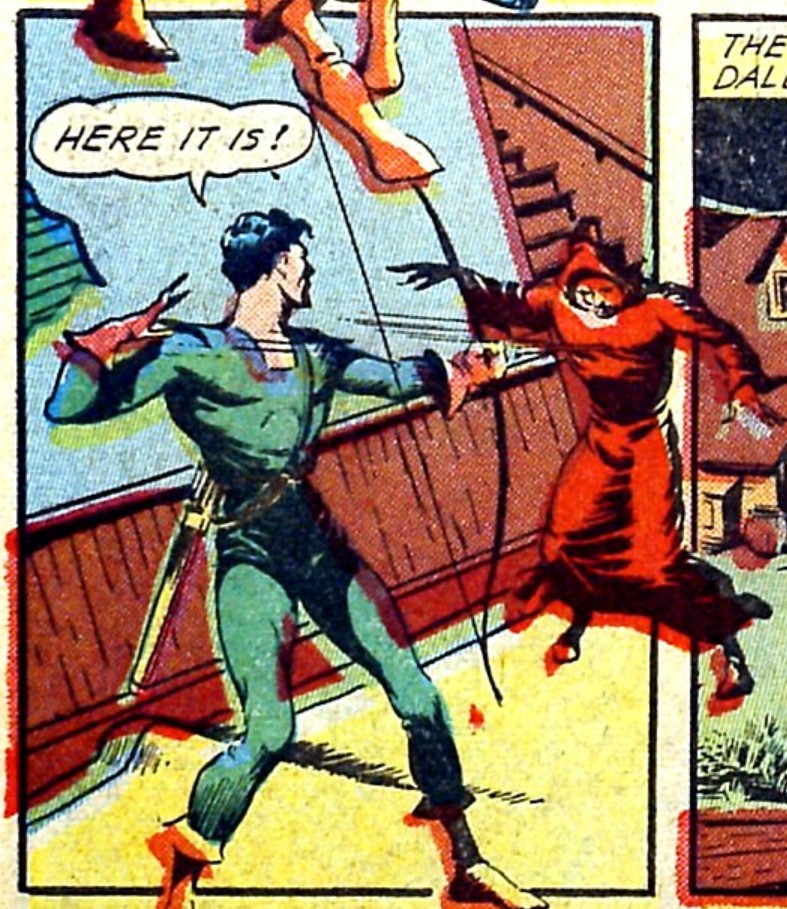
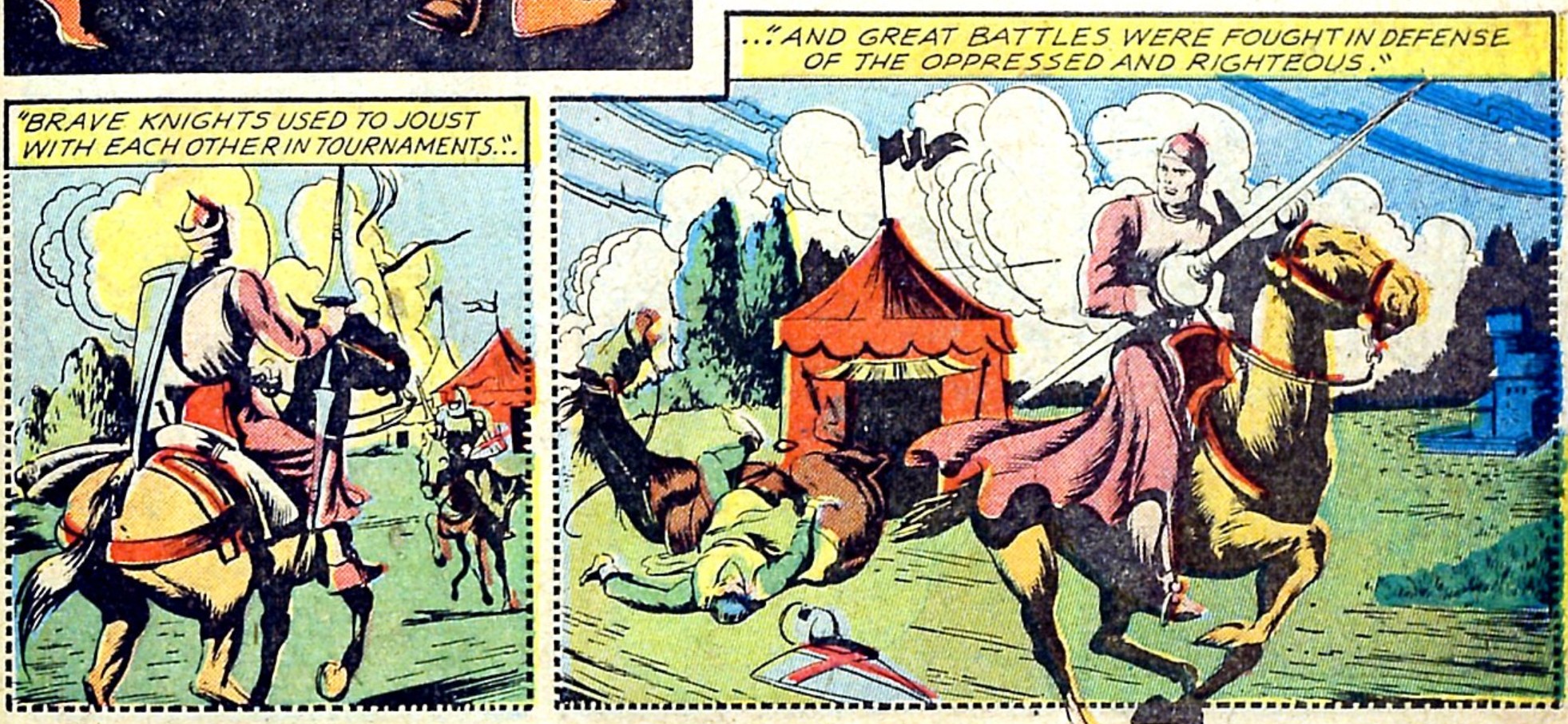
The Curse of Skeleton Munroe

Category: Harry “A” Chesler

  • REAL PERSON ROUND-UP 025

    If comics are reflections of the real world then why should we be surprised to find them so full of real people?

    Adolf Hitler:

    Hiller is the “mad dictator” who inspires Hercules to reincarnate and eventually become Marvel Boy. He’s about as close as you get to putting a Hitler in your comic as you can get without actually saying the name. The whole name. The “t” part. (Daring Mystery Comics 006, 1940)

    This otherwise-unnamed Fuehrer of a likewise nameless underground nation that vexes the America inhabited by Captain Daring in 3051 CE is a clear inspired-by-Hitler type. (Daring Mystery Comics 007, 1941)

    Citizen V takes a break from his propaganda campaign in Occupied Europe to sneak into Germany and become a member of the Punched Hitler in the Nose Club. (Daring Mystery Comics 008, 1942)

    This version of Hitler appears in a long dream sequence in the comedic Army Life strip “Private Rook” that appears to exist solely to make a joke about him being gay (the bit where he is the Princess Tanya’s Fairy Godmother, specifically). This isn’t great, but it is remarkable for being the only time I personally have seen such a thing in a Golden Age comic. (Army and Navy Comics 003, 1941)

    Though Cap punches Hitler on the cover of his very first issue, it is in fact Bucky who lands the first blow on him (and Goering) in the pages of a comic. (Captain America Comics 002, 1941)

    the Borgias:

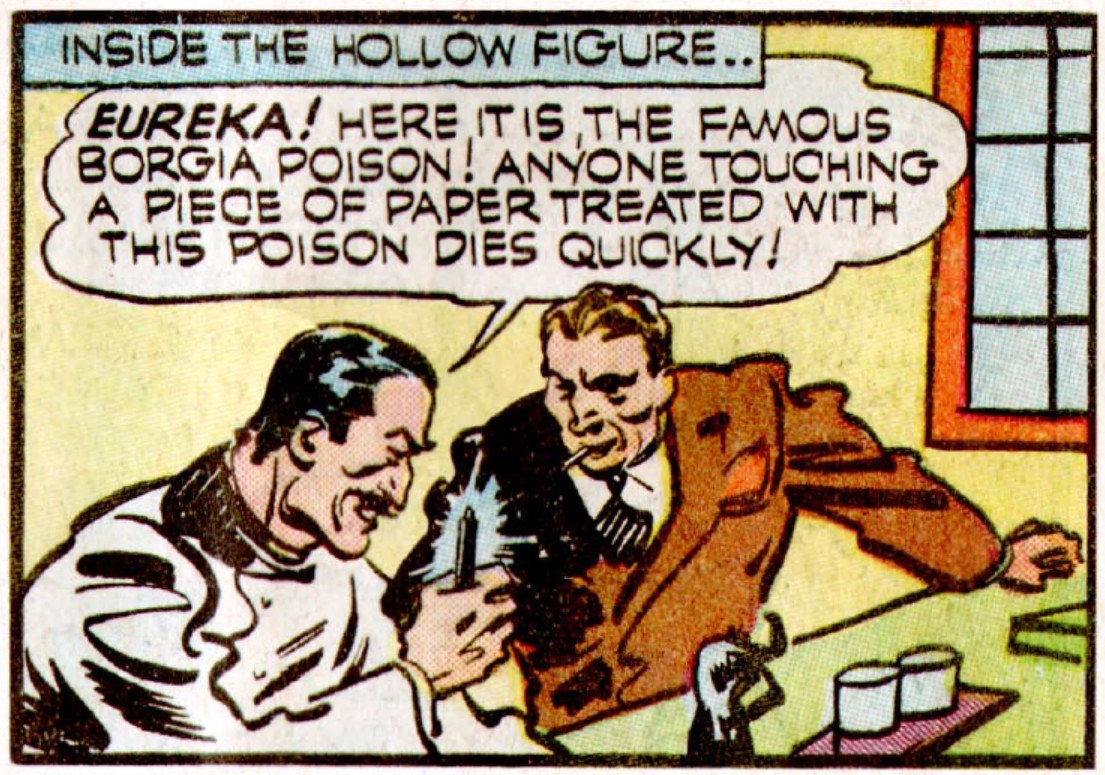
    Cesare, Lucrezia and the rest of the Borgia family might not actually appear in comics all that often, but they certainly do figure into their plots via the absolute piles of poisoned and poison-adjacent artifacts that are attributed to them. Borgia trinkets crop up so frequently, in fact, that I am surprised that it’s taken us this long to encounter one, in the form of a hollow silver statuette that contains a deadly contact poison. (Fantastic Comics 018, 1941)

    Fort Knox:

    Stardust the Super Wizard’s final foe, the unfortunately-named “Slant-Eye,” was a classic comic book Fort Knox robber. (Fantastic Comics 016, 1941)

    Francis Biddle:

    Major Victory has to consult with the US Attorney General in 1941, and in 1941 the US Attorney General was Francis Biddle. The man in the panel above is not Francis Biddle. (Dynamic Comics 002, 1941)

    Franklin D Roosevelt:

    Seen ordering the creation of a super-soldier, i.e. Captain America, to combat domestic espionage. (Captain America Comics 001, 1941)

    Fritz Kuhn:

    Fritz Knoll, purveyor of domestic espionage, is probably a reference to the chief Bundist. (Fantastic Comics 021, 1941)

    Henry L Stimson:

    The US didn’t even have a Secretary of Defense until after WWII, so I am not sure who this guy hanging out with Samson is supposed to be. The analogous position at the time this comic came out was Secretary of War, and that was Henry L Stimson, and this is not him. A true mystery man in all senses. (Fantastic Comics 023, 1941)

    J Edgar Hoover:

    J Arthur Grover, head of the FBI and clear J Edgar Hover stand-in, is also the man in charge of the program that would eventually be known as Project: Rebirth, aka the super-soldier program that produces Captain America later in this same issue. (Captain America Comics 001, 1941)

    Tutankhamen:

    Some of King Tut’s grave goods are among the items stolen by the Butterfly. (Captain America Comics 003 1941)

  • REAL PERSON ROUND-UP 025

    REAL PERSON ROUND-UP 025

    If comics are reflections of the real world then why should we be surprised to find them so full of real people?

    Adolf Hitler:

    Hiller is the “mad dictator” who inspires Hercules to reincarnate and eventually become Marvel Boy. He’s about as close as you get to putting a Hitler in your comic as you can get without actually saying the name. The whole name. The “t” part. (Daring Mystery Comics 006, 1940)

    This otherwise-unnamed Fuehrer of a likewise nameless underground nation that vexes the America inhabited by Captain Daring in 3051 CE is a clear inspired-by-Hitler type. (Daring Mystery Comics 007, 1941)

    Citizen V takes a break from his propaganda campaign in Occupied Europe to sneak into Germany and become a member of the Punched Hitler in the Nose Club. (Daring Mystery Comics 008, 1942)

    This version of Hitler appears in a long dream sequence in the comedic Army Life strip “Private Rook” that appears to exist solely to make a joke about him being gay (the bit where he is the Princess Tanya’s Fairy Godmother, specifically). This isn’t great, but it is remarkable for being the only time I personally have seen such a thing in a Golden Age comic. (Army and Navy Comics 003, 1941)

    Though Cap punches Hitler on the cover of his very first issue, it is in fact Bucky who lands the first blow on him (and Goering) in the pages of a comic. (Captain America Comics 002, 1941)

    the Borgias:

    Cesare, Lucrezia and the rest of the Borgia family might not actually appear in comics all that often, but they certainly do figure into their plots via the absolute piles of poisoned and poison-adjacent artifacts that are attributed to them. Borgia trinkets crop up so frequently, in fact, that I am surprised that it’s taken us this long to encounter one, in the form of a hollow silver statuette that contains a deadly contact poison. (Fantastic Comics 018, 1941)

    Fort Knox:

    Stardust the Super Wizard’s final foe, the unfortunately-named “Slant-Eye,” was a classic comic book Fort Knox robber. (Fantastic Comics 016, 1941)

    Francis Biddle:

    Major Victory has to consult with the US Attorney General in 1941, and in 1941 the US Attorney General was Francis Biddle. The man in the panel above is not Francis Biddle. (Dynamic Comics 002, 1941)

    Franklin D Roosevelt:

    Seen ordering the creation of a super-soldier, i.e. Captain America, to combat domestic espionage. (Captain America Comics 001, 1941)

    Fritz Kuhn:

    Fritz Knoll, purveyor of domestic espionage, is probably a reference to the chief Bundist. (Fantastic Comics 021, 1941)

    Henry L Stimson:

    The US didn’t even have a Secretary of Defense until after WWII, so I am not sure who this guy hanging out with Samson is supposed to be. The analogous position at the time this comic came out was Secretary of War, and that was Henry L Stimson, and this is not him. A true mystery man in all senses. (Fantastic Comics 023, 1941)

    J Edgar Hoover:

    J Arthur Grover, head of the FBI and clear J Edgar Hover stand-in, is also the man in charge of the program that would eventually be known as Project: Rebirth, aka the super-soldier program that produces Captain America later in this same issue. (Captain America Comics 001, 1941)

    Tutankhamen:

    Some of King Tut’s grave goods are among the items stolen by the Butterfly. (Captain America Comics 003 1941)
  • PROBLEMATIC ROUND-UP 008

    Once again I must regretfully inform you that some comic books are problematic. Like, racially.

    the Laughing Hyenas: 

    Hey, it’s our first racial hate group, and I think I’m just going to preemptively file these under “problematic” because they’re a) not fun to talk about and b) necessitate talking about hate-crimes even if I, for example, choose not to use the panels with lynchings in them.

    The Laughing Hyenas are actually kind of a hate group by proxy, as they have been hired to keep the Black residents of the geographically-nonspecific town of Souda “in line” by murdering one of them every once in a while, and have been doing so frequently enough and/or long enough that even the local folks willing to volunteer for such a task have gotten sick of it, so boss Bull Karson had to import some Chicago toughguys to do his dirty work for him.

    Oddly, given the sheer volume of murder that the Laughing Hyenas were perpetrating, the Silver Streak doesn’t actually bring them in to the authorities ore even extra-judiciously kill them. Instead, he just dumps them on a slow boat to Rangoon. (Silver Streak Comics 013, 1941)

    the Modern Thief of Bagdad:

    Ali Hassan, aka the Modern Thief of Bagdad, is an Iraqi thief who comes to NYC to steal the Konoor Diamond, and as a result comes into conflict with Captain Battle and his young protege Hale Battle. A simple story that would ordinarily wrap up quite quickly, but this is a book-length yarn, which means that there is an extended chase sequence that occupies the 28 pages between the theft and Hassan’s arrival back in Baghdad. Some highlights:

    Chapter 1, “The Modern Thief of Bagdad!”: Hassan steals the gem, then give Battle and Hale the slip in Chinatown. Olyra, the mysterious guardian of the Konoor Diamond, is kidnapped.

    Chapter 2, “Perils of the Sargasso Sea!”: Hassan’s submarine becomes mired in sargassum and is attacked by a sea monster. Battle and Hale kill the beast. Hassan and his men dress up like ghost pirates. Olyra is rescued and then kidnapped again.

    Chapter 3, “Lost in the Underground World!”: Hassan’s plane crashes in Africa and he and Olyra are captured by cannibals (lil’ bonus racism for you there). Battle and Hale rescue them before being betrayed and dumped in a pit of quicksand. There is a brief interlude in an cave system full of monsters before it suddenly blows up. Hassan and his men dress up like ghosts. Olyra is rescued.

    Chapter 4, “House of Giants”: Battle & co track Hassan to a castle in Tibet, where they are captured and subjected to a shrink ray. They have various adventures as tiny men before resuming their original size. Olyra is kidnapped.

    I would call Hassan himself… an average amount of racist. He’s depicted in much the same generically foreign vein as I’ve seen in a South American president or a Basque fisherman (or indeed a Cape Breton fisherman at least once). As a villain, he’s pretty great: bombastic, treacherous, fond of leaving boastful notes for his enemies. If it was just him I might have skipped making this a Problematic Round-Up entry.

    It’s not just him, however, and once the story hits Chapter 5, “Magic Spell of the Arabian Nights” we get a real dose of Orientalism full in the face, as our heroes touch down in a Baghdad straight out of the Arabian Nights, complete with a wicked ruler (confusingly named Emperor Pasha Golu) who Hassan has been working for the whole time.

    It’s such a pastiche of a city, in fact, that Hale and Olyra just kind of stumble across Aladdin’s lamp and flying carpet while they are escaping from a dungeon. I suppose that all this is at least a little thematically appropriate, as Ali Hassan, the Modern Thief of Bagdad, is a reference to a movie that is a remake of a different movie that is itself a pastiche of the Arabian Nights.

    The Modern Thief of Bagdad meets his end in a pretty underwhelming manner: Captain Battle ducks as he swings a sword at him and he falls off of a balcony. A pretty terrible way to go for a villain who clearly thought that he was very cool, to be honest. The evil Pash Golu also meets his end in the process, leaving Olyra free to reveal that she is actually Olyria, Princess and true ruler of Bagdad. A truly impenetrable alias! 

    Finally, such is Hale Battle’s hunger for souvenirs that he uses his third genie with to acquire a replica of the diamond for his collection, even though for my money the real deal Lamp of Aladdin with one wish left on it would be the ultimate keepsake. (Captain Battle Comics 002, 1941)

    the King:

    The King is a fellow who gains control over a Romani group by showing them a… birthmark? tattoo? that proves his right to rule and that looks so intensely falsifiable that I am shocked there isn’t some sort two-factor authentication, or even a code phrase. And just what is is reason for exerting this control? Why, so that he can turn his new subjects into a child kidnapping ring. You can see how I would consider this problematic.

    The King is of course not the real ruler, that is not a real skull birthmark and he is no match for Dynamic Man. He turns out to be a crooked newspaper publisher named Brower who loves money more than making good plans to acquire it. (Dynamic Comics 002, 1941)

    the Dragon:

    The Dragon is a very ordinary Yellow Peril villain who is after some top secret bomber plans on behalf of an unspecified Asian nation. There are exactly four interesting things about him: 1) he is the first villain faced by Samson and David in their brief New Look era before they disappear along with most of Fox Features’ other characters during their financial trouble. 2) he is a classic calling card leaver in the form of a claw mark on the chests of men he has killed

     3) he works alongside his sister Orchid, which isn’t the rarest arrangement but is always fun to note

     4) he has these stone lions outside of his HQ that grab intruders as they come through. It’s a fun trap but never actually explained: are they some sort of mechanism, or demonic magic like the caption box suggests?

    Much of the issue in questioned is concerned with Samson chasing the Dragon and Orchid around. Once he catches up to them it’s all over. (Fantastic Comics 022, 1941)

  • PROBLEMATIC ROUND-UP 008

    Once again I must regretfully inform you that some comic books are problematic. Like, racially.

    the Laughing Hyenas: 

    Hey, it’s our first racial hate group, and I think I’m just going to preemptively file these under “problematic” because they’re a) not fun to talk about and b) necessitate talking about hate-crimes even if I, for example, choose not to use the panels with lynchings in them.

    The Laughing Hyenas are actually kind of a hate group by proxy, as they have been hired to keep the Black residents of the geographically-nonspecific town of Souda “in line” by murdering one of them every once in a while, and have been doing so frequently enough and/or long enough that even the local folks willing to volunteer for such a task have gotten sick of it, so boss Bull Karson had to import some Chicago toughguys to do his dirty work for him.

    Oddly, given the sheer volume of murder that the Laughing Hyenas were perpetrating, the Silver Streak doesn’t actually bring them in to the authorities ore even extra-judiciously kill them. Instead, he just dumps them on a slow boat to Rangoon. (Silver Streak Comics 013, 1941)

    the Modern Thief of Bagdad:

    Ali Hassan, aka the Modern Thief of Bagdad, is an Iraqi thief who comes to NYC to steal the Konoor Diamond, and as a result comes into conflict with Captain Battle and his young protege Hale Battle. A simple story that would ordinarily wrap up quite quickly, but this is a book-length yarn, which means that there is an extended chase sequence that occupies the 28 pages between the theft and Hassan’s arrival back in Baghdad. Some highlights:

    Chapter 1, “The Modern Thief of Bagdad!”: Hassan steals the gem, then give Battle and Hale the slip in Chinatown. Olyra, the mysterious guardian of the Konoor Diamond, is kidnapped.

    Chapter 2, “Perils of the Sargasso Sea!”: Hassan’s submarine becomes mired in sargassum and is attacked by a sea monster. Battle and Hale kill the beast. Hassan and his men dress up like ghost pirates. Olyra is rescued and then kidnapped again.

    Chapter 3, “Lost in the Underground World!”: Hassan’s plane crashes in Africa and he and Olyra are captured by cannibals (lil’ bonus racism for you there). Battle and Hale rescue them before being betrayed and dumped in a pit of quicksand. There is a brief interlude in an cave system full of monsters before it suddenly blows up. Hassan and his men dress up like ghosts. Olyra is rescued.

    Chapter 4, “House of Giants”: Battle & co track Hassan to a castle in Tibet, where they are captured and subjected to a shrink ray. They have various adventures as tiny men before resuming their original size. Olyra is kidnapped.

    I would call Hassan himself… an average amount of racist. He’s depicted in much the same generically foreign vein as I’ve seen in a South American president or a Basque fisherman (or indeed a Cape Breton fisherman at least once). As a villain, he’s pretty great: bombastic, treacherous, fond of leaving boastful notes for his enemies. If it was just him I might have skipped making this a Problematic Round-Up entry.

    It’s not just him, however, and once the story hits Chapter 5, “Magic Spell of the Arabian Nights” we get a real dose of Orientalism full in the face, as our heroes touch down in a Baghdad straight out of the Arabian Nights, complete with a wicked ruler (confusingly named Emperor Pasha Golu) who Hassan has been working for the whole time.

    It’s such a pastiche of a city, in fact, that Hale and Olyra just kind of stumble across Aladdin’s lamp and flying carpet while they are escaping from a dungeon. I suppose that all this is at least a little thematically appropriate, as Ali Hassan, the Modern Thief of Bagdad, is a reference to a movie that is a remake of a different movie that is itself a pastiche of the Arabian Nights.

    The Modern Thief of Bagdad meets his end in a pretty underwhelming manner: Captain Battle ducks as he swings a sword at him and he falls off of a balcony. A pretty terrible way to go for a villain who clearly thought that he was very cool, to be honest. The evil Pash Golu also meets his end in the process, leaving Olyra free to reveal that she is actually Olyria, Princess and true ruler of Bagdad. A truly impenetrable alias! 

    Finally, such is Hale Battle’s hunger for souvenirs that he uses his third genie with to acquire a replica of the diamond for his collection, even though for my money the real deal Lamp of Aladdin with one wish left on it would be the ultimate keepsake. (Captain Battle Comics 002, 1941)

    the King:

    The King is a fellow who gains control over a Romani group by showing them a… birthmark? tattoo? that proves his right to rule and that looks so intensely falsifiable that I am shocked there isn’t some sort two-factor authentication, or even a code phrase. And just what is is reason for exerting this control? Why, so that he can turn his new subjects into a child kidnapping ring. You can see how I would consider this problematic.

    The King is of course not the real ruler, that is not a real skull birthmark and he is no match for Dynamic Man. He turns out to be a crooked newspaper publisher named Brower who loves money more than making good plans to acquire it. (Dynamic Comics 002, 1941)

    the Dragon:

    The Dragon is a very ordinary Yellow Peril villain who is after some top secret bomber plans on behalf of an unspecified Asian nation. There are exactly four interesting things about him: 1) he is the first villain faced by Samson and David in their brief New Look era before they disappear along with most of Fox Features’ other characters during their financial trouble. 2) he is a classic calling card leaver in the form of a claw mark on the chests of men he has killed

     3) he works alongside his sister Orchid, which isn’t the rarest arrangement but is always fun to note

     4) he has these stone lions outside of his HQ that grab intruders as they come through. It’s a fun trap but never actually explained: are they some sort of mechanism, or demonic magic like the caption box suggests?

    Much of the issue in questioned is concerned with Samson chasing the Dragon and Orchid around. Once he catches up to them it’s all over. (Fantastic Comics 022, 1941)

  • DIVINE ROUND-UP 029

    Comic book religion. Tricky stuff.

    Hercules: 

    The thing that really jumps out at you when you first encounter this version of Hercules is that he goes to Valhalla when he dies, which is weird. The second thing is that he is appearing in a Golden Age Marvel comic and so there might be fun storytelling ramifications considering the fact that Hercules is a moderately popular (and alive) Marvel Comics character with appearances from the mid-60s to today. Perhaps the fact that this is a pretty Roman mythology (aside from the Valhalla thing) and Hercules from  the Champions is from a Greek one can play into it.

    The third thing that jumps out at you comes on maybe your third reading of the comic in question, when you pay a bit more attention to that first panel in which Hercules is dying and realize that he is not only meant to have survived until some time after the founding of the United States but that the heavy shadowing on the faces of the people in that panel kind of implies that he might have been one of the Founding Fathers? There just aren’t enough clues in the art to tell for sure but I know Simon and Kirby’s tricks and making George Washington Hercules is just their style.

    After spending a while in Valhalla, Herc gets worried about the rise of fascism and decides to reincarnate as a mortal in order to be there to lend a hand when the US needs him (a real snub to his former fave of Rome) so he heads on back to be reborn as Marvel Boy. 

    God Style: Real (Daring Mystery Comics 006, 1940)

    Jupiter:

    Like his son Hercules, this version of Jupiter is very concerned with personal freedom and the fate of the United States in particular. Or maybe he’s just a good father who wants to support his son’s little projects.

    Whatever the reason, he shows up on his reincarnated son’s fifteenth birthday to deliver a cool super-hero uniform before making a very cool exit via lightning storm. 

    God Style: Real (Daring Mystery Comics 006, 1940)

    Father Patriot:

    Father Patriot is the brand-new anthropomorphic personification of the spirit of America created by an unknown comics scribe for the origin story of Major Victory. As I have already speculated behind that link, my only real guess as to why they might have done this is to avoid stepping on Quality Comics’ toes by using Uncle Sam for the role. I was going to complain about them not replacing him with one the less-used personifications of America like Brother Jonathan or Columbia, but on reflection I can see why they might have wanted to go with an all-new character. If nothing else, this means that they had free reign to add as much patriotic nonsense to his design as they wanted to, like his retinue of patriotic angels or the fact that he can whale on the Liberty Bell to impart strength unto his champion. They also got to design a set of patriotic clothing for him, and while it doesn’t quite match up to the classic Uncle Sam look I do appreciate his big gaudy belt buckle.

    Speaking of those mysterious angelic servants: does this indicate that the glories of to American Heaven are not exclusive to the mythology of Captain Fearless?

    God Style: Real (Anthropomorphic Personification) (Dynamic Comics 001, 1941)

    Maloo:

    No non-white and non-monotheistic group is immune to the threat of Golden Age comics just making up some random god that they supposedly worship, and the Aboriginal Australians are no exception. Maloo is a giant, vicious kangaroo who the Face is nearly sacrificed to but who ends up dead instead. Sorry, Maloo. Sorry, Aboriginal Australians.

    God Style: Animist (The Face 001, 1941) 

  • GENERIC COSTUMED VILLAIN ROUND-UP 040

    GENERIC COSTUMED VILLAIN ROUND-UP 040

    Once again I am plagued by the absolute dregs of villainy.

    A Vampire:

    Vampires are one of the types of character that are statistically likely to make it through my classification system and be certified as super, but this particular one who a) lives in a swamp shack, b) has two meals in a row taken away from him by the Green Knight, c) doesn’t even get a name and d) ends up dead with his shack burned down around his ears, is too much of a loser to make it to even minor villain status. He does, however, provide the Green Knight with a sidekick in the form of one of his prospective victims, which is something. (Dynamic Comics 002, 1941)

    Hank Rutter:

    This fellow might have been called the Mask or the Masked Man if it weren’t for the fact that his heroic foe is already called the Mask. As such, he’s just a gambling focused villain with a bit more interest in concealing his identity than usual.

    It’s no surprise that the unnamed masked villain is in actuality Hank Rutter, big-time gambler. What is surprising is that he manages to learn the Mask’s secret identity as DA Tony Colby. Especially to him, as Colby responds by knocking him off a roof to his death. (Exciting Comics 007, 1941)

    Henry Devoe: 

    When this masked drug kingpin shows up with a very visible withered left hand and then civic leader Henry Devoe is on the front page of the newspaper, also with a very prominent withered left hand the next day, my assumption as a longtime consumer of comic books and detective fiction was that Devoe was being framed, but no, he’s the guy. While I commend him for making his disability visible and thus normalizing it, I do question his decision not to disguise such a distinguishing characteristic while out and about doing drug-related murders. (Exciting Comics 012, 1941)

    Black Terror impostor:

    When the Black Terror decides to play nice with the police and inform them about Henry Devoe’s perfidy, he is surely disappointed to learn that Police Chief Nelson is a crooked cop who guns him down on sight and then steals his uniform in order to extort Devoe. And we wonder why most vigilantes have an adversarial relationship with the police.

    Nelson’s plan is hindered by the fact that Henry Devoe’s response to having the Black Terror show up in his living room is exactly the same as his own had been: to shoot him on sight. And unlike Bob “the Black Terror” Benton, Nelson hasn’t been huffing enough formic ether to survive a close-range gunshot. (Exciting Comics 012, 1941)

  • MINOR SUPER-VILLAIN 959: THE INVISIBLE MENACE

    (Dynamic Comics 002, 1941)

    It’s a story as old as comics and then some: an inventor has come up with a cool superscientific gizmo – in this case an invisibility serum – and no sooner are they done than some gangsters come stiffing around looking to exploit it. This particular gang is headed by an unnamed and trigger-happy fellow who guns down the scientist and then his own men in order to get his mitts on the single available dose of the stuff.

    The gangster dubs himself “the Invisible Menace” and this is the only reason I am calling him that instead of “the Invisible Killer” as everyone else in the story including the caption boxes does. 

    There’s a kind of critical and/or cultural debate over the madness of the main character in HG Wells’ the Invisible Man, over whether the titular character goes mad with the power inherent in being invisible or the process itself has some flaw that warps the human mind. Whichever way you slice it, the Invisible Menace has Invisibility Madness: no sooner does he fade from sight than he is slaughtering people left and right. Not that he wasn’t killing people while he was still visible but at least that was to some purpose. This is just wanton murder.

    The big question is: is this guy invisible forever? Neither he nor we ever find out, and frankly it matters quite a lot because it’s going to be pretty difficult to enjoy your riches as an invisible guy if the only other invisible guy anyone has ever heard of is famous for attacking a garden party with a tommy gun.

    The question never really gets resolved thanks to one of the great flaws in any invisibility-related plan: that you are still detectable via other senses. Accordingly, the Invisible Menace is stopped at the fangs of the dog hero K-9.

    Categorized in: Abstract Concepts (Menace), Body (Physical Qualities – Invisibility), Powers (Invisibility)

  • MINOR SUPER-HERO ROUND-UP 090

    MINOR SUPER-HERO ROUND-UP 090

    We’re simply up to our eyeballs in minor super-heroes!

    K-9:

    K-9, an injured German Shepherd (they call him a police dog but I think that that’s as an alternate breed name due to the war, like how the British call them Alsatians) nursed back to health and given a terrible name by scrappy teen Tip Starr, is given ample opportunity to fight crime thanks to his association with Tip’s brother, Police Detective Dick Starr. (Dynamic Comics 001, 1941)

    Categorized in: Alphanumeric (K, 9), Animals (Dogs), Origin (Animals)

    Dynamic Boy:

    When orphan Kent Banning is severely injured while rescuing Doctor Brown’s unnamed daughter from a burning schoolhouse, Brown returns the favour by injecting him with a mysterious fluid that he got from a dying Tibetan Lama. This fluid not only saves Kent’s life but endows him with the standard array of super-powers: enhanced speed and agility, super strength and the power of flight. He also adopts the lad, which makes the chaste romance between Kent and “She Seriously Never Gets A Name” Brown just a little bit weird. She does make him a costume, which is nice. And it clearly has room for him to grow into!

    Probably the best thing about Dynamic Boy is just how lanky and awkward he is. Contextually, he’s about the same age as Robin and most of the other sidekicks in Golden Age comics, i.e., somewhere between 12 and 15 years old, but Dynamic Boy really feels like it, particularly in the sequence above, where he learns that he can fly by tripping over his own feet. (Dynamic Comics 002, 1941)

    Categorized in: Generica (Boys), Language (Superlatives – Dynamic), Origin (Mystic Mutates)

    Lady Satan:

    Lady Satan’s career begins after an ocean liner is sank by Nazi bombers and an unnamed woman (there is some impression that she uses Satan as her surname while adventuring, but whether it is her real name is hard to say) is the only survivor. Swearing vengeance, she heads back to Europe to vex the Axis.

    I really like Lady Satan! For one thing, she just kind of relies on the mystery inherent in being a hot lady in a mask and doesn’t even switch to a secret identity to seduce horny Nazis into revealing their secrets. For another, she’s supremely adaptive. Got captured and about to be shot as a spy? No problem, Lady Satan will merely steal the executioner’s pistol, take him hostage, steal a plane, crash into the pursuing planes, parachute into a handy river, steal a car and be in Berlin at the same time as the fellow she was caught trying to rob in the first place. Just a very competent character.

    She also packs a chlorine gas gun, which is horrifying to contemplate firing at another person, let alone firing it in an enclosed space. I suppose that war crimes don’t apply to you if you are a stateless vigilante, but everybody has to breathe. (Dynamic Comics 002, 1941)

    Categorized in: Famous Figures (Satan), Origin (Vengeance Quest), Royalty (Ladies)

    the Green Knight:

    Contrary to his name, the Green Knight is more of an archer-type hero than some sort of armoured bruiser or dashing cavalier. He is also our first Florida-based super-hero, as far as I can figure (many before him have visited, certainly, but none before have deigned to live there).

    As the Green Knight explains to Lance Cooper, an orphan boy who he rescues from a vampire in the Everglades, he is in actuality Denis Knight, a rich guy who collects Medieval weapons and has a rose-tinted view of knighthood that informs his forays into vigilante justice.

    Speaking of Lance, he abbreviates the usual perfunctory super-hero boy-adoption process even further by just coming out and asking to join up with Knight. He gets a mini version of the Green Knight’s costume (and sadly loses his cheeky little orphan cap in the process) and follows him into battle for the remainder of his two-adventure career as Lance, which is a very annoying name indeed. Is it just using his regular name like so many kid sidekicks do, or are they doing a bit of a winking acknowledgement that his name already fits the knightly theme? Would it kill them to give him a spear? (Dynamic Comics 002, 1941)

    Green Knight Categorized in: Colours (Green), Famous Figures (Arthurian)*, Royalty (Knights)

    Lance Categorized in: Locations (Florida), Objects (Lances), Origins (Sidekicks)

    * the character does not have anything to do with Arthuriana thematically, but the name “the Green Knight” is nonetheless enough of a reference for me

  • MINOR SUPER-VILLAIN 957: THE PROFESSOR

    (Dynamic Comics v1 001, 1941)

    Unlike most Professors in comics, this fellow is seemingly not named that because he is a scientist but rather because he is a clever criminal. He and his powerful companion Hugo are hired by the evocatively-named Hell Gang to intercept and destroy some key evidence while it is en route from the District Attorney’s office to the courthouse where Hell Gang leadership is on trial.

    It’s not fair to blame the Professor for this because there’s no way that he could know, but Jim Hornsby, aka the Black Cobra, works at the very district attorney’s office that the records are coming from and so is in a perfect position to stick his nose in and foil the whole plan. The records are delivered just in time to convict the Hell Gang, and though the Professor and Hugo get away I am pretty concerned about the Professor’s spine after the punch he takes in that final panel above.

    Categorized in: Generica (Professors), Misc (Mercenaries)

  • GENERIC COSTUMED VILLAIN ROUND-UP 039

    Those who also ran, we salute you. 

    Karl the Hermit:

    Karl, as his name implies, is a mean ol’ hermit who lives atop a mountain. He has has got himself a critter called the Thing that Walks Like a Man that he uses to act out his misanthropic impulses, such as when he sends it to kill his cousin Rushman. What is his motivation for doing all this? Don’t worry about it – he’s a crazy old hermit!

    Karl’s actions attract the attention of the Silver Streak and Meteor, and both he and the Thing end up doing a header off of a cliff. (Silver Streak Comics 015, 1941)

    Lord Garnett:

    Lord Garnett, English MP, engages in a little pigeon-based espionage on behalf of the Nazis and gets socked by the Silver Streak for his efforts. As can be deduced by his trademark braying laugh, this is the guy who later pivots into propaganda broadcasting as a Lord Haw-Haw analog, but here we are only concerned with his foray into masked spymanship. (Daredevil Comics 001, 1941)

    Anders:

    When a masked arsonist starts burning down all of a company’s buildings in a comic it’s equal odds on whether it’s corporate sabotage, extortion or insurance fraud. I guess those are the main choices in real life as well, now that I think about it. In this case it’s some pretty solvable insurance fraud, as the Anders Warehouse Company is being burned down by Mr Anders for the money. (Dynamic Comics 001, 1941)

    Mr Black:

    Mr Black, Art Supervisor of the Municipal Museum in the undefined city that Lucky Coyne calls home, has happened upon a foolproof scheme: kidnap a painter and force him to create forgeries, then sell those forgeries for beaucoup bucks. There are only two problems with this scheme: 1) Black loses his job immediately for spending museum funds on one of his own forged paintings and 2) both the museum and the painter’s daughter come to Lucky Coyne for help, leading on a severe blow to the head for Mr Black. (Dynamic Comics 002, 1941)