The Curse of Skeleton Munroe

Category: super-hero

  • SUPER-HERO FILE 007: NAMOR THE SUB-MARINER

    (Marvel Mystery Comics 003, 1940)

    Though Namor started his comics journey as an outright villain, by his third appearance, the world was ready to see a softer side of him. This journey to redemption begins when the police notice just how horny he was in his last outing and assign NYPD officer Betty Dean to capture him. On her own with no backup, of course.

    Despite the fact that her boss is seemingly trying to commit murder by super-villain on her, Betty is very good at her job and puts a plan into place that theoretically has the Sub-Mariner at her mercy: she lurks around the waterfront with a swimsuit under her clothes until someone spots Namor in the vicinity and then pretends to be drowning. Once he has answered the siren call of an attractive woman in trouble, Betty employs Sherlock Holmes’ favourite means of capturing someone: get close to them and then put a gun to their head.

    Alas for Betty, while this plan would have worked if Namor had been an ordinary swimming murderer, he is in fact a bulletproof fish man and she ends up stranded on a buoy far out at sea. It is at this point, however that Namor performs his very first super-heroic act: when confronted with a sea battle between a British convoy and some German sea raiders, he instinctively comes to the aid of the underdog and sinks the Nazis.

    Betty takes this as an opportunity to explain that Americans are, like, totally peaceful and would never blow up Atlantis on purpose, and actually manages to sway his opinion! No more will he war on the USA, unless another attractive woman takes the time to point out that maybe they would have if they thought it was a good idea or profitable enough or might have inconvenienced the English/French/Spanish depending on historical era.

    Namor returns to Atlantis’ cool-ass iceberg palace in Marvel Mystery Comics v1 004 and convinces the Emperor and never-before-seen Council of Three to change their minds about the US in about five minutes, then sets out with a fleet of Atlantis’ finest steam-powered (I’m sorry: artificial steam-powered) aerial submarines to wage war on the Axis. I’m not going to cover a lot of it because it’s pretty repetitive, but a large part of Namor’s Golden Age super-heroic career consists of sallying forth with the Atlantean Aerial Navy and blowing up huge chunks of the German and Japanese Navies. Like he possibly blows up more ships than the Axis actually possessed.

    Don’t think that we have seen the last of the villainous Namor, by the way, because that guy is always lurking in the (small, ankle-mounted) wings.

    Update 1940 

  • SUPER-HERO FILE 007: NAMOR THE SUB-MARINER

    (Marvel Mystery Comics 003, 1940)

    Though Namor started his comics journey as an outright villain, by his third appearance, the world was ready to see a softer side of him. This journey to redemption begins when the police notice just how horny he was in his last outing and assign NYPD officer Betty Dean to capture him. On her own with no backup, of course.

    Despite the fact that her boss is seemingly trying to commit murder by super-villain on her, Betty is very good at her job and puts a plan into place that theoretically has the Sub-Mariner at her mercy: she lurks around the waterfront with a swimsuit under her clothes until someone spots Namor in the vicinity and then pretends to be drowning. Once he has answered the siren call of an attractive woman in trouble, Betty employs Sherlock Holmes’ favourite means of capturing someone: get close to them and then put a gun to their head.

    Alas for Betty, while this plan would have worked if Namor had been an ordinary swimming murderer, he is in fact a bulletproof fish man and she ends up stranded on a buoy far out at sea. It is at this point, however that Namor performs his very first super-heroic act: when confronted with a sea battle between a British convoy and some German sea raiders, he instinctively comes to the aid of the underdog and sinks the Nazis.

    Betty takes this as an opportunity to explain that Americans are, like, totally peaceful and would never blow up Atlantis on purpose, and actually manages to sway his opinion! No more will he war on the USA, unless another attractive woman takes the time to point out that maybe they would have if they thought it was a good idea or profitable enough or might have inconvenienced the English/French/Spanish depending on historical era.

    Namor returns to Atlantis’ cool-ass iceberg palace in Marvel Mystery Comics v1 004 and convinces the Emperor and never-before-seen Council of Three to change their minds about the US in about five minutes, then sets out with a fleet of Atlantis’ finest steam-powered (I’m sorry: artificial steam-powered) aerial submarines to wage war on the Axis. I’m not going to cover a lot of it because it’s pretty repetitive, but a large part of Namor’s Golden Age super-heroic career consists of sallying forth with the Atlantean Aerial Navy and blowing up huge chunks of the German and Japanese Navies. Like he possibly blows up more ships than the Axis actually possessed.

    Don’t think that we have seen the last of the villainous Namor, by the way, because that guy is always lurking in the (small, ankle-mounted) wings.

    Update 1940 

  • SUPER-HERO FILE 006: THE ANGEL

    (Marvel Comics 001, 1939)

    A two-fisted vigilante in the Batman mode, the Angel was a big enough name in Marvel’s Golden Age comics that it would be kind of surprising that he has never really been revived post-Silver Age if not for the fact that his name was, and that the subsequent and ongoing popularity of the X-Men means that there was always a full “Angel” slot on the Marvel roster. On top of this (and probably because of this) the Angel was eventually revealed to be the mastermind behind the Scourge of the Underworld program, lending a villainous tarnish to his name that certainly contributed to his lack of a modern legacy.

    The Angel never really gets an origin in the Golden Age, and thanks to the fact that he was never brought back in any meaningful way, this persists until the Marvel 70th Anniversary books in 2009, when he is revealed to have grown up in a prison or something. It’s not better than just mysteriously having no origin at all, so I never internalized it.

    One thing that the Angel does have, however, is a calling card. Two of them, in fact, as he both signs his notes to police and criminals with a little drawing of an angel and also projects long-lasting shadow images of an angel onto nearby surfaces, this latter also being his only real super-power.

  • SUPER-HERO FILE 005: THE HUMAN TORCH

    SUPER-HERO FILE 005: THE HUMAN TORCH

    (Marvel Comics 001, 1939)

    The Human Torch! The first major (and first overall) Marvel super-hero, despite the fact that my disorganized ass is writing about him third!

    The Human Torch is a synthetic man, aka an android (aka a synthezoid, which as far as I can tell means “cooler android” and won’t come into use until the 60s anyway) and created by Professor “Not Yet Phineas” Horton. Later stories will add all kinds of influences on and collaborators with Horton (including our recent subject Doctor Nemesis), but in the beginning it was just him, toiling away over his blonde creation.

    The Human Torch’s origin is shaped by three major factors: first, that Horton’s process was flawed in some strange way and as a result his android bursts into flame when exposed to oxygen. Secondly, there is the fact that Horton, despite the obvious scientific acumen and indeed genius on display in his creation, is seemingly devoid of any scientific curiosity outside of this. When confronted with the problem of a flaming android, Horton just throws his hands in the air and gives up without making any kind of real effort to mitigate the problem.

    Finally, the Torch is hampered by the fact that humanity at large, including Horton, is motivated by fame and fortune. Everyone who meets him wants to exploit him in some way, unless they are afraid of him – this is presumably why Horton’s first act upon creating him is to call in reporters rather than work on getting him to stop exploding.

    Though Horton can’t bring himself to work on a solution for the Torch’s problem, he balks at destroying his creation and so opts to seal him inside of an airless steel cylinder and then bury that cylinder in cement.

    Somehow, however, and perhaps relating to the fact that it was dropped into semi-solid cement from a decent height rather than laid down carefully and then covered up, the cylinder develops a crack through which enough air seeps in to set the Torch alight and cause him to burst his prison asunder. Everyone’s worst fears seem to be confirmed, as the newly self-aware android charges through the city streets, setting men, hats and telephone poles alight. A curious thing happens, however, and perhaps this reflects yet another failing on the part of Horton: the Human Torch realizes that he is hurting people and doesn’t want to. You should have talked to your artificial son, Professor, and then you might not have felt it necessary to seal him in concrete.

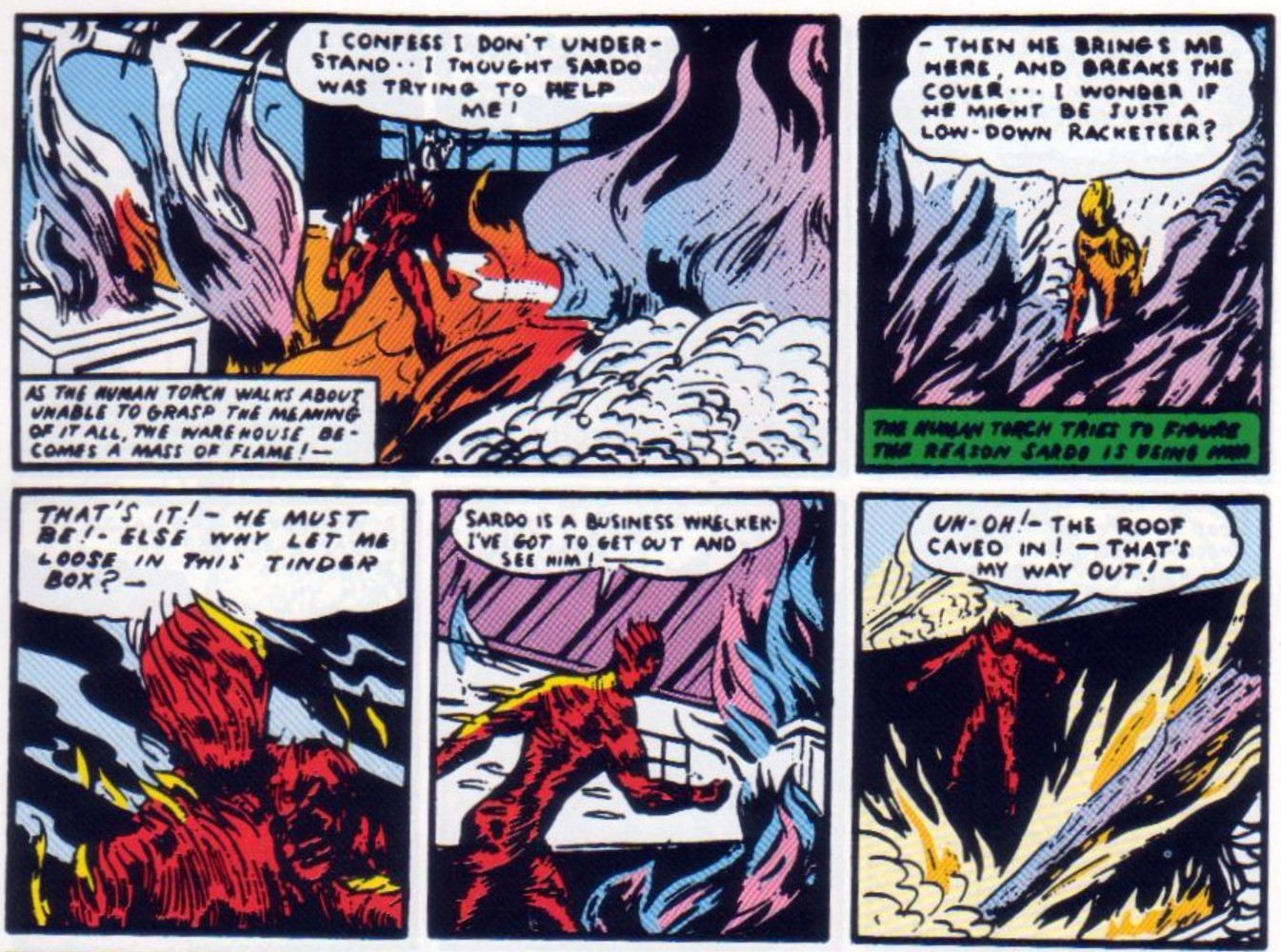
    In attempting to control his own flame (see? once again the child outstrips the parent), the Torch dunks himself in a swimming pool that turns out to belong to a criminal named Sardo who immediately sees the profit potential in a flaming man. Side note: Sardo also has a swimming pool that doubles as a vacuum chamber. Is there any use for such a thing beyond “elaborate deathtrap?”

    Sardo’s reaction to the Torch falls under theme #3 of this origin: Human Greed. He uses his weird pool to transfer the android to a sealed container and then uses him to burn down a warehouse as part of a protection racket scheme. Just like Horton, however, Sardo fails to reckon with the fact that the Torch might have opinions of his own about such things, and meets his end in their subsequent confrontation. 

    The Human Torch eventually figures out how to control his own flame thanks to Sardo’s stockpile of liquid nitrogen tanks – the nitrogen snuff the flame only temporarily but having done so a couple of times the Torch gets the hang of how to do so at will. We almost get a heartwarming father/son reunion as Horton argues for the Torch to be released into his custody, but then he goes and ruins it all by immediately starting to scheme about how much money he is going to make off of his creation’s back. This is the final straw as far as the Human Torch is concerned and he leaves via the most direct route: straight up.

    (Per Marvel Mystery Comics v1 002 this sets Horton’s house on fire and leads to his death, and the Torch isn’t sad about it)

    UPDATES

    Update 1940

  • SUPER-HERO FILE 004: BUCKY

    (Captain America Comics 001, 1940)

    I probably wouldn’t have thought of this before writing so many entries about Golden Age super-heroes and their hastily shoehorned-in boy companions, but Bucky really is a top-tier sidekick, conceptually. Probably not the top, since Robin really set the gold standard, but close! Consider:

    In terms of the How Does He Acquire the Boy aspect of things, it couldn’t be simpler. There’s no need for some contrived (or ridiculously omitted) adoption process because Bucky is the Camp Lehigh mascot, meaning that he and Steve Rogers are essentially work friends. And since they also basically live together (in the same field of tents as one another, at least) the process of Bucky learning that Steve is Captain America and subsequently becoming his partner is as simple as him not being very careful about barging into other people’s homes without knocking. 

    Not only does Bucky get his own costume (not always guaranteed), but it’s an unusually good one: thematically similar to his partner’s but not derivative of it, and a smart enough look that it’s appeared on various Bucky-inspired characters to this day.

    I thought that Bucky might have been at the forefront of the “sidekicks
    without their own code name” movement but looking at the dates he is
    just a part of a larger trend. Similarly, he is just one of a wave of normal
    teenaged boys who adventure alongside a super-powered adult men. Neither of these are great features for a boy sidekick to have, but the fact that he is a victim of both trends rather than their originator goes a long way.

    (case in point: crypto-fascist crook the Wax Man figures out that the two Buckys he has encountered are the same – it’s a miracle that this doesn’t happen more often) (Captain America Comics 002, 1941)

  • SUPER HERO FILE 003: CAPTAIN AMERICA

    (Captain America Comics 001, 1940)

    Captain America! Hitler-Puncher Number One! Quite possibly in the top five of super-heroics’ most well-known origins – a young man, physically unfit for the military but wishing to serve his country, is transformed into a super soldier with a combination of chemicals and radiation. The scientist responsible for this is murdered by an enemy spy rendering the young man a unique hero rather than the first of many. His first act as a hero is to bring the assassin to justice. A classic origin story, and one so well-trodden that my dad probably knows it. The really interesting thing about this origin is all the elements of it that were not there at first but rather accreted over time.

    Perhaps the biggest difference between the initial presentation of Captain America’s origin and the ones that would come later is the fact that Steve Rogers is simply not a character in the original. Okay, perhaps that is too far, but there is absolutely none of the stuff with Steve heading in to volunteer and getting turned away, and certainly none of the later addition of him as the downtrodden but good-hearted patriot. He’s merely an emaciated canvas for the doctors to work on – he doesn’t even get a word out until after Erskine is shot.

    Not quite as thematically potent, perhaps, but the absence of the Vita-Ray treatment after Steve gets his Super Soldier Formula is very notable when you’re expecting it. Turns out that that isn’t added until the 60s! 

    The assassination of Dr Erskine and its aftermath play out essentially the same as they always will, though the assassin is eventually specifically said to be electrocuted after crashing into the Vita-Ray machine, which obviously can’t be the case here. Please also note Dr Erskine being called Professor Reinstein here, something that has been given a few different explanations over the years.

    Steve Rogers is installed in the US Army as the lowest-ranked Private in history, which might be limiting to an on-the-go young super-hero except for the fact of the vexing conundrum of Camp Lehigh’s location, which places him in close proximity to both East and West Coast locations depending on the needs of the story. Rogers’ immediate superior, the belligerent Sergeant Duffy, has sadly all but disappeared from modern retellings. 

  • SUPER-HERO FILE 002: CAPTAIN MARVEL JUNIOR

    SUPER-HERO FILE 002: CAPTAIN MARVEL JUNIOR

    (Whiz Comics 025, 1941)

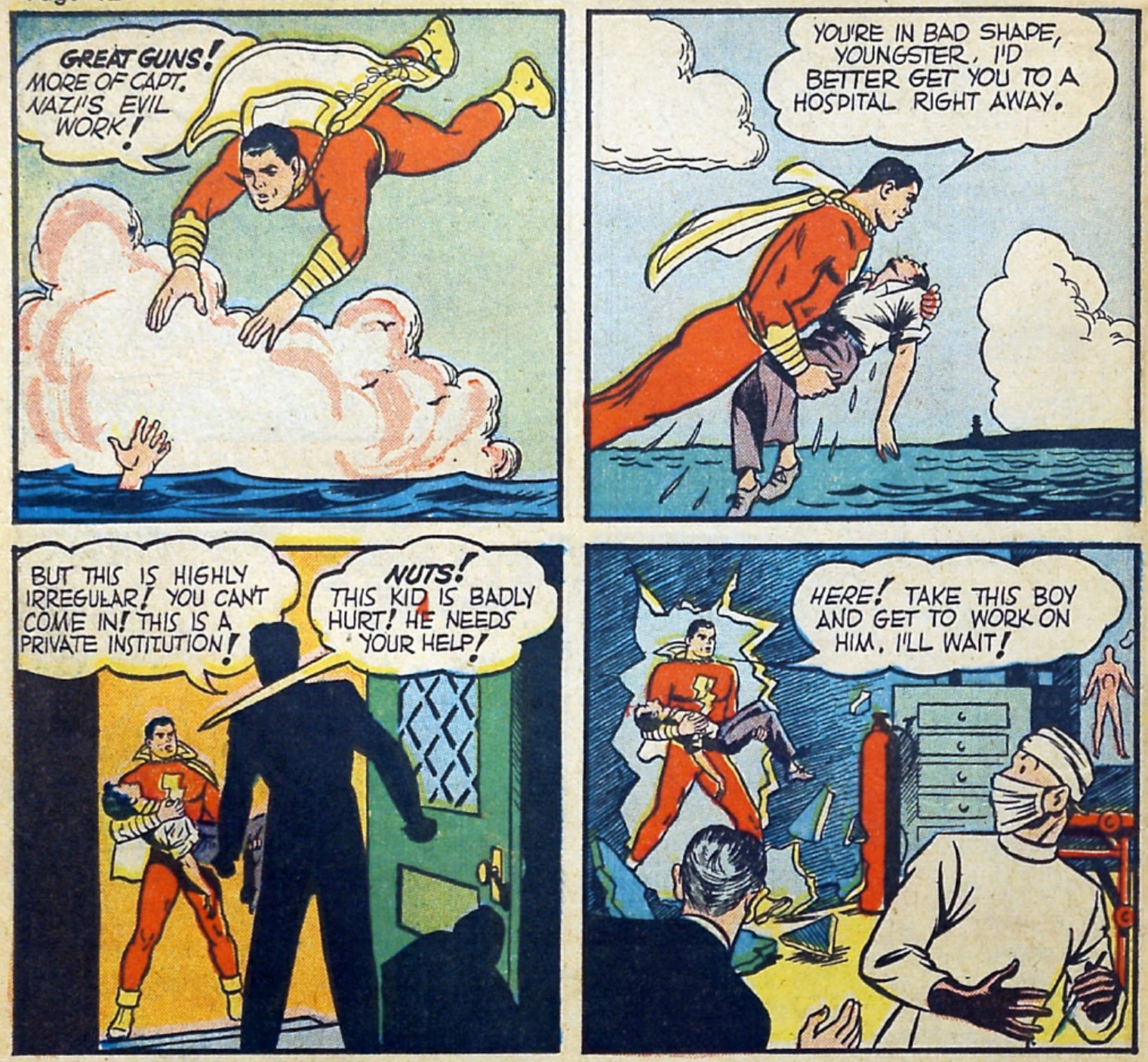
    After the vile Captain Nazi is knocked into New York Fawcett City Harbor during a battle with Captain Marvel, he is pulled from the water by young Freddy Freeman and his grandfather and immediately rewards their good deed by murdering them both. Or so he thinks! It turns out that Freddy is merely grievously injured, and Captain Marvel is able to bring him to a hospital for care.

    Informed that Freddy is not expected to live through the night, Billy Batson makes the decision to bring him to the secret underground realm of the wizard Shazam in hopes that he might be able to do something for him. The wizard’s shade is summoned via an apparently mystical brazier (and hey, I think that this is Shazam’s first appearance since he was squashed by that huge block of stone during Billy’s origin!) but rather than help Freddy, Shazam places the onus of doing so on Captain Marvel’s shoulders.

    In practical terms, this means that rather than SHAZAM, the newly-minted Captain Marvel Junior says “Captain Marvel” to transform, which as many have pointed out before me means that he cannot actually say his own name without changing identities. Does the fact that Captain Marvel can do this ever come up again? Perhaps it ties in to the more modern conception of him as a sort of larval being who will eventually evolve into a new wizard, but I’m not sure if it come up in the intervening decades.

    Perhaps my favourite thing about Captain Marvel Junior is that since his comics were not drawn by CC Beck they have a different style to them and that when the Marvel Family are all together they emphatically do not adjust this. Everyone else (except perhaps Mary Marvel) is running around with that clean art style with those little black eyes and Cap Jr just keeps on looking like a young Elvis. It’s always fun!

    UPDATES: 

  • SUPER-HERO FILE 002: CAPTAIN MARVEL JUNIOR

    SUPER-HERO FILE 002: CAPTAIN MARVEL JUNIOR

    (Whiz Comics 025, 1941)

    After the vile Captain Nazi is knocked into New York Fawcett City Harbor during a battle with Captain Marvel, he is pulled from the water by young Freddy Freeman and his grandfather and immediately rewards their good deed by murdering them both. Or so he thinks! It turns out that Freddy is merely grievously injured, and Captain Marvel is able to bring him to a hospital for care.

    Informed that Freddy is not expected to live through the night, Billy Batson makes the decision to bring him to the secret underground realm of the wizard Shazam in hopes that he might be able to do something for him. The wizard’s shade is summoned via an apparently mystical brazier (and hey, I think that this is Shazam’s first appearance since he was squashed by that huge block of stone during Billy’s origin!) but rather than help Freddy, Shazam places the onus of doing so on Captain Marvel’s shoulders.

    In practical terms, this means that rather than SHAZAM, the newly-minted Captain Marvel Junior says “Captain Marvel” to transform, which as many have pointed out before me means that he cannot actually say his own name without changing identities. Does the fact that Captain Marvel can do this ever come up again? Perhaps it ties in to the more modern conception of him as a sort of larval being who will eventually evolve into a new wizard, but I’m not sure if it come up in the intervening decades.

    Perhaps my favourite thing about Captain Marvel Junior is that since his comics were not drawn by CC Beck they have a different style to them and that when the Marvel Family are all together they emphatically do not adjust this. Everyone else (except perhaps Mary Marvel) is running around with that clean art style with those little black eyes and Cap Jr just keeps on looking like a young Elvis. It’s always fun!

    UPDATES: 

  • SUPER-HERO FILE 001: CAPTAIN MARVEL

    (Whiz Comics 002, 1940) 

    When I fist made this blog it was mostly as a way to keep up a twitter thread that I was really enjoying but which was not enough to keep me on a rapidly-curdling social media platform. This is why all of the early entries are so short: because they’re just beefed-up tweets. This is also why I focused so heavily on obscure super-villains at first and only expanded my purview to include obscure super-heroes and more prominent super-villains gradually and haphazardly over time. Well, it’s time for another expansion of scope, because there are all kinds of interesting things about the big-name super-heroes and I just gotta mention them when I see them. Thus, the Super-Hero Files, which, if all goes to plan, are going to act as landing pages for all of those interesting things. And as he’s the first major super-hero to cross my computer screen since I decided to do this, our initial subject is Captain Marvel!

    Any super-hero origin story has its weird and charming elements that are later revisited and iterated on throughout the years, but Captain Marvel’s might just have the most of those? Let’s count them as we go.

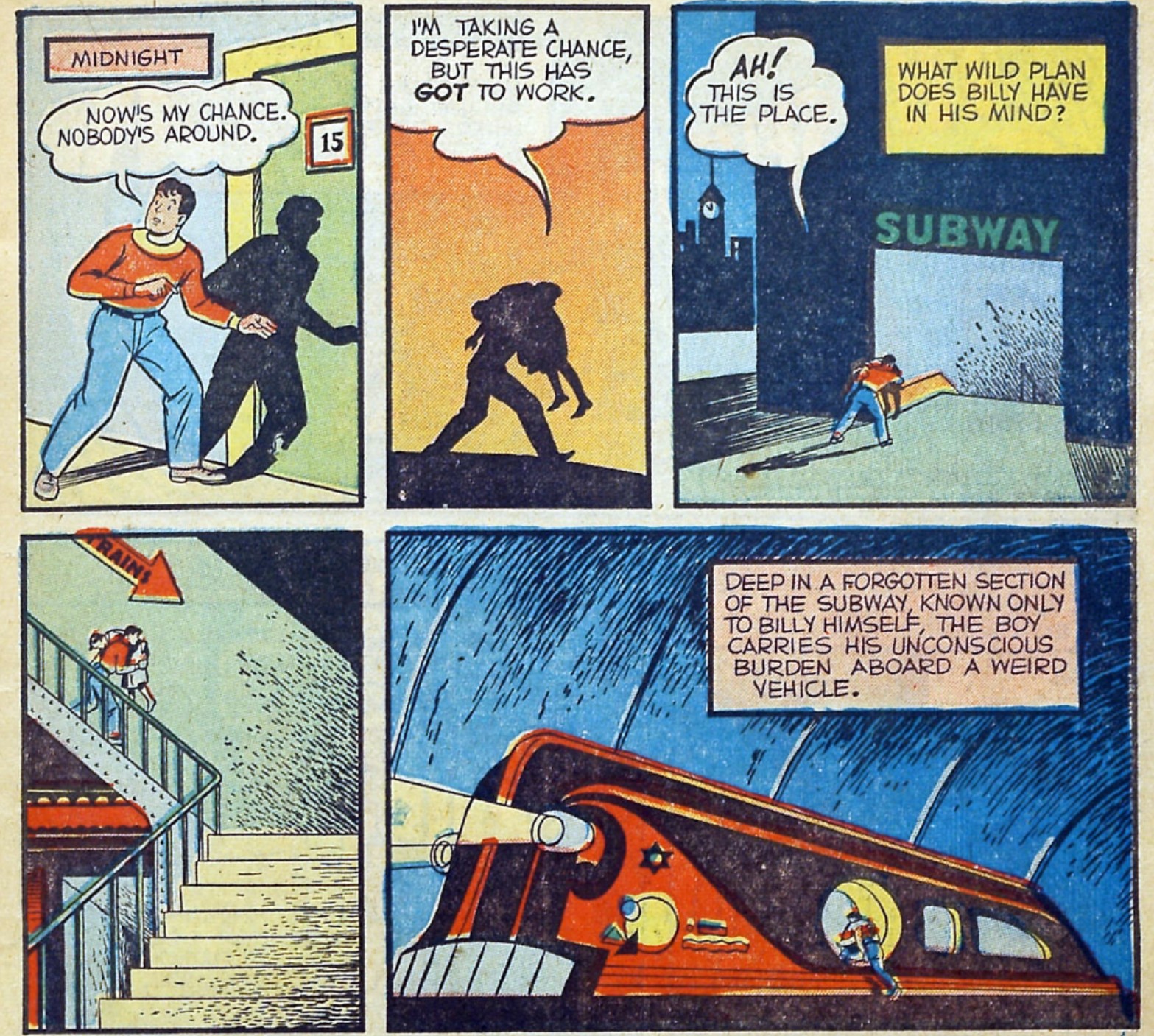
    Billy Batson, the most downtrodden and good-hearted boy in the world (1) is approached by a mysterious shadowy man (2) and taken on a ride in a magical subway car (3).

    (1) Future retelling of this origin try to double down on both the misery and the goodness but it’s there from the start. He sleeps in a subway station, but he’s upbeat about it.

    (2) Remains mysterious until 1994, when Roy Thomas establishes that this is the ghost of Billy Batson’s father.

    (3) I don’t know if the subway car is ever revealed to actually be Zeus’ chariot or something but I am pretty happy that it keeps on showing up and hasn’t been relegated to the “Too Silly FOR COMIC BOOKS” pile.

    Billy enters a colossal cavern (4) and walks past statues of the Seven Deadly Enemies of Man (5). He is greeted by the wizard Shazam and given a brief tutorial on the meaning of his name (6). Also note the big globe and book flanking the wizard’s throne (7).

    (4) Eventually, this space is revealed to be located in the extradimensional Rock of Eternity, but as of 1940 it’s just a big magic cave that you can just wander into if you start wandering around in the tunnels below the city.

    (5) Pride, Envy, Greed, Hatred, Selfishness, Laziness and Injustice. The names get remixed occasionally – notably the more modern version read more like the Catholic Seven Deadly Sins – but this bunch will eventually get their own entry as minor super-villains after they come to life and battle Captain Marvel.

    (6) Also a quick rundown of the powers of Captain Marvel! Solomon, wisdom of; Hercules, strength of; Atlas, stamina of; Zeus, power of; Achilles, courage of; Mercury, speed of.

    (7) I don’t know if these are ever given a real explanation – I see some claims that the book is Shazam’s Historama but that’s a retcon at best.

    Shazam uses his Historama (8) to reiterate the miserable nature of Billy Batson’s life: orphaned and then chucked out on his ear by his greedy uncle Ebenezer (9).

    (8) See? The book is clearly closed in the same panel as the Historama is active.

    (9) Billy’s terrible uncle is an occasional recurring antagonist, but doesn’t recur as often as I’d expect. 

    Billy is given the power to become Captain Marvel by shouting the word SHAZAM (10), upon which the wizard, his work on Earth complete, is smushed by the symbolic granite block that has until that point hung above his throne on a slender thread (11). 

    (10) Just a classic super-hero bit. Copied ad nauseam.

    (11) I always forget that the wizard Shazam dies in his very first appearance, possibly because he continues to appear as a spectral advisor to Captain Marvel and the entire Marvel Family.

    Returning to his life in Fawcett City (12), Billy manages to finagle a job as an occasionally-roving radio announcer (13) by making a deal with radio magnate Sterling Morris before foiling the schemes of Dr Sivana (14) for the first time. 

    (12) Technically Golden Age Captain Marvel stories pretty clearly take place in New York City and Fawcett City doesn’t really come into being until the DC Comics days, and while I’m normally a dumb stickler for that sort of thing, it just feels right to go with the retcon flow on that particular point.

    (13) Just a great super-hero job, up there with reporter or newspaper photographer in terms of being in the know about developing situations. Too bad it’s not as relevant today as back in the 40s – is Billy an Extreme Vlogger or something nowadays?

    (14) Stay tuned for that guy.

    In conclusion: yes there are a lot of touchpoints in Captain Marvel’s origin, and that’s without all of the later stuff like Mary that would be included right off the bat in later retellings. It’s a rich text. 

    UPDATES:

    Update 1941

    HONOURS:

    Honours – Captain Marvel

    TROPHY ROOM: 

    Trophy Room – Captain Marvel