The Curse of Skeleton Munroe

Category: 1938

  • MONSTER, CRITTER AND CREATURE ROUND-UP 003

    I hope everyone likes monsters as much as I do because there are a whole lot of them to cover.

    Beaked Tyros:

    When polar explorer Anthony Conrad gets lost in an Arctic storm and falls through a hole in the pack ice, he reasonably expects to meet his demise. Instead, he falls into the subterranean kingdom of Artica and is chosen by the elderly Artican king – also a stranded former surface explorer – as his successor. 

    As part of the coronation process, Anthony must prove his mettle to his prospective subjects, and step two of that process is Thrilling Arena Combat with the horrible beaked tyros “Lord of Artica’s Jungles,” and I love this thing. Though it looks like just another low-rent carnosaur at first glance, upon closer examination it has many bizarre features, including weird bird legs, thin, unpleasant-looking teeth, radially-symmetrical hands that are possibly equipped with suckers on the palms, and skin that is described as “hairy” in the caption box. Truly this is a strange and wonderful beast that sadly must be chopped up in service to the story. (Cyclone Comics 001, 1940)

    the Beast:

    When asked to prove his worthiness to wed the Princess Ahloo, our hero Abdallah knows exactly what to do: ride directly to a nearby valley full of dinosauroids and slay one of them. Though one of the pteranodon-adjacent flying reptiles that confront him when he enters the valley would probably be sufficient to satisfy Ahloo’s father, Abdallah instead opts to battle a creature referred to only as the Beast, a possibly-fire-breathing, possibly-carnivorous sauropodoid that give him a truly heroic-level challenge. And it works! He gets the girl! (Funny Pages v2 003, 1937)

    the Birds:

    These vulture-monsters come very close to destroying the Blue Bolt on his very first adventure. They are only prevented from doing so, in fact, because they work for the Green Sorceress and she has become infatuated with Our Hero here on sight.

    I’m always a big fan of these kinds of monster birds that up the ante on deadliness by throwing most of the birdliness of the creature out the window and instead give them the body plan of a griffin. Really great stuff and my only note is that some of the tails are very unpleasant to look at. (Blue Bolt v1 001, 1940)

    Bolu:

    Meg and Mickey are two children who have access to a magical time-travel stone and use it to just kind of blunder around throughout history. In this particular instance they have ended up in the Stone Age and are only saved from being eaten by some uncharitable portrayals of our collective ancestors by the appearance of a dinosaur, called Bolu by the cavemen and of course far, far more out of place than two 20th Century kids could ever hope to be. There is some indication that the bolu was summoned by the Spirit of the Stone to save the two from becoming dinner, but if that’s the case then why do the cavemen already know about it? (The Comics 007, 1938)

    Carnicantileia:

    The swamp-dwelling carnicantileia briefly menaces Flip Falcon and his associates during one of his early adventures when he mostly uses his fantastic time-and-space machine to go to Mars. It’s a pretty impressive snake-style beast, and as such it’s a real shame that it is killed in such a goofy way, by having a big rock thrown down its gullet. (Fantastic Comics 003, 1940)

    Carnivoplant:

    The carnivoplant is a classic man-eating plant, subtype seaweed, that almost kills adventurer Kinks Mason before it in turn is preyed upon by a swarm of phosphomites. And just what are phosphomites, you may ask? Contextually, they are small glowing creatures that eat carnivoplants, and that is all the information we get. (Fight Comics 001, 1940)

    Cave Monster:

    Modern day cowboy hero Bull’s-Eye Bill and his companions meet this cave reptile while pursuing an outlaw, and as I previously observed, it was clearly meant to set up an adventure into a prehistoric underground world that subsequent creators chose not to take advantage of. 

    As for the one beast that we do get to see fight some cowboys, I really appreciate how lizardy it looks, as well as how it seems to be posing for maximum dramatic effect in every panel, even when killing a guy or writhing around in its death throes. (Target Comics v1 007, 1940)

    the Ozix:

    Someday
    when I post a picture of a creature that is just a big cat with some extra stuff stapled onto it in one of these round-ups I will be able to refer to it
    as a standard type of creature, but I simply haven’t done the work yet.
    The ozix, then, is a beast with the body of a leopard and the head of a
    crocodile – how novel a concept! Adventurer Congo Jack must slay this
    one during his adventures under the earth. (Lightning Comics v2 002,
    1941) 

    Dakk:

    Returning to the adventures of King Anthony in the sub-Arctic world of Artica, here we see him as he is about to tour his kingdom on the back of a domesticated dakk, and I must say that I like the very beast-of-burden look that they have given to this creature’s head. Sadly, this particular dakk has been poisoned as part of an attempt to assassinate the new king.

    This assassination attempt is only partially successful, as Anthony survives the fall into the jungles of Artica but is then placed in further peril at the claws of the various creatures that live there, such as this amazing giraffe-patterned water lizard.

    Though he escapes the lizard, Anthony is almost immediately attacked by a great horned tigrid, which is is of course a regular tiger with two little horns on its head, and another example of what I was talking about in the ozix entry.

    Finally, after stumbling upon the roots of the conspiracy against him and dealing with them violently, King Anthony makes his way home on a humble unicorn. (Cyclone Comics 003, 1940) 

    the Storm Monster:

    A giant reptilian beast that plagues an African village on a yearly basis (during a huge storm, natch), the Storm Monster meets its end after swallowing Kaänga whole, upon which he carves his way free of its guts with his trusty knife. (Jungle Comics 021, 1941)

  • MEDIA IN COMICS 007

    We’ve got some real early media for you today, so get ready for the crustiest scans of microfiche you ever saw.

    Movies:

    Steve Rogers and Bucky almost get to the movies to see a flick called Million Dollar Robbery before being interrupted by a real, if smaller-scale, robbery. BONUS: a classic case of real movies stars barely obfuscated by having their first names swapped, in Humphrey Raft and George Bogart, aka George Raft and Humphrey Bogart. (Captain America Comics 004, 1941)

    Hired to look into dirty dealings on the Stupendous Films lot, Slam Bradley and Shorty Morgan go undercover as stunt doubles. The comedy film that Shorty works on is never named, but Slam briefly works on a film called Jungle Man. (Detective Comics v1 004, 1937)

    Larry Steele’s own investigations into a series of high-profile kidnappings take him to the set of Too Much Money, a movie we never learn anything about. (Detective Comics v1 005, 1937)

    It’s just barely possible to make out that this movie that the Radio Squad boys watch is called The Fighting Cop. A bit on the nose, boys! (More Fun Comics 038, 1938)

    Music:

    Detective Bruce Nelson investigates a series of murders committed on stage while each victim was singing the same song. That song was originally called “The Night is Blue,” but is now known as “The Song of Death.” (Detective Comics 020, 1938)

    In Action Comics 006, a grifter named Nick Williams falsifies some contracts and begins licensing Superman’s name all over town, and one of the results of this is a song! Specifically, a big band tune called “You’re a Superman!”

    I wouldn’t call it the greatest song ever written (no song should include the word “resistless,” for example), but it’s not entirely terrible. (Action Comics v1 006, 1938)

    Newspaper Columns:

    Written by Paul Revere Sr, ultra-patriot and father to comic book adventure kid Paul Revere Jr, “America Awake!” is one of those exciting titles that works for an anti-Nazi column in 1941 and also potentially for a pro-Nazi one in the present. (Banner Comics 003, 1941)

    Jay Garson Jr, aka the Ragman, wrote his “Crime Does Not Pay” column right up until someone tried to kill him for it and he was forced to fake his own death. And then kept on writing it for a while afterward, seemingly mostly in order to give his old editor a hard time. (Cat-Man Comics 001, 1941)

    Radio Shows:

    In addition to “You’re a Superman!” Nick Wilson’s Superman-licensing deals included a Superman radio show, meaning that the DC Universe had one a full two years before we did.

    Wilson also mentions having sold movie and comic book rights, but as he is beaten up and forced to stop his scheme by the real Superman not long after this conversation it’s likely that those never saw the light of day. (Action Comics v1 006, 1938)

    Theatre:

    Slam Bradley and Shorty Morgan investigate the crimes of the Broadway Bandit by getting jobs on Broadway, specifically as tap dancers in a production called Love on Ice that despite its name seems to be a variety show rather than anything with a discernible plot. (Detective Comics v1 016, 1938)

    Renick’s Frolics, the show in which “The Song of Death” appears, is another of these variety productions. (Detective Comics v1 020, 1938)

    We learn nothing about Darkest Dawn other than the fact that someone is trying to kill the lead actress and Nadir, Master of Magic, is on the case. (New Adventure Comics 028, 1938)

  • MEDIA IN COMICS 007

    We’ve got some real early media for you today, so get ready for the crustiest scans of microfiche you ever saw.

    Movies:

    Steve Rogers and Bucky almost get to the movies to see a flick called Million Dollar Robbery before being interrupted by a real, if smaller-scale, robbery. BONUS: a classic case of real movies stars barely obfuscated by having their first names swapped, in Humphrey Raft and George Bogart, aka George Raft and Humphrey Bogart. (Captain America Comics 004, 1941)

    Hired to look into dirty dealings on the Stupendous Films lot, Slam Bradley and Shorty Morgan go undercover as stunt doubles. The comedy film that Shorty works on is never named, but Slam briefly works on a film called Jungle Man. (Detective Comics v1 004, 1937)

    Larry Steele’s own investigations into a series of high-profile kidnappings take him to the set of Too Much Money, a movie we never learn anything about. (Detective Comics v1 005, 1937)

    It’s just barely possible to make out that this movie that the Radio Squad boys watch is called The Fighting Cop. A bit on the nose, boys! (More Fun Comics 038, 1938)

    Music:

    Detective Bruce Nelson investigates a series of murders committed on stage while each victim was singing the same song. That song was originally called “The Night is Blue,” but is now known as “The Song of Death.” (Detective Comics 020, 1938)

    In Action Comics 006, a grifter named Nick Williams falsifies some contracts and begins licensing Superman’s name all over town, and one of the results of this is a song! Specifically, a big band tune called “You’re a Superman!”

    I wouldn’t call it the greatest song ever written (no song should include the word “resistless,” for example), but it’s not entirely terrible. (Action Comics v1 006, 1938)

    Newspaper Columns:

    Written by Paul Revere Sr, ultra-patriot and father to comic book adventure kid Paul Revere Jr, “America Awake!” is one of those exciting titles that works for an anti-Nazi column in 1941 and also potentially for a pro-Nazi one in the present. (Banner Comics 003, 1941)

    Jay Garson Jr, aka the Ragman, wrote his “Crime Does Not Pay” column right up until someone tried to kill him for it and he was forced to fake his own death. And then kept on writing it for a while afterward, seemingly mostly in order to give his old editor a hard time. (Cat-Man Comics 001, 1941)

    Radio Shows:

    In addition to “You’re a Superman!” Nick Wilson’s Superman-licensing deals included a Superman radio show, meaning that the DC Universe had one a full two years before we did.

    Wilson also mentions having sold movie and comic book rights, but as he is beaten up and forced to stop his scheme by the real Superman not long after this conversation it’s likely that those never saw the light of day. (Action Comics v1 006, 1938)

    Theatre:

    Slam Bradley and Shorty Morgan investigate the crimes of the Broadway Bandit by getting jobs on Broadway, specifically as tap dancers in a production called Love on Ice that despite its name seems to be a variety show rather than anything with a discernible plot. (Detective Comics v1 016, 1938)

    Renick’s Frolics, the show in which “The Song of Death” appears, is another of these variety productions. (Detective Comics v1 020, 1938)

    We learn nothing about Darkest Dawn other than the fact that someone is trying to kill the lead actress and Nadir, Master of Magic, is on the case. (New Adventure Comics 028, 1938)

  • MEDIA IN COMICS 001

    MEDIA IN COMICS 001

    I’ve often mentioned how comics as a medium has a grand tradition of not using the real names for people (see about half the entries in our collection of Real Folk in comics) places (see the grand list of fictional countries on every continent of our list of Locations) and things, so I hope that it won’t surprise you when I say that they make up all the media, too. And since I have a big list of all the made-up books, newspaper columns, stage shows and movies sitting around already I figured I should share.

    Movies:

    Lover Mine (Funny Picture Stories v2 005, 1938)

    Flying Cadets, Colossal Pictures, stunts by the Four Aces (The Funnies 021, 1938)

    Star-Dust (Funny Picture Stories v3 002, 1939)

    War Eagles, Colossal Studios (Keen Detective Funnies v2 006, 1939)

    Pilots All, Mammoth Film Company (Keen Detective Funnies v2 010, 1939)

    The Mystery of the Creeping Spook, Superbo Pictures (Keen Detective Funnies v2 011, 1939)

    White Goddess (Funny Pages v3 008 1939) 

    Newspaper Columns:

    “On Broadway” by Walt “Bob Phantom” Whitney. (Blue Ribbon Comics 002, 1939)

    Plays:

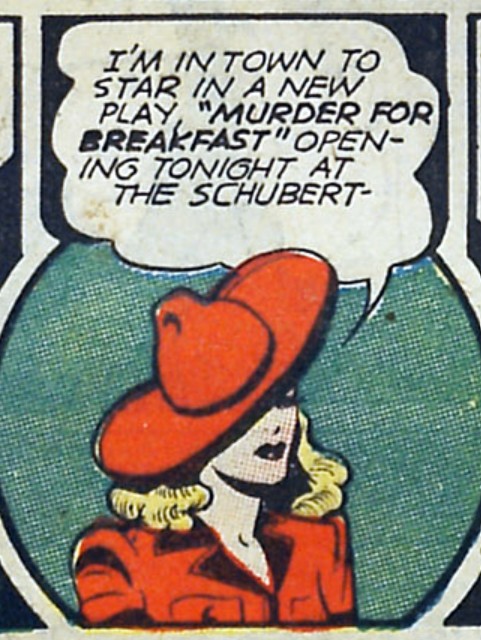
    “Murder for Breakfast”, starring Kay Kenyon, one of Presto Martin’s many Hollywood friends. (Silver Streak Comics 010, 1941)

    Songs:

    “Boogie-Woogie Blast” (Champion Comics 002, 1939)

  • MEDIA IN COMICS 001

    I’ve often mentioned how comics as a medium has a grand tradition of not using the real names for people (see about half the entries in our collection of Real Folk in comics) places (see the grand list of fictional countries on every continent of our list of Locations) and things, so I hope that it won’t surprise you when I say that they make up all the media, too. And since I have a big list of all the made-up books, newspaper columns, stage shows and movies sitting around already I figured I should share.

    Movies:

    Lover Mine (Funny Picture Stories v2 005, 1938)

    Flying Cadets, Colossal Pictures, stunts by the Four Aces (The Funnies 021, 1938)

    Star-Dust (Funny Picture Stories v3 002, 1939)

    War Eagles, Colossal Studios (Keen Detective Funnies v2 006, 1939)

    Pilots All, Mammoth Film Company (Keen Detective Funnies v2 010, 1939)

    The Mystery of the Creeping Spook, Superbo Pictures (Keen Detective Funnies v2 011, 1939)

    White Goddess (Funny Pages v3 008 1939) 

    Newspaper Columns:

    “On Broadway” by Walt “Bob Phantom” Whitney. (Blue Ribbon Comics 002, 1939)

    Plays:

    “Murder for Breakfast”, starring Kay Kenyon, one of Presto Martin’s many Hollywood friends. (Silver Streak Comics 010, 1941)

    Songs:

    “Boogie-Woogie Blast” (Champion Comics 002, 1939)

  • DIVINE ROUND-UP 019

    These pantheons are going to fill up if we’re not careful.

    Ammon-Ra:

    Worshipped by a secret sect in the hidden underground city-state of Ruxor in Egypt, Ammon-Ra, contrary to the above image, is probably just an idol that Yarko the Great is making speak so that he doesn’t have to keep magically duelling High Priest Ramma-Tep. 

    God style: Idol (Wonderworld Comics 018, 1940)

    Kila:

    Kila, the supposed Hindu God of Destruction, is represented here by a ruby idol. There’s not much else concrete to say about this particular god, because Sheldon Lenox, the fellow selling the idol, stages a series of crimes using a fake cult in order to get it back and that sort of thing really muddies the waters.

    God Style: Idol (Detective Comics v1 035, 1940)

    Kilu:

    In a classic set-up, a pirate captain and a wicked witch doctor have teamed up to control an island tribe using a hollow idol of the tribe’s god, Kilu. The whole operation is upended by the heroic Captain Fortune and the idol of Kilu is blasted by his ship’s cannon.

    God Style: Idol (Feature Comics 030, 1940)

    Koru: 

    Having heard about a fabulous fortune in rubies somewhere in the African jungle, adventure Tod Hunter and his monocled pal Tommy set out to steal them from their place on the idol of Koru, God of the Ruby Eye. Let me tell you, they are pretty put out when the worshippers of Koru very reasonably imprison them rather than allow them to waltz in and deface their sacred idol. 

    The duo (along with some other miscellaneous imprisoned treasure hunters) of course end up escaping and stealing all of the rubies, because they are the protagonists of an adventure story and thus are in the right, Along the way they discover that the idol of Koru is hollow and has a little guy living inside of it to speak in the god’s voice, just like every other giant idol in comics.

    God Style: Idol (New Adventure Comics 027, 1938) 

  • DIVINE ROUND-UP 018

    Idols, idols, idols! 

    the Great God Khwass: 

    Khwass, Great God of Vengeance, is a comparatively rare villain’s god who actually follows through on his promises. He is invoked vs Dr Fung by the daughter of a former foe and not only replies to her prayers but deploys sleeping gas and a weird monster to aid her in her quest for vengeance. 

    God Style: Real (Wonderworld Comics 016, 1940)

    Ice God Emul:

    Captain Venture and the Planet Princess Zyra’s great enemy, King Leon of Asteroid Djung, loves to subcontract out his villainy, and to that end he has engaged the services of Frigo, King of the Ice Planet. Frigo is to kill Captain Venture and deliver Zyra to King Leon for marriage but of course betrays him and slates all three for sacrifice to the Ice God Emul.

    The idol of Emul is destroyed in the subsequent battle and escape, and what’s interesting here is that Emul is explicitly just the idol. As Frigo states, “the god Emul is no more.” Wild.

    God Style: Idol (Master Comics 015, 1941)

    Bubastis & Isis:

    In an early adventure in Egypt, Zatara comes across a member of a lost archaeological expedition who is on the verge of death, and who is magically revealed to have found a lost temple to Bubastis. Travelling there in hopes of finding the rest of the expedition, Zatara encounters the ancient priest Amen-Hotep, who is part of one of those weird remnant Ancient Egyptian populations that exist under the sands of Egypt in adventure fiction, and whose priestly magics are comparable to Zatara’s own.

    The temple of Bubastis also turns out to be a temple to Isis, as Zatara discovers when he meets a less-powerful but still magically potent priestess of Isis and is almost sacrificed by her. Amen-Hotep seems to be an Isis worshipper as well, as he animates a statue of the goddess to smite Zatara with – it’s possible that the two goddesses are being conflated here.

    Zatara ends up melting the statue of Isis and disintegrating Amen-Hotep. The priestess is “sent away,” presumably with the rest of her people in tow, and the temple is turned over to the archaeologists to plunder.

    God Style: Real (Action Comics 005, 1938) 

    Khor: 

    Khor is known as the Blind God because the magical diamond that was the eye of his idol was stolen long ago, and since that diamond subsequently became the source of super-heroic adventurer Diamond Jack’s power, the priesthood of Khor is out for his blood.

    The high priest animates the idol of Khor and sends it to destroy Diamond Jack and recover the eye. This is impressive but not innovative – we just saw the Amen-Hotep do the same with a statue of Isis, after all – but what is is the custom roadster-cum-juggernaut that the thing rides around in. Was ever aan evil god so sporty?

    The whole thing ends back at the temple, as Diamond Jack disrupts the ritual that keeps Khor animated and the high priest ends up being crushed under the falling idol. So long, Khor. 

    God Style: Idol (Real?) (Slam-Bang Comics 004, 1940) 

  • DIVINE ROUND-UP 018

    Idols, idols, idols! 

    the Great God Khwass: 

    Khwass, Great God of Vengeance, is a comparatively rare villain’s god who actually follows through on his promises. He is invoked vs Dr Fung by the daughter of a former foe and not only replies to her prayers but deploys sleeping gas and a weird monster to aid her in her quest for vengeance. 

    God Style: Real (Wonderworld Comics 016, 1940)

    Ice God Emul:

    Captain Venture and the Planet Princess Zyra’s great enemy, King Leon of Asteroid Djung, loves to subcontract out his villainy, and to that end he has engaged the services of Frigo, King of the Ice Planet. Frigo is to kill Captain Venture and deliver Zyra to King Leon for marriage but of course betrays him and slates all three for sacrifice to the Ice God Emul.

    The idol of Emul is destroyed in the subsequent battle and escape, and what’s interesting here is that Emul is explicitly just the idol. As Frigo states, “the god Emul is no more.” Wild.

    God Style: Idol (Master Comics 015, 1941)

    Bubastis & Isis:

    In an early adventure in Egypt, Zatara comes across a member of a lost archaeological expedition who is on the verge of death, and who is magically revealed to have found a lost temple to Bubastis. Travelling there in hopes of finding the rest of the expedition, Zatara encounters the ancient priest Amen-Hotep, who is part of one of those weird remnant Ancient Egyptian populations that exist under the sands of Egypt in adventure fiction, and whose priestly magics are comparable to Zatara’s own.

    The temple of Bubastis also turns out to be a temple to Isis, as Zatara discovers when he meets a less-powerful but still magically potent priestess of Isis and is almost sacrificed by her. Amen-Hotep seems to be an Isis worshipper as well, as he animates a statue of the goddess to smite Zatara with – it’s possible that the two goddesses are being conflated here.

    Zatara ends up melting the statue of Isis and disintegrating Amen-Hotep. The priestess is “sent away,” presumably with the rest of her people in tow, and the temple is turned over to the archaeologists to plunder.

    God Style: Real (Action Comics 005, 1938) 

    Khor: 

    Khor is known as the Blind God because the magical diamond that was the eye of his idol was stolen long ago, and since that diamond subsequently became the source of super-heroic adventurer Diamond Jack’s power, the priesthood of Khor is out for his blood.

    The high priest animates the idol of Khor and sends it to destroy Diamond Jack and recover the eye. This is impressive but not innovative – we just saw the Amen-Hotep do the same with a statue of Isis, after all – but what is is the custom roadster-cum-juggernaut that the thing rides around in. Was ever aan evil god so sporty?

    The whole thing ends back at the temple, as Diamond Jack disrupts the ritual that keeps Khor animated and the high priest ends up being crushed under the falling idol. So long, Khor. 

    God Style: Idol (Real?) (Slam-Bang Comics 004, 1940) 

  • REAL PERSON ROUND-UP 018

    World leaders and others. 

    Adolf Hitler: 

    I’m pretty sure that the “Navy Jones” strip is set in an undefined near-future time, which makes the Dictator of Europe here a future analog of Adolf Hitler rather than a stand-in for him. I’m almost certain that that’s the case. Anyway, he tries to invade the US with a fleet of amphibious tanks and gets his ass handed to him by Navy Jones and his fish men. (Weird Comics 008, 1940)

    Chiang Kai-shek and Soong Mei-ling: 

    Styled as Madame and Generalissimo “Kang Shy-check,” the former comes to adventurer Shanghai Sheridan for aid after the latter is captured by Japanese collaborator Wu Fang. (Top-Notch Comics 005, 1940)

    Clyde Beatty: 

    Famous animal trainer and circus mogul Clyde Beatty had a long-running strip across several Dell Comics titles, though given that the supporting cast and premise tended to reset to zero every time the strip changed hands it might be more accurate to say that he had a sequential series of features linked only by his presence. (Crackajack Funnies 001, 1938)

    Franklin Delano Roosevelt:

    A fairly off-model FDR chairs an emergency meeting to discuss what to do about an alien invasion. (War Comics 002, 1940)

    J Edgar Hoover: 

    The Sparkler accepts an assignment from “head G-Man”/his old college roommate’s dad M.L. Roover. (Wham Comics 002, 1940)

    Sténio Vincent: 

    I don’t necessarily trust the creators of the “Voodoo Man” feature to even remember that it is set in Haiti, let alone go to the trouble to accurately represent Haiti’s president on-panel, so I have to give it to them: this is an okay drawing of Sténio Vincent, the President of Haiti c. 1940. Was it done on purpose? Nobody can say. (Weird Comics 004, 1940) 

    Gaius Marius & Sulla: 

    It’s impossible to be certain if Marius and Sulla, the Roman figures associated with the origin of super-hero the Dart, are in fact meant to be Gaius Marius and Sulla, the political figures from the late Roman Republic, but the timeline almost matches up. Plus, there really weren’t that many Sullas running around Rome. (Weird Comics 005, 1940) 

    Mata Hari: 

    Just a notorious spy named Hattie Mary in the comedy melodrama comic strip “Hairbreadth Harry”. (Famous Funnies 074, 1940) 

    Winston Churchill: 

    Inspector Blake of Scotland Yard is called to 10 Downing Street to talk to the Prime Minister, and it sure doesn’t look like he’s Winston Churchill. I do like to roast comics for not getting the appearances of world leaders right, but when it’s somewhere like Madagascar you might at least have the excuse that finding a picture of the current leader of that country might be difficult in the US in 1940, but surely this not so for the Prime Minister of the UK.

    The other possible defense for this, of course, is that this comic came out in June 1940 and Churchill took power in April so Neville Chamberlain might still have been PM when this was drawn, but this is hampered somewhat by the fact that it doesn’t really look like him either. (Whirlwind Comics 001, 1940)

  • REAL PERSON ROUND-UP 018

    World leaders and others. 

    Adolf Hitler: 

    I’m pretty sure that the “Navy Jones” strip is set in an undefined near-future time, which makes the Dictator of Europe here a future analog of Adolf Hitler rather than a stand-in for him. I’m almost certain that that’s the case. Anyway, he tries to invade the US with a fleet of amphibious tanks and gets his ass handed to him by Navy Jones and his fish men. (Weird Comics 008, 1940)

    Chiang Kai-shek and Soong Mei-ling: 

    Styled as Madame and Generalissimo “Kang Shy-check,” the former comes to adventurer Shanghai Sheridan for aid after the latter is captured by Japanese collaborator Wu Fang. (Top-Notch Comics 005, 1940)

    Clyde Beatty: 

    Famous animal trainer and circus mogul Clyde Beatty had a long-running strip across several Dell Comics titles, though given that the supporting cast and premise tended to reset to zero every time the strip changed hands it might be more accurate to say that he had a sequential series of features linked only by his presence. (Crackajack Funnies 001, 1938)

    Franklin Delano Roosevelt:

    A fairly off-model FDR chairs an emergency meeting to discuss what to do about an alien invasion. (War Comics 002, 1940)

    J Edgar Hoover: 

    The Sparkler accepts an assignment from “head G-Man”/his old college roommate’s dad M.L. Roover. (Wham Comics 002, 1940)

    Sténio Vincent: 

    I don’t necessarily trust the creators of the “Voodoo Man” feature to even remember that it is set in Haiti, let alone go to the trouble to accurately represent Haiti’s president on-panel, so I have to give it to them: this is an okay drawing of Sténio Vincent, the President of Haiti c. 1940. Was it done on purpose? Nobody can say. (Weird Comics 004, 1940) 

    Gaius Marius & Sulla: 

    It’s impossible to be certain if Marius and Sulla, the Roman figures associated with the origin of super-hero the Dart, are in fact meant to be Gaius Marius and Sulla, the political figures from the late Roman Republic, but the timeline almost matches up. Plus, there really weren’t that many Sullas running around Rome. (Weird Comics 005, 1940) 

    Mata Hari: 

    Just a notorious spy named Hattie Mary in the comedy melodrama comic strip “Hairbreadth Harry”. (Famous Funnies 074, 1940) 

    Winston Churchill: 

    Inspector Blake of Scotland Yard is called to 10 Downing Street to talk to the Prime Minister, and it sure doesn’t look like he’s Winston Churchill. I do like to roast comics for not getting the appearances of world leaders right, but when it’s somewhere like Madagascar you might at least have the excuse that finding a picture of the current leader of that country might be difficult in the US in 1940, but surely this not so for the Prime Minister of the UK.

    The other possible defense for this, of course, is that this comic came out in June 1940 and Churchill took power in April so Neville Chamberlain might still have been PM when this was drawn, but this is hampered somewhat by the fact that it doesn’t really look like him either. (Whirlwind Comics 001, 1940)