The Curse of Skeleton Munroe

Category: Captain America

  • MONSTER, CRITTER AND CREATURE ROUND-UP 001

    I’ve threatened to do it for long enough, it’s time for the creatures to have their day.

    Alligator Men:

    Our very first creatures are also our first tough call. Steel Sterling fights these Alligator Men in Brazonia, South America while on the trail of Dr Yar (aka the Black Knight), and with any group of intelligent humanoids there is the question: did our villain make them using the power of mad science, or did he find them in the jungle and convince them to follow him?

    The thing that sways my opinion on the Alligator Men is the fact that Dr Yar also has this swarm of giant mosquitoes at his command. If someone is going to the trouble of overcoming the square cube law to create a not-very-successful trap for his arch enemy then bioengineering a batch of alligator-headed goons has got to be a walk in the park, comparatively. (Zip Comics 003, 1940)

    Alligoscerous:

    This alligoscerous, a lake monster native to the hidden Diamond Empire in Asia and burdened with a most unlovely name, makes an attempt to dine on the Rocket and his allies and pays for it with its eyes. (Pep Comics 004, 1940)

    Allosaurus:

    Abdallah is a minor Centaur Publications character who has fantastical adventures in 10th Century Arabia, such as in this instance, when a caravan he is leading is attacked by a pack of allosaurus. It’s honestly giving me a warm flashback to AD&D adventure modules.

    Continuing in the tabletop RPG theme, later in that same story Abdallah must travel through an underground dungeon of sorts to save his father’s life, and does battle with this very heraldic griffin. (Funny Pages v3 008, 1939)

    Amphisaur:

    The amphisaur, an ancient dinosaur hibernating below the sea floor, is awakened by Naval manoeuvres and immediately begins laying waste to the works of mankind. It’s very Gozilla-before-Godzilla, though without the poignancy of the nuclear war metaphor.

    Though the beast’s hide is proof against all conventional weaponry and it is even immune to mummy-turned-super-hero Mystico’s arcane power for the slightly contrived reason that it dates from before magic was invented, it is ultimately undone when an entire skyscraper is repurposed into a jumbo-sized spear to impale it. (Startling Comics 004, 1940)

    the Sea Dragon:

    The Sea Dragon, which pops up to vex and befuddle the US Navy in Hawaii, is in reality a classic (and astonishingly huge) submarine disguised as a monster and operated by an unnamed, not-quite-Japanese, Navy. (Captain America Comics 005, 1941)

    Tangako:

    Adventurer Reef Kinkaid and his companions, stranded in a lost valley filled with prehistoric life in the Amazon jungle, must confront a variety of monsters, including the horned cave-ape tangako, which Reef grapples to death…

    … the cave-dwelling alagasaurus, which he grapples and beats to death…

    … and the annoyingly-spelled pterodactl, which he grapples to death. (Amazing-Man Comics 016, 1940)

    Bonus Dinosaurs!


    These random dinosaurs and prehistoric mammals are encountered by the Black Hood during a confusing trip through time. (Jackpot Comics 003, 1941)

  • MEDIA IN COMICS 007

    We’ve got some real early media for you today, so get ready for the crustiest scans of microfiche you ever saw.

    Movies:

    Steve Rogers and Bucky almost get to the movies to see a flick called Million Dollar Robbery before being interrupted by a real, if smaller-scale, robbery. BONUS: a classic case of real movies stars barely obfuscated by having their first names swapped, in Humphrey Raft and George Bogart, aka George Raft and Humphrey Bogart. (Captain America Comics 004, 1941)

    Hired to look into dirty dealings on the Stupendous Films lot, Slam Bradley and Shorty Morgan go undercover as stunt doubles. The comedy film that Shorty works on is never named, but Slam briefly works on a film called Jungle Man. (Detective Comics v1 004, 1937)

    Larry Steele’s own investigations into a series of high-profile kidnappings take him to the set of Too Much Money, a movie we never learn anything about. (Detective Comics v1 005, 1937)

    It’s just barely possible to make out that this movie that the Radio Squad boys watch is called The Fighting Cop. A bit on the nose, boys! (More Fun Comics 038, 1938)

    Music:

    Detective Bruce Nelson investigates a series of murders committed on stage while each victim was singing the same song. That song was originally called “The Night is Blue,” but is now known as “The Song of Death.” (Detective Comics 020, 1938)

    In Action Comics 006, a grifter named Nick Williams falsifies some contracts and begins licensing Superman’s name all over town, and one of the results of this is a song! Specifically, a big band tune called “You’re a Superman!”

    I wouldn’t call it the greatest song ever written (no song should include the word “resistless,” for example), but it’s not entirely terrible. (Action Comics v1 006, 1938)

    Newspaper Columns:

    Written by Paul Revere Sr, ultra-patriot and father to comic book adventure kid Paul Revere Jr, “America Awake!” is one of those exciting titles that works for an anti-Nazi column in 1941 and also potentially for a pro-Nazi one in the present. (Banner Comics 003, 1941)

    Jay Garson Jr, aka the Ragman, wrote his “Crime Does Not Pay” column right up until someone tried to kill him for it and he was forced to fake his own death. And then kept on writing it for a while afterward, seemingly mostly in order to give his old editor a hard time. (Cat-Man Comics 001, 1941)

    Radio Shows:

    In addition to “You’re a Superman!” Nick Wilson’s Superman-licensing deals included a Superman radio show, meaning that the DC Universe had one a full two years before we did.

    Wilson also mentions having sold movie and comic book rights, but as he is beaten up and forced to stop his scheme by the real Superman not long after this conversation it’s likely that those never saw the light of day. (Action Comics v1 006, 1938)

    Theatre:

    Slam Bradley and Shorty Morgan investigate the crimes of the Broadway Bandit by getting jobs on Broadway, specifically as tap dancers in a production called Love on Ice that despite its name seems to be a variety show rather than anything with a discernible plot. (Detective Comics v1 016, 1938)

    Renick’s Frolics, the show in which “The Song of Death” appears, is another of these variety productions. (Detective Comics v1 020, 1938)

    We learn nothing about Darkest Dawn other than the fact that someone is trying to kill the lead actress and Nadir, Master of Magic, is on the case. (New Adventure Comics 028, 1938)

  • MEDIA IN COMICS 007

    We’ve got some real early media for you today, so get ready for the crustiest scans of microfiche you ever saw.

    Movies:

    Steve Rogers and Bucky almost get to the movies to see a flick called Million Dollar Robbery before being interrupted by a real, if smaller-scale, robbery. BONUS: a classic case of real movies stars barely obfuscated by having their first names swapped, in Humphrey Raft and George Bogart, aka George Raft and Humphrey Bogart. (Captain America Comics 004, 1941)

    Hired to look into dirty dealings on the Stupendous Films lot, Slam Bradley and Shorty Morgan go undercover as stunt doubles. The comedy film that Shorty works on is never named, but Slam briefly works on a film called Jungle Man. (Detective Comics v1 004, 1937)

    Larry Steele’s own investigations into a series of high-profile kidnappings take him to the set of Too Much Money, a movie we never learn anything about. (Detective Comics v1 005, 1937)

    It’s just barely possible to make out that this movie that the Radio Squad boys watch is called The Fighting Cop. A bit on the nose, boys! (More Fun Comics 038, 1938)

    Music:

    Detective Bruce Nelson investigates a series of murders committed on stage while each victim was singing the same song. That song was originally called “The Night is Blue,” but is now known as “The Song of Death.” (Detective Comics 020, 1938)

    In Action Comics 006, a grifter named Nick Williams falsifies some contracts and begins licensing Superman’s name all over town, and one of the results of this is a song! Specifically, a big band tune called “You’re a Superman!”

    I wouldn’t call it the greatest song ever written (no song should include the word “resistless,” for example), but it’s not entirely terrible. (Action Comics v1 006, 1938)

    Newspaper Columns:

    Written by Paul Revere Sr, ultra-patriot and father to comic book adventure kid Paul Revere Jr, “America Awake!” is one of those exciting titles that works for an anti-Nazi column in 1941 and also potentially for a pro-Nazi one in the present. (Banner Comics 003, 1941)

    Jay Garson Jr, aka the Ragman, wrote his “Crime Does Not Pay” column right up until someone tried to kill him for it and he was forced to fake his own death. And then kept on writing it for a while afterward, seemingly mostly in order to give his old editor a hard time. (Cat-Man Comics 001, 1941)

    Radio Shows:

    In addition to “You’re a Superman!” Nick Wilson’s Superman-licensing deals included a Superman radio show, meaning that the DC Universe had one a full two years before we did.

    Wilson also mentions having sold movie and comic book rights, but as he is beaten up and forced to stop his scheme by the real Superman not long after this conversation it’s likely that those never saw the light of day. (Action Comics v1 006, 1938)

    Theatre:

    Slam Bradley and Shorty Morgan investigate the crimes of the Broadway Bandit by getting jobs on Broadway, specifically as tap dancers in a production called Love on Ice that despite its name seems to be a variety show rather than anything with a discernible plot. (Detective Comics v1 016, 1938)

    Renick’s Frolics, the show in which “The Song of Death” appears, is another of these variety productions. (Detective Comics v1 020, 1938)

    We learn nothing about Darkest Dawn other than the fact that someone is trying to kill the lead actress and Nadir, Master of Magic, is on the case. (New Adventure Comics 028, 1938)

  • REAL PERSON ROUND-UP 026

    Once again we point and go “Hey. It’s that guy.”

    Adolf Hitler:

    Captain Courageous has to deal with a few pseudo-Nazis working for Hitler-alike Hinkler. (Banner Comics 003, 1941) 

    Real Hitler takes a scheme-foiling by Vulcan pretty hard. (Four Favorites 001, 1941)

    Devil’s Island:

    Captain America and Bucky infiltrate Devil’s Island to free a prisoner who is not only a victim of carceral justice taken to unjust extremes but also as an arm of the Nazi government in France. (Captain America Comics 005, 1941)

    the Duke and Duchess of Windsor:

    The Duke of Windsor, aka the former King Edward VIII of England and his wife Wallis, Duchess of Windsor, welcome Speed Martin to the Bahamas in the Duke’s wartime role as the Governor General of that territory. (The Funnies 051, 1941)

    FDR:

    Super-American rescues the most obscured-by-shadow (and completely silent!) FDR we have yet seen from the evil Tyrannus. The usual shadowed-features treatment that he usually gets is so over the top in that it looks like the President is going to be dramatically revealed to be some sort of frog monster in the next panel. (Fight Comics 015, 1941)

    By contrast, here’s a very recognizable FDR congratulating newsreel cameraman Speed Martin on returning from Europe with some vital intel on the Axis war machine. (The Funnies 051, 1941)

    And by contrast with that, here’s “Mr Jones,” the mysterious government official who recruits Captain Midnight into his country’s service and who is heavily implied to be a disguised FDR, even though he lacks the President’s famously large head. (The Funnies 057, 1941)

    (don’t worry: someone thought about the big head issue and inflated it by The Funnies 058)

    the German-American Bund:

    Very rare appearance of the German-American Bund under it’s own name, even if the actual group was already in severe decline at the point this book was published. (Captain America Comics 005, 1941)

    Harold R. Stark:

    He’s not named, but the Chief of Naval Operations seen here sure looks like the man who held the position at the time, Harold R. Stark. Did they do a photo reference this one time? (The Funnies 055, 1941)

    Joe Dimaggio:

    “Joey Diraggio,” star player for the Brooklyn Badgers and victim of the Black Toad. (Captain America Comics 007, 1941)

    the Venus de Milo:

    The Venus de Milo is stolen by Zeus and brought back to Ancient Greece so that he can turn it into a human woman to be his wife. Zanzibar the Magician rescues the statue woman and brings her back to the present with him, but the question is never resolved: does he chop off her arms and turn her into a statue again? Is the Fox Features Universe minus one statue and plus one blonde lady? (Mystery Men Comics 002, 1939)

    Winston Churchill:

    Personally thanks Vulcan for escorting a convoy to England. (Four Favourites 001, 1941) 

  • MINOR SUPER-VILLAIN 972: THE BLACK TALON

    (Captain America Comics 009, 1941)

    The Black Talon is honestly such a disappointing character. Two-thirds of him is composed of concepts that I love, but that remaining third is very rough. A hard character to endorse.

    First good Part: The Black Talon, aka Pascal Horta, is a mad artist who kills both as a way of eliminating his rivals and as a means of deriving inspiration for his series of horror-themed portraits. I always love seeing the mad arts represented in a field that traditionally favours the mad sciences, plus we must applaud the efficiency.

    Second Good Part: Horta’s origin involves the classic trope of the evil transplant that brings some part of its original owner’s mentality to its new host. Specifically, his right hand is crushed in a car accident and is replaced with that of condemned murderer Strangler Burns. A terrific trope, particularly as it so easily dovetails with a Jekyll/ Hyde concept where you can introduce the idea that the transplant recipient isn’t posessed but it just using the idea of a murderer’s body part to enact their own inmost desires. In this specific instance, this idea is offset somewhat by the fact that the hand itself is portrayed as super-human: incredibly strong, equipped with clawlike fingernails (the eponymous Black Talons) and even fireproof as of its second appearance, but the point still stands. 

    (I’ve never asked a transplant surgeon but I reckon that they must hate this trope)

    If you read through all of the panels up to this point you might have noticed the third, unfun thing about the Black Talon: that at least as much weight is given to the fact that the hand comes from an African American man as from a murderer. Could a thoughtful writer do something interesting with the concept of a man who is horrified by the race of his own hand? Certainly! Do they do this here? Certainly not. It really says something when Marvel’s other Black Talons being chicken-themed Voodoo priests is the less racist option.

    After a couple of encounters with Captain America and Bucky, the Black Talon is killed when Cap punches him out a window to his death. Or so Captain America believes, because he never bothers to go check. In reality, Horta is scuttling off to get ready to return in an upcoming issue of Young Allies. Stay tuned!

    Categorized in: Body (Nonhuman Parts, Hands), Colours (Black), Origin (Evil Transplant)

  • REAL PERSON ROUND-UP 025

    If comics are reflections of the real world then why should we be surprised to find them so full of real people?

    Adolf Hitler:

    Hiller is the “mad dictator” who inspires Hercules to reincarnate and eventually become Marvel Boy. He’s about as close as you get to putting a Hitler in your comic as you can get without actually saying the name. The whole name. The “t” part. (Daring Mystery Comics 006, 1940)

    This otherwise-unnamed Fuehrer of a likewise nameless underground nation that vexes the America inhabited by Captain Daring in 3051 CE is a clear inspired-by-Hitler type. (Daring Mystery Comics 007, 1941)

    Citizen V takes a break from his propaganda campaign in Occupied Europe to sneak into Germany and become a member of the Punched Hitler in the Nose Club. (Daring Mystery Comics 008, 1942)

    This version of Hitler appears in a long dream sequence in the comedic Army Life strip “Private Rook” that appears to exist solely to make a joke about him being gay (the bit where he is the Princess Tanya’s Fairy Godmother, specifically). This isn’t great, but it is remarkable for being the only time I personally have seen such a thing in a Golden Age comic. (Army and Navy Comics 003, 1941)

    Though Cap punches Hitler on the cover of his very first issue, it is in fact Bucky who lands the first blow on him (and Goering) in the pages of a comic. (Captain America Comics 002, 1941)

    the Borgias:

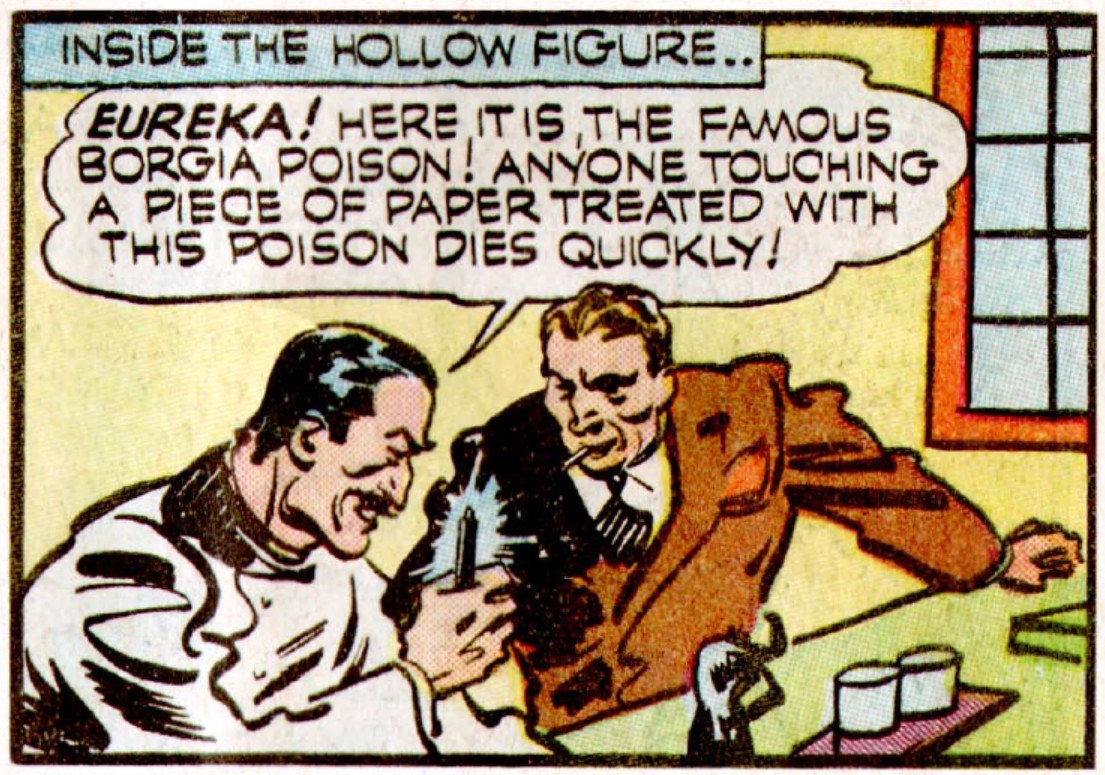
    Cesare, Lucrezia and the rest of the Borgia family might not actually appear in comics all that often, but they certainly do figure into their plots via the absolute piles of poisoned and poison-adjacent artifacts that are attributed to them. Borgia trinkets crop up so frequently, in fact, that I am surprised that it’s taken us this long to encounter one, in the form of a hollow silver statuette that contains a deadly contact poison. (Fantastic Comics 018, 1941)

    Fort Knox:

    Stardust the Super Wizard’s final foe, the unfortunately-named “Slant-Eye,” was a classic comic book Fort Knox robber. (Fantastic Comics 016, 1941)

    Francis Biddle:

    Major Victory has to consult with the US Attorney General in 1941, and in 1941 the US Attorney General was Francis Biddle. The man in the panel above is not Francis Biddle. (Dynamic Comics 002, 1941)

    Franklin D Roosevelt:

    Seen ordering the creation of a super-soldier, i.e. Captain America, to combat domestic espionage. (Captain America Comics 001, 1941)

    Fritz Kuhn:

    Fritz Knoll, purveyor of domestic espionage, is probably a reference to the chief Bundist. (Fantastic Comics 021, 1941)

    Henry L Stimson:

    The US didn’t even have a Secretary of Defense until after WWII, so I am not sure who this guy hanging out with Samson is supposed to be. The analogous position at the time this comic came out was Secretary of War, and that was Henry L Stimson, and this is not him. A true mystery man in all senses. (Fantastic Comics 023, 1941)

    J Edgar Hoover:

    J Arthur Grover, head of the FBI and clear J Edgar Hover stand-in, is also the man in charge of the program that would eventually be known as Project: Rebirth, aka the super-soldier program that produces Captain America later in this same issue. (Captain America Comics 001, 1941)

    Tutankhamen:

    Some of King Tut’s grave goods are among the items stolen by the Butterfly. (Captain America Comics 003 1941)

  • REAL PERSON ROUND-UP 025

    REAL PERSON ROUND-UP 025

    If comics are reflections of the real world then why should we be surprised to find them so full of real people?

    Adolf Hitler:

    Hiller is the “mad dictator” who inspires Hercules to reincarnate and eventually become Marvel Boy. He’s about as close as you get to putting a Hitler in your comic as you can get without actually saying the name. The whole name. The “t” part. (Daring Mystery Comics 006, 1940)

    This otherwise-unnamed Fuehrer of a likewise nameless underground nation that vexes the America inhabited by Captain Daring in 3051 CE is a clear inspired-by-Hitler type. (Daring Mystery Comics 007, 1941)

    Citizen V takes a break from his propaganda campaign in Occupied Europe to sneak into Germany and become a member of the Punched Hitler in the Nose Club. (Daring Mystery Comics 008, 1942)

    This version of Hitler appears in a long dream sequence in the comedic Army Life strip “Private Rook” that appears to exist solely to make a joke about him being gay (the bit where he is the Princess Tanya’s Fairy Godmother, specifically). This isn’t great, but it is remarkable for being the only time I personally have seen such a thing in a Golden Age comic. (Army and Navy Comics 003, 1941)

    Though Cap punches Hitler on the cover of his very first issue, it is in fact Bucky who lands the first blow on him (and Goering) in the pages of a comic. (Captain America Comics 002, 1941)

    the Borgias:

    Cesare, Lucrezia and the rest of the Borgia family might not actually appear in comics all that often, but they certainly do figure into their plots via the absolute piles of poisoned and poison-adjacent artifacts that are attributed to them. Borgia trinkets crop up so frequently, in fact, that I am surprised that it’s taken us this long to encounter one, in the form of a hollow silver statuette that contains a deadly contact poison. (Fantastic Comics 018, 1941)

    Fort Knox:

    Stardust the Super Wizard’s final foe, the unfortunately-named “Slant-Eye,” was a classic comic book Fort Knox robber. (Fantastic Comics 016, 1941)

    Francis Biddle:

    Major Victory has to consult with the US Attorney General in 1941, and in 1941 the US Attorney General was Francis Biddle. The man in the panel above is not Francis Biddle. (Dynamic Comics 002, 1941)

    Franklin D Roosevelt:

    Seen ordering the creation of a super-soldier, i.e. Captain America, to combat domestic espionage. (Captain America Comics 001, 1941)

    Fritz Kuhn:

    Fritz Knoll, purveyor of domestic espionage, is probably a reference to the chief Bundist. (Fantastic Comics 021, 1941)

    Henry L Stimson:

    The US didn’t even have a Secretary of Defense until after WWII, so I am not sure who this guy hanging out with Samson is supposed to be. The analogous position at the time this comic came out was Secretary of War, and that was Henry L Stimson, and this is not him. A true mystery man in all senses. (Fantastic Comics 023, 1941)

    J Edgar Hoover:

    J Arthur Grover, head of the FBI and clear J Edgar Hover stand-in, is also the man in charge of the program that would eventually be known as Project: Rebirth, aka the super-soldier program that produces Captain America later in this same issue. (Captain America Comics 001, 1941)

    Tutankhamen:

    Some of King Tut’s grave goods are among the items stolen by the Butterfly. (Captain America Comics 003 1941)

  • MEDIA IN COMICS 006

    Now that’s entertainment. 

    Magazines: 

    Are magazine titles in comics more likely to be plays on real ones than other forms of media? Perhaps. We’ll just have to see how many variations on Life and Time we can find over the years. Pretending to work for Living has enough caché that it gets these fascists into a secure aircraft plant – how long has it been since magazines were so relevant? (Big Shot Comics 014, 1941)

    Movies:

    I never actually mentioned it in the entry on the Hunchback of Hollywood, but the anti-Nazi movie that incites the story’s action is called The Tyrant. Featuring Steve Rogers, Bucky Barnes and Sergeant Duffy in minor roles! (Captain America Comics 003, 1941)

    Rang-a-Tang the Wonder Dog’s boy companion Richy (the Amazing Boy) never seemed to be that impressive to me, but Hollywood disagreed and he was made both the star and subject of a film called Riverfront Richy with lots of animal stunts. (Blue Ribbon Comics 011, 1941)

    There’s never any real indication of what Scoopin’ Jive is about – music seems likely – but it’s such a baffling name for a movie that I must celebrate it (Crackajack Funnies 036, 1941)

    Similarly, we never really learn what Wings Aflutter is about, other than being a “new Navy Air smash hit” with a terrible name. (Jumbo Comics 034, 1941)

    Theatre:

    Minor super-villain the Black Death of course takes his costume and MO from a character in a stage production called The Black Death. There’s not quite enough of the play’s plot in the story to know if the fictional Black Death is supposed to be a metaphor or something or some sort of slasher movie killer as it appears. I sincerely hope it’s the latter. (Thrilling Comics 010, 1940)

    One of Professor X’s attempts to get Sub-Zero involves attacking him in the audience of a big stage musical that his girlfriend Mary is appearing in as part of the “Living Chandelier”. “George Whyte’s Sandels” is a very specific-seeming reference, but I am unable to easily connect it to a show of the era. (Blue Bolt v1 006, 1940)

    Fuller Spunk, former star of stage and now Holmes-inspired detective, starred in the evocatively-named shows Hector’s Last Gulp and The Gripes of Raft. (Hyper-Mystery Comics 001, 1940)

    Waltz of the Vampires is a ballet performance that is narratively used to set off vampire Carlos Hubbelo’s bloodlust, but more importantly, it kind of rules? Comic book media is so often a version of something from the real world that it’s always very fun to see something like this that (as far as I can tell) is just a sincere depiction of a vampire ballet. (Blue Ribbon Comics 011, 1941)

  • SUPER-HERO FILE 004: BUCKY

    (Captain America Comics 001, 1940)

    I probably wouldn’t have thought of this before writing so many entries about Golden Age super-heroes and their hastily shoehorned-in boy companions, but Bucky really is a top-tier sidekick, conceptually. Probably not the top, since Robin really set the gold standard, but close! Consider:

    In terms of the How Does He Acquire the Boy aspect of things, it couldn’t be simpler. There’s no need for some contrived (or ridiculously omitted) adoption process because Bucky is the Camp Lehigh mascot, meaning that he and Steve Rogers are essentially work friends. And since they also basically live together (in the same field of tents as one another, at least) the process of Bucky learning that Steve is Captain America and subsequently becoming his partner is as simple as him not being very careful about barging into other people’s homes without knocking. 

    Not only does Bucky get his own costume (not always guaranteed), but it’s an unusually good one: thematically similar to his partner’s but not derivative of it, and a smart enough look that it’s appeared on various Bucky-inspired characters to this day.

    I thought that Bucky might have been at the forefront of the “sidekicks
    without their own code name” movement but looking at the dates he is
    just a part of a larger trend. Similarly, he is just one of a wave of normal
    teenaged boys who adventure alongside a super-powered adult men. Neither of these are great features for a boy sidekick to have, but the fact that he is a victim of both trends rather than their originator goes a long way.

    (case in point: crypto-fascist crook the Wax Man figures out that the two Buckys he has encountered are the same – it’s a miracle that this doesn’t happen more often) (Captain America Comics 002, 1941)

  • SUPER HERO FILE 003: CAPTAIN AMERICA

    (Captain America Comics 001, 1940)

    Captain America! Hitler-Puncher Number One! Quite possibly in the top five of super-heroics’ most well-known origins – a young man, physically unfit for the military but wishing to serve his country, is transformed into a super soldier with a combination of chemicals and radiation. The scientist responsible for this is murdered by an enemy spy rendering the young man a unique hero rather than the first of many. His first act as a hero is to bring the assassin to justice. A classic origin story, and one so well-trodden that my dad probably knows it. The really interesting thing about this origin is all the elements of it that were not there at first but rather accreted over time.

    Perhaps the biggest difference between the initial presentation of Captain America’s origin and the ones that would come later is the fact that Steve Rogers is simply not a character in the original. Okay, perhaps that is too far, but there is absolutely none of the stuff with Steve heading in to volunteer and getting turned away, and certainly none of the later addition of him as the downtrodden but good-hearted patriot. He’s merely an emaciated canvas for the doctors to work on – he doesn’t even get a word out until after Erskine is shot.

    Not quite as thematically potent, perhaps, but the absence of the Vita-Ray treatment after Steve gets his Super Soldier Formula is very notable when you’re expecting it. Turns out that that isn’t added until the 60s! 

    The assassination of Dr Erskine and its aftermath play out essentially the same as they always will, though the assassin is eventually specifically said to be electrocuted after crashing into the Vita-Ray machine, which obviously can’t be the case here. Please also note Dr Erskine being called Professor Reinstein here, something that has been given a few different explanations over the years.

    Steve Rogers is installed in the US Army as the lowest-ranked Private in history, which might be limiting to an on-the-go young super-hero except for the fact of the vexing conundrum of Camp Lehigh’s location, which places him in close proximity to both East and West Coast locations depending on the needs of the story. Rogers’ immediate superior, the belligerent Sergeant Duffy, has sadly all but disappeared from modern retellings.