The Curse of Skeleton Munroe

Category: patriotic hero

  • MINOR SUPER-HERO ROUND-UP 103

    Soon there will be more minor super-heroes than there are humans for them to protect.

    the Sentinel:

    In 1783, on the Boston Common, the newly-minted Spirit of America charges a cannon with the “powders of patriotism” in anticipation that someday a champion will be needed to defend the new nation from destruction. Finally, in 1941 (the Civil War not, apparently, being enough of a reason), the cannon fires on its own and releases the Sentinel, mystic champion of the American people.

    As one might expect, the Sentinel is broadly superhuman: he can fly, is super strong and is immune to most harm. He also has a halo of fire that he can disappear into and shrink to a tiny flame, effectively rendering him invisible and allowing him to vex friend and foe alike with his comings and goings. Oddly, he has no other control over fire. (Liberty Scouts Comics 003, 1941)

    Doctor Nemesis:

    Doctor Nemesis is really Dr Jim Bradley, intern at Mercy Hospital in an unnamed city (that is probably meant to be NYC but later retconned as San Francisco) who has developed a foolproof truth serum and decided to keep it to himself rather than risk criminals getting their hands on it – presumably the concern is that they would use it to learn bank vault combinations and other secret information. Since he himself continually runs into situations in which a foolproof truth serum is a handy way to solve a crime, Bradley adopts a costumed identity and sets out to achieve a better tomorrow via a series of injections. 


    Doctor Nemesis might just be the most calling card-using super-person who we have yet encountered. He hands out at least four of them in his first adventure alone.

    Doctor Nemesis has a pretty simple crimefighting routine: identify a potential injustice and then drug everyone involved until he has a clear idea of who is responsible, then beat them up and have them give a drugged confession in front of a police witness. The police in turn are perfectly happy to receive these confessions that they technically haven’t coerced from people, though there has to be a clever defense attorney somewhere in Unnamed City who is just waiting to get a Doctor Nemesis client so that they can really dig into the admissibility of admissions given under the influence of mysterious vigilante juice.

    It’s been a while since we have encountered a character who was later revived and incorporated into the Battle-Axis, Marvel’s team of disaffected public domain Golden Age super-heroes who went over to the Nazis, but Doctor Nemesis here is one of them under the technically-but-not-really more badass name of Dr Death. As always, it’s hard to say just who got done dirtiest by Roy Thomas when he was assembling the Battle-Axis roster but Doctor Nemesis is certainly a candidate, if only because he doesn’t even have the Human’s Meteor’s flimsy “I’m Irish American and fuck the British” or the Spider Widow’s “the Commies killed my husband” excuses. Instead, he simply implies that the Nazis are paying him well.

    Subsequent writers (specifically Matt Fraction, if I have things right) clearly thought that Doctor Nemesis was worth revisiting. He was given a long career as a Nazi hunter to counteract his short career as a Nazi and briefly became a core X-Man, though nowadays every time I look up what he’s up to it seems that he has become weirder and more peripheral to the action than the last. (Lightning Comics v1 006, 1941)

    Lash Lightning **UPDATE**:

    I haven’t been very careful to delineate whether the character has been going by “Flash” or “Lash” Lightning due to the fact that it profoundly does not matter (they just call him “Lightning” in the stories themselves, for instance) but I might as well make note of this, the issue in which the actual change was made. (Lightning Comics v2 002, 1941)

    Marvo the Magician **UPDATE**:

    Up until the exact point pictured above, Marvo the Magician was unique among magical comic book super-heroes, for though many of them (including Zatara, the big cheese himself) are said to be using their magic to create illusions and fool the minds of others, it is all demonstrably lies (or more charitably a different definition of “illusion” than I am using), as they all produce material effects in the world. Only pure, beautiful Marvo can claim that he uses illusions and nothing more to frighten and confound his foes, and I have been checking.

    That is, up to this issue, when Marvo creates the “illusion” of an ocean liner (complete with a crooked sailor who kidnaps her and hands her over to pirates!) that the woman he is helping proceeds to board and sail away on. Unless the implication is that she has been so convinced that the liner exists that she has swum or perhaps hovered her way to her destination (well, part way to her destination), the inescapable fact is that this ship is more than a mere illusion. Nothing is certain in this wicked world, folks. (Lightning Comics v2 003, 1941)

  • MINOR SUPER-HERO ROUND-UP 102

    You won’t believe what I just found: more super-heroes!

    the Liberty Scouts:

    When fascist forces armed with high-tech weaponry begin attacking targets calculated to cripple US war capacity, they are repeatedly driven away by a trio of anonymous heroes who leave behind Liberty Bell calling cards. Both the fascists and US officials are eager to learn just who these so-called Liberty Patriots are, but President Roosevelt is the one who actually gets to find out, thanks to his association with patriotic millionaire Patrick Henry.

    Henry drives FDR out to his country estate, Liberty House, where he introduces him to three mysterious youths beginning with Smokey, the inventive genius of the group, and whose amphibious tank is counted as a land vehicle for the air/sea/land theme that the three have going on.

    Skipper, “the best sailor on the Seven Seas,” is also clearly the group member who is most invested in the paramilitary aspect of the whole operation. He has a super-powerful miniature submarine.

    Finally, we have Strut, the youngest of the group. He’s got a souped up fighter plane called the Comet (initially the only named super vehicle in the bunch, though the tank is later named Ironsides), plus a cool-ass wingsuit. He’s also the only one of the three with any discernible personality, even if it’s “won’t shut up about cherry pie.”

    So just how does Mr Henry know these three youngsters and why are they living in his house? Because they are his own sons! He loves his country so much that he has moulded his children into weapons designed to defend it, and the President loves it. (Liberty Scouts Comics 002, 1941)

    The Liberty Scouts eventually change their name to the Liberty Guards after the Boy Scouts of America complain about their monopoly on the word “scout” being infringed.

    Categorized in: Accessories (Calling Card Leavers), Groups, Origin (Patriotic Heroes)

    Man of War:

    Impatient with the slow progress of World War II, the god Mars decides to create a divine being imbued with the powers of the Greco-Roman pantheon and send them down to help the Axis conquer Europe faster and with more bloodshed. He gifts his champion with “the Strength of Hercules, the Speed of Mercury, the Wisdom of Zeus” (making him about 0.5 of a Captain Marvel) and arms him with the infinitely sharp Sword of Mars before sending him on his way.

    In a legitimately funny twist, Mars forgets to account for the rotation of the Earth during the presumably-lengthy demigod-crafting process and shoots his new creation at Dayton, Ohio (okay, at one of the more than thirty Daytons in the United States. Or in another city that has an unrelated Dayton Munitions Factory. Probably Dayton, Ohio, though) instead of Berlin or wherever he intended for it to go. Thus, Man of War (as he calls himself) is instantiated in the “peace-loving nation” of the USA and is dedicated to virtuous, defensive warfare instead of awful slaughter in the name of power-hungry politicians (insert joke about the US war machine here. Man of War must have had a rough go of things as the 20th Century progressed).

    So what are the powers of the gods? Mostly generic super strength and invulnerability, though Man of War is able to breathe and move freely underwater thanks to the gifts of Neptune. He also has one bespoke power gifted upon him by Mars: to disappear or appear in any explosion, up to and including those created when bullets are fired (which would be a bit more useful if he weren’t already bulletproof). (Liberty Scouts Comics 002, 1941)

    In Man of War Comics 001, Mars reveals Man of War’s weakness to the dictator Luko: that he is powered by rays emitted by the planets of the Solar System, and that confining him in a lead-lined chamber will block those rays and render him merely human. This nearly works, but as the Sword of Mars is not planet-powered he is soon able to carve his way free.

    Categorized in: Accessories (Swords), Activities (War), Origins (Demigods)

    Vapo-Man:

    Bradford “Brad” Cole is a chemist assisting at the laboratory of Dr Kreiner, who in turn is performing unspecified research that is evidently valuable enough to the US government that some fascist saboteurs blow it up. Cole, unlike Kreiner, is lucky enough not to be exploded but instead is showered with a randomized mix of chemicals that change him into a man of vapour.

    The dying Kreiner explains that he is now a chemical man, which is apparently something that chemists have been trying to create for centuries. He extracts a promise from Cole that he will use this power to fight evil, and saddles him with the terrible name of Vapo-Man just before dying, thus ensuring that Crawford can never change it without feeling very guilty.

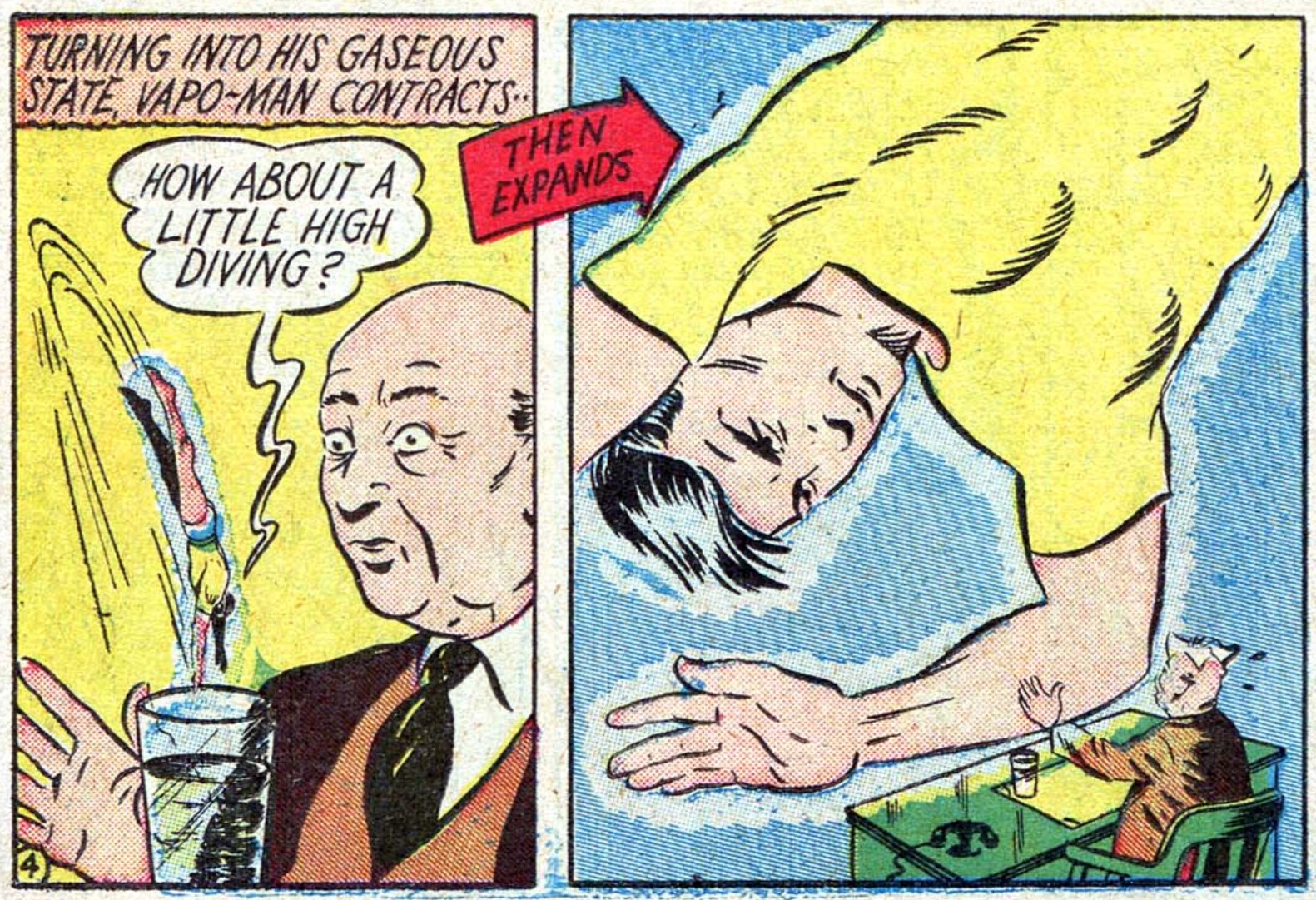
    As Vapo-Man, Crawford can change all or part of his size, can fly, has at least some super strength, can disintegrate matter with a touch, and can become intangible at will. All of this adds up to make him feel a lot like a more mystical character like Phantasmo, though he lacks the charm to support it. (Liberty Scouts Comics 002, 1941)

    Categorized in: Elements (Steam and Mist), Origins (Chemical Mutates), Powers (Intangibility)

    Fire-Man:

    Jim, a man working for the Civilian Conservation Corps in Utah sets out to battle the latest in a series of mysterious fires and finds himself being kidnapped by a mysterious silver-clad giant.

    This turns out to be Gaston, henchman to a fellow known only as the Mad Scientist. The Mad Scientist has a dream: to incinerate a human in such a way that they remain alive and coherent but composed of gaseous rather than solid matter, and Jim is his latest unwilling experimental subject. Luckily for Jim, this time it works, and the only real change appears to be a significantly lower density, such that he is obliged to wear a weighted uniform (that doubles nicely for a super suit, natch) in order to keep from floating away. Even with it on, he light enough to leap around as if he were flying.

    Jim is otherwise an ordinary human, but a miscalculation on the part of the Mad Scientist (dunking him in a vat of chemicals while trying to destroy him) also endows him with super strength.

    Finally, Jim’s new metabolism causes him to give off fire-retardant gasses as a part of his respiration, which is handy, as he chooses to go by Fire-Man, meaning that he, alongside the Mad Scientist’s niece Nancy, ends up fighting a lot of arsonists (Liberty Scouts Comics 002, 1941)

    Categorized in: Elements (Fire), Origins (Electrical Mutates), Powers (Decreased Density)

  • MINOR SUPER-HERO ROUND-UP 102

    MINOR SUPER-HERO ROUND-UP 102

    You won’t believe what I just found: more super-heroes!

    the Liberty Scouts:

    When fascist forces armed with high-tech weaponry begin attacking targets calculated to cripple US war capacity, they are repeatedly driven away by a trio of anonymous heroes who leave behind Liberty Bell calling cards. Both the fascists and US officials are eager to learn just who these so-called Liberty Patriots are, but President Roosevelt is the one who actually gets to find out, thanks to his association with patriotic millionaire Patrick Henry.

    Henry drives FDR out to his country estate, Liberty House, where he introduces him to three mysterious youths beginning with Smokey, the inventive genius of the group, and whose amphibious tank is counted as a land vehicle for the air/sea/land theme that the three have going on.

    Skipper, “the best sailor on the Seven Seas,” is also clearly the group member who is most invested in the paramilitary aspect of the whole operation. He has a super-powerful miniature submarine.

    Finally, we have Strut, the youngest of the group. He’s got a souped up fighter plane called the Comet (initially the only named super vehicle in the bunch, though the tank is later named Ironsides), plus a cool-ass wingsuit. He’s also the only one of the three with any discernible personality, even if it’s “won’t shut up about cherry pie.”

    So just how does Mr Henry know these three youngsters and why are they living in his house? Because they are his own sons! He loves his country so much that he has moulded his children into weapons designed to defend it, and the President loves it. (Liberty Scouts Comics 002, 1941)

    The Liberty Scouts eventually change their name to the Liberty Guards after the Boy Scouts of America complain about their monopoly on the word “scout” being infringed.

    Categorized in: Accessories (Calling Card Leavers), Groups, Origin (Patriotic Heroes)

    Man of War:

    Impatient with the slow progress of World War II, the god Mars decides to create a divine being imbued with the powers of the Greco-Roman pantheon and send them down to help the Axis conquer Europe faster and with more bloodshed. He gifts his champion with “the Strength of Hercules, the Speed of Mercury, the Wisdom of Zeus” (making him about 0.5 of a Captain Marvel) and arms him with the infinitely sharp Sword of Mars before sending him on his way.

    In a legitimately funny twist, Mars forgets to account for the rotation of the Earth during the presumably-lengthy demigod-crafting process and shoots his new creation at Dayton, Ohio (okay, at one of the more than thirty Daytons in the United States. Or in another city that has an unrelated Dayton Munitions Factory. Probably Dayton, Ohio, though) instead of Berlin or wherever he intended for it to go. Thus, Man of War (as he calls himself) is instantiated in the “peace-loving nation” of the USA and is dedicated to virtuous, defensive warfare instead of awful slaughter in the name of power-hungry politicians (insert joke about the US war machine here. Man of War must have had a rough go of things as the 20th Century progressed).

    So what are the powers of the gods? Mostly generic super strength and invulnerability, though Man of War is able to breathe and move freely underwater thanks to the gifts of Neptune. He also has one bespoke power gifted upon him by Mars: to disappear or appear in any explosion, up to and including those created when bullets are fired (which would be a bit more useful if he weren’t already bulletproof). (Liberty Scouts Comics 002, 1941)

    In Man of War Comics 001, Mars reveals Man of War’s weakness to the dictator Luko: that he is powered by rays emitted by the planets of the Solar System, and that confining him in a lead-lined chamber will block those rays and render him merely human. This nearly works, but as the Sword of Mars is not planet-powered he is soon able to carve his way free.

    Categorized in: Accessories (Swords), Activities (War), Origins (Demigods)

    Vapo-Man:

    Bradford “Brad” Cole is a chemist assisting at the laboratory of Dr Kreiner, who in turn is performing unspecified research that is evidently valuable enough to the US government that some fascist saboteurs blow it up. Cole, unlike Kreiner, is lucky enough not to be exploded but instead is showered with a randomized mix of chemicals that change him into a man of vapour.

    The dying Kreiner explains that he is now a chemical man, which is apparently something that chemists have been trying to create for centuries. He extracts a promise from Cole that he will use this power to fight evil, and saddles him with the terrible name of Vapo-Man just before dying, thus ensuring that Crawford can never change it without feeling very guilty.

    As Vapo-Man, Crawford can change all or part of his size, can fly, has at least some super strength, can disintegrate matter with a touch, and can become intangible at will. All of this adds up to make him feel a lot like a more mystical character like Phantasmo, though he lacks the charm to support it. (Liberty Scouts Comics 002, 1941)

    Categorized in: Elements (Steam and Mist), Origins (Chemical Mutates), Powers (Intangibility)

    Fire-Man:

    Jim, a man working for the Civilian Conservation Corps in Utah sets out to battle the latest in a series of mysterious fires and finds himself being kidnapped by a mysterious silver-clad giant.

    This turns out to be Gaston, henchman to a fellow known only as the Mad Scientist. The Mad Scientist has a dream: to incinerate a human in such a way that they remain alive and coherent but composed of gaseous rather than solid matter, and Jim is his latest unwilling experimental subject. Luckily for Jim, this time it works, and the only real change appears to be a significantly lower density, such that he is obliged to wear a weighted uniform (that doubles nicely for a super suit, natch) in order to keep from floating away. Even with it on, he light enough to leap around as if he were flying.

    Jim is otherwise an ordinary human, but a miscalculation on the part of the Mad Scientist (dunking him in a vat of chemicals while trying to destroy him) also endows him with super strength.

    Finally, Jim’s new metabolism causes him to give off fire-retardant gasses as a part of his respiration, which is handy, as he chooses to go by Fire-Man, meaning that he, alongside the Mad Scientist’s niece Nancy, ends up fighting a lot of arsonists (Liberty Scouts Comics 002, 1941)

    Categorized in: Elements (Fire), Origins (Electrical Mutates), Powers (Decreased Density)

  • MINOR SUPER-HERO ROUND-UP 097

    It’s astonishing. They just keep on coming up with more super-heroes.

    the Flame **UPDATE**:

    Like many other long-running Fox Features characters, the Flame gets a bit of an overhaul late in 1941. In the Flame’s case, this includes an expansion to his powers: long able to get around by running on the stream of fire produced by his flame gun, the Flame is now simply able to fly. He can also now pick up and move fire around, as seen in this very innovative bit of fire-fighting in The Flame 006.

    The Flame also gets a proper secret identity (Gary Preston) and a job (private investigator) as a part of this revamp. And he gets a supporting cast, in the form of secretary Linda Dale and punch drunk ex-boxer/assistant/comic relief character Pug! (The Flame 007, 1941)

    Finally, though the Flame was explicitly a NYC-based super-hero in his earliest experiences, his 1940-41 adventures frequently have the liminal feel of the many stories set in generic unnamed US cities. In one of his very final appearances, he gets a proper fictional burg to call his own: Big City. (Big 3 006, 1941)

    the Yank and the Rebel:

    I think I’ve occasionally mentioned the inherent ridiculousness of the concepts behind many if not all patriotic super-heroes – it’s something that really jumps out at you as you read through as many Golden Age comics as I have. Please believe me, then, when I say that the Yank and the Rebel are the most conceptually ludicrous patriotic heroes of the lot, and I will be thoroughly (and probably not pleasantly) surprised if I’m ever proven wrong.

    As might be surmised from their names, the Yank and the Rebel are two otherwise unidentified soldiers who are on opposite sides during the American Civil War. While locked in hand-to-hand-to-gun combat, the two fall into a fissure opened by the artillery bombardments at the Battle of Gettysburg, landing next to a convenient radioactive pool that holds them in a state of suspended animation for the next seventy-eight years.

    The duo are eventually awakened when Army manoeuvres re-open the cavern, and they resume their battle until a helpful general explains that the American Civil War ended in some sort of peaceful draw, that nobody really “lost” or “won” the war and that the North and the South are all totally cool with one another now. So why did he put so much spin on history? Probably for the same notion of national unity in the face of war that inspired the people at Fox Features to do so.

    Regardless of the reasoning behind them, the officer’s words inspire a new spirit of patriotism and cooperation in the Yank and the Rebel, and the two team up to hunt spies and saboteurs for two whole adventures before evaporating in the Fox Features financial crisis of 1942. In what is certain to be a massive surprise to nobody, no modern publisher has taken advantage of the fact that these fellows are in the public domain. (The Flame 007, 1941)

    Categorized in: Locations (Specific Places), Origin (Patriotic Heroes), Team Membership (Confederate Army, Union Army) 

    Vulcan **UPDATE**:

    Taking a cue from the Flame, fellow fire-themed hero Vulcan gets a slight expansion to his powers in 1941: he can now create and use flame constructs such as this cool sword. (Four Favorites 001, 1941) 

    It’s not all good news for our favourite demigod, howver, as 1941 is also the year that Vulcan is given a weakness to cold. (Four Favorites 002, 1941)

    Lash Lightning **UPDATE**:

    Lash Lightning gives blood to injured army private Tom Jasper, who immediately develops mild superhumanism in the form of increased muscle mass and vigour. This is especially notable because it really is the ultimate expression of the writers on this feature forgetting that Lash’s powers are derived from a magical amulet and not from his own body. Sad times. (Four Favorites 002, 1941)

  • MINOR SUPER-HERO ROUND-UP 097

    It’s astonishing. They just keep on coming up with more super-heroes.

    the Flame **UPDATE**:

    Like many other long-running Fox Features characters, the Flame gets a bit of an overhaul late in 1941. In the Flame’s case, this includes an expansion to his powers: long able to get around by running on the stream of fire produced by his flame gun, the Flame is now simply able to fly. He can also now pick up and move fire around, as seen in this very innovative bit of fire-fighting in The Flame 006.

    The Flame also gets a proper secret identity (Gary Preston) and a job (private investigator) as a part of this revamp. And he gets a supporting cast, in the form of secretary Linda Dale and punch drunk ex-boxer/assistant/comic relief character Pug! (The Flame 007, 1941)

    Finally, though the Flame was explicitly a NYC-based super-hero in his earliest experiences, his 1940-41 adventures frequently have the liminal feel of the many stories set in generic unnamed US cities. In one of his very final appearances, he gets a proper fictional burg to call his own: Big City. (Big 3 006, 1941)

    the Yank and the Rebel:

    I think I’ve occasionally mentioned the inherent ridiculousness of the concepts behind many if not all patriotic super-heroes – it’s something that really jumps out at you as you read through as many Golden Age comics as I have. Please believe me, then, when I say that the Yank and the Rebel are the most conceptually ludicrous patriotic heroes of the lot, and I will be thoroughly (and probably not pleasantly) surprised if I’m ever proven wrong.

    As might be surmised from their names, the Yank and the Rebel are two otherwise unidentified soldiers who are on opposite sides during the American Civil War. While locked in hand-to-hand-to-gun combat, the two fall into a fissure opened by the artillery bombardments at the Battle of Gettysburg, landing next to a convenient radioactive pool that holds them in a state of suspended animation for the next seventy-eight years.

    The duo are eventually awakened when Army manoeuvres re-open the cavern, and they resume their battle until a helpful general explains that the American Civil War ended in some sort of peaceful draw, that nobody really “lost” or “won” the war and that the North and the South are all totally cool with one another now. So why did he put so much spin on history? Probably for the same notion of national unity in the face of war that inspired the people at Fox Features to do so.

    Regardless of the reasoning behind them, the officer’s words inspire a new spirit of patriotism and cooperation in the Yank and the Rebel, and the two team up to hunt spies and saboteurs for two whole adventures before evaporating in the Fox Features financial crisis of 1942. In what is certain to be a massive surprise to nobody, no modern publisher has taken advantage of the fact that these fellows are in the public domain. (The Flame 007, 1941)

    Categorized in: Locations (Specific Places), Origin (Patriotic Heroes), Team Membership (Confederate Army, Union Army) 

    Vulcan **UPDATE**:

    Taking a cue from the Flame, fellow fire-themed hero Vulcan gets a slight expansion to his powers in 1941: he can now create and use flame constructs such as this cool sword. (Four Favorites 001, 1941) 

    It’s not all good news for our favourite demigod, howver, as 1941 is also the year that Vulcan is given a weakness to cold. (Four Favorites 002, 1941)

    Lash Lightning **UPDATE**:

    Lash Lightning gives blood to injured army private Tom Jasper, who immediately develops mild superhumanism in the form of increased muscle mass and vigour. This is especially notable because it really is the ultimate expression of the writers on this feature forgetting that Lash’s powers are derived from a magical amulet and not from his own body. Sad times. (Four Favorites 002, 1941)

  • MINOR SUPER-HERO ROUND-UP 096

    Even the most minor of super-heroes gets the chance to shine brightly in the Round-Up.

    Super-American:

    I can’t decide if I’m surprised or not that the development of the archetype of the patriotic hero was so rapid as to produce a character called “Super-American” less than a year after the debut of Captain America. He’s simultaneously straight out to the sketchbook of a 60s underground comix guy (or indeed a more modern edgy comics guy) and a perfectly ordinary 1940s comic book character. Regardless: Super-American!

    Super-American is an unnamed resident of the year 2350, who journeys back in time after Dr Allen Bruce uses his Chronopticon device to ask the President of 24th Century America for a little help with all the fascist spies and so forth who are causing trouble in 1940s America. 

    This is way too early for a pop time travel story to get too worried about issues of causality and so forth, so I guess we must assume that Super-American uses the kind of time travel where your time travel escapades already happened so you can’t actually change your own present. Or maybe the kind where the time you leave from is inevitable, so your actions in the past merely cause it to happen in a different way. Or even the kind where messing around in the past causes a divergent timeline, but the new futures he creates are similar enough to still produce a Super-American.

    Thanks to good old-fashioned futuristic technology, Super-American is endowed with powers such as super strength and speed, invulnerability and flight. Plus, he’s super-duper patriotic! Like, annoyingly so! As one might expect of someone who willingly wears that helmet. (Fight Comics 015, 1941)

    Categorized in: Language (Superlatives (Super)), Locations (Specific Locales), Origins (Displaced in Time)

    Captain Fight:

    Patriotic hero Captain Fight is actually Jeff Crockett, gym teacher at Freeville High in Freeville, Maryland. Despite being held in contempt by his male students for turning down a career in prizefighting due to a conviction that violence should not be used frivolously, Crockett does not hesitate to don a sporty outfit and deal out fistic justice to the enemies of America when they show their faces in his specific small town. (Fight Comics 016, 1941)

    Categorized in: Activities (Fighting), Day Jobs (High School Teachers), Generica (Captains)

    Yank Adams: 

    Unusually for a boy sidekick, Yank Wilson is not an easily-adoptable orphan, instead, he is one of Jeff “Captain Fight” Crockett’s students and also the son of local inventor and espionage target Professor Adams. Yank recognizes Crockett through his weird mask pretty much instantly and a crime-fighting team is formed. (Fight Comics 016, 1941)

    Categorized in: Day Job (High School Student), Origins (Sidekicks)

    Zanzibar the Magician:

    Zanzibar is a standard unit of magical super-hero who adventured in a variety of Fox Features books from 1939 to early 1942. Though his adventures are decently entertaining fare I’m afraid that the most interesting fact I can give you about Zanzibar himself is that at one point he switches from a red fez to a blue one. (Mystery Men Comics 001, 1939)

    Categorized in: Locations (Place Names as Proper Names), Magic Users (Magicians), Powers (Various Magic)

  • MINOR SUPER-HERO ROUND-UP 096

    Even the most minor of super-heroes gets the chance to shine brightly in the Round-Up.

    Super-American:

    I can’t decide if I’m surprised or not that the development of the archetype of the patriotic hero was so rapid as to produce a character called “Super-American” less than a year after the debut of Captain America. He’s simultaneously straight out to the sketchbook of a 60s underground comix guy (or indeed a more modern edgy comics guy) and a perfectly ordinary 1940s comic book character. Regardless: Super-American!

    Super-American is an unnamed resident of the year 2350, who journeys back in time after Dr Allen Bruce uses his Chronopticon device to ask the President of 24th Century America for a little help with all the fascist spies and so forth who are causing trouble in 1940s America. 

    This is way too early for a pop time travel story to get too worried about issues of causality and so forth, so I guess we must assume that Super-American uses the kind of time travel where your time travel escapades already happened so you can’t actually change your own present. Or maybe the kind where the time you leave from is inevitable, so your actions in the past merely cause it to happen in a different way. Or even the kind where messing around in the past causes a divergent timeline, but the new futures he creates are similar enough to still produce a Super-American.

    Thanks to good old-fashioned futuristic technology, Super-American is endowed with powers such as super strength and speed, invulnerability and flight. Plus, he’s super-duper patriotic! Like, annoyingly so! As one might expect of someone who willingly wears that helmet. (Fight Comics 015, 1941)

    Categorized in: Language (Superlatives (Super)), Locations (Specific Locales), Origins (Displaced in Time)

    Captain Fight:

    Patriotic hero Captain Fight is actually Jeff Crockett, gym teacher at Freeville High in Freeville, Maryland. Despite being held in contempt by his male students for turning down a career in prizefighting due to a conviction that violence should not be used frivolously, Crockett does not hesitate to don a sporty outfit and deal out fistic justice to the enemies of America when they show their faces in his specific small town. (Fight Comics 016, 1941)

    Categorized in: Activities (Fighting), Day Jobs (High School Teachers), Generica (Captains)

    Yank Adams: 

    Unusually for a boy sidekick, Yank Wilson is not an easily-adoptable orphan, instead, he is one of Jeff “Captain Fight” Crockett’s students and also the son of local inventor and espionage target Professor Adams. Yank recognizes Crockett through his weird mask pretty much instantly and a crime-fighting team is formed. (Fight Comics 016, 1941)

    Categorized in: Day Job (High School Student), Origins (Sidekicks)

    Zanzibar the Magician:

    Zanzibar is a standard unit of magical super-hero who adventured in a variety of Fox Features books from 1939 to early 1942. Though his adventures are decently entertaining fare I’m afraid that the most interesting fact I can give you about Zanzibar himself is that at one point he switches from a red fez to a blue one. (Mystery Men Comics 001, 1939)

    Categorized in: Locations (Place Names as Proper Names), Magic Users (Magicians), Powers (Various Magic)

  • SUPER-HERO FILE 004: BUCKY

    (Captain America Comics 001, 1940)

    I probably wouldn’t have thought of this before writing so many entries about Golden Age super-heroes and their hastily shoehorned-in boy companions, but Bucky really is a top-tier sidekick, conceptually. Probably not the top, since Robin really set the gold standard, but close! Consider:

    In terms of the How Does He Acquire the Boy aspect of things, it couldn’t be simpler. There’s no need for some contrived (or ridiculously omitted) adoption process because Bucky is the Camp Lehigh mascot, meaning that he and Steve Rogers are essentially work friends. And since they also basically live together (in the same field of tents as one another, at least) the process of Bucky learning that Steve is Captain America and subsequently becoming his partner is as simple as him not being very careful about barging into other people’s homes without knocking. 

    Not only does Bucky get his own costume (not always guaranteed), but it’s an unusually good one: thematically similar to his partner’s but not derivative of it, and a smart enough look that it’s appeared on various Bucky-inspired characters to this day.

    I thought that Bucky might have been at the forefront of the “sidekicks
    without their own code name” movement but looking at the dates he is
    just a part of a larger trend. Similarly, he is just one of a wave of normal
    teenaged boys who adventure alongside a super-powered adult men. Neither of these are great features for a boy sidekick to have, but the fact that he is a victim of both trends rather than their originator goes a long way.

    (case in point: crypto-fascist crook the Wax Man figures out that the two Buckys he has encountered are the same – it’s a miracle that this doesn’t happen more often) (Captain America Comics 002, 1941)

  • SUPER HERO FILE 003: CAPTAIN AMERICA

    (Captain America Comics 001, 1940)

    Captain America! Hitler-Puncher Number One! Quite possibly in the top five of super-heroics’ most well-known origins – a young man, physically unfit for the military but wishing to serve his country, is transformed into a super soldier with a combination of chemicals and radiation. The scientist responsible for this is murdered by an enemy spy rendering the young man a unique hero rather than the first of many. His first act as a hero is to bring the assassin to justice. A classic origin story, and one so well-trodden that my dad probably knows it. The really interesting thing about this origin is all the elements of it that were not there at first but rather accreted over time.

    Perhaps the biggest difference between the initial presentation of Captain America’s origin and the ones that would come later is the fact that Steve Rogers is simply not a character in the original. Okay, perhaps that is too far, but there is absolutely none of the stuff with Steve heading in to volunteer and getting turned away, and certainly none of the later addition of him as the downtrodden but good-hearted patriot. He’s merely an emaciated canvas for the doctors to work on – he doesn’t even get a word out until after Erskine is shot.

    Not quite as thematically potent, perhaps, but the absence of the Vita-Ray treatment after Steve gets his Super Soldier Formula is very notable when you’re expecting it. Turns out that that isn’t added until the 60s! 

    The assassination of Dr Erskine and its aftermath play out essentially the same as they always will, though the assassin is eventually specifically said to be electrocuted after crashing into the Vita-Ray machine, which obviously can’t be the case here. Please also note Dr Erskine being called Professor Reinstein here, something that has been given a few different explanations over the years.

    Steve Rogers is installed in the US Army as the lowest-ranked Private in history, which might be limiting to an on-the-go young super-hero except for the fact of the vexing conundrum of Camp Lehigh’s location, which places him in close proximity to both East and West Coast locations depending on the needs of the story. Rogers’ immediate superior, the belligerent Sergeant Duffy, has sadly all but disappeared from modern retellings. 

  • MINOR SUPER-HERO ROUND-UP 091

    Have a few mid-tier minor super-heroes, for a change.

    the Black Terror:

    Pharmacist Bob Benton is the kind of guy who will step in when a little kid is being roughed up by thugs, but despite this he is pretty relentlessly bullied by city Comptroller Rodney Clark* and (in a less overt but still insidious way) their mutual love interest Jean Starr.

    * Clark is such a bully, in fact, that I assumed that he was going to eventually turn out to be crooked but instead he gets murdered** after a couple of issues.

    ** In fact I was wrong when I wrote this: he is merely almost  murdered and seemingly never recovers sufficiently to return to the comic. I guess I was just hoping that he would get murdered because he is, again, such a bully.

    Perhaps because of this, Benton spends his spare time working on a “tonic for run-down people,” or so he says. I assume that he’s going for something closer to anabolic steroids, and thanks to his new assistant Tim Roland (the kid who was getting beaten up earlier), he stumbles upon the formula for something even better: formic ether! 

    Thanks to those sweet sweet formic ether fumes, Benton becomes a super-human and in a real break for society decides to keep on being a decent guy rather than setting out for revenge on all those people who pushed him around when he was weak (though he does take the opportunity to give Rodney Clark a black eye every issue until he’s murdered he retires). He gets his super suit in the most efficient way possible: by sending Tim down to the costume shop to see what they have in stock.

    The formic ethers give Benton tremendous strength and a sort of mid-tier invulnerability: he can shrug off a sock on the jaw no problem, and eventually proves to be bulletproof, but he gets knocked around and knocked out an awful lot. (Exciting Comics 009, 1941)

    Tim Roland:

    Though Bob tells Tim that he can’t join him on his quest for vigilante glory, he also just kind of leaves a smoking bottle of super power serum sitting out where anyone can get it – frankly he’s lucky not to have to team up with Rodney Clark. Instead, Tim – who has had the foresight to pick up a second costume for himself, but not to pick a super-hero name – huffs a little formic ether and gets straight to busting heads.

    Tim is the rare Golden Age sidekick who appears to be legitimately around eight to ten years old, instead of a stocky thirteen to fifteen like so many of his peers. Even more remarkably, he stays roughly in this age bracket for a couple of years, as far as can be ascertained (multiple artists mean that his height fluctuates quite a lot, but he pretty consistently wears short pants in his civilian identity). He’s also one of those orphan boys who just kind of falls into a super-guy’s orbit and becomes adopted by default. (Exciting Comics 009, 1941)

    The Black Terror dabbles in the common practice of leaving a calling card in his first appearance, and makes the baffling decision to go with his domino mask as a design, rather than the cool skull-and-crossbones on his chest.

    Categorized in: Accessories (Calling Cards), Body (Emotions – Terror), Origins (Chemical Mutates), Origins (Sidekicks)

    the Sphinx **UPDATE**:

    The Sphinx adopts the identity of the Domino Kid in order to have a very brief boxing career. (Exciting Comics 012, 1941)

    Categorized in: Origins (Secondary Identities)

    the Liberator:

    Like many super-heroes, the Liberator starts out as a weedy nerd. Specifically, he is Dr Nelson Drew, lecturer in Chemistry at Claflin College. He is, troublingly, in love with Annabel, one of his students, who also serves as one of his major bullies – she is not only bored by chemistry (but you chose to take the course, Annabel!) but also scornful of Drew for caring about it when so much is afoot in the world, but… I don’t actually know what her problem is? Like, chemistry was wildly consequential to the US war effort? Perhaps if he taught a social science I could see her point of view, if not agree with it. 

    While doing a little light research into Ancient Egyptian poisons (okay, this is arguably inconsequential), Drew discovers the lost formula for a drug called Lamesis which will supposedly make one into their physical ideal. Though skeptical, he brews up a batch and since his lab safety appears to be nonexistent (troubling indeed for a guy who is researching poisons) he immediately gets a snootful of the stuff, and  turns into a big ol’ hunk. I really enjoy how viscerally unpleasant the transformation process looks here – sadly this transformation conceit doesn’t last more than a couple of issues.

    This unexpected transformation isn’t a dream come true for Drew, and he spends his first outing in his new body – the Lamesis turns out to be a temporary thing, you see – trying to figure out how to turn back, and engages in his first bout of super-heroism after discovering that the scientist he was trying to consult with had been murdered by fascists. 

    I also enjoy the origin of the Liberator’s costume: there are plenty of super-heroes going around in their old Halloween costumes, but he might be the only one who gets his outfit by stealing someone else’s. Would he have become such an explicitly patriotic hero if he hadn’t ended up in a star-spangled shirt? (Exciting Comics 015, 1941)

    Categorized in: Accessories (Drugs), Day Jobs (College Professors), Origins (Patriotic Heroes)

    VERY MINOR UPDATES:

    John Thesson, aka the Son of the Gods, after being a character of no fixed address for his first several appearances, finally settles down: he was in Washington DC in Exciting Comics 006, but it wasn’t until 007 that it became clear that that is where he chose to hang his hat and offer his services to the US Government.

    The Mask sheds two of his assistants, Silk and Butch, as of Exciting Comics 007, and becomes of interest to the law somewhere between 009 and 010.