The Curse of Skeleton Munroe

Category: fatale

  • MINOR SUPER-VILLAIN 548: MADAME DOOM

    (Smash Comics 004, 1939)

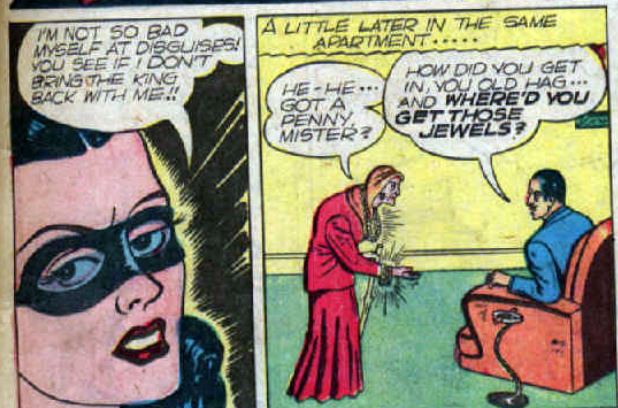
    We will be seeing more of Madame Doom, as she is Black X’s only real recurring foe (I think), but as far as 1939 goes she made one appearance and this is it. 

    Madame Doom, a freelance spy, is working for “the dictators” in an attempt to steal US defense plans and prevent the signing of a pretty vague treaty that acts as a deus ex machina reason for war not to have broken out yet (war with the US, that is).

    In this first appearance Madam Doom is a very by-the-book Will Eisner femme fatale: a ruthless lady with the hots for the hero (reciprocated).

    Black X doesn’t quite let her go on purpose but he certainly doesn’t try very hard to catch her. This is a mistake! The bloom definitely wears off the rose in this relationship later on.

    UPDATE: Madame Doom 1940

  • MINOR SUPER-VILLAIN 444: FRAU IZAN

    (Mystery Men Comics 023, 1941)

    Our story begins in media res as Lieutenant Drake of Naval Intelligence cleans up the goons of Nazi crypto-fascist (they get real close to calling her a Nazi in this one but she works for the Opatseg instead of the Gestapo, so I guess she’s just another Izan) femme fatale spy named Frau Izan.

    Izan gets away and is subsequently given an injection by sinister Nazi Izan scientist Doktere von Shnyder that turns her into my favourite kind of shrunken person: one with the proportional strength of a regular person. BONUS: they go to the trouble to establish that she made a little teeny dress for herself ahead of time. 

    The shrinking treatment, by the way, is supposed to last for two hours but in a surprise power play von Shnyder reveals that it’s permanent and that he’s taking over as head of the regional Opatseg. Just goes to show: you can’t truust a Nazi, even when they have a thin film of plausible deniability.

    (von Shnyder does get his, never fear)

    In a surprising turn, Frau Izan is forgiven her espionage activities due to being too small. I suppose it’s a hard-to-replicate defence but there’s going to be hell to pay if this establishes precedent and a lot of people start taking advantage of it using bootleg shrink rays and so forth.

    They tease Frau Izan becoming a regular part of the team (called Miss America for some reason) but she in fact never reappears again – probably they made Miss X take care of her and that’s where she is now.

  • MINOR SUPER-VILLAIN 369: ILLYRIA, QUEEN OF SPIES

    (Master Comics 012-014, 016-017, 019-020; Minute-Man Comics 001-002, 1941)

    Illyria, Queen of Spies! (AKA Queen Spy, Spy Queen, Queen of All Spies, Queen of Foreign Spies, etc) Definitely in the running for my favourite of the “recurring femme fatale spymaster” subgenre of super-villain, particularly as she is a foe to Minute-Man, one of the most bland piles of wallpaper paste ever to wear a patriotic costume.

    Beyond merely distracting me from how bored I am by Minute-Man, Illyria provides interest via a fairly wide range of plots and schemes and thus is kind of hard to boil down into a pithy summary. So: a numbered list:

    1. In her first appearance Illyria wears a snazzy orange robe, the better to whip off when captured so as to take advantage of Minute-Man’s “won’t hit girls” policy and get away. She and her three distinctive henchmen spend the issue shooting down US Army aircraft on behalf of their unspecified nation using a special blindingly-bright plane (Master Comics 012, 1941)

    2.In her second outing, Illyria engages in the already-old gag of using war games as a cover to massacre soldiers with real bullets. The interesting aspect of the story is that she is established as an explicit Axis agent (though of a never-specified power) and recruits spies from the other Axis powers to aid her in her schemes (Master Comics 014, 1941)

    3. This one’s just an attempt to kidnap a scientist who has developed a new explosive. It is the origin of the “Queen of Spies” part of her moniker, though. This adventure also marks the first time that Illyria is actually captured, as she is just as slippery as any recurring femme fatale  (Master Comics 014, 1941)

    4. After precisely one issue in the hoosegow, Illyria breaks out (that poor nurse) and attempts to blow up a Fourth of July celebration. (Master Comics 016, 1941)

    5. In service to a pretty rote kidnapping, Illyria deploys both a remote-controlled bomber and X-33, an extremely cool robot soldier who is sadly (for him) not at all waterproof. (Master Comics 017, 1941)

    6. Master Comics 019 & 020 are concerned with boring old espionage focused on stealing bombers and bomber plans: ho hum. Illyria does step up the villainy to include slavery in the latter appearance, though.

    7. Minute-Man 001 features Illyria and her drum-playing chum in a scheme to cause a native uprising on the US-held island of Barracoon in the Gulf of Mexico. The main draw of the story is Illyria’s keen voodoo dance hat but if you want to read a comic that inadvertently highlights the evils of colonialism then this is the one for you, along with about 90% of all Golden Age comics set outside of Europe or North America. And some of the ones set in North America, too.

    8. Illyria’s final appearance in Minute-Man 002 retroactively establishes that the Queen of Spies has been working for the heretofore unmentioned Green Hood, who is tired of her getting foiled all of the time. It’s a bit of an anticlimax for her, as the story is much more concerned with the Green Hood than her. Still, she manages to get away at the end, joining the ranks of the surprisingly populous “recurring femme fatale spies who don’t end up getting caught by dint of not recurring that extra time.”

    (at least I reckon that was her last appearance. She was captured at the end of Master Comics 020, dated November 1941, while Minute-Man 002 was the Winter Issue, dated September to December 1941)

  • MINOR SUPER-VILLAIN 366: THE SCAVENGERS

    (Military Comics 005, 1941) 

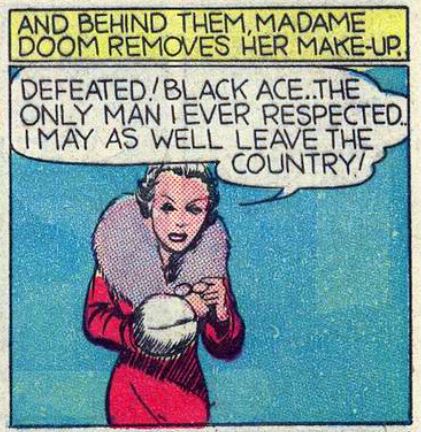
    The Scavengers are an interesting bunch, but all of the most interesting things about them are implied rather than stated. As seen above, they show up to loot and murder in the aftermath of WWII battles. The fact that they all look the same, like little rat-men, is probably meant to be a metaphorical signifier of their moral degradation but I like the implication that this is what happens to battlefield looters, like the the transformation of a ghoul or other cannibal. This of course means that there could be Scavengers throughout human history – fun!

    The Scavengers don’t actually get to do much scavenging in-story, sadly. Instead, they are captured by the Nazis and enlisted in their capacity as weird little creeps to dispose of the Blackhawks. And they do pretty well at it! Their downfall comes due to the interference of the excellently-named femme fatale Red Laura, who somewhat predictably falls for Blackhawk’s nobility and shirtlessness.

    Despite having a heroic last stand, pictured above, Red Laura actually manages to survive the issue. One hopes that she was a bit more picky about who she worked for going forward, because I am inordinately fond of her. It’s just such a good name!

    In conclusion, the Scavengers should be BRUNG BACK. Not only did they not all die at the end of the adventure (as the Blackhawks are about as likely to punch out as to shoot an opponent) but the idea of them cropping up in the aftermath of war throughout history is very cool! We need more types of human monster who wear their spiritual corruption on the outside, if only for greater variety in D&D.

  • MINOR SUPER-VILLAIN 365: THE BLACK TIGRESS

    (Military Comics 004, 1941)

    The Black Tigress is a Gestapo agent operating in Egypt with the goal of capturing or destroying the Suez Canal with her army of little Perter Lorre looking Nazis. Nothing particularly remarkable, but she does have the distinction of being the first of many, many minor super-villains to be faced by the Blackhawks.

    She is also the first of many femmes fatale to be encountered by Blackhawk himself, and Will Eisner creation (and Howard Chaykin adoptee, for that matter) that he is, he will encounter many. She is even the first of those to fall in love with Blackhawk, not that it turned out well for her: her love not reciprocated, she dies while trying to murder the object of her affections.

  • MINOR SUPER-HERO 330: RATHIA

    (Human Torch v1 005b, 1941)

    Bit of an unfair one here: Rathia is a princess of a Baltic kingdom of Atlanteans who persuades the Sub-Mariner to attempt world conquest. She is unquestionably a bad egg but by far the worst crimes of the issue are perpetuated by Namor himself and include: imprisoning and nearly killing Toro, mind controlling the Human Torch, flooding Africa and NYC, sinking the Italian Navy, nearly destroying Moscow and various war crimes. Crucially, Rathia does not exert any influence other than puffing up Namor’s ego – no mind control, nothing. Maybe a roll in the hay. Despite this, she is the one who stands trial as “World Enemy No. 2 – second only to Hitler!” while Namor just has to look contrite.

    In conclusion, this should probably be part of a Yearbook post about Namor but I am aggressively disinterested in him so Rathia takes the hit once again.  

    Seriously, look at this guy. Contemptible.

  • MINOR SUPER-HERO 330: RATHIA

    (Human Torch v1 005b, 1941)

    Bit of an unfair one here: Rathia is a princess of a Baltic kingdom of Atlanteans who persuades the Sub-Mariner to attempt world conquest. She is unquestionably a bad egg but by far the worst crimes of the issue are perpetuated by Namor himself and include: imprisoning and nearly killing Toro, mind controlling the Human Torch, flooding Africa and NYC, sinking the Italian Navy, nearly destroying Moscow and various war crimes. Crucially, Rathia does not exert any influence other than puffing up Namor’s ego – no mind control, nothing. Maybe a roll in the hay. Despite this, she is the one who stands trial as “World Enemy No. 2 – second only to Hitler!” while Namor just has to look contrite.

    In conclusion, this should probably be part of a Yearbook post about Namor but I am aggressively disinterested in him so Rathia takes the hit once again.  

    Seriously, look at this guy. Contemptible.

  • MINOR SUPER-VILLAIN 234: THE WITCH

    (Flash Comics v1 005, 1940) 

    Long-running foe/ally/love interest of Golden Age master of disguise the King (or King Standish, if you want to go by his full name), the Witch probably deserves a more thorough examination than I’m going to give her, but the fact is that though she is a good character and an admirable foil to the King, the King himself is a bit dull. Sorry, Witchie.

    I will say that the New Orleans-set King story in World’s Finest 002, in which the Witch is revealed to be a descendent of pirate Jean Lafitte and that her father was actually a crook who had kidnapped her as a baby to spite a different crook and in which she loses not one but two fathers… is a good time, will read again.

    ADDENDUM: I don’t know if she’s telling the truth here, but the idea tht the Witch’s criminal upbringing was messed up enough that she doesn’t even have a name is enough to make me like her 10x more. (Flash Comics v1 009, 1940)

  • MINOR SUPER-VILLAIN 231: UNA CATHAY

    (Flash Comics v1 003, 1940)

    Big fan of Una Cathay! The criminal scientist-type super-villains that you get in the Golden Age could get a little samey after a while – even if they all had their individual weirnesses, they were all of a common stripe – and it’s amazing how fresh a well put-together lady-villain makes the old tropes seem. 

    Una’s main deal was extracting the secret of eternal life from a young scientist named Dick Blendon who, unfortunately for her, was an old college pal of Carter “Hawkman” Hall.

    Like our old pal the Lord of Life, Una’s preferred technique was to administer to her victims a drug that simulated death and then grave-rob their bodies and pretend that she was bringing them back from the dead instead of reviving them. Unlike the Lord of Life, she kept her faux revenants in big jars that she claimed to be full of life-sustaining fluid. Love love love a guy in a big jar with his head poking out. Amazing visuals.

    Una also brings a kind of ambiguously ethnic element to her villainy, which of course means that she has voodoo powers that she nearly manages to kill Hawkman with except that Shiera somehow knows the warning signs of an incipient voodoo execution and saves his ass.

    Everything comes crashing down for Una Cathay after that: Hawkman lets all of the men out of their jars, her pal Count Torgoff falls off a roof while trying to stab Hawkman to death and she herself dies in a Hawkman-caused car accident. It’s almost like you shouldn’t turn to violent crime in your search for immortality, lest violence be meted back unto ye. Or something!

  • MINOR SUPER-VILLAIN 227: FRAULEIN DOKTOR’S DAUGHTER

    (Feature Comics 046-055, 1941-1942) 

    If you, like me, aren’t familiar with WWI-era espionage figures, then this one will require some explanation. Fraulein Doktor was the only name that German spy Elsbeth Schragmüller was known by, even after the war had ended and up until German records were seized in 1945, in fact. And once Captain Bruce Blackburn’s adventures had wrung all of the interest they could out of the German-American Bund, a sexy spy nemesis was just the ticket! Thus: Sonya (presumably) Schragmüller, Fraulein Doktor’s Daughter!

    Sonya’s a fine foe for a regular-style espionage character like Bruce Blackburn, full of all of the staples of the genre: poisons, disguises, fake cults, horniness, etc., but she has three real features of interest aside from being the made-up child of a real person:

    -she has an enormous body count relative to her number of appearances, managing to knock off at least a couple of US intelligence agents per operation.

    -even though she refers to her country of origin as “the Homeland” as is standard in the Counterspy strip, she is presented as the daughter of a German intelligence agent – this is about as close to outright saying she’s a Nazi as you get in mid-1941! (I sometimes feel weird getting so excited for actual Nazis to show up in the books I’m reading, but if it’s so I can see them get beat up a bunch I guess it’s fine)

    -since she’s the major ongoing villain of the Bruce Blackburn strip, and since the industry standard way to keep an espionage villain around is to have them escape at the end of every story, she never really gets caught, and since the strip ends in mid-1942, she ends her time in comics at large, a rare fate.

    ADDENDUM: CARL

    In the first Fraulein Doktor’s Daughter story she has no henchmen. In the second, she has three, Carl, Fritz and Otto, all apprehended. In the third, a second Carl, probably also arrested. In the fourth, Karl, who ends up dead. What does this mean beyond the writers having a limited pool of German names to draw from? I have no idea!