The Curse of Skeleton Munroe

Category: Bulletman

  • MEDIA IN COMICS 011

    I’ve heard of comics in the media, but media in comics?

    Books:

    This book is only our second example of a piece of media called Crime Does Not Pay! but I am confident in predicting that that particular phrase – the regular shouting of which appears to be the major means by which people in the 1940s discouraged children from adopting a life outside the law – is going to be the one we see the most as time goes on.

    We don’t learn too much about the contents of this particular book, but it makes a decent projectile for Robin here. (Detective Comics v1 050, 1941)

    Spider Craft, on the other hand, is pretty clearly just a reference book on spiders, albeit one with a very charming name. (Detective Comics v1 057, 1941)

    Movies:

    While attending to his extremely unruly supporting cast, Captain Terry Thunder happens upon a movie improbably being shot in North Africa in 1941. This movie is unnamed, but G.G., the director, is also responsible for the film Lost Souls, about which nothing else is known. (Jungle Comics 020, 1941)

    Radio:

    Radio Quiz show How Do You Know is your place to try your luck at winning two dollars and a big double box of Kracked Korn in a knock down quiz-off against Dolliver King. (Feature Comics 034, 1940)

    If there’s one kind of radio program that comic books love the most it’s the “man on the street” style with their handy remote microphone for all your evidence-gathering or (as seen here) confession-broadcasting needs. This particular show is called Public Opinion. (Nickel Comics 004, 1940)

    Theatre:

    The Fancy Follies of 1940 is a revue-style show that is the site of the first in a series of entertainment industry murders investigated by the Flash. (Flash Comics 002, 1940)

    Billed as a musical, In the Groove is another show plagued by crime. The Purple Trio clear things up after they manage to scrape together enough dough to get inside. (Smash Comics 015, 1940)

    Thanks to the fact that they had to pose as performers to solve the In the Groove case, the Purple Trio get their own self-titled show. The Purple Trio show probably involves more than the acrobatics we see here, but that’s all that the group gets through in this issue before they realize that a) one man has bought out the entire theatre and b) he has been murdered. (Smash Comics 016, 1940)

    This backstage conversation is all we get to see of the melodrama Remote Control, which is a real shame. What does a play with that title look like in 1940? (Crack Comics 008, 1940)

    Finally we have The Totsy Revue, attended by Johnny Thunder in one of his many attempts to impress the ever-fickle Daisy Darling, thanks to a tip that the show’s headliner Hoco tThe One and Only) is passing counterfeit money as part of his act. (Flash Comics 008, 1940)

  • SUPER-VILLAIN 002 UPDATE: CAPTAIN NAZI (1941)

    SUPER-VILLAIN 002 UPDATE: CAPTAIN NAZI (1941)

    Our second full-fledged super-villain is the odious Captain Nazi, and he had a short but busy run in 1941:

    After being deployed by Adolf Hitler himself as a foil to the threat of the American super-hero, Captain Nazi makes a very public appearance in Times Square in order to issue a challenge to Bulletman. This also attracts the attention of Captain Marvel, leading to the second Fawcett Comics character meetup of 1941 as they decide to team up and kick his ass together.

    In contrast to the bluster of his challenge, Captain Nazis’ activities in NYC are more sneaky sabotage than high-stakes public super-combat. Specifically, an attempt to derail a subway car is foiled by Captain Marvel, while an attempted Ferris Wheel disaster is effectively countered by Bulletman.

    Loathe as I am to praise Captain Nazi  I must admit that he is an effectively ruthless villain – if he didn’t have the misfortune of being pitted against two of the more powerful superhumans available he would be riding roughshod over US infrastructure instead of taking child-hostages and escaping into the shadows.

    After attempt to blow up the Brooklyn Naval Yards – foiled by Captain Marvel, natch – Captain Nazi demonstrates the trademark Fawcett character semi-awareness that he is in a comic book and leaves a note declaring his intent to come over to Whiz Comics to make life difficult there. (Master Comics 021, 1941)

    Sure enough, Captain Nazi returns as promised and continues his campaign of sabotage against a dam and an experimental aircraft.

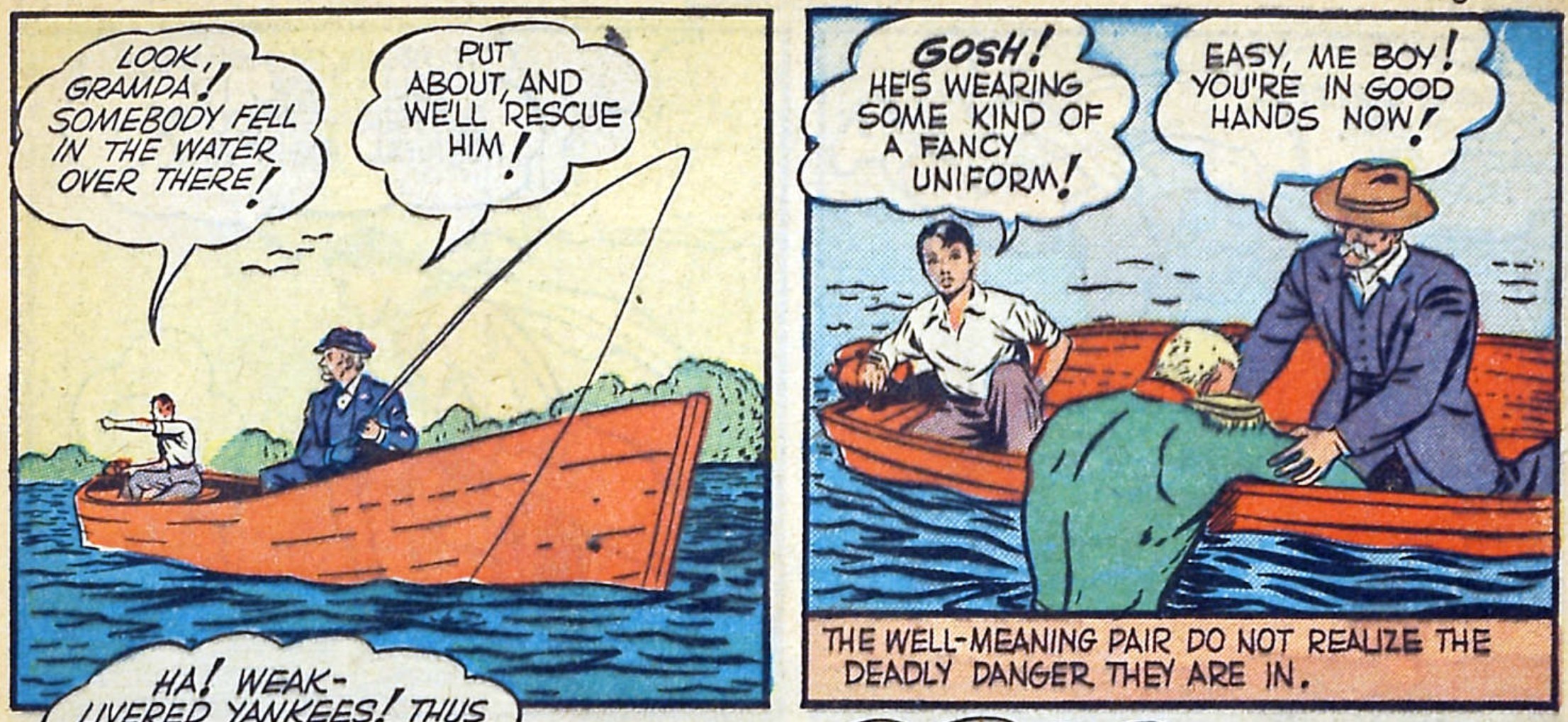
    After being hurled into the ocean by Captain Marvel, Captain Nazi commits the act that he is most well known for as he repays the kindness of young Freddy Freeman’s grandfather by murdering him and making off with his boat, leaving Freddy himself for dead. This of course is the origin of Captain Marvel Junior, as the only way that Freddy survives is by being imbued with a fraction of Captain Marvel’s own power.

    Thus, the villain once again creates his own nemesis.

    (Whiz Comics 025, 1941)

    BODY COUNT: 3+

    END-OF-YEAR STATUS: At Large 

  • SUPER-VILLAIN 002 UPDATE: CAPTAIN NAZI (1941)

    Our second full-fledged super-villain is the odious Captain Nazi, and he had a short but busy run in 1941:

    After being deployed by Adolf Hitler himself as a foil to the threat of the American super-hero, Captain Nazi makes a very public appearance in Times Square in order to issue a challenge to Bulletman. This also attracts the attention of Captain Marvel, leading to the second Fawcett Comics character meetup of 1941 as they decide to team up and kick his ass together.

    In contrast to the bluster of his challenge, Captain Nazis’ activities in NYC are more sneaky sabotage than high-stakes public super-combat. Specifically, an attempt to derail a subway car is foiled by Captain Marvel, while an attempted Ferris Wheel disaster is effectively countered by Bulletman.

    Loathe as I am to praise Captain Nazi  I must admit that he is an effectively ruthless villain – if he didn’t have the misfortune of being pitted against two of the more powerful superhumans available he would be riding roughshod over US infrastructure instead of taking child-hostages and escaping into the shadows.

    After attempt to blow up the Brooklyn Naval Yards – foiled by Captain Marvel, natch – Captain Nazi demonstrates the trademark Fawcett character semi-awareness that he is in a comic book and leaves a note declaring his intent to come over to Whiz Comics to make life difficult there. (Master Comics 021, 1941)

    Sure enough, Captain Nazi returns as promised and continues his campaign of sabotage against a dam and an experimental aircraft.

    After being hurled into the ocean by Captain Marvel, Captain Nazi commits the act that he is most well known for as he repays the kindness of young Freddy Freeman’s grandfather by murdering him and making off with his boat, leaving Freddy himself for dead. This of course is the origin of Captain Marvel Junior, as the only way that Freddy survives is by being imbued with a fraction of Captain Marvel’s own power.

    Thus, the villain once again creates his own nemesis.

    (Whiz Comics 025, 1941)

    BODY COUNT: 3+

    END-OF-YEAR STATUS: At Large 

  • MINOR SUPER-HERO ROUND-UP 068

    MINOR SUPER-HERO ROUND-UP 068

    A few classic minor super-heroes. Bulletman and Bulletgirl in particular have just barely managed not to remain relevant – I suppose the pointy helmet is too much of a hurdle for the modern audience.

    Bulletman: 

    Jim Barr is perhaps the most thoroughly-motivated super-hero of the Golden Age. He is:

    a. from a long line of police officers

    b. the son of a famed police officer who was murdered for being too good a cop and who

    c. told the young Jim that he must become a police officer while on his death bed 

    d. and after all that he was too scrawny and bookish to be a cop and so had to settle for being a forensic scientist

    Jim ends up working in his father’s old station under the command of Sergeant Kent, a pro-torture bully who is often held up as the greatest of all the cops in the city, and who is also the father of love interest Susan Barr. 

    Jim’s personal project is a serum that will destroy “all germs and toxins” in the human body, including that which he believes to be the source of crime and violence. He chooses to test this serum out on himself and his body, freed from a variety of invisible ailments, develops into a physical paragon over the course of a night’s sleep.

    (Sergeant Kent really earns his reputation as a great police officer by failing to notice that his colleague has basically doubled in size over night. In his defense, Jim is wearing big clothes)

    Jim decides that the best way to use this new power is to operate outside of the law, probably due to all of his time hanging around with top cop Kent. He uses his now super intelligence to build the Gravity-Regulator Helmet, which allows him to fly and also generates a force field that augments his natural resilience to make him nigh-invulnerable and able to smash through things head-first (I swear that somewhere I read a story in which it was explained that it made him bulletproof by drawing the bullets to the helmet but danged if I can find it now.). His costume, yellow jodhpurs and all, is assembled out of things that were lying around at the police station, no mention of where. (Nickel Comics 001, 1940)

    If I had to classify Bulletman’s personality, I would go with “extremely no-nonsense” or maybe “wooden, which is why it is important that he is eventually joined by his female counterpart: 

    Bulletgirl: 

    Bulletgirl is the aforementioned Susan Kent, daughter to good cop/bad cop Sergeant Kent and member of Bulletman’s supporting cast from the beginning. For about the first year of Bulletman’s adventures she fills a low-effort version of the Lois Lane role: curious about the hero’s identity but not especially proactive about trying to uncover it. She also gets kidnapped and targeted for death a lot thanks to her father’s skill at making enemies. Then, in Master Comics 012, Bulletman is knocked out in a collision with Triple Threat’s super vehicle and Susan learns that he is actually Jim Barr. Jim obligingly tells Susan the secret of his origin but resolutely refuses to consider teaming up with her.

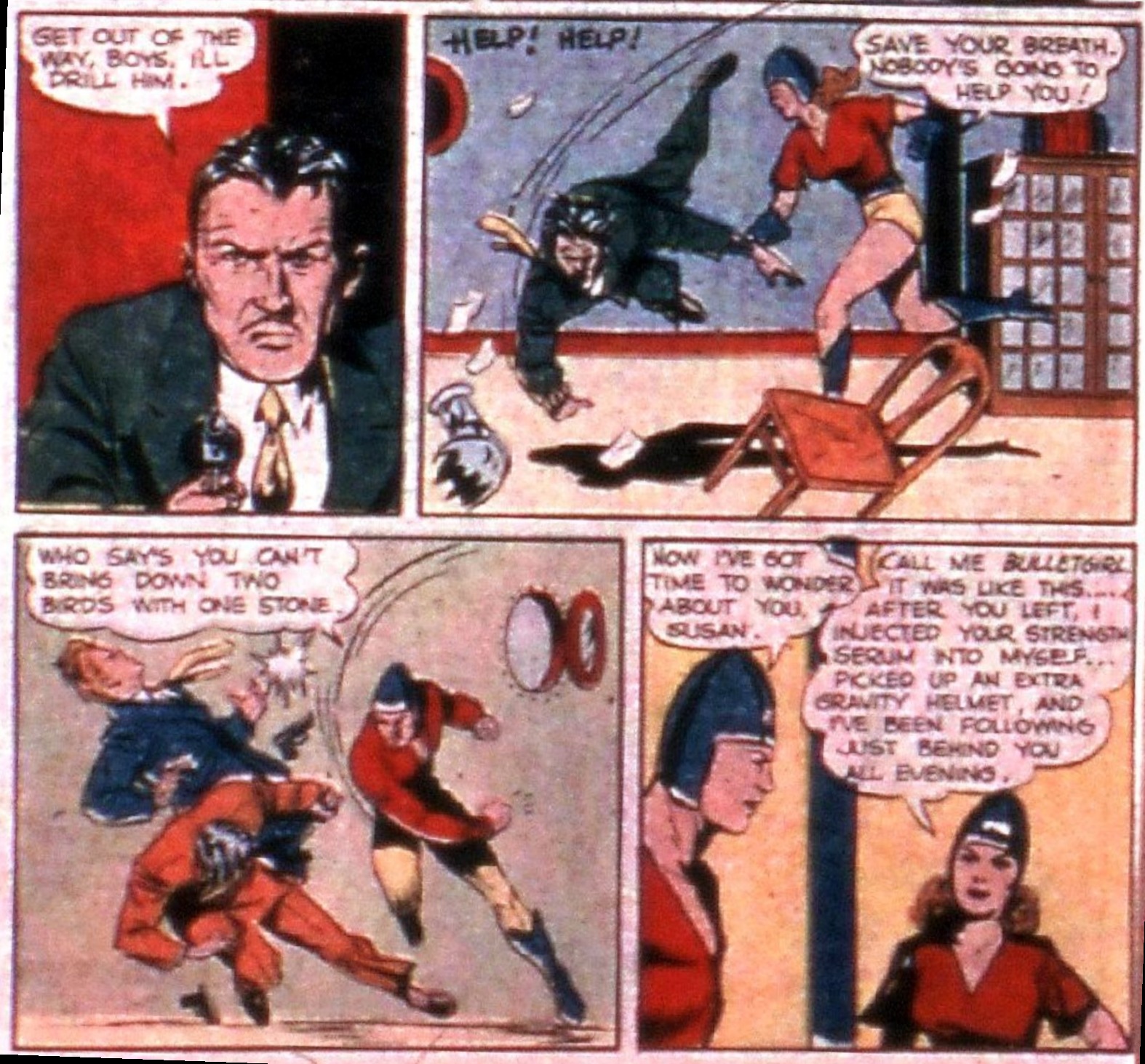
    Susan of course injects herself with the serum and crabs a spare Gravity-Regulator Helmet and costume (though she goes for hot pants over jodhpurs) the instant that Bulletman is out of the room, and This is a very good illustration of why I am so fond of Bulletgirl: she has all of the personality that Bulletman lacks. She’s scrappy and quippy and after an issue or two of “too dangerous for girls” chauvinism from Jim is a full partner in the superheroic exercise. She does get kidnapped and left behind a bit more than I’d like but that’s comic books in a nutshell. 

    In conclusion: Bulletgirl! (Master Comics 013, 1941)

    Minute-Man: 

    Like Jim Barr, Jack Weston is the son of a dead hero, though Jack’s father Robert Weston died during the Battle of Chateau-Thierry in World War I. We don’t get nearly as much background on Jack, other than the fact that he was raised by his father’s friend General Milton, but thanks to Milton, Jack becomes Minute-Man, a patriotic super-hero, in what is kind of presented as a draft.

    Jack is sent to join the Army as a lowly Private so that he can keep an eye out for sabotage and espionage affecting the armed forces. Despite having no super serum or particular special training, he proves to be physically near-superhuman as he engages a variety of costumed and non-costumed foes over the course of his mid-length career.

    Minute-Man also dabbles in leaving calling cards, which I always like to make note of. (Master Comics 011, 1941)

    Doctor Voodoo **UPDATE**: 

    In Whiz Comics 017, Doctor Voodoo returns home to find that Maxinya (the Heaven-Woman, natch) has gone missing. He tracks her abductors through the jungle until he comes across their destination: a European castle, smack in the middle of the Amazon. 

    The mystery deepens as Voodoo enters the castle and finds what seems to be an entire Medieval court, headed by the boorish King Richard, who seeks his aid in conquering the jungle. 

    Doctor Voodoo refuses to help King Richard, and so is forced to meet the knight Sir Ganal in combat. Voodoo prevails and wins Ganal over to his side, complete with a promise to reveal the origin of the castle’s presence in the jungle. Alas, this shall never come to pass, because the story does a hard pivot in the next issue. 

    King Richard plays the whole jungle conquest/attempted murder thing off as if it was some sort of test, and sends Doctor Voodoo off to meet with his court wizard. He. in turn, transports Voodoo back in time to the 1400s or thereabouts to retrieve a magical McGuffin called the Golden Flask, with another promise to explain what this whole affair is about once he returns.

    Unfortunately for all us completionists out there, the explanation never comes because Doctor Voodoo never returns. He bops around the oceans for about a year and actually does manage to get his hands on the Golden Flask but his feature is cancelled before he can return it to the wizard and find out just what the heck is going on. Maxinya is waiting for him still, presumably. (Whiz Comics 018, 1941)

  • MINOR SUPER-VILLAIN 896: THE INVISIBLE MAN

    (America’s Greatest Comics 001, 1941)

    An invisible killer is on the loose in New York City, robbing banks and hijacking gold shipments and murdering bank clerks, and while an invisible killer is a very scary thing to contemplate we must as ourselves: is armed robbery the best criminal use of the power of invisibility? If nothing else, a stealthier approach would have kept the involvement of an invisible man a secret for longer, since as it stands the poor gunned-down bank clerk in the above panels managed to survive long enough to tell the police about him.

    All of this criminal activity draws the attention of Bulletman and Bulletgirl, of course, and soon enough they are face to nothing with the Invisible Man in a deserted street. Sadly for the crime statistics, the Invisible Man seems to have the kind of invisibility that renders him completely uncatchable, even during a long conversation with Bulletman, a man wearing a hat that allows him to fly and who, crucially, can see him for part of the time. 

    Though the Invisible Man’s reign of terror continues for some time after this confrontation, his downfall comes after Bulletman realizes that invisibility is only a useful superpower in lighted areas and that battling him in darkness will level the playing field. Just why this is a more effective approach that simply flailing wildly at the sound of his voice is a mystery to me but I guess we must acknowledge success when it happens.

  • GENERIC COSTUMED VILLAIN ROUND-UP 007

    The hits keep on coming:

    This Fellow’s name is Becker and he and his wife run a gang while pretending to be among its victims. An okay scheme, but not really up to foiling Bulletman and Bulletgirl. (Master Comics 014, 1941)

    This guy here is why I have such a hard time relegating masked Western bandits to the dregs of the generic costumed villains: he’s as by-the-numbers a bandit as they come, he robs one stagecoach total, he ends up dying because he falls off his horse… but he is frequently and consistently referred to a “Alkali, the Scourge of the Plains” which is as endearing as it is possible to be. (Master Comics 019, 1941)

    I’m overlooking the fact that this bundist-style not-exactly-German spy encountered by Miss America doesn’t actually wear a costume because a) he’s called the Leader, b) he lives in a wax museum and c) he has a pet gorilla named Gargo. (Military Comics 002, 1941)

    Captain Rajah, AKA the Master, was a jewel thief who ran up against Captain Desmo, in a story even more weirdly pro-colonial than Captain Desmo stories usually are – Captain Rajah is immediately suspicious for being an Indian officer in the Bengal Lancers, continued to be suspected throughout and then turned out to be the Master. The story is from before the invention of “defying expectations”. (More Fun Comics 065, 1941)

  • GENERIC COSTUMED VILLAIN ROUND-UP 007

    The hits keep on coming:

    This Fellow’s name is Becker and he and his wife run a gang while pretending to be among its victims. An okay scheme, but not really up to foiling Bulletman and Bulletgirl. (Master Comics 014, 1941)

    This guy here is why I have such a hard time relegating masked Western bandits to the dregs of the generic costumed villains: he’s as by-the-numbers a bandit as they come, he robs one stagecoach total, he ends up dying because he falls off his horse… but he is frequently and consistently referred to a “Alkali, the Scourge of the Plains” which is as endearing as it is possible to be. (Master Comics 019, 1941)

    I’m overlooking the fact that this bundist-style not-exactly-German spy encountered by Miss America doesn’t actually wear a costume because a) he’s called the Leader, b) he lives in a wax museum and c) he has a pet gorilla named Gargo. (Military Comics 002, 1941)

    Captain Rajah, AKA the Master, was a jewel thief who ran up against Captain Desmo, in a story even more weirdly pro-colonial than Captain Desmo stories usually are – Captain Rajah is immediately suspicious for being an Indian officer in the Bengal Lancers, continued to be suspected throughout and then turned out to be the Master. The story is from before the invention of “defying expectations”. (More Fun Comics 065, 1941)

  • MINOR SUPER-HERO 362: THE SON OF COUNT DRACULA

    (Master Comics 020, 1941)

    The Son of Count Dracula: 100/100 for theming and commitment to the bit, 0/100 for practical planning. 

    So: a team of private detectives named Splithair and Undermeyer are hired to investigate a series of disappearances associated with Vampire Castle, located in the castle-rich hills of New York State. Splithair is quickly captured by the Son of Count Dracula (tSoCD) and Undermeyer is only saved by the timely intervention of a nosy Bulletman. TSoCD retreats from the dawn and Bulletman escorts a panicky Undermeyer home.

    The next day Bulletgirl, justifiably upset at being left behind on the first outing, does some investigating of her own and is promptly added to tSoCD’s collection of prisoners, and then Bulletman shows up to save the day.

    The Son of Count Dracula turns out to be Splithair, of course, and while I admire his imagination and sticktoitiveness I must note that it is entirely his fault that he was caught. Beyond even the question of whether he should have taken the job to investigate his own crimes there is the simple fact that he didn’t need to run a vampire-themed kidnapping ring out of Vampire Castle. Run a regular kidnapping ring somewhere inconspicuous, man! Make yourself at least a little hard to find!

  • MINOR SUPER-HERO 362: THE SON OF COUNT DRACULA

    (Master Comics 020, 1941)

    The Son of Count Dracula: 100/100 for theming and commitment to the bit, 0/100 for practical planning. 

    So: a team of private detectives named Splithair and Undermeyer are hired to investigate a series of disappearances associated with Vampire Castle, located in the castle-rich hills of New York State. Splithair is quickly captured by the Son of Count Dracula (tSoCD) and Undermeyer is only saved by the timely intervention of a nosy Bulletman. TSoCD retreats from the dawn and Bulletman escorts a panicky Undermeyer home.

    The next day Bulletgirl, justifiably upset at being left behind on the first outing, does some investigating of her own and is promptly added to tSoCD’s collection of prisoners, and then Bulletman shows up to save the day.

    The Son of Count Dracula turns out to be Splithair, of course, and while I admire his imagination and sticktoitiveness I must note that it is entirely his fault that he was caught. Beyond even the question of whether he should have taken the job to investigate his own crimes there is the simple fact that he didn’t need to run a vampire-themed kidnapping ring out of Vampire Castle. Run a regular kidnapping ring somewhere inconspicuous, man! Make yourself at least a little hard to find!

  • MINOR SUPER-VILLAIN 359: THE UNHOLY THREE

    (Master Comics 017-019, 1941)

    The Unholy Three! A little guy (Nosey), a huge guy (Brutus) and a gorilla (Herbert)!

    Oh and of course we must not forget the fourth member of the Unholy Three, their boss “Doctor” J. Twiddley Fairchild (quotation marks his). Details in the actual story are sketchy but it seems as if Fairchild was jailed for larceny, escaped, assembled the other three as his minions and set out to get revenge on those who were responsible for his imprisonment – in other words an old fashioned Judge and Jury Revenge Killing scheme.

    This is where things get a bit annoying for me personally. JaJRK schemes are quantifiable based on the number of attempted slayings divided by the number of successful ones. The problem is that while we know that the Unholy Three end up killing all but one of their targets we do not in fact have any idea of how many targets there were – it’s more than three but up to something like twenty+ if the defense team and witnesses are included.

    Sadly then, JUDGE AND JURY REVENGE KILLING SCORE: n-1/n

    The Unholy Three (all four of them) end up getting caught by Bulletman and Bulletgirl before managing to finish off the last of their targets, but someone at Master Comics must have liked them because they returned for a two-issue story. Too bad for J. Twiddley Fairchild: he didn’t make it out of the initial jailbreak alive. Leadership of the group passed to Nosey and Bulletman became the new target for revenge.

    The actual action is whatever – the Unholy Three kidnap Bulletgirl and try to kill them both with a deathtrap and the second part opens with Bulletman thinking that Bulletgirl has died while the Unholy Three think that Bulletman has. This doesn’t really go anywhere interesting.

    Ultimately the Three attempt to flee the country and Bulletman kicks them off a cliff to their demise.

    OR DOES HE? Because the Unholy Three are collectively our second villain to be resurrected off-panel in time to sign the Crime Exchange petition. Like Mr Murder they never appear again but just knowing that two guys and a gorilla are out there somewhere is enough for me.