The Curse of Skeleton Munroe

Category: saboteur

  • MINOR SUPER-VILLAIN 1002: MASTERMIND

    (Lightning Comics v2 001, 1941)

    Lash Lightning, while aimlessly flying around the countryside at night, encounters a footsore scientist named Amy Lane. Turns out that her castle (!) has been stolen by a man named Mastermind and that she has been walking for several hours in an attempt to get help. In a move that always seems kind of rude to me, Lightning immediately flies her all the way back to the castle to investigate. The mysterious Mastermind is no longer present when they arrive, but the castle’s laboratory is now filled with strange electrical equipment.

    But just where is Mastermind (who is also frequently called the Mastermind)? As you may recall from our one thousandth entry, he is in the middle of breaking Lightning’s recurring foe the Mummy out of jail in an attempt to wrangle the formula for his invulnerability coating out of him. You don’t see this kind of thing very often and I have to assume that the inherent egomania required to become a super-villain prevents most of them from acknowledging that anyone else might have a good idea.

    Upon returning to the castle and discovering Lightning and Lane in his newly-stolen laboratory, Mastermind demonstrates what the electrical equipment is for by using it to charge himself with lightning in this state he is immune to electricity (and only electricity, hence the need for the Mummy’s radium solution), can throw destructive bolts of lightning, and is able to teleport both himself and others, though just why this makes him resemble a dracula with glowing eyes is not explained.

    Mastermind and the Mummy demonstrate the value of teamwork by subduing Lightning with relatively little effort, then immediately revert to super-villain type and engage in a struggle for dominance that sees the Mummy reduced to a smouldering pile of medical gauze and Mastermind is left forever vulnerable to being punched in the face.

    Undeterred, Mastermind sets out to enact his ultimate scheme: to extort money from the US government in exchange for not helping the Axis to take over America, and as the government (in the form of this room full of Army officers) refuses to pay up based solely on the threats of a goth, he sets out to do just that.

    Mastermind seeks out a nearby cell of pseudo-Nazi spies and offers his services as a saboteur, then proves that he can deliver the goods by blowing up the Washington Monument. I am not ashamed to admit that I yelled aloud when I read this part of the book – that’s the sort of high-tier, messing-with-national-symbols villainy that you don’t get a lot of in this era.

    Mastermind’s pitch to the spies is of course successful and he goes on a real sabotage tear, though none of it is as crazy or memorable as that initial salvo. By this point Lash Lightning has recovered and escaped, and the two have a final confrontation back at Amy Lane’s castle as Mastermind is nipping back for a quick recharge. Instead of that pick-me-up, however, he gets thrown to his doom on the rocks below.

    OR DOES HE??

    No he does not, because Mastermind is back in Lightning Comics v2 002 and he’s explicitly rather than implicitly collaborating with the Nazis. This time, he’s got a mind control serum that he uses to take over the minds of everyone at Fort Hancock.

    And just why does he mind control an entire fort worth of soldiers? Why, to both prevent them from operating the shore defenses as the Nazi fleet is sailing into the nearby city’s harbour and as auxiliary troops for the subsequent shelling and invasion of that city, of course.

    Lightning is of course not going to stand for this kind of thing: he blows up/drives off the fleet, cures the men of the Mastermind’s control with a careful application of electricity and takes care of Mastermind himself with the careful application of a sock on the jaw.

    In his third appearance in Lightning Comics v2 003, Mastermind escapes jail by arranging to have himself sent a tiny recharging device that appears to just plug into the electrical outlet that I never really pictured 1940s prison cells as having but which gives him enough juice for one teleport away.

    This time around, Mastermind steals an experimental dirigible equipped with heat and paralysis rays and uses it to prep the way for yet another Nazi invasion by attacking US defense facilities.

    Not only does Lash Lightning show up and take him down with an almost insulting level of ease, but he does so accompanied by a pretty devastating put-down. It’s the old law of diminishing returns, as a villain who started out as a formidable opponent becomes more and more of a pushover as time goes on. Mastermind jumps to his death rather than being captured this time, only of course he doesn’t because he is a teleporter.

    Sure enough, when Mastermind returns in Lightning Comics v2 004, he confirms that teleportation saved his bacon. This time around he is working for the Nazis yet again, but rather than paving the way for invasion he is attempting to destroy some war materiel making its way from America to the UK via Canada. And speaking of Canada, since Lash Lightning prevents the supplies from being destroyed as they cross the border, the bulk of this issue takes place in my home country. Specifically, Mastermind is the very first super-villain who we have encountered doing supercrime in the province of Quebec!

    Not great supercrime, mind you. He does manage to poison Lightning, but instead of taking proper advantage of this he just throws him off of a roof, something that he would ordinarily survive and something I think would be reasonable to assume he would survive even while half dead.

    And yes, he does survive, returning to to punch out Mastermind’s lights and foil all of his plans. It’s back to prison for our pale friend, and this time they must have made sure to check all of his incoming cake deliveries a bit more thoroughly because as far as I can tell he never appears again.

    Categorized in: Origins (Evil Equivalents), Powers (Teleportation), Professions in Crime (Masterminds)

  • MAD AND CRIMINAL SCIENTIST ROUND-UP 027

    A series of cautionary tales for budding young scientists.

    Orid Dass:

    Orid Dass is your standard jungle scientist: he’s out there making apes into men and men into apes, all for the love of the ape-man game. He also has the distinction of being the only foe faced by Fantomah the one post-Fletcher Hanks adventure in which she is still kind of a jungle demigod rather than a jungle hero who knows some magic.

    In that capacity, Fantomah does a little man/ape transformation of her own, turning both Dass and his ape-men into little green monkeys until he reverts his latest victim (a white guy) to human form, though why she couldn’t just do it herself is not explored.

    Dass briefly gets one over on Fantomah by dropping her into a pit lined with radioactive ore, as this is also the one issue in which her powers are neutralized in the presence of radiation, but is subsequently crushed when his entire base collapses on top of him – the downside to the convenience of building your science compound on top of a huge radioactive cavern system, I guess. (Jungle Comics 016, 1941)

    Doktor Teufel:

    Doktor Teufel lives on the aptly-named Death Mountain and spends his time enslaving passing US aviators and building advanced radio-powered technology, implicitly in service to some nefarious plot against the United States. He’s a prime example of the kind of villain who is perfectly positioned to achieve all of his goals but who has not planned for the fact that a radium-powered super-hero – specifically Radior, the X-Ray Powerman – is going to walk fly a convertible through his front door and dismantle his entire operation in twenty minutes. (Key Ring Comics, 1941)

    Dr Dietz:

    We meet Dr Dietz after he has successfully stolen a high-powered experimental aircraft, and he spends so much time bragging about this and about how great a weapon it will make once he has mounted his disintegrator ray cannon (or “death-beam”) on it to Federal Agent Steve Crawford* that he never actually gets around to mentioning whether he intends to use it for espionage or for personal gain. He himself is disintegrated before he gets a chance to clarify. (Liberty Scouts Comics 002, 1941)

    *Referred to as “Steve Crawford, Undercover Man” despite the fact that in this, his only recorded adventure he is operating under his own name and openly as a lawman.

    the Mad Scientist:

    The aptly-named Mad Scientist has been setting forest fires as a way of capturing strapping young firefighters from the nearby CCC* base as fodder for his experiments. He is aided in this by his mind-controlled niece Nancy and a huge goon named Gaston (who wears a very cool-looking protective suit while traipsing through the burning forests).

    And just what is the radical theory that has driven the Mad Scientist to both the fringes of society and the outskirts of scientific ethics? Why, he believes that if he electronically incinerates a human body just right then it will become “solid gas.” Exactly what does this mean? I cannot really say, but going by the available evidence from his eventual successful creation the result is a living, tangible human with a massively decreased density and a radically different metabolism. 

    *the Civilian Conservation Corps, a New Deal work program.

    As I said, the process is eventually successful, turning a CCC firefighter named Jim into the mighty Fire-Man, but while the Mad Scientist was able to conceptualize and bring into existence an entirely new form of life he was not as visionary about the benefits of proper lab safety and both he and Gaston were fatally exploded in Fire-Man’s subsequent attempt to escape his captor. (Liberty Scouts Comics 002, 1941)

  • MAD AND CRIMINAL SCIENTIST ROUND-UP 027

    A series of cautionary tales for budding young scientists.

    Orid Dass:

    Orid Dass is your standard jungle scientist: he’s out there making apes into men and men into apes, all for the love of the ape-man game. He also has the distinction of being the only foe faced by Fantomah the one post-Fletcher Hanks adventure in which she is still kind of a jungle demigod rather than a jungle hero who knows some magic.

    In that capacity, Fantomah does a little man/ape transformation of her own, turning both Dass and his ape-men into little green monkeys until he reverts his latest victim (a white guy) to human form, though why she couldn’t just do it herself is not explored.

    Dass briefly gets one over on Fantomah by dropping her into a pit lined with radioactive ore, as this is also the one issue in which her powers are neutralized in the presence of radiation, but is subsequently crushed when his entire base collapses on top of him – the downside to the convenience of building your science compound on top of a huge radioactive cavern system, I guess. (Jungle Comics 016, 1941)

    Doktor Teufel:

    Doktor Teufel lives on the aptly-named Death Mountain and spends his time enslaving passing US aviators and building advanced radio-powered technology, implicitly in service to some nefarious plot against the United States. He’s a prime example of the kind of villain who is perfectly positioned to achieve all of his goals but who has not planned for the fact that a radium-powered super-hero – specifically Radior, the X-Ray Powerman – is going to walk fly a convertible through his front door and dismantle his entire operation in twenty minutes. (Key Ring Comics, 1941)

    Dr Dietz:

    We meet Dr Dietz after he has successfully stolen a high-powered experimental aircraft, and he spends so much time bragging about this and about how great a weapon it will make once he has mounted his disintegrator ray cannon (or “death-beam”) on it to Federal Agent Steve Crawford* that he never actually gets around to mentioning whether he intends to use it for espionage or for personal gain. He himself is disintegrated before he gets a chance to clarify. (Liberty Scouts Comics 002, 1941)

    *Referred to as “Steve Crawford, Undercover Man” despite the fact that in this, his only recorded adventure he is operating under his own name and openly as a lawman.

    the Mad Scientist:

    The aptly-named Mad Scientist has been setting forest fires as a way of capturing strapping young firefighters from the nearby CCC* base as fodder for his experiments. He is aided in this by his mind-controlled niece Nancy and a huge goon named Gaston (who wears a very cool-looking protective suit while traipsing through the burning forests).

    And just what is the radical theory that has driven the Mad Scientist to both the fringes of society and the outskirts of scientific ethics? Why, he believes that if he electronically incinerates a human body just right then it will become “solid gas.” Exactly what does this mean? I cannot really say, but going by the available evidence from his eventual successful creation the result is a living, tangible human with a massively decreased density and a radically different metabolism. 

    *the Civilian Conservation Corps, a New Deal work program.

    As I said, the process is eventually successful, turning a CCC firefighter named Jim into the mighty Fire-Man, but while the Mad Scientist was able to conceptualize and bring into existence an entirely new form of life he was not as visionary about the benefits of proper lab safety and both he and Gaston were fatally exploded in Fire-Man’s subsequent attempt to escape his captor. (Liberty Scouts Comics 002, 1941)

  • MINOR SUPER-VILLAIN 980: THE WERE-WOLF

    (Four Favorites 001, 1941)

    Lash Lightning is one of those characters who is so very powerful that he outclasses all regular human opposition, barring some extraordinary circumstance. That’s why a movie-style, immune-to-all-harm werewolf is a perfect foil for him!

    The story of the Were-Wolf begins c.1921 (or possibly 1911 – accounts vary!), when Sumter Military Academy student Adolph Krimetz, sick of being bullied and nicknamed “Wolf” because of his unusual appearance, attacks a fellow student and accidentally kills him. Fearing official reprisals, Krimetz flees into the wilderness, where he remains for the next twenty (or thirty!) years. 

    Eventually, Krimetz decides to get revenge on the men who bullied him at school, as he blames them for his exile from society. He is emboldened in his quest by the fact that at some point in the intervening years he discovered that his childhood nickname was ironically close to the truth, because he is in fact an actual werewolf!

    Krimetz’s particular style of lycanthropy is worth noting here: he transforms into something approaching a fully canine form, but only in his upper body, meaning that he technically remains humanoid. It’s a wild look, particularly when paired with his homemade fur kilt and footwraps. As the Were-Wolf, Krimetz is super strong, able to travel long distances in a series of super-jumps and is completely immune to all harm – presumably excepting harm caused by silver, but this is never really brought up.

    Starting with his old classmates Generals Andrews and Johnson (and Johnson’s daughter Joan, filling the role of damsel in distress), Krimetz proceeds to kidnap at least sixteen people. Like fellow revenge-seeker the Master, he seems to be compelled to assemble all of his potential victims before killing any of them, and like the Master this ultimately backfires on him. Krimetz, at least, has a motive beyond revenge for doing so, as he plans on torturing military secrets out of his enemies so that he can sell them to the highest bidder.

    Before doing any of that, however, Krimetz sets out to destroy Sumter Military Academy, the scene of his childhood humiliations. Since he has captured Lash Lightning and is thus leaving him alone with all of his prisoners, this is effectively a recipe for their escape. Having freed everyone, Lash rushes off to prevent the bombing.

    While Lash might be incapable of harming the Were-Wolf, it turns out that a big old lightning bolt can compel him to turn back into a human, and a human is very vulnerable to, for instance, being punched headlong onto a barrel of TNT and exploding.

    REVENGE KILLER SCORE: either 0/16 or 0/216+ if we’re including all of the military school kids he also failed to murder.

    BUT WAIT:

    Even though the Were-Wolf is clearly exploded at the end of his first appearance, he does not in fact die. He returns in Four Favorites 002, still obsessed with revenge but directed against the US military in general, rather than the specific people and institutions who harmed him in his youth. To that end, he derails a troop train that is travelling across the Midwest, and goes on to attempt similar acts against an army convoy and some troop-transporting aircraft

    A lot of the dramatic focus of this issue is taken up by the plight of Old Mike Jasper, the railway switchman who Krimetz frames for the derailment and who is almost convicted for the crime a mere one day later despite the fact that a) the case against him is extremely circumstantial and b) much of it is based around a general skepticism of his claim that a werewolf did it, never mind that a werewolf just kidnapped more than a dozen high-level army officers and is currently out there sabotaging military transports. Old Mike has a terrible lawyer, is what I’m implying.

    Krimetz is jailed for the mass murdering, but he will return for a further two appearances in 1942! 

  • MINOR SUPER-VILLAIN 967: THE FANG

    (Fantastic Comics 017, 1941)

    The Fang is a recurring villain in the mould of his Fox Features contemporaries the Rook and the Beast: you can knock him down and seemingly kill him as much as you want but he’s just going to keep on coming back to do more crimes.

    When he first appears, the Fang’s major goal is to acquire the Burma Emerald from its caretaker Princess Kava, in order to decipher the secret of invisibility that has been carved into its surface. His initial attempt to snatch the emerald leads him to murder Police Sergeant Marley of the Princess’ protection detail, which directly inspires Marley’s son Chuck to become a costumed crimefighter under the tutelage of the Black Fury.

    Perhaps because Black Fury scribe realized that a series of comics about a man trying and failing to achieve invisibility would be less interesting than one about an invisible crook, the Fang breaks prison in his second appearance and gets ahold of the emerald almost immediately. So what does he use his newfound powers of invisibility for?

    – bank robbery (Fantastic Comics 018)

    – framing a man for murder in order to buy his house that has an ideal smuggling setup in the form of a secret tunnel to the coast (Fantastic Comics 019)

    – sabotaging arms shipments to Allied Europe on behalf of the Axis (Fantastic Comics 020)

    I judge these… okay criminal uses of invisibility. Nothing spectacular.

    Though I set up the comparison between the Fang and the Rook/the Beast
    myself, I must now point out the way in which he differs from them: he doesn’t seemingly die at the end of every appearance. Instead, he alternates seeming to die being caught: he’s caught in Fantastic 017, crashes into an oil tank in 018, caught again in 019, and does a header into a well full of slime in Fantastic Comics 020. 

    If there’s one thing that invisibility powers are extremely good at it’s in helping to fake one’s own death, though how they help to get out of an ooze pit is beyond me.

    Sadly and annoyingly, the final page or two of the Fang’s last appearance is not currently available. He is in the process of planting a bomb at the end of the portion that we do have, which makes it highly likely that he went on to be blown up, and that death finally claimed him. Alternately, perhaps he was arrested again and just treated with the appropriate amount of care by the authorities. It is my hope that we will someday learn the truth.

    Categorized in: Body (Nonhuman Parts – Fangs), Narrative Footballs (Origin Story Guys), Powers (Invisibility)

  • MINOR SUPER-VILLAIN 967: THE FANG

    (Fantastic Comics 017, 1941)

    The Fang is a recurring villain in the mould of his Fox Features contemporaries the Rook and the Beast: you can knock him down and seemingly kill him as much as you want but he’s just going to keep on coming back to do more crimes.

    When he first appears, the Fang’s major goal is to acquire the Burma Emerald from its caretaker Princess Kava, in order to decipher the secret of invisibility that has been carved into its surface. His initial attempt to snatch the emerald leads him to murder Police Sergeant Marley of the Princess’ protection detail, which directly inspires Marley’s son Chuck to become a costumed crimefighter under the tutelage of the Black Fury.

    Perhaps because Black Fury scribe realized that a series of comics about a man trying and failing to achieve invisibility would be less interesting than one about an invisible crook, the Fang breaks prison in his second appearance and gets ahold of the emerald almost immediately. So what does he use his newfound powers of invisibility for?

    – bank robbery (Fantastic Comics 018)

    – framing a man for murder in order to buy his house that has an ideal smuggling setup in the form of a secret tunnel to the coast (Fantastic Comics 019)

    – sabotaging arms shipments to Allied Europe on behalf of the Axis (Fantastic Comics 020)

    I judge these… okay criminal uses of invisibility. Nothing spectacular.

    Though I set up the comparison between the Fang and the Rook/the Beast
    myself, I must now point out the way in which he differs from them: he doesn’t seemingly die at the end of every appearance. Instead, he alternates seeming to die being caught: he’s caught in Fantastic 017, crashes into an oil tank in 018, caught again in 019, and does a header into a well full of slime in Fantastic Comics 020. 

    If there’s one thing that invisibility powers are extremely good at it’s in helping to fake one’s own death, though how they help to get out of an ooze pit is beyond me.

    Sadly and annoyingly, the final page or two of the Fang’s last appearance is not currently available. He is in the process of planting a bomb at the end of the portion that we do have, which makes it highly likely that he went on to be blown up, and that death finally claimed him. Alternately, perhaps he was arrested again and just treated with the appropriate amount of care by the authorities. It is my hope that we will someday learn the truth.

    Categorized in: Body (Nonhuman Parts – Fangs), Narrative Footballs (Origin Story Guys), Powers (Invisibility)

  • MINOR SUPER-VILLAIN 938: HERR SKULL

    (Silver Streak Comics 014, 1941)

    Herr Skull is the leader of the Skull Men, a band of fascist saboteurs who dress up like ghoulish skeletons in order to facilitate their crimes. Why do they have spikes on top of their heads? I do not know the answer to that. Perhaps Herr Skull just thought the look needed a bit more to really pop.

    Spike aside, the plan works! The Skull Men are terrifying enough that their victims are caught completely off guard, as these unfortunate armoured truck guards demonstrate, and those who do not manage to flee are ruthlessly killed.

    Using the defense money stolen from the armoured truck job, Herr Skull and his men embark on a campaign of death and destruction around NYC, striking at aircraft, naval and ammunition production.

    The flaw in the Skull Men’s operation is exposed by Captain Battle and sidekick Hale Battle, who almost capture them during the armoured car job but are knocked out by a gas grenade long enough for the gang to make their escape. Simply put, Herr Skull’s whole plan hinges on the Skull Men’s victims being too frightened to fight back with no apparent backup plan for if they do. When the Battle duo infiltrate their sewer lair it’s all over.

    SKULL SCORE: visible eyes make it a 4, dropping to 3 because it’s just a mask.

    Categorized in: Body (Skulls), Generica (Herrs), Ideology (Crypto-Fascists)

    Silver Streak Comics 014 is the issue in which Hale Battle starts his ongoing souvenir collection. He adds one of the Skull Men masks to it at the end of the issue…

    … but the real start of his obsession is in the cliffhanger from their previous adventure which involved sinking a u-boat and from which he retained a torpedo propeller.

  • MINOR SUPER-VILLAIN 933: THE RIPPER

    (Silver Streak Comics 011, 1941)

    For the third issue in a row, a souped up super-plane takes to the skies of probably-California to menace law-abiding aviators. The Ripper, like the Heater before it, is a vehicle with a singular name being run by a group, which is a mildly interesting taxonomic trend that unfortunately does not continue to occur.

    Where the Wingers and the Heater were armed with sci-fi ray cannons, the Ripper relies on a comparatively low-tech blade that is used to slice up aircraft and parachutes alike. Ironically, this is a far less believable means of attacking a plane on the wing than a thermodynamic ray of some sort. Just what kind of flying does the Ripper’s pilot have to be doing to slice off a wing with a comparatively short, fixed blade, anyway? Just how sharp can that thing be considering that it looks perfectly cylindrical? There are some wavy lines around the blade in precisely one panel – perhaps it’s meant to be a vibro-blade of some kind.

    Like the Heater before them, the crew of the Ripper are prepared for Cloud Curtis and his crew to interfere in their plans. In addition to the standard-issue bulletproofing, their plane is equipped with a magnetic generator to lock the Golden Bullet’s grapplers in place on their hull and knockout gas dispensers on the plane’s exterior act as a counter to Curtis’ favoured tactic of clambering onto an enemy aircraft’s exterior. Cloud and his assistants are taken into custody but not, crucially, immediately murdered.

    In contrast to the Heater, the Ripper has an actual defined goal: shut down US aviation in order to weaken the country for vague foreign agent reasons. And it’s astonishingly effective!

    Having not been murdered, Cloud and pals soon escape and take to the skies, where the Ripper crew learn the same posthumous lesson as the Heater gang before them: if you render yourself impossible to capture then you are much more likely to be killed outright. One shattered propeller later, the skies are safe for trainee pilots once more.

    Categorized in: Accessories (Aircraft), Activities (Ripping), Espionage (Saboteurs)

  • MINOR SUPER-VILLAIN 925: THE IRON-JAW

    (Silver Streak Comics 009, 1941)

    The US is being rocked by a series of explosions targeting munitions factories and other facilities contributing to national defense, and not even the speed of the Silver Streak is enough to combat the organizational skills and coordination of the mysterious mastermind behind them. It is only by sheer coincidence that he happens upon an imperilled security guard from a plant in Georgia and learns from him that the men who blew up his workplace were under command of a mysterious figure called “Iron-Jaw” and that they all work for the “Axes Government”.

    Even with this information under his belt, the Silver Streak still loses two more factories to the Iron-Jaw before finally running down some of his men in Boston and discovering the secret of their great organizational abilities: a super-miniaturized (for the 40s) radio set used to relay orders to the Axes forces in America. By following the instructions coming from a captured unit, the Streak and Whiz are finally able to get the jump on the Iron-Jaw’s men and prevent the destruction of a plant in Pittsburgh, though the mastermind remains on the loose.

    The Iron-Jaw returns in Silver Streak Comics 010 with a new set of goals – the focus is now on shutting down media criticism of the Axes. To that end, the Silver Streak is drawn away via a report of a potential bombing in Chicago while Iron-Jaw is grabbing the real target, broadcaster Kitty Doyle, in NYC.

    This is Silver Streak we’re talking about here, so he returns in time to interrupt the kidnapping in progress. the mysterious Iron-Jaw is revealed to be a moderately cool-looking/ moderately goofy-looking/ fairly spiky humanoid robot. With a gold finish, no less – so much for thematic consistency.

    Though Iron-Jaw briefly gets the upper hand, even a super strong, very pointy robot is no match for the world’s fastest man and it takes a fatal header onto the streets of Manhattan below.

    Here’s something about the Iron-Jaw: in its first appearance, all it does is talk, while in its second it is completely mute. This dovetails interestingly with something that Kitty reports after its defeat, that investigation of the robot indicates that it was controlled by trans-oceanic radio waves originating from the Axes government. Which seems to indicate that the Iron-Jaw was merely operating as the mouth and hands of one or more spymasters in some comic book pastiche of Germany, which in turn means that this is one of the few times in Golden Age comics in which the villain gets away at the end!* Neat!

    *excluding all of the recurring villains who get away all the time, of course. 

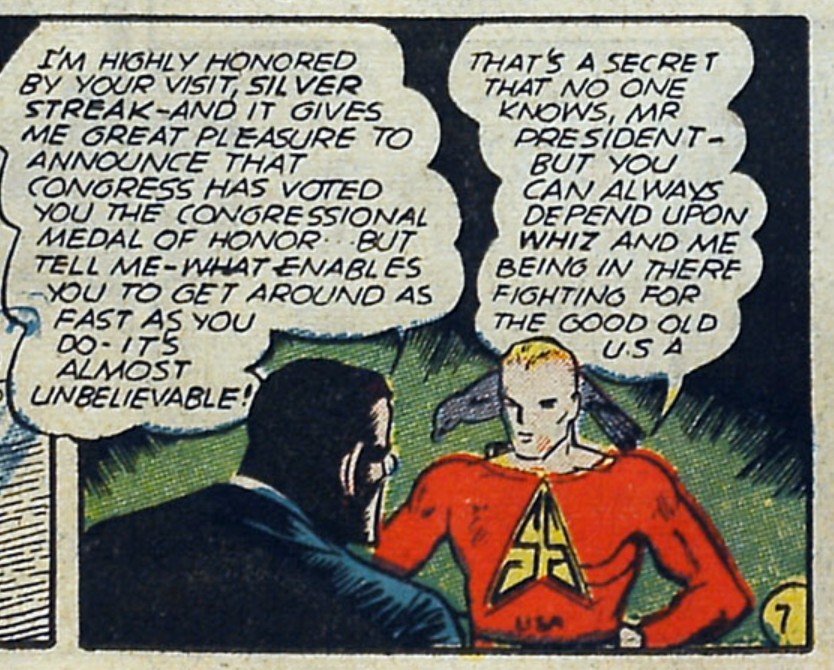
    Finally, Silver Streak and Whiz get to meet FDR to get his congratulationss, plus a Congressional Medal of Honor!

    Categorized in: Body (Jaws), Elements (Iron), Origins (Robots) 

  • MINOR SUPER-VILLAIN 925: THE IRON-JAW

    MINOR SUPER-VILLAIN 925: THE IRON-JAW

    (Silver Streak Comics 009, 1941)

    The US is being rocked by a series of explosions targeting munitions factories and other facilities contributing to national defense, and not even the speed of the Silver Streak is enough to combat the organizational skills and coordination of the mysterious mastermind behind them. It is only by sheer coincidence that he happens upon an imperilled security guard from a plant in Georgia and learns from him that the men who blew up his workplace were under command of a mysterious figure called “Iron-Jaw” and that they all work for the “Axes Government”.

    Even with this information under his belt, the Silver Streak still loses two more factories to the Iron-Jaw before finally running down some of his men in Boston and discovering the secret of their great organizational abilities: a super-miniaturized (for the 40s) radio set used to relay orders to the Axes forces in America. By following the instructions coming from a captured unit, the Streak and Whiz are finally able to get the jump on the Iron-Jaw’s men and prevent the destruction of a plant in Pittsburgh, though the mastermind remains on the loose.

    The Iron-Jaw returns in Silver Streak Comics 010 with a new set of goals – the focus is now on shutting down media criticism of the Axes. To that end, the Silver Streak is drawn away via a report of a potential bombing in Chicago while Iron-Jaw is grabbing the real target, broadcaster Kitty Doyle, in NYC.

    This is Silver Streak we’re talking about here, so he returns in time to interrupt the kidnapping in progress. the mysterious Iron-Jaw is revealed to be a moderately cool-looking/ moderately goofy-looking/ fairly spiky humanoid robot. With a gold finish, no less – so much for thematic consistency.

    Though Iron-Jaw briefly gets the upper hand, even a super strong, very pointy robot is no match for the world’s fastest man and it takes a fatal header onto the streets of Manhattan below.

    Here’s something about the Iron-Jaw: in its first appearance, all it does is talk, while in its second it is completely mute. This dovetails interestingly with something that Kitty reports after its defeat, that investigation of the robot indicates that it was controlled by trans-oceanic radio waves originating from the Axes government. Which seems to indicate that the Iron-Jaw was merely operating as the mouth and hands of one or more spymasters in some comic book pastiche of Germany, which in turn means that this is one of the few times in Golden Age comics in which the villain gets away at the end!* Neat!

    *excluding all of the recurring villains who get away all the time, of course. 

    Finally, Silver Streak and Whiz get to meet FDR to get his congratulationss, plus a Congressional Medal of Honor!

    Categorized in: Body (Jaws), Elements (Iron), Origins (Robots)