The Curse of Skeleton Munroe

Category: calling card

  • SUPER-HERO FILE 006: THE ANGEL

    (Marvel Comics 001, 1939)

    A two-fisted vigilante in the Batman mode, the Angel was a big enough name in Marvel’s Golden Age comics that it would be kind of surprising that he has never really been revived post-Silver Age if not for the fact that his name was, and that the subsequent and ongoing popularity of the X-Men means that there was always a full “Angel” slot on the Marvel roster. On top of this (and probably because of this) the Angel was eventually revealed to be the mastermind behind the Scourge of the Underworld program, lending a villainous tarnish to his name that certainly contributed to his lack of a modern legacy.

    The Angel never really gets an origin in the Golden Age, and thanks to the fact that he was never brought back in any meaningful way, this persists until the Marvel 70th Anniversary books in 2009, when he is revealed to have grown up in a prison or something. It’s not better than just mysteriously having no origin at all, so I never internalized it.

    One thing that the Angel does have, however, is a calling card. Two of them, in fact, as he both signs his notes to police and criminals with a little drawing of an angel and also projects long-lasting shadow images of an angel onto nearby surfaces, this latter also being his only real super-power.

  • MINOR SUPER-VILLAIN 1000: THE MUMMY

    MINOR SUPER-VILLAIN 1000: THE MUMMY

    Number 1000!!*

    (Lightning Comics v1 005, 1941)

    The Old Man of the Pyramids summons (F)lash Lightning to his thundercloud lair to warn him about trouble at Midton College, and he is right, as can only be expected of a wise old oracular father figure. This particular trouble is called Professor Vatz and is a professor of chemistry who is ready to give up academia for the heady world of supercrime.

    Vatz’s new career is founded on two inventions: his “Hotlight,” a ray gun that seems to spit out both bright light and great heat sufficient to kill a regular person or knock out a superhuman figure like Lightning, and a radium compound that makes ordinary cloth into a form of armour resistant to conventional attack. Vatz decides to apply this solution to mummy wrappings, and while I can kind of see that being a way to ensure that the his armour is applied as close to his body as possible, but just what his justification is for using wrappings from an actual mummy is completely inscrutable to me.

    As always, mummy wrappings are a fantastic look and they are only enhanced by the fact that Vatz either chooses to leave the little flyaway portions of his hair sticking out of the sides or simply does not care that they are. It’s some very very strong bald guy energy and perhaps the most significant addition to the mummy look in two thousand years.

    The newly-fledged Mummy recruits a few gangsters and goes on a mild crime spree but is soon tracked down by a recovered Lightning. This leaves the problem of the Mummy’s invincibility to solve, and Lightning does so with aplomb: if the wrappings are the vehicle for the invulnerability, simply remove the wrappings before applying violence.

    (please note that the Mummy had a calling card all ready to go, and it’s a cute one. He only ever gets to use it the once, however)

    The Mummy returns in Lightning Comics v1 006, in what is effectively a bottle episode. Professor Vatz, given far both too much credit for a rapid reformation and unfettered access to the prison laboratory, is able to recreate his radium solution and take over – but not actually escape – the prison he has been locked up in.

    The only thing that the Mummy seems to be unable to replicate in prison is his Hotlight. Instead, he sports a much cooler “Nitro Gun” that shoots explosive pellets. He is also able to whip up a “Lightning Arrester” to drain the electric energy from Lash Lightning’s body when he inevitably turns up to foil the Mummy’s plans.

    Despite the fact that he is able to disable Lightning and throw him into the prison gas chamber, the Mummy does not account for the possibility that his lightning powers might return to him and allow him to escape. He is soon recaptured in the exact same manner as he was in their first encounter and I must say that the fact that Professor Vatz failed to account for this – perhaps by means of a tricky little knot or fastener – really lowers him in my estimation.

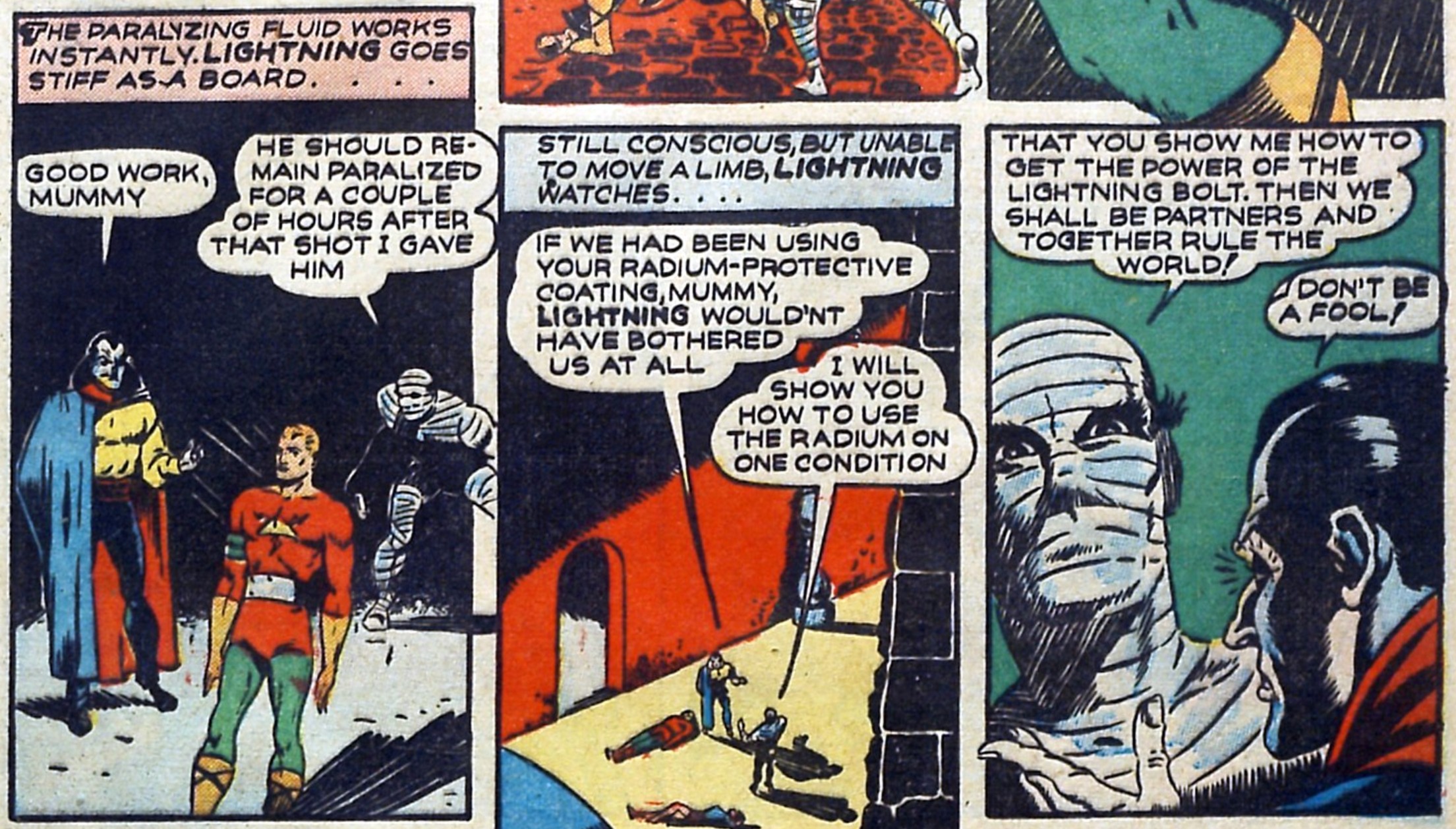
    In the Mummy’s final appearance, in Lightning Comics v2 001, he is broken out of a prison hospital by Lash Lightning’s new archfoe Mastermind, who is hoping to learn the secret of Professor Vatz’s radium coating in order render himself immune to harm. 

    The Mummy makes three key mistakes in his dealings with Mastermind: 1) he tries to negotiate after the initial deal has been struck, proposing that the radium formula be revealed in exchange for the secret to Mastermind’s own ability to command lightning. This might work if the Mummy were dealing with a reasonable person, but Mastermind is a super-villain, a class of inherently unreasonable people. 2) The Mummy escalates the confrontation to a physical one without first applying the radium solution and thus rendering himself immune to harm, and 3) he gets himself obliterated by a lightning bolt. he does therefore mess up Mastermind’s plans by taking his formula to the grave, but it must be cold comfort when one is a smouldering corpse.

    Farewell, the Mummy. You weren’t a very good super-villain but you were an entertaining one.

    Categorized in: Accessories (Anti-Hero; Heat Rays), Day Jobs (College Professors), Supranormal Beings (Mummies)

    *technically Fang Ryan is number 1000 and the Mummy is number 999, but I like mummies more than snake-themed gangsters so I fudged it for the sake of the round number.

  • MINOR SUPER-HERO ROUND-UP 103

    Soon there will be more minor super-heroes than there are humans for them to protect.

    the Sentinel:

    In 1783, on the Boston Common, the newly-minted Spirit of America charges a cannon with the “powders of patriotism” in anticipation that someday a champion will be needed to defend the new nation from destruction. Finally, in 1941 (the Civil War not, apparently, being enough of a reason), the cannon fires on its own and releases the Sentinel, mystic champion of the American people.

    As one might expect, the Sentinel is broadly superhuman: he can fly, is super strong and is immune to most harm. He also has a halo of fire that he can disappear into and shrink to a tiny flame, effectively rendering him invisible and allowing him to vex friend and foe alike with his comings and goings. Oddly, he has no other control over fire. (Liberty Scouts Comics 003, 1941)

    Doctor Nemesis:

    Doctor Nemesis is really Dr Jim Bradley, intern at Mercy Hospital in an unnamed city (that is probably meant to be NYC but later retconned as San Francisco) who has developed a foolproof truth serum and decided to keep it to himself rather than risk criminals getting their hands on it – presumably the concern is that they would use it to learn bank vault combinations and other secret information. Since he himself continually runs into situations in which a foolproof truth serum is a handy way to solve a crime, Bradley adopts a costumed identity and sets out to achieve a better tomorrow via a series of injections. 


    Doctor Nemesis might just be the most calling card-using super-person who we have yet encountered. He hands out at least four of them in his first adventure alone.

    Doctor Nemesis has a pretty simple crimefighting routine: identify a potential injustice and then drug everyone involved until he has a clear idea of who is responsible, then beat them up and have them give a drugged confession in front of a police witness. The police in turn are perfectly happy to receive these confessions that they technically haven’t coerced from people, though there has to be a clever defense attorney somewhere in Unnamed City who is just waiting to get a Doctor Nemesis client so that they can really dig into the admissibility of admissions given under the influence of mysterious vigilante juice.

    It’s been a while since we have encountered a character who was later revived and incorporated into the Battle-Axis, Marvel’s team of disaffected public domain Golden Age super-heroes who went over to the Nazis, but Doctor Nemesis here is one of them under the technically-but-not-really more badass name of Dr Death. As always, it’s hard to say just who got done dirtiest by Roy Thomas when he was assembling the Battle-Axis roster but Doctor Nemesis is certainly a candidate, if only because he doesn’t even have the Human’s Meteor’s flimsy “I’m Irish American and fuck the British” or the Spider Widow’s “the Commies killed my husband” excuses. Instead, he simply implies that the Nazis are paying him well.

    Subsequent writers (specifically Matt Fraction, if I have things right) clearly thought that Doctor Nemesis was worth revisiting. He was given a long career as a Nazi hunter to counteract his short career as a Nazi and briefly became a core X-Man, though nowadays every time I look up what he’s up to it seems that he has become weirder and more peripheral to the action than the last. (Lightning Comics v1 006, 1941)

    Lash Lightning **UPDATE**:

    I haven’t been very careful to delineate whether the character has been going by “Flash” or “Lash” Lightning due to the fact that it profoundly does not matter (they just call him “Lightning” in the stories themselves, for instance) but I might as well make note of this, the issue in which the actual change was made. (Lightning Comics v2 002, 1941)

    Marvo the Magician **UPDATE**:

    Up until the exact point pictured above, Marvo the Magician was unique among magical comic book super-heroes, for though many of them (including Zatara, the big cheese himself) are said to be using their magic to create illusions and fool the minds of others, it is all demonstrably lies (or more charitably a different definition of “illusion” than I am using), as they all produce material effects in the world. Only pure, beautiful Marvo can claim that he uses illusions and nothing more to frighten and confound his foes, and I have been checking.

    That is, up to this issue, when Marvo creates the “illusion” of an ocean liner (complete with a crooked sailor who kidnaps her and hands her over to pirates!) that the woman he is helping proceeds to board and sail away on. Unless the implication is that she has been so convinced that the liner exists that she has swum or perhaps hovered her way to her destination (well, part way to her destination), the inescapable fact is that this ship is more than a mere illusion. Nothing is certain in this wicked world, folks. (Lightning Comics v2 003, 1941)

  • MINOR SUPER-HERO ROUND-UP 102

    MINOR SUPER-HERO ROUND-UP 102

    You won’t believe what I just found: more super-heroes!

    the Liberty Scouts:

    When fascist forces armed with high-tech weaponry begin attacking targets calculated to cripple US war capacity, they are repeatedly driven away by a trio of anonymous heroes who leave behind Liberty Bell calling cards. Both the fascists and US officials are eager to learn just who these so-called Liberty Patriots are, but President Roosevelt is the one who actually gets to find out, thanks to his association with patriotic millionaire Patrick Henry.

    Henry drives FDR out to his country estate, Liberty House, where he introduces him to three mysterious youths beginning with Smokey, the inventive genius of the group, and whose amphibious tank is counted as a land vehicle for the air/sea/land theme that the three have going on.

    Skipper, “the best sailor on the Seven Seas,” is also clearly the group member who is most invested in the paramilitary aspect of the whole operation. He has a super-powerful miniature submarine.

    Finally, we have Strut, the youngest of the group. He’s got a souped up fighter plane called the Comet (initially the only named super vehicle in the bunch, though the tank is later named Ironsides), plus a cool-ass wingsuit. He’s also the only one of the three with any discernible personality, even if it’s “won’t shut up about cherry pie.”

    So just how does Mr Henry know these three youngsters and why are they living in his house? Because they are his own sons! He loves his country so much that he has moulded his children into weapons designed to defend it, and the President loves it. (Liberty Scouts Comics 002, 1941)

    The Liberty Scouts eventually change their name to the Liberty Guards after the Boy Scouts of America complain about their monopoly on the word “scout” being infringed.

    Categorized in: Accessories (Calling Card Leavers), Groups, Origin (Patriotic Heroes)

    Man of War:

    Impatient with the slow progress of World War II, the god Mars decides to create a divine being imbued with the powers of the Greco-Roman pantheon and send them down to help the Axis conquer Europe faster and with more bloodshed. He gifts his champion with “the Strength of Hercules, the Speed of Mercury, the Wisdom of Zeus” (making him about 0.5 of a Captain Marvel) and arms him with the infinitely sharp Sword of Mars before sending him on his way.

    In a legitimately funny twist, Mars forgets to account for the rotation of the Earth during the presumably-lengthy demigod-crafting process and shoots his new creation at Dayton, Ohio (okay, at one of the more than thirty Daytons in the United States. Or in another city that has an unrelated Dayton Munitions Factory. Probably Dayton, Ohio, though) instead of Berlin or wherever he intended for it to go. Thus, Man of War (as he calls himself) is instantiated in the “peace-loving nation” of the USA and is dedicated to virtuous, defensive warfare instead of awful slaughter in the name of power-hungry politicians (insert joke about the US war machine here. Man of War must have had a rough go of things as the 20th Century progressed).

    So what are the powers of the gods? Mostly generic super strength and invulnerability, though Man of War is able to breathe and move freely underwater thanks to the gifts of Neptune. He also has one bespoke power gifted upon him by Mars: to disappear or appear in any explosion, up to and including those created when bullets are fired (which would be a bit more useful if he weren’t already bulletproof). (Liberty Scouts Comics 002, 1941)

    In Man of War Comics 001, Mars reveals Man of War’s weakness to the dictator Luko: that he is powered by rays emitted by the planets of the Solar System, and that confining him in a lead-lined chamber will block those rays and render him merely human. This nearly works, but as the Sword of Mars is not planet-powered he is soon able to carve his way free.

    Categorized in: Accessories (Swords), Activities (War), Origins (Demigods)

    Vapo-Man:

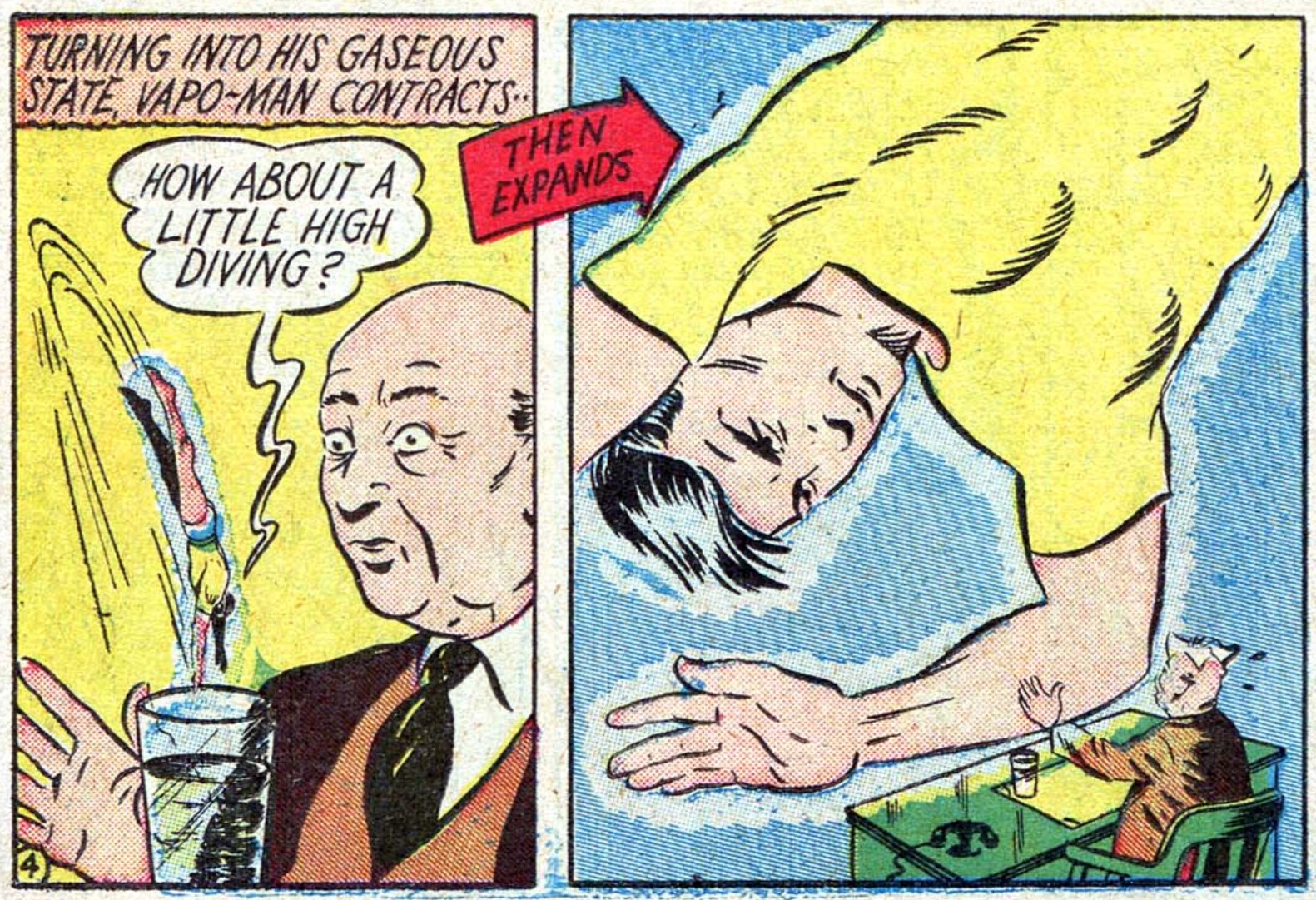
    Bradford “Brad” Cole is a chemist assisting at the laboratory of Dr Kreiner, who in turn is performing unspecified research that is evidently valuable enough to the US government that some fascist saboteurs blow it up. Cole, unlike Kreiner, is lucky enough not to be exploded but instead is showered with a randomized mix of chemicals that change him into a man of vapour.

    The dying Kreiner explains that he is now a chemical man, which is apparently something that chemists have been trying to create for centuries. He extracts a promise from Cole that he will use this power to fight evil, and saddles him with the terrible name of Vapo-Man just before dying, thus ensuring that Crawford can never change it without feeling very guilty.

    As Vapo-Man, Crawford can change all or part of his size, can fly, has at least some super strength, can disintegrate matter with a touch, and can become intangible at will. All of this adds up to make him feel a lot like a more mystical character like Phantasmo, though he lacks the charm to support it. (Liberty Scouts Comics 002, 1941)

    Categorized in: Elements (Steam and Mist), Origins (Chemical Mutates), Powers (Intangibility)

    Fire-Man:

    Jim, a man working for the Civilian Conservation Corps in Utah sets out to battle the latest in a series of mysterious fires and finds himself being kidnapped by a mysterious silver-clad giant.

    This turns out to be Gaston, henchman to a fellow known only as the Mad Scientist. The Mad Scientist has a dream: to incinerate a human in such a way that they remain alive and coherent but composed of gaseous rather than solid matter, and Jim is his latest unwilling experimental subject. Luckily for Jim, this time it works, and the only real change appears to be a significantly lower density, such that he is obliged to wear a weighted uniform (that doubles nicely for a super suit, natch) in order to keep from floating away. Even with it on, he light enough to leap around as if he were flying.

    Jim is otherwise an ordinary human, but a miscalculation on the part of the Mad Scientist (dunking him in a vat of chemicals while trying to destroy him) also endows him with super strength.

    Finally, Jim’s new metabolism causes him to give off fire-retardant gasses as a part of his respiration, which is handy, as he chooses to go by Fire-Man, meaning that he, alongside the Mad Scientist’s niece Nancy, ends up fighting a lot of arsonists (Liberty Scouts Comics 002, 1941)

    Categorized in: Elements (Fire), Origins (Electrical Mutates), Powers (Decreased Density)

  • MINOR SUPER-HERO ROUND-UP 102

    You won’t believe what I just found: more super-heroes!

    the Liberty Scouts:

    When fascist forces armed with high-tech weaponry begin attacking targets calculated to cripple US war capacity, they are repeatedly driven away by a trio of anonymous heroes who leave behind Liberty Bell calling cards. Both the fascists and US officials are eager to learn just who these so-called Liberty Patriots are, but President Roosevelt is the one who actually gets to find out, thanks to his association with patriotic millionaire Patrick Henry.

    Henry drives FDR out to his country estate, Liberty House, where he introduces him to three mysterious youths beginning with Smokey, the inventive genius of the group, and whose amphibious tank is counted as a land vehicle for the air/sea/land theme that the three have going on.

    Skipper, “the best sailor on the Seven Seas,” is also clearly the group member who is most invested in the paramilitary aspect of the whole operation. He has a super-powerful miniature submarine.

    Finally, we have Strut, the youngest of the group. He’s got a souped up fighter plane called the Comet (initially the only named super vehicle in the bunch, though the tank is later named Ironsides), plus a cool-ass wingsuit. He’s also the only one of the three with any discernible personality, even if it’s “won’t shut up about cherry pie.”

    So just how does Mr Henry know these three youngsters and why are they living in his house? Because they are his own sons! He loves his country so much that he has moulded his children into weapons designed to defend it, and the President loves it. (Liberty Scouts Comics 002, 1941)

    The Liberty Scouts eventually change their name to the Liberty Guards after the Boy Scouts of America complain about their monopoly on the word “scout” being infringed.

    Categorized in: Accessories (Calling Card Leavers), Groups, Origin (Patriotic Heroes)

    Man of War:

    Impatient with the slow progress of World War II, the god Mars decides to create a divine being imbued with the powers of the Greco-Roman pantheon and send them down to help the Axis conquer Europe faster and with more bloodshed. He gifts his champion with “the Strength of Hercules, the Speed of Mercury, the Wisdom of Zeus” (making him about 0.5 of a Captain Marvel) and arms him with the infinitely sharp Sword of Mars before sending him on his way.

    In a legitimately funny twist, Mars forgets to account for the rotation of the Earth during the presumably-lengthy demigod-crafting process and shoots his new creation at Dayton, Ohio (okay, at one of the more than thirty Daytons in the United States. Or in another city that has an unrelated Dayton Munitions Factory. Probably Dayton, Ohio, though) instead of Berlin or wherever he intended for it to go. Thus, Man of War (as he calls himself) is instantiated in the “peace-loving nation” of the USA and is dedicated to virtuous, defensive warfare instead of awful slaughter in the name of power-hungry politicians (insert joke about the US war machine here. Man of War must have had a rough go of things as the 20th Century progressed).

    So what are the powers of the gods? Mostly generic super strength and invulnerability, though Man of War is able to breathe and move freely underwater thanks to the gifts of Neptune. He also has one bespoke power gifted upon him by Mars: to disappear or appear in any explosion, up to and including those created when bullets are fired (which would be a bit more useful if he weren’t already bulletproof). (Liberty Scouts Comics 002, 1941)

    In Man of War Comics 001, Mars reveals Man of War’s weakness to the dictator Luko: that he is powered by rays emitted by the planets of the Solar System, and that confining him in a lead-lined chamber will block those rays and render him merely human. This nearly works, but as the Sword of Mars is not planet-powered he is soon able to carve his way free.

    Categorized in: Accessories (Swords), Activities (War), Origins (Demigods)

    Vapo-Man:

    Bradford “Brad” Cole is a chemist assisting at the laboratory of Dr Kreiner, who in turn is performing unspecified research that is evidently valuable enough to the US government that some fascist saboteurs blow it up. Cole, unlike Kreiner, is lucky enough not to be exploded but instead is showered with a randomized mix of chemicals that change him into a man of vapour.

    The dying Kreiner explains that he is now a chemical man, which is apparently something that chemists have been trying to create for centuries. He extracts a promise from Cole that he will use this power to fight evil, and saddles him with the terrible name of Vapo-Man just before dying, thus ensuring that Crawford can never change it without feeling very guilty.

    As Vapo-Man, Crawford can change all or part of his size, can fly, has at least some super strength, can disintegrate matter with a touch, and can become intangible at will. All of this adds up to make him feel a lot like a more mystical character like Phantasmo, though he lacks the charm to support it. (Liberty Scouts Comics 002, 1941)

    Categorized in: Elements (Steam and Mist), Origins (Chemical Mutates), Powers (Intangibility)

    Fire-Man:

    Jim, a man working for the Civilian Conservation Corps in Utah sets out to battle the latest in a series of mysterious fires and finds himself being kidnapped by a mysterious silver-clad giant.

    This turns out to be Gaston, henchman to a fellow known only as the Mad Scientist. The Mad Scientist has a dream: to incinerate a human in such a way that they remain alive and coherent but composed of gaseous rather than solid matter, and Jim is his latest unwilling experimental subject. Luckily for Jim, this time it works, and the only real change appears to be a significantly lower density, such that he is obliged to wear a weighted uniform (that doubles nicely for a super suit, natch) in order to keep from floating away. Even with it on, he light enough to leap around as if he were flying.

    Jim is otherwise an ordinary human, but a miscalculation on the part of the Mad Scientist (dunking him in a vat of chemicals while trying to destroy him) also endows him with super strength.

    Finally, Jim’s new metabolism causes him to give off fire-retardant gasses as a part of his respiration, which is handy, as he chooses to go by Fire-Man, meaning that he, alongside the Mad Scientist’s niece Nancy, ends up fighting a lot of arsonists (Liberty Scouts Comics 002, 1941)

    Categorized in: Elements (Fire), Origins (Electrical Mutates), Powers (Decreased Density)

  • MINOR SUPER-VILLAIN 978: THE BLACK LEGION

    (The Flame 007, 1941)

    The Black Legion is a mysterious cult who recruit members by sending them a sternly-worded letter through the mail. Presumably they have some way of researching their potential inductees to screen for susceptibility to peer pressure and so forth, because the initiation process involves carving a large letter D into your own chest while swearing fealty to the cult’s leader, the skull-masked Master of Death.

    The Black Legion takes its vows seriously, as member Graves finds when he tries to leave and is brutally murdered. Even Linda Dale, the niece of Black Legion co-leader Emma Dale, is almost killed when she asks a few too many questions about the secret ceremonies taking place in her basement on a regular basis. Lucky for her, then, that she has just become a member of the Flame’s supporting cast, as has Pug, the newest prospective member of the cult.

    So just what is the deal with the Black Legion? What ethos they espouse or dark deity they serve? What, in short, is the point of all this? As the Flame learns after busting the place up, it’s all a huge scam. Emma Dale and the Master of Death have been recruiting gullible fools to the organization and then pocketing the mandatory membership fees, and making even more money off of sales of the mandatory green velour robes. It’s a shocking indictment of the state of comic book cults.

    Categorized in: Colours (Black), Fraud (Con Artists), Misc (Cults)

  • MINOR SUPER-VILLAIN 976: DOCTOR DROOL

    (The Flame 004, 1941)

    Doctor Drool* is a medical doctor who was recently executed for an unspecified crime. He has, however, planned for this eventuality, and his assistant Scully is on-hand to collect him from his mausoleum at the earliest opportunity so that he can administer a revivification treatment to him. Thus restored, Doctor Drool swears revenge on the Judge, District Attorney and jury who convicted him, a fourteen-person death list that would eventually grow to include the Flame as number fifteen.

    Doctor Drool’s real distinction is that his story is serialized over three issues, namely The Flame 004 and 005 and Big 3 003. Sadly, this is not the bold departure from the rapidly-solidifying episodic formula that it could be.

    *his actual surname. Heavy contender for the worst name in comics. 

    Perhaps the best aspect of this extended story is the fact that Drool is able to make many more on-panel attempts at revenge than is typical. This really drives home the terror of the situation for his victims, particularly given his method of murder: sending threatening notes, etc to drive them into a frenzy of fear and then firing a gun loaded with blanks at them to incite a heart attack (a method of murder not without its risks, as two strong-hearted jurists do survive). Please also note the signature on the notes is a stylized representation of Drool’s own tombstone.

    The repetition doesn’t work quite as well in all aspects of the story, alas. For instance: the Flame knows that Drool is operating out of his old home (the unnervingly-named Drool Mansion) though he cannot find his secret lab for most of the story. This leads to him searching the place on five separate occasions, and on three of those he falls for the same trick in which Drool has set up a dummy of himself that sets off a deathtrap when the Flame attacks it.

    (that said, there is a charming bit in which the Flame finds two mice in the mansion’s cellar on his first visit there and reports on the status of their growing family every time he revisits the place, until Drool Mansion is finally destroyed and the now eight-strong mouse family move house en mass. There’s also a recurring bit in which the Flame scares a pair of cemetery workers that is not quite as charming but still fun)

    After maybe a month in-comic, Drool is eventually stopped after he falls off of a building and ironically dies of fright despite being caught by the Flame before he could hit the ground. And since the police never really believed that Doctor Drool was behind the killings, the Flame just tosses him back into his coffin as if he had never went on a killing spree at all. I reckon that there is a pretty high chance that he would’ve been brought back again at least one more time if the next issue didn’t mark the start of the New Look Flame under a different creative team. Scully is still at large, after all, and we never learn where those mice end up!

    JUDGE AND JURY REVENGE KILLER SCORE: 5/15

    Categorized in: Accessories (Calling Cards), Doctors and Professors, Origin (Faked Own Death)

  • MINOR SUPER-HERO ROUND-UP 095

    There really are a lot of these guys, aren’t there?

    Hurricane:

    As presented, Hurricane is a real mythological mash-em-up: “son of Thor” but also “last descendant of the Ancient Greek immortals,” and arch-enemy to the Roman god Pluto. Pantheism, baybee!

    Hurricane’s whole deal is in being super fast, like mythically fast. The fact that he has a divine opponent is quite nice, in that it offsets some of the tendency of speedster characters to walk all over their opponents as can be seen above.

    As befits a divine being with such a diverse background, Hurricane also has a Swiss Army Knife of as-needed powers, including weather control, flight, invisibility and changing into his super-suit in a flash of radiance. His signature (non-speed-related) power is the ability to stick a couple of little wings onto an object or person to give them the power of super-fast flight while looking cute.

    Hurricane is one of several older characters to eventually be retconned as former identities of Makkari of the Eternals, but we will deal with that if we ever get to the mid-70s. (Captain America Comics 001, 1940)

    Categorized in: Origin (Deities), Powers (Super Speed, Various), Weather (Hurricanes)

    Tuk:

    Speaking of retcons, here we have Tuk, Caveboy, hero of the year 50 000 BCE! Orphaned as a baby and raised by Ak, last of the Shaggy Ones, Tuk (referred to throughout as one of the Hairless Ones, natch) is the child of two mysterious figures who Ak believed to be some sort of divine being, but who refer to themselves as exiles from a place called “Attilan.” 

    The real-world explanation for this is surely that Jack Kirby liked the idea of an ancient and mysterious super-kingdom with a name that could have eventually mutated into “Atlantis” over time and used it more than once. The rise of continuity perverts and the fact that Kirby also used Attilan as the name of the Inhumans’ home city means that Tuk has now been given the status of first generation Inhuman offspring, and his eventual interbreeding with early humanity is part of the reason that they are so genetically flexible and keep developing super powers all over the place.

    Tuk is joined on his travels by Tanir, a Cro-Magnon man and the very first archery-based super-adventurer, at least chronologically. While Tuk has been minorly enshrined in Marvel Comics history, Tanir has largely been ignored, and that’s a shame. (Captain America Comics 001, 1940)

    Categorized in: Origin (Heroes of the Past, Human Offshoots), Power (Weapons Masters (Bow))

    Father Time:

    It’s Father Time! Possibly my favourite under-used Golden Age Marvel super-hero!

    Father Time is really Larry Scott, a man whose father John is found guilty of murder and fast-tracked for execution, quite possibly because he keeps saying that he is innocent. In a series of events that hopefully ends up haunting that judge for the rest of his days, Larry manages to acquire the evidence to prove that his father is innocent, only to arrive mere moments too late to save him.

    Larry’s takeaway from all this is that time is always on the side of crooks rather than the law, and so he sets out to re-balance things by adopting the costumed persona of Father Time and beating criminal ass. It’s a simple but effective origin, if much more pro-legal system than one might otherwise expect. 

    Some notable Father Time innovations: the use of a scythe as both a throwing weapon and urban traversal aid, an extremely unique mask design (eyebrow to upper lip with a full nose cutout!) complimenting a decent over-all look, and the use of a calling card in the form of a clock face with an attached skull and crossbones. (Captain America Comics 006, 1941)

    Categorized in: Abstract Concepts (Time), Famous Figures (Father Time), Origin (Motivated by Loss)

    Spy Fighter **UPDATE**:

    Despite the fact that I am a spreadsheet-keeping, blog-writing, categorization fan, I do in fact think that a slavish dedication to continuity can stifle creativity. So what if the details of a character’s backstory are inconsistent across appearances as long as it’s all fun, right? That said… this “Spy Fighter” episode is set in 2041 CE, while the first one is set in 1997 CE, meaning that poor Saber here has been battling the enemies of Greater America for 44 long years. He still looks great, though. (Fight Comics 012, 1941)

    While Fight Comics 013 continues this trend with a story set in 2042 (45 years!), the final three Spy Fighter stories abandon the science fiction and super-hero aspects of the character altogether. The Spy Fighter in Fight Comics 014 through 016 is effectively a separate character who is a non-powered espionage agent supporting the Allied forces in Egypt and the surrounding region – a true fall from grace for an interestingly weird character.

  • PROBLEMATIC ROUND-UP 008

    Once again I must regretfully inform you that some comic books are problematic. Like, racially.

    the Laughing Hyenas: 

    Hey, it’s our first racial hate group, and I think I’m just going to preemptively file these under “problematic” because they’re a) not fun to talk about and b) necessitate talking about hate-crimes even if I, for example, choose not to use the panels with lynchings in them.

    The Laughing Hyenas are actually kind of a hate group by proxy, as they have been hired to keep the Black residents of the geographically-nonspecific town of Souda “in line” by murdering one of them every once in a while, and have been doing so frequently enough and/or long enough that even the local folks willing to volunteer for such a task have gotten sick of it, so boss Bull Karson had to import some Chicago toughguys to do his dirty work for him.

    Oddly, given the sheer volume of murder that the Laughing Hyenas were perpetrating, the Silver Streak doesn’t actually bring them in to the authorities ore even extra-judiciously kill them. Instead, he just dumps them on a slow boat to Rangoon. (Silver Streak Comics 013, 1941)

    the Modern Thief of Bagdad:

    Ali Hassan, aka the Modern Thief of Bagdad, is an Iraqi thief who comes to NYC to steal the Konoor Diamond, and as a result comes into conflict with Captain Battle and his young protege Hale Battle. A simple story that would ordinarily wrap up quite quickly, but this is a book-length yarn, which means that there is an extended chase sequence that occupies the 28 pages between the theft and Hassan’s arrival back in Baghdad. Some highlights:

    Chapter 1, “The Modern Thief of Bagdad!”: Hassan steals the gem, then give Battle and Hale the slip in Chinatown. Olyra, the mysterious guardian of the Konoor Diamond, is kidnapped.

    Chapter 2, “Perils of the Sargasso Sea!”: Hassan’s submarine becomes mired in sargassum and is attacked by a sea monster. Battle and Hale kill the beast. Hassan and his men dress up like ghost pirates. Olyra is rescued and then kidnapped again.

    Chapter 3, “Lost in the Underground World!”: Hassan’s plane crashes in Africa and he and Olyra are captured by cannibals (lil’ bonus racism for you there). Battle and Hale rescue them before being betrayed and dumped in a pit of quicksand. There is a brief interlude in an cave system full of monsters before it suddenly blows up. Hassan and his men dress up like ghosts. Olyra is rescued.

    Chapter 4, “House of Giants”: Battle & co track Hassan to a castle in Tibet, where they are captured and subjected to a shrink ray. They have various adventures as tiny men before resuming their original size. Olyra is kidnapped.

    I would call Hassan himself… an average amount of racist. He’s depicted in much the same generically foreign vein as I’ve seen in a South American president or a Basque fisherman (or indeed a Cape Breton fisherman at least once). As a villain, he’s pretty great: bombastic, treacherous, fond of leaving boastful notes for his enemies. If it was just him I might have skipped making this a Problematic Round-Up entry.

    It’s not just him, however, and once the story hits Chapter 5, “Magic Spell of the Arabian Nights” we get a real dose of Orientalism full in the face, as our heroes touch down in a Baghdad straight out of the Arabian Nights, complete with a wicked ruler (confusingly named Emperor Pasha Golu) who Hassan has been working for the whole time.

    It’s such a pastiche of a city, in fact, that Hale and Olyra just kind of stumble across Aladdin’s lamp and flying carpet while they are escaping from a dungeon. I suppose that all this is at least a little thematically appropriate, as Ali Hassan, the Modern Thief of Bagdad, is a reference to a movie that is a remake of a different movie that is itself a pastiche of the Arabian Nights.

    The Modern Thief of Bagdad meets his end in a pretty underwhelming manner: Captain Battle ducks as he swings a sword at him and he falls off of a balcony. A pretty terrible way to go for a villain who clearly thought that he was very cool, to be honest. The evil Pash Golu also meets his end in the process, leaving Olyra free to reveal that she is actually Olyria, Princess and true ruler of Bagdad. A truly impenetrable alias! 

    Finally, such is Hale Battle’s hunger for souvenirs that he uses his third genie with to acquire a replica of the diamond for his collection, even though for my money the real deal Lamp of Aladdin with one wish left on it would be the ultimate keepsake. (Captain Battle Comics 002, 1941)

    the King:

    The King is a fellow who gains control over a Romani group by showing them a… birthmark? tattoo? that proves his right to rule and that looks so intensely falsifiable that I am shocked there isn’t some sort two-factor authentication, or even a code phrase. And just what is is reason for exerting this control? Why, so that he can turn his new subjects into a child kidnapping ring. You can see how I would consider this problematic.

    The King is of course not the real ruler, that is not a real skull birthmark and he is no match for Dynamic Man. He turns out to be a crooked newspaper publisher named Brower who loves money more than making good plans to acquire it. (Dynamic Comics 002, 1941)

    the Dragon:

    The Dragon is a very ordinary Yellow Peril villain who is after some top secret bomber plans on behalf of an unspecified Asian nation. There are exactly four interesting things about him: 1) he is the first villain faced by Samson and David in their brief New Look era before they disappear along with most of Fox Features’ other characters during their financial trouble. 2) he is a classic calling card leaver in the form of a claw mark on the chests of men he has killed

     3) he works alongside his sister Orchid, which isn’t the rarest arrangement but is always fun to note

     4) he has these stone lions outside of his HQ that grab intruders as they come through. It’s a fun trap but never actually explained: are they some sort of mechanism, or demonic magic like the caption box suggests?

    Much of the issue in questioned is concerned with Samson chasing the Dragon and Orchid around. Once he catches up to them it’s all over. (Fantastic Comics 022, 1941)

  • PROBLEMATIC ROUND-UP 008

    Once again I must regretfully inform you that some comic books are problematic. Like, racially.

    the Laughing Hyenas: 

    Hey, it’s our first racial hate group, and I think I’m just going to preemptively file these under “problematic” because they’re a) not fun to talk about and b) necessitate talking about hate-crimes even if I, for example, choose not to use the panels with lynchings in them.

    The Laughing Hyenas are actually kind of a hate group by proxy, as they have been hired to keep the Black residents of the geographically-nonspecific town of Souda “in line” by murdering one of them every once in a while, and have been doing so frequently enough and/or long enough that even the local folks willing to volunteer for such a task have gotten sick of it, so boss Bull Karson had to import some Chicago toughguys to do his dirty work for him.

    Oddly, given the sheer volume of murder that the Laughing Hyenas were perpetrating, the Silver Streak doesn’t actually bring them in to the authorities ore even extra-judiciously kill them. Instead, he just dumps them on a slow boat to Rangoon. (Silver Streak Comics 013, 1941)

    the Modern Thief of Bagdad:

    Ali Hassan, aka the Modern Thief of Bagdad, is an Iraqi thief who comes to NYC to steal the Konoor Diamond, and as a result comes into conflict with Captain Battle and his young protege Hale Battle. A simple story that would ordinarily wrap up quite quickly, but this is a book-length yarn, which means that there is an extended chase sequence that occupies the 28 pages between the theft and Hassan’s arrival back in Baghdad. Some highlights:

    Chapter 1, “The Modern Thief of Bagdad!”: Hassan steals the gem, then give Battle and Hale the slip in Chinatown. Olyra, the mysterious guardian of the Konoor Diamond, is kidnapped.

    Chapter 2, “Perils of the Sargasso Sea!”: Hassan’s submarine becomes mired in sargassum and is attacked by a sea monster. Battle and Hale kill the beast. Hassan and his men dress up like ghost pirates. Olyra is rescued and then kidnapped again.

    Chapter 3, “Lost in the Underground World!”: Hassan’s plane crashes in Africa and he and Olyra are captured by cannibals (lil’ bonus racism for you there). Battle and Hale rescue them before being betrayed and dumped in a pit of quicksand. There is a brief interlude in an cave system full of monsters before it suddenly blows up. Hassan and his men dress up like ghosts. Olyra is rescued.

    Chapter 4, “House of Giants”: Battle & co track Hassan to a castle in Tibet, where they are captured and subjected to a shrink ray. They have various adventures as tiny men before resuming their original size. Olyra is kidnapped.

    I would call Hassan himself… an average amount of racist. He’s depicted in much the same generically foreign vein as I’ve seen in a South American president or a Basque fisherman (or indeed a Cape Breton fisherman at least once). As a villain, he’s pretty great: bombastic, treacherous, fond of leaving boastful notes for his enemies. If it was just him I might have skipped making this a Problematic Round-Up entry.

    It’s not just him, however, and once the story hits Chapter 5, “Magic Spell of the Arabian Nights” we get a real dose of Orientalism full in the face, as our heroes touch down in a Baghdad straight out of the Arabian Nights, complete with a wicked ruler (confusingly named Emperor Pasha Golu) who Hassan has been working for the whole time.

    It’s such a pastiche of a city, in fact, that Hale and Olyra just kind of stumble across Aladdin’s lamp and flying carpet while they are escaping from a dungeon. I suppose that all this is at least a little thematically appropriate, as Ali Hassan, the Modern Thief of Bagdad, is a reference to a movie that is a remake of a different movie that is itself a pastiche of the Arabian Nights.

    The Modern Thief of Bagdad meets his end in a pretty underwhelming manner: Captain Battle ducks as he swings a sword at him and he falls off of a balcony. A pretty terrible way to go for a villain who clearly thought that he was very cool, to be honest. The evil Pash Golu also meets his end in the process, leaving Olyra free to reveal that she is actually Olyria, Princess and true ruler of Bagdad. A truly impenetrable alias! 

    Finally, such is Hale Battle’s hunger for souvenirs that he uses his third genie with to acquire a replica of the diamond for his collection, even though for my money the real deal Lamp of Aladdin with one wish left on it would be the ultimate keepsake. (Captain Battle Comics 002, 1941)

    the King:

    The King is a fellow who gains control over a Romani group by showing them a… birthmark? tattoo? that proves his right to rule and that looks so intensely falsifiable that I am shocked there isn’t some sort two-factor authentication, or even a code phrase. And just what is is reason for exerting this control? Why, so that he can turn his new subjects into a child kidnapping ring. You can see how I would consider this problematic.

    The King is of course not the real ruler, that is not a real skull birthmark and he is no match for Dynamic Man. He turns out to be a crooked newspaper publisher named Brower who loves money more than making good plans to acquire it. (Dynamic Comics 002, 1941)

    the Dragon:

    The Dragon is a very ordinary Yellow Peril villain who is after some top secret bomber plans on behalf of an unspecified Asian nation. There are exactly four interesting things about him: 1) he is the first villain faced by Samson and David in their brief New Look era before they disappear along with most of Fox Features’ other characters during their financial trouble. 2) he is a classic calling card leaver in the form of a claw mark on the chests of men he has killed

     3) he works alongside his sister Orchid, which isn’t the rarest arrangement but is always fun to note

     4) he has these stone lions outside of his HQ that grab intruders as they come through. It’s a fun trap but never actually explained: are they some sort of mechanism, or demonic magic like the caption box suggests?

    Much of the issue in questioned is concerned with Samson chasing the Dragon and Orchid around. Once he catches up to them it’s all over. (Fantastic Comics 022, 1941)