The Curse of Skeleton Munroe

Category: Tabu Wizard of the Jungle

  • MINOR SUPER-VILLAIN 997: THE ZOMBIE WITCH

    (Jungle Comics 024, 1941)

    The Zombie Witch (aka the Queen of the Zombies, aka Celie) is, as the name suggests, a witch with a penchant for raising the dead – often while they are still actively being mourned. She demonstrates a few other magic powers (e.g., scrying in a bowl of water, crocodile charming) but the zombie thing is her bread and butter.

    So what, specifically, does she want a bunch of reanimated corpses for? Well! I won’t say that it’s for a good reason but it certainly an innovative one: Celie has pulled a con on some unscrupulous fellows and convinced them that a worthless mountain is full of gold, and is now going to sell them zombie labour to work the mines. It’s not a bad way to use up surplus zombies, if you ignore the horror.

    Tabu of course objects to the fraud just as hard as he does to the necromancy, and wastes no time in ratting the Zombie Witch out to her clients. They in turn waste no time in murdering her, but not before she orders her zombies to “kill the white men,” thus in turn sealing their dooms. Only Tabu makes it out alive.

    Categorized in: Accessories (Henchmen (Zombies)), Careers in Magic (Witches), Fraud (Con Artistry)

  • MINOR SUPER-VILLAIN 997: THE ZOMBIE WITCH

    (Jungle Comics 024, 1941)

    The Zombie Witch (aka the Queen of the Zombies, aka Celie) is, as the name suggests, a witch with a penchant for raising the dead – often while they are still actively being mourned. She demonstrates a few other magic powers (e.g., scrying in a bowl of water, crocodile charming) but the zombie thing is her bread and butter.

    So what, specifically, does she want a bunch of reanimated corpses for? Well! I won’t say that it’s for a good reason but it certainly an innovative one: Celie has pulled a con on some unscrupulous fellows and convinced them that a worthless mountain is full of gold, and is now going to sell them zombie labour to work the mines. It’s not a bad way to use up surplus zombies, if you ignore the horror.

    Tabu of course objects to the fraud just as hard as he does to the necromancy, and wastes no time in ratting the Zombie Witch out to her clients. They in turn waste no time in murdering her, but not before she orders her zombies to “kill the white men,” thus in turn sealing their dooms. Only Tabu makes it out alive.

    Categorized in: Accessories (Henchmen (Zombies)), Careers in Magic (Witches), Fraud (Con Artistry)

  • DIVINE ROUND-UP 033

    The theme today is animal gods.

    Joboloa the Elephant God:

    Joboloa the Elephant God is invoked by Fantomah to punish the evil M’Dibo by means of a horde of spectral pachyderms. Honestly he is an odd choice for the job, as while M’Dibo’s crimes involve elephant ivory it’s not so much that he’s killing elephants to get it as stealing it from other people. Is Joboloa cool with elephant hunting as long as a proper chain of possession is maintained?

    God Style: Real (Jungle Comics 020, 1941)

    God of the Vultures:

    We don’t learn too much about the God of the Vultures other than that its worship involves human sacrifice and that its devotees seem to have some control over the vultures that live near the temple. Possibly because they are into the human sacrifices. Tabu, Wizard of the Jungle, someone who is very much not into human sacrifices, busts them up.

    God Style: Idol (Jungle Comics 021, 1941)

    Monkey and Cobra Cults:

    In possibly the only time that the fact that Jungle Comics stories just kind of saw wildly between being set in Africa and India is justified, Fantomah is captured by slavers in Africa and comes ashore in India when she escapes them. There, she immediately gets mixed up in a conflict between the Cobra Cult who worship the Sacred Cobras, and the Monkey Cult who presumably do the same but with sacred monkeys. The former try to sacrifice Fantomah, so they are the bad guys.

    God Style: Animist (Jungle Comics 021, 1941)

    Crocodile God:

    This unnamed crocodile deity this is has some rivalry with the priesthood of Damballah, or at least its representative in this village does. It can be hard to differentiate the tenets of a religion from the actions of its worst adherents, after all. One thing is certain, however: a crocodile theme makes for some terrific architectural and fashion options.

    God Style: Idol (Jungle Comics 023, 1941)

  • MINOR SUPER-VILLAIN 994: AKINA

    MINOR SUPER-VILLAIN 994: AKINA

    (Jungle Comics 015, 1941)

    Akina is the hereditary ruler of the African kingdom of Lomar, and as such she has just inherited the mystical Stone of Hanniban. As a newly invested magical being, she falls into the very common trap of deciding that she must be the very best and most powerful of all magic users right away, and immediately sets out to prove herself by challenging Tabu, Wizard of the Jungle to a death duel.

    This goes poorly. Tabu defeats the inexperienced Akina without even breaking a sweat and depowers the stone to boot – hopefully it wasn’t the linchpin of some sort of defence strategy that Lomar depended on. A few highlights form their magic battle:

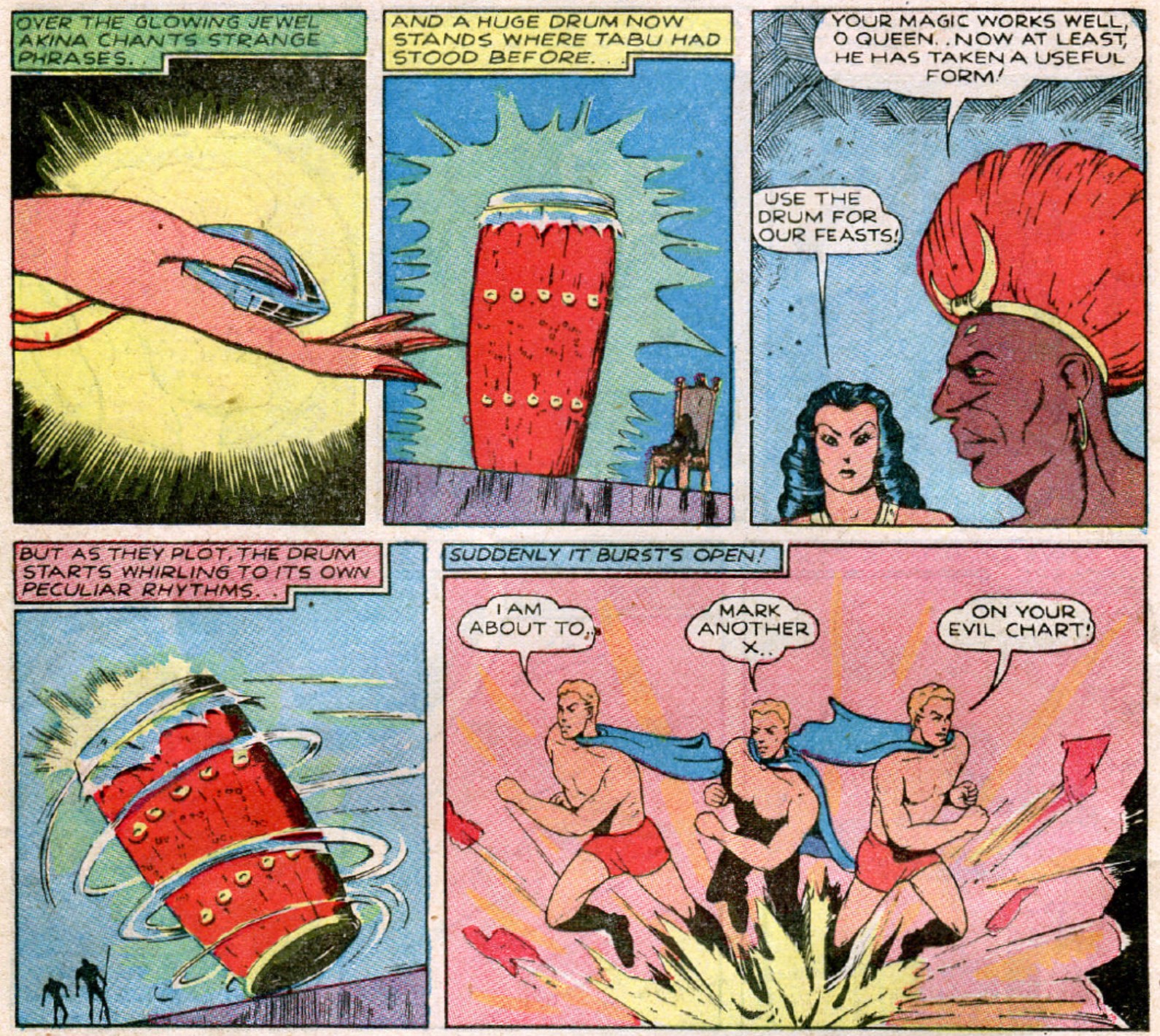
    Tabu gets turned into a drum, then explodes and reforms as three Tabus.

    Akina summons these giant flaming lizards, which Tabu then levitates straight into her palace. Do the lizards eat a lot of people who are arguably blameless in Akina’s crimes? Indeed they do.

    Tabu ultimately concludes the duel by shrinking both Akina and the entire Black Ivory Palace of Lomar; The Stone of Hanniban is the only thing that he leaves at its original size, and though it’s never spelled out, one can reasonably assume that this is as part of a trick to get Akina to fork over the thing willingly rather than have her neck be broken by its relatively enormous weight.

    Categorized in: Accessories (Gems), Generica (Ends in A), Powers (Various Magics)

  • CATALOGUE OF WOUNDS 013

    If I see a wound, I catalogue it.

    Camilla, Queen of the Lost Empire:

    Shot in the back with an arrow. (Jungle Comics 019, 1941)

    Captain Flag:

    Nearly dies of the Black Hand’s horrible hand disease. (Blue Ribbon Comics 016, 1941)

    the Cat-Man:

    Stabbed in the chest, to death (he gets better). (Crash Comics Adventures 004, 1940)

    Killed by a blood-freezing ray. He gets better again. (Crash Comics Adventures 005, 1940)

    Dynamo:

    Dynamo gets his skull creased by a bullet in the classic fashion. (Science Comics 005, 1940)

    the Green Mask:

    Michael Shelby is shot in the chest, prompting pal Professor Lascomb to stick him in the machine that turns him into the Green Mask. (Green Mask v1 001 1940)

    Domino the Miracle Boy:

    Later in the same issue, the boy known only as Don gets seriously exploded and must also be placed in the machine. (Green Mask v1 001, 1940)

    Kaänga: 

    Not even being an off-brand Tarzan can save you from being shot in the left shoulder,, as Kaänga learns here. (Jungle Comics 010, 1940)

    the Mask:

    District Attorney Colby is blinded by acid as part of his journey to becoming the Mask. (Exciting Comics 001, 1940)

    Tabu, Wizard of the Jungle:

    Tabu is shot in the right shoulder by this jerk. (Jungle Comics 019, 1941)

    Just one issue later, Tabu is speared in the right arm by a different jerk. (Jungle Comics 020, 1941)

  • DIVINE ROUND-UP 032

    It can’t all be off-brand Greek gods. I’m elbow-deep in the 1941 issues of Jungle Comics, so here are some off-brand African deities.

    Damballah and Gbeji-Nibu:

    The evil witch doctor N’Goku has been using his magical abilities to cause problems in his area (plagues of snakes, a sickness among the cattle) and then solve them for cash money, and then when Fantomah (post-Fletcher Hanks) points out that he is doing so he attempts to do away with her. N’Goku invokes Gbeji-Nibu, the God of Steers, as well as Damballah the Snake God, and since the latter is a real deity in West African Vodún we must assume that the former is as well, though as far as I can tell he has been made up for this comic.

    Neither Damballah or Gbeji-Nibu are fictional in the world of the comic, however, as both of them are pretty mad at N’Goku for his misdeeds and send a divine animal avatar to punish him. To death. Interestingly, it seems that N’Goku’s fatal mistake was not in using his divine gifts for evil but in crossing Fantomah, who is on good enough terms with Damballah that she calls upon him a few issues later to deal with a snake-pit situation she finds herself in.

    God Style: Invoked (Real) (Jungle Comics 018, 1941)

    Tokpodu:

    We don’t learn anything about the entity called Tokpodu but it evidently does hold some power, as the wizard Guluba here is able to use his jackal-hair whip to shrink both people and animals after invoking this entity. He too crosses Fantomah and ends up paying for it with his life.

    God Style: Invoked (Real?) (Jungle Comics 019, 1941)

    Leopards:

    There’s
    not much info on what this fellow is actually up to. Certainly he is
    sacrificing lambs (and attempts to sacrifice a human) to some leopards
    that he has in a pit in an ancient lost Egyptian temple, but whether he
    is worshipping them specifically or they are acting as avatars of a
    deity that was worshipped in the temple is unclear. I can’t find an Egyptian god
    with an especial link to leopards but that might just be a sign of poor
    research on my part. Complete understanding of this issue is hampered by the fact that the story’s protagonist is a lion and thus not equipped to do exposition or offer any real insight at all.

    God style: Animist (I guess) (Jungle Comics 020, 1941)

    the Elephant God:

    This nameless Elephant God is worshipped by the Goru people, who hold all elephants sacred, except for a brief period when wealthy hunter Ali ben Yusi rolls through and convinces them that ivory hunting is more profitable. This ends when a herd of elephants smash up the village and the Goru reconsider their allegiances.

    God Style: Idol (Real?) (Jungle Comics 020, 1941)

  • DIVINE ROUND-UP 032

    It can’t all be off-brand Greek gods. I’m elbow-deep in the 1941 issues of Jungle Comics, so here are some off-brand African deities.

    Damballah and Gbeji-Nibu:

    The evil witch doctor N’Goku has been using his magical abilities to cause problems in his area (plagues of snakes, a sickness among the cattle) and then solve them for cash money, and then when Fantomah (post-Fletcher Hanks) points out that he is doing so he attempts to do away with her. N’Goku invokes Gbeji-Nibu, the God of Steers, as well as Damballah the Snake God, and since the latter is a real deity in West African Vodún we must assume that the former is as well, though as far as I can tell he has been made up for this comic.

    Neither Damballah or Gbeji-Nibu are fictional in the world of the comic, however, as both of them are pretty mad at N’Goku for his misdeeds and send a divine animal avatar to punish him. To death. Interestingly, it seems that N’Goku’s fatal mistake was not in using his divine gifts for evil but in crossing Fantomah, who is on good enough terms with Damballah that she calls upon him a few issues later to deal with a snake-pit situation she finds herself in.

    God Style: Invoked (Real) (Jungle Comics 018, 1941)

    Tokpodu:

    We don’t learn anything about the entity called Tokpodu but it evidently does hold some power, as the wizard Guluba here is able to use his jackal-hair whip to shrink both people and animals after invoking this entity. He too crosses Fantomah and ends up paying for it with his life.

    God Style: Invoked (Real?) (Jungle Comics 019, 1941)

    Leopards:

    There’s
    not much info on what this fellow is actually up to. Certainly he is
    sacrificing lambs (and attempts to sacrifice a human) to some leopards
    that he has in a pit in an ancient lost Egyptian temple, but whether he
    is worshipping them specifically or they are acting as avatars of a
    deity that was worshipped in the temple is unclear. I can’t find an Egyptian god
    with an especial link to leopards but that might just be a sign of poor
    research on my part. Complete understanding of this issue is hampered by the fact that the story’s protagonist is a lion and thus not equipped to do exposition or offer any real insight at all.

    God style: Animist (I guess) (Jungle Comics 020, 1941)

    the Elephant God:

    This nameless Elephant God is worshipped by the Goru people, who hold all elephants sacred, except for a brief period when wealthy hunter Ali ben Yusi rolls through and convinces them that ivory hunting is more profitable. This ends when a herd of elephants smash up the village and the Goru reconsider their allegiances.

    God Style: Idol (Real?) (Jungle Comics 020, 1941)

  • MAD AND CRIMINAL SCIENTIST ROUND-UP 026

    If we criminalize mad science then only criminal scientists will be mad.

    Mauser:

    Mauser is the second of two foes battled by two-fisted chemist Guy Gorham and also the second rogue biologist. Was this comic setting up some sort of biologist/chemist beef that never got a chance to pay off? Mauser’s plans are never really spelled out, but he’s got a colony of vampire bats that he seems to be training to attack human targets, which isn’t great but which spells his undoing when he steals Gorham’s food concentrate formula for use as vampire feed – presumably for when human blood is in short supply. 

    A couple of other things about Mauser: he has a pretty decent uniform which he shares with his underlings, and despite his name (and the name of his henchman Herr Klotz) he does not appear to be a fascist. (Great Comics 002, 1941)

    Dr Berchtoldt:

    All Dr Berchtoldt wants to do is peacefully develop his robot army (and then take over the world). They won’t let him do it on land, so he moves under the sea, where he still gets hassled by the Man, in the form of Navy Jones. And all he did was kidnap Princess Coral and threaten to marry her against her will: is that any justification for hounding a man from his undersea fortress and then blowing up him and his super submarine alike? (Green Mask v1 006, 1941)

    de Moire:

    De Moire and his pal the Skipper have come to the part of Africa that Kaänga hangs out in to do unethical human experiments on what they assume are expendable people. After transforming one guy into a huge green killing machine, de Moire becomes obsessed with doing the same to Kaänga to make an even more beefy creature. This obsession leads him to neglect his original creation, and it wanders off and gets a look at itself in a pool of water and realizes that it is now ugly, which in turn leads it to slay de Moire. The Skipper is likewise killed, leaving Kaänga to battle the monster to the death. (Jungle Comics 013, 1941)

    Zalov Varno:

    Zalov Varno has been sending teams of men out to attack the oil fields of Debra-Tabuk, prompting Tabu, Wizard of the Jungle to pay him a visit and see just what his deal is. Though he captures Tabu with surprising ease given the latter’s vast magical power, Varno never actually explains just what he wants the oil for, which is in my opinion one of the greatest of villainous sins. I don’t even feel bad for him when he gets killed with his own Devitalizer Beam.

    The most interesting thing about Varno is what exactly is going on with his right eye. As far as I can tell, he wears some sort of semi-spherical black monocle, but just why he might care to do so is left as an exercise for the reader. (Jungle Comics 013, 1941)

  • MAD AND CRIMINAL SCIENTIST ROUND-UP 026

    If we criminalize mad science then only criminal scientists will be mad.

    Mauser:

    Mauser is the second of two foes battled by two-fisted chemist Guy Gorham and also the second rogue biologist. Was this comic setting up some sort of biologist/chemist beef that never got a chance to pay off? Mauser’s plans are never really spelled out, but he’s got a colony of vampire bats that he seems to be training to attack human targets, which isn’t great but which spells his undoing when he steals Gorham’s food concentrate formula for use as vampire feed – presumably for when human blood is in short supply. 

    A couple of other things about Mauser: he has a pretty decent uniform which he shares with his underlings, and despite his name (and the name of his henchman Herr Klotz) he does not appear to be a fascist. (Great Comics 002, 1941)

    Dr Berchtoldt:

    All Dr Berchtoldt wants to do is peacefully develop his robot army (and then take over the world). They won’t let him do it on land, so he moves under the sea, where he still gets hassled by the Man, in the form of Navy Jones. And all he did was kidnap Princess Coral and threaten to marry her against her will: is that any justification for hounding a man from his undersea fortress and then blowing up him and his super submarine alike? (Green Mask v1 006, 1941)

    de Moire:

    De Moire and his pal the Skipper have come to the part of Africa that Kaänga hangs out in to do unethical human experiments on what they assume are expendable people. After transforming one guy into a huge green killing machine, de Moire becomes obsessed with doing the same to Kaänga to make an even more beefy creature. This obsession leads him to neglect his original creation, and it wanders off and gets a look at itself in a pool of water and realizes that it is now ugly, which in turn leads it to slay de Moire. The Skipper is likewise killed, leaving Kaänga to battle the monster to the death. (Jungle Comics 013, 1941)

    Zalov Varno:

    Zalov Varno has been sending teams of men out to attack the oil fields of Debra-Tabuk, prompting Tabu, Wizard of the Jungle to pay him a visit and see just what his deal is. Though he captures Tabu with surprising ease given the latter’s vast magical power, Varno never actually explains just what he wants the oil for, which is in my opinion one of the greatest of villainous sins. I don’t even feel bad for him when he gets killed with his own Devitalizer Beam.

    The most interesting thing about Varno is what exactly is going on with his right eye. As far as I can tell, he wears some sort of semi-spherical black monocle, but just why he might care to do so is left as an exercise for the reader. (Jungle Comics 013, 1941)

  • ALIENS AND SO FORTH ROUND-UP 025

    ALIENS AND SO FORTH ROUND-UP 025

    We got Fish-Men, we got Fishmen, we got other kinds of men.

    Fishmen:

    Adventurer Lance Rand has acquired a map showing the location of the sunken continent of Atlantis and so naturally he sets out to see if it’s accurate and more importantly to find out if there’s any ancient Atlantean treasure there for him to loot. Making his way to the ocean floor, Lance and his pal Tubby are almost immediately accosted by a Fishman riding on a sea monster. This is a good sign!

    The sunken city of Atlantis does indeed turn out to me right where the map said it was, complete with some monumental bare-assed statuary. Lance and Tubby are able to drive their submarine tractor right up to the base of what must have been an important Atlantean idol and pry the disco ball-sized diamond out of its forehead, upon which they have to deal with another squad of hostile Fishmen. Though the implication is of course that these fellows are the descendants of drowned Atlantis, the fact that they never say anything really makes it hard to confirm. Perhaps they are unrelated underwater humanoids who just disapprove of Lance and Tubby’s wanton looting. Whichever it is, I really dig the little wing-fins that grow out of their backs. (Cat-Man Comics 001, 1941)

    Fish-Men: 

    When oceanic adventurer Navy Jones’ submarine is lost at sea, he is rescued by an undersea race of aquatic humanoids who don’t really have an official name but who are more often than not called Fish-Men or something similar. Despite some early conflict engineered by the scheming Prime Minister, Jones soon becomes the Fish-Men’s champion.

    Fish-Men society is ruled over by a more humanoid nobility, represented here in the forms of their unnamed king and his daughter/ Navy Jones’ love interest, Princess Coral. As usual, the reasons for these morphological differences are not explained and likely boil down to “we didn’t want our hero to be romantically involved with a fish.”

    Like many Fiction House heroes, Navy Jones passed through a lot of hands over the course of his career, and the Fish-Men had a correspondingly large number of looks, each of them charming in its own way.(Science Comics 001, 1940)

    Fishmen:

    This Fishman is encountered by Tabu, Wizard of the Jungle in what is probably a prehistoric underground enclave that a group of explorers stumble across “far to the Southeast of the Congo”. I say probably because Tabu gasses on about how they have gone back in time, which might be meant literally and might just be a bit of excessively flowery exposition. 

    The above is virtually all of the on-panel time that the Fishmen get, as the narrative is much more focused on the drama of one of the explorers falling in love with a cave woman. (Jungle Comics 011, 1940) 

    Flame-Men: 

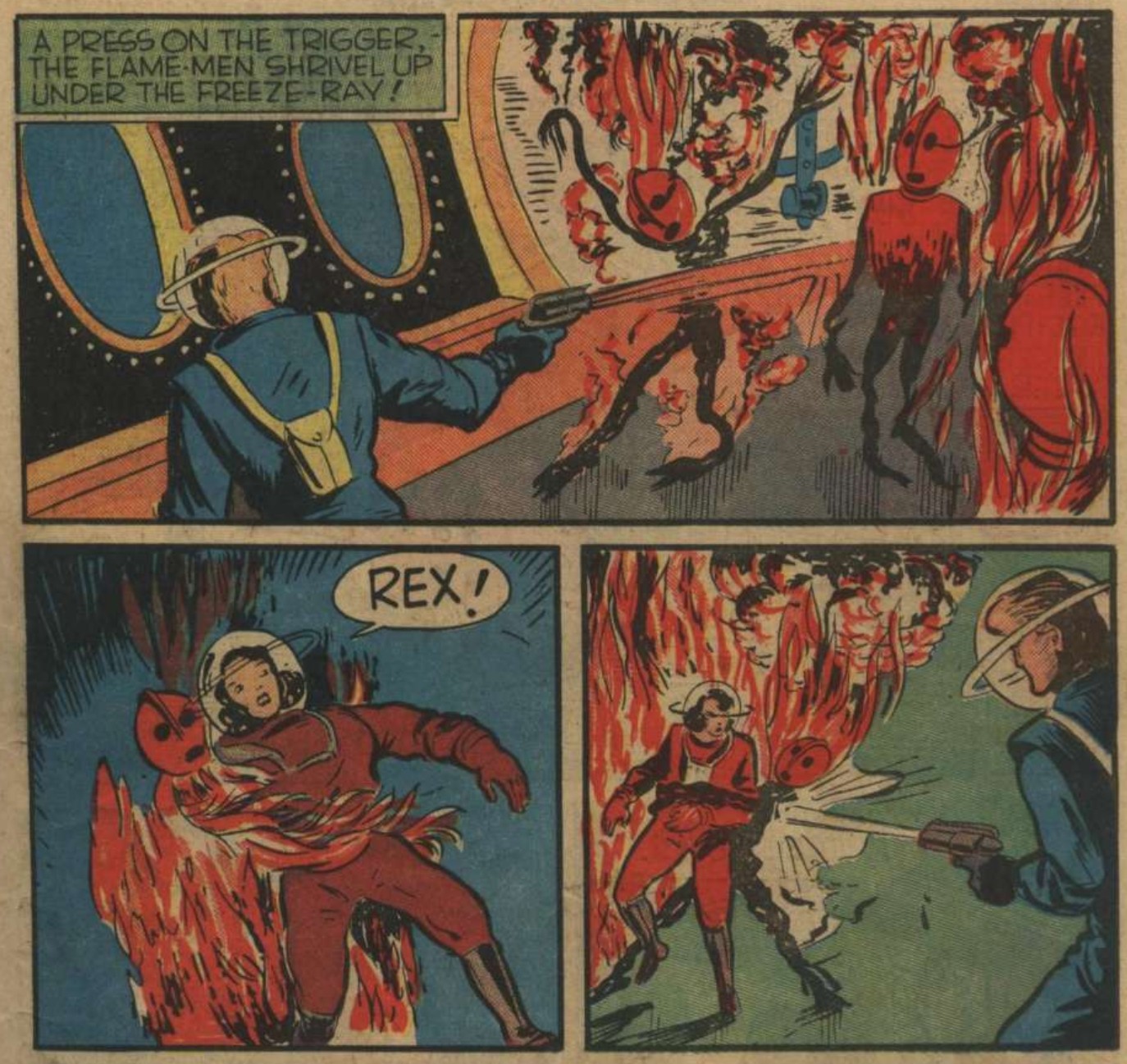
    Just as Rex Dexter of Mars and his companion Cynde are about to leave the planet Nexis and its friendly inhabitants, the Nexis as part of their never-ending attempt to reach Mars, the world is attacked by some sort of apocalyptic flame weapon.

    Rocketing into space to investigate, Rex and Cynde discover that the source of the attack is a fiery comet that is being directed by a massive spacecraft, by which they are swiftly captured. Inside they find the Flame-Men from Planet Emalf, who are attacking Nexis as the first move in their attempt to destroy the rest of the universe. Why are they doing this? No idea.

    The Flame-Men are unprepared for Rex’s freeze-ray gun, and shrivel up into little burnt matchstick men in a way that is as aesthetically pleasing as it is unsettling. (Mystery Men Comics 010, 1940) 

    Categorized under: Aliens, Animals (Fish), Elements (Fire), Generica (Men)