The Curse of Skeleton Munroe

Category: David

  • PROBLEMATIC ROUND-UP 009

    It it the nature of comic books that we will always be doing Problematic Updates.

    Dr Finkle:

    Dr Finkle himself is nothing special: he’s a psuedo-Nazi teamed up with the pseudo-Japanese Matsui in a scheme to steal securities belonging to Axis-conquered countries that are held in America. The real issue lies with Finkle’s primary agents, who you may notice being referred to as “Indian Monsters” in the final panel above.

    These “Indian Monsters” are straight out of something like Bone Tomahawk: inhumanly huge, fast and strong, barely verbal, ravenous cannibals that Finkle keeps under control with a steady diet of human flesh… literally monsters, in other words.

    I was going to say that the only good thing about them is that they eventually eat Dr Finkle but no, I must be thinking about some other monster-men. Instead, a special agent named Betty shoots Finkle and they immediately transfer allegiance to her thanks to “ancient Indian folklore.” It’s enough to tire a guy out. (Four Favorites 002, 1940)

    Loanga:

    Loanga is your regular old 1940s voodoo witch doctor, though he deviates from the norm by not being from Haiti but from another Caribbean island named Naseba, a name that feels like it should be in reference to something but if it is I cannot figure it out. Loango aims to take over the world with his zombie hordes and is starting with the United States, having captured and zombified Secretary of State Brant and compelled him to push for the disarmament all US military installations.

    As usual it is interesting to note the specifics of Loanga’s zombies. They are created out of living people using a combination of drugs and mind control and though they are still alive and able to speak, they cannot be killed by conventional means. They are cured and go back to normal when Loanga dies – whether this means that the ones who were dealt lethal wounds just fully die is not explored. Finally, they cast no shadows, and there’s something going on with their eyes – the ones who we see trying to pass as regular folk all wear dark glasses, but no reason for doing so is given.

    Loanga is ultimately undone by his own belief in the power of sympathetic magic: when comic relief artist character J. Rembrandt Speedball paints his portrait and then destroys it in a fit of pique at the thought of being executed by firing squad, he drops dead. All the zombies are freed or dead and the world is saved! (Fantastic Comics 023, 1941)

    the Big Boss:

    The Big Boss, a mysterious masked Chinese man who controls the opium trade in the Western city of Middletown (highly inaccurate name btw) unsurprisingly turns out to be J Harold Stetson, the prominent banker who has been making a lot of noise about how much he hates all this opium smuggling (and please note the misspelling that initially has his middle name as the weirdly amusing “Harlod”). (Lightning Comics v2 002, 1941)

    the Death Patrol:

    Here’s the tragic thing about the Death Patrol: it’s mostly something that I really like. I’ll lay out the setup and you see if you can spot when we get into Problematic territory.

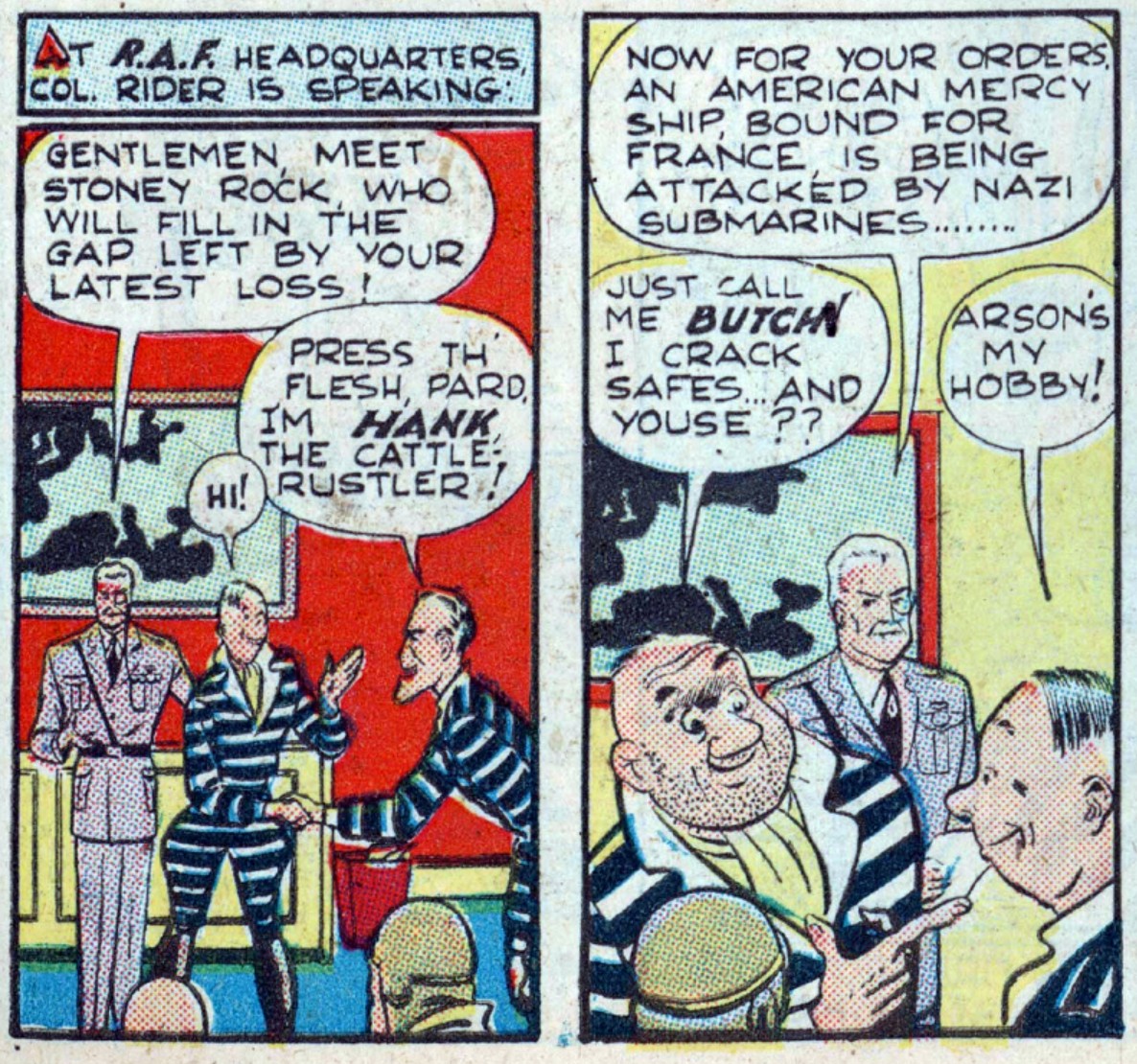
    The Death Patrol is formed when wealthy pilot/failure Del van Dyne’s plane is hijacked by a quartet of escaped convicts (and the pal who helped them break out). Del manages to weaponize his sense of rich guy ennui/ desire to make a difference in the world to convince the five to join him in volunteering to help the RAF defend the UK from Axis aggression, and thankfully all five are expert pilots in addition to their professional skills so this is a bit more plausible than it might otherwise be.

    The hook of the early Death Patrol stories, and the source of their name, is the fact that they only take on the most dangerous missions and have an attrition rate of one member per adventure. (Military Comics 001, 1941)

    The original lineup of the Death Patrol is as follows:

    Del van Dyne: Wealthy failure and leader of the group. Alive at the end of 1941.

    Butch O’Keefe: Safecracker. Sacrifices himself to stop a Nazi bomber group by crashing into them.

    Gramps: Pickpocket. Alive at the end of 1941.

    Hank: Rustler. Alive at the end of 1941.

    Peewee: Forger. Shot in the back by Nazis in the very first Death Patrol adventure.

    Slick Ward: Con artist. Dies in an exploding Nazi dirigible.

    Additional members added in 1941 as the death toll rises: 

    Stoney Rock: Arsonist. Shot by Nazis on his first mission. (Military Comics 002, 1941)

    Zazzy: Kleptomaniac. Dies while rescuing workers from an exploding Nazi factory. (Military Comics 003, 1941)

    Chief Chuck-a-lug: Former Wild West show performer stranded in Europe due to the conflict, and yes, congratulations, you spotted it. This is where the Death Patrol officially becomes Hard to Recommend, because from this point forward there will always be one or more racist comic relief characters running around and, for instance, yelling about scalping people. Alive at the end of 1941. (Military Comics 004, 1941)

    King Hotentot: The ruler of a small African country that has been occupied by the Axis, King Hotenetot is a prime example of the Educated Savage, a classic unfunny comedy trope in which a character speaks eloquently due to a classical education but still, for example, runs around with a spear threatening to eat people like he’s just flown in from a hateful jungle adventure. Still alive at the end of 1941. (Military Comics 005, 1941)

    Jumping back to some of the fun things about the Death Patrol, here are their fun prison-themed flightsuits and skull-in-a-hat insignia which is personalized with a custom hat for each pilot. Fun! 

    The Death Patrol also flies around in eccentric homemade airplanes, which is whimsical! It’s the sort of thing that makes you want to recommend the comic to a friend, until you remember all the Problems.

  • PROBLEMATIC ROUND-UP 009

    PROBLEMATIC ROUND-UP 009

    It it the nature of comic books that we will always be doing Problematic Updates.

    Dr Finkle:

    Dr Finkle himself is nothing special: he’s a psuedo-Nazi teamed up with the pseudo-Japanese Matsui in a scheme to steal securities belonging to Axis-conquered countries that are held in America. The real issue lies with Finkle’s primary agents, who you may notice being referred to as “Indian Monsters” in the final panel above.

    These “Indian Monsters” are straight out of something like Bone Tomahawk: inhumanly huge, fast and strong, barely verbal, ravenous cannibals that Finkle keeps under control with a steady diet of human flesh… literally monsters, in other words.

    I was going to say that the only good thing about them is that they eventually eat Dr Finkle but no, I must be thinking about some other monster-men. Instead, a special agent named Betty shoots Finkle and they immediately transfer allegiance to her thanks to “ancient Indian folklore.” It’s enough to tire a guy out. (Four Favorites 002, 1940)

    Loanga:

    Loanga is your regular old 1940s voodoo witch doctor, though he deviates from the norm by not being from Haiti but from another Caribbean island named Naseba, a name that feels like it should be in reference to something but if it is I cannot figure it out. Loango aims to take over the world with his zombie hordes and is starting with the United States, having captured and zombified Secretary of State Brant and compelled him to push for the disarmament all US military installations.

    As usual it is interesting to note the specifics of Loanga’s zombies. They are created out of living people using a combination of drugs and mind control and though they are still alive and able to speak, they cannot be killed by conventional means. They are cured and go back to normal when Loanga dies – whether this means that the ones who were dealt lethal wounds just fully die is not explored. Finally, they cast no shadows, and there’s something going on with their eyes – the ones who we see trying to pass as regular folk all wear dark glasses, but no reason for doing so is given.

    Loanga is ultimately undone by his own belief in the power of sympathetic magic: when comic relief artist character J. Rembrandt Speedball paints his portrait and then destroys it in a fit of pique at the thought of being executed by firing squad, he drops dead. All the zombies are freed or dead and the world is saved! (Fantastic Comics 023, 1941)

    the Big Boss:

    The Big Boss, a mysterious masked Chinese man who controls the opium trade in the Western city of Middletown (highly inaccurate name btw) unsurprisingly turns out to be J Harold Stetson, the prominent banker who has been making a lot of noise about how much he hates all this opium smuggling (and please note the misspelling that initially has his middle name as the weirdly amusing “Harlod”). (Lightning Comics v2 002, 1941)

    the Death Patrol:

    Here’s the tragic thing about the Death Patrol: it’s mostly something that I really like. I’ll lay out the setup and you see if you can spot when we get into Problematic territory.

    The Death Patrol is formed when wealthy pilot/failure Del van Dyne’s plane is hijacked by a quartet of escaped convicts (and the pal who helped them break out). Del manages to weaponize his sense of rich guy ennui/ desire to make a difference in the world to convince the five to join him in volunteering to help the RAF defend the UK from Axis aggression, and thankfully all five are expert pilots in addition to their professional skills so this is a bit more plausible than it might otherwise be.

    The hook of the early Death Patrol stories, and the source of their name, is the fact that they only take on the most dangerous missions and have an attrition rate of one member per adventure. (Military Comics 001, 1941)

    The original lineup of the Death Patrol is as follows:

    Del van Dyne: Wealthy failure and leader of the group. Alive at the end of 1941.

    Butch O’Keefe: Safecracker. Sacrifices himself to stop a Nazi bomber group by crashing into them.

    Gramps: Pickpocket. Alive at the end of 1941.

    Hank: Rustler. Alive at the end of 1941.

    Peewee: Forger. Shot in the back by Nazis in the very first Death Patrol adventure.

    Slick Ward: Con artist. Dies in an exploding Nazi dirigible.

    Additional members added in 1941 as the death toll rises: 

    Stoney Rock: Arsonist. Shot by Nazis on his first mission. (Military Comics 002, 1941)

    Zazzy: Kleptomaniac. Dies while rescuing workers from an exploding Nazi factory. (Military Comics 003, 1941)

    Chief Chuck-a-lug: Former Wild West show performer stranded in Europe due to the conflict, and yes, congratulations, you spotted it. This is where the Death Patrol officially becomes Hard to Recommend, because from this point forward there will always be one or more racist comic relief characters running around and, for instance, yelling about scalping people. Alive at the end of 1941. (Military Comics 004, 1941)

    King Hotentot: The ruler of a small African country that has been occupied by the Axis, King Hotenetot is a prime example of the Educated Savage, a classic unfunny comedy trope in which a character speaks eloquently due to a classical education but still, for example, runs around with a spear threatening to eat people like he’s just flown in from a hateful jungle adventure. Still alive at the end of 1941. (Military Comics 005, 1941)

    Jumping back to some of the fun things about the Death Patrol, here are their fun prison-themed flightsuits and skull-in-a-hat insignia which is personalized with a custom hat for each pilot. Fun! 

    The Death Patrol also flies around in eccentric homemade airplanes, which is whimsical! It’s the sort of thing that makes you want to recommend the comic to a friend, until you remember all the Problems.
  • REAL PERSON ROUND-UP 025

    REAL PERSON ROUND-UP 025

    If comics are reflections of the real world then why should we be surprised to find them so full of real people?

    Adolf Hitler:

    Hiller is the “mad dictator” who inspires Hercules to reincarnate and eventually become Marvel Boy. He’s about as close as you get to putting a Hitler in your comic as you can get without actually saying the name. The whole name. The “t” part. (Daring Mystery Comics 006, 1940)

    This otherwise-unnamed Fuehrer of a likewise nameless underground nation that vexes the America inhabited by Captain Daring in 3051 CE is a clear inspired-by-Hitler type. (Daring Mystery Comics 007, 1941)

    Citizen V takes a break from his propaganda campaign in Occupied Europe to sneak into Germany and become a member of the Punched Hitler in the Nose Club. (Daring Mystery Comics 008, 1942)

    This version of Hitler appears in a long dream sequence in the comedic Army Life strip “Private Rook” that appears to exist solely to make a joke about him being gay (the bit where he is the Princess Tanya’s Fairy Godmother, specifically). This isn’t great, but it is remarkable for being the only time I personally have seen such a thing in a Golden Age comic. (Army and Navy Comics 003, 1941)

    Though Cap punches Hitler on the cover of his very first issue, it is in fact Bucky who lands the first blow on him (and Goering) in the pages of a comic. (Captain America Comics 002, 1941)

    the Borgias:

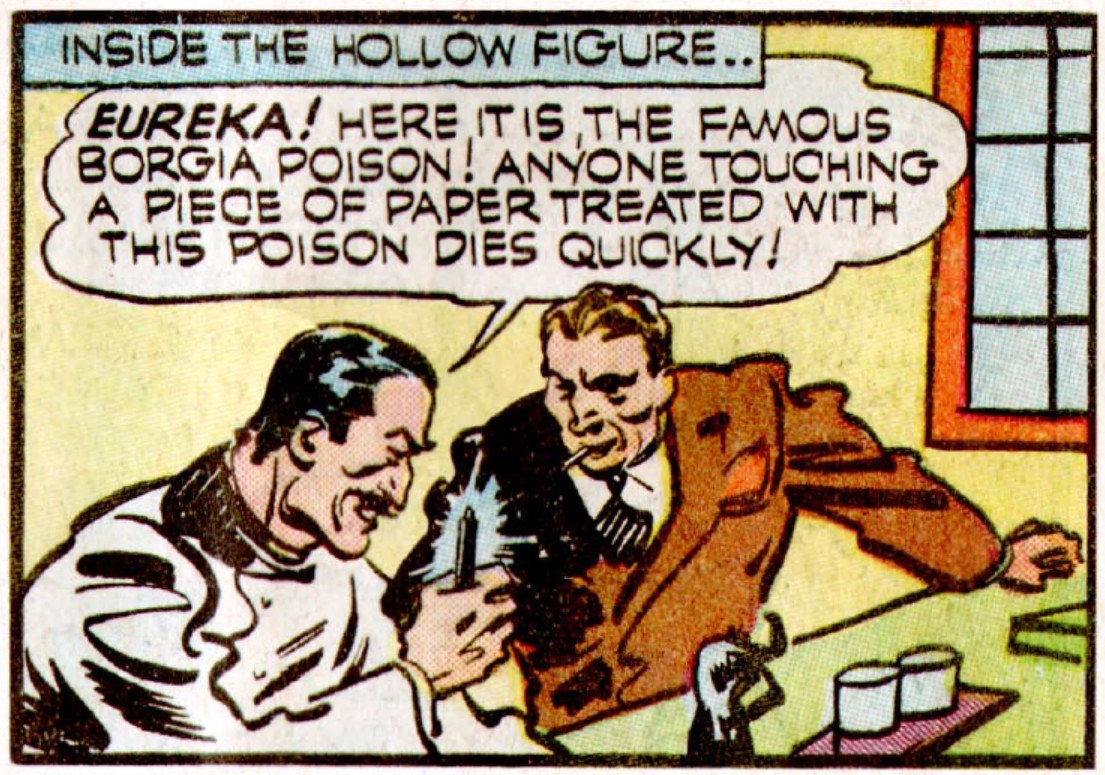
    Cesare, Lucrezia and the rest of the Borgia family might not actually appear in comics all that often, but they certainly do figure into their plots via the absolute piles of poisoned and poison-adjacent artifacts that are attributed to them. Borgia trinkets crop up so frequently, in fact, that I am surprised that it’s taken us this long to encounter one, in the form of a hollow silver statuette that contains a deadly contact poison. (Fantastic Comics 018, 1941)

    Fort Knox:

    Stardust the Super Wizard’s final foe, the unfortunately-named “Slant-Eye,” was a classic comic book Fort Knox robber. (Fantastic Comics 016, 1941)

    Francis Biddle:

    Major Victory has to consult with the US Attorney General in 1941, and in 1941 the US Attorney General was Francis Biddle. The man in the panel above is not Francis Biddle. (Dynamic Comics 002, 1941)

    Franklin D Roosevelt:

    Seen ordering the creation of a super-soldier, i.e. Captain America, to combat domestic espionage. (Captain America Comics 001, 1941)

    Fritz Kuhn:

    Fritz Knoll, purveyor of domestic espionage, is probably a reference to the chief Bundist. (Fantastic Comics 021, 1941)

    Henry L Stimson:

    The US didn’t even have a Secretary of Defense until after WWII, so I am not sure who this guy hanging out with Samson is supposed to be. The analogous position at the time this comic came out was Secretary of War, and that was Henry L Stimson, and this is not him. A true mystery man in all senses. (Fantastic Comics 023, 1941)

    J Edgar Hoover:

    J Arthur Grover, head of the FBI and clear J Edgar Hover stand-in, is also the man in charge of the program that would eventually be known as Project: Rebirth, aka the super-soldier program that produces Captain America later in this same issue. (Captain America Comics 001, 1941)

    Tutankhamen:

    Some of King Tut’s grave goods are among the items stolen by the Butterfly. (Captain America Comics 003 1941)

  • REAL PERSON ROUND-UP 025

    If comics are reflections of the real world then why should we be surprised to find them so full of real people?

    Adolf Hitler:

    Hiller is the “mad dictator” who inspires Hercules to reincarnate and eventually become Marvel Boy. He’s about as close as you get to putting a Hitler in your comic as you can get without actually saying the name. The whole name. The “t” part. (Daring Mystery Comics 006, 1940)

    This otherwise-unnamed Fuehrer of a likewise nameless underground nation that vexes the America inhabited by Captain Daring in 3051 CE is a clear inspired-by-Hitler type. (Daring Mystery Comics 007, 1941)

    Citizen V takes a break from his propaganda campaign in Occupied Europe to sneak into Germany and become a member of the Punched Hitler in the Nose Club. (Daring Mystery Comics 008, 1942)

    This version of Hitler appears in a long dream sequence in the comedic Army Life strip “Private Rook” that appears to exist solely to make a joke about him being gay (the bit where he is the Princess Tanya’s Fairy Godmother, specifically). This isn’t great, but it is remarkable for being the only time I personally have seen such a thing in a Golden Age comic. (Army and Navy Comics 003, 1941)

    Though Cap punches Hitler on the cover of his very first issue, it is in fact Bucky who lands the first blow on him (and Goering) in the pages of a comic. (Captain America Comics 002, 1941)

    the Borgias:

    Cesare, Lucrezia and the rest of the Borgia family might not actually appear in comics all that often, but they certainly do figure into their plots via the absolute piles of poisoned and poison-adjacent artifacts that are attributed to them. Borgia trinkets crop up so frequently, in fact, that I am surprised that it’s taken us this long to encounter one, in the form of a hollow silver statuette that contains a deadly contact poison. (Fantastic Comics 018, 1941)

    Fort Knox:

    Stardust the Super Wizard’s final foe, the unfortunately-named “Slant-Eye,” was a classic comic book Fort Knox robber. (Fantastic Comics 016, 1941)

    Francis Biddle:

    Major Victory has to consult with the US Attorney General in 1941, and in 1941 the US Attorney General was Francis Biddle. The man in the panel above is not Francis Biddle. (Dynamic Comics 002, 1941)

    Franklin D Roosevelt:

    Seen ordering the creation of a super-soldier, i.e. Captain America, to combat domestic espionage. (Captain America Comics 001, 1941)

    Fritz Kuhn:

    Fritz Knoll, purveyor of domestic espionage, is probably a reference to the chief Bundist. (Fantastic Comics 021, 1941)

    Henry L Stimson:

    The US didn’t even have a Secretary of Defense until after WWII, so I am not sure who this guy hanging out with Samson is supposed to be. The analogous position at the time this comic came out was Secretary of War, and that was Henry L Stimson, and this is not him. A true mystery man in all senses. (Fantastic Comics 023, 1941)

    J Edgar Hoover:

    J Arthur Grover, head of the FBI and clear J Edgar Hover stand-in, is also the man in charge of the program that would eventually be known as Project: Rebirth, aka the super-soldier program that produces Captain America later in this same issue. (Captain America Comics 001, 1941)

    Tutankhamen:

    Some of King Tut’s grave goods are among the items stolen by the Butterfly. (Captain America Comics 003 1941)

  • PROBLEMATIC ROUND-UP 008

    Once again I must regretfully inform you that some comic books are problematic. Like, racially.

    the Laughing Hyenas: 

    Hey, it’s our first racial hate group, and I think I’m just going to preemptively file these under “problematic” because they’re a) not fun to talk about and b) necessitate talking about hate-crimes even if I, for example, choose not to use the panels with lynchings in them.

    The Laughing Hyenas are actually kind of a hate group by proxy, as they have been hired to keep the Black residents of the geographically-nonspecific town of Souda “in line” by murdering one of them every once in a while, and have been doing so frequently enough and/or long enough that even the local folks willing to volunteer for such a task have gotten sick of it, so boss Bull Karson had to import some Chicago toughguys to do his dirty work for him.

    Oddly, given the sheer volume of murder that the Laughing Hyenas were perpetrating, the Silver Streak doesn’t actually bring them in to the authorities ore even extra-judiciously kill them. Instead, he just dumps them on a slow boat to Rangoon. (Silver Streak Comics 013, 1941)

    the Modern Thief of Bagdad:

    Ali Hassan, aka the Modern Thief of Bagdad, is an Iraqi thief who comes to NYC to steal the Konoor Diamond, and as a result comes into conflict with Captain Battle and his young protege Hale Battle. A simple story that would ordinarily wrap up quite quickly, but this is a book-length yarn, which means that there is an extended chase sequence that occupies the 28 pages between the theft and Hassan’s arrival back in Baghdad. Some highlights:

    Chapter 1, “The Modern Thief of Bagdad!”: Hassan steals the gem, then give Battle and Hale the slip in Chinatown. Olyra, the mysterious guardian of the Konoor Diamond, is kidnapped.

    Chapter 2, “Perils of the Sargasso Sea!”: Hassan’s submarine becomes mired in sargassum and is attacked by a sea monster. Battle and Hale kill the beast. Hassan and his men dress up like ghost pirates. Olyra is rescued and then kidnapped again.

    Chapter 3, “Lost in the Underground World!”: Hassan’s plane crashes in Africa and he and Olyra are captured by cannibals (lil’ bonus racism for you there). Battle and Hale rescue them before being betrayed and dumped in a pit of quicksand. There is a brief interlude in an cave system full of monsters before it suddenly blows up. Hassan and his men dress up like ghosts. Olyra is rescued.

    Chapter 4, “House of Giants”: Battle & co track Hassan to a castle in Tibet, where they are captured and subjected to a shrink ray. They have various adventures as tiny men before resuming their original size. Olyra is kidnapped.

    I would call Hassan himself… an average amount of racist. He’s depicted in much the same generically foreign vein as I’ve seen in a South American president or a Basque fisherman (or indeed a Cape Breton fisherman at least once). As a villain, he’s pretty great: bombastic, treacherous, fond of leaving boastful notes for his enemies. If it was just him I might have skipped making this a Problematic Round-Up entry.

    It’s not just him, however, and once the story hits Chapter 5, “Magic Spell of the Arabian Nights” we get a real dose of Orientalism full in the face, as our heroes touch down in a Baghdad straight out of the Arabian Nights, complete with a wicked ruler (confusingly named Emperor Pasha Golu) who Hassan has been working for the whole time.

    It’s such a pastiche of a city, in fact, that Hale and Olyra just kind of stumble across Aladdin’s lamp and flying carpet while they are escaping from a dungeon. I suppose that all this is at least a little thematically appropriate, as Ali Hassan, the Modern Thief of Bagdad, is a reference to a movie that is a remake of a different movie that is itself a pastiche of the Arabian Nights.

    The Modern Thief of Bagdad meets his end in a pretty underwhelming manner: Captain Battle ducks as he swings a sword at him and he falls off of a balcony. A pretty terrible way to go for a villain who clearly thought that he was very cool, to be honest. The evil Pash Golu also meets his end in the process, leaving Olyra free to reveal that she is actually Olyria, Princess and true ruler of Bagdad. A truly impenetrable alias! 

    Finally, such is Hale Battle’s hunger for souvenirs that he uses his third genie with to acquire a replica of the diamond for his collection, even though for my money the real deal Lamp of Aladdin with one wish left on it would be the ultimate keepsake. (Captain Battle Comics 002, 1941)

    the King:

    The King is a fellow who gains control over a Romani group by showing them a… birthmark? tattoo? that proves his right to rule and that looks so intensely falsifiable that I am shocked there isn’t some sort two-factor authentication, or even a code phrase. And just what is is reason for exerting this control? Why, so that he can turn his new subjects into a child kidnapping ring. You can see how I would consider this problematic.

    The King is of course not the real ruler, that is not a real skull birthmark and he is no match for Dynamic Man. He turns out to be a crooked newspaper publisher named Brower who loves money more than making good plans to acquire it. (Dynamic Comics 002, 1941)

    the Dragon:

    The Dragon is a very ordinary Yellow Peril villain who is after some top secret bomber plans on behalf of an unspecified Asian nation. There are exactly four interesting things about him: 1) he is the first villain faced by Samson and David in their brief New Look era before they disappear along with most of Fox Features’ other characters during their financial trouble. 2) he is a classic calling card leaver in the form of a claw mark on the chests of men he has killed

     3) he works alongside his sister Orchid, which isn’t the rarest arrangement but is always fun to note

     4) he has these stone lions outside of his HQ that grab intruders as they come through. It’s a fun trap but never actually explained: are they some sort of mechanism, or demonic magic like the caption box suggests?

    Much of the issue in questioned is concerned with Samson chasing the Dragon and Orchid around. Once he catches up to them it’s all over. (Fantastic Comics 022, 1941)

  • PROBLEMATIC ROUND-UP 008

    Once again I must regretfully inform you that some comic books are problematic. Like, racially.

    the Laughing Hyenas: 

    Hey, it’s our first racial hate group, and I think I’m just going to preemptively file these under “problematic” because they’re a) not fun to talk about and b) necessitate talking about hate-crimes even if I, for example, choose not to use the panels with lynchings in them.

    The Laughing Hyenas are actually kind of a hate group by proxy, as they have been hired to keep the Black residents of the geographically-nonspecific town of Souda “in line” by murdering one of them every once in a while, and have been doing so frequently enough and/or long enough that even the local folks willing to volunteer for such a task have gotten sick of it, so boss Bull Karson had to import some Chicago toughguys to do his dirty work for him.

    Oddly, given the sheer volume of murder that the Laughing Hyenas were perpetrating, the Silver Streak doesn’t actually bring them in to the authorities ore even extra-judiciously kill them. Instead, he just dumps them on a slow boat to Rangoon. (Silver Streak Comics 013, 1941)

    the Modern Thief of Bagdad:

    Ali Hassan, aka the Modern Thief of Bagdad, is an Iraqi thief who comes to NYC to steal the Konoor Diamond, and as a result comes into conflict with Captain Battle and his young protege Hale Battle. A simple story that would ordinarily wrap up quite quickly, but this is a book-length yarn, which means that there is an extended chase sequence that occupies the 28 pages between the theft and Hassan’s arrival back in Baghdad. Some highlights:

    Chapter 1, “The Modern Thief of Bagdad!”: Hassan steals the gem, then give Battle and Hale the slip in Chinatown. Olyra, the mysterious guardian of the Konoor Diamond, is kidnapped.

    Chapter 2, “Perils of the Sargasso Sea!”: Hassan’s submarine becomes mired in sargassum and is attacked by a sea monster. Battle and Hale kill the beast. Hassan and his men dress up like ghost pirates. Olyra is rescued and then kidnapped again.

    Chapter 3, “Lost in the Underground World!”: Hassan’s plane crashes in Africa and he and Olyra are captured by cannibals (lil’ bonus racism for you there). Battle and Hale rescue them before being betrayed and dumped in a pit of quicksand. There is a brief interlude in an cave system full of monsters before it suddenly blows up. Hassan and his men dress up like ghosts. Olyra is rescued.

    Chapter 4, “House of Giants”: Battle & co track Hassan to a castle in Tibet, where they are captured and subjected to a shrink ray. They have various adventures as tiny men before resuming their original size. Olyra is kidnapped.

    I would call Hassan himself… an average amount of racist. He’s depicted in much the same generically foreign vein as I’ve seen in a South American president or a Basque fisherman (or indeed a Cape Breton fisherman at least once). As a villain, he’s pretty great: bombastic, treacherous, fond of leaving boastful notes for his enemies. If it was just him I might have skipped making this a Problematic Round-Up entry.

    It’s not just him, however, and once the story hits Chapter 5, “Magic Spell of the Arabian Nights” we get a real dose of Orientalism full in the face, as our heroes touch down in a Baghdad straight out of the Arabian Nights, complete with a wicked ruler (confusingly named Emperor Pasha Golu) who Hassan has been working for the whole time.

    It’s such a pastiche of a city, in fact, that Hale and Olyra just kind of stumble across Aladdin’s lamp and flying carpet while they are escaping from a dungeon. I suppose that all this is at least a little thematically appropriate, as Ali Hassan, the Modern Thief of Bagdad, is a reference to a movie that is a remake of a different movie that is itself a pastiche of the Arabian Nights.

    The Modern Thief of Bagdad meets his end in a pretty underwhelming manner: Captain Battle ducks as he swings a sword at him and he falls off of a balcony. A pretty terrible way to go for a villain who clearly thought that he was very cool, to be honest. The evil Pash Golu also meets his end in the process, leaving Olyra free to reveal that she is actually Olyria, Princess and true ruler of Bagdad. A truly impenetrable alias! 

    Finally, such is Hale Battle’s hunger for souvenirs that he uses his third genie with to acquire a replica of the diamond for his collection, even though for my money the real deal Lamp of Aladdin with one wish left on it would be the ultimate keepsake. (Captain Battle Comics 002, 1941)

    the King:

    The King is a fellow who gains control over a Romani group by showing them a… birthmark? tattoo? that proves his right to rule and that looks so intensely falsifiable that I am shocked there isn’t some sort two-factor authentication, or even a code phrase. And just what is is reason for exerting this control? Why, so that he can turn his new subjects into a child kidnapping ring. You can see how I would consider this problematic.

    The King is of course not the real ruler, that is not a real skull birthmark and he is no match for Dynamic Man. He turns out to be a crooked newspaper publisher named Brower who loves money more than making good plans to acquire it. (Dynamic Comics 002, 1941)

    the Dragon:

    The Dragon is a very ordinary Yellow Peril villain who is after some top secret bomber plans on behalf of an unspecified Asian nation. There are exactly four interesting things about him: 1) he is the first villain faced by Samson and David in their brief New Look era before they disappear along with most of Fox Features’ other characters during their financial trouble. 2) he is a classic calling card leaver in the form of a claw mark on the chests of men he has killed

     3) he works alongside his sister Orchid, which isn’t the rarest arrangement but is always fun to note

     4) he has these stone lions outside of his HQ that grab intruders as they come through. It’s a fun trap but never actually explained: are they some sort of mechanism, or demonic magic like the caption box suggests?

    Much of the issue in questioned is concerned with Samson chasing the Dragon and Orchid around. Once he catches up to them it’s all over. (Fantastic Comics 022, 1941)

  • FASCIST GOON CLEARING HOUSE 014

    Surely fascists will stop being such a problem eventually, right?

    the German Help Club:

    Probably the most straightforwardly cynical version of the German American Bund that we’ve seen so far, the German Help Club is simply a mass extortion scheme in which the German-American residents of NYC are forced to give up 15% of their earnings or see their relatives back in Germany be persecuted and jailed. Pat Patriot breaks them up with extreme prejudice. (Daredevil Comics 006, 1941)

    Gorilla-Suited Saboteurs: 

    This bunch of Nazis dress up in bulletproof gorilla suits in order to sabotage British operations in Uganda, but they are unable to contend with jungle adventurer ed Crane. (Exciting Comics 008, 1941)

    the Nazi Bund:

    The Nazi Bund is yet another riff on the German-American Bund as an actually impactful spy organization. Is Bund leader Fanz Mann a version of the real-life Bund leader Fritz Kuhn or just a Nazi with a generic German name? Hard to say, but in either case he gets smashed up by Samson. (Fantastic Comics 020, 1941)

    Herr Arson:

    Herr Arson runs one of those Fifth Column cells that gave 1940s comic book heroes so much trouble. He has three major claims to fame: 1) Herr Arson is a fantastic name for a Nazi saboteur, 2) Given that, the fact that, of four acts of sabotage he commits this issue, only one is arson is very funny.

    3) Herr Arson might just get the most killed that I have ever seen in a comic, as the Flame uses his flame gun to utterly vaporize him in the middle of the street. (The Flame 006, 1941)

  • MINOR SUPER-HERO ROUND-UP 093

    Fox Features, you burned hot and bright and brought us so many minor super-heroes.

    the Black Fury:

    The Black Fury, like Bob Phantom before him, is a newspaper gossip columnist who moonlights as a costumed vigilante. What are the chances that we would have two of those? I enjoy his costume even if it is somewhat generic even for 1941, though I am a bit upset that the glowing gemstone on his and his sidekick’s foreheads is never addressed. For instance: is it really glowing or is that a stylistic choice?

    As of his first appearance, John has already been the Black Fury for an unspecified amount of time, having adopted the mantle after his father was killed by gangsters for writing “anti-crime editorials” in the newspaper, a thing that comic book criminals react to like they are a farm lobby trying to influence government nutritional guidelines. (Fantastic Comics 017, 1941)

    Categorized in: Day Job (Newspaper Columnists), Origin (Crime Orphans), Supranormal Beings (Mythological – Furies)

    Chuck:

    John Perry relates his origin as the Black Fury to young Chuck Marley after Chuck’s own father, Police Sergeant Marley, is killed by henchmen of the evil Fang. Chuck is essentially bequeathed to Perry as the elder Marley lies dying, which is a very straightforward way for a hero to acquire a boy for sidekick duties.

    Chuck does not get his own super-hero name, alas (at least not right away, spoilers for some comics from 1942), but he does get his own costume, which is more than a lot of sidekicks can say. The fact that his costume is exactly the same as the Black Fury’s does make it a bit difficult to tell them apart at times but that’s a small price to pay for the peace of mind of knowing that Chuck’s identity is at least somewhat protected. (Fantastic Comics 017, 1941)

    Categorized in: Day Job (High School Students),  Origin (Crime Orphans), Origin (Sidekicks)

    the Banshee:

    The origin story of the Banshee involves a remarkable number of steps. First, Irishman Jim O’Donnell finds that his step-father has been murdered out on the moors by the evil Scorpion, who is only prevented from bumping off Jim as well because he is extremely superstitious, mistakes a wailing wind for the cry of a banshee and runs off.

    Jim discovers that the Scorpion has set out for the United States and, unable to secure a visa (“I am seeking vengeance on my step-father’s killer” seemingly not good enough. Probably they would have let him in if it was his full-on father, though) stows away on a steamship. He is spotted disembarking in New York, making him one of the small group of super-heroes whose civilian rather than super identities are wanted by the authorities and the only one that I am aware of who is wanted for entering the country illegally.

    But just why is the Scorpion in America? Why, to murder Jim’s step-father’s niece, who, as his only remaining blood relative, will inherit some land that is rich in gold and which the Scorpion is trying to get his mitts on. Just why Jim is out of the picture is unexplained – he and his step-dad have a relationship that is at the very least strong enough for a vengeance quest, so why shouldn’t Jim be in the will?

    Jim once again benefits from the Scorpion’s banshee-focused superstitions after he falls through a load of bedsheets and onto the villain’s head, with an assist by a distant police siren. This might just be the rarest and dumbest of super-hero costume origins, the Dressed by Slapstick approach.

    Having enacted his vengeance, Jim decides to remain in the US and continue his fight against crime as the Banshee. He throws together a more super-heroic version of his accidental costume and crashes on Joan’s couch while he figures out what to do about work, and it’s okay that Joan kind of becomes his love interest because she is only his step-cousin. 

    All this just to have an Irish guy fighting crime in NYC.  (Fantastic Comics 021, 1941)

    (from Fantastic Comics 022 on, Jim adopts a simpler version of his initial pass at the super-hero look. He also adopts the “banshee wail” as his calling card rather than simply relying on it to happen diegetically as needed)

    Categorized in: Accessories (Style – Calling Cards, Costume Origins),  Origin (Crime Orphans), Supranormal Beings (Banshees)

    Samson **UPDATE**:

    Some time in mid-to-late 1941, Fox Features presumably decided to round out a few of their more prominent characters such as the Flame, the Green Mask and Samson and give them a supporting cast so that they weren’t just ping-ponging from adventure to adventure without any sense of continuity. In Samson’s case, he gained a love interest with the very on-the-nose name of Lila Dee, along with a moderately annoying comic relief character in the form of perpetually-horny artist J. Rembrandt Speedball.

    The same issue marks the very first time that someone thought to have David use a sling instead of just going around lassoing people the whole time. Credit to Al Carreño for that one. (Fantastic Comics 022, 1941)

    This is also when Samson takes a stab at having a secret identity, but since he still has to have his trademark shoulder-length hair and that is a Huge Giveaway in 1941, this involves wearing a Very Big Coat with a Very Big Collar that he can pull up around his ears. Did he even try a wig before going coat shopping, you reckon? (Fantastic Comics 023, 1941)

  • MINOR SUPER-HERO ROUND-UP 093

    Fox Features, you burned hot and bright and brought us so many minor super-heroes.

    the Black Fury:

    The Black Fury, like Bob Phantom before him, is a newspaper gossip columnist who moonlights as a costumed vigilante. What are the chances that we would have two of those? I enjoy his costume even if it is somewhat generic even for 1941, though I am a bit upset that the glowing gemstone on his and his sidekick’s foreheads is never addressed. For instance: is it really glowing or is that a stylistic choice?

    As of his first appearance, John has already been the Black Fury for an unspecified amount of time, having adopted the mantle after his father was killed by gangsters for writing “anti-crime editorials” in the newspaper, a thing that comic book criminals react to like they are a farm lobby trying to influence government nutritional guidelines. (Fantastic Comics 017, 1941)

    Categorized in: Day Job (Newspaper Columnists), Origin (Crime Orphans), Supranormal Beings (Mythological – Furies)

    Chuck:

    John Perry relates his origin as the Black Fury to young Chuck Marley after Chuck’s own father, Police Sergeant Marley, is killed by henchmen of the evil Fang. Chuck is essentially bequeathed to Perry as the elder Marley lies dying, which is a very straightforward way for a hero to acquire a boy for sidekick duties.

    Chuck does not get his own super-hero name, alas (at least not right away, spoilers for some comics from 1942), but he does get his own costume, which is more than a lot of sidekicks can say. The fact that his costume is exactly the same as the Black Fury’s does make it a bit difficult to tell them apart at times but that’s a small price to pay for the peace of mind of knowing that Chuck’s identity is at least somewhat protected. (Fantastic Comics 017, 1941)

    Categorized in: Day Job (High School Students),  Origin (Crime Orphans), Origin (Sidekicks)

    the Banshee:

    The origin story of the Banshee involves a remarkable number of steps. First, Irishman Jim O’Donnell finds that his step-father has been murdered out on the moors by the evil Scorpion, who is only prevented from bumping off Jim as well because he is extremely superstitious, mistakes a wailing wind for the cry of a banshee and runs off.

    Jim discovers that the Scorpion has set out for the United States and, unable to secure a visa (“I am seeking vengeance on my step-father’s killer” seemingly not good enough. Probably they would have let him in if it was his full-on father, though) stows away on a steamship. He is spotted disembarking in New York, making him one of the small group of super-heroes whose civilian rather than super identities are wanted by the authorities and the only one that I am aware of who is wanted for entering the country illegally.

    But just why is the Scorpion in America? Why, to murder Jim’s step-father’s niece, who, as his only remaining blood relative, will inherit some land that is rich in gold and which the Scorpion is trying to get his mitts on. Just why Jim is out of the picture is unexplained – he and his step-dad have a relationship that is at the very least strong enough for a vengeance quest, so why shouldn’t Jim be in the will?

    Jim once again benefits from the Scorpion’s banshee-focused superstitions after he falls through a load of bedsheets and onto the villain’s head, with an assist by a distant police siren. This might just be the rarest and dumbest of super-hero costume origins, the Dressed by Slapstick approach.

    Having enacted his vengeance, Jim decides to remain in the US and continue his fight against crime as the Banshee. He throws together a more super-heroic version of his accidental costume and crashes on Joan’s couch while he figures out what to do about work, and it’s okay that Joan kind of becomes his love interest because she is only his step-cousin. 

    All this just to have an Irish guy fighting crime in NYC.  (Fantastic Comics 021, 1941)

    (from Fantastic Comics 022 on, Jim adopts a simpler version of his initial pass at the super-hero look. He also adopts the “banshee wail” as his calling card rather than simply relying on it to happen diegetically as needed)

    Categorized in: Accessories (Style – Calling Cards, Costume Origins),  Origin (Crime Orphans), Supranormal Beings (Banshees)

    Samson **UPDATE**:

    Some time in mid-to-late 1941, Fox Features presumably decided to round out a few of their more prominent characters such as the Flame, the Green Mask and Samson and give them a supporting cast so that they weren’t just ping-ponging from adventure to adventure without any sense of continuity. In Samson’s case, he gained a love interest with the very on-the-nose name of Lila Dee, along with a moderately annoying comic relief character in the form of perpetually-horny artist J. Rembrandt Speedball.

    The same issue marks the very first time that someone thought to have David use a sling instead of just going around lassoing people the whole time. Credit to Al Carreño for that one. (Fantastic Comics 022, 1941)

    This is also when Samson takes a stab at having a secret identity, but since he still has to have his trademark shoulder-length hair and that is a Huge Giveaway in 1941, this involves wearing a Very Big Coat with a Very Big Collar that he can pull up around his ears. Did he even try a wig before going coat shopping, you reckon? (Fantastic Comics 023, 1941)

  • MINOR SUPER-VILLAIN 966: ARPOR, HIGH PRIEST OF EVIL

    (Fantastic Comics 015, 1941)

    I’ve mentioned this in the past but it bears repeating: some Golden Age comics read like a fever dream, in which barely connected events just kind of float by as you read. This story is one of those, but also has a sort of exquisite corpse quality in that the connections between events almost make sense but when you step back and look at the whole it is astonishing. To whit:

    – Samson and David are just hanging around in whatever US city they call home when they notice a weird truck in the street outside. When they go out to investigate the truck it turns out to be full of poison gas.

    – After disposing of the truck (the purpose of which is never revealed), the duo follow some nearby thugs to a warehouse full of counterfeiting equipment. Samson tosses the whole building into the river and then fishes out the one surviving thug.

    – The thug reforms out of gratitude and tells Samson that the mastermind behind the warehouse is Arpor, High Priest of Evil.

    – Samson and David make their way to Arpor’s stronghold in the nearby mountains, dodging various traps and ambushes along the way. Eventually, Samson pretends to be knocked out by a fall so that he can be captured. He is taken back to Arpor’s temple lair to be sacrificed to a moderately off-model Kali. As an aside, Arpor’s cultist minions appear to be called Fiends, which is fun.

    – Not even a whole cult is enough to take on Samson and Arpor is eventually rounded up (after a few more hijinks) and taken away to jail.

    So what is Arpor up to here? Is the counterfeiting setup funding the cult or meant to destabilize society in some way that ties in with the usual comic book shorthand of Kali = Thuggees = wanton murder? Is this where the poison gas comes in? We will never know!

    Shout out to this sweet cone-shaped lightning rifle that Arpor uses to blast Samson into submission. Love an energy weapon that dares to not just look like a fancy tommy gun.

    Categorized in: Abstract Concepts (Evil), Misc (Cult Leaders), Profession (Priests)