The Curse of Skeleton Munroe

Category: Flip Falcon

  • MONSTER, CRITTER AND CREATURE ROUND-UP 003

    I hope everyone likes monsters as much as I do because there are a whole lot of them to cover.

    Beaked Tyros:

    When polar explorer Anthony Conrad gets lost in an Arctic storm and falls through a hole in the pack ice, he reasonably expects to meet his demise. Instead, he falls into the subterranean kingdom of Artica and is chosen by the elderly Artican king – also a stranded former surface explorer – as his successor. 

    As part of the coronation process, Anthony must prove his mettle to his prospective subjects, and step two of that process is Thrilling Arena Combat with the horrible beaked tyros “Lord of Artica’s Jungles,” and I love this thing. Though it looks like just another low-rent carnosaur at first glance, upon closer examination it has many bizarre features, including weird bird legs, thin, unpleasant-looking teeth, radially-symmetrical hands that are possibly equipped with suckers on the palms, and skin that is described as “hairy” in the caption box. Truly this is a strange and wonderful beast that sadly must be chopped up in service to the story. (Cyclone Comics 001, 1940)

    the Beast:

    When asked to prove his worthiness to wed the Princess Ahloo, our hero Abdallah knows exactly what to do: ride directly to a nearby valley full of dinosauroids and slay one of them. Though one of the pteranodon-adjacent flying reptiles that confront him when he enters the valley would probably be sufficient to satisfy Ahloo’s father, Abdallah instead opts to battle a creature referred to only as the Beast, a possibly-fire-breathing, possibly-carnivorous sauropodoid that give him a truly heroic-level challenge. And it works! He gets the girl! (Funny Pages v2 003, 1937)

    the Birds:

    These vulture-monsters come very close to destroying the Blue Bolt on his very first adventure. They are only prevented from doing so, in fact, because they work for the Green Sorceress and she has become infatuated with Our Hero here on sight.

    I’m always a big fan of these kinds of monster birds that up the ante on deadliness by throwing most of the birdliness of the creature out the window and instead give them the body plan of a griffin. Really great stuff and my only note is that some of the tails are very unpleasant to look at. (Blue Bolt v1 001, 1940)

    Bolu:

    Meg and Mickey are two children who have access to a magical time-travel stone and use it to just kind of blunder around throughout history. In this particular instance they have ended up in the Stone Age and are only saved from being eaten by some uncharitable portrayals of our collective ancestors by the appearance of a dinosaur, called Bolu by the cavemen and of course far, far more out of place than two 20th Century kids could ever hope to be. There is some indication that the bolu was summoned by the Spirit of the Stone to save the two from becoming dinner, but if that’s the case then why do the cavemen already know about it? (The Comics 007, 1938)

    Carnicantileia:

    The swamp-dwelling carnicantileia briefly menaces Flip Falcon and his associates during one of his early adventures when he mostly uses his fantastic time-and-space machine to go to Mars. It’s a pretty impressive snake-style beast, and as such it’s a real shame that it is killed in such a goofy way, by having a big rock thrown down its gullet. (Fantastic Comics 003, 1940)

    Carnivoplant:

    The carnivoplant is a classic man-eating plant, subtype seaweed, that almost kills adventurer Kinks Mason before it in turn is preyed upon by a swarm of phosphomites. And just what are phosphomites, you may ask? Contextually, they are small glowing creatures that eat carnivoplants, and that is all the information we get. (Fight Comics 001, 1940)

    Cave Monster:

    Modern day cowboy hero Bull’s-Eye Bill and his companions meet this cave reptile while pursuing an outlaw, and as I previously observed, it was clearly meant to set up an adventure into a prehistoric underground world that subsequent creators chose not to take advantage of. 

    As for the one beast that we do get to see fight some cowboys, I really appreciate how lizardy it looks, as well as how it seems to be posing for maximum dramatic effect in every panel, even when killing a guy or writhing around in its death throes. (Target Comics v1 007, 1940)

    the Ozix:

    Someday
    when I post a picture of a creature that is just a big cat with some extra stuff stapled onto it in one of these round-ups I will be able to refer to it
    as a standard type of creature, but I simply haven’t done the work yet.
    The ozix, then, is a beast with the body of a leopard and the head of a
    crocodile – how novel a concept! Adventurer Congo Jack must slay this
    one during his adventures under the earth. (Lightning Comics v2 002,
    1941) 

    Dakk:

    Returning to the adventures of King Anthony in the sub-Arctic world of Artica, here we see him as he is about to tour his kingdom on the back of a domesticated dakk, and I must say that I like the very beast-of-burden look that they have given to this creature’s head. Sadly, this particular dakk has been poisoned as part of an attempt to assassinate the new king.

    This assassination attempt is only partially successful, as Anthony survives the fall into the jungles of Artica but is then placed in further peril at the claws of the various creatures that live there, such as this amazing giraffe-patterned water lizard.

    Though he escapes the lizard, Anthony is almost immediately attacked by a great horned tigrid, which is is of course a regular tiger with two little horns on its head, and another example of what I was talking about in the ozix entry.

    Finally, after stumbling upon the roots of the conspiracy against him and dealing with them violently, King Anthony makes his way home on a humble unicorn. (Cyclone Comics 003, 1940) 

    the Storm Monster:

    A giant reptilian beast that plagues an African village on a yearly basis (during a huge storm, natch), the Storm Monster meets its end after swallowing Kaänga whole, upon which he carves his way free of its guts with his trusty knife. (Jungle Comics 021, 1941)

  • MINOR SUPER-VILLAIN 609 UPDATE: LUCIFER

    When we covered the Fourth Dimensional being called Lucifer, who might be the for-real Devil (if the Fourth Dimension is also the afterlife) and might just be a big weirdo (if it isn’t), I said that we would see him again. Well here he is!

    Flip Falcon next encounters Lucifer after he takes a woman named Nora into the Fourth Dimension in order to heal her face, which was scarred with acid by a vindictive man. This is a noble quest, but it once again raises the question of just how all these regular people are accessing accurate information about the properties of the Fourth Dimension, e.g., that it contains “a purifying element which restores the marred”? It’s not Flip, as he never seems to know about these things when people tell him about them. Then who? Is Flip’s assistant Peg publishing 4D guidebooks on the sly?

    Regardless of where she got it, Nora’s information was sound and her face is cured almost immediately upon entering Flip’s dimensional portal. And just as soon as she is healed, Lucifer swoops in and kidnaps her in order to turn her into a giant woman with “my mind” as he puts it, and whether this is meant literally or if it’s just a way of saying that she will have his moral outlook is tough to say. Either way, it’s a real wild insight into Lucifer’s psychology and sense of the romantic.

    We never do get to meet Lucifer’s ideal woman, as Flip Falcon simply zips in to interrupt the process and then sneaks out the back door. It is, all in all, an embarrassing episode for the (possible) arch-devil. (Fantastic Comics 015, 1941)

    This humiliating defeat possibly explains why Lucifer’s next appearance involves him returning to his roots with an attempt to wipe out humanity. Specifically (vaguely?) he is forcing “elements of dimension space” into our atmosphere, to disastrous effect.

     Unfortunately for Lucifer, Flip Falcon has a new trick since he last foiled this specific plan by this specific guy, and so rather than employing his trail of pan-dimensional energy to merely immobilize his foe, he instead annihilates him utterly. What the destruction of the Great Adversary might mean to the faithful is not explored. (Fantastic Comics 020, 1941)

  • MINOR SUPER-VILLAIN 609 UPDATE: LUCIFER

    When we covered the Fourth Dimensional being called Lucifer, who might be the for-real Devil (if the Fourth Dimension is also the afterlife) and might just be a big weirdo (if it isn’t), I said that we would see him again. Well here he is!

    Flip Falcon next encounters Lucifer after he takes a woman named Nora into the Fourth Dimension in order to heal her face, which was scarred with acid by a vindictive man. This is a noble quest, but it once again raises the question of just how all these regular people are accessing accurate information about the properties of the Fourth Dimension, e.g., that it contains “a purifying element which restores the marred”? It’s not Flip, as he never seems to know about these things when people tell him about them. Then who? Is Flip’s assistant Peg publishing 4D guidebooks on the sly?

    Regardless of where she got it, Nora’s information was sound and her face is cured almost immediately upon entering Flip’s dimensional portal. And just as soon as she is healed, Lucifer swoops in and kidnaps her in order to turn her into a giant woman with “my mind” as he puts it, and whether this is meant literally or if it’s just a way of saying that she will have his moral outlook is tough to say. Either way, it’s a real wild insight into Lucifer’s psychology and sense of the romantic.

    We never do get to meet Lucifer’s ideal woman, as Flip Falcon simply zips in to interrupt the process and then sneaks out the back door. It is, all in all, an embarrassing episode for the (possible) arch-devil. (Fantastic Comics 015, 1941)

    This humiliating defeat possibly explains why Lucifer’s next appearance involves him returning to his roots with an attempt to wipe out humanity. Specifically (vaguely?) he is forcing “elements of dimension space” into our atmosphere, to disastrous effect.

     Unfortunately for Lucifer, Flip Falcon has a new trick since he last foiled this specific plan by this specific guy, and so rather than employing his trail of pan-dimensional energy to merely immobilize his foe, he instead annihilates him utterly. What the destruction of the Great Adversary might mean to the faithful is not explored. (Fantastic Comics 020, 1941)

  • ALIENS AND SO FORTH ROUND-UP 043

    We’ve met a few of them in the past, but here’s another dose of the inhabitants of the Fourth Dimension, as explored by Flip Falcon.

    Zezo:

    Zezo works for the Fourth Dimensional villain Lucifer as a guardian. We don’t learn too much about this fellow – is he a one-off or representative of a whole species, for example – but I like his moxie and his big teeth. (Fantastic Comics 015, 1941)

    Koggo:

    Koggo is an even more mysterious fellow than Zezo, given that he is more obviously the product of a civilization of some sort: he has clothing and weapons and hypodermics full of Agony Serum, and also a conceptual framework that allows him to believe that human pilots are somehow trying to invade the Fourth Dimension. This leads him to kill and kidnap several of them until he is stopped when he is exploded by Flip Falcon. (Fantastic Comics 018, 1941)

    Fourth Dimensional Dragons: 

    Fourth Dimensional dragons have a body plan that is a variation of the modern fantasy concept of the wyvern, with wings and front limbs appended to a long serpentine body. It’s unclear just how intelligent they are: Robbo here acts like an animal, but he also has a name. (Fantastic Comics 015, 1941)

    Serpo (Poison Dragon of the Elements) also has a name, but given his seeming status as more of a natural disaster than an inhabitant of the Fourth Dimension, that might just be equivalent to when we name hurricanes. Intriguingly, Serpo is able to cross the dimensional boundaries under his own power.

    Serpo comes to the attention of Flip Falcon after he abducts a woman from Earth and learns too late that he is susceptible to being exploded. (Fantastic Comics 016, 1941)

    Demi-Things:

    Any time you talk about Flip Falcon and the Fourth Dimension, you’re going to get Demi-Things coming up. The first time this occurs is when Gogo, Master of the Demi-Things attempts to abduct the same woman who had already been snatched by Serpo. And just like Serpo, Gogo is unprepared for the explosive power of Flip’s dimensional energy. (Fantastic Comics 016, 1941) 

    The death of Gogo opens the way for Kandor to become Lord of the Demi-Things, and while we have no indication of whether he is a more benevolent ruler than his predecessor, he certainly is aware of the fact that he rules at Flip Falcon’s whim. Or perhaps they really are friends, who knows. (Fantastic Comics 018, 1941)

    Finally, we have Zorka, the Giant Demi-Thing. Zorka guards a region of the Fourth Dimension containing the element “acco-nito.” Why? This is not explained – perhaps it’s just a classic case of treasure-hoarding. In any case, Flip needs so acco-nito to save a woman’s life, so Zorka gets exploded.(Fantastic Comics 019, 1941)

    Octopus Men:

    Strictly speaking, the Octopus Men are not Fourth Dimensional beings, instead, they are the inhabitants of the wandering planet Octo, which up and wanders straight through the dimensional barrier one day and allows the Octopus Men to start beating ten kinds of hell out of the Demi-Things.

    Despite this, the Octopus Men prove just as vulnerable to being exploded as all of Flip’s other enemies, which he discovers after intervening to prevent the conquered Demi-Things from being impressed into a life of space piracy by the Octopus Men’s boss, a human man named Otho. Just how he came to be on an extrasolar planet in the first place, let alone in charge of the place, is left unexplored, but since Flip drags him back to Earth to stand trial we must assume that that’s where he started out. I have no idea what Flip thinks that the charges might be, by the way. (Fantastic Comics 017, 1941)

    Unnamed Species: 

    This unnamed fellow is remarkable mostly for being the antagonist of Flip Falcon’s final adventure. He seems to live on a planetoid by himself, has captured space explorer Irwin Burns and demands help in his plan to go to Earth and kidnap a woman (he needs a “queen” and can’t be bothered to date).

    As befits the final Flip Falcon villain, this fellow gets exploded. It’s a real shame that this is our last look at the Fourth Dimension as the cosmology was getting very weird: it’s another dimension but also Hell and/or Purgatory and it connects to all space and time and as a result of this you can just kind of pass from our dimension to it by travelling far enough out into space? I mean, talk about a rich setting for cosmic horror. (Fantastic Comics 021, 1941) 

  • MINOR SUPER-VILLAIN 965: DR THORNE

    MINOR SUPER-VILLAIN 965: DR THORNE

    (Fantastic Comics 014, 1941)

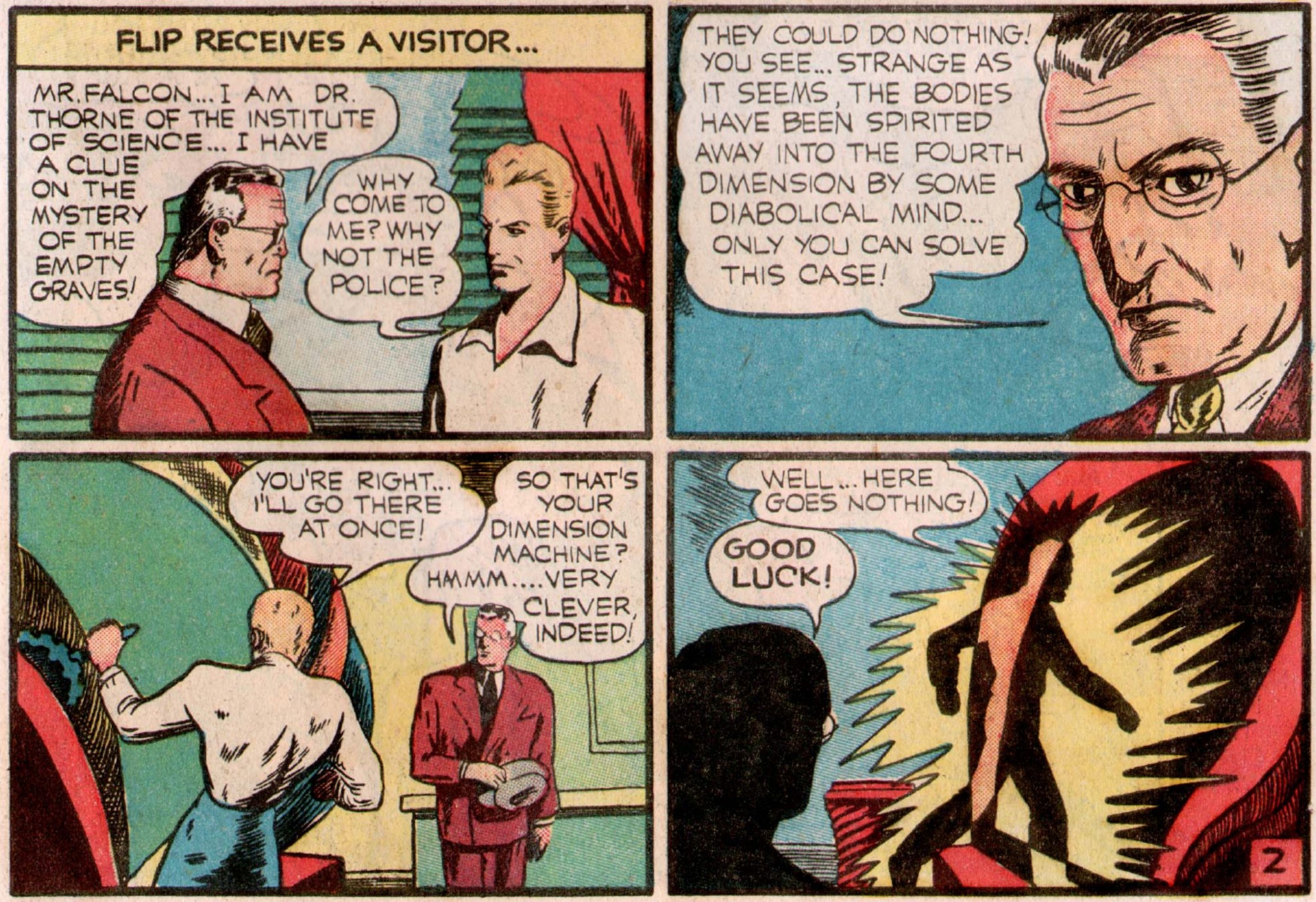
    We open on a mysterious figure using backwards-talk magic to raise hundreds of spirits from their graves and shunt them into the Fourth Dimension. To what end? We shall learn that soon!

    Flip Falcon, expert in all things fourth dimensional. is contacted by Dr Thorne of the Institute of Science asking for help with this problem. You might have noticed that Dr Thorne is also the name of Minor Super Villain 965, and that is because they are the same guy. This is a trap, and Flip should be able to see that because while the border between the Third Dimension and the Fourth has proven to be quite permeable over the course of his comic adventures the idea that the missing bodies have travelled interdimensionally should not occur to any but the perpetrator. 

    Please also note that despite Dr Thorne’s minions being consistently described as ghost of spirits, their bodies are also dug up as part of his little necromantic ritual. Perhaps Thorne did so so that there would be evidence to point at in order to draw Flip in?

    Flip investigates and finds that the ghosts are indeed hanging around in the Fourth Dimension. He also finds (and is taken prisoner by) Dr Thorne, who knows that anyone hoping to engage in Fourth Dimensional villainy needs to take care of Flip Falcon first.

    Flip is transported to Thorne’s lab in his Castle of Misery (great name) where his dimensional energy-charged body is used as a battery to fill up the ghosts with extra ghost-energy that kills humans on contact. We can only speculate as to why Thorne is mass-murdering humans in this manner – perhaps its no more complicated than the classic necromancer’s desire to create more ghostly minions.

    For all that he has been a capable villain so far, Dr Thorne is in no way OSHA compliant, and he is electrocuted seemingly the instant a light tap from Flip causes him to sprawl over his instrument panel. Flip risks his life by touching the machinery long enough to turn it off, causing the ghosts on Earth to fall down “dead,” and all that’s left is the cleanup. That is, if these spirits were in fact housed in all of those missing bodies and those bodies are now littering the city streets. If they were indeed purely spiritual entities we might have a situation in which there are just incorporeal bodies everywhere and nothing can be done about it. Horrifying claim to fame for this poor city!

  • MINOR SUPER-VILLAIN 965: DR THORNE

    (Fantastic Comics 014, 1941)

    We open on a mysterious figure using backwards-talk magic to raise hundreds of spirits from their graves and shunt them into the Fourth Dimension. To what end? We shall learn that soon!

    Flip Falcon, expert in all things fourth dimensional. is contacted by Dr Thorne of the Institute of Science asking for help with this problem. You might have noticed that Dr Thorne is also the name of Minor Super Villain 965, and that is because they are the same guy. This is a trap, and Flip should be able to see that because while the border between the Third Dimension and the Fourth has proven to be quite permeable over the course of his comic adventures the idea that the missing bodies have travelled interdimensionally should not occur to any but the perpetrator. 

    Please also note that despite Dr Thorne’s minions being consistently described as ghost of spirits, their bodies are also dug up as part of his little necromantic ritual. Perhaps Thorne did so so that there would be evidence to point at in order to draw Flip in?

    Flip investigates and finds that the ghosts are indeed hanging around in the Fourth Dimension. He also finds (and is taken prisoner by) Dr Thorne, who knows that anyone hoping to engage in Fourth Dimensional villainy needs to take care of Flip Falcon first.

    Flip is transported to Thorne’s lab in his Castle of Misery (great name) where his dimensional energy-charged body is used as a battery to fill up the ghosts with extra ghost-energy that kills humans on contact. We can only speculate as to why Thorne is mass-murdering humans in this manner – perhaps its no more complicated than the classic necromancer’s desire to create more ghostly minions.

    For all that he has been a capable villain so far, Dr Thorne is in no way OSHA compliant, and he is electrocuted seemingly the instant a light tap from Flip causes him to sprawl over his instrument panel. Flip risks his life by touching the machinery long enough to turn it off, causing the ghosts on Earth to fall down “dead,” and all that’s left is the cleanup. That is, if these spirits were in fact housed in all of those missing bodies and those bodies are now littering the city streets. If they were indeed purely spiritual entities we might have a situation in which there are just incorporeal bodies everywhere and nothing can be done about it. Horrifying claim to fame for this poor city!

  • ALIENS AND SO FORTH ROUND-UP 036

    Once again we bring you some aliens.

    the Tribe of Gurban:

    The Tribe of Gurban come down out of “the upper valley of the Nile” and clash with the ancient superhuman Dynaman in his one Golden Age adventure, and there’s a part of me questions whether it’s even worth noting groups like this who are just humans but bigger (about eight to ten feet tall if I’m any judge). But no: giants in caveman singlets who attempt to conquer Egypt c. 2500 BCE and who use sauropods as beasts of burden always deserve recognition, particularly when they’re very technically canon to the Marvel Comics Universe.

    Dynaman doesn’t have too much trouble sending Chief Ribur and his compatriots packing, but not before they unleash their ultimate weapon: the Wild War Beasts. (Daring Mystery Comics 006, 1940)

    Inhabitants of Phobos:

    I didn’t really cover them in the entry on Spacehawk’s Martian enemy Glork, but his plan to smash Phobos into Mars in revenge for him losing an election wasn’t just bad news for the Martians but also for these adorable little dudes. They’re just trying to live on a very small moon, Glork! Why are you hassling them? (Target Comics v1 009, 1940)

    Insect-Men:

    Not two issues after his adventures with the Serviles and their enemies the Heidites, Flip Falcon is hopping back into his all-purpose machine and heading back to Mercury for a little aimless exploring. There, he is confronted by a completely different group of aliens than the two he had already met, and while the out-of-universe explanation for this is simply that the “Flip Falcon” comic was nobody’s baby and had a very loose relationship with internal continuity, it is fun to imagine that the sun-blasted surface of Mercury is just teeming with weird life forms. 

    Though the Insect-Men are huge cool-looking bug-men who communicate using long warbling cries (and are able to break the strand of energy that tethers Flip to his machine, a strand that can restrain Lucifer himself), by fat the most interesting thing about them is their unnamed queen, who shows up soon after her followers capture Flip and reveals that she is the child of a similarly-unnamed human man and an Insect. This raises an enormous number of questions: just who is this human? How did he get to Mercury? When did he decide to make love to an enormous humanoid bug? How is it possible to produce hybrid Earth mammal/ Mercurian insect offspring? Is it just her feet that are weird looking or does she have insectoid legs? None of these questions are in fact answered in the text.

    The Queen of the Insect-Men is, it seems, a more picky lover than her father, and so falls for Flip Falcon the instant she lays eyes on him. After watching a little light gladiatorial combat she is ready for the marriage to commence, and the only thing that saves Flip from a lifetime of caring for weird little grubs with baby faces is that his faithful assistant Adele reinstates the connection between Flip and his machine in time, which fries the wedding party and allows him to fly on home. (Fantastic Comics 007, 1940)

    Insects:

    Like Flip Falcon, Stuart Taylor has a time-space machine and a penchant for blasting himself into the void to see what is there. In this instance, Stuart has flung himself randomly forward in time and fetched up on the shores of the year 9250 CE to find that while humanity yet endures they are at the mercy of a species of giant intelligent insects. After helping to repel an Insect attack on one of the remaining human settlements, Stuart offers to infiltrate their capitol, where he is quickly captured and taken to the Insects’ long-winded ruler.

    Stuart jumps the ruler while it is busy manning the city’s defenses against an attack by the humans, and I must say that I really like the image of it in its little console chair. It really looks like the artist (Lou Fine) really sat down for a minute and thought about how that would work. Though the Insect ruler outclasses Taylor physically, it is undone by its own prowess, as it throws him into a control console and causes an electrical overload that leads to its own death (Taylor is fine). (Jumbo Comics 013, 1940)

  • ALIENS AND SO FORTH ROUND-UP 036

    Once again we bring you some aliens.

    the Tribe of Gurban:

    The Tribe of Gurban come down out of “the upper valley of the Nile” and clash with the ancient superhuman Dynaman in his one Golden Age adventure, and there’s a part of me questions whether it’s even worth noting groups like this who are just humans but bigger (about eight to ten feet tall if I’m any judge). But no: giants in caveman singlets who attempt to conquer Egypt c. 2500 BCE and who use sauropods as beasts of burden always deserve recognition, particularly when they’re very technically canon to the Marvel Comics Universe.

    Dynaman doesn’t have too much trouble sending Chief Ribur and his compatriots packing, but not before they unleash their ultimate weapon: the Wild War Beasts. (Daring Mystery Comics 006, 1940)

    Inhabitants of Phobos:

    I didn’t really cover them in the entry on Spacehawk’s Martian enemy Glork, but his plan to smash Phobos into Mars in revenge for him losing an election wasn’t just bad news for the Martians but also for these adorable little dudes. They’re just trying to live on a very small moon, Glork! Why are you hassling them? (Target Comics v1 009, 1940)

    Insect-Men:

    Not two issues after his adventures with the Serviles and their enemies the Heidites, Flip Falcon is hopping back into his all-purpose machine and heading back to Mercury for a little aimless exploring. There, he is confronted by a completely different group of aliens than the two he had already met, and while the out-of-universe explanation for this is simply that the “Flip Falcon” comic was nobody’s baby and had a very loose relationship with internal continuity, it is fun to imagine that the sun-blasted surface of Mercury is just teeming with weird life forms. 

    Though the Insect-Men are huge cool-looking bug-men who communicate using long warbling cries (and are able to break the strand of energy that tethers Flip to his machine, a strand that can restrain Lucifer himself), by fat the most interesting thing about them is their unnamed queen, who shows up soon after her followers capture Flip and reveals that she is the child of a similarly-unnamed human man and an Insect. This raises an enormous number of questions: just who is this human? How did he get to Mercury? When did he decide to make love to an enormous humanoid bug? How is it possible to produce hybrid Earth mammal/ Mercurian insect offspring? Is it just her feet that are weird looking or does she have insectoid legs? None of these questions are in fact answered in the text.

    The Queen of the Insect-Men is, it seems, a more picky lover than her father, and so falls for Flip Falcon the instant she lays eyes on him. After watching a little light gladiatorial combat she is ready for the marriage to commence, and the only thing that saves Flip from a lifetime of caring for weird little grubs with baby faces is that his faithful assistant Adele reinstates the connection between Flip and his machine in time, which fries the wedding party and allows him to fly on home. (Fantastic Comics 007, 1940)

    Insects:

    Like Flip Falcon, Stuart Taylor has a time-space machine and a penchant for blasting himself into the void to see what is there. In this instance, Stuart has flung himself randomly forward in time and fetched up on the shores of the year 9250 CE to find that while humanity yet endures they are at the mercy of a species of giant intelligent insects. After helping to repel an Insect attack on one of the remaining human settlements, Stuart offers to infiltrate their capitol, where he is quickly captured and taken to the Insects’ long-winded ruler.

    Stuart jumps the ruler while it is busy manning the city’s defenses against an attack by the humans, and I must say that I really like the image of it in its little console chair. It really looks like the artist (Lou Fine) really sat down for a minute and thought about how that would work. Though the Insect ruler outclasses Taylor physically, it is undone by its own prowess, as it throws him into a control console and causes an electrical overload that leads to its own death (Taylor is fine). (Jumbo Comics 013, 1940)

  • ALIENS AND SO FORTH ROUND-UP 035

    Aliens! Aliens? Aliens.

    the Black-Light Men:

    Like the Emerald Men of Asperus, the Black-Light Men travel on a mobile planet (the Black-Light Planet, natch, so named because it is not visible using conventional light) and like so many Fletcher Hanks villains they are looking to take over the Earth, in this case by pulling the whole planet out of orbit and freezing it solid before selling it on to the Martians. Due to the Black-Light Planet’s perpetual cold, the Black-Light Men are all blubbery. Just what the little rhino horn situation they have going on is for is beyond me. 

    Luckily for the Earth, space hero Whirlwind Carter is on the case and the planet-jacking is halted before more than a measly few million people are killed. Carter leads the Earth military in a retaliatory strike on the Black-Light Planet but it quickly turns into a hand-to hand battle that leaves the human forces ata severe disadvantage.

    Thanks to Whirlwind Carter’s companion Brenda, the Black-Light Men are discovered to have a crippling fear of fire and armed with that knowledge the Earthian forces are able to drive them to self-destruction. (Daring Mystery Comics 005, 1940)

    Serviles: 

    Flip Falcon’s portal to the Fourth Dimension allows him to do a whole lot of different things, for instance: look at images of the planet Mercury and notice that there is a cool-looking city there, then visit that city with his partner Adele. We soon learn that the city is called Servil, and it is inhabited by some truly delightful aliens with the bodies of plucked chickens and the heads of bargain-basement mannequins and who are revealed to be called Serviles in a text box several issues after this appearance.

    The Serviles communicate using extremely cute golden helmets. Up until this point they might just be the perfect alien species, but they have to go and ruin it all by being weird 1940s misogynists and denying women the ability to speak (!) because they “talk too much.”

    Anyway, Servile civilization is plagued by these cool-looking dragonoid beasts called Heidites that crawl over from the hot side of Mercury to eat them, but who could care? (Fantastic Comics 005, 1940)

    Hoof-Men: 

    The Hoof-Men are 1. extremely burly 2. hoofed and 3. of a class of science fiction alien that can best be described as “space bullies,” who exist to give humans a hard time. In this case they have captured the (also very burly) space explorer Professor Darrel and are threatening to turn him into a bug if he doesn’t say that Hoof-Men are better than humans, and it all gets a little too real until space hero Cosmic Carson has to step in and break things up. (Science Comics 003, 1940)

    Hoppers:

    The Hoppers are yet another group of Fletcher Hanks aliens who live on a wandering planetoid, in this case on that looks just like a cartoon tropical island and seems to just aimlessly float through space. As might be expected given their name the Hoppers a big on jumping and can seemingly do so to get from planet to planet. They have the beefiest legs in comics and show them off in what I can only describe as bicycle shorts, in an astounding bit of predictive design-work.

    Unlike most Fletcher Hanks aliens, the Hoppers don’t have some sort of over-the-top plan to destroy humanity – they aren’t even hostile, as far as I can tell. They do hop on over to Space Smith’s ship as soon as it comes into range, which he interprets as a hostile act, but I’m inclined to disagree. The only aggression the Hoppers display is after they are trapped under a big metal net, and even then it is nonlethal.

    Perhaps Smith agrees with me after all, because instead of gruesomely killing the Hoppers he instead essentially pranks them by bringing them to New York City to be spooked by the hustle and bustle of big city life, with its bodegas and whatnot. Unable to hack the Big Apple, they hop back to their small-town planetoid. (Fantastic Comics 005, 1940)

  • ALIENS AND SO FORTH ROUND-UP 018

    It’s time to return to spaaaaaace! 

    Urolians and Urians: 

    The “Blast Bennett” feature is set far enough in the future (5940 CE, according to the caption on a single panel that I’m taking as gospel until contradicted) that I generally assume that all of the human-looking aliens that Blast and his pal Red encounter are representative of far-flung Earth colonies rather than of lack of alien design imagination, but I just had to point out the fact that the two planets in this comic are named Urol and Ur. It’s very annoying!

    Anyway, Blast’s pal Red falls into the hands of the bearded and hostile peoples of Urol, then Blast shows up and frees both him and the princess of Ur, traditional enemies of the Urolians, and ultimately helps the Urians (never actually called that in-comic, but we must have a demonym) defeat the slow-but-powerful Urolian space fleet, ensuring peace at the barrel of a ray gun. (Weird Comics 008, 1940)

    Dwarf Men of Mars: 

    Flick Falcon (famously later changed to Flip because “Flick” and “Fuck” look very similar in comic book lettering) is a character who does all of his adventuring by jumping into an interdimensional teleporter in his laboratory and tooling around the universe. The first time he does this he ends up blasted to Mars so hard that his organs end up on the opposite sides of his body.

    Flick/Flip finds a Mars in conflict, with two native intelligent species under threat of conquest by invading aliens. He ends up allying with the so-called Dwarf-Men, who probably don’t call themselves that. They’re pretty standard humanoid aliens, with the obvious exception being their tininess. Plus they all wear hats with teacup handles on them for no stated reason. (Fantastic Comics 002, 1940) 

    Martian Slave-Giants: 

    The second of the Martian races are referred to as the Slave-Giants, as they have been subjugated by the invaders already. Their main duties seem to be wandering around looking for interesting things such as Flick Falcon to grab and throw toward the invaders’ headquarters. Please also note the wildly inconsistent scale.

    As mentioned in the last Divine Round-Up, the giants are controlled by way of their religious devotion, with the invaders delivering orders in the form of commandments issued by a radio receiver concealed inside of the idol of their goddess. Flick and his gal pal Adele disrupt this by smashing the idol and substituting her as a living replacement, and so the Giants are theoretically no longer enslaved. (Fantastic Comics 001, 1939)

    Three-Arm Invaders: 

    And what of the invaders themselves? These are appropriately known as the Three-Arm[ed] Invaders, and occasionally as the Three-Arm[ed] Ones, Tyrants, or at least once Swine. They are one or two steps more alien than the quite humanoid inhabitants of Mars, with little pig-trotter feet and tusks and that eponymous third arm emerging from their sternums. They also have the most distressing horns that I have ever seen, in that they are more akin to big hairy warts than anything else.

    The Three-Arm Invaders possess similar dimension-hopping technology to that used by Flick Falcon, which they intend to use to both comprehend and conquer the universe. They are held back somewhat by their comparatively frail physical forms, but I suppose that’s what the Slave-Giants are for.

    When the Three-Arm Invaders are last seen, they are reacting to the news of the Slave-Giants’ emancipation by raining hellacious destruction down on the Giants’ city in an attempt to destroy Flick and Adele. After escaping from this conflagration, the duo never bother to go back to Mars, so the struggle of the Martian peoples vs the Invaders is left unresolved. (Fantastic Comics 001, 1939)


    One more thing about the Three-Arm Invaders: they seem to be yet another species in which the males look like gross weirdos and the females like cute human women (they do have little pig trotter feet, but that can be cute!). Unfortunately for the Three-Arm women (who only have two arms, sure, but how else do I refer to them?) the whole deal with the Slave-Giants and their goddess means that having a bunch of cute girls around would only confuse things and break the Three-Arms’ control. Thus, the Three-Arm women are sealed inside of big fruits until they are too old to be cute any more. Three-Armed Invaders: not just evil conquerors, but also misogynists!

    The formerly fruit-bound Three-Arm woman in the above panels seems to be shaping up to be an ally to Flick Falcon, but somewhere in between issues 002 and 003 of Fantastic Comcis she disappears and Flick ends up allied with the formerly suspicious and hostile Dwarf-Men. Hopefully the unseen resolution to this whole invasion involves the liberation of the Three-Arm women, leading to an overthrow of Three-Arm society. (Fantastic Comics 002, 1940)