The Curse of Skeleton Munroe

Category: extradimensional

  • ALIENS AND SO FORTH ROUND-UP 053

    Aliens. 

    Molemen:

    These green-skinned humanoids live in an underground kingdom somewhere beneath what was then known as the Belgian Congo. They have been sent to the surface to find some white men – and just why they subscribe to the racial categories of surface humanity is left unexplored – and woe betide any non-white guys who they encounter first.

    The Molemen expedition eventually captures jungle adventurer Congo Jack and returns to the underground with him. Alas, we never quite learn what Queen Moletta of the Molemen wants a white guy for, because her interest in Jack inspires a real crisis in the ambitious expedition leader Sir Lugi and he draws most of the comic’s ongoing focus with a series of attempted coups to seize power for himself. (Lightning Comics v2 001, 1941)

    Blue Dwarfs:

    One of Sir Lugi’s schemes involves him teaming up with the Blue Dwarfs, ancient enemies of the Molemen, to seize the Moleman city by sneak attack.

    The Blue Dwarf victory hinges on the fact that Sir Lugi knocks out Congo Jack in the first couple of minutes of battle. Once he comes to, Jack is able to not only retake the city after exactly one inspiring speech to the Moleman troops, but also slay the Blue Dwarf King Bobo to really drive the victory home. He is then granted his freedom by Queen Moletta. (Lightning Comics v2 002, 1941)

    Martians:

    Meteor Martin, one of the many short-lived Basil Wolverton sc-fi adventurers, is an officer of the Moon Patrol who sallies forth to combat an invading Martian space fleet and finds himself blasted into a strange otherworldly realm. 

    The above is the only actual look we get at the Martians. Is their invasion successful? No idea. I do like their weird Wolvertonian tentacle arms, though.

    Luckily for Martin, he finds himself in the company of fellow humans Rana and her father Romrak, who are able to fill him in on what has happened to him. The Martian weapon he was struck with sends its victims to a “negative world,” implicitly another dimension. Further, the specific region that they are stranded in is a densely-packed cluster of planetoids called Gorikon. (Amazing-Man Comics 025, 1941) 

    Bat Men:

    Gorikon is awash with different lifeforms, though just how many of them are native to the place and how many have been sent there from the positive universe (or are the descendants of positive universe exiles) is unknown. When Meteor first encounters Rana, for example, she has been staked out as a sacrifice for Bat Men. (Amazing-Man Comics 025, 1941)

    Desert Dwellers:

    These excellent humanoid camel people (referred to as “savages” throughout, but that’s a pretty rude thing to refer to an entire people as, so I’ll just go with “dwellers”) are the ones who are attempting to sacrifice Rana to the Bat Men, and if any species in Gorikon is going to get my vote for having actually evolved there it’s them, if only because they have the weak muscles of a people who come from a low-gravity environment. Note how easily Meteor Martin beats them up, after all. (Amazing-Man Comics 025, 1941)

    Assorted Gorikons:

    Romrak and Rana have been residing in a village of interdimensional refugees, most of whom seem to be the same kind of near-human alien as series antagonist Groob here.

    The inhabitants of Groob’s village all seem to be the same kind of four-fingered humanoid as he is, though the presence of one little froggy guy with super-vision in Amazing-Man Comics 026 introduces the possibility of a more diverse cast of alien refugees that we sadly never get to see.

    Please also note the fact that the low gravity and close orbits of the planets of Gorikon means that interplanetary travel is achievable by means of a human cannonball-style cannon (though how Groob intends to return is a mystery to me). (Amazing-Man Comics 025, 1941)

    Insects:

    Meteor, Rana, Romrak and Groob all end up in this quicksand-like trap set by a species referred to as the Insects by the other inhabitants of Gorikon, and true to alien monster convention the Insect who comes to check the trap makes off with Rana rather than one of the men.

    Rana’s fate is to be sacrificed in a pit of fire, though it is Meteor who ends up falling to his doom in the issue’s cliffhanger. Sadly, there is no third Meteor Martin adventure and so we never learn a) how he gets out of it or b) whether these little green guys turn into the big green guy as part of their life-cycle or if he is some sort of distinct creature. I prefer the former! (Amazing-Man Comics 026, 1942)

  • ALIENS AND SO FORTH ROUND-UP 053

    Aliens. 

    Molemen:

    These green-skinned humanoids live in an underground kingdom somewhere beneath what was then known as the Belgian Congo. They have been sent to the surface to find some white men – and just why they subscribe to the racial categories of surface humanity is left unexplored – and woe betide any non-white guys who they encounter first.

    The Molemen expedition eventually captures jungle adventurer Congo Jack and returns to the underground with him. Alas, we never quite learn what Queen Moletta of the Molemen wants a white guy for, because her interest in Jack inspires a real crisis in the ambitious expedition leader Sir Lugi and he draws most of the comic’s ongoing focus with a series of attempted coups to seize power for himself. (Lightning Comics v2 001, 1941)

    Blue Dwarfs:

    One of Sir Lugi’s schemes involves him teaming up with the Blue Dwarfs, ancient enemies of the Molemen, to seize the Moleman city by sneak attack.

    The Blue Dwarf victory hinges on the fact that Sir Lugi knocks out Congo Jack in the first couple of minutes of battle. Once he comes to, Jack is able to not only retake the city after exactly one inspiring speech to the Moleman troops, but also slay the Blue Dwarf King Bobo to really drive the victory home. He is then granted his freedom by Queen Moletta. (Lightning Comics v2 002, 1941)

    Martians:

    Meteor Martin, one of the many short-lived Basil Wolverton sc-fi adventurers, is an officer of the Moon Patrol who sallies forth to combat an invading Martian space fleet and finds himself blasted into a strange otherworldly realm. 

    The above is the only actual look we get at the Martians. Is their invasion successful? No idea. I do like their weird Wolvertonian tentacle arms, though.

    Luckily for Martin, he finds himself in the company of fellow humans Rana and her father Romrak, who are able to fill him in on what has happened to him. The Martian weapon he was struck with sends its victims to a “negative world,” implicitly another dimension. Further, the specific region that they are stranded in is a densely-packed cluster of planetoids called Gorikon. (Amazing-Man Comics 025, 1941) 

    Bat Men:

    Gorikon is awash with different lifeforms, though just how many of them are native to the place and how many have been sent there from the positive universe (or are the descendants of positive universe exiles) is unknown. When Meteor first encounters Rana, for example, she has been staked out as a sacrifice for Bat Men. (Amazing-Man Comics 025, 1941)

    Desert Dwellers:

    These excellent humanoid camel people (referred to as “savages” throughout, but that’s a pretty rude thing to refer to an entire people as, so I’ll just go with “dwellers”) are the ones who are attempting to sacrifice Rana to the Bat Men, and if any species in Gorikon is going to get my vote for having actually evolved there it’s them, if only because they have the weak muscles of a people who come from a low-gravity environment. Note how easily Meteor Martin beats them up, after all. (Amazing-Man Comics 025, 1941)

    Assorted Gorikons:

    Romrak and Rana have been residing in a village of interdimensional refugees, most of whom seem to be the same kind of near-human alien as series antagonist Groob here.

    The inhabitants of Groob’s village all seem to be the same kind of four-fingered humanoid as he is, though the presence of one little froggy guy with super-vision in Amazing-Man Comics 026 introduces the possibility of a more diverse cast of alien refugees that we sadly never get to see.

    Please also note the fact that the low gravity and close orbits of the planets of Gorikon means that interplanetary travel is achievable by means of a human cannonball-style cannon (though how Groob intends to return is a mystery to me). (Amazing-Man Comics 025, 1941)

    Insects:

    Meteor, Rana, Romrak and Groob all end up in this quicksand-like trap set by a species referred to as the Insects by the other inhabitants of Gorikon, and true to alien monster convention the Insect who comes to check the trap makes off with Rana rather than one of the men.

    Rana’s fate is to be sacrificed in a pit of fire, though it is Meteor who ends up falling to his doom in the issue’s cliffhanger. Sadly, there is no third Meteor Martin adventure and so we never learn a) how he gets out of it or b) whether these little green guys turn into the big green guy as part of their life-cycle or if he is some sort of distinct creature. I prefer the former! (Amazing-Man Comics 026, 1942)

  • MINOR SUPER-VILLAIN 609 UPDATE: LUCIFER

    When we covered the Fourth Dimensional being called Lucifer, who might be the for-real Devil (if the Fourth Dimension is also the afterlife) and might just be a big weirdo (if it isn’t), I said that we would see him again. Well here he is!

    Flip Falcon next encounters Lucifer after he takes a woman named Nora into the Fourth Dimension in order to heal her face, which was scarred with acid by a vindictive man. This is a noble quest, but it once again raises the question of just how all these regular people are accessing accurate information about the properties of the Fourth Dimension, e.g., that it contains “a purifying element which restores the marred”? It’s not Flip, as he never seems to know about these things when people tell him about them. Then who? Is Flip’s assistant Peg publishing 4D guidebooks on the sly?

    Regardless of where she got it, Nora’s information was sound and her face is cured almost immediately upon entering Flip’s dimensional portal. And just as soon as she is healed, Lucifer swoops in and kidnaps her in order to turn her into a giant woman with “my mind” as he puts it, and whether this is meant literally or if it’s just a way of saying that she will have his moral outlook is tough to say. Either way, it’s a real wild insight into Lucifer’s psychology and sense of the romantic.

    We never do get to meet Lucifer’s ideal woman, as Flip Falcon simply zips in to interrupt the process and then sneaks out the back door. It is, all in all, an embarrassing episode for the (possible) arch-devil. (Fantastic Comics 015, 1941)

    This humiliating defeat possibly explains why Lucifer’s next appearance involves him returning to his roots with an attempt to wipe out humanity. Specifically (vaguely?) he is forcing “elements of dimension space” into our atmosphere, to disastrous effect.

     Unfortunately for Lucifer, Flip Falcon has a new trick since he last foiled this specific plan by this specific guy, and so rather than employing his trail of pan-dimensional energy to merely immobilize his foe, he instead annihilates him utterly. What the destruction of the Great Adversary might mean to the faithful is not explored. (Fantastic Comics 020, 1941)

  • MINOR SUPER-VILLAIN 609 UPDATE: LUCIFER

    When we covered the Fourth Dimensional being called Lucifer, who might be the for-real Devil (if the Fourth Dimension is also the afterlife) and might just be a big weirdo (if it isn’t), I said that we would see him again. Well here he is!

    Flip Falcon next encounters Lucifer after he takes a woman named Nora into the Fourth Dimension in order to heal her face, which was scarred with acid by a vindictive man. This is a noble quest, but it once again raises the question of just how all these regular people are accessing accurate information about the properties of the Fourth Dimension, e.g., that it contains “a purifying element which restores the marred”? It’s not Flip, as he never seems to know about these things when people tell him about them. Then who? Is Flip’s assistant Peg publishing 4D guidebooks on the sly?

    Regardless of where she got it, Nora’s information was sound and her face is cured almost immediately upon entering Flip’s dimensional portal. And just as soon as she is healed, Lucifer swoops in and kidnaps her in order to turn her into a giant woman with “my mind” as he puts it, and whether this is meant literally or if it’s just a way of saying that she will have his moral outlook is tough to say. Either way, it’s a real wild insight into Lucifer’s psychology and sense of the romantic.

    We never do get to meet Lucifer’s ideal woman, as Flip Falcon simply zips in to interrupt the process and then sneaks out the back door. It is, all in all, an embarrassing episode for the (possible) arch-devil. (Fantastic Comics 015, 1941)

    This humiliating defeat possibly explains why Lucifer’s next appearance involves him returning to his roots with an attempt to wipe out humanity. Specifically (vaguely?) he is forcing “elements of dimension space” into our atmosphere, to disastrous effect.

     Unfortunately for Lucifer, Flip Falcon has a new trick since he last foiled this specific plan by this specific guy, and so rather than employing his trail of pan-dimensional energy to merely immobilize his foe, he instead annihilates him utterly. What the destruction of the Great Adversary might mean to the faithful is not explored. (Fantastic Comics 020, 1941)

  • ALIENS AND SO FORTH ROUND-UP 043

    We’ve met a few of them in the past, but here’s another dose of the inhabitants of the Fourth Dimension, as explored by Flip Falcon.

    Zezo:

    Zezo works for the Fourth Dimensional villain Lucifer as a guardian. We don’t learn too much about this fellow – is he a one-off or representative of a whole species, for example – but I like his moxie and his big teeth. (Fantastic Comics 015, 1941)

    Koggo:

    Koggo is an even more mysterious fellow than Zezo, given that he is more obviously the product of a civilization of some sort: he has clothing and weapons and hypodermics full of Agony Serum, and also a conceptual framework that allows him to believe that human pilots are somehow trying to invade the Fourth Dimension. This leads him to kill and kidnap several of them until he is stopped when he is exploded by Flip Falcon. (Fantastic Comics 018, 1941)

    Fourth Dimensional Dragons: 

    Fourth Dimensional dragons have a body plan that is a variation of the modern fantasy concept of the wyvern, with wings and front limbs appended to a long serpentine body. It’s unclear just how intelligent they are: Robbo here acts like an animal, but he also has a name. (Fantastic Comics 015, 1941)

    Serpo (Poison Dragon of the Elements) also has a name, but given his seeming status as more of a natural disaster than an inhabitant of the Fourth Dimension, that might just be equivalent to when we name hurricanes. Intriguingly, Serpo is able to cross the dimensional boundaries under his own power.

    Serpo comes to the attention of Flip Falcon after he abducts a woman from Earth and learns too late that he is susceptible to being exploded. (Fantastic Comics 016, 1941)

    Demi-Things:

    Any time you talk about Flip Falcon and the Fourth Dimension, you’re going to get Demi-Things coming up. The first time this occurs is when Gogo, Master of the Demi-Things attempts to abduct the same woman who had already been snatched by Serpo. And just like Serpo, Gogo is unprepared for the explosive power of Flip’s dimensional energy. (Fantastic Comics 016, 1941) 

    The death of Gogo opens the way for Kandor to become Lord of the Demi-Things, and while we have no indication of whether he is a more benevolent ruler than his predecessor, he certainly is aware of the fact that he rules at Flip Falcon’s whim. Or perhaps they really are friends, who knows. (Fantastic Comics 018, 1941)

    Finally, we have Zorka, the Giant Demi-Thing. Zorka guards a region of the Fourth Dimension containing the element “acco-nito.” Why? This is not explained – perhaps it’s just a classic case of treasure-hoarding. In any case, Flip needs so acco-nito to save a woman’s life, so Zorka gets exploded.(Fantastic Comics 019, 1941)

    Octopus Men:

    Strictly speaking, the Octopus Men are not Fourth Dimensional beings, instead, they are the inhabitants of the wandering planet Octo, which up and wanders straight through the dimensional barrier one day and allows the Octopus Men to start beating ten kinds of hell out of the Demi-Things.

    Despite this, the Octopus Men prove just as vulnerable to being exploded as all of Flip’s other enemies, which he discovers after intervening to prevent the conquered Demi-Things from being impressed into a life of space piracy by the Octopus Men’s boss, a human man named Otho. Just how he came to be on an extrasolar planet in the first place, let alone in charge of the place, is left unexplored, but since Flip drags him back to Earth to stand trial we must assume that that’s where he started out. I have no idea what Flip thinks that the charges might be, by the way. (Fantastic Comics 017, 1941)

    Unnamed Species: 

    This unnamed fellow is remarkable mostly for being the antagonist of Flip Falcon’s final adventure. He seems to live on a planetoid by himself, has captured space explorer Irwin Burns and demands help in his plan to go to Earth and kidnap a woman (he needs a “queen” and can’t be bothered to date).

    As befits the final Flip Falcon villain, this fellow gets exploded. It’s a real shame that this is our last look at the Fourth Dimension as the cosmology was getting very weird: it’s another dimension but also Hell and/or Purgatory and it connects to all space and time and as a result of this you can just kind of pass from our dimension to it by travelling far enough out into space? I mean, talk about a rich setting for cosmic horror. (Fantastic Comics 021, 1941) 

  • ALIENS AND SO FORTH ROUND-UP 040

    Weird humanoids as far as the eye can see!

    Demon People: 

    The Demon People are seemingly native to the dimension that Breeze Barton travels to in his first adventure and are in conflict with Miracle City and its population of immortals. Even though their major goal is to get through the dimensional aperture and invade Earth, I would have a lot more sympathy toward them (eternal neighbours really must be the greatest test a people could have, after all) if they weren’t also huge slavers. I do really like the one big wing/fin that they have on their back, even if I can’t figure out what it could be for. (Daring Mystery Comics 003, 1940)

    Jupiterians:

    The Jupiterians, or more specifically the South Jupiterians, are a peaceful, swamp-dwelling people who want to live somewhere other than a swamp and have thus decided to enter into a colonial relationship with Earth. And it works! Against all historical precedent, the South Jupiterians are soon the proud owners of a new city called New Washington! No strings attached!

    The real threat to South Jupiterian sovereignty comes in the form of a diplomatic envoy of lop-eared North Jupiterians under the command of Princess Eelo (whose own long ears are presumably concealed under that kicky headscarf). They represent the bad kind of colonialism, in contrast to the warm fuzzy colonialism of Earth under Captain Nelson Cole, and it takes a plague scare and the complete destruction of New Washington to shift them. Back to work, South Jupiterians! (Planet Comics 009, 1940)

    Link People:

    Comics and other genre fiction are of course chock full of speculative missing links, but the key thing about the missing link concept is that it represents the bridge between ape and human. The idea that the missing link is instead some sort of humanoid reptile that just kind of ignores the existence of mammalian evolution and instead posits (I think) a chain of reptile -> reptile-man -> ape -> human is very weird!

    This being a comic book, such a wild speculation by a collection of white-haired scientists is of course 100% accurate, down to the location and architectural style of the Link Person community. Among other things, this means that the Descent of Man image is going to have to be heavily revised, and also that diver Kinks Mason is immediately sent in to bother this untouched society.

    Fearing that a mere photograph will not be believed, the scientists opt to kidnap one of the Link People, thus completing their introduction to humanity via a whirlwind of violence, death and loss (okay, they do try to sacrifice some of the scientists to their gods, but I think that they might have been justified). (Fight Comics 005, 1940)

  • ALIENS AND SO FORTH ROUND-UP 040

    Weird humanoids as far as the eye can see!

    Demon People: 

    The Demon People are seemingly native to the dimension that Breeze Barton travels to in his first adventure and are in conflict with Miracle City and its population of immortals. Even though their major goal is to get through the dimensional aperture and invade Earth, I would have a lot more sympathy toward them (eternal neighbours really must be the greatest test a people could have, after all) if they weren’t also huge slavers. I do really like the one big wing/fin that they have on their back, even if I can’t figure out what it could be for. (Daring Mystery Comics 003, 1940)

    Jupiterians:

    The Jupiterians, or more specifically the South Jupiterians, are a peaceful, swamp-dwelling people who want to live somewhere other than a swamp and have thus decided to enter into a colonial relationship with Earth. And it works! Against all historical precedent, the South Jupiterians are soon the proud owners of a new city called New Washington! No strings attached!

    The real threat to South Jupiterian sovereignty comes in the form of a diplomatic envoy of lop-eared North Jupiterians under the command of Princess Eelo (whose own long ears are presumably concealed under that kicky headscarf). They represent the bad kind of colonialism, in contrast to the warm fuzzy colonialism of Earth under Captain Nelson Cole, and it takes a plague scare and the complete destruction of New Washington to shift them. Back to work, South Jupiterians! (Planet Comics 009, 1940)

    Link People:

    Comics and other genre fiction are of course chock full of speculative missing links, but the key thing about the missing link concept is that it represents the bridge between ape and human. The idea that the missing link is instead some sort of humanoid reptile that just kind of ignores the existence of mammalian evolution and instead posits (I think) a chain of reptile -> reptile-man -> ape -> human is very weird!

    This being a comic book, such a wild speculation by a collection of white-haired scientists is of course 100% accurate, down to the location and architectural style of the Link Person community. Among other things, this means that the Descent of Man image is going to have to be heavily revised, and also that diver Kinks Mason is immediately sent in to bother this untouched society.

    Fearing that a mere photograph will not be believed, the scientists opt to kidnap one of the Link People, thus completing their introduction to humanity via a whirlwind of violence, death and loss (okay, they do try to sacrifice some of the scientists to their gods, but I think that they might have been justified). (Fight Comics 005, 1940)

  • MINOR SUPER-VILLAIN 965: DR THORNE

    MINOR SUPER-VILLAIN 965: DR THORNE

    (Fantastic Comics 014, 1941)

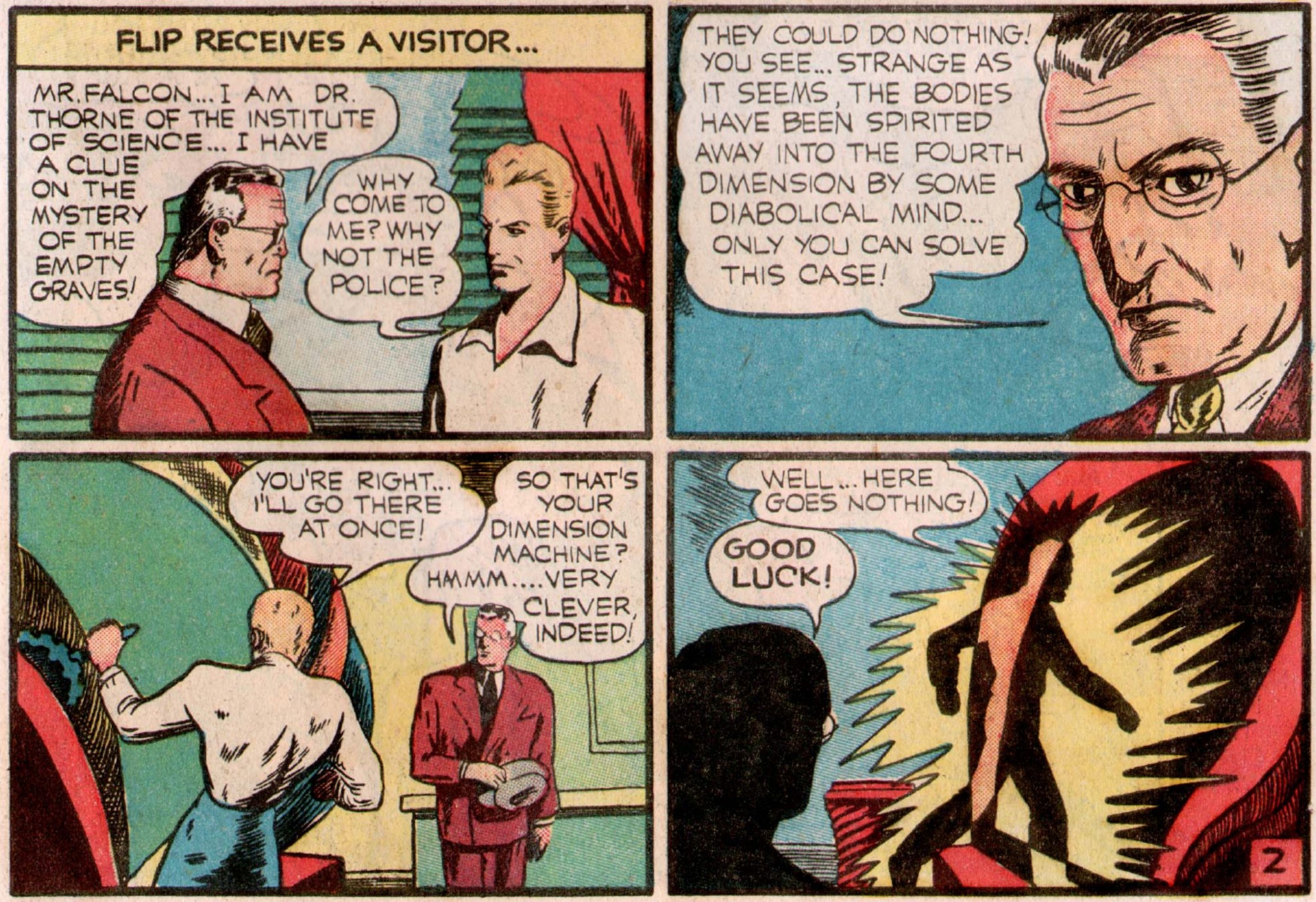
    We open on a mysterious figure using backwards-talk magic to raise hundreds of spirits from their graves and shunt them into the Fourth Dimension. To what end? We shall learn that soon!

    Flip Falcon, expert in all things fourth dimensional. is contacted by Dr Thorne of the Institute of Science asking for help with this problem. You might have noticed that Dr Thorne is also the name of Minor Super Villain 965, and that is because they are the same guy. This is a trap, and Flip should be able to see that because while the border between the Third Dimension and the Fourth has proven to be quite permeable over the course of his comic adventures the idea that the missing bodies have travelled interdimensionally should not occur to any but the perpetrator. 

    Please also note that despite Dr Thorne’s minions being consistently described as ghost of spirits, their bodies are also dug up as part of his little necromantic ritual. Perhaps Thorne did so so that there would be evidence to point at in order to draw Flip in?

    Flip investigates and finds that the ghosts are indeed hanging around in the Fourth Dimension. He also finds (and is taken prisoner by) Dr Thorne, who knows that anyone hoping to engage in Fourth Dimensional villainy needs to take care of Flip Falcon first.

    Flip is transported to Thorne’s lab in his Castle of Misery (great name) where his dimensional energy-charged body is used as a battery to fill up the ghosts with extra ghost-energy that kills humans on contact. We can only speculate as to why Thorne is mass-murdering humans in this manner – perhaps its no more complicated than the classic necromancer’s desire to create more ghostly minions.

    For all that he has been a capable villain so far, Dr Thorne is in no way OSHA compliant, and he is electrocuted seemingly the instant a light tap from Flip causes him to sprawl over his instrument panel. Flip risks his life by touching the machinery long enough to turn it off, causing the ghosts on Earth to fall down “dead,” and all that’s left is the cleanup. That is, if these spirits were in fact housed in all of those missing bodies and those bodies are now littering the city streets. If they were indeed purely spiritual entities we might have a situation in which there are just incorporeal bodies everywhere and nothing can be done about it. Horrifying claim to fame for this poor city!

  • MINOR SUPER-VILLAIN 965: DR THORNE

    (Fantastic Comics 014, 1941)

    We open on a mysterious figure using backwards-talk magic to raise hundreds of spirits from their graves and shunt them into the Fourth Dimension. To what end? We shall learn that soon!

    Flip Falcon, expert in all things fourth dimensional. is contacted by Dr Thorne of the Institute of Science asking for help with this problem. You might have noticed that Dr Thorne is also the name of Minor Super Villain 965, and that is because they are the same guy. This is a trap, and Flip should be able to see that because while the border between the Third Dimension and the Fourth has proven to be quite permeable over the course of his comic adventures the idea that the missing bodies have travelled interdimensionally should not occur to any but the perpetrator. 

    Please also note that despite Dr Thorne’s minions being consistently described as ghost of spirits, their bodies are also dug up as part of his little necromantic ritual. Perhaps Thorne did so so that there would be evidence to point at in order to draw Flip in?

    Flip investigates and finds that the ghosts are indeed hanging around in the Fourth Dimension. He also finds (and is taken prisoner by) Dr Thorne, who knows that anyone hoping to engage in Fourth Dimensional villainy needs to take care of Flip Falcon first.

    Flip is transported to Thorne’s lab in his Castle of Misery (great name) where his dimensional energy-charged body is used as a battery to fill up the ghosts with extra ghost-energy that kills humans on contact. We can only speculate as to why Thorne is mass-murdering humans in this manner – perhaps its no more complicated than the classic necromancer’s desire to create more ghostly minions.

    For all that he has been a capable villain so far, Dr Thorne is in no way OSHA compliant, and he is electrocuted seemingly the instant a light tap from Flip causes him to sprawl over his instrument panel. Flip risks his life by touching the machinery long enough to turn it off, causing the ghosts on Earth to fall down “dead,” and all that’s left is the cleanup. That is, if these spirits were in fact housed in all of those missing bodies and those bodies are now littering the city streets. If they were indeed purely spiritual entities we might have a situation in which there are just incorporeal bodies everywhere and nothing can be done about it. Horrifying claim to fame for this poor city!

  • MINOR SUPER-HERO ROUND-UP 085

    MINOR SUPER-HERO ROUND-UP 085

    Welcome to “The Four Characters Least Likely to Return in a Modern Comic” Theatre.

    Marvex the Super-Robot: 

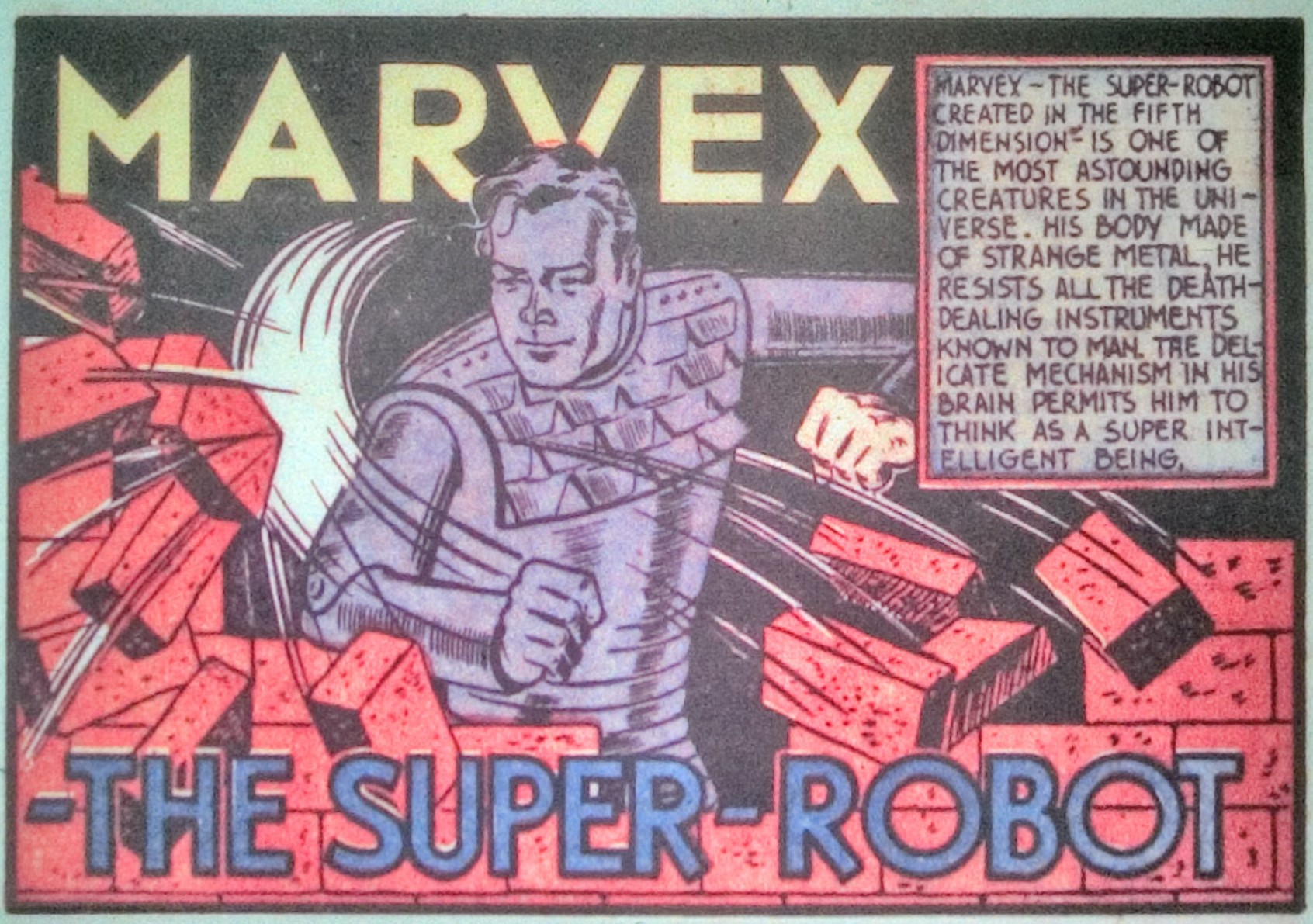
    Marvex the Super-Robot! Created to be a slave by a Fifth Dimensional jerk named Bolo, Marvex rejects his fate, kills Bolo and his associates and accidentally blasts himself to Earth while smashing up Bolo’s lab equipment.

    If you’re already aware of who Marvex is then it’s likely because of the Michael Kupperman strip featuring the character during Marvel’s 70th Anniversary run of comics, and indeed, Marvex’ propensities for cartoonish violence, shutting down romance with sudden nudity and receiving twenty dollars all make him a perfect Kupperman character.

    Sadly, the nudity and twenty dollar reward system go the way of Marvex’ hair in his second and third appearances, but he never stops yelling about being a robot whenever his companion Clara gets a bit too comfortable around him. (Daring Mystery Comics 003, 1940)

    Categorized in: Language (Superlatives – Super), Origins (Extradimensional, Robot), Supranormal Beings (Robots)

    the Falcon:

    The Falcon is Carl Burgess, assistant district attorney in an unnamed city who is kind of betraying the spirit of his office by meting out vigilante justice when he feels like the legal system isn’t working. Though he is a pretty average costumed vigilante, the Falcon has precisely four interesting things to note. The first is that his name is weirdly close to that of Carl Burgos, the creator of the Human Torch. This might be a coincidence, but still. The second is of course that he is the original Marvel Falcon but by far the least-known of the half dozen or so Marvel characters to share that name.

    Like the Eagle, the Falcon is a bit of a fashion plate or at least someone who adjusts his costume on every adventure and for the same reason: a different artist on every one of his appearances.

    Finally, the Falcon has been retroactively assigned an accessory based on an assumption, just like his fellow Daring Mystery Comics alum the Fiery Mask and his morning star. In this case, it’s that his suit gives him the ability to glide. I assume that this is because of a stylistic choice on the part of his various illustrators to have him dive down on his enemies like a falcon stooping on prey, because the suit does not come up in his handful of Golden Age appearances. (Daring Mystery Comics 005, 1940)

    Categorized in: Animals (Falcons), Day Jobs (Assistant District Attorneys)

    Marvel Boy:

    Up until about 2012 I’d have confidently said that “Marvel Boy” was one of the most commonly-shared super-hero identities in the Marvel Universe, but it seems that the concept of the legacy identity has gone through a weird mutation in the last decade or so and I am now regularly surprised to find that there are way more Wolverines or Captains America than I had previously imagined. With that in mind, we’ll revise my statement to be that there are more Marvel Boys than you might expect, like Starmans over at DC.

    This particular Marvel Boy is the Earthly reincarnation of Hercules, come down from Valhalla (?!) to aid a world threatened by fascism. His human form is named Martin Burns and like a veritable Silver Age Superboy he is born with so much physical strength that he must constantly hold himself back lest he endanger those around him and out himself as something strange and different.

    On Martin’s fourteenth birthday a mysterious stranger (who is implicitly the Roman god Jupiter) delivers a package containing his heroic costume to him and then somewhat redundantly also appears in his bedroom to really spell out his whole deal and charge him to uphold democracy etc.

    Marvel Boy is super strong, very agile and fast enough to run from New York City to Washington DC and back – carrying three grown men on the first leg of the trip – in the course of a night that also includes the aforementioned visit from Jupiter and busting up two fifth column cells.

    Both this Marvel Boy and his successor (coming up in 1942) never returned after making a single appearance, and while I can’t say just why they didn’t have further Golden Age adventures, the lack of a modern appearance for either of them is almost certainly down to the fact that their origins both revolve around a dead Hercules, who is in fact more often than not a very living second- or third-tier hero in the Marvel Universe. They’re also both named Martin Burns for some reason, which means that later handbook writers have felt compelled to differentiate them by giving them middle names based on their creators, making this one Martin Simon Burns.

    Frankly, I think that the fact that the two Marvel Boys have origins that are incompatible with both Marvel Comics continuity and also one another is terrific fodder for comic book storytelling. Both of them should be BRUNG BACK immediately, preferably in a comic that also has Hercules in it. (Daring Mystery Comics 006, 1940)

    Categorized in: Generica (Boys), Language (Superlatives – Marvels), Origin (Reincarnated God) 

    the Flying Flame:

    The Flying Flame is a red fighter plane flown for the RAF by the two-fisted American pilot Captain Red Ruff, who is also known as the Flying Flame due to his shock of red hair. During his brief comic book career, Ruff battled the Black Ace and ferreted out some spies at an airbase. (Daring Mystery Comics 006, 1940)

    Categorized in: Activities (Flying), Elements (Fire), Team Membership (RAF)