The Curse of Skeleton Munroe

Category: magic item

  • MINOR SUPER-VILLAIN 994: AKINA

    MINOR SUPER-VILLAIN 994: AKINA

    (Jungle Comics 015, 1941)

    Akina is the hereditary ruler of the African kingdom of Lomar, and as such she has just inherited the mystical Stone of Hanniban. As a newly invested magical being, she falls into the very common trap of deciding that she must be the very best and most powerful of all magic users right away, and immediately sets out to prove herself by challenging Tabu, Wizard of the Jungle to a death duel.

    This goes poorly. Tabu defeats the inexperienced Akina without even breaking a sweat and depowers the stone to boot – hopefully it wasn’t the linchpin of some sort of defence strategy that Lomar depended on. A few highlights form their magic battle:

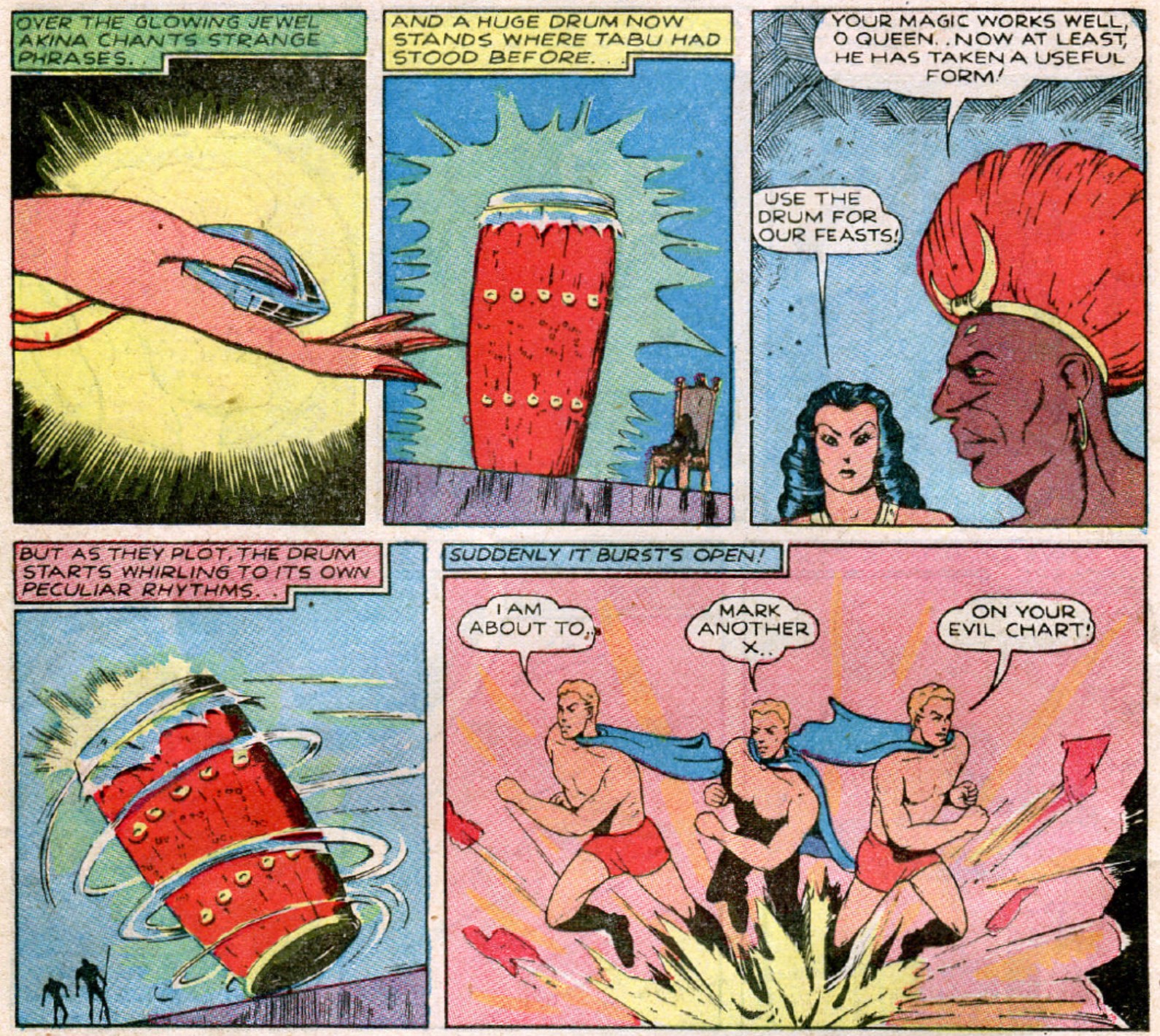
    Tabu gets turned into a drum, then explodes and reforms as three Tabus.

    Akina summons these giant flaming lizards, which Tabu then levitates straight into her palace. Do the lizards eat a lot of people who are arguably blameless in Akina’s crimes? Indeed they do.

    Tabu ultimately concludes the duel by shrinking both Akina and the entire Black Ivory Palace of Lomar; The Stone of Hanniban is the only thing that he leaves at its original size, and though it’s never spelled out, one can reasonably assume that this is as part of a trick to get Akina to fork over the thing willingly rather than have her neck be broken by its relatively enormous weight.

    Categorized in: Accessories (Gems), Generica (Ends in A), Powers (Various Magics)

  • MINOR SUPER-VILLAIN 988: FORD

    MINOR SUPER-VILLAIN 988: FORD

    (Jackpot Comics 003, 1941)

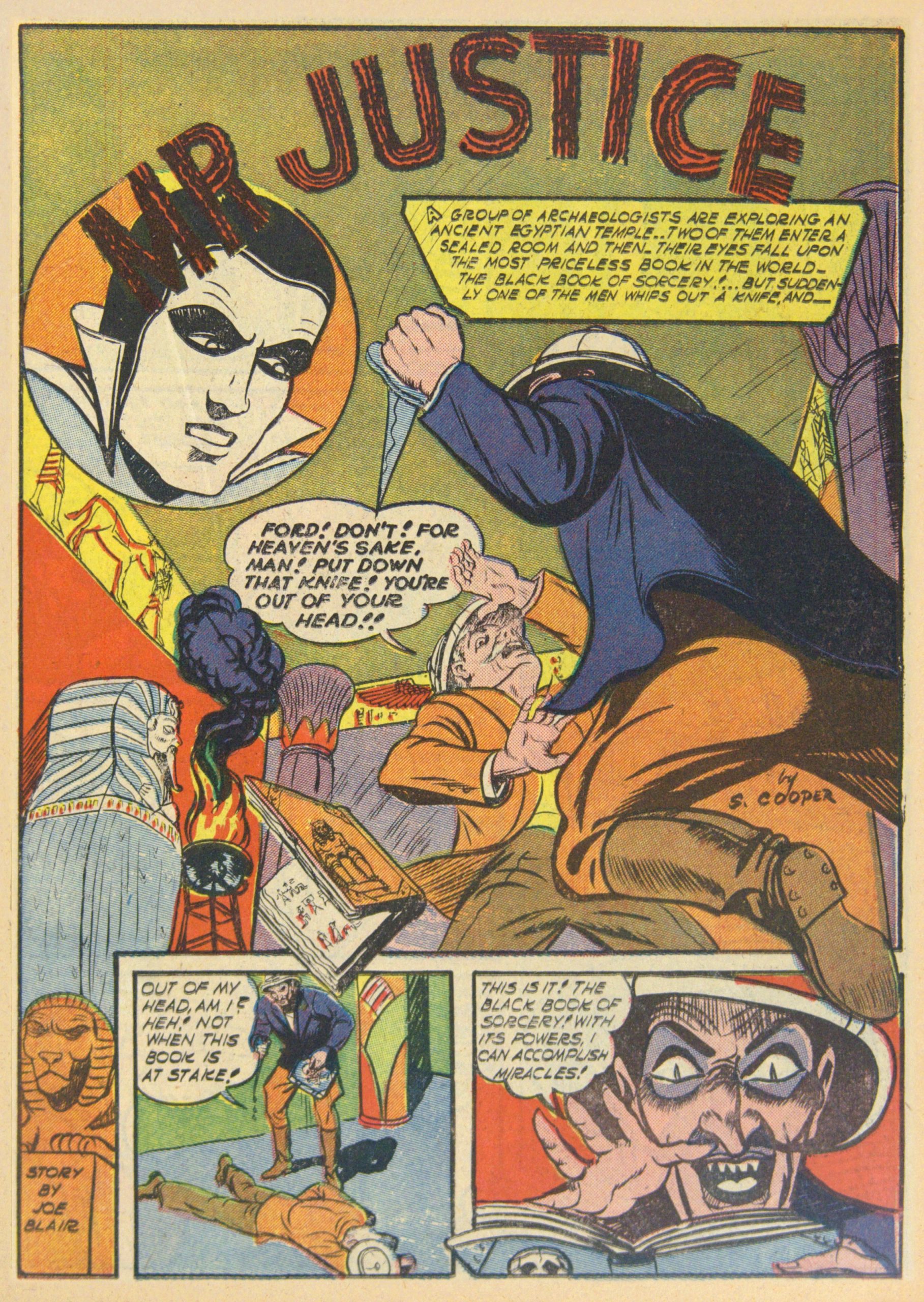
    We meet Ford for the first time as he is knifing his fellow archaeologist Baker to death in an ancient Egyptian tomb, in order to be the sole possessor of the fabled Black Book of Sorcery which they have just found.

    Two points about Ford right off the bat: 1. he is only ever called Ford. No first name, even! This is what I get for grumbling internally about how boring William Scott’s name was. 2. He looks like the Devil. This makes sense in the context of a Mr Justice comic, as artist Sam Cooper was never shy about tying one’s morality to their appearance, but in-universe, is it a reflection of the corruption of his soul or was he always that one archaeologist who looked like Satan?

    Having secured the Black Book of Sorcery, Ford is now subject to critiques of how he uses it. His first effort involves raising the mummies that are housed in the temple from the dead in order to murder the remaining six archaeologists in the expedition and thus cover up his crime. I would call this a rash act, but then again I would probably try stealing the book before committing murder in the first place. I suppose Ford and I are just different people.

    Next, he covers up the mummy murders by collapsing the entire temple on top of the bodies. This is a pretty wild stunt for an archaeologist of all people to pull, and on top of that it’s not even a great way to conceal some bodies, as rubble is famously clearable. It’s also a waste of a number of perfectly good mummies, mummies who might have been some help in cleaning up a crime scene.

    Having made his way back to the unnamed city that both he and Mr Justice call home, Ford attempts to profit off of his new mastery of the necromantic arts by raising deceased millionaire’s son John Grant from the dead to hit up his parents for a loan. Ethical considerations aside, this kind of thing isn’t the worst way to make some dough via dark magic: you could emotionally blackmail the parents with the thought of their child being condemned to a miserable half-dead existence, or maybe use privileged family information to commit some sort of financial fraud or very precise burglary, for example. 

    Ford just sends Grant to bust down the front door and demand cash, which is a total bust as Grant’s parents are left feeling more existentially horrified than inclined to pay out.  Honestly, if smash-and-grab stuff like this is all that you’re going to use necromancy for you might as well stick with the squad of beefcake mummies rather than raising up bespoke dead guys for every job.

    This is the point that Mr Justice gets involved in the story, by the way. You can’t do dark majick inside the borders of [CITY NAME NOT FOUND] and hope to escape his gaze.

    For his final trick, Ford summons the very off-model spirit of Nero, “the most horrible tyrant the world has ever known” as a counter to Mr Justice. Nero in turn proposes a sort of ghost road trip to the Edge of Infinity to access the Immunity Vacuum and become immortal in a way that is distinct from the immortality already enjoyed by the souls of the dead in the Mr Justice cosmology.

    Perhaps the Immunity Vacuum confers a version of immortality that prevents one’s soul from being beaten up by another ghost and thrown into the “depths of eternal nothingness,” never to emerge, and if it is it’s too bad for Ford and Nero that the latter’s chariot isn’t faster because that’s exactly what Mr Justice does to them.

    Unsurprisingly, this kills Ford’s body, which makes it simplicity itself for Mr Justice to collect the Black Book of Sorcery and use the convenient self-destruct spell that it holds to render it blank.

    Categorized in: Accessories (Book of Magic), Day Jobs (Archaeologists), Supercrime (Necromancy)

  • MINOR SUPER-VILLAIN 988: FORD

    (Jackpot Comics 003, 1941)

    We meet Ford for the first time as he is knifing his fellow archaeologist Baker to death in an ancient Egyptian tomb, in order to be the sole possessor of the fabled Black Book of Sorcery which they have just found.

    Two points about Ford right off the bat: 1. he is only ever called Ford. No first name, even! This is what I get for grumbling internally about how boring William Scott’s name was. 2. He looks like the Devil. This makes sense in the context of a Mr Justice comic, as artist Sam Cooper was never shy about tying one’s morality to their appearance, but in-universe, is it a reflection of the corruption of his soul or was he always that one archaeologist who looked like Satan?

    Having secured the Black Book of Sorcery, Ford is now subject to critiques of how he uses it. His first effort involves raising the mummies that are housed in the temple from the dead in order to murder the remaining six archaeologists in the expedition and thus cover up his crime. I would call this a rash act, but then again I would probably try stealing the book before committing murder in the first place. I suppose Ford and I are just different people.

    Next, he covers up the mummy murders by collapsing the entire temple on top of the bodies. This is a pretty wild stunt for an archaeologist of all people to pull, and on top of that it’s not even a great way to conceal some bodies, as rubble is famously clearable. It’s also a waste of a number of perfectly good mummies, mummies who might have been some help in cleaning up a crime scene.

    Having made his way back to the unnamed city that both he and Mr Justice call home, Ford attempts to profit off of his new mastery of the necromantic arts by raising deceased millionaire’s son John Grant from the dead to hit up his parents for a loan. Ethical considerations aside, this kind of thing isn’t the worst way to make some dough via dark magic: you could emotionally blackmail the parents with the thought of their child being condemned to a miserable half-dead existence, or maybe use privileged family information to commit some sort of financial fraud or very precise burglary, for example. 

    Ford just sends Grant to bust down the front door and demand cash, which is a total bust as Grant’s parents are left feeling more existentially horrified than inclined to pay out.  Honestly, if smash-and-grab stuff like this is all that you’re going to use necromancy for you might as well stick with the squad of beefcake mummies rather than raising up bespoke dead guys for every job.

    This is the point that Mr Justice gets involved in the story, by the way. You can’t do dark majick inside the borders of [CITY NAME NOT FOUND] and hope to escape his gaze.

    For his final trick, Ford summons the very off-model spirit of Nero, “the most horrible tyrant the world has ever known” as a counter to Mr Justice. Nero in turn proposes a sort of ghost road trip to the Edge of Infinity to access the Immunity Vacuum and become immortal in a way that is distinct from the immortality already enjoyed by the souls of the dead in the Mr Justice cosmology.

    Perhaps the Immunity Vacuum confers a version of immortality that prevents one’s soul from being beaten up by another ghost and thrown into the “depths of eternal nothingness,” never to emerge, and if it is it’s too bad for Ford and Nero that the latter’s chariot isn’t faster because that’s exactly what Mr Justice does to them.

    Unsurprisingly, this kills Ford’s body, which makes it simplicity itself for Mr Justice to collect the Black Book of Sorcery and use the convenient self-destruct spell that it holds to render it blank.

    Categorized in: Accessories (Book of Magic), Day Jobs (Archaeologists), Supercrime (Necromancy)

  • MINOR SUPER-HERO ROUND-UP 089

    Just when you think that there couldn’t be any more super-heroes, another batch appears.

    Major Victory:

    After an unnamed soldier stationed at US Army Camp Courage dies in an attempt to prevent the camp’s arsenal from being bombed, his body is hauled away by angelic figures and ushered into the presence of a star-spangled old man.

    This, it turns out, is Father Patriot, a new and legally distinct anthropomorphic personification of the spirit of the United States. Were the folks at Chesler concerned about using Uncle Sam due to the fact that Quality Comics was already doing so? Perhaps! Regardless of his origin, Father Patriot revives the soldier as an exemplar of the self-sacrificing military hero. Unusually for a character who has been restored to life by a mystical force, Major Victory (as he is dubbed) does not come back with any powers but is instead gifted with a costume, an airfield base complete with high-powered radio receiver and an airplane and just told to have at it.

    Major Victory is not entirely without supernatural enhancement, however: if he’s ever in a big enough jam then Father Patriot can ring the Liberty Bell to give him a rush of strength sufficient to snap a steel chain.  (Dynamic Comics 001, 1941)

    Categorized in: Generica (Majors), Origin (Patriotic Heroes), Origin (Resurrected)

    Dynamic Man:

    I’m really kicking myself here. Back when I started this blog I was focusing on super-villains and only really talking about the weirder super-heroes, and while I eventually realized my error and started talking about every super-hero at least a little (hence the round-up framework – if I only have a small amount to say about any one hero there are three more to bulk out the post) I’m still playing catch-up. This is all to say that if I’d done things right to start with I’d already have an entry on the Marvel Comics Dynamic Man to point to instead of an assertion that one is coming up in a few month when Mystic Comics comes back around in my reading list.

    This is especially galling because both the Marvel and the Chesler Dynamic Mans are androids who emerge from their birthing tubes as their creators are dying in front of them. This is a fun coincidence, probably! There are of course plenty of differences between the two: the Chesler Dynamic Man is created specifically to combat the villainous Yellow Spot, while the Marvel one is more of an exercise in creation for its own sake. Chesler Dynamic Man is also possibly a magical construct rather than a humanoid robot. My evidence for this amounts to the fact that he was created by “authority on ancient black magic” Dr Moore, who talks about giving him “the power of steel, the speed of an eagle and the wisdom of the sages,” which is pretty poetic if you’re talking about an android and might be literal if you’re growing some sort of super-homunculus.

    Dynamic Man is a hero of the Superman variety, with the powers of flight, super strength and a general invulnerability to harm. He also wears these gloves that I find very distracting – sure, that long point that extends up the forearm is an interesting addition to the costume, but how does it stay in place? Does Dynamic Man have to apply a little spirit gum to his arm every time he gets dressed?

    Finally, Dynamic Man flies with every limb maximally akimbo, and continues to do so throughout his super-heroic career. It’s honestly kind of charming. (Dynamic Comics 001, 1941)

    Categorized in: Generica (Mans), Language (Superlatives – Dynamic), Origins (Magical Constructs)

    Hale the Magician:

    It’s 1541 and the young Englishman Hale (no first name given) and his father are the only two good – though still fairly racist – Europeans in South America and thus object to the brutal treatment of the indigenous peoples by the Spanish. They head up into the mountains to pledge their support to Chief Xingu of the Maoni Indians and soon find themselves locked in battle with a group of angry conquistadors. It’s a short-lived battle, as Xingu reveals himself to be a master of science and magic by producing a lightning storm from his spear. The Spanish sensibly flee, but not before killing Hale Sr.

    Thanks to his selfless heroism (and after passing a series of challenges), Hale the Younger is essentially adopted by Xingu, who teaches his new ward all the technomagical secrets of the Maoni. Together, they create the Magic Spearhead, an artifact that contains the sum of all those powers, but before they can test it out Hale is struck down by a jealous rival. Xingu places Hale’s body in a special tomb with the promise that he will return to life one day

    Cut to 1941, the prophesied time of Hale’s revival, and scientist Henry Starrett and his daughter Lois are on-hand to witness the grand event. After waiting for months, they run out of food and Starrett makes the oafish decision to smash open the tomb with a big stick. This vandalism must have been part of the prophecy, because smashing the tomb kills Starrett and restores Hale to life in what is possibly some sort of inadvertent sacrifice.

    Thanks to the Magic Spearhead, Hale has all of the limitless power of his fellows in the fraternity of comic book magicians and he returns to the States with Lois to use those powers for the good of mankind. In an extremely frustrating development, Hale never sees fit to attach the Magic Spearhead to a spear body, making it more like a weird magic knife, but maybe it’s just me and nobody else is bothered by this. I mean, Xingu had his magic coming out of a full-sized spear, Hale. (Dynamic Comics 001, 1941)

    Categorized in: Accessories (Spears), Magical Professions (Magicians), Origins (Resurrected)

    the Black Cobra:

    The Black Cobra is a standard unit of costumed vigilante. In day-to-day life he is Jim Hornsby, son and office clerk of District Attorney Hornsby, but when danger looms he suits up and starts slinging fists. It’s not a great costume, mind you, both because it’s too busy and, importantly not black. Plus I checked out his other appearances and that is the best that that cowl is ever going to look.

    The Black Cobra also has the one variation on the meek alter ego that is more grating than the disappointed love interest: the emotionally abusive disappointed parent. Hornsby Senior in contention for Worst Father in Comics. (Dynamic Comics 001, 1941)

    Categorized in: Animals (Cobras), Colours (Black), Day Jobs (Clerks)
  • PROBLEMATIC ROUND-UP 007

    Damn their problematic hides!

    Rango: 

    A former Vaudeville magician who employs a magical gem and some rubberoid mask blackface to establish himself as medicine man/bandit chief in Africa, Rango aka Harrigan is ultimately unmasked by Yarko the Great. (Wonderworld Comics 015, 1940) 

    Unnamed Witch Doctor: 

    This unnamed Haitian witch doctor has a very unusual scheme: blind entire American cities with a floating vision of some of his men and then loot those same cities of all of their diamonds. Why diamonds specifically? No clue. He is also notable for giving Zambini the Miracle Man a harder time than Satan himself, before eventually being killed, just like Satan himself. (Zip Comics 005, 1940)

    War Hatchet: 

    Fascist spies striking at the US by inciting Native American tribes to violence is unfortunately going to crop up more than a couple of times as we make our way through the comics of the Forties (and I reckon that the same plot will be recycled with Commie spies in the Fifties and Sixties, alas). This time, the plot is spearheaded by a fellow who calls himself War Hatchet, a European ex-pat turned bandit chief who has returned to the fold to do some espionage work for the dear old unnamed fatherland. 

    As is often the case, War Hatchet makes an okay argument for the colonized to rise up against their oppressors, only with a bunch of murder appended and the unspoken coda that there will be new oppressors later on. Spy Smasher not only stabs him to death but chucks him into a fire afterward. (Spy Smasher 001, 1941)

    the Yellow Horde: 

    The Yellow Horde is a gang of guys in cool looking yellow suits who break into defense plants and shoot poison gas balls everywhere. They turn out to be Chinese, and while the name is arguably in reference to the cool suits I just can’t bring myself to trust 1940s America not to get a little bit of racism in for fun.

    The Yellow Horde’s boss turns out to be an unnamed costumed Nazi who is pretending to be Chinese but also forcing the Horde into doing his bidding. why both? Who knows. Ultimately he gets beaten up by the Hood. (Cat-Man Comics 005, 1941)

  • PROBLEMATIC ROUND-UP 007

    Damn their problematic hides!

    Rango: 

    A former Vaudeville magician who employs a magical gem and some rubberoid mask blackface to establish himself as medicine man/bandit chief in Africa, Rango aka Harrigan is ultimately unmasked by Yarko the Great. (Wonderworld Comics 015, 1940) 

    Unnamed Witch Doctor: 

    This unnamed Haitian witch doctor has a very unusual scheme: blind entire American cities with a floating vision of some of his men and then loot those same cities of all of their diamonds. Why diamonds specifically? No clue. He is also notable for giving Zambini the Miracle Man a harder time than Satan himself, before eventually being killed, just like Satan himself. (Zip Comics 005, 1940)

    War Hatchet: 

    Fascist spies striking at the US by inciting Native American tribes to violence is unfortunately going to crop up more than a couple of times as we make our way through the comics of the Forties (and I reckon that the same plot will be recycled with Commie spies in the Fifties and Sixties, alas). This time, the plot is spearheaded by a fellow who calls himself War Hatchet, a European ex-pat turned bandit chief who has returned to the fold to do some espionage work for the dear old unnamed fatherland. 

    As is often the case, War Hatchet makes an okay argument for the colonized to rise up against their oppressors, only with a bunch of murder appended and the unspoken coda that there will be new oppressors later on. Spy Smasher not only stabs him to death but chucks him into a fire afterward. (Spy Smasher 001, 1941)

    the Yellow Horde: 

    The Yellow Horde is a gang of guys in cool looking yellow suits who break into defense plants and shoot poison gas balls everywhere. They turn out to be Chinese, and while the name is arguably in reference to the cool suits I just can’t bring myself to trust 1940s America not to get a little bit of racism in for fun.

    The Yellow Horde’s boss turns out to be an unnamed costumed Nazi who is pretending to be Chinese but also forcing the Horde into doing his bidding. why both? Who knows. Ultimately he gets beaten up by the Hood. (Cat-Man Comics 005, 1941)

  • MINOR SUPER-VILLAIN 936: SIN KHAII

    (Silver Streak Comics 013, 1941)

    Sin Khaii, a lama at the same monastery that Thun-Dohr was raised at, has been cast out for unspecified reasons. His reaction to being an outcast – to steal Pandora’s Box and use it in a war on all humanity – would seem to retroactively justify the exile, however. Just why a Tibetan monastery would be the hiding place of Pandora’s Box is likewise left unexplored.

    Sin Kahii is able to use the Box to unleash fresh evils upon mankind, in the form of mosquito-like insects that are under his control. The first such is a plague called the Black Madness, which seems to act both as a traditional and deadly disease and as a vector for insanity, as seen above after Dr Benson Bell concocts a cure for it and his assistant is immediately driven to homicidal rage to keep it from being distributed.

    No madness or madman is a match for the mystic might of Thun-Dohr, however. Sin Khaii’s first plot is foiled with a sock to the jaw. Of Clavell, the madman. Sin Khaii remains unpunched.

    Since regular humans have proved to be no match for his foe, Sin Khaii’s next plan involves allying with someone more powerful, namely the ancient and evil Black Pharaoh (check in in a day or two for more on him). To that end, he levitates the Pharaoh’s whole damn pyramid and moves it from Giza to the former site of the New York World’s Fair (I was going to gripe about the comic missing an opportunity to feature the pyramid next to the Trylon and Perisphere but it seems like they were demolished with much more alacrity than I might have expected).

    As will be discussed further in the Black Pharaoh’s own entry, his imprisonment in the pyramid can only be ended when he and his servants’ places are taken by other people. Sin Khaii facilitates this via another Pandora’s Box bug, in this case “curiosity.” Could one argue that curiosity is not one of the evils contained in the box since Pandora already had it her curiosity was in fact foundational to the whole myth? I think that one could, but of course if we’re going to insist on mythic accuracy then Sin Khaii is going to have to be finding increasingly unlikely ways to weaponize hope, seeing as it’s the only thing that’s supposed to still be in the dang thing.

    Once the Black Pharaoh is free, he and Sin Khaii plot to destroy the United States but are once again foiled by the flying fists of Thun-Dohr. The pyramid (and all of the sand in Egypt) is restored to its proper resting place and Sin Khaii, still at large, swears further vengeance. Sadly for us plot resolution fans out there, the “Thun-Dohr” feature never returned after this second instalment and Sin Khaii is presumably at large to this day.

    Categorized in: Accessories (Pandora’s Box), Day Jobs (Lamas), Powers (Various Magical)

  • MINOR SUPER-HERO ROUND-UP 078

    Lev Gleason characters for EVERYONE!

    Daredevil **UPDATE**:

    Daredevil had but one appearance in 1940, so it’s no surprise that the character still had some changes and revisions to go once 1941 rolled around. Firstly, his costume gets an update, with yellow swapped out for red and the complicated “DD” design on the abdomen dropped entirely.

    The most dramatic change, however, is that the Daredevil can now talk. Just how Bart Hill’s traumatic muteness was alleviated is unaddressed – I’m sure that the real answer is that it was inconvenient to write around and so was quietly dropped, but imagining that his successful crimefighting career allowed him to let go of the past is nice.

    Finally, Bart is now a wealthy playboy with a fiance (Tonia Saunders) who isn’t too sure about marrying this manchild after all. Thankfully, Tonia discovers the truth about Bart’s double life in her first appearance, because the Clark/Lois dynamic can get a bit tedious when grafted onto every super-hero’s relationship by default.

    Our final update from Silver Streak Comics 007 is this revelation that the Daredevil’s mastery of the boomerang is so complete that, when thrown by the Claw, he can cause his own body to act like one. This here might just be a new contender for inclusion in lists of obscure and ridiculous super powers, folks.

    In Silver Streak Comics 008 & 009, Daredevil employs a couple of high-tech fighter planes called “the Airdevil,” which a top-notch example of a jokey super-accessory name. Both planes are destroyed during Daredevil’s clashes with the Claw, and he seems to have given up on the idea of the custom plane, at least for the year 1941.

    In Silver Streak Comics 015 Daredevil employs a decoy double named Chester to help in the capture of a villain named the Serpent. Who is Chester? No idea. Will he ever return? Probably not.

    Finally, in Daredevil Comics 002, Daredevil engages in what I would say is some Spider-Man style super-hero quipping as he battles this horde of silent men. Not that super-heroes aren’t constantly mouthing off, mind you, but it doesn’t have this kind of flow. I shall be looking out for more of this kind of patter to see how long it takes to become an established thing.

    Categorized in: Accessories (Airplanes), Day Job (Wealthy Socialite)

    Presto Martin: 

    Presto Martin, though voted “Least Likely to Succeed” in college, is now Captain of Detectives in the NYPD. More importantly for our purposes, he is a master of disguise who is for instance more than willing to take the place of a heavyweight boxer in the ring if it means that he can solve a big case. (Silver Streak Comics 007, 1941)

    Per Silver Streak Comics 008, Presto is aided in his work by a super-moldable plastic putty of his own concoction.

    Categorized in: Day Job (Police Captain), Powers (Master of Disguise), Team Membership (NYPD)

    Zongar, the Miracle Man:

    Zongar, the Miracle Man, is a functionally-omnipotent magical adventurer like so many of his peers, but rather than casting spells per se Zongar uses a mystical amulet to command the spirit Abaraxx to do his bidding. This might have lead to some interesting developments over time if, for example, a nogoodnik were to get ahold of the amulet but alas, Zongar had only one recorded adventure. (Silver Streak Comics 007, 1941)

    Categorized in: Abstract Concepts (Miracles), Accessories (Amulets)

    Cloud Curtis: 

    Dashing young aviator Cloud Curtis has developed the super plane Golden Bullet, which he flies both as a job and against the enemies of the US and which has one of the goofier features of any comic book super plane in the form of that big propeller located halfway down the fuselage. Curtis is assisted by the apelike Crusher McCoy and the avuncular Pop Whistler as he keeps the airways safe from a series of increasingly unlikely airplane-based threats. (Silver Streak Comics 007, 1941)

    Categorized in: Accessories (Airplanes), Day Job (Aviators)

  • MINOR SUPER-HERO ROUND-UP 076

    Yet more super-heroes for your delectation.

    the Black Widow:

    There are a lot of Black Widows in comics, but Linda Masters is the first one who I have encountered who is actually a widow and not just a woman named after a spider as a way of emphasizing how creepy-deadly she is. And since her husband was Murdered by a Crime™, she expresses her grief by becoming a crimefighter.

    We don’t see a lot of the Black Widow’s modus operandi during her single recorded adventure, but she is handy with a gun and a judo throw. She spends most of her time standing outside in an overcoat in the rain, so we don’t even get much of a chance to observe her costume aside from the fact that it includes a black turtleneck with a particularly leggy spider logo on it. 

    She is also at least a better detective than the police in whatever NYC-alike city she calls home, given that the entirety of her first adventure takes place while they are misreading the directions she gave them to the villain’s hideout that she has already found. (Cat-Man Comics 001, 1941)

    Categorized in: Animals (Arachnids), Colours (Black), Family (Widows)

    the Flying Legion: 

    Headquartered out of a hollowed-out mesa, this combination air rescue/air vigilante corps is notable mainly for the fact that every single member seems to have a nickname, from leader Chute Harmon to his aides Wolf, Slip and Piston. Perhaps it’s part of the onboarding process. (Cat-Man Comics 002, 1941)

    Categorized in: Generica (Legions), Professions (Aviators)

    the Pied Piper: 

    The Pied Piper is a super-hero whose origin combines two popular tropes: that of the member of the legal system who discovers that the justice they seek can only be found outside of the normal bounds of the law and that of the framed person who must operate outside the law to clear their name (BONUS: he is also an example of a much less common trope, that of the super-hero who has a little mustache). Specifically, the Pied Piper is Stephen Prentice, a lawyer who finds himself framed twice in rapid succession and must turn to his mastery of the pipes to expose the corrupt judge and political boss behind the plot against him.

    (the second framing is for a pretty standard murder, but the first one does demand some comment. Prentice is framed for defending a guilty man for murder, with the really damning aspect being that he supposedly set out to do so while knowing that he was guilty. While I am admittedly not a lawyer I cannot imagine that this would be enough to ruin someone’s career, even in 1941. Which is probably why they doubled down and also framed him for murder, now that I think of it)

    As his name implies, the Pied Piper employs flute and recorder type instruments in his crimefighting, and while his first adventure heavily implies that he is using the power of suggestion to make his foes believe that the music has the power to compel them, subsequent stories make it clear that he is armed with one or more magical instruments acquired as part of his flute-collecting hobby.

    Some examples of just what a man can do when armed with a magical flute:

    – knock a man unconscious

    – compel a man to give a confession

    – kill animals 

    – collapse buildings 

    It really is a very useful item. (Cat-Man Comics 003, 1941)

    Categorized in: Accessories (Musical Instruments), Famous Figures (Literary), Professions (Law)

    the Hood: 

    The Hood, in reality FBI agent Craig Williams, is a non-super-powered vigilante who had only one appearance in 1941, and while I’m sure that there is more to say about him, almost all of it will have to come in the due course of time.

    Two things I can say about him are 1. his adventures are extremely dynamic and 2. he kind of looks like the Golden Age Atom. Chew on that for a while, I guess. (Cat-Man Comics 005, 1941)

    Categorized in: Objects (Hoods), Professions (Law)

  • MINOR SUPER-HERO ROUND-UP 074

    Some more of those “minor super-heroes” you like so much. 

    the Cat-Man **Update**:

    Hey, it’s the Cat-Man! As you may or may not recall, the Cat Man (sans hyphen) debuted in Crash Comics Adventures in 1940 and was the only survivor of that comics short run. The most obvious change to his character is his costume, which goes from its former jungle chic look through a blue-and-orange phase  before settling on the orange-and-darker orange look that he will stick with for the rest of his career.

    In addition to the costumes and the hyphen, Cat-Man got a slight tweak to his origin: rather than being orphaned by a hostile tribe in India, David Merrywether’s parents are now said to have been killed by bandits in Burma. David also has a job now: he’s a private detective for the first four issues of Cat-Man Comics, after which he enlists and becomes a lieutenant in the US Army.

    The Cat-Man also gets a couple of new powers in 1941: he is able to see otherwise-invisible radiation and displays some degree of super strength.

    Finally: his nine lives. Though he still has this power, David manages to only die once during the whole of 1941, bringing his total remaining lives down to six.

    the Kitten: 

    Actually, not quite finally, as this is also the year that the Cat-Man gets a sidekick. While en route to investigate a series of train explosions, Lt David “the Cat-Man” Merrywether picks up a hitchhiking man and his niece. The man turns out to be a real scumbag, but the girl, named Katie Conn, turns on her uncle rather than see him rob and possibly murder Merrywether. Once the uncle is tossed in the hoosegow it’s a classic case of a child just entering a super-hero’s orbit and getting auto-adopted.

    Katie turns out to be the orphaned child of a pair of circus acrobats, which as we know is a perfect background for a potential super-hero’s sidekick to have. She also appears to be a few years younger than your typical kid sidekick – if they average in at about 13-15 I’d call her 11 or 12, though as usual the limitations of Golden Age art make estimating the age of kids difficult at best.

    Merrywether does his best to conceal his dual identity from his new ward but doesn’t quite manage it, and her self-assigned new role as the Cat-Man’s sidekick is announced in the final panel of the last Cat-Man story of 1941. More specifics on her in action as a sidekick in 1942. I will say that it’s nice to see a kid sidekick with both a costume and a code name. (Cat-Man Comics 005, 1941)

    Blaze Baylor: 

    Blaze Baylor is the son of the famous fire chief Smoky Baylor, who was killed by arsonists, and who is now a very specific anti-arson crimefighter. Though the name of the strip is “‘Blaze’ Baylor and the Arson Ring,” there is no indication in any of his adventures that the arsonists he battles are connected to one another in any way. (Cat-Man Comics 001 1941)

    Dr Diamond: 

    Dr Drake Gorden is bound for the South Seas when the freighter he is travelling on is sunk by a waterspout. He passes out after washing up on a beach at the base of an unscaleable cliff and is carried off by an eagle that takes him to the home of a frankly weird guy who has dressed him in a generic super-hero costume.

    This never-named man explains that thirty years prior he had come into possession of a legendary black diamond that conferred great physical power to its wielder, and that he had retired to the island to await the arrival of someone worthy enough to receive it. Dr Gorden, a man who he just met and who has spoken all of thirty-three words to him, several of which were to refer to a pair of brown pants as his “American clothes,” is his pick.

    Whatever the opposite of the Refusal of the Call part of the Hero’s Journey is, that’s what Dr Gorden has. He immediately renames himself Dr Diamond and launches into a monologue about just how hard he’s going to bust up crime that is so over the top that it would make me personally reconsider giving him any sort of power whatsoever. Despite my misgivings, Dr Diamond does an adequate job of using the powers conferred by the gem (super strength, enhanced speed, some degree of invincibility) to battle crime for four issues before fading into the mists of obscurity. (Cat-Man Comics 001, 1941)