The Curse of Skeleton Munroe

Category: minor super-hero

  • MINOR SUPER-HERO ROUND-UP 104

    Here are some very minor Marvel Comics super-heroes, or at least super-hero adjacent comic book adventurers.

    the Masked Raider:

    The Masked Raider is actually Jim Gardley, a small-time rancher in the town of Cactusville (which has apparently been officially placed in California? the hell?) is run off his land and framed as a rustler by crooked business interests. Adopting his masked persona and acquiring a souped-up horse named Lightning, he strikes back at his persecutors and goes on to spread justice throughout the West.

    Recently (well, seven years ago), Marvel Comics 1000 recontextualized the Masked Raider as being part of a chain of super-heroes who are empowered by an artifact known as the Eternity Mask, but that’s all future stuff. As far as we are concerned, for the next 80-odd years worth of comics the Masked Raider is just a two-fisted cowboy. (Marvel Comics 001, 1939)

    Ka-Zar:

    Ka-Zar is in actuality David Rand, who was gradually orphaned after his family was stranded in the jungle when he was a toddler. First his mother dies of a fever, which, along with a bit of head trauma, causes his father to have a mental break and decide to settle down in the jungle rather than try to get back home. Some years later, the vile emerald hunter de Kraft invades this jungle life and kills David’s father, leaving David to be brought up the rest of the way by the lion Zar and his mate. Ka-Zar = “Brother of Zar,” which is a better origin than most jungle man nonsense names get. Ka-Zar’s origin ends when he slays de Kraft, who has returned to get more delicious emeralds.

    This particular Ka-Zar is of course doomed to obscurity thanks to the existence of the other Ka-Zar, who somehow continues to appear to this day. Marvel has no need of any more jungle heroes, let alone a surplus Ka-Zar. (Marvel Comics 001, 1939)

    Ferret:

    Though private detective characters are a dime a dozen in Golden Age comics, Ferret here is distinguished in a few ways: firstly by the fact of his cool name, secondly by dint of having a bit of the weaselly appearance of his namesake rather than being your typical comic book squarejaw, and finally because he is a bit of a go-to in more modern comic flashbacks when they want to add a bit of non-costumed 40s flair. (Marvel Mystery Comics v1 004, 1940)

    Most importantly, as of Marvel Mystery Comics v1 005, Ferret has a real ferret named Nosey for a pet.

    Terry Vance:

    Terry Vance, aka the Schoolboy Sleuth, aka the Boy of a Hundred Hobbies is a science-minded youth, of the subtype that deals in actual science and not comic book super tech. Mostly, at least – he does occasionally stretch the bounds of what a remote controlled plane can do.

    Vance splits his time between school, the Bike Club, his famed Hundred Hobbies and solving grisly murders that have the police flummoxed, and he does it all with the aid of a monkey named Dr Watson and a reporter pal named Deadline Dawson. 

    If any of these characters is a ripe candidate for revival, it’s Terry*, as a venerable old detective, an embittered old tech billionaire, a benevolent old tech billionaire… the possibilities are finite but vast! Heck, have him still be a teen, having gotten too close to the super-villainous side of crime and been blasted through time and/or space. (Marvel Mystery Comics v1 010, 1940)

    *Ferret was killed off by Ed Brubaker, alas. 

  • MINOR SUPER-HERO ROUND-UP 103

    Soon there will be more minor super-heroes than there are humans for them to protect.

    the Sentinel:

    In 1783, on the Boston Common, the newly-minted Spirit of America charges a cannon with the “powders of patriotism” in anticipation that someday a champion will be needed to defend the new nation from destruction. Finally, in 1941 (the Civil War not, apparently, being enough of a reason), the cannon fires on its own and releases the Sentinel, mystic champion of the American people.

    As one might expect, the Sentinel is broadly superhuman: he can fly, is super strong and is immune to most harm. He also has a halo of fire that he can disappear into and shrink to a tiny flame, effectively rendering him invisible and allowing him to vex friend and foe alike with his comings and goings. Oddly, he has no other control over fire. (Liberty Scouts Comics 003, 1941)

    Doctor Nemesis:

    Doctor Nemesis is really Dr Jim Bradley, intern at Mercy Hospital in an unnamed city (that is probably meant to be NYC but later retconned as San Francisco) who has developed a foolproof truth serum and decided to keep it to himself rather than risk criminals getting their hands on it – presumably the concern is that they would use it to learn bank vault combinations and other secret information. Since he himself continually runs into situations in which a foolproof truth serum is a handy way to solve a crime, Bradley adopts a costumed identity and sets out to achieve a better tomorrow via a series of injections. 


    Doctor Nemesis might just be the most calling card-using super-person who we have yet encountered. He hands out at least four of them in his first adventure alone.

    Doctor Nemesis has a pretty simple crimefighting routine: identify a potential injustice and then drug everyone involved until he has a clear idea of who is responsible, then beat them up and have them give a drugged confession in front of a police witness. The police in turn are perfectly happy to receive these confessions that they technically haven’t coerced from people, though there has to be a clever defense attorney somewhere in Unnamed City who is just waiting to get a Doctor Nemesis client so that they can really dig into the admissibility of admissions given under the influence of mysterious vigilante juice.

    It’s been a while since we have encountered a character who was later revived and incorporated into the Battle-Axis, Marvel’s team of disaffected public domain Golden Age super-heroes who went over to the Nazis, but Doctor Nemesis here is one of them under the technically-but-not-really more badass name of Dr Death. As always, it’s hard to say just who got done dirtiest by Roy Thomas when he was assembling the Battle-Axis roster but Doctor Nemesis is certainly a candidate, if only because he doesn’t even have the Human’s Meteor’s flimsy “I’m Irish American and fuck the British” or the Spider Widow’s “the Commies killed my husband” excuses. Instead, he simply implies that the Nazis are paying him well.

    Subsequent writers (specifically Matt Fraction, if I have things right) clearly thought that Doctor Nemesis was worth revisiting. He was given a long career as a Nazi hunter to counteract his short career as a Nazi and briefly became a core X-Man, though nowadays every time I look up what he’s up to it seems that he has become weirder and more peripheral to the action than the last. (Lightning Comics v1 006, 1941)

    Lash Lightning **UPDATE**:

    I haven’t been very careful to delineate whether the character has been going by “Flash” or “Lash” Lightning due to the fact that it profoundly does not matter (they just call him “Lightning” in the stories themselves, for instance) but I might as well make note of this, the issue in which the actual change was made. (Lightning Comics v2 002, 1941)

    Marvo the Magician **UPDATE**:

    Up until the exact point pictured above, Marvo the Magician was unique among magical comic book super-heroes, for though many of them (including Zatara, the big cheese himself) are said to be using their magic to create illusions and fool the minds of others, it is all demonstrably lies (or more charitably a different definition of “illusion” than I am using), as they all produce material effects in the world. Only pure, beautiful Marvo can claim that he uses illusions and nothing more to frighten and confound his foes, and I have been checking.

    That is, up to this issue, when Marvo creates the “illusion” of an ocean liner (complete with a crooked sailor who kidnaps her and hands her over to pirates!) that the woman he is helping proceeds to board and sail away on. Unless the implication is that she has been so convinced that the liner exists that she has swum or perhaps hovered her way to her destination (well, part way to her destination), the inescapable fact is that this ship is more than a mere illusion. Nothing is certain in this wicked world, folks. (Lightning Comics v2 003, 1941)

  • MINOR SUPER-HERO ROUND-UP 102

    MINOR SUPER-HERO ROUND-UP 102

    You won’t believe what I just found: more super-heroes!

    the Liberty Scouts:

    When fascist forces armed with high-tech weaponry begin attacking targets calculated to cripple US war capacity, they are repeatedly driven away by a trio of anonymous heroes who leave behind Liberty Bell calling cards. Both the fascists and US officials are eager to learn just who these so-called Liberty Patriots are, but President Roosevelt is the one who actually gets to find out, thanks to his association with patriotic millionaire Patrick Henry.

    Henry drives FDR out to his country estate, Liberty House, where he introduces him to three mysterious youths beginning with Smokey, the inventive genius of the group, and whose amphibious tank is counted as a land vehicle for the air/sea/land theme that the three have going on.

    Skipper, “the best sailor on the Seven Seas,” is also clearly the group member who is most invested in the paramilitary aspect of the whole operation. He has a super-powerful miniature submarine.

    Finally, we have Strut, the youngest of the group. He’s got a souped up fighter plane called the Comet (initially the only named super vehicle in the bunch, though the tank is later named Ironsides), plus a cool-ass wingsuit. He’s also the only one of the three with any discernible personality, even if it’s “won’t shut up about cherry pie.”

    So just how does Mr Henry know these three youngsters and why are they living in his house? Because they are his own sons! He loves his country so much that he has moulded his children into weapons designed to defend it, and the President loves it. (Liberty Scouts Comics 002, 1941)

    The Liberty Scouts eventually change their name to the Liberty Guards after the Boy Scouts of America complain about their monopoly on the word “scout” being infringed.

    Categorized in: Accessories (Calling Card Leavers), Groups, Origin (Patriotic Heroes)

    Man of War:

    Impatient with the slow progress of World War II, the god Mars decides to create a divine being imbued with the powers of the Greco-Roman pantheon and send them down to help the Axis conquer Europe faster and with more bloodshed. He gifts his champion with “the Strength of Hercules, the Speed of Mercury, the Wisdom of Zeus” (making him about 0.5 of a Captain Marvel) and arms him with the infinitely sharp Sword of Mars before sending him on his way.

    In a legitimately funny twist, Mars forgets to account for the rotation of the Earth during the presumably-lengthy demigod-crafting process and shoots his new creation at Dayton, Ohio (okay, at one of the more than thirty Daytons in the United States. Or in another city that has an unrelated Dayton Munitions Factory. Probably Dayton, Ohio, though) instead of Berlin or wherever he intended for it to go. Thus, Man of War (as he calls himself) is instantiated in the “peace-loving nation” of the USA and is dedicated to virtuous, defensive warfare instead of awful slaughter in the name of power-hungry politicians (insert joke about the US war machine here. Man of War must have had a rough go of things as the 20th Century progressed).

    So what are the powers of the gods? Mostly generic super strength and invulnerability, though Man of War is able to breathe and move freely underwater thanks to the gifts of Neptune. He also has one bespoke power gifted upon him by Mars: to disappear or appear in any explosion, up to and including those created when bullets are fired (which would be a bit more useful if he weren’t already bulletproof). (Liberty Scouts Comics 002, 1941)

    In Man of War Comics 001, Mars reveals Man of War’s weakness to the dictator Luko: that he is powered by rays emitted by the planets of the Solar System, and that confining him in a lead-lined chamber will block those rays and render him merely human. This nearly works, but as the Sword of Mars is not planet-powered he is soon able to carve his way free.

    Categorized in: Accessories (Swords), Activities (War), Origins (Demigods)

    Vapo-Man:

    Bradford “Brad” Cole is a chemist assisting at the laboratory of Dr Kreiner, who in turn is performing unspecified research that is evidently valuable enough to the US government that some fascist saboteurs blow it up. Cole, unlike Kreiner, is lucky enough not to be exploded but instead is showered with a randomized mix of chemicals that change him into a man of vapour.

    The dying Kreiner explains that he is now a chemical man, which is apparently something that chemists have been trying to create for centuries. He extracts a promise from Cole that he will use this power to fight evil, and saddles him with the terrible name of Vapo-Man just before dying, thus ensuring that Crawford can never change it without feeling very guilty.

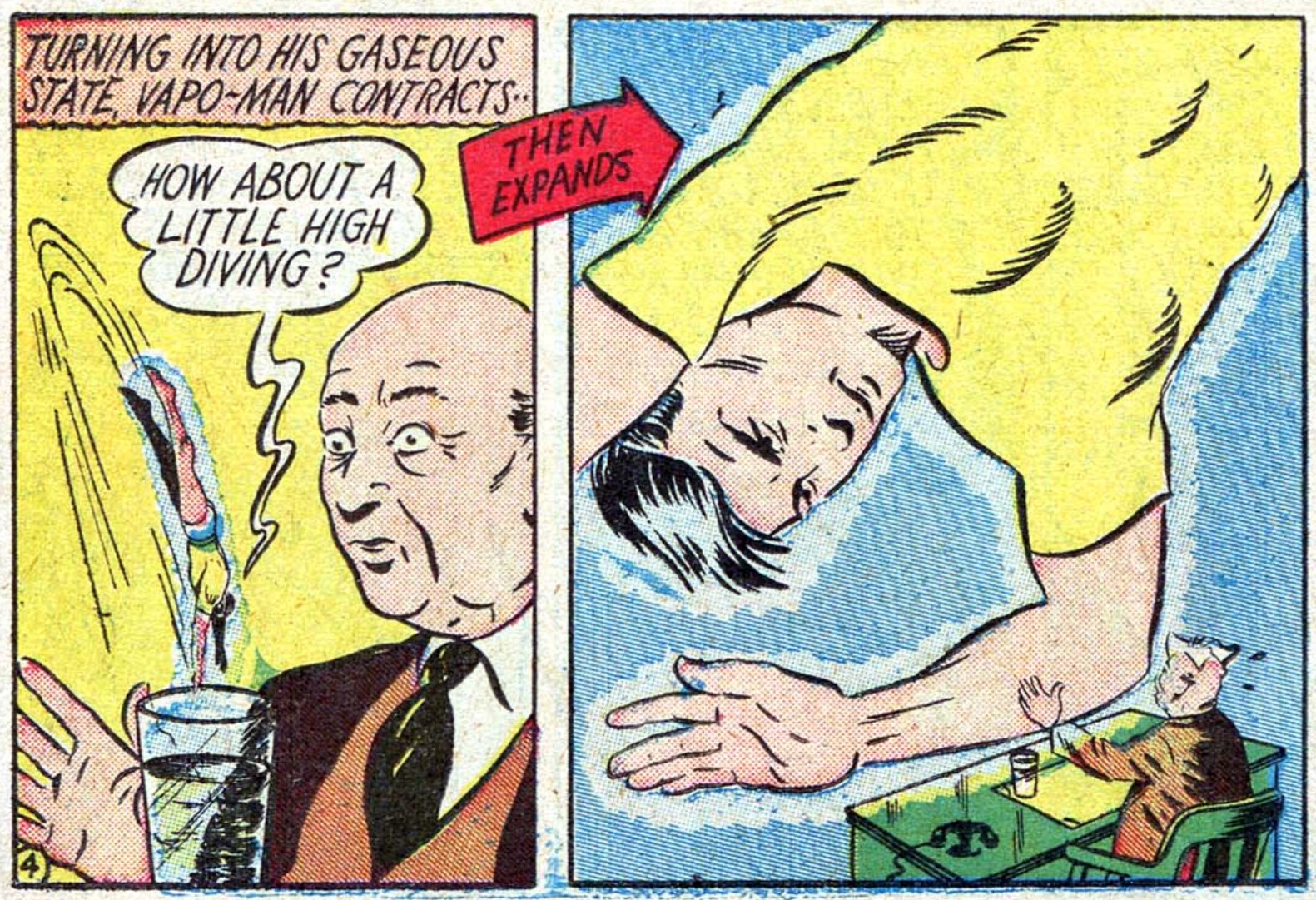
    As Vapo-Man, Crawford can change all or part of his size, can fly, has at least some super strength, can disintegrate matter with a touch, and can become intangible at will. All of this adds up to make him feel a lot like a more mystical character like Phantasmo, though he lacks the charm to support it. (Liberty Scouts Comics 002, 1941)

    Categorized in: Elements (Steam and Mist), Origins (Chemical Mutates), Powers (Intangibility)

    Fire-Man:

    Jim, a man working for the Civilian Conservation Corps in Utah sets out to battle the latest in a series of mysterious fires and finds himself being kidnapped by a mysterious silver-clad giant.

    This turns out to be Gaston, henchman to a fellow known only as the Mad Scientist. The Mad Scientist has a dream: to incinerate a human in such a way that they remain alive and coherent but composed of gaseous rather than solid matter, and Jim is his latest unwilling experimental subject. Luckily for Jim, this time it works, and the only real change appears to be a significantly lower density, such that he is obliged to wear a weighted uniform (that doubles nicely for a super suit, natch) in order to keep from floating away. Even with it on, he light enough to leap around as if he were flying.

    Jim is otherwise an ordinary human, but a miscalculation on the part of the Mad Scientist (dunking him in a vat of chemicals while trying to destroy him) also endows him with super strength.

    Finally, Jim’s new metabolism causes him to give off fire-retardant gasses as a part of his respiration, which is handy, as he chooses to go by Fire-Man, meaning that he, alongside the Mad Scientist’s niece Nancy, ends up fighting a lot of arsonists (Liberty Scouts Comics 002, 1941)

    Categorized in: Elements (Fire), Origins (Electrical Mutates), Powers (Decreased Density)

  • MINOR SUPER-HERO ROUND-UP 102

    You won’t believe what I just found: more super-heroes!

    the Liberty Scouts:

    When fascist forces armed with high-tech weaponry begin attacking targets calculated to cripple US war capacity, they are repeatedly driven away by a trio of anonymous heroes who leave behind Liberty Bell calling cards. Both the fascists and US officials are eager to learn just who these so-called Liberty Patriots are, but President Roosevelt is the one who actually gets to find out, thanks to his association with patriotic millionaire Patrick Henry.

    Henry drives FDR out to his country estate, Liberty House, where he introduces him to three mysterious youths beginning with Smokey, the inventive genius of the group, and whose amphibious tank is counted as a land vehicle for the air/sea/land theme that the three have going on.

    Skipper, “the best sailor on the Seven Seas,” is also clearly the group member who is most invested in the paramilitary aspect of the whole operation. He has a super-powerful miniature submarine.

    Finally, we have Strut, the youngest of the group. He’s got a souped up fighter plane called the Comet (initially the only named super vehicle in the bunch, though the tank is later named Ironsides), plus a cool-ass wingsuit. He’s also the only one of the three with any discernible personality, even if it’s “won’t shut up about cherry pie.”

    So just how does Mr Henry know these three youngsters and why are they living in his house? Because they are his own sons! He loves his country so much that he has moulded his children into weapons designed to defend it, and the President loves it. (Liberty Scouts Comics 002, 1941)

    The Liberty Scouts eventually change their name to the Liberty Guards after the Boy Scouts of America complain about their monopoly on the word “scout” being infringed.

    Categorized in: Accessories (Calling Card Leavers), Groups, Origin (Patriotic Heroes)

    Man of War:

    Impatient with the slow progress of World War II, the god Mars decides to create a divine being imbued with the powers of the Greco-Roman pantheon and send them down to help the Axis conquer Europe faster and with more bloodshed. He gifts his champion with “the Strength of Hercules, the Speed of Mercury, the Wisdom of Zeus” (making him about 0.5 of a Captain Marvel) and arms him with the infinitely sharp Sword of Mars before sending him on his way.

    In a legitimately funny twist, Mars forgets to account for the rotation of the Earth during the presumably-lengthy demigod-crafting process and shoots his new creation at Dayton, Ohio (okay, at one of the more than thirty Daytons in the United States. Or in another city that has an unrelated Dayton Munitions Factory. Probably Dayton, Ohio, though) instead of Berlin or wherever he intended for it to go. Thus, Man of War (as he calls himself) is instantiated in the “peace-loving nation” of the USA and is dedicated to virtuous, defensive warfare instead of awful slaughter in the name of power-hungry politicians (insert joke about the US war machine here. Man of War must have had a rough go of things as the 20th Century progressed).

    So what are the powers of the gods? Mostly generic super strength and invulnerability, though Man of War is able to breathe and move freely underwater thanks to the gifts of Neptune. He also has one bespoke power gifted upon him by Mars: to disappear or appear in any explosion, up to and including those created when bullets are fired (which would be a bit more useful if he weren’t already bulletproof). (Liberty Scouts Comics 002, 1941)

    In Man of War Comics 001, Mars reveals Man of War’s weakness to the dictator Luko: that he is powered by rays emitted by the planets of the Solar System, and that confining him in a lead-lined chamber will block those rays and render him merely human. This nearly works, but as the Sword of Mars is not planet-powered he is soon able to carve his way free.

    Categorized in: Accessories (Swords), Activities (War), Origins (Demigods)

    Vapo-Man:

    Bradford “Brad” Cole is a chemist assisting at the laboratory of Dr Kreiner, who in turn is performing unspecified research that is evidently valuable enough to the US government that some fascist saboteurs blow it up. Cole, unlike Kreiner, is lucky enough not to be exploded but instead is showered with a randomized mix of chemicals that change him into a man of vapour.

    The dying Kreiner explains that he is now a chemical man, which is apparently something that chemists have been trying to create for centuries. He extracts a promise from Cole that he will use this power to fight evil, and saddles him with the terrible name of Vapo-Man just before dying, thus ensuring that Crawford can never change it without feeling very guilty.

    As Vapo-Man, Crawford can change all or part of his size, can fly, has at least some super strength, can disintegrate matter with a touch, and can become intangible at will. All of this adds up to make him feel a lot like a more mystical character like Phantasmo, though he lacks the charm to support it. (Liberty Scouts Comics 002, 1941)

    Categorized in: Elements (Steam and Mist), Origins (Chemical Mutates), Powers (Intangibility)

    Fire-Man:

    Jim, a man working for the Civilian Conservation Corps in Utah sets out to battle the latest in a series of mysterious fires and finds himself being kidnapped by a mysterious silver-clad giant.

    This turns out to be Gaston, henchman to a fellow known only as the Mad Scientist. The Mad Scientist has a dream: to incinerate a human in such a way that they remain alive and coherent but composed of gaseous rather than solid matter, and Jim is his latest unwilling experimental subject. Luckily for Jim, this time it works, and the only real change appears to be a significantly lower density, such that he is obliged to wear a weighted uniform (that doubles nicely for a super suit, natch) in order to keep from floating away. Even with it on, he light enough to leap around as if he were flying.

    Jim is otherwise an ordinary human, but a miscalculation on the part of the Mad Scientist (dunking him in a vat of chemicals while trying to destroy him) also endows him with super strength.

    Finally, Jim’s new metabolism causes him to give off fire-retardant gasses as a part of his respiration, which is handy, as he chooses to go by Fire-Man, meaning that he, alongside the Mad Scientist’s niece Nancy, ends up fighting a lot of arsonists (Liberty Scouts Comics 002, 1941)

    Categorized in: Elements (Fire), Origins (Electrical Mutates), Powers (Decreased Density)

  • MINOR SUPER-HERO ROUND-UP 100

    MINOR SUPER-HERO ROUND-UP 100

    You like minor super-heroes? We got more than four hundred of them!

    the Night Bird:

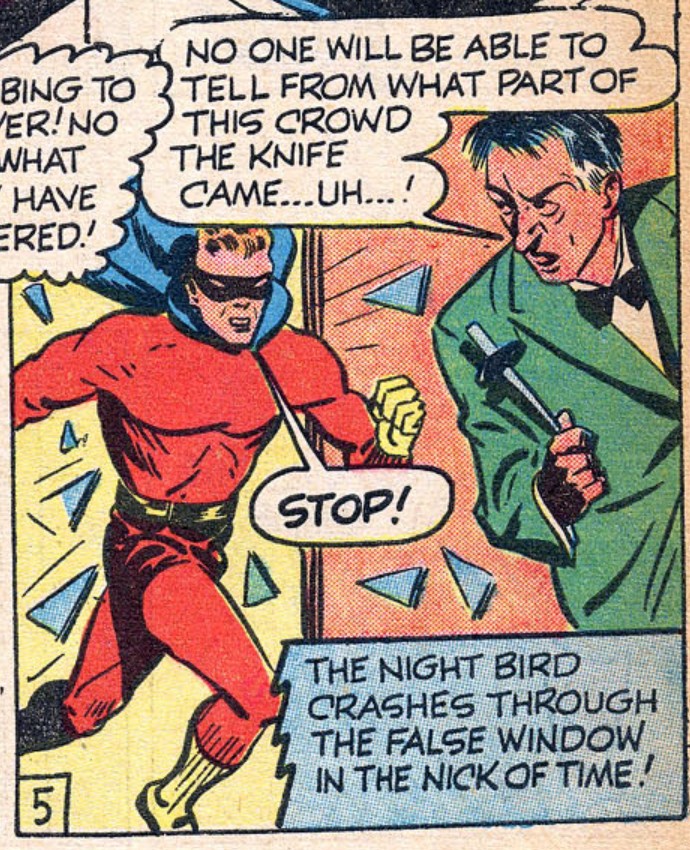
    The Night Bird might just have the simplest origin in the history of super-heroes: when newspaper Dell (just Dell) is captured by gangsters, her photographer Lens Crockett sets out to rescue her. Deciding that he needs a disguise, Crockett looks in the office storeroom and finds a full super-hero outfit stuffed in a bin – if it were about ten years later this might be a joke about Superman changing in the Daily Planet storeroom but he didn’t really get up to that so much yet so it’s just weird and random. Crokett’s costumed outing goes well, so he decides to keep going out there and fighting crime. And that’s the origin.

    The Night Bird (aka the Nightbird) only has a bare handful of appearances, so he doesn’t get a lot of room for character development. There are a couple of interesting things to note about him, however: firstly there isn’t even a hint of romantic feeling between Crockett and Dell which is always nice if only for the change of pace from the typical setup. Secondly, and in common with his fellow newspaper photographer the Fox, Lens Crockett seems to be a legitimate clumsy doofus in his civilian identity rather than a suave coolguy putting on an act. (Green Mask v1 006, 1941)

    The Night Bird also continues the grand Fox Features tradition of changing costume designs between issues with a palette swap between his first and second appearances. His costume continues to change in minor ways as time goes on, but this is the only major one.

    Categorized in: Animals (Birds), Day Jobs (Newspaper Photographers), Locations (Temporal Locations)

    the Tumbler:

    When famous circus acrobat Lee Brothers, known professionally as the Tumbler, goes to visit his old mentor Sockey, he finds him mixed up with a gang of payroll robbers who have decided to use his property as a hideout. Lee and Sockey manage to escape with the loot but Sockey dies in the process and Lee is reported dead.

    As is only sensible, Lee does not immediately clear up this mistake and go on with his life but takes this as an opportunity to adopt a costumed identity and get up to a little vigilante justice. His decision to do so while calling himself the Tumbler and thus inviting connection with the supposedly deceased Brother is a bit suspect, however. (Green Mask v1 007, 1941)

    This is even more in his second (and final) appearance, when he does the traditional costume change and just starts wearing his old acrobat costume again. Does the Tumbler want to have his identity revealed?

    Categorized in: Activities (Acrobatics), Day Jobs (Circus Acrobats), Professions (Acrobats)

    the Mechanized Skeleton:

    This was a surprising one! I really and truly thought that the Mechanized Skeleton was going to be a bad guy. This is mostly because he almost certainly was going to be one when he was first introduced, as can be deduced from the fact that the Skeleton’s creator Chico is ranting an raving about “having power” and “showing them all” as he assembles and tests his creation. As the Mechanized Skeleton had a very minor appearance in the 1940 run of Reg’lar Fellers Heroic Comics with the bulk appearing in the 1941 books I recently read I have been awaiting his return for more than a year, real-time, with the expectation that I would see some science skeleton-on-science zombie battling once it and the Purple Zombie finally met.

    Chico doesn’t do much to dispel my assumptions about him and his creation in his next couple of appearances, as he demonstrates a very loose attitude to law and order: in Reg’lar Fellers Heroic Comics 004 he attempts to steal Purple Zombie creator Kim Hale’s car, only to lose his Skeleton (and inadvertently save Hale’s life) when a car bomb goes off. Then in RFHC 005, Chico attempts to procure a set of clothing for the replacement Mechanized Skeleton he has just completed by driving a car off the road and killing all of the occupants. Was the car full of gangsters who had kidnapped the Purple Zombie in an attempt to recruit him into their gang? Yes it was. Did Chico know this? No he didn’t – the car might have been filled with nuns and orphans as far as he was concerned.

    (please note that issue 005 does feature my anticipated Purple Zombie/ Mechanized Skeleton battle and that the Skeleton is comically outmatched) 

    Despite all of this evidence of Chico’s villainous nature, once Kim Hale and the Purple Zombie get ahold of him he suddenly reveals that he, like Hale has created his scientific version of a Halloween monster not for evil but for the betterment of mankind. Specifically, he made them as a foil to a Nazi death ray that has been giving the Allies a lot of trouble – what better foil to a death ray than the already-dead, after all? Such is the power of Chico’s newly-revealed convictions that the Purple Zombie goes with him when he sneaks off in the night to battle the Hun.

    And it works! The Purple Zombie leads a squad of Mechanized Skeletons (all hilariously decked out in doughboy helmets) to victory in just a couple of pages!

    Chico requests (and receives) a hero’s burial for the Mechanized Skeletons, causing me to wonder for the first time just where he got the base materials for them from. Though they are gone for good, Chico himself stays on as a supporting cast member during the next phase of the Purple Skeleton’s career as he and Kim Hale are basted back in time. (Reg’lar Fellers Heroic Comics 003, 1940)

    Categorized in: Origins (Face Turns), Origins (Robots), Supranormal Beings (Undead (Skeletons))

    Man O’Metal:

    In addition to having on of the more strangely-constructed names in comics, Man O’Metal, aka Pat Dempsey, has a bafflingly straightforward origin on par with his fellow Eastern Color character Fearless Flint: while working in a foundry one day, Dempsey is caught in a flood of an unspecified molten metal, and instead of dying horribly he transforms into a superhuman metal man. It’s a weirdly modern style of origin in that there is absolutely no attempt to introduce an external catalyst for this change – if he were a DC Comics character he would just turn out to have the metagene, for example.

    Man O’Metal is like Fearless Flint in a couple of other ways: firstly, his power switches off after a few minutes, but can be restarted by the touch of metal (including incoming bullets, which proves to be handy). This requirement later changes from metal to heat or electricity, but the bullets are evidently hot enough to qualify. 

    Dempsey’s boss is underwhelmed by the prospect of having a white-hot metal guy running around his foundry and so he just kind of gives him to the FBI without really consulting him on whether this is something he might want to do. The FBI have a bit more vision re: the potential inherent in a superhuman employee and happily accept. He is immediately sent off to Badagero, South America to root out subversives. (Reg’lar Fellers Heroic Comics 007, 1941)

    Categorized in: Elements (Metal), Origins (Material Mutates), Team Memberships (FBI)

    Very Minor Hydroman Updates: Hydroman is confirmed as vulnerable to freezing (Reg’lar Fellers Heroic Comics 004, 1941), is now wanted by the police (Reg’lar Fellers Heroic Comics 007, 1941).

  • MINOR SUPER-HERO ROUND-UP 099

    Super-heroes. Like heroes, but super.

    Captain Midnight:

    Like the second, more popular (though still pretty obscure) Captain Midnight that will be published by Fawcett starting in 1942, this fellow is an adaptation of the radio character, and unlike the second Captain Midnight, this one is a pretty direct adaptation. It’s a bit abbreviated and you kind of have to keep referring to the Captain Midnight Wikipedia page to fill in the gaps where your assumed familiarity with the radio show lies, but it’s all there:

    Captain Midnight is an otherwise-unnamed pilot who gets his nickname after returning on the stroke of 12 after completing a secret mission to prevent Paris from being captured by the Germans during World War One. In the present day (1941) he is recruited to head a secret counter-espionage unit called the Secret Squadron by a mysterious government official who is implicitly Franklin Delano Roosevelt in disguise. 

    The Secret Squadron has hidden airbases and headquarters all over the United States and is comprised of a horde of agents referred to by alphanumeric designations starting at SS-1 (Captain Midnight) up to at least SS-85 (the guy who runs the elevator in one of the bases). The “SS” part of the names is quietly changed to “SQ” once the US enters WWII, but I don’t think that this comic book adaptation goes on long enough for that to be a concern.

    Finally, Captain Midnight’s flying clock insignia is very fun. (The Funnies 057, 1941)

    Categorized in: Generica (Captains), Locations (Temporal Locations), Origins (WWI Vets)

    the Great Zarro:

    The Great Zarro is otherwise nameless adventurer with the power of flight. He is also one of the most bland super-heroes in the history of the medium, personality-wise.

    A former circus acrobat, the Great Zarro lost his job, fiance and friends when a gang of extortionists burned the whole circus down and killed everyone but Rags, his lover’s kid brother. The two swear an eternal war on crime and Zarro gains his ability to fly by consuming some magical herbs given to him by the circus fortune teller, who was just good enough to fortell that he would need them but evidently failed to see why. 

    There are precisely two interesting things about this character: Firstly, that as a circus acrobat he was known as Eagle Man, while as a flying super-hero he goes by the Great Zarro. That’s a fun little inversion of naming conventions!

    Secondly, there’s Rags. Rags is an example of something that you occasionally get with comic relief characters, where they and only they are rendered as a full cartoon while everyone else is in a comic book. This is a particularly egregious clash of styles in a comic as full of stiff, human-proportioned figures as “The Great Zarro,” rendering Rags more of a figure of horror than comedy. Rags finally becomes a real boy in the third and final Zarro adventure, but it’s too little too late. (Great Comics 001, 1941)

    Categorized in: Day Jobs (Circus Acrobats), Language (Superlatives (Greats)), Powers (Flight)

    Madame Strange:

    On the one hand, Madame Strange is pretty great: she’s at least somewhat super fast and super strong, will throw a knife at the drop of a hat and prevents the Japanese destruction of Pearl Harbor in November 1941 (though not the one in December). Just like Ripley in Alien, she is an example of a character not being written as a “girl-version” of a default-male archetype but simply as that archetype, which is basically always the more entertaining option.

    On the other hand, Madam Strange suffers from the same lack of depth – including any sort of backstory – as so many of her peers. Sure she can throw a knife into a goon from a city block away, but is that enough? I also do not care for the combination of red top, pale blue bottoms, aesthetically.  (Great Comics 001, 1941)

    Categorized in: Abstract Concepts (Strangeness), Genrica (Madames), Powers (Enhanced Strength and Speed) 

    the Green Mask and Domino the Miracle Boy **Update**:

    I am reasonably certain that this is the first time that Domino is given a first name. Don! He’s Don! (Green Mask v1 006, 1941)

    The same issue that Don gets his name also marks the introduction of the Green Mask’s expanded supporting cast. Joining his reporter pal News Blake are heiress/ love interest Olivia Tracey and her chauffeur Peters, who serves as comic relief thanks to his two character traits of “enthusiastic tinkerer” and “very clumsy and hapless.” (Green Mask v1 006, 1941)

    I can’t find anywhere that it’s explicitly stated (which may be exacerbated by the fact that the only copy of this issue that I can find is missing 8 pages or so) but by Green Mask v1 008 Olivia Tracey seems to explicitly know that Michael Shelby and the Green Mask – and by extension Don and Domino – are the same.

  • MINOR SUPER-HERO ROUND-UP 098

    We’ve got no time for major super-heroes around here. We’re too busy with the minor ones.

    the Black Ace:

    The Black Ace, aka Captain McRae, is yet another American pilot serving in the RAF in advance of the US entrance into WWII. As such, he is not only a highly accomplished pilot and bombardier but fully versed in the arts of prison escape, hand-to-hand combat, impersonating German soldiers and leaping from plane to plane in mid-flight. (Four Favorites 002, 1941)

    Categorized in: Activities (Cards), Colours (Black), Team Memberships (RAF)

    Phantasmo **Update**:

    The thing about Phantasmo is that he does all of his super-heroing while in his super-huge astral form, and I guess that I had somehow gotten the impression that most of his powers were tied to that form, because I while reading his 1941 run of adventures I kept being surprised when he would do something like heal an old man (The Funnies 052) or kill a bunch of guys with a giant fish while in Phil Anson form (The Funnies 051). 

    I guess it’s pretty convenient to have the option of being an invulnerable giant but that getting your mortal hands dirty lends a certain thrill to the crimefighting – that’s probably why he tolerates the poor standard of care that he gets from Whizzer McGee as he guards the unconscious Anson-body, hey?

    In The Funnies 061, Phantasmo and Whizzer witness the murder of a crooked FBI filing clerk named Ted Bart and, partially because they are touched by his dying confession (“I only blackmailed a gang boss-turned politician to help my sister, honest!”) and partially due to this desire for more action in his life (life as an FBI filing clerk v. action packed), Phantasmo takes over his identity. The series ends before this development pays off beyond giving Phantasmo a few crime leads, but it’s still an interesting turn for the character to take.

    Whizzer McGee:

    Phantasmo’s young friend Whizzer McGee does not really qualify as a sidekick most if the time. He’s more of an employee, really, who watches over Phil Anson’s unconscious body while his mind is out terrorizing criminals. And he’s not even good at it! Whizzer and the body are always getting into scrapes because of Whizzer’s incompetence (and also because Phil is very bad at picking a convenient place to leave his mortal coil, in all fairness).

    Despite this, Phantasmo gives Whizzer McGee the opportunity to be a real-deal super-powered guy when he has to go out of town for a few days, in the form of an amulet that gives him invulnerability and super strength. I can only assume that Phil was worried that Whizzer would immediately walk out into traffic if someone wasn’t around to tell him not to and was trying to bump up the likelihood of his survival a bit.  

    Whizzer screws it all up of course – not only does he lose the amulet by trying to capture a smuggling gang single-handed, but he spills Phantasmo’s secrets – including his secret identity and home address! – to the gang boss after he does a low-effort impression of an FBI agent. Surprisingly, this leads to absolutely no consequences going forward: Whizzer keeps his job, the amulet doesn’t end up in the wrong hands… it’s not even a factor in Phantasmo changing secret identities. (The Funnies 056, 1941)

    Categorized in: Accessories (Amulets), Origins (Sidekicks)

    the Black Knight **Update**:

    In our initial look at the Black Knight, we spent a lot of time trying to nail down exactly when the series is supposed to take place, and we are not backing down from that challenge. We have determined that he lived in at least the early 12th Century CE, which the presence of Canterbury Cathedral (looking much as it does today, a form it took after being rebuilt and refurbished in the 11th and 12th Centuries) supports. This is comforting! All of our hard work paid off! Hold on to that feeling for a little while.

    The firmly 12th Century Black Knight’s 1941 adventures continue much as they had in 1940: the Black Knight travels the land slaying villains in the name of Good King Victor. Things get a bit less episodic with the introduction of a mysterious ring that the Knight is given by the King in The Funnies 053, that is then revealed to contain some mysterious drugs in issue 054.

    The Funnies 053 also introduces Peter, an archer who begins travelling with the Black Knight after helping him slay some bandits. He’s very serious about being a sidekick, is Peter.

    So we have: a reasonably firm grasp on the time period, an ongoing plot hook and a new friend. All of which is dumped in the trash as of The Funnies 055-056, when Good King Victor falls victim to an illness with only one known cure, a drug that is only available in Egypt.

    The ring is completely forgotten until the Black Knight need to escape a prison guard and the mysterious drugs turn out to be knockout drops. Peter is technically still around to the end, but he and the other members of the Black Knight’s party are all dressed like desert nomads and usually end up tagging behind him on camelback rather than actually participating in the story. As for the 12th Century… the artist’s vision of what Medieval North Africa looked like was not quite as precisely calibrated as it was for Medieval England, and so we start getting things like hookahs (15th-16th Century and even then in India) almost immediately.

    The transition to Egypt does come with a pretty good alternate costume unlock for the Black Knight, though there are also some weird Jesus overtones. (The Funnies 059)

    The Black Knight’s plan to get the drug involves appealing directly to the Queen of Egypt for aid, which is appropriate, as she is from the same lineage of fictional monarchs as Good King Victor. In actuality, Egypt was in the hands of a series of Muslim dynasties from the 650s through to the 1500s when the Ottomans took it. The plotters above, meanwhile, are all from Sudan, which was Nubian-controlled and matrilineal at the time, so the misogyny is weird.

    Once the Queen actually shows up (The Funnies 061) it is pretty clear that she is based on Cleopatra (died 30 BC), which is fine. One huge anachronism is much easier to deal with than a million mild ones, after all. The Black Knight is clearly set in an alternate timeline or a human zoo built by aliens with poor research skills.

    Finally, the Egyptian odyssey introduces a love interest for the Black Knight in the form of a Persian (?) woman named Zellah who he rescues from a harem in The Funnies 057. There isn’t too much to this relationship – it’s just kind of nice. The Black Knight does get this sick scorpion amulet from her, but it’s just before she and the Queen of Egypt are kidnapped in a cliffhanger ending that is never resolved, so overall, it’s a bummer.

  • MINOR SUPER-HERO ROUND-UP 098

    We’ve got no time for major super-heroes around here. We’re too busy with the minor ones.

    the Black Ace:

    The Black Ace, aka Captain McRae, is yet another American pilot serving in the RAF in advance of the US entrance into WWII. As such, he is not only a highly accomplished pilot and bombardier but fully versed in the arts of prison escape, hand-to-hand combat, impersonating German soldiers and leaping from plane to plane in mid-flight. (Four Favorites 002, 1941)

    Categorized in: Activities (Cards), Colours (Black), Team Memberships (RAF)

    Phantasmo **Update**:

    The thing about Phantasmo is that he does all of his super-heroing while in his super-huge astral form, and I guess that I had somehow gotten the impression that most of his powers were tied to that form, because I while reading his 1941 run of adventures I kept being surprised when he would do something like heal an old man (The Funnies 052) or kill a bunch of guys with a giant fish while in Phil Anson form (The Funnies 051). 

    I guess it’s pretty convenient to have the option of being an invulnerable giant but that getting your mortal hands dirty lends a certain thrill to the crimefighting – that’s probably why he tolerates the poor standard of care that he gets from Whizzer McGee as he guards the unconscious Anson-body, hey?

    In The Funnies 061, Phantasmo and Whizzer witness the murder of a crooked FBI filing clerk named Ted Bart and, partially because they are touched by his dying confession (“I only blackmailed a gang boss-turned politician to help my sister, honest!”) and partially due to this desire for more action in his life (life as an FBI filing clerk v. action packed), Phantasmo takes over his identity. The series ends before this development pays off beyond giving Phantasmo a few crime leads, but it’s still an interesting turn for the character to take.

    Whizzer McGee:

    Phantasmo’s young friend Whizzer McGee does not really qualify as a sidekick most if the time. He’s more of an employee, really, who watches over Phil Anson’s unconscious body while his mind is out terrorizing criminals. And he’s not even good at it! Whizzer and the body are always getting into scrapes because of Whizzer’s incompetence (and also because Phil is very bad at picking a convenient place to leave his mortal coil, in all fairness).

    Despite this, Phantasmo gives Whizzer McGee the opportunity to be a real-deal super-powered guy when he has to go out of town for a few days, in the form of an amulet that gives him invulnerability and super strength. I can only assume that Phil was worried that Whizzer would immediately walk out into traffic if someone wasn’t around to tell him not to and was trying to bump up the likelihood of his survival a bit.  

    Whizzer screws it all up of course – not only does he lose the amulet by trying to capture a smuggling gang single-handed, but he spills Phantasmo’s secrets – including his secret identity and home address! – to the gang boss after he does a low-effort impression of an FBI agent. Surprisingly, this leads to absolutely no consequences going forward: Whizzer keeps his job, the amulet doesn’t end up in the wrong hands… it’s not even a factor in Phantasmo changing secret identities. (The Funnies 056, 1941)

    Categorized in: Accessories (Amulets), Origins (Sidekicks)

    the Black Knight **Update**:

    In our initial look at the Black Knight, we spent a lot of time trying to nail down exactly when the series is supposed to take place, and we are not backing down from that challenge. We have determined that he lived in at least the early 12th Century CE, which the presence of Canterbury Cathedral (looking much as it does today, a form it took after being rebuilt and refurbished in the 11th and 12th Centuries) supports. This is comforting! All of our hard work paid off! Hold on to that feeling for a little while.

    The firmly 12th Century Black Knight’s 1941 adventures continue much as they had in 1940: the Black Knight travels the land slaying villains in the name of Good King Victor. Things get a bit less episodic with the introduction of a mysterious ring that the Knight is given by the King in The Funnies 053, that is then revealed to contain some mysterious drugs in issue 054.

    The Funnies 053 also introduces Peter, an archer who begins travelling with the Black Knight after helping him slay some bandits. He’s very serious about being a sidekick, is Peter.

    So we have: a reasonably firm grasp on the time period, an ongoing plot hook and a new friend. All of which is dumped in the trash as of The Funnies 055-056, when Good King Victor falls victim to an illness with only one known cure, a drug that is only available in Egypt.

    The ring is completely forgotten until the Black Knight need to escape a prison guard and the mysterious drugs turn out to be knockout drops. Peter is technically still around to the end, but he and the other members of the Black Knight’s party are all dressed like desert nomads and usually end up tagging behind him on camelback rather than actually participating in the story. As for the 12th Century… the artist’s vision of what Medieval North Africa looked like was not quite as precisely calibrated as it was for Medieval England, and so we start getting things like hookahs (15th-16th Century and even then in India) almost immediately.

    The transition to Egypt does come with a pretty good alternate costume unlock for the Black Knight, though there are also some weird Jesus overtones. (The Funnies 059)

    The Black Knight’s plan to get the drug involves appealing directly to the Queen of Egypt for aid, which is appropriate, as she is from the same lineage of fictional monarchs as Good King Victor. In actuality, Egypt was in the hands of a series of Muslim dynasties from the 650s through to the 1500s when the Ottomans took it. The plotters above, meanwhile, are all from Sudan, which was Nubian-controlled and matrilineal at the time, so the misogyny is weird.

    Once the Queen actually shows up (The Funnies 061) it is pretty clear that she is based on Cleopatra (died 30 BC), which is fine. One huge anachronism is much easier to deal with than a million mild ones, after all. The Black Knight is clearly set in an alternate timeline or a human zoo built by aliens with poor research skills.

    Finally, the Egyptian odyssey introduces a love interest for the Black Knight in the form of a Persian (?) woman named Zellah who he rescues from a harem in The Funnies 057. There isn’t too much to this relationship – it’s just kind of nice. The Black Knight does get this sick scorpion amulet from her, but it’s just before she and the Queen of Egypt are kidnapped in a cliffhanger ending that is never resolved, so overall, it’s a bummer.

  • MINOR SUPER-HERO ROUND-UP 097

    It’s astonishing. They just keep on coming up with more super-heroes.

    the Flame **UPDATE**:

    Like many other long-running Fox Features characters, the Flame gets a bit of an overhaul late in 1941. In the Flame’s case, this includes an expansion to his powers: long able to get around by running on the stream of fire produced by his flame gun, the Flame is now simply able to fly. He can also now pick up and move fire around, as seen in this very innovative bit of fire-fighting in The Flame 006.

    The Flame also gets a proper secret identity (Gary Preston) and a job (private investigator) as a part of this revamp. And he gets a supporting cast, in the form of secretary Linda Dale and punch drunk ex-boxer/assistant/comic relief character Pug! (The Flame 007, 1941)

    Finally, though the Flame was explicitly a NYC-based super-hero in his earliest experiences, his 1940-41 adventures frequently have the liminal feel of the many stories set in generic unnamed US cities. In one of his very final appearances, he gets a proper fictional burg to call his own: Big City. (Big 3 006, 1941)

    the Yank and the Rebel:

    I think I’ve occasionally mentioned the inherent ridiculousness of the concepts behind many if not all patriotic super-heroes – it’s something that really jumps out at you as you read through as many Golden Age comics as I have. Please believe me, then, when I say that the Yank and the Rebel are the most conceptually ludicrous patriotic heroes of the lot, and I will be thoroughly (and probably not pleasantly) surprised if I’m ever proven wrong.

    As might be surmised from their names, the Yank and the Rebel are two otherwise unidentified soldiers who are on opposite sides during the American Civil War. While locked in hand-to-hand-to-gun combat, the two fall into a fissure opened by the artillery bombardments at the Battle of Gettysburg, landing next to a convenient radioactive pool that holds them in a state of suspended animation for the next seventy-eight years.

    The duo are eventually awakened when Army manoeuvres re-open the cavern, and they resume their battle until a helpful general explains that the American Civil War ended in some sort of peaceful draw, that nobody really “lost” or “won” the war and that the North and the South are all totally cool with one another now. So why did he put so much spin on history? Probably for the same notion of national unity in the face of war that inspired the people at Fox Features to do so.

    Regardless of the reasoning behind them, the officer’s words inspire a new spirit of patriotism and cooperation in the Yank and the Rebel, and the two team up to hunt spies and saboteurs for two whole adventures before evaporating in the Fox Features financial crisis of 1942. In what is certain to be a massive surprise to nobody, no modern publisher has taken advantage of the fact that these fellows are in the public domain. (The Flame 007, 1941)

    Categorized in: Locations (Specific Places), Origin (Patriotic Heroes), Team Membership (Confederate Army, Union Army) 

    Vulcan **UPDATE**:

    Taking a cue from the Flame, fellow fire-themed hero Vulcan gets a slight expansion to his powers in 1941: he can now create and use flame constructs such as this cool sword. (Four Favorites 001, 1941) 

    It’s not all good news for our favourite demigod, howver, as 1941 is also the year that Vulcan is given a weakness to cold. (Four Favorites 002, 1941)

    Lash Lightning **UPDATE**:

    Lash Lightning gives blood to injured army private Tom Jasper, who immediately develops mild superhumanism in the form of increased muscle mass and vigour. This is especially notable because it really is the ultimate expression of the writers on this feature forgetting that Lash’s powers are derived from a magical amulet and not from his own body. Sad times. (Four Favorites 002, 1941)

  • MINOR SUPER-HERO ROUND-UP 097

    It’s astonishing. They just keep on coming up with more super-heroes.

    the Flame **UPDATE**:

    Like many other long-running Fox Features characters, the Flame gets a bit of an overhaul late in 1941. In the Flame’s case, this includes an expansion to his powers: long able to get around by running on the stream of fire produced by his flame gun, the Flame is now simply able to fly. He can also now pick up and move fire around, as seen in this very innovative bit of fire-fighting in The Flame 006.

    The Flame also gets a proper secret identity (Gary Preston) and a job (private investigator) as a part of this revamp. And he gets a supporting cast, in the form of secretary Linda Dale and punch drunk ex-boxer/assistant/comic relief character Pug! (The Flame 007, 1941)

    Finally, though the Flame was explicitly a NYC-based super-hero in his earliest experiences, his 1940-41 adventures frequently have the liminal feel of the many stories set in generic unnamed US cities. In one of his very final appearances, he gets a proper fictional burg to call his own: Big City. (Big 3 006, 1941)

    the Yank and the Rebel:

    I think I’ve occasionally mentioned the inherent ridiculousness of the concepts behind many if not all patriotic super-heroes – it’s something that really jumps out at you as you read through as many Golden Age comics as I have. Please believe me, then, when I say that the Yank and the Rebel are the most conceptually ludicrous patriotic heroes of the lot, and I will be thoroughly (and probably not pleasantly) surprised if I’m ever proven wrong.

    As might be surmised from their names, the Yank and the Rebel are two otherwise unidentified soldiers who are on opposite sides during the American Civil War. While locked in hand-to-hand-to-gun combat, the two fall into a fissure opened by the artillery bombardments at the Battle of Gettysburg, landing next to a convenient radioactive pool that holds them in a state of suspended animation for the next seventy-eight years.

    The duo are eventually awakened when Army manoeuvres re-open the cavern, and they resume their battle until a helpful general explains that the American Civil War ended in some sort of peaceful draw, that nobody really “lost” or “won” the war and that the North and the South are all totally cool with one another now. So why did he put so much spin on history? Probably for the same notion of national unity in the face of war that inspired the people at Fox Features to do so.

    Regardless of the reasoning behind them, the officer’s words inspire a new spirit of patriotism and cooperation in the Yank and the Rebel, and the two team up to hunt spies and saboteurs for two whole adventures before evaporating in the Fox Features financial crisis of 1942. In what is certain to be a massive surprise to nobody, no modern publisher has taken advantage of the fact that these fellows are in the public domain. (The Flame 007, 1941)

    Categorized in: Locations (Specific Places), Origin (Patriotic Heroes), Team Membership (Confederate Army, Union Army) 

    Vulcan **UPDATE**:

    Taking a cue from the Flame, fellow fire-themed hero Vulcan gets a slight expansion to his powers in 1941: he can now create and use flame constructs such as this cool sword. (Four Favorites 001, 1941) 

    It’s not all good news for our favourite demigod, howver, as 1941 is also the year that Vulcan is given a weakness to cold. (Four Favorites 002, 1941)

    Lash Lightning **UPDATE**:

    Lash Lightning gives blood to injured army private Tom Jasper, who immediately develops mild superhumanism in the form of increased muscle mass and vigour. This is especially notable because it really is the ultimate expression of the writers on this feature forgetting that Lash’s powers are derived from a magical amulet and not from his own body. Sad times. (Four Favorites 002, 1941)