The Curse of Skeleton Munroe

Category: Marvel Mystery Comics

  • MINOR SUPER-VILLAIN 280: PRINCE ITOR

    (Marvel Mystery Comics v1 021, 1941)

    I like Prince Itor because he’s a weenie. Not enough of those in the Golden Age. He’s not even really the focus of this story, which ain’t called “The Idol of Death” for nothing.

    So: Morrison here owns the titular Idol and is loaning it to the Egyptian Museum, but the transfer process and time was leaked in the papers, which leads to at least half of he story being taken up with a heist that Prince Itor has absolutely no involvement in.

    Itor himself doesn’t get a lot of backstory: his family are presumably like those deposed European royals who are always mooching around high society, but for thousands instead of hundreds of years. Unless of course there is an ancient prophecy about the power of the pharaohs awakening in a completely unrelated family. Either would be good!

    Itor does eventually get ahold of the idol, by the simple method of having his men take it off of the crooks who went to the hard work of actually stealing it. That pharaonic power turns out to have a kick to it, in the form of a bad case of monster-face. 

    Whatever powers the ancient monster-Pharaohs wielded do not get a full exploration, as Itor discovers pretty quickly that he can control the people around him. What follows is a pretty brief and unsuccessful attempt to destroy the Human Torch using a subwayful of commuters that ends when  the Torch melts the idol and a fleeing Prince conveniently flings himself onto the third rail – no fuss, no muss.

    But why did I call Prince Itor a weenie? Very simply it’s because he’s the kind of villain who hangs back and lets his employees do all of the work, whether it’s stealing the idol or marching in mind-controlled lockstep against a man of living flame. He’s the kind of bumbling aristocratic oaf who can’t even escape without accidentally electrocuting himself – I love to loathe him. And as with every other good aristocratic oaf, he has a highly-competent aide to take care of all of the nitty-gritty for him
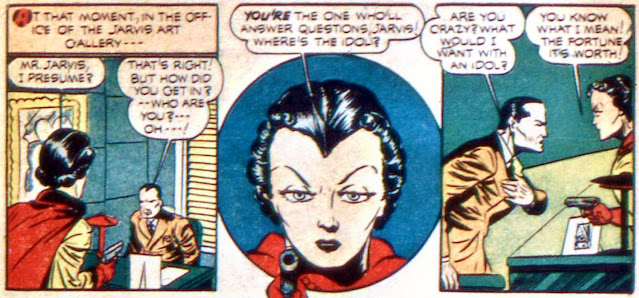
    Nalda! The Jeeves to Itor’s Wooster, if Jeeves was a pistol-wielding femme fatale in a cape and a pair of buccaneer gloves. Nalda! The kind of second-in-command that is clearly the power behind the throne. Nalda!

    I was going to say that it’s sad that Nalda only appears on a single page but no, I’m glad. That means that she survived the adventure and likely got away to empty Itor’s bank accounts and set herself up in Madripoor or the like. She’s probably still there, something like 105 years old, running her underground casino/ assassination service/ chain of cat cafes like a ruthless raisin. Godspeed, Nalda.

  • MINOR SUPER-VILLAIN 279: THE CAT’S PAW

    (Marvel Mystery Comics v1 018-020, 1941)

    The Cat’s Paw gets a pretty classic intro: Dr Lin, the Angel’s old mentor and friend who was introduced in the previous issue, is ruthlessly murdered via high-speed application of poisoned dart. The Angel give chase, but fails to make the bust.

    The next day we see some of the Cat’s Paw’s scheme begin to emerge. She’s killing industrialists for some reason. But why?

    Here’s our first look at the villain in question, because I chose some odd images to clip. A couple of things about her stand out:

    -she’s our first example (if not necessarily Marvel’s first example – they’ve got a half-dozen other titles at this point) of a few things in a Marvel comic: a female super-villain, a proper costumed crook, themed weaponry in the form of a cat-claw launcher, and, kind of, a recurring villain.

    -on that last point: not really. Though the Cat’s Paw does appear in three issues worth of  Angel comics, it’s all one story, just decompressed a bit.

    -it is of course notable that she looks a bit like 90s Catwoman

    -most importantly: in the above image both the Cat’s Paw and the Angel are attending a costume party as themselves! A twofer! 

    Eventually, the Angel tracks the Cat’s Paw down to her HQ in one of the dozens of deserted castles that litter the mountains a short drive from NYC in any given comic book universe.

    Now for the disappointing news: the reason that the Cat’s Paw was killing all of those industrialists is that she was acting as a… catspaw for the Nazis in their bid to weaken US support for Britain (and here once more I must note that Marvel was really leading the pack on making Nazi villains for-real Nazis well before Pearl Harbor). She does rediscover her patriotism once her Nazi handler tries to bump her off, which is better than nothing, I suppose. 

    Here’s where I’d normally be decrying the comic for killing her off at the end, pointing out how ambiguous the “guess we’ll never find the corpse, oh well” nature of her death is, and call for her to be brung back as a legacy villain, but the Nazi collaboration is really sticking in my craw. Honestly if she hadn’t walked it back at the end I’d be all for the Cat’s Paw showing up as an Axis agent in period pieces going forward but as-is I reckon she can lie fallow.

  • MINOR SUPER-VILLAIN 279: THE CAT’S PAW

    (Marvel Mystery Comics v1 018-020, 1941)

    The Cat’s Paw gets a pretty classic intro: Dr Lin, the Angel’s old mentor and friend who was introduced in the previous issue, is ruthlessly murdered via high-speed application of poisoned dart. The Angel give chase, but fails to make the bust.

    The next day we see some of the Cat’s Paw’s scheme begin to emerge. She’s killing industrialists for some reason. But why?

    Here’s our first look at the villain in question, because I chose some odd images to clip. A couple of things about her stand out:

    -she’s our first example (if not necessarily Marvel’s first example – they’ve got a half-dozen other titles at this point) of a few things in a Marvel comic: a female super-villain, a proper costumed crook, themed weaponry in the form of a cat-claw launcher, and, kind of, a recurring villain.

    -on that last point: not really. Though the Cat’s Paw does appear in three issues worth of  Angel comics, it’s all one story, just decompressed a bit.

    -it is of course notable that she looks a bit like 90s Catwoman

    -most importantly: in the above image both the Cat’s Paw and the Angel are attending a costume party as themselves! A twofer! 

    Eventually, the Angel tracks the Cat’s Paw down to her HQ in one of the dozens of deserted castles that litter the mountains a short drive from NYC in any given comic book universe.

    Now for the disappointing news: the reason that the Cat’s Paw was killing all of those industrialists is that she was acting as a… catspaw for the Nazis in their bid to weaken US support for Britain (and here once more I must note that Marvel was really leading the pack on making Nazi villains for-real Nazis well before Pearl Harbor). She does rediscover her patriotism once her Nazi handler tries to bump her off, which is better than nothing, I suppose. 

    Here’s where I’d normally be decrying the comic for killing her off at the end, pointing out how ambiguous the “guess we’ll never find the corpse, oh well” nature of her death is, and call for her to be brung back as a legacy villain, but the Nazi collaboration is really sticking in my craw. Honestly if she hadn’t walked it back at the end I’d be all for the Cat’s Paw showing up as an Axis agent in period pieces going forward but as-is I reckon she can lie fallow.

  • MINOR SUPER-VILLAIN 278: THE VAMPIRE KILLER

    (Marvel Mystery Comics v1 020, 1941)

    We open on a fear-gripped Star City (not the one you’re thinking of), in which ten people have been killed and drained of their blood. VAMPIRE! KILLER!

    An eleventh soon joins their ranks, and we get a look at the Vampire Killer in his cool as hell Shadow cosplay. VAMPIRE! KILLER! INTO! FASHION!

    But it seems all is not as we thought! Extradimensional smoke-man the Vision, exercising the oft-overlooked super-hero skill of Research, discovers that the so-called Vampire Killer is in reality biochemical Experiment 36-B, AKA Florus Homo. I don’t know that I want to blame the victim here, but engineering an intelligent plant that feeds on blood is a comic book science version of Russian Roulette. PLANT! MAN! DAD! EATER!

    And of course, having learned that the Vampire Killer is no vampire, we get to see it’s face in all of its Kirby-designed glory. Makes you wish that it hadn’t been set on fire by the Vision one page later. But it’s a plant, right? And seeds! Seeds can stay viable for centuries! There’s still hope, even now! BRING! BACK! TURNIP! HEAD!

  • HONOURS – SUB-MARINER

    (Marvel Mystery Comics v1 020, 1941) 

    It’s a bit marginal, but this is a boxing match between Namor the Sub-Mariner and Killer Casey, the Heavyweight Champion of (the US/ the World). Was it for the title? Who knows, but Namor won.

  • MINOR SUPER-VILLAIN 277: THE MASKED CHIEF

    (Marvel Mystery Comics v1 020, 1941)

    This here is the Masked Chief, at least according to the caption boxes (welcome to the unofficial name club, fella), a fairly standard masked gang boss enhanced by several factors of variable wildness. First and least: he is yet another in the long line of Human Torch foes who choose to use arson as their  modus operandi. Sure he’s not specifically challenging the Torch, but he must know that he’s employed by the city, right? The Jim Hammond identity is basically unused – even his partner on the police force calls him Torch for heaven’s sake.

    Secondly, New York Mayor Fiorello La Guardia, though unnamed, is a major secondary character in this story. Fun in and of itself, but La Guardia is convinced (with some encouragement from the Masked Chief) that the attempt to ransom the city via arson is the work of recently eliminated corrupt NY politicians. Which means, unless this was a very specific reference that I couldn’t find, that Tammany Hall is the suspect? Whee!

    Thirdly, and more perplexing than fun, the Human Torch is insanely mean to Toro throughout this story. Just a complete asshole. I’m not the world’s foremost Golden Age Human Torch expert but it seems wildly out of character for him – I guess we’ll see if I’m right about that going forward.

    And finally: the Masked Chief is not, in fact, the 1941-era successor to Boss Tweed but rather the escaped convict that the Human Torch and Toro were hunting when the story began, a man with the fairly excellent name of Hawk Rivers.

  • MINOR SUPER-VILLAIN 276: THE INVISIBLE SLAYER

    (Marvel Mystery Comics v1 019, 1941)

    There’s a bit in the introductions to the Top 10 anthologies in which Neopolis mayor John Q. Public lays out the exponential propagation of super-heroes, -villains, -pets, -monsters and so forth that takes place in a comic universe that I think of often as I read through these old adventures. Heroes inspire sidekicks and imitators; their enemies build robots and create doppelgangers to counter them, etc, until you have superhumans everywhere. 

    There’s one thing that isn’t brought up in that intro that absolutely contributes to the proliferation of the extranormal in a super-hero universe: any friend, family member or acquaintance (and especially any old college classmate, for some reason) is highly likely to either become a super-villain or to be targeted by one. Out of universe, it is of course an easy way to bring the hero in on a case, but in-universe: what a wild series of coincidences!

    In this case, we find Professor Zog summoned to the side of his old college pal Sir John Chadwick, who has seen almost his entire family killed by a mysterious set of floating hands in recent weeks. Zog is of course a bro and immediately flies to England to solve this problem via Applied Robot Violence. The first battle between Electro and the Invisible Slayer ends in a robo-defeat, but Zog manages to shoot the killer and follows its trail of blood to…

    The nearby mansion of Basil Drake, who turns out to be behind the whole thing to such a degree that one must wonder about Sir Chadwick’s powers of observation. Drake’s mansion contains a herd of gorillas, for heaven’s sake. His motivation for five murders and many more attempteds is that Chadwick’s daughter sensibly rejected his marriage proposal, which is, I must say, a stupid reason to delve into super-villainy.

    And of course even after Drake bumps himself off rather than be captured we must deal with the Invisible Slayer itself, or himself, as it turns out, because the Slayer is in fact Drake’s servant Chandi, cast as a monster due to his size and race.

    A story featuring disembodied hands and herds of gorillas, ruined for me by racism and misogyny. I hope you’re happy, Basil Drake.

  • CREEPS OF THE WORLD: LIMBOS

    (Marvel Mystery Comics 019, 1941)

    I think this giant man has the Limbos MO covered: cause earthquakes via lava manipulation, then attack.

    The real great thing about the Limbos, however, is the lower body. Give me this style of lizard-man any day. The poisoned bit is icing on the cake, really.

  • MINOR SUPER-VILLAIN 275: THE HAG

    (Marvel  Mystery Comics v1 019, 1941)

    I don’t have to go into how wild it is that this woman is called a Hag, right? The wild misogyny of it all? Great, thanks.

    Aside from her name, the Hag is a gang boss, and one who dreams big. Her plan involves causing a citywide power outage in NYC so that her men could  tamper with the Stock Exchange and then clean up the next day while everyone panics about a nonexistent stock crash that she engineered. And also for some reason she takes over a radio station to get access to incoming news? The motivation behind that one is weird to me.

    The real flaw in the Hag’s plan is that while she accounts for the presence of the Human Torch and Toro, she doesn’t really deal with them. Her men are equipped with flame-resistant clothing and fire-suppressing chemicals, but they just serve to help in avoiding the Torch. Ultimately, he catches up, there is an explosion (inevitable), and the Hag is no more.

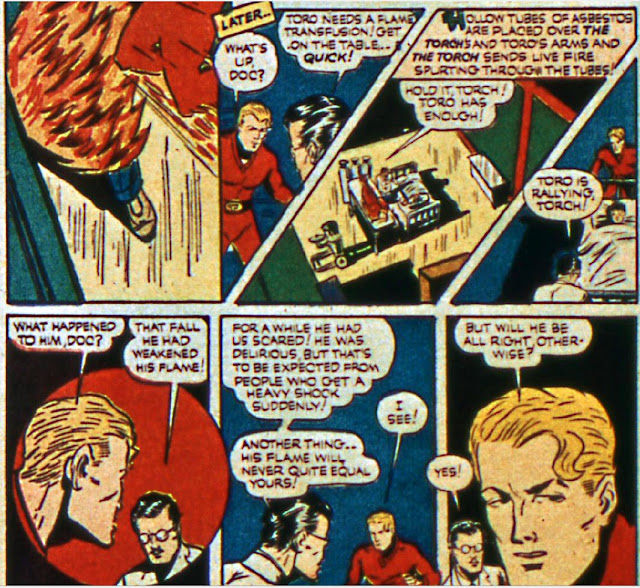
    This adventure also features the concept of Toro needing a “flame transfusion” after being severely hurt, which is very terrific, and which seems to be a convoluted way for Carl Burgos to canonically establish that Toro’s powers are a little weaker than the Torch’s? For some reason? It’ll be interesting to see if this is ever referenced again, frankly.

    ADDENDUM: forgot to mention the Hag’s sweet calling card:

    ADDENDUM II: Toro’s reduced fire-power actually came up in the subsequent issue, so I’m going to go ahead and try to note every issue it came up in right here:

    Marvel Mystery Comics v1 019
    Marvel Mystery Comics v1 020
    Human Torch v1 004
  • MINOR SUPER-VILLAIN 275: THE HAG

    (Marvel  Mystery Comics v1 019, 1941)

    I don’t have to go into how wild it is that this woman is called a Hag, right? The wild misogyny of it all? Great, thanks.

    Aside from her name, the Hag is a gang boss, and one who dreams big. Her plan involves causing a citywide power outage in NYC so that her men could  tamper with the Stock Exchange and then clean up the next day while everyone panics about a nonexistent stock crash that she engineered. And also for some reason she takes over a radio station to get access to incoming news? The motivation behind that one is weird to me.

    The real flaw in the Hag’s plan is that while she accounts for the presence of the Human Torch and Toro, she doesn’t really deal with them. Her men are equipped with flame-resistant clothing and fire-suppressing chemicals, but they just serve to help in avoiding the Torch. Ultimately, he catches up, there is an explosion (inevitable), and the Hag is no more.

    This adventure also features the concept of Toro needing a “flame transfusion” after being severely hurt, which is very terrific, and which seems to be a convoluted way for Carl Burgos to canonically establish that Toro’s powers are a little weaker than the Torch’s? For some reason? It’ll be interesting to see if this is ever referenced again, frankly.

    ADDENDUM: forgot to mention the Hag’s sweet calling card:

    ADDENDUM II: Toro’s reduced fire-power actually came up in the subsequent issue, so I’m going to go ahead and try to note every issue it came up in right here:

    Marvel Mystery Comics v1 019
    Marvel Mystery Comics v1 020
    Human Torch v1 004