The Curse of Skeleton Munroe

Category: god

  • ALIENS AND SO FORTH ROUND-UP 055

    More aliens? Just how many more can there be?

    Fantasans:

    When time/space traveller Whiz Wilson visits Earth of the year 4400 CE, he finds that it is being bombarded by comets originating from the far-off planet Fantasa. Going there with the aid of his trusty Futuroscope, he learns that Molla, the rightful ruler of Fantasa, has been deposed by the wicked Gorano and that Gorano has a fanatical (and unexplained) hatred of humanity that is his reason for the comet attack. One quick Futuroscope-aided counter-coup later and Fantasa is back in more peaceful hands and Earth is safe. (Lightning Comics v2 003, 1941)

    Mercurian Cave-People:

    The very first outer space adventure of the Space Rovers sees them taking an unexpected rocket trip and being forced to make a landing on Mercury to get their bearings. Once they disembark they discover that the fire caused by their landing has been taken as a sign that the local deity (the Fire God, God-Style: Animistic) is angry and demands sacrifice. Ted and Jane pitch in to save the poor sacrifice, and in a rare happy ending for such people she gets to haul ass across the river to marry a dude named Kulu. (Exciting Comics 002, 1940)

    Mercurians of Thian:

    Having ruined the sacrifice, Ted is next up for being burned at the stake, and to make matters worse, Jane is hauled off by a giant bird (which turns out to be called a Mercurian Roc) before she can free him.

    Ted manages to free himself, and the two both end up in the city of Thian, which is populated by a second kind of Mercurian who are possessed of more advanced technology than the Cave-People but who look absolutely terrible. They aren’t even particularly good hosts, as can be seen here when they drug and capture the Star Rovers before the main course arrives.

    And just what is the reason that these Mercurians had for treating their guests so rudely? Because they only live for twenty years and they need people from more long-lived species to study (i.e. vivisect) so that they can live to a somewhat riper old age. 

    Since these particular tests subjects are space heroes, things go poorly from here. Head Scientist Flaedo gets electrocuted, the Star Rovers escape on Roc-back and the Mercurians of Thian hopefully reconsider their commitment to scientific ethics. (Exciting Comics 002, 1940) 

    Mercurians:

    Time adventurer Stuart Taylor and his companions Dr and Laura Hayward encounter this society of possibly human-derived Mercurians when they voyage to the year 4000 in pursuit of a man named Rogro who has stolen Dr Hayward’s time technology. The major difference between Mercurians and humans is the fact that the former all have “synthetic blood” which makes them vulnerable to extreme heat and must be quite inconvenient for someone living on what is generally acknowledge to be a pretty hot planet.

    Though the Mercurian society seems peaceful when they arrive, things go south quickly once Rogro promises the Mercurian king that he can engineer new blood for everyone if he can use the blood inside of Stuart and his friends as raw materials. The time travellers only survive the resulting riots by smashing up the protective dome over the Mercurian city (and note the fact that the writer now says that the Mercurians have a problem with oxygen instead of heat. Why? Who knows). (Jumbo Comics 019, 1940)

  • DIVINE ROUND-UP 035

    Time to revise the Comparative Religion curriculum again because we found some new gods.

    Adobi:

    Just to what extent these Molemen worship the god Adobi is impossible to say. This particular Moleman hold him in high enough esteem to implore him to sanctify a forced political marriage, if that counts for anything much. I really wish we had a better angle on Adobi’s front side so I could see the big gems in his chest and forehead better.

    God Style: Idol (Lightning Comics v2 002, 1941)

    Vango:

    After escaping the lands of the Adobi-worshipping Molemen, Congo Jack encounters the worshippers of the multi-armed Vango. We don’t learn too much about Vango himself, alas, as the bulk of the narrative is taken up with a religious schism between pro- and anti-human sacrifice Vango worshippers. He looks good!

    God Style: Idol (Lightning Comics v2 004, 1941)

    Fire:

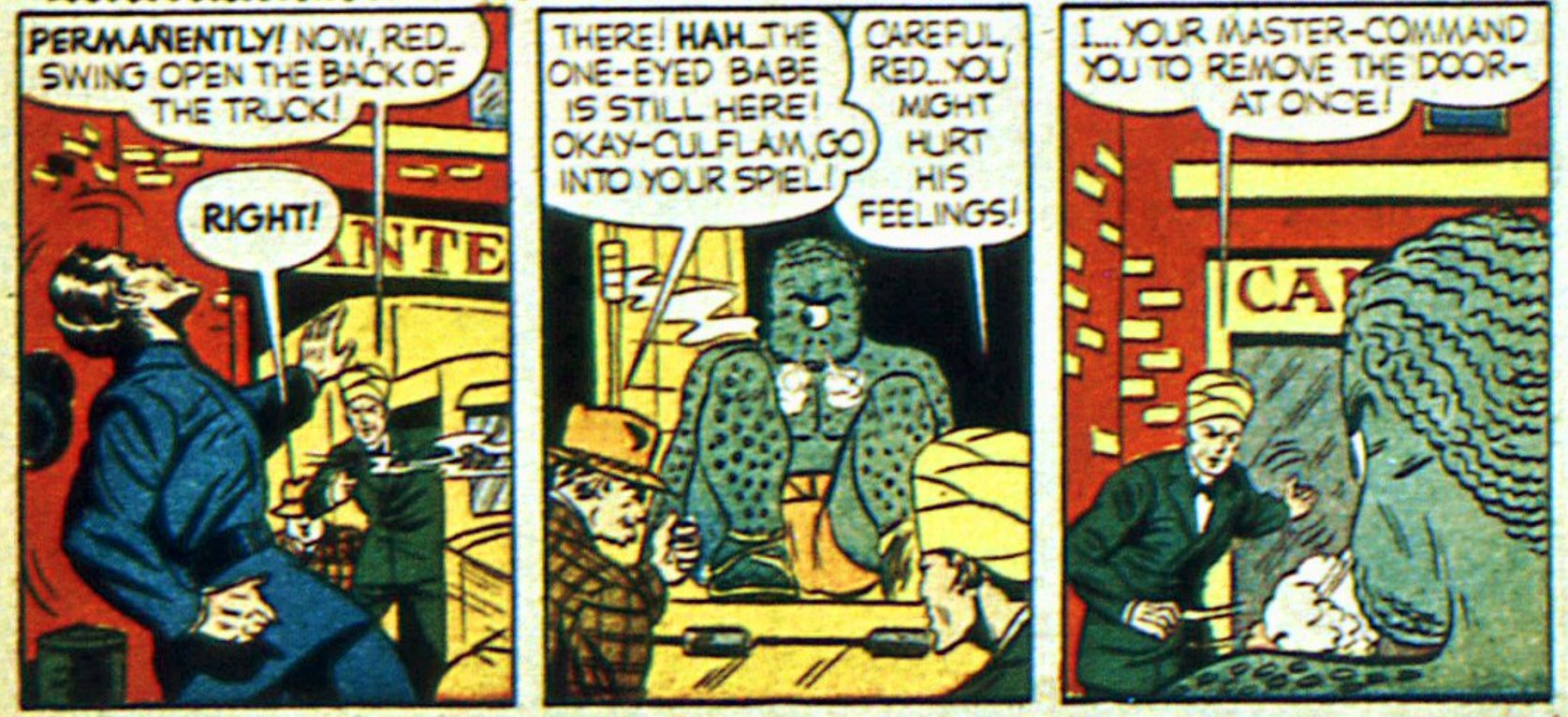
    The Fire-Men (aka the Fire-Cult) are a weird bunch to categorize. They are initially antagonists to the Human Torch, and give him a run for their money with their flame control powers while they hunt down and kill a former member. Then, however, they reveal that he was not merely an apostate but someone who was planning on using the cult’s teachings to profit while causing great destruction, and that he had a partner who is still at large. The Torch is left with to choice but to team up with his former adversaries.

    Though the Fire-Men presumably worship or at least pay fealty to the flame that they control, the real focus of the group is less religious than practical, as they work to contain the rampaging Flame Monsters of Tibet, giant green humanoids who emit flame from their pores. 

    (the second traitor to the cult turns out to be a man named Culflam, who later passes on the Fire-Men’s teachings to the Torch’s enemy the Parrot)

    God Style: Animist (Real?) (Marvel Mystery Comics v1 014, 1940)

    Flamosa the Fire God:

    God of the people of the volcanic Inferno Isle in the Pacific, who appear to have been manipulated into practicing human sacrifice by a group of Nazis in order to dispose of Allied scientists in the area. The Angel semi-accidentally blows up half the island and sets off the volcano, and the worship of Flamosa is abandoned.

    God Style: Idol (Marvel Mystery Comics v1 023, 1941)

  • DIVINE ROUND-UP 035

    DIVINE ROUND-UP 035

    Time to revise the Comparative Religion curriculum again because we found some new gods.

    Adobi:

    Just to what extent these Molemen worship the god Adobi is impossible to say. This particular Moleman hold him in high enough esteem to implore him to sanctify a forced political marriage, if that counts for anything much. I really wish we had a better angle on Adobi’s front side so I could see the big gems in his chest and forehead better.

    God Style: Idol (Lightning Comics v2 002, 1941)

    Vango:

    After escaping the lands of the Adobi-worshipping Molemen, Congo Jack encounters the worshippers of the multi-armed Vango. We don’t learn too much about Vango himself, alas, as the bulk of the narrative is taken up with a religious schism between pro- and anti-human sacrifice Vango worshippers. He looks good!

    God Style: Idol (Lightning Comics v2 004, 1941)

    Fire:

    The Fire-Men (aka the Fire-Cult) are a weird bunch to categorize. They are initially antagonists to the Human Torch, and give him a run for their money with their flame control powers while they hunt down and kill a former member. Then, however, they reveal that he was not merely an apostate but someone who was planning on using the cult’s teachings to profit while causing great destruction, and that he had a partner who is still at large. The Torch is left with to choice but to team up with his former adversaries.

    Though the Fire-Men presumably worship or at least pay fealty to the flame that they control, the real focus of the group is less religious than practical, as they work to contain the rampaging Flame Monsters of Tibet, giant green humanoids who emit flame from their pores. 

    (the second traitor to the cult turns out to be a man named Culflam, who later passes on the Fire-Men’s teachings to the Torch’s enemy the Parrot)

    God Style: Animist (Real?) (Marvel Mystery Comics v1 014, 1940)

    Flamosa the Fire God:

    God of the people of the volcanic Inferno Isle in the Pacific, who appear to have been manipulated into practicing human sacrifice by a group of Nazis in order to dispose of Allied scientists in the area. The Angel semi-accidentally blows up half the island and sets off the volcano, and the worship of Flamosa is abandoned.

    God Style: Idol (Marvel Mystery Comics v1 023, 1941)

  • DIVINE ROUND-UP 034

    DIVINE ROUND-UP 034

    Here come some more gods and god-adjacent beings for you.

    the Golden Skull:

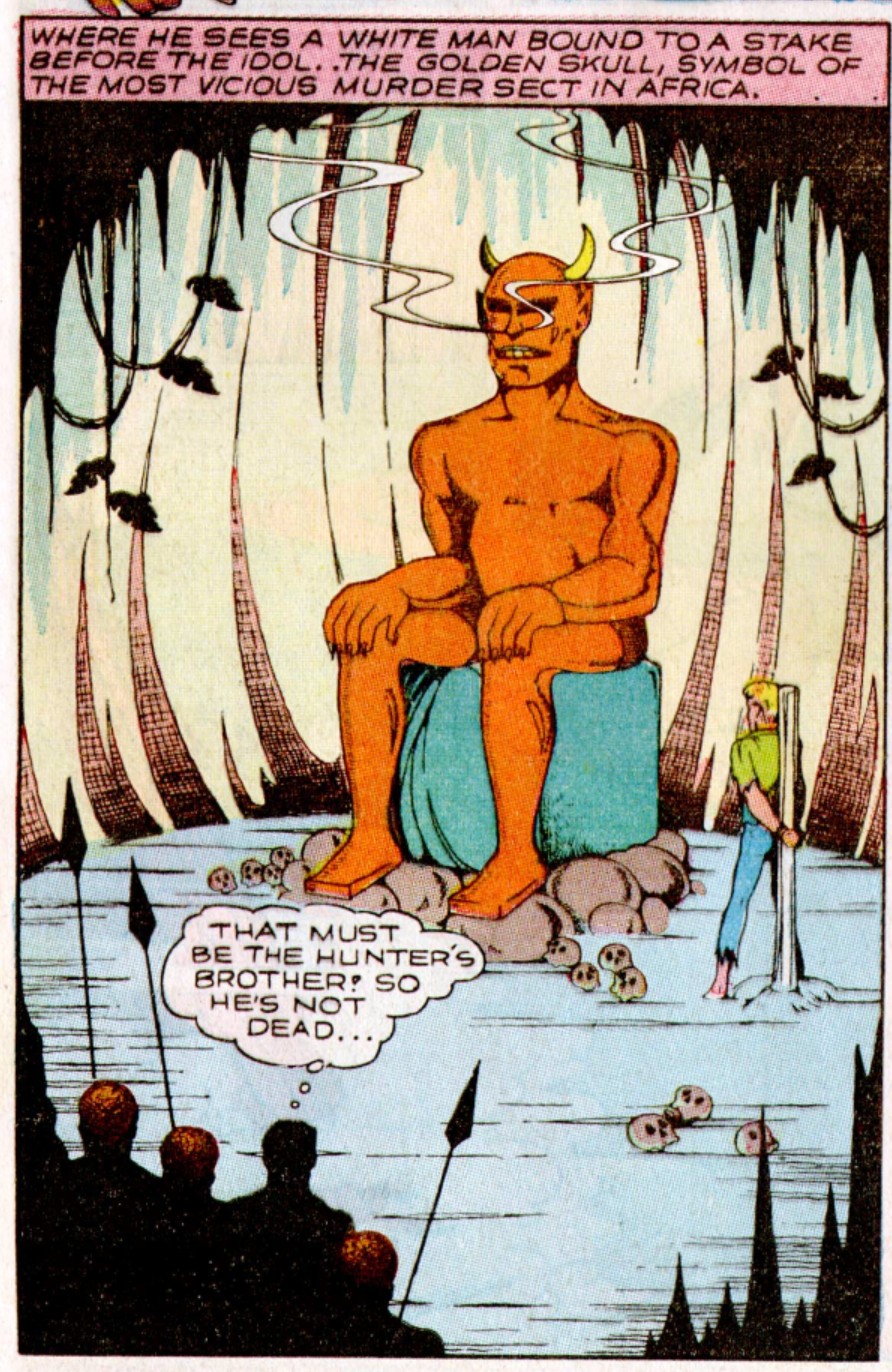
    While I must of course frown and shake my head at the concept of human sacrifice, you really have to hand it to the worshippers of the Golden Skull (who is, yes, very much not golden and also not especially skully), for giving their god a name that guarantees that a constant stream of American and European treasure hunters would arrive on their doorstep in search of swag. It’s the perfect sustainable human sacrifice supply solution!

    Sadly, the Golden Skull sect are not quite as canny about the location of their temple as they are about marketing, and the whole operation gets blown sky high when the volcano it is housed in erupts at an inopportune time.

    God Style: Idol (Jungle Comics 024, 1941)

    God of the Apes:

    We don’t learn much about the God of the Apes other than the fact that it is presumably worshipped or otherwise connected to apes and that it is real enough that Fantomah can call upon it to turn some crooked big game hunters into gorillas.

    God Style: Invoked (Real) (Jungle Comics 024, 1941)

    Mars:

    This right here is a pretty traditional comic book depiction of Mars, God of War, right down to the fact that he is loving the carnage and slaughter in Europe (and is implicitly the Guy Behind WWII). He loves it so much, in fact, that he creates Man of War as his personal agent on Earth to speed the whole process up, but he then fumbles the process so badly that he accidentally creates an Allied super-hero instead. 

    God Style: Real (Liberty Scouts Comics 002, 1941)

    the Spirit of America:

    This Spirit of America is in the Columbia mode, being an ethereal and star-spangled woman who implicitly comes into existence as a result of the American Revolution. In 1783 she primes a cannon with “powders of patriotism” just in case she ever needs to create a mystic champion at some point in the future (i.e., upcoming super-hero the Sentinel). 

    God Style: Real (Anthropomorphic Personification) (Liberty Scouts Comics 003, 1941)

  • DIVINE ROUND-UP 033

    The theme today is animal gods.

    Joboloa the Elephant God:

    Joboloa the Elephant God is invoked by Fantomah to punish the evil M’Dibo by means of a horde of spectral pachyderms. Honestly he is an odd choice for the job, as while M’Dibo’s crimes involve elephant ivory it’s not so much that he’s killing elephants to get it as stealing it from other people. Is Joboloa cool with elephant hunting as long as a proper chain of possession is maintained?

    God Style: Real (Jungle Comics 020, 1941)

    God of the Vultures:

    We don’t learn too much about the God of the Vultures other than that its worship involves human sacrifice and that its devotees seem to have some control over the vultures that live near the temple. Possibly because they are into the human sacrifices. Tabu, Wizard of the Jungle, someone who is very much not into human sacrifices, busts them up.

    God Style: Idol (Jungle Comics 021, 1941)

    Monkey and Cobra Cults:

    In possibly the only time that the fact that Jungle Comics stories just kind of saw wildly between being set in Africa and India is justified, Fantomah is captured by slavers in Africa and comes ashore in India when she escapes them. There, she immediately gets mixed up in a conflict between the Cobra Cult who worship the Sacred Cobras, and the Monkey Cult who presumably do the same but with sacred monkeys. The former try to sacrifice Fantomah, so they are the bad guys.

    God Style: Animist (Jungle Comics 021, 1941)

    Crocodile God:

    This unnamed crocodile deity this is has some rivalry with the priesthood of Damballah, or at least its representative in this village does. It can be hard to differentiate the tenets of a religion from the actions of its worst adherents, after all. One thing is certain, however: a crocodile theme makes for some terrific architectural and fashion options.

    God Style: Idol (Jungle Comics 023, 1941)

  • DIVINE ROUND-UP 032

    It can’t all be off-brand Greek gods. I’m elbow-deep in the 1941 issues of Jungle Comics, so here are some off-brand African deities.

    Damballah and Gbeji-Nibu:

    The evil witch doctor N’Goku has been using his magical abilities to cause problems in his area (plagues of snakes, a sickness among the cattle) and then solve them for cash money, and then when Fantomah (post-Fletcher Hanks) points out that he is doing so he attempts to do away with her. N’Goku invokes Gbeji-Nibu, the God of Steers, as well as Damballah the Snake God, and since the latter is a real deity in West African Vodún we must assume that the former is as well, though as far as I can tell he has been made up for this comic.

    Neither Damballah or Gbeji-Nibu are fictional in the world of the comic, however, as both of them are pretty mad at N’Goku for his misdeeds and send a divine animal avatar to punish him. To death. Interestingly, it seems that N’Goku’s fatal mistake was not in using his divine gifts for evil but in crossing Fantomah, who is on good enough terms with Damballah that she calls upon him a few issues later to deal with a snake-pit situation she finds herself in.

    God Style: Invoked (Real) (Jungle Comics 018, 1941)

    Tokpodu:

    We don’t learn anything about the entity called Tokpodu but it evidently does hold some power, as the wizard Guluba here is able to use his jackal-hair whip to shrink both people and animals after invoking this entity. He too crosses Fantomah and ends up paying for it with his life.

    God Style: Invoked (Real?) (Jungle Comics 019, 1941)

    Leopards:

    There’s
    not much info on what this fellow is actually up to. Certainly he is
    sacrificing lambs (and attempts to sacrifice a human) to some leopards
    that he has in a pit in an ancient lost Egyptian temple, but whether he
    is worshipping them specifically or they are acting as avatars of a
    deity that was worshipped in the temple is unclear. I can’t find an Egyptian god
    with an especial link to leopards but that might just be a sign of poor
    research on my part. Complete understanding of this issue is hampered by the fact that the story’s protagonist is a lion and thus not equipped to do exposition or offer any real insight at all.

    God style: Animist (I guess) (Jungle Comics 020, 1941)

    the Elephant God:

    This nameless Elephant God is worshipped by the Goru people, who hold all elephants sacred, except for a brief period when wealthy hunter Ali ben Yusi rolls through and convinces them that ivory hunting is more profitable. This ends when a herd of elephants smash up the village and the Goru reconsider their allegiances.

    God Style: Idol (Real?) (Jungle Comics 020, 1941)

  • DIVINE ROUND-UP 032

    It can’t all be off-brand Greek gods. I’m elbow-deep in the 1941 issues of Jungle Comics, so here are some off-brand African deities.

    Damballah and Gbeji-Nibu:

    The evil witch doctor N’Goku has been using his magical abilities to cause problems in his area (plagues of snakes, a sickness among the cattle) and then solve them for cash money, and then when Fantomah (post-Fletcher Hanks) points out that he is doing so he attempts to do away with her. N’Goku invokes Gbeji-Nibu, the God of Steers, as well as Damballah the Snake God, and since the latter is a real deity in West African Vodún we must assume that the former is as well, though as far as I can tell he has been made up for this comic.

    Neither Damballah or Gbeji-Nibu are fictional in the world of the comic, however, as both of them are pretty mad at N’Goku for his misdeeds and send a divine animal avatar to punish him. To death. Interestingly, it seems that N’Goku’s fatal mistake was not in using his divine gifts for evil but in crossing Fantomah, who is on good enough terms with Damballah that she calls upon him a few issues later to deal with a snake-pit situation she finds herself in.

    God Style: Invoked (Real) (Jungle Comics 018, 1941)

    Tokpodu:

    We don’t learn anything about the entity called Tokpodu but it evidently does hold some power, as the wizard Guluba here is able to use his jackal-hair whip to shrink both people and animals after invoking this entity. He too crosses Fantomah and ends up paying for it with his life.

    God Style: Invoked (Real?) (Jungle Comics 019, 1941)

    Leopards:

    There’s
    not much info on what this fellow is actually up to. Certainly he is
    sacrificing lambs (and attempts to sacrifice a human) to some leopards
    that he has in a pit in an ancient lost Egyptian temple, but whether he
    is worshipping them specifically or they are acting as avatars of a
    deity that was worshipped in the temple is unclear. I can’t find an Egyptian god
    with an especial link to leopards but that might just be a sign of poor
    research on my part. Complete understanding of this issue is hampered by the fact that the story’s protagonist is a lion and thus not equipped to do exposition or offer any real insight at all.

    God style: Animist (I guess) (Jungle Comics 020, 1941)

    the Elephant God:

    This nameless Elephant God is worshipped by the Goru people, who hold all elephants sacred, except for a brief period when wealthy hunter Ali ben Yusi rolls through and convinces them that ivory hunting is more profitable. This ends when a herd of elephants smash up the village and the Goru reconsider their allegiances.

    God Style: Idol (Real?) (Jungle Comics 020, 1941)

  • DIVINE ROUND-UP 031

    It’s a wide-ranging and complicated theological world out there. 

    the Death Orchid:

    Once again we have a giant flower – in this case a carnivorous one – that is being worshipped as a god. Interestingly, the people doing so are Lamas, which I think might be being incorrectly used as a general term for Tibetans of a religious inclination, unless there are some major aspects of Tibetan Buddhism that I haven’t heard about.

    Adventure aviator Captain Kidd flies a fellow named Professor Teller to Tibet to find this fabled plant only to nearly be sacrificed to it with him and ultimately to destroy it. The price of scientific inquiry, I suppose.

    Lamas! 

    God Style: Animist (Fantastic Comics 019, 1941)

    Isis: 

    This version of the goddess Isis is okay with her followers being evil and scheming, as evidenced by the fact that her high priest is Nagana, aka the Queen of Evil, but not so hot on blasphemy, as seen here when she drops her own temple on Nagana as well as the faithful Kalkor and hundreds of others. 

    Then when Nagana manages to come back to life in the present day she immediately starts badmouthing Isis again, prompting the goddess to show up (topless, in a repeat of the last time we saw her) and introduce an immortal foe for her in the form of Kalkor.

    GOD STYLE: Real (Fantastic Comics 022, 1941)

    the Black Sword:

    The theology of the Black Sword Cult is not entirely clear, so the fact that they worship this swordfish is at least partially speculation on my part. They do use it to conduct human sacrifices, and the high priest does kill herself after Oran of the Jungle slays it, so I’m gonna go ahead and call this as a swordfish cult.

    God Style: Animist, probably (Fight Comics 012, 1941)

    Zeus: 

    Zeus has a reputation for being weird and horny all the time, but this version of him might take the cake. He has stolen the Venus de Milo from the present and taken it back to Ancient Greece to bring it to life and marry it. Wild stuff. Featuring Hercules for a split second before Zanzibar the Magician turns him into a bird! 

    God Style: Real (Mystery Men Comics 002, 1939)

  • DIVINE ROUND-UP 031

    It’s a wide-ranging and complicated theological world out there. 

    the Death Orchid:

    Once again we have a giant flower – in this case a carnivorous one – that is being worshipped as a god. Interestingly, the people doing so are Lamas, which I think might be being incorrectly used as a general term for Tibetans of a religious inclination, unless there are some major aspects of Tibetan Buddhism that I haven’t heard about.

    Adventure aviator Captain Kidd flies a fellow named Professor Teller to Tibet to find this fabled plant only to nearly be sacrificed to it with him and ultimately to destroy it. The price of scientific inquiry, I suppose.

    Lamas! 

    God Style: Animist (Fantastic Comics 019, 1941)

    Isis: 

    This version of the goddess Isis is okay with her followers being evil and scheming, as evidenced by the fact that her high priest is Nagana, aka the Queen of Evil, but not so hot on blasphemy, as seen here when she drops her own temple on Nagana as well as the faithful Kalkor and hundreds of others. 

    Then when Nagana manages to come back to life in the present day she immediately starts badmouthing Isis again, prompting the goddess to show up (topless, in a repeat of the last time we saw her) and introduce an immortal foe for her in the form of Kalkor.

    GOD STYLE: Real (Fantastic Comics 022, 1941)

    the Black Sword:

    The theology of the Black Sword Cult is not entirely clear, so the fact that they worship this swordfish is at least partially speculation on my part. They do use it to conduct human sacrifices, and the high priest does kill herself after Oran of the Jungle slays it, so I’m gonna go ahead and call this as a swordfish cult.

    God Style: Animist, probably (Fight Comics 012, 1941)

    Zeus: 

    Zeus has a reputation for being weird and horny all the time, but this version of him might take the cake. He has stolen the Venus de Milo from the present and taken it back to Ancient Greece to bring it to life and marry it. Wild stuff. Featuring Hercules for a split second before Zanzibar the Magician turns him into a bird! 

    God Style: Real (Mystery Men Comics 002, 1939)

  • DIVINE ROUND-UP 030

    In today’s exploration of the divine, we delve into the extended lore of Sir Richard of Warwick, aka the Golden Knight, starting with his three magical brothers in-law.

    Mokon, King of the Moon:

    Mokon, King of the Moon, appears at Sir Richard’s window one night to claim the hand of his sister Marion in marriage, and though we the reader are hearing about this deal (and indeed about this or any of the Golden Knight’s sisters) for the first time, Sir Richard is well aware of whatever deal his father made to ally his kingdom with the Moon itself.

    Mokon gives Richard a silver rod as proof of his identity, and also possibly as some sort of dowry? This rod will come in quite useful later on, as it is magic and has the ill-defined ability to freeze things. 

    It seems that this is a true arranged marriage, as we get to see the first meeting between Marion and King Mokon just before he flies her away to the Moon. At this point we must ask: just what’s the deal with this guy? Is he a god? “King of the Moon” is certainly a deific title, and he has cool magical powers. Later issues will show that he actually lives on the Moon. There’s going to be a lot of back and forth about just what these guys are as we go forward in this entry but the format dictates that I state up front that I’m going with Some Sort of Godly Entity.

    God Style: Real Entity (Fantastic Comics 016, 1941)

    Sukon, King of the Sun: 

    Sukon, King of the Sun, shows up later in the same day to marry Richard’s second (heretofore unseen) sister, Elaine. Sukon is like a less cool version of his big brother Mokon – he even has a slightly less cool token, the golden rod, which paralyzes people. 

    God Style: Real Entity (Fantastic Comics 016, 1941)

    Winkon, King of the Winds: 

    After Sukon leaves, Lucifer himself (see the next Demonic Round-Up for him) wants to get in on the extended family action and shows up to marry Richard’s third sister, Jane. Richard has two problems with this: 1. Jane is too young and 2. it’s the freaking devil, man. Lucifer then makes off with Richard’s lover Alice instead. Shortly thereafter we learn a third reason: that Jane is already promised to Winkon, King of the Winds, youngest and weeniest brother of Mokon and Sukon. He doesn’t even have a token!

    Though Winkon doesn’t actually lift a hand to help out, he does tell Sir Richard how to get to Hell to rescue Alice. He also exits on a really unfortunately creepy line – just look at Alice’s face!

    God Style: Real Entity (Fantastic Comics 016, 1941)

    Further Adventures of the Golden Knight and his Magical Brothers In-Law:

    As is always the case when a wild new bit of lore is dropped into a comic I was initially afraid that we would see no more of the Golden Knight’s new extended family, but I need not have worried:

    Sir Richard and Alice take advantage of their new connections to visit Mokon and Marion on the Moon in the following issue. This does nothing to clear up the questions about the three brothers’ divine status, but does allow us to see a cool moon-bird.

    Bakalma:

    We are also introduced to Mokon’s rival for the throne of the Moon, Bakalma, who kidnaps Marion and Alice and holds them in his underwater palace – is Bakalma the god of the moon’s oceans? If so, he must have a pretty good chance of being the only on in fiction.

    In order to aid Richard in his pursuit of their loves, Mokon calls upon Xakolma, the Moon God, (God Style: Invoked (Real?)) to grant Richard the power to travel and breathe under water. Just what is the relationship between the humanoid entities like Mokon and Bakalma and the unseen Xakolma? We will receive no further clarification on that, so I’m going to consider them to be part of a godly continuum like the Greek pantheon, with Xakolma being further up the chain of divinity in a Uranus -> Cronus -> Zeus -> Herakles kind of situation.

    Bakalma has a very cool palace shaped like a melting monster head, but seemingly no idea what he’s doing. When Richard bursts in on him he’s trying to wrest Mokon’s secrets out of Marion, who has been on the Moon for like a month or two, tops.

    Bakalma perishes when the nearby volcano Venturious unexpectedly erupts. Is Venturious part of the extended Lunar pantheon as well or was this just a fun coincidence? (Fantastic Comics 017, 1941)

    Richard and Alice are on their way to visit Sukon and Elaine on the sun when they have the above exchange that doesn’t serve to resolve the issue of whether the brothers are gods or not (Sukon’s high technology allowing Elaine, a mortal woman, to live on the Sun, yes. Anything about Sukon being a mortal man, no). Sadly the rest of the issue is concerned with an unexpected detour to the planet Zutarn and nothing further is learned, and this is the final Golden Knight story so there will be no future revelations. We do however learn that the Sun is actually cold, and any heat that it emits is due to ultra-violet ultra-resonic rays being converted when they reach the atmosphere. You dolt. (Fantastic Comics 020, 1941)