The Curse of Skeleton Munroe

Category: Major Victory

  • REAL PERSON ROUND-UP 025

    If comics are reflections of the real world then why should we be surprised to find them so full of real people?

    Adolf Hitler:

    Hiller is the “mad dictator” who inspires Hercules to reincarnate and eventually become Marvel Boy. He’s about as close as you get to putting a Hitler in your comic as you can get without actually saying the name. The whole name. The “t” part. (Daring Mystery Comics 006, 1940)

    This otherwise-unnamed Fuehrer of a likewise nameless underground nation that vexes the America inhabited by Captain Daring in 3051 CE is a clear inspired-by-Hitler type. (Daring Mystery Comics 007, 1941)

    Citizen V takes a break from his propaganda campaign in Occupied Europe to sneak into Germany and become a member of the Punched Hitler in the Nose Club. (Daring Mystery Comics 008, 1942)

    This version of Hitler appears in a long dream sequence in the comedic Army Life strip “Private Rook” that appears to exist solely to make a joke about him being gay (the bit where he is the Princess Tanya’s Fairy Godmother, specifically). This isn’t great, but it is remarkable for being the only time I personally have seen such a thing in a Golden Age comic. (Army and Navy Comics 003, 1941)

    Though Cap punches Hitler on the cover of his very first issue, it is in fact Bucky who lands the first blow on him (and Goering) in the pages of a comic. (Captain America Comics 002, 1941)

    the Borgias:

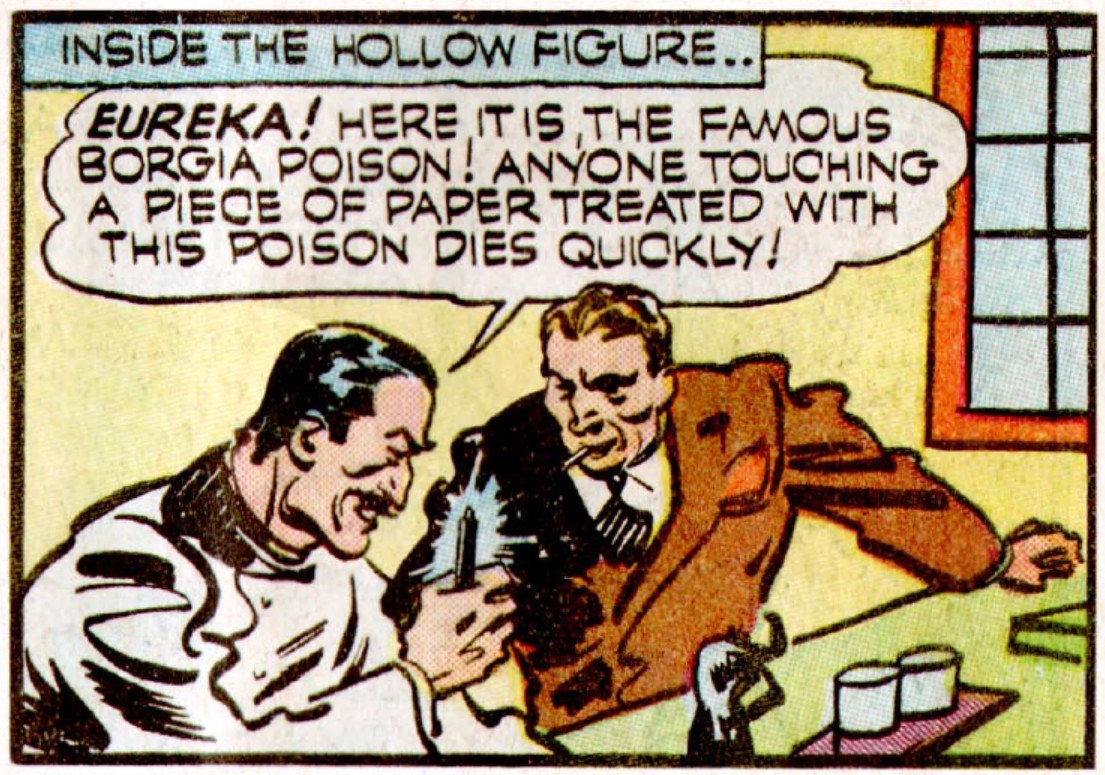
    Cesare, Lucrezia and the rest of the Borgia family might not actually appear in comics all that often, but they certainly do figure into their plots via the absolute piles of poisoned and poison-adjacent artifacts that are attributed to them. Borgia trinkets crop up so frequently, in fact, that I am surprised that it’s taken us this long to encounter one, in the form of a hollow silver statuette that contains a deadly contact poison. (Fantastic Comics 018, 1941)

    Fort Knox:

    Stardust the Super Wizard’s final foe, the unfortunately-named “Slant-Eye,” was a classic comic book Fort Knox robber. (Fantastic Comics 016, 1941)

    Francis Biddle:

    Major Victory has to consult with the US Attorney General in 1941, and in 1941 the US Attorney General was Francis Biddle. The man in the panel above is not Francis Biddle. (Dynamic Comics 002, 1941)

    Franklin D Roosevelt:

    Seen ordering the creation of a super-soldier, i.e. Captain America, to combat domestic espionage. (Captain America Comics 001, 1941)

    Fritz Kuhn:

    Fritz Knoll, purveyor of domestic espionage, is probably a reference to the chief Bundist. (Fantastic Comics 021, 1941)

    Henry L Stimson:

    The US didn’t even have a Secretary of Defense until after WWII, so I am not sure who this guy hanging out with Samson is supposed to be. The analogous position at the time this comic came out was Secretary of War, and that was Henry L Stimson, and this is not him. A true mystery man in all senses. (Fantastic Comics 023, 1941)

    J Edgar Hoover:

    J Arthur Grover, head of the FBI and clear J Edgar Hover stand-in, is also the man in charge of the program that would eventually be known as Project: Rebirth, aka the super-soldier program that produces Captain America later in this same issue. (Captain America Comics 001, 1941)

    Tutankhamen:

    Some of King Tut’s grave goods are among the items stolen by the Butterfly. (Captain America Comics 003 1941)

  • REAL PERSON ROUND-UP 025

    REAL PERSON ROUND-UP 025

    If comics are reflections of the real world then why should we be surprised to find them so full of real people?

    Adolf Hitler:

    Hiller is the “mad dictator” who inspires Hercules to reincarnate and eventually become Marvel Boy. He’s about as close as you get to putting a Hitler in your comic as you can get without actually saying the name. The whole name. The “t” part. (Daring Mystery Comics 006, 1940)

    This otherwise-unnamed Fuehrer of a likewise nameless underground nation that vexes the America inhabited by Captain Daring in 3051 CE is a clear inspired-by-Hitler type. (Daring Mystery Comics 007, 1941)

    Citizen V takes a break from his propaganda campaign in Occupied Europe to sneak into Germany and become a member of the Punched Hitler in the Nose Club. (Daring Mystery Comics 008, 1942)

    This version of Hitler appears in a long dream sequence in the comedic Army Life strip “Private Rook” that appears to exist solely to make a joke about him being gay (the bit where he is the Princess Tanya’s Fairy Godmother, specifically). This isn’t great, but it is remarkable for being the only time I personally have seen such a thing in a Golden Age comic. (Army and Navy Comics 003, 1941)

    Though Cap punches Hitler on the cover of his very first issue, it is in fact Bucky who lands the first blow on him (and Goering) in the pages of a comic. (Captain America Comics 002, 1941)

    the Borgias:

    Cesare, Lucrezia and the rest of the Borgia family might not actually appear in comics all that often, but they certainly do figure into their plots via the absolute piles of poisoned and poison-adjacent artifacts that are attributed to them. Borgia trinkets crop up so frequently, in fact, that I am surprised that it’s taken us this long to encounter one, in the form of a hollow silver statuette that contains a deadly contact poison. (Fantastic Comics 018, 1941)

    Fort Knox:

    Stardust the Super Wizard’s final foe, the unfortunately-named “Slant-Eye,” was a classic comic book Fort Knox robber. (Fantastic Comics 016, 1941)

    Francis Biddle:

    Major Victory has to consult with the US Attorney General in 1941, and in 1941 the US Attorney General was Francis Biddle. The man in the panel above is not Francis Biddle. (Dynamic Comics 002, 1941)

    Franklin D Roosevelt:

    Seen ordering the creation of a super-soldier, i.e. Captain America, to combat domestic espionage. (Captain America Comics 001, 1941)

    Fritz Kuhn:

    Fritz Knoll, purveyor of domestic espionage, is probably a reference to the chief Bundist. (Fantastic Comics 021, 1941)

    Henry L Stimson:

    The US didn’t even have a Secretary of Defense until after WWII, so I am not sure who this guy hanging out with Samson is supposed to be. The analogous position at the time this comic came out was Secretary of War, and that was Henry L Stimson, and this is not him. A true mystery man in all senses. (Fantastic Comics 023, 1941)

    J Edgar Hoover:

    J Arthur Grover, head of the FBI and clear J Edgar Hover stand-in, is also the man in charge of the program that would eventually be known as Project: Rebirth, aka the super-soldier program that produces Captain America later in this same issue. (Captain America Comics 001, 1941)

    Tutankhamen:

    Some of King Tut’s grave goods are among the items stolen by the Butterfly. (Captain America Comics 003 1941)
  • DIVINE ROUND-UP 029

    Comic book religion. Tricky stuff.

    Hercules: 

    The thing that really jumps out at you when you first encounter this version of Hercules is that he goes to Valhalla when he dies, which is weird. The second thing is that he is appearing in a Golden Age Marvel comic and so there might be fun storytelling ramifications considering the fact that Hercules is a moderately popular (and alive) Marvel Comics character with appearances from the mid-60s to today. Perhaps the fact that this is a pretty Roman mythology (aside from the Valhalla thing) and Hercules from  the Champions is from a Greek one can play into it.

    The third thing that jumps out at you comes on maybe your third reading of the comic in question, when you pay a bit more attention to that first panel in which Hercules is dying and realize that he is not only meant to have survived until some time after the founding of the United States but that the heavy shadowing on the faces of the people in that panel kind of implies that he might have been one of the Founding Fathers? There just aren’t enough clues in the art to tell for sure but I know Simon and Kirby’s tricks and making George Washington Hercules is just their style.

    After spending a while in Valhalla, Herc gets worried about the rise of fascism and decides to reincarnate as a mortal in order to be there to lend a hand when the US needs him (a real snub to his former fave of Rome) so he heads on back to be reborn as Marvel Boy. 

    God Style: Real (Daring Mystery Comics 006, 1940)

    Jupiter:

    Like his son Hercules, this version of Jupiter is very concerned with personal freedom and the fate of the United States in particular. Or maybe he’s just a good father who wants to support his son’s little projects.

    Whatever the reason, he shows up on his reincarnated son’s fifteenth birthday to deliver a cool super-hero uniform before making a very cool exit via lightning storm. 

    God Style: Real (Daring Mystery Comics 006, 1940)

    Father Patriot:

    Father Patriot is the brand-new anthropomorphic personification of the spirit of America created by an unknown comics scribe for the origin story of Major Victory. As I have already speculated behind that link, my only real guess as to why they might have done this is to avoid stepping on Quality Comics’ toes by using Uncle Sam for the role. I was going to complain about them not replacing him with one the less-used personifications of America like Brother Jonathan or Columbia, but on reflection I can see why they might have wanted to go with an all-new character. If nothing else, this means that they had free reign to add as much patriotic nonsense to his design as they wanted to, like his retinue of patriotic angels or the fact that he can whale on the Liberty Bell to impart strength unto his champion. They also got to design a set of patriotic clothing for him, and while it doesn’t quite match up to the classic Uncle Sam look I do appreciate his big gaudy belt buckle.

    Speaking of those mysterious angelic servants: does this indicate that the glories of to American Heaven are not exclusive to the mythology of Captain Fearless?

    God Style: Real (Anthropomorphic Personification) (Dynamic Comics 001, 1941)

    Maloo:

    No non-white and non-monotheistic group is immune to the threat of Golden Age comics just making up some random god that they supposedly worship, and the Aboriginal Australians are no exception. Maloo is a giant, vicious kangaroo who the Face is nearly sacrificed to but who ends up dead instead. Sorry, Maloo. Sorry, Aboriginal Australians.

    God Style: Animist (The Face 001, 1941) 

  • MINOR SUPER-VILLAIN 958: THE YELLOW HOOD

    (Dynamic Comics 002, 1941)

    In probably the cheekiest campaign of terror ever, American defense officials are being murdered and then their shrunken skulls are being sent along to places where people are waiting for them with notes reading “Don’t wait for me any longer, here I am.”

    You may have noticed that all of the skull deliveries involved a man named Professor Curran, and being seasoned comics readers you rightly would have suspected that he was involved in the scheme somehow. It can’t be him, however, as Curran is one of the victims, murdered just out of sight of a captured Major Victory.

    Just kidding: the Yellow Hood and Professor Curran are one and the same, and the murder was staged to throw suspicion off of him. Curran’s role as a Chief Air Warden meant that he was in a prime position to facilitate a Nazi invasion of the United States, and the murders were designed to weaken US defenses further. It’s a high risk/ high reward endeavour, as evidenced by the fact that Curran chucks himself off a cliff rather than be captured by Major Victory.

    Categorized in: Accessories (Calling Cards), Colours (Yellow), Objects (Hoods)

  • MINOR SUPER-HERO ROUND-UP 089

    Just when you think that there couldn’t be any more super-heroes, another batch appears.

    Major Victory:

    After an unnamed soldier stationed at US Army Camp Courage dies in an attempt to prevent the camp’s arsenal from being bombed, his body is hauled away by angelic figures and ushered into the presence of a star-spangled old man.

    This, it turns out, is Father Patriot, a new and legally distinct anthropomorphic personification of the spirit of the United States. Were the folks at Chesler concerned about using Uncle Sam due to the fact that Quality Comics was already doing so? Perhaps! Regardless of his origin, Father Patriot revives the soldier as an exemplar of the self-sacrificing military hero. Unusually for a character who has been restored to life by a mystical force, Major Victory (as he is dubbed) does not come back with any powers but is instead gifted with a costume, an airfield base complete with high-powered radio receiver and an airplane and just told to have at it.

    Major Victory is not entirely without supernatural enhancement, however: if he’s ever in a big enough jam then Father Patriot can ring the Liberty Bell to give him a rush of strength sufficient to snap a steel chain.  (Dynamic Comics 001, 1941)

    Categorized in: Generica (Majors), Origin (Patriotic Heroes), Origin (Resurrected)

    Dynamic Man:

    I’m really kicking myself here. Back when I started this blog I was focusing on super-villains and only really talking about the weirder super-heroes, and while I eventually realized my error and started talking about every super-hero at least a little (hence the round-up framework – if I only have a small amount to say about any one hero there are three more to bulk out the post) I’m still playing catch-up. This is all to say that if I’d done things right to start with I’d already have an entry on the Marvel Comics Dynamic Man to point to instead of an assertion that one is coming up in a few month when Mystic Comics comes back around in my reading list.

    This is especially galling because both the Marvel and the Chesler Dynamic Mans are androids who emerge from their birthing tubes as their creators are dying in front of them. This is a fun coincidence, probably! There are of course plenty of differences between the two: the Chesler Dynamic Man is created specifically to combat the villainous Yellow Spot, while the Marvel one is more of an exercise in creation for its own sake. Chesler Dynamic Man is also possibly a magical construct rather than a humanoid robot. My evidence for this amounts to the fact that he was created by “authority on ancient black magic” Dr Moore, who talks about giving him “the power of steel, the speed of an eagle and the wisdom of the sages,” which is pretty poetic if you’re talking about an android and might be literal if you’re growing some sort of super-homunculus.

    Dynamic Man is a hero of the Superman variety, with the powers of flight, super strength and a general invulnerability to harm. He also wears these gloves that I find very distracting – sure, that long point that extends up the forearm is an interesting addition to the costume, but how does it stay in place? Does Dynamic Man have to apply a little spirit gum to his arm every time he gets dressed?

    Finally, Dynamic Man flies with every limb maximally akimbo, and continues to do so throughout his super-heroic career. It’s honestly kind of charming. (Dynamic Comics 001, 1941)

    Categorized in: Generica (Mans), Language (Superlatives – Dynamic), Origins (Magical Constructs)

    Hale the Magician:

    It’s 1541 and the young Englishman Hale (no first name given) and his father are the only two good – though still fairly racist – Europeans in South America and thus object to the brutal treatment of the indigenous peoples by the Spanish. They head up into the mountains to pledge their support to Chief Xingu of the Maoni Indians and soon find themselves locked in battle with a group of angry conquistadors. It’s a short-lived battle, as Xingu reveals himself to be a master of science and magic by producing a lightning storm from his spear. The Spanish sensibly flee, but not before killing Hale Sr.

    Thanks to his selfless heroism (and after passing a series of challenges), Hale the Younger is essentially adopted by Xingu, who teaches his new ward all the technomagical secrets of the Maoni. Together, they create the Magic Spearhead, an artifact that contains the sum of all those powers, but before they can test it out Hale is struck down by a jealous rival. Xingu places Hale’s body in a special tomb with the promise that he will return to life one day

    Cut to 1941, the prophesied time of Hale’s revival, and scientist Henry Starrett and his daughter Lois are on-hand to witness the grand event. After waiting for months, they run out of food and Starrett makes the oafish decision to smash open the tomb with a big stick. This vandalism must have been part of the prophecy, because smashing the tomb kills Starrett and restores Hale to life in what is possibly some sort of inadvertent sacrifice.

    Thanks to the Magic Spearhead, Hale has all of the limitless power of his fellows in the fraternity of comic book magicians and he returns to the States with Lois to use those powers for the good of mankind. In an extremely frustrating development, Hale never sees fit to attach the Magic Spearhead to a spear body, making it more like a weird magic knife, but maybe it’s just me and nobody else is bothered by this. I mean, Xingu had his magic coming out of a full-sized spear, Hale. (Dynamic Comics 001, 1941)

    Categorized in: Accessories (Spears), Magical Professions (Magicians), Origins (Resurrected)

    the Black Cobra:

    The Black Cobra is a standard unit of costumed vigilante. In day-to-day life he is Jim Hornsby, son and office clerk of District Attorney Hornsby, but when danger looms he suits up and starts slinging fists. It’s not a great costume, mind you, both because it’s too busy and, importantly not black. Plus I checked out his other appearances and that is the best that that cowl is ever going to look.

    The Black Cobra also has the one variation on the meek alter ego that is more grating than the disappointed love interest: the emotionally abusive disappointed parent. Hornsby Senior in contention for Worst Father in Comics. (Dynamic Comics 001, 1941)

    Categorized in: Animals (Cobras), Colours (Black), Day Jobs (Clerks)