The Curse of Skeleton Munroe

Category: anthropomorphic personification

  • MINOR SUPER-HERO ROUND-UP 103

    Soon there will be more minor super-heroes than there are humans for them to protect.

    the Sentinel:

    In 1783, on the Boston Common, the newly-minted Spirit of America charges a cannon with the “powders of patriotism” in anticipation that someday a champion will be needed to defend the new nation from destruction. Finally, in 1941 (the Civil War not, apparently, being enough of a reason), the cannon fires on its own and releases the Sentinel, mystic champion of the American people.

    As one might expect, the Sentinel is broadly superhuman: he can fly, is super strong and is immune to most harm. He also has a halo of fire that he can disappear into and shrink to a tiny flame, effectively rendering him invisible and allowing him to vex friend and foe alike with his comings and goings. Oddly, he has no other control over fire. (Liberty Scouts Comics 003, 1941)

    Doctor Nemesis:

    Doctor Nemesis is really Dr Jim Bradley, intern at Mercy Hospital in an unnamed city (that is probably meant to be NYC but later retconned as San Francisco) who has developed a foolproof truth serum and decided to keep it to himself rather than risk criminals getting their hands on it – presumably the concern is that they would use it to learn bank vault combinations and other secret information. Since he himself continually runs into situations in which a foolproof truth serum is a handy way to solve a crime, Bradley adopts a costumed identity and sets out to achieve a better tomorrow via a series of injections. 


    Doctor Nemesis might just be the most calling card-using super-person who we have yet encountered. He hands out at least four of them in his first adventure alone.

    Doctor Nemesis has a pretty simple crimefighting routine: identify a potential injustice and then drug everyone involved until he has a clear idea of who is responsible, then beat them up and have them give a drugged confession in front of a police witness. The police in turn are perfectly happy to receive these confessions that they technically haven’t coerced from people, though there has to be a clever defense attorney somewhere in Unnamed City who is just waiting to get a Doctor Nemesis client so that they can really dig into the admissibility of admissions given under the influence of mysterious vigilante juice.

    It’s been a while since we have encountered a character who was later revived and incorporated into the Battle-Axis, Marvel’s team of disaffected public domain Golden Age super-heroes who went over to the Nazis, but Doctor Nemesis here is one of them under the technically-but-not-really more badass name of Dr Death. As always, it’s hard to say just who got done dirtiest by Roy Thomas when he was assembling the Battle-Axis roster but Doctor Nemesis is certainly a candidate, if only because he doesn’t even have the Human’s Meteor’s flimsy “I’m Irish American and fuck the British” or the Spider Widow’s “the Commies killed my husband” excuses. Instead, he simply implies that the Nazis are paying him well.

    Subsequent writers (specifically Matt Fraction, if I have things right) clearly thought that Doctor Nemesis was worth revisiting. He was given a long career as a Nazi hunter to counteract his short career as a Nazi and briefly became a core X-Man, though nowadays every time I look up what he’s up to it seems that he has become weirder and more peripheral to the action than the last. (Lightning Comics v1 006, 1941)

    Lash Lightning **UPDATE**:

    I haven’t been very careful to delineate whether the character has been going by “Flash” or “Lash” Lightning due to the fact that it profoundly does not matter (they just call him “Lightning” in the stories themselves, for instance) but I might as well make note of this, the issue in which the actual change was made. (Lightning Comics v2 002, 1941)

    Marvo the Magician **UPDATE**:

    Up until the exact point pictured above, Marvo the Magician was unique among magical comic book super-heroes, for though many of them (including Zatara, the big cheese himself) are said to be using their magic to create illusions and fool the minds of others, it is all demonstrably lies (or more charitably a different definition of “illusion” than I am using), as they all produce material effects in the world. Only pure, beautiful Marvo can claim that he uses illusions and nothing more to frighten and confound his foes, and I have been checking.

    That is, up to this issue, when Marvo creates the “illusion” of an ocean liner (complete with a crooked sailor who kidnaps her and hands her over to pirates!) that the woman he is helping proceeds to board and sail away on. Unless the implication is that she has been so convinced that the liner exists that she has swum or perhaps hovered her way to her destination (well, part way to her destination), the inescapable fact is that this ship is more than a mere illusion. Nothing is certain in this wicked world, folks. (Lightning Comics v2 003, 1941)
  • DIVINE ROUND-UP 034

    DIVINE ROUND-UP 034

    Here come some more gods and god-adjacent beings for you.

    the Golden Skull:

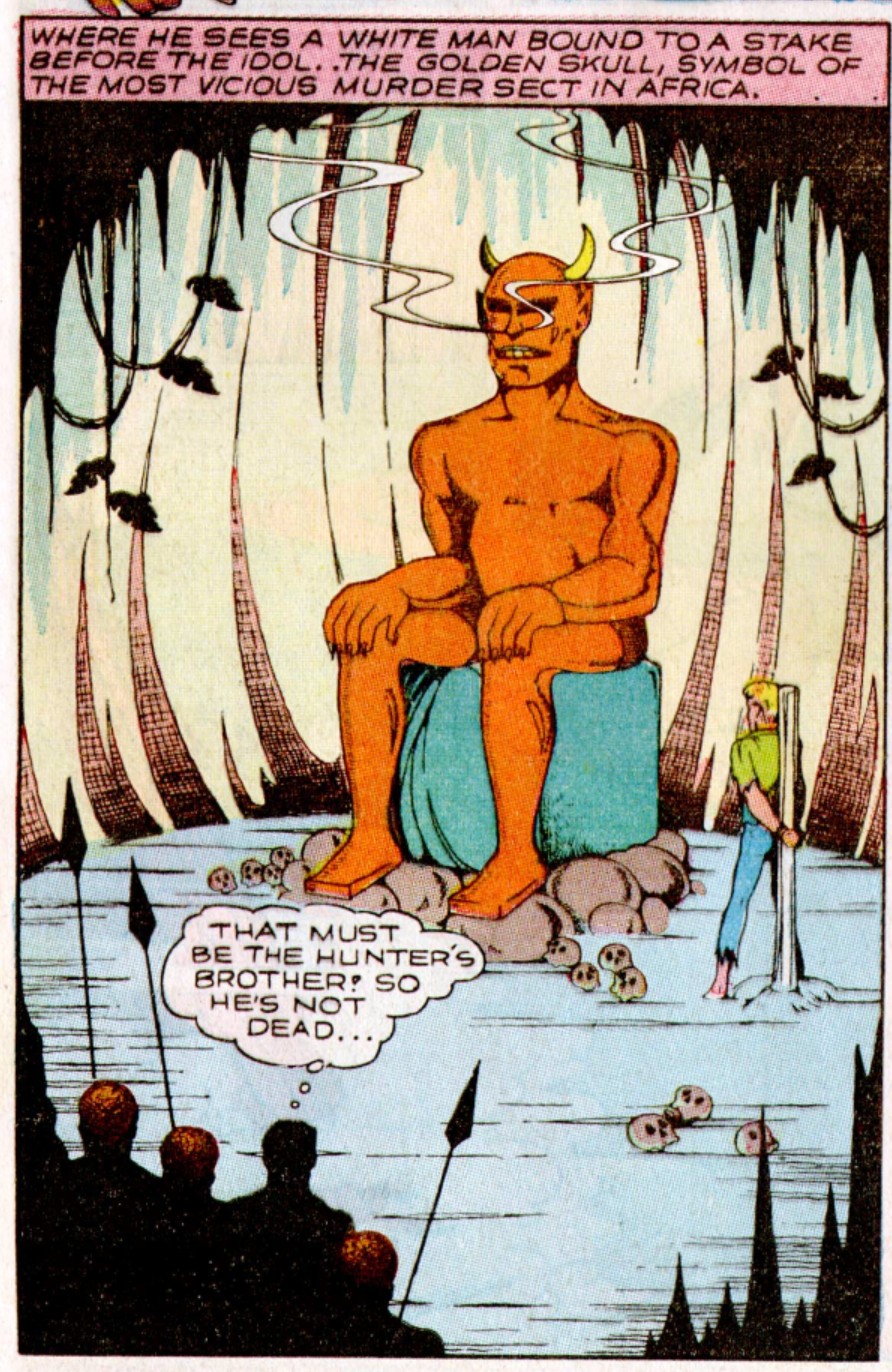
    While I must of course frown and shake my head at the concept of human sacrifice, you really have to hand it to the worshippers of the Golden Skull (who is, yes, very much not golden and also not especially skully), for giving their god a name that guarantees that a constant stream of American and European treasure hunters would arrive on their doorstep in search of swag. It’s the perfect sustainable human sacrifice supply solution!

    Sadly, the Golden Skull sect are not quite as canny about the location of their temple as they are about marketing, and the whole operation gets blown sky high when the volcano it is housed in erupts at an inopportune time.

    God Style: Idol (Jungle Comics 024, 1941)

    God of the Apes:

    We don’t learn much about the God of the Apes other than the fact that it is presumably worshipped or otherwise connected to apes and that it is real enough that Fantomah can call upon it to turn some crooked big game hunters into gorillas.

    God Style: Invoked (Real) (Jungle Comics 024, 1941)

    Mars:

    This right here is a pretty traditional comic book depiction of Mars, God of War, right down to the fact that he is loving the carnage and slaughter in Europe (and is implicitly the Guy Behind WWII). He loves it so much, in fact, that he creates Man of War as his personal agent on Earth to speed the whole process up, but he then fumbles the process so badly that he accidentally creates an Allied super-hero instead. 

    God Style: Real (Liberty Scouts Comics 002, 1941)

    the Spirit of America:

    This Spirit of America is in the Columbia mode, being an ethereal and star-spangled woman who implicitly comes into existence as a result of the American Revolution. In 1783 she primes a cannon with “powders of patriotism” just in case she ever needs to create a mystic champion at some point in the future (i.e., upcoming super-hero the Sentinel). 

    God Style: Real (Anthropomorphic Personification) (Liberty Scouts Comics 003, 1941)

  • DIVINE ROUND-UP 029

    Comic book religion. Tricky stuff.

    Hercules: 

    The thing that really jumps out at you when you first encounter this version of Hercules is that he goes to Valhalla when he dies, which is weird. The second thing is that he is appearing in a Golden Age Marvel comic and so there might be fun storytelling ramifications considering the fact that Hercules is a moderately popular (and alive) Marvel Comics character with appearances from the mid-60s to today. Perhaps the fact that this is a pretty Roman mythology (aside from the Valhalla thing) and Hercules from  the Champions is from a Greek one can play into it.

    The third thing that jumps out at you comes on maybe your third reading of the comic in question, when you pay a bit more attention to that first panel in which Hercules is dying and realize that he is not only meant to have survived until some time after the founding of the United States but that the heavy shadowing on the faces of the people in that panel kind of implies that he might have been one of the Founding Fathers? There just aren’t enough clues in the art to tell for sure but I know Simon and Kirby’s tricks and making George Washington Hercules is just their style.

    After spending a while in Valhalla, Herc gets worried about the rise of fascism and decides to reincarnate as a mortal in order to be there to lend a hand when the US needs him (a real snub to his former fave of Rome) so he heads on back to be reborn as Marvel Boy. 

    God Style: Real (Daring Mystery Comics 006, 1940)

    Jupiter:

    Like his son Hercules, this version of Jupiter is very concerned with personal freedom and the fate of the United States in particular. Or maybe he’s just a good father who wants to support his son’s little projects.

    Whatever the reason, he shows up on his reincarnated son’s fifteenth birthday to deliver a cool super-hero uniform before making a very cool exit via lightning storm. 

    God Style: Real (Daring Mystery Comics 006, 1940)

    Father Patriot:

    Father Patriot is the brand-new anthropomorphic personification of the spirit of America created by an unknown comics scribe for the origin story of Major Victory. As I have already speculated behind that link, my only real guess as to why they might have done this is to avoid stepping on Quality Comics’ toes by using Uncle Sam for the role. I was going to complain about them not replacing him with one the less-used personifications of America like Brother Jonathan or Columbia, but on reflection I can see why they might have wanted to go with an all-new character. If nothing else, this means that they had free reign to add as much patriotic nonsense to his design as they wanted to, like his retinue of patriotic angels or the fact that he can whale on the Liberty Bell to impart strength unto his champion. They also got to design a set of patriotic clothing for him, and while it doesn’t quite match up to the classic Uncle Sam look I do appreciate his big gaudy belt buckle.

    Speaking of those mysterious angelic servants: does this indicate that the glories of to American Heaven are not exclusive to the mythology of Captain Fearless?

    God Style: Real (Anthropomorphic Personification) (Dynamic Comics 001, 1941)

    Maloo:

    No non-white and non-monotheistic group is immune to the threat of Golden Age comics just making up some random god that they supposedly worship, and the Aboriginal Australians are no exception. Maloo is a giant, vicious kangaroo who the Face is nearly sacrificed to but who ends up dead instead. Sorry, Maloo. Sorry, Aboriginal Australians.

    God Style: Animist (The Face 001, 1941) 

  • DIVINE ROUND-UP 010

    Pad out your pantheon with some of these:

    Death:

    This version of Death may lack the social graces necessary to welcome Kardak the Mystic and his pal Lorna rather than attempt to murder them for entering his domain, but he does have a very good version of the classic “robed skeleton” look. And his house is charmingly coffin-themed, to boot! 

    God Style: Anthropomorphic Personification (Top-Notch Comics 008, 1940)

    Ramu, God of Fire: 

    Ramu, God of Fire is another one of your deities created so that a group of “primitive savages” will have a reason to menace some “noble explorers” with the threat of being human sacrificed. Ramu at least is kind of fun because while he might have started out looking like the figure depicted on those red sacrificial poles, by the end of the comic this image has been supplanted by that of the miniature rocket ship that Minimidget and Ritty accidentally pilot into the middle of the ceremony.

    God Style: Idol  (Amazing-Man Comics 010, 1940)

    the Sacred Steam God:

    The Sacred Steam God is worshipped by the Quadropel Men, who themselves are notable for living beneath the land of Aquatania, which itself lies below the Marquesas Islands. Worship of the Sacred Steam God of course involves human sacrifice, but erstwhile victim Terry is saved when Chuck Hardy topples the inexplicably-full-of-scalding-water idol onto the crows of spectators. 

    God Style: Idol (Amazing-Man Comics 009, 1940)

    Sakka: 

    Sakka is, yes, another figure to whom some Noble White Explorers are almost sacrificed while making their way through the jungles of Matto Grosso in Brazil. Here’s the difference, though: Sakka isn’t just some idol, he’s an ancestor spirit, and his name and his ancient sword are all that the big-eyed Earth-Men need to keep their faith strong and bloodthirsty, at least until adventurer Rocky Ryan picks up the sword and is acclaimed the second coming of Sakka, that is. 

    God Style: Invoked (Big-Shot Comics 014, 1941) 

  • DIVINE ROUND-UP 009

    I came across Jumbo Comics 031 while filling in gods from my backlog in another Divine Round-Up entry and realized that the array of entities represented in the Stuart Taylor story in that issue should be presented as a block.

    Mercury: 

    This story begins as most Stuart Taylor stories do, with reckless use of time travel technology. Specifically, Taylor’s love interest Laura Hayward has travelled back to Ancient Greece to buy a new hat, because as we know: women be hat shopping. It’s practically all they think about!

    Laura’s Twentieth Century charms are apparently too much for the local deities to bear, because before Stuart can collect her and be condescending about headwear she is kidnapped by Mercury and spirited away to Olympus, which among other things places the gods of this issue in the hybrid Greco-Roman Pantheon.

    the Oracle of Delphi: 

    Stuart and Dr Hayward’s next move is to consult with the Oracle of Delphi to get a line on how exactly they might follow Mercury and recover Laura from him, and I must say that I really enjoy this weird wisp-of-air version of the Oracle, despite it being tremendously off-model. 

    Medusa: 

    The Oracle directs Our Heroes to seek information from Medusa, who turns out to be depicted in typical style, though somewhat more enormous than is generally the case. I do appreciate that this issue answers the age old question: “is Medusa vulnerable to ray gun blasts?” 

    the Evils Contained in Pandora’s Box: 

    The final stop on Stuart and Hayward’s quest is to retrieve a laurel wreath from inside of Pandora’s Box, which is just sitting in a field in the middle of nowhere. The comic kind of glosses over the fact that Stuart Taylor is responsible for unleashing the Evils of Mankind, but I am fully prepared to do so, as it might just be his worst snafu in a career full of the reckless and unthinking use of time travel. 

    The specific evils released from this version of Pandora’s Box are: 

    Disease – a classic for a reason. The generic ghost look suggests that the artist did not want to draw a lot of pustules.

    Greed – an evil little pig man. 

    Hunger – another one right out of the classic Four Horsemen of the Apocalypse set. Much more gruesome than Disease, when the opposite is usually the case.

    Intolerance – I was going to call this guy an unusual inclusion, but on reflection I’ll bet that most Pandora’s Box lineups include Hate, which isn’t far off. Definitely looks intolerant.

    and bringing up the rear… 

    War, aka Mars: 

    What is unusual inclusion is not War, who I reckon is there pretty often, but specifically Mars, God of War. Is the implication that this fairly major god was powerless until released by human hands? Is the War who is usually depicted in PB lineups some sort of aspect of war or a specific type of warfare? No clue. What is certain is that Stuart Taylor knocks this War’s block off.

    And speaking of block-knocking, that’s what also happens to Mercury once Taylor, Laurel wreath firmly on brow, makes his way to Olympus to finally rescue Laura. The story ends on a fairly limp callback joke about women and their genetic predilection for hat-shopping, one which I rolled my eyes at even before I realized that Laura wearing the divine laurel wreath as a regular hat at the end would be a much better bit. (Jumbo Comics 031, 1941)

  • DIVINE ROUND-UP 009

    I came across Jumbo Comics 031 while filling in gods from my backlog in another Divine Round-Up entry and realized that the array of entities represented in the Stuart Taylor story in that issue should be presented as a block.

    Mercury: 

    This story begins as most Stuart Taylor stories do, with reckless use of time travel technology. Specifically, Taylor’s love interest Laura Hayward has travelled back to Ancient Greece to buy a new hat, because as we know: women be hat shopping. It’s practically all they think about!

    Laura’s Twentieth Century charms are apparently too much for the local deities to bear, because before Stuart can collect her and be condescending about headwear she is kidnapped by Mercury and spirited away to Olympus, which among other things places the gods of this issue in the hybrid Greco-Roman Pantheon.

    the Oracle of Delphi: 

    Stuart and Dr Hayward’s next move is to consult with the Oracle of Delphi to get a line on how exactly they might follow Mercury and recover Laura from him, and I must say that I really enjoy this weird wisp-of-air version of the Oracle, despite it being tremendously off-model. 

    Medusa: 

    The Oracle directs Our Heroes to seek information from Medusa, who turns out to be depicted in typical style, though somewhat more enormous than is generally the case. I do appreciate that this issue answers the age old question: “is Medusa vulnerable to ray gun blasts?” 

    the Evils Contained in Pandora’s Box: 

    The final stop on Stuart and Hayward’s quest is to retrieve a laurel wreath from inside of Pandora’s Box, which is just sitting in a field in the middle of nowhere. The comic kind of glosses over the fact that Stuart Taylor is responsible for unleashing the Evils of Mankind, but I am fully prepared to do so, as it might just be his worst snafu in a career full of the reckless and unthinking use of time travel. 

    The specific evils released from this version of Pandora’s Box are: 

    Disease – a classic for a reason. The generic ghost look suggests that the artist did not want to draw a lot of pustules.

    Greed – an evil little pig man. 

    Hunger – another one right out of the classic Four Horsemen of the Apocalypse set. Much more gruesome than Disease, when the opposite is usually the case.

    Intolerance – I was going to call this guy an unusual inclusion, but on reflection I’ll bet that most Pandora’s Box lineups include Hate, which isn’t far off. Definitely looks intolerant.

    and bringing up the rear… 

    War, aka Mars: 

    What is unusual inclusion is not War, who I reckon is there pretty often, but specifically Mars, God of War. Is the implication that this fairly major god was powerless until released by human hands? Is the War who is usually depicted in PB lineups some sort of aspect of war or a specific type of warfare? No clue. What is certain is that Stuart Taylor knocks this War’s block off.

    And speaking of block-knocking, that’s what also happens to Mercury once Taylor, Laurel wreath firmly on brow, makes his way to Olympus to finally rescue Laura. The story ends on a fairly limp callback joke about women and their genetic predilection for hat-shopping, one which I rolled my eyes at even before I realized that Laura wearing the divine laurel wreath as a regular hat at the end would be a much better bit. (Jumbo Comics 031, 1941)

  • DIVINE ROUND-UP 005

    Once again we add to the scriptures. 

    the Shadowman: 


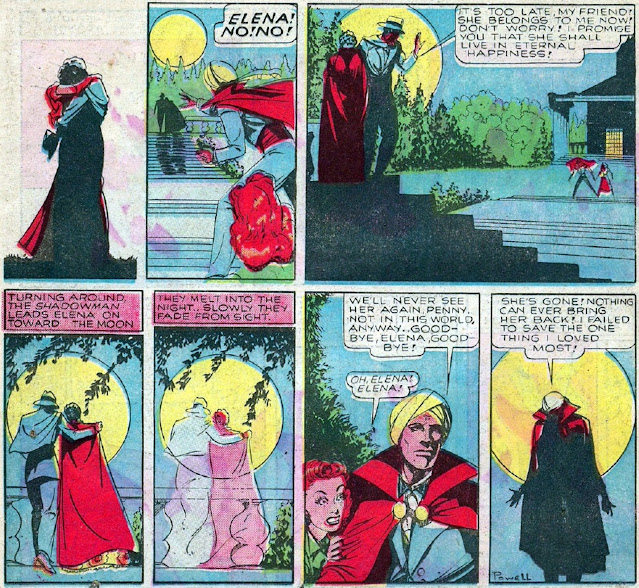
    Like his predecessor/inspiration Yarko the Great, Mr Mystic also has a semi-friendly/ semi-adversarial relationship with the personification of death. In this case, Death is a guy in a cool suit with a half-cape, and he is called the Shadowman, presumably because of his perpetually-in shadow face.

    The Shadowman’s first couple of appearances cast him as a mysterious stranger who helps Mr Mystic in his battle against various evils (including scientist Ghantse, who the Shadowman seems to work for in his initial appearance). At this point the Shadowman is merely a mysterious man who has a miraculous ability to survive the most deadly of situations.

    In the 17 November 1940 Spirit Section, Mr Mystic ventures into the Land of Mythology on a quest for the Ring of the Gods, which turns out to be held by Death. This version of Death is a traditional Grim Reaper style skeleton in a robe, and he swears vengeance on Mr Mystic for the theft of the ring. 

    The Grim Reaper version of Death is never explicitly tied to the Shadowman, and it’s possible that they were intended to be different in some fundamental way – different aspects of death, perhaps. The Whole Ring of the Gods incident is not brought up by the Shadowman the next time he meets Mr Mystic (1 December 1940), so Mystic might be off the hook for that. It’s a bit of a moot point, however, as this installment of “Mr Mystic” is all about him saving the life of a little girl named Joan Barton, and it allows us to get more of a grip on the Shadowman’s code: he objects to bot murder and life-saving interventions as equally disruptive to the natural order. Mr Mystic now has two threats from Death hanging over him. 

    (this episode also establishes the deal with the Shadowman’s shadowy face: if you look at it sans shadow, you die) 

    The second-to-final Mr Mystic comic of the year (22 December 1940) features the Shadowman’s revenge on Mystic: he is going to seduce/kill his fiance Elena.

    While the Shadowman seems to have access to some sort of primordial seductive power relating to the inevitable entropic march toward the grave, he is not above employing cheap romantic comedy plot devices to drive a wedge between the lovers.

    Death is the inevitable winner of the contest, of course, and Elena goes off with him to… the afterlife? His home? Are they married now or is she just dead? We shall never know, alas, though we will see the Shadowman again.

    God Style: real anthropomorphic personification (The Spirit Section, 22 September, 1940)

    Jwang Tyoy:

    We don’t get a lot of the teachings of Jwang Tyoy beyond the fact that he is the god of a South American “anti-civilization” cult. The focus of the comic is much more focused on the very off-model pterodactyls that the cult leader uses to do he bidding, and for good reason!

    God Style: idol (Shadow Comics v1 004, 1940) 

    Kutu: 

    Kutu, aka Tuku, is possibly a moon god, definitely South American, and has the traditional jewel socketed into his idol for adventurers to steal and get into Big Trouble. 

    God Style: idol (Comics Magazine 002, 1936)  

    Nahapatan: 

    Nahapatan, the Golden Idol, is housed in a hidden Aztec city, where it is the subject of active worship. Does this stop Professor Roberts, his nephew Tim and adventurer Ken Masters from barging in and stealing it to put in Robert’s museum? It does not.

    God Style: idol (Masked Marvel 001, 1940)

  • DIVINE ROUND-UP 005

    Once again we add to the scriptures. 

    the Shadowman: 


    Like his predecessor/inspiration Yarko the Great, Mr Mystic also has a semi-friendly/ semi-adversarial relationship with the personification of death. In this case, Death is a guy in a cool suit with a half-cape, and he is called the Shadowman, presumably because of his perpetually-in shadow face.

    The Shadowman’s first couple of appearances cast him as a mysterious stranger who helps Mr Mystic in his battle against various evils (including scientist Ghantse, who the Shadowman seems to work for in his initial appearance). At this point the Shadowman is merely a mysterious man who has a miraculous ability to survive the most deadly of situations.

    In the 17 November 1940 Spirit Section, Mr Mystic ventures into the Land of Mythology on a quest for the Ring of the Gods, which turns out to be held by Death. This version of Death is a traditional Grim Reaper style skeleton in a robe, and he swears vengeance on Mr Mystic for the theft of the ring. 

    The Grim Reaper version of Death is never explicitly tied to the Shadowman, and it’s possible that they were intended to be different in some fundamental way – different aspects of death, perhaps. The Whole Ring of the Gods incident is not brought up by the Shadowman the next time he meets Mr Mystic (1 December 1940), so Mystic might be off the hook for that. It’s a bit of a moot point, however, as this installment of “Mr Mystic” is all about him saving the life of a little girl named Joan Barton, and it allows us to get more of a grip on the Shadowman’s code: he objects to bot murder and life-saving interventions as equally disruptive to the natural order. Mr Mystic now has two threats from Death hanging over him. 

    (this episode also establishes the deal with the Shadowman’s shadowy face: if you look at it sans shadow, you die) 

    The second-to-final Mr Mystic comic of the year (22 December 1940) features the Shadowman’s revenge on Mystic: he is going to seduce/kill his fiance Elena.

    While the Shadowman seems to have access to some sort of primordial seductive power relating to the inevitable entropic march toward the grave, he is not above employing cheap romantic comedy plot devices to drive a wedge between the lovers.

    Death is the inevitable winner of the contest, of course, and Elena goes off with him to… the afterlife? His home? Are they married now or is she just dead? We shall never know, alas, though we will see the Shadowman again.

    God Style: real anthropomorphic personification (The Spirit Section, 22 September, 1940)

    Jwang Tyoy:

    We don’t get a lot of the teachings of Jwang Tyoy beyond the fact that he is the god of a South American “anti-civilization” cult. The focus of the comic is much more focused on the very off-model pterodactyls that the cult leader uses to do he bidding, and for good reason!

    God Style: idol (Shadow Comics v1 004, 1940) 

    Kutu: 

    Kutu, aka Tuku, is possibly a moon god, definitely South American, and has the traditional jewel socketed into his idol for adventurers to steal and get into Big Trouble. 

    God Style: idol (Comics Magazine 002, 1936)  

    Nahapatan: 

    Nahapatan, the Golden Idol, is housed in a hidden Aztec city, where it is the subject of active worship. Does this stop Professor Roberts, his nephew Tim and adventurer Ken Masters from barging in and stealing it to put in Robert’s museum? It does not.

    God Style: idol (Masked Marvel 001, 1940)

  • DIVINE ROUND-UP 002

    Oh so spiritual, we are.

    Koli Tow: 

    Hal Hazard and his brother Hoagy are adventuring in the South Seas when they get shipwrecked, which is not really an excuse for just wandering into a local temple to eat the food offerings but I guess when you’re hungry a little sacrilege is easy to justify. Even so, the local worshippers of Koli Tow aren’t particularly understanding about it, and given the nature of the comic there’s a human sacrifice in the offing until Hal and Hoagy escape to take their brand of cultural sensitivity to another island. 

    God Style: idol (Circus, the Comic Riot 001, 1938)

    the Canal God: 

    An adventure on Mars brings the Space Rovers to the temple of the Canal God, who basically just looks like a dude because this is a Mars populated by basic-ass humanoids. Just what persentage of Martian gods are going to turn out to be canal-related, anyway? 

    God style: idol (Exciting Comics 004, 1940)

    Death: 

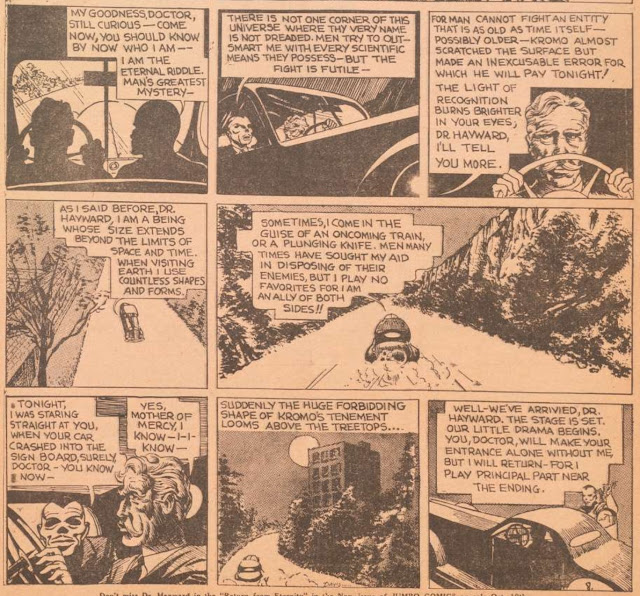
    There are a few ways that the anthropomorphic personification of death is commonly written -compassionate, dispassionate, cruel, goofy – but this particular one crops up in genre fiction a fair amount: personally offended by people attempting to extend their lifespan. This particular version of Death is both pissy about the scientist Kromo’s attempt to live forever via soul transfer and willing to take a hand in preventing him from doing so. He also seems to really enjoy freaking people out, as seen in his car ride with heroic scientist Dr Hayward. 

    God style: real, anthropomorphic personification. (Jumbo Comics 002-004, 1938) 

    Deli-Deli: 

    As is often the case I am torn between finding Malaysian idol-god Deli-Deli charmingly goofy looking and knowing that the goofiness is part of the sneering “these primitive people will worship anything at the heart of many this kind of jungle adventure.

    God-style: idol (Big Shot Comics 013, 1941) 

  • DIVINE ROUND-UP 002

    Oh so spiritual, we are.

    Koli Tow: 

    Hal Hazard and his brother Hoagy are adventuring in the South Seas when they get shipwrecked, which is not really an excuse for just wandering into a local temple to eat the food offerings but I guess when you’re hungry a little sacrilege is easy to justify. Even so, the local worshippers of Koli Tow aren’t particularly understanding about it, and given the nature of the comic there’s a human sacrifice in the offing until Hal and Hoagy escape to take their brand of cultural sensitivity to another island. 

    God Style: idol (Circus, the Comic Riot 001, 1938)

    the Canal God: 

    An adventure on Mars brings the Space Rovers to the temple of the Canal God, who basically just looks like a dude because this is a Mars populated by basic-ass humanoids. Just what persentage of Martian gods are going to turn out to be canal-related, anyway? 

    God style: idol (Exciting Comics 004, 1940)

    Death: 

    There are a few ways that the anthropomorphic personification of death is commonly written -compassionate, dispassionate, cruel, goofy – but this particular one crops up in genre fiction a fair amount: personally offended by people attempting to extend their lifespan. This particular version of Death is both pissy about the scientist Kromo’s attempt to live forever via soul transfer and willing to take a hand in preventing him from doing so. He also seems to really enjoy freaking people out, as seen in his car ride with heroic scientist Dr Hayward. 

    God style: real, anthropomorphic personification. (Jumbo Comics 002-004, 1938) 

    Deli-Deli: 

    As is often the case I am torn between finding Malaysian idol-god Deli-Deli charmingly goofy looking and knowing that the goofiness is part of the sneering “these primitive people will worship anything at the heart of many this kind of jungle adventure.

    God-style: idol (Big Shot Comics 013, 1941)