The Curse of Skeleton Munroe

Category: Vulcan

  • MINOR SUPER-HERO ROUND-UP 097

    It’s astonishing. They just keep on coming up with more super-heroes.

    the Flame **UPDATE**:

    Like many other long-running Fox Features characters, the Flame gets a bit of an overhaul late in 1941. In the Flame’s case, this includes an expansion to his powers: long able to get around by running on the stream of fire produced by his flame gun, the Flame is now simply able to fly. He can also now pick up and move fire around, as seen in this very innovative bit of fire-fighting in The Flame 006.

    The Flame also gets a proper secret identity (Gary Preston) and a job (private investigator) as a part of this revamp. And he gets a supporting cast, in the form of secretary Linda Dale and punch drunk ex-boxer/assistant/comic relief character Pug! (The Flame 007, 1941)

    Finally, though the Flame was explicitly a NYC-based super-hero in his earliest experiences, his 1940-41 adventures frequently have the liminal feel of the many stories set in generic unnamed US cities. In one of his very final appearances, he gets a proper fictional burg to call his own: Big City. (Big 3 006, 1941)

    the Yank and the Rebel:

    I think I’ve occasionally mentioned the inherent ridiculousness of the concepts behind many if not all patriotic super-heroes – it’s something that really jumps out at you as you read through as many Golden Age comics as I have. Please believe me, then, when I say that the Yank and the Rebel are the most conceptually ludicrous patriotic heroes of the lot, and I will be thoroughly (and probably not pleasantly) surprised if I’m ever proven wrong.

    As might be surmised from their names, the Yank and the Rebel are two otherwise unidentified soldiers who are on opposite sides during the American Civil War. While locked in hand-to-hand-to-gun combat, the two fall into a fissure opened by the artillery bombardments at the Battle of Gettysburg, landing next to a convenient radioactive pool that holds them in a state of suspended animation for the next seventy-eight years.

    The duo are eventually awakened when Army manoeuvres re-open the cavern, and they resume their battle until a helpful general explains that the American Civil War ended in some sort of peaceful draw, that nobody really “lost” or “won” the war and that the North and the South are all totally cool with one another now. So why did he put so much spin on history? Probably for the same notion of national unity in the face of war that inspired the people at Fox Features to do so.

    Regardless of the reasoning behind them, the officer’s words inspire a new spirit of patriotism and cooperation in the Yank and the Rebel, and the two team up to hunt spies and saboteurs for two whole adventures before evaporating in the Fox Features financial crisis of 1942. In what is certain to be a massive surprise to nobody, no modern publisher has taken advantage of the fact that these fellows are in the public domain. (The Flame 007, 1941)

    Categorized in: Locations (Specific Places), Origin (Patriotic Heroes), Team Membership (Confederate Army, Union Army) 

    Vulcan **UPDATE**:

    Taking a cue from the Flame, fellow fire-themed hero Vulcan gets a slight expansion to his powers in 1941: he can now create and use flame constructs such as this cool sword. (Four Favorites 001, 1941) 

    It’s not all good news for our favourite demigod, howver, as 1941 is also the year that Vulcan is given a weakness to cold. (Four Favorites 002, 1941)

    Lash Lightning **UPDATE**:

    Lash Lightning gives blood to injured army private Tom Jasper, who immediately develops mild superhumanism in the form of increased muscle mass and vigour. This is especially notable because it really is the ultimate expression of the writers on this feature forgetting that Lash’s powers are derived from a magical amulet and not from his own body. Sad times. (Four Favorites 002, 1941)

  • MINOR SUPER-HERO ROUND-UP 097

    It’s astonishing. They just keep on coming up with more super-heroes.

    the Flame **UPDATE**:

    Like many other long-running Fox Features characters, the Flame gets a bit of an overhaul late in 1941. In the Flame’s case, this includes an expansion to his powers: long able to get around by running on the stream of fire produced by his flame gun, the Flame is now simply able to fly. He can also now pick up and move fire around, as seen in this very innovative bit of fire-fighting in The Flame 006.

    The Flame also gets a proper secret identity (Gary Preston) and a job (private investigator) as a part of this revamp. And he gets a supporting cast, in the form of secretary Linda Dale and punch drunk ex-boxer/assistant/comic relief character Pug! (The Flame 007, 1941)

    Finally, though the Flame was explicitly a NYC-based super-hero in his earliest experiences, his 1940-41 adventures frequently have the liminal feel of the many stories set in generic unnamed US cities. In one of his very final appearances, he gets a proper fictional burg to call his own: Big City. (Big 3 006, 1941)

    the Yank and the Rebel:

    I think I’ve occasionally mentioned the inherent ridiculousness of the concepts behind many if not all patriotic super-heroes – it’s something that really jumps out at you as you read through as many Golden Age comics as I have. Please believe me, then, when I say that the Yank and the Rebel are the most conceptually ludicrous patriotic heroes of the lot, and I will be thoroughly (and probably not pleasantly) surprised if I’m ever proven wrong.

    As might be surmised from their names, the Yank and the Rebel are two otherwise unidentified soldiers who are on opposite sides during the American Civil War. While locked in hand-to-hand-to-gun combat, the two fall into a fissure opened by the artillery bombardments at the Battle of Gettysburg, landing next to a convenient radioactive pool that holds them in a state of suspended animation for the next seventy-eight years.

    The duo are eventually awakened when Army manoeuvres re-open the cavern, and they resume their battle until a helpful general explains that the American Civil War ended in some sort of peaceful draw, that nobody really “lost” or “won” the war and that the North and the South are all totally cool with one another now. So why did he put so much spin on history? Probably for the same notion of national unity in the face of war that inspired the people at Fox Features to do so.

    Regardless of the reasoning behind them, the officer’s words inspire a new spirit of patriotism and cooperation in the Yank and the Rebel, and the two team up to hunt spies and saboteurs for two whole adventures before evaporating in the Fox Features financial crisis of 1942. In what is certain to be a massive surprise to nobody, no modern publisher has taken advantage of the fact that these fellows are in the public domain. (The Flame 007, 1941)

    Categorized in: Locations (Specific Places), Origin (Patriotic Heroes), Team Membership (Confederate Army, Union Army) 

    Vulcan **UPDATE**:

    Taking a cue from the Flame, fellow fire-themed hero Vulcan gets a slight expansion to his powers in 1941: he can now create and use flame constructs such as this cool sword. (Four Favorites 001, 1941) 

    It’s not all good news for our favourite demigod, howver, as 1941 is also the year that Vulcan is given a weakness to cold. (Four Favorites 002, 1941)

    Lash Lightning **UPDATE**:

    Lash Lightning gives blood to injured army private Tom Jasper, who immediately develops mild superhumanism in the form of increased muscle mass and vigour. This is especially notable because it really is the ultimate expression of the writers on this feature forgetting that Lash’s powers are derived from a magical amulet and not from his own body. Sad times. (Four Favorites 002, 1941)

  • REAL PERSON ROUND-UP 026

    Once again we point and go “Hey. It’s that guy.”

    Adolf Hitler:

    Captain Courageous has to deal with a few pseudo-Nazis working for Hitler-alike Hinkler. (Banner Comics 003, 1941) 

    Real Hitler takes a scheme-foiling by Vulcan pretty hard. (Four Favorites 001, 1941)

    Devil’s Island:

    Captain America and Bucky infiltrate Devil’s Island to free a prisoner who is not only a victim of carceral justice taken to unjust extremes but also as an arm of the Nazi government in France. (Captain America Comics 005, 1941)

    the Duke and Duchess of Windsor:

    The Duke of Windsor, aka the former King Edward VIII of England and his wife Wallis, Duchess of Windsor, welcome Speed Martin to the Bahamas in the Duke’s wartime role as the Governor General of that territory. (The Funnies 051, 1941)

    FDR:

    Super-American rescues the most obscured-by-shadow (and completely silent!) FDR we have yet seen from the evil Tyrannus. The usual shadowed-features treatment that he usually gets is so over the top in that it looks like the President is going to be dramatically revealed to be some sort of frog monster in the next panel. (Fight Comics 015, 1941)

    By contrast, here’s a very recognizable FDR congratulating newsreel cameraman Speed Martin on returning from Europe with some vital intel on the Axis war machine. (The Funnies 051, 1941)

    And by contrast with that, here’s “Mr Jones,” the mysterious government official who recruits Captain Midnight into his country’s service and who is heavily implied to be a disguised FDR, even though he lacks the President’s famously large head. (The Funnies 057, 1941)

    (don’t worry: someone thought about the big head issue and inflated it by The Funnies 058)

    the German-American Bund:

    Very rare appearance of the German-American Bund under it’s own name, even if the actual group was already in severe decline at the point this book was published. (Captain America Comics 005, 1941)

    Harold R. Stark:

    He’s not named, but the Chief of Naval Operations seen here sure looks like the man who held the position at the time, Harold R. Stark. Did they do a photo reference this one time? (The Funnies 055, 1941)

    Joe Dimaggio:

    “Joey Diraggio,” star player for the Brooklyn Badgers and victim of the Black Toad. (Captain America Comics 007, 1941)

    the Venus de Milo:

    The Venus de Milo is stolen by Zeus and brought back to Ancient Greece so that he can turn it into a human woman to be his wife. Zanzibar the Magician rescues the statue woman and brings her back to the present with him, but the question is never resolved: does he chop off her arms and turn her into a statue again? Is the Fox Features Universe minus one statue and plus one blonde lady? (Mystery Men Comics 002, 1939)

    Winston Churchill:

    Personally thanks Vulcan for escorting a convoy to England. (Four Favourites 001, 1941) 

  • MINOR SUPER-VILLAIN 777: EMBER, THE EMPRESS OF FIRE

    (Super-Mystery Comics v1 003, 1940)

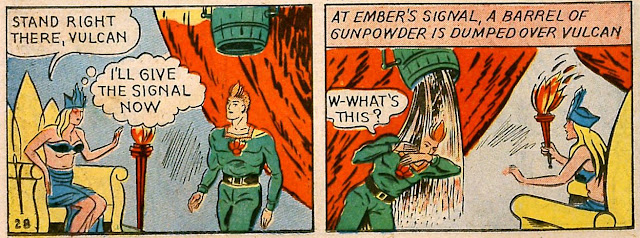
    This is a bit of a weird one. Vulcan, the Volcanic Man, has just saved both a field of gasoline tanks and a government arson inspector named Grace Horner from being incinerated by “notorious arsonist-spy” Torchy Fargo, who then retires to a nearby castle* to report his failure to Ember, the Empress of Fire. Just what is the deal with these two, you ask? We shall explore that momentarily.

    *Vulcan is plausibly based out of New York City, so this is another location in the Castle District of the Northeastern United States.

    Ember decides to deal with both Vulcan and Horner by the simple expedient of inviting them to her castle. It’s a simple trick, but an effective one.

    Ember first tries to kill Vulcan by dumping a bunch of gunpowder on him and then setting him on fire and then, once he proves to be as fireproof as his name might imply, she decides to recruit him to the cause. Why together they could dump gunpowder on entire nations and set them alight!

    Sadly for Ember, Vulcan does not want to become her Emperor of Fire and so declines her offer. Stung, she dumps him and Grace into a standard-issue super-villain’s death pit to rot or possibly be subjected to further deathtraps. And this is where things take a turn – everything up until now has been within the normal bounds of what on might expect in a super-hero comic: a spy who specializes in arson reports to some sort of fire-themed… cult leader? living in a castle staffed by ersatz Pacific Islanders. Regular stuff, like I said.

    But then, Torchy Fargo tosses Ember down into the hole as well, because he is the real head of the (fake?) fire cult and he heard her say that she would replace him with Vulcan. Ember was just a figurehead who let the power go to her head, as she says.

    But… what the hell was this arrangement? Ember isn’t going on television to claim responsibility for Torchy’s crimes or acting as a go-between with people looking to contract his services. Heck, the government already knew about Torchy because that’s why Grace Horner was on his tail! So just why was Torchy going back to a castle filled with (fake?) fire cultists and reporting to a fake superior in a bikini top every night?

    I’m going to deploy this carefully, because there are certain comic book theories and observations that are usually only trotted out by the intellectually tedious, but I think that this might have been a sex thing. We don’t need to explore it further, it’s just the conclusion that most fits the evidence at hand.

    But speaking of sex things, as in gender, a thing happens at the end of this comic that I have noticed a fair few times in the first three issues of Super-Mystery Comics, as having brought Torchy Fargo to justice via a massive gas explosion, Vulcan just lets Ember go so that she can “devote the rest of [her] life to serving humanity.” Did Ace Magazines hold the official position that women can not truly be evil? The evidence is mounting that they might have!

  • MINOR SUPER-HERO ROUND-UP 045

    Ah the super-hero.

    Ace Buckley: 

    Ace Buckley is a time traveller, a subgenre of comic book hero mostly notable for the fact that they have no one to blame for their troubles but themselves. Like most of his peers, Buckley (along with his intriguingly-named companion Toni Stark, whose role in the stories is to get captured and then swan around in minimal clothing while waiting for Buckley to rescue her) flings himself willy-nilly into the hotspots of human history and then murders his way free with barely a though to such things as “causality” or “the grandfather paradox” or “the integrity of the timestream”. (Startling Comics 003, 1940)

    Magic Morro: 

    Some time around 1922, young Jack Morrow and his father are shipwrecked on an uncharted Atlantic island. Proclaimed to be the next prophesied leader of local inhabitants the Utangos, Jack is raised to be a superhuman white jungle guy in the classic Tarzan style, only with all kinds of magical knowledge imparted to him by the former ruler, Tanta Talu. As Magic Morro, he is super strong, immune to fire, possibly bulletproof, can turn himself invisible and move objects with his mind, and those are just the abilities that he demonstrated in his first year worth of adventures!

    (Bonus Parenthetical: despite having a fully magical ruler who can do prophecy and summon lightning and stuff, the Utangos also have a standard issue treacherous witch doctor, who is named Mango! What’s with all the evil Mangos?) (Super Comics 021, 1940)

    Vulcan: 

    Vulcan, the Volcanic Man is the descendant of the Roman god of the same name and shares with him a broad dominion over fire, if not an inclination toward metalworking. He generates heat, can pick up and manipulate flame, is immune to heat and flame and also the forces involved in being blasted out of a volcano in the South Pacific and landing in the United States, is bulletproof in the sense that bullets melt before they can injure him, etc. He also has a radical fire-themed haircut.

    Like a lot of fire-based super-heroes, Vulcan ends up fighting a lot of hapless arsonists who waste all of their best fire-based deathtraps of a guy who can’t shut up about how he used to live in a volcano. (Super Mystery Comics v1 001)

    UPDATE 1 

    Magno:

    Control over magnetism is one of the classic comic book powers and Magno here (not our first Magno and certainly not our last) has the bargain basement version of it: he can pull things toward himself or pull himself toward things, a version of flight that requires enough admin work on the part of the artist that it is eventually rounded up to his just being able to fly outright. He also eventually gets a magnetic anti-bullet force field for a similar reason, I reckon: it’s no fun having to do the admin of Magno disarming every crook in every room he enters individually.

    Also unfortunately falling by the wayside over time is Magno’s power to project his face onto solid objects to vex and annoy crooks and cops alike. Was this meant to be an aspect of his magnetic abilities somehow or just a cool thing he could do? It is never specified.

    Finally, I must note that the somewhat abstract design on Magno’s chest is a representation of a bar magnet, in one of its few victories over the horseshoe magnet on the battlefields of graphic design. (Super-Mystery Comics v1 001, 1940)

  • MINOR SUPER-HERO ROUND-UP 045

    Ah the super-hero.

    Ace Buckley: 

    Ace Buckley is a time traveller, a subgenre of comic book hero mostly notable for the fact that they have no one to blame for their troubles but themselves. Like most of his peers, Buckley (along with his intriguingly-named companion Toni Stark, whose role in the stories is to get captured and then swan around in minimal clothing while waiting for Buckley to rescue her) flings himself willy-nilly into the hotspots of human history and then murders his way free with barely a though to such things as “causality” or “the grandfather paradox” or “the integrity of the timestream”. (Startling Comics 003, 1940)

    Magic Morro: 

    Some time around 1922, young Jack Morrow and his father are shipwrecked on an uncharted Atlantic island. Proclaimed to be the next prophesied leader of local inhabitants the Utangos, Jack is raised to be a superhuman white jungle guy in the classic Tarzan style, only with all kinds of magical knowledge imparted to him by the former ruler, Tanta Talu. As Magic Morro, he is super strong, immune to fire, possibly bulletproof, can turn himself invisible and move objects with his mind, and those are just the abilities that he demonstrated in his first year worth of adventures!

    (Bonus Parenthetical: despite having a fully magical ruler who can do prophecy and summon lightning and stuff, the Utangos also have a standard issue treacherous witch doctor, who is named Mango! What’s with all the evil Mangos?) (Super Comics 021, 1940)

    Vulcan: 

    Vulcan, the Volcanic Man is the descendant of the Roman god of the same name and shares with him a broad dominion over fire, if not an inclination toward metalworking. He generates heat, can pick up and manipulate flame, is immune to heat and flame and also the forces involved in being blasted out of a volcano in the South Pacific and landing in the United States, is bulletproof in the sense that bullets melt before they can injure him, etc. He also has a radical fire-themed haircut.

    Like a lot of fire-based super-heroes, Vulcan ends up fighting a lot of hapless arsonists who waste all of their best fire-based deathtraps of a guy who can’t shut up about how he used to live in a volcano. (Super Mystery Comics v1 001)

    UPDATE 1 

    Magno:

    Control over magnetism is one of the classic comic book powers and Magno here (not our first Magno and certainly not our last) has the bargain basement version of it: he can pull things toward himself or pull himself toward things, a version of flight that requires enough admin work on the part of the artist that it is eventually rounded up to his just being able to fly outright. He also eventually gets a magnetic anti-bullet force field for a similar reason, I reckon: it’s no fun having to do the admin of Magno disarming every crook in every room he enters individually.

    Also unfortunately falling by the wayside over time is Magno’s power to project his face onto solid objects to vex and annoy crooks and cops alike. Was this meant to be an aspect of his magnetic abilities somehow or just a cool thing he could do? It is never specified.

    Finally, I must note that the somewhat abstract design on Magno’s chest is a representation of a bar magnet, in one of its few victories over the horseshoe magnet on the battlefields of graphic design. (Super-Mystery Comics v1 001, 1940)

  • MINOR SUPER-VILLAIN 690: VULCAN

    (Pep Comics 006, 1940)

    A man working in a London steam plant dies by falling into an industrial furnace. A horrible thing to happen! Why am I showing you this horrible thing?

    I am showing it to you because it is not in fact a horrible accident but a horrible murder, and we know that because the murderer left a horrible little bit of doggerel in order to crow about what he did, and he signed it “Vulcan.”

    Our old pal Inspector Bentley of Scotland Yard is brought in on this case, and it’s a lucky day for him because there are only four possible suspects: the four men who were in the immediate area when John Baker was killed, including his father, his brothers Rex and Bob and his romantic rival Barney Reyman. Like I said: lucky for Inspector Bentley because I’m beginning to suspect that he isn’t a particularly astute detective when he doesn’t have a guy in a rubber mask to hit with his cane.

    Am I saying this because Bentley’s only idea is to have everyone go back to where they were when the murder took place with the foreman standing in for his son and Pa Baker is basically instantly murdered too? Kind of, but it’s more of an observation that his investigations are a bit brute force. For instance, once this second member of the Baker clan is bumped off, Bentley arranges for another one to stand in front of the open furnace.

    Did Bentley know what he was doing? Was he calling Bob Baker’s bluff in order to force him to confess by dodging the deathtrap he had set up for his family members (a button-activated swinging pipe, fyi)? It’s possible, but I personally think that the “Vulcan = hatred for father and brothers” clue is some bullshit. Does Vulcan have more than his share of family drama? Absolutely, but no more than any other Greco-Roman god and frankly I would peg a guy named Vulcan as a potential matricide, if anything.

    So was he right or just trying to winnow down the suspect list a bit? Inspector Bentley will never tell.