The Curse of Skeleton Munroe

Category: bring ’em back

  • MINOR SUPER-HERO ROUND-UP 104

    Here are some very minor Marvel Comics super-heroes, or at least super-hero adjacent comic book adventurers.

    the Masked Raider:

    The Masked Raider is actually Jim Gardley, a small-time rancher in the town of Cactusville (which has apparently been officially placed in California? the hell?) is run off his land and framed as a rustler by crooked business interests. Adopting his masked persona and acquiring a souped-up horse named Lightning, he strikes back at his persecutors and goes on to spread justice throughout the West.

    Recently (well, seven years ago), Marvel Comics 1000 recontextualized the Masked Raider as being part of a chain of super-heroes who are empowered by an artifact known as the Eternity Mask, but that’s all future stuff. As far as we are concerned, for the next 80-odd years worth of comics the Masked Raider is just a two-fisted cowboy. (Marvel Comics 001, 1939)

    Ka-Zar:

    Ka-Zar is in actuality David Rand, who was gradually orphaned after his family was stranded in the jungle when he was a toddler. First his mother dies of a fever, which, along with a bit of head trauma, causes his father to have a mental break and decide to settle down in the jungle rather than try to get back home. Some years later, the vile emerald hunter de Kraft invades this jungle life and kills David’s father, leaving David to be brought up the rest of the way by the lion Zar and his mate. Ka-Zar = “Brother of Zar,” which is a better origin than most jungle man nonsense names get. Ka-Zar’s origin ends when he slays de Kraft, who has returned to get more delicious emeralds.

    This particular Ka-Zar is of course doomed to obscurity thanks to the existence of the other Ka-Zar, who somehow continues to appear to this day. Marvel has no need of any more jungle heroes, let alone a surplus Ka-Zar. (Marvel Comics 001, 1939)

    Ferret:

    Though private detective characters are a dime a dozen in Golden Age comics, Ferret here is distinguished in a few ways: firstly by the fact of his cool name, secondly by dint of having a bit of the weaselly appearance of his namesake rather than being your typical comic book squarejaw, and finally because he is a bit of a go-to in more modern comic flashbacks when they want to add a bit of non-costumed 40s flair. (Marvel Mystery Comics v1 004, 1940)

    Most importantly, as of Marvel Mystery Comics v1 005, Ferret has a real ferret named Nosey for a pet.

    Terry Vance:

    Terry Vance, aka the Schoolboy Sleuth, aka the Boy of a Hundred Hobbies is a science-minded youth, of the subtype that deals in actual science and not comic book super tech. Mostly, at least – he does occasionally stretch the bounds of what a remote controlled plane can do.

    Vance splits his time between school, the Bike Club, his famed Hundred Hobbies and solving grisly murders that have the police flummoxed, and he does it all with the aid of a monkey named Dr Watson and a reporter pal named Deadline Dawson. 

    If any of these characters is a ripe candidate for revival, it’s Terry*, as a venerable old detective, an embittered old tech billionaire, a benevolent old tech billionaire… the possibilities are finite but vast! Heck, have him still be a teen, having gotten too close to the super-villainous side of crime and been blasted through time and/or space. (Marvel Mystery Comics v1 010, 1940)

    *Ferret was killed off by Ed Brubaker, alas. 
  • MINOR SUPER-HERO ROUND-UP 085

    MINOR SUPER-HERO ROUND-UP 085

    Welcome to “The Four Characters Least Likely to Return in a Modern Comic” Theatre.

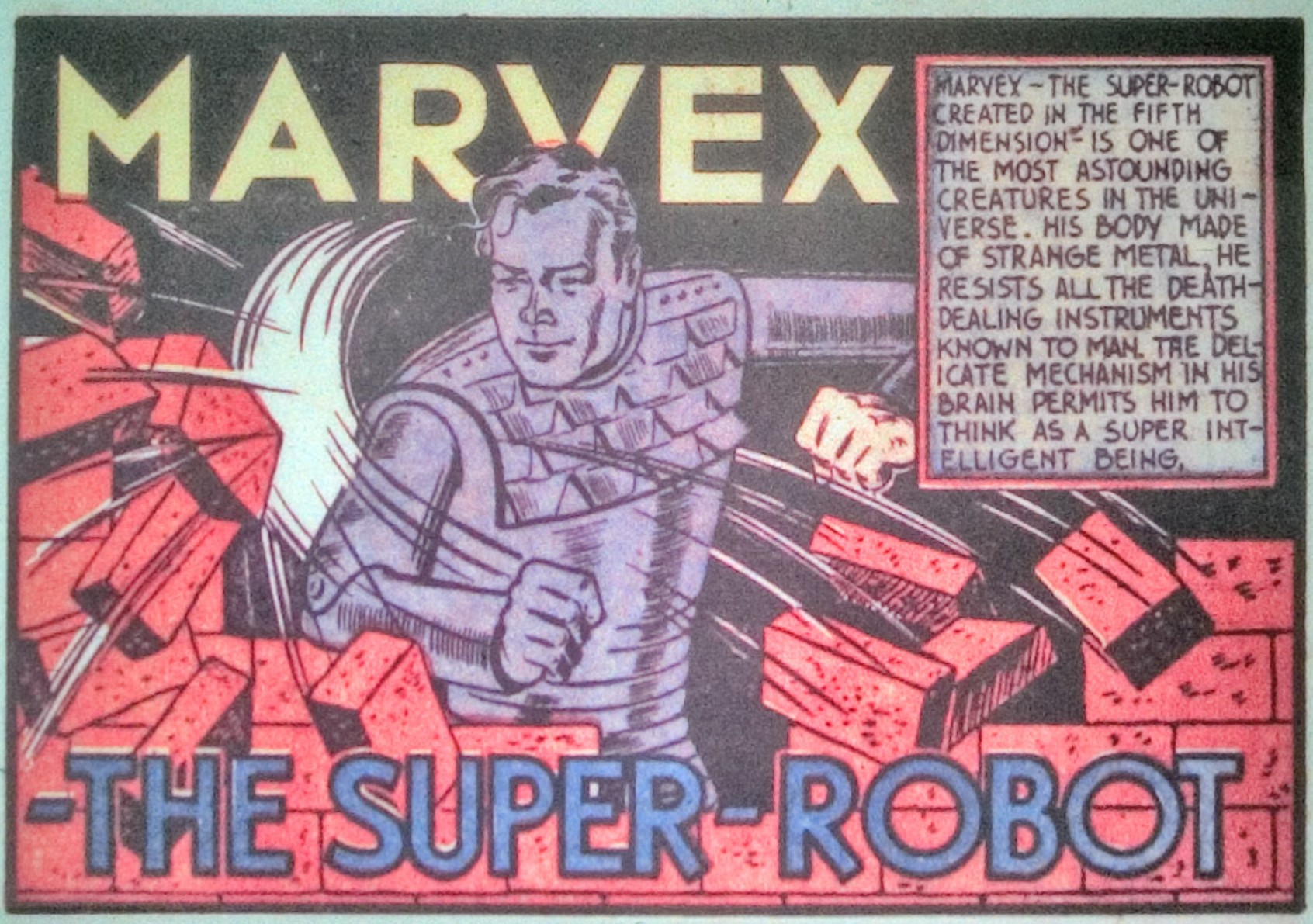
    Marvex the Super-Robot: 

    Marvex the Super-Robot! Created to be a slave by a Fifth Dimensional jerk named Bolo, Marvex rejects his fate, kills Bolo and his associates and accidentally blasts himself to Earth while smashing up Bolo’s lab equipment.

    If you’re already aware of who Marvex is then it’s likely because of the Michael Kupperman strip featuring the character during Marvel’s 70th Anniversary run of comics, and indeed, Marvex’ propensities for cartoonish violence, shutting down romance with sudden nudity and receiving twenty dollars all make him a perfect Kupperman character.

    Sadly, the nudity and twenty dollar reward system go the way of Marvex’ hair in his second and third appearances, but he never stops yelling about being a robot whenever his companion Clara gets a bit too comfortable around him. (Daring Mystery Comics 003, 1940)

    Categorized in: Language (Superlatives – Super), Origins (Extradimensional, Robot), Supranormal Beings (Robots)

    the Falcon:

    The Falcon is Carl Burgess, assistant district attorney in an unnamed city who is kind of betraying the spirit of his office by meting out vigilante justice when he feels like the legal system isn’t working. Though he is a pretty average costumed vigilante, the Falcon has precisely four interesting things to note. The first is that his name is weirdly close to that of Carl Burgos, the creator of the Human Torch. This might be a coincidence, but still. The second is of course that he is the original Marvel Falcon but by far the least-known of the half dozen or so Marvel characters to share that name.

    Like the Eagle, the Falcon is a bit of a fashion plate or at least someone who adjusts his costume on every adventure and for the same reason: a different artist on every one of his appearances.

    Finally, the Falcon has been retroactively assigned an accessory based on an assumption, just like his fellow Daring Mystery Comics alum the Fiery Mask and his morning star. In this case, it’s that his suit gives him the ability to glide. I assume that this is because of a stylistic choice on the part of his various illustrators to have him dive down on his enemies like a falcon stooping on prey, because the suit does not come up in his handful of Golden Age appearances. (Daring Mystery Comics 005, 1940)

    Categorized in: Animals (Falcons), Day Jobs (Assistant District Attorneys)

    Marvel Boy:

    Up until about 2012 I’d have confidently said that “Marvel Boy” was one of the most commonly-shared super-hero identities in the Marvel Universe, but it seems that the concept of the legacy identity has gone through a weird mutation in the last decade or so and I am now regularly surprised to find that there are way more Wolverines or Captains America than I had previously imagined. With that in mind, we’ll revise my statement to be that there are more Marvel Boys than you might expect, like Starmans over at DC.

    This particular Marvel Boy is the Earthly reincarnation of Hercules, come down from Valhalla (?!) to aid a world threatened by fascism. His human form is named Martin Burns and like a veritable Silver Age Superboy he is born with so much physical strength that he must constantly hold himself back lest he endanger those around him and out himself as something strange and different.

    On Martin’s fourteenth birthday a mysterious stranger (who is implicitly the Roman god Jupiter) delivers a package containing his heroic costume to him and then somewhat redundantly also appears in his bedroom to really spell out his whole deal and charge him to uphold democracy etc.

    Marvel Boy is super strong, very agile and fast enough to run from New York City to Washington DC and back – carrying three grown men on the first leg of the trip – in the course of a night that also includes the aforementioned visit from Jupiter and busting up two fifth column cells.

    Both this Marvel Boy and his successor (coming up in 1942) never returned after making a single appearance, and while I can’t say just why they didn’t have further Golden Age adventures, the lack of a modern appearance for either of them is almost certainly down to the fact that their origins both revolve around a dead Hercules, who is in fact more often than not a very living second- or third-tier hero in the Marvel Universe. They’re also both named Martin Burns for some reason, which means that later handbook writers have felt compelled to differentiate them by giving them middle names based on their creators, making this one Martin Simon Burns.

    Frankly, I think that the fact that the two Marvel Boys have origins that are incompatible with both Marvel Comics continuity and also one another is terrific fodder for comic book storytelling. Both of them should be BRUNG BACK immediately, preferably in a comic that also has Hercules in it. (Daring Mystery Comics 006, 1940)

    Categorized in: Generica (Boys), Language (Superlatives – Marvels), Origin (Reincarnated God) 

    the Flying Flame:

    The Flying Flame is a red fighter plane flown for the RAF by the two-fisted American pilot Captain Red Ruff, who is also known as the Flying Flame due to his shock of red hair. During his brief comic book career, Ruff battled the Black Ace and ferreted out some spies at an airbase. (Daring Mystery Comics 006, 1940)

    Categorized in: Activities (Flying), Elements (Fire), Team Membership (RAF)

  • MINOR SUPER-VILLAIN 897: MR SKELETON

    (America’s Greatest Comics 001, 1941)

    Mr Skeleton is one of the handful of minor super-villains who are
    foundational to this blog, the true weirdos who my mind turns to
    whenever the subject of obscure comic book characters comes up, and so
    it’s a real relief  to have him finally hsow his face here. This will
    keep happening at least until we reach 1978 and train-themed
    super-villain Casey Jones appears here.

    There are three really important aspects to Mr Skeleton that keep him in my thoughts:

    1. Appearance 

    He’s a chalk-white, twelve to eighteen foot tall man with an emaciated frame, huge hands and feet and a real pumpkin head with the face of a cartoon villain. It’s an extraordinary look, made even more so by his choice to dress in green trunks, a yellow halter top and a green cape. And he has eccentric facial hair!

    It’s a look that works well as both an over-the top campy cartoon villain and as a source of horror – just imagine that face looming out of the shadows at someone. 

    2. Plans and Methods 

    Mr Skeleton’s goal, as far as it is articulated, is to conquer the United States, but he doesn’t really get into the how and why of this because he is busy with step one: recruitment. 

    Specifically, Mr Skeleton needs generals to lead an army against the US, and he has what he seems to think is a surefire method of recruiting them: he kidnaps them and threatens to skeletonize them. This is a tactic that would probably work on me.

    Oddly, Mr Skeleton’s first step in his attempted conquest is to assassinate FDR, a task which he assigns to his most shifty aide. Who fails, by the way, and is skeletonized for his trouble. But why attempt to massively destabilize the US government when you’re still trying to recruit generals for your army of conquest? Honestly, MR Skeleton could probably benefit from a few kidnapped executive assistants. 

    3. DEATH 

    After being foiled by Minute-Man a couple of times, Mr Skeleton decides to get his recruitment program back on track in the most direct manner possible, by marching into the nearest Army camp and grabbing a fresh batch of generals. While he is doing so and simultaneously beating up the entire US Army, he is confronted by Minute-Man once again and ends up being smacked so hard that he turns into a kind of bone explosion. I guess he really was mostly just skeleton, however that works.

    Obviously I believe with all my heart that they should bring back Mr Skeleton – his mixture of goofy and horrifying is always welcome in comics, battling Batman or Wild Dog or somone. You don’t even have to stretch too far to have him come back since he was already some sort of skeleton-man: just put him back together. 

  • MINOR SUPER-VILLAIN 872: TEXA

    (Zip Comics 003, 1940)

    The Scarlet Avenger looks out his window one sunny day and sees “DEATH TO THE SCARLET AVENGER” in skywriting. This, it turns out is a very effective ploy, as when he flies up to check it out he is swarmed and captured by some very off-model pterodactyls.

    The beasts take him to a dirigible, where he is is introduced to Texa, an eight foot tall woman and self-proclaimed “Queen of Crime,” who is looking to rob Fort Knox and wisely set out to eliminate the Scarlet Avenger ahead of time rather than wait and do it on the day.

    The Scarlet Avenger is of course loaded down with little gadgets, and he manages to escape from Texa’s deathtrap by employing, in turn, his personal electric field, smokescreen and capsule parachute, proving once again that super-villains should have better procedures in place for searching captives.

    Please note the companionable arm that Texa has around one of her minions (called variously the Tribe of the Hood and the Hooded Tribe, FYI) in that second-last panel. I like that! It suggests a better-than-average minion work experience.

    Believing that the Scarlet Avenger is dead, Texa proceeds with her admittedly very cool plan to use a big magnet to pick up the entire Fort Knox vault and fly away with it, upon which the very much alive Avenger and his legion of operatives fly up and release the magnet using anti-magnetic rays. Fort Knox is saved, albeit probably very banged up.

    The Scarlet Avenger is shot down by a very cool bubble weapon, leading to a cliffhanger as he is pinned by dirigible fire in the Kentucky desert*. Will he make it out of this overwhelming display of firepower?

    *just why is there a desert landscape in Kentucky? It’s equally likely that:

    a. That wasn’t literally supposed to be Fort Knox but a fictional US Gold Reserve in a more Western state

    b. The air battle ranged a bit farther than depicted on-panel

    c. the artist just kind of drew what they wanted and hang the geography 

    The answer is of course yes, and for the simple reason that as the story in Zip Comics 004 begins, Texa abruptly decides to capture the Scarlet Avenger rather than kill him. Out come the “pterodactyls” once more! Plus the Tribe of the Hood decide to put on shirts.

    Texa employs the mind-bending properties of the Chamber of Disks to render the Scarlet Avenger susceptible to hypnotic mind control so that she can use him and his network in her next plot: to kidnap FDR! 

    Spoiler: the Scarlet Avenger is not really hypnotized and rather than aiding Texa he is working against her.

    A faceless FDR is saved from the now-fully-clothed and jetpack-equipped Tribe of the Hood by the last-minute intervention of the Scarlet Avenger, which is good, but I can’t help but think that he could have mitigated the danger to the president somewhat by turning on Texa before she had him encased in an electric force field.

    Our second cliffhanger! Texas men have the Scarlet Avenger’s operatives under heavy fire, as their boss rides a jetpack man up to the dirigible to help them! Will they make it out of this one alive? 

    Indeed they will! The Scarlet Avenger arrives just in time to prevent Texa from killing his top aide Operative 12, upon which the villain dumps the entire Scarlet Avenger organization out a trap door. Everyone floats down using their personal parachute capsules and presumably feels grateful that the Scarlet Avenger isn’t the kind of boss who keeps all the gadgets for himself.

    Texa’s final ploy involves raising a criminal army by doing a mass jailbreak of Alcatraz, which always seems to me like a way to acquire a pretty motley crew of henchmen with a really wide range of skills and attitudes toward employment as faceless cogs, but who am I to critique a plan like this? I’ve never even broken one guy out of jail to be my minion.

    It’s no surprise that the Scarlet Avengers operatives show up to stop this operation, and since Texa is once again employing her super magnet, they are all kitted out in cool non-ferrous outfits and wielding… copper machine guns I guess. It’s very good look for them!

    Texa’s dirigible ends up on the wrong end of one too many ray gun blasts from the Scarlet Avenger’s rocket plane and goes down in flames, taking the entire Tribe of the Hood with it, but Texa herself escapes in perhaps the coolest possible manner: in a transparent cube carried by pterodactyls. It’s a heck of a way to make an exit and one that stands, as she never appears again. Somewhere an eight foot tall gandma is reminiscing about the glory days, I guess (obviously I reckon that Texa should be BROUGHT BACK in a more modern Archie super-hero comic. People would go nuts for this big tall crime lady!).

  • ALIENS AND SO FORTH ROUND-UP 019

    ALIENS AND SO FORTH ROUND-UP 019

    Today we have, per usual, something from the comic I’m currently reading followed by some stuff from the archives. It’s a good system!

    Glompers: 

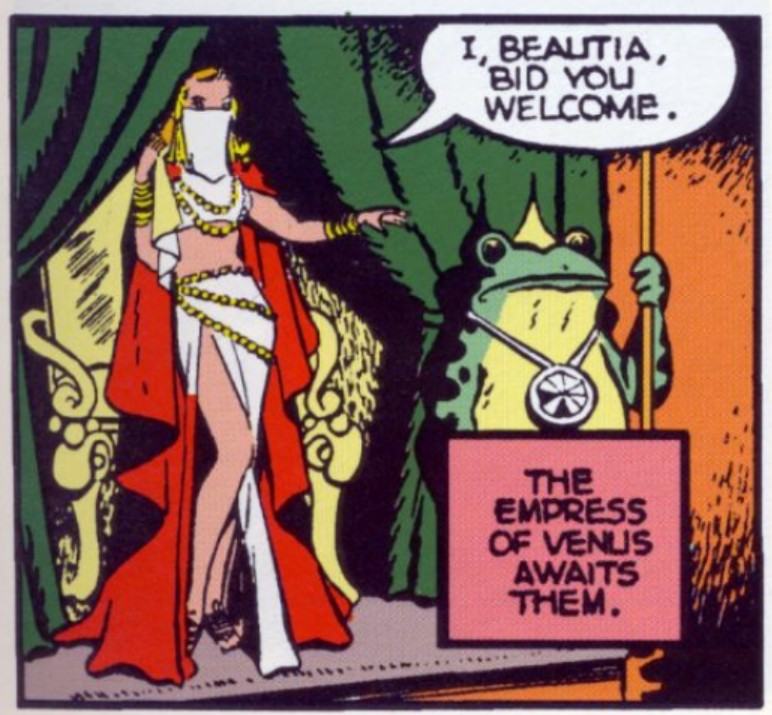
    We first meet the Glompers on the planet Venus after Dr Sivana has tricked Billy Batson and by extension Captain Marvel into joining him on an experimental rocket trip, with the intention of killing and/or stranding him there. They are immediately the most charming aliens I have ever seen, despite or perhaps because of the fact that they are just large frogs wearing trunks and little conical hats.

    The Glompers are ruled over by Beautia, Empress of Venus (later revealed to be Sivana’s daughter), and again I must emphasize just how friggin’ charming they are. Just look at his little spear! (Whiz Comics 003b, 1940)

    Sadly, as far as I can tell the Glompers only reappear one other time, as part of a plan by Dr Sivana to unleash them on Earth (Whiz Comics 015, 1941). The reformed-except-for-occasional-bursts-of-filial-duty Beautia expounds on the Glompers somewhat, revealing that they, like terrestrial frogs, are rapacious carnivores. Still charming! 

    In conclusion, since as far as I know the current DC Universe does not have a canonical native species on Venus and I have to say that I think that the Glompers should fill that roll. Make ’em big ol’ acid-spewing frog men!

    Alligator Men/Mermaids: 

    Rod Rian is an officer of Earth’s Sky Police in the year 2500 CE who finds himself on the planet Mephistos, having adventures among the various intelligent species that reside there. Perhaps the least explored of these are the friendly Alligator Men, who either coexist with a species of Mephistan mermaids or are yet another species with extreme sexual dimorphism. Either way: love a reptile man. (Flash Comics v1 011, 1940)

    Amazons of the Winged Death: 

    Don Drake, like Rod Rian, is an Earth man who finds himself on an alien world populated with all kinds of different species of intelligent life, in his case the planet Saro. Unlike Rod, Don’s adventures take place in the then-present day of 1935.

    The Amazons of the Winged Death are, as the name suggests, statuesque humanoid females. They ride horrible insects (the Winged Death of the name, natch) and are generally hostile, though Don does manage to ally with at least a few of them. (New Fun Comics 004, 1935)

    the Ape Men: 

    Brad Hardy, like Rod and Don, is an adventurer who finds himself in a world full of strange and often hostile creatures. Like Don, he is contemporary to the comic that he appears in, but unlike both of them, the world he finds himself in exists on Earth, in a cavernous realm below Mongolia. 

    The Ape Men (also Ape-Men and Apemen) are pretty typical: monkey faced humanoids with tails and a bad attitude. I do enjoy their Living Ape-God, who seems to just be the largest Ape Man. (More Fun Comics 009, 1936)

  • MINOR SUPER-HERO ROUND-UP 061

    Superfolk galore! 

    the Buzzard: 

    In an unnamed New-York-alike city, the gadgeteering mayor equips a young man with a suite of devices to help him engage in a vigilante crusade against crime. Chief among these gadgets is a gas that makes whomever it touches resemble a balding, big-nosed man in thick glasses and a tailcoat – the perfect disguise! Armed with this gas, plus some clawed gloves and a heat ray, the Buzzard begins tearing his way through the city’s underworld. 

    The gas also seems to allow the Buzzard to make his shadow resemble his namesake bird, an ability that is very useful for vexing the city’s Buzzard-hating police chief who, it turns out, is also the father of the Buzzard’s secret identity. 

    I unironically love the Buzzard and his whole weird setup, and while I find most modern revivals of public domain Golden Age characters to be a pretty mixed bag, I’m pretty bummed that none of them have elevated him out of his single issue obscurity – he’s got a real weirdo charm that the fiftieth version of the Nedor characters can’t approach. (Wham Comics 002, 1940) 

    the Cyclone: 

    The Cyclone is really Peter Grant, a young man who has a fairly unique version of the Batman origin, which of course is when a tragedy inspires an obsessive dedication to training and working toward some related goal, i.e., in Batman’s case the murder of his parents inspiring his eternal war against crime. The real twist in the Cyclone’s case seems to be the total absence of a motivation: Grant just woke up one day and decided to turn his body into a living weapon to aim at evil.

    The Cyclone is presented as being a regular human and so I had been assuming that the whirlwind patterns around his lower body when he jumps around were a stylistic choice meant to represent his fantastic leaping ability. They really are some enormous jumps, however, so it’s also possible that the Cyclone is meant to have some sort of wind-assisted jumping power. He only had three adventures, alas, so we shall never know. (Whirlwind Comics 001, 1940)

    Ibis the Invincible: 

    Ibis the Invincible, aka Prince Amentep, is a 12th Dynasty Egyptian who just kind of spontaneously comes back to life after 4000 years as a mummy. Why? Well, it’s not spelled out until the 1942 Ibis the Invincible series, but spoilers: his true love had been shot with an arrow that put her to sleep for those four millennia and he put himself in a magical sleep of his own in order to be with her again. 

    Ibis achieves this state of mystic sleep with the aid of the Ibistick, a magical wand capable of very nearly anything. Much like his fellow Golden Age magical super-heroes, Ibis’ near-omnipotence can occasionally seem plot-obliteratingly powerful. 

    The key difference between Ibis and his contemporaries, however, is that the Ibistick is a small object that is constantly being lost or stolen. Further, it requires absolutely no special knowledge to be used and can be operated by both children and animals with ease. More than a few of Ibis’ greatest foes (e.g., the Hobo-Millionaire) are simply regular humans armed with his own magic wand. The caveat to all this is the fact that the Ibistick will never harm its true owner, and will in fact inflict any baleful magic cast from it at him back on its wielder. This means that Ibis is able to defeat an evil wielder of the Ibistick by merely being annoying enough that they try to turn him into a toad or gold or ice or on on memorable occasion to mind control Taia into stabbing him to death and then wait for it to backfire on them. (Whiz Comics 002, 1940)

    UPDATE 1941 

    Taia: 

    Taia is the 4000-year-sleeping love for whom Ibis the Invincible made his way to the future. After a bit of moping around the globe he manages to track down her mummy and revive her, upon which they kind of implicitly are a married couple. While I very much enjoy Taia and the dynamic she has with Ibis, she does get a pretty raw deal – being your own husband’s de facto sidekick is bad enough, but Taia very rarely gets to be anything more than a kidnap victim/bargaining chip. The few modern versions of Ibis the Invincible try to do more with her, but they still don’t do much.

    Taia is said to be cousin to “Senwosri III” who is probably meant to be Pharaoh Senusret III, given that Taia and Ibis are said to be from the 12th Dynasty. So that’s something. (Whiz Comics 002, 1940)


  • MINOR SUPER-VILLAIN 858: THE FROST

    (Wham Comics 002, 1940)

    Just after Blue Fire gets his powers and vows to use them to beat up “criminals, racketeers and foreign spies” he is served a chance to do so on a silver platter when his local newspaper carries an account of a ship at sea being sabotaged by a very cold man who just stood around in the engine room until everything broke. 

    Making his way to the ship in question, Blue Fire uses his intangibility power to invade the passengers’ privacy by searching every stateroom until he finds some orders written in “a foreign language” that prove the saboteur’s identity, just in time for the man himself to make an appearance. One hastily-gulped-down pill later, the man is revealed to be the Frost, which is a very good name for a cold guy. More importantly, the Frost might just be the best look for a cold-based character that I have ever seen – the heavy shading combined with the thick coat of clear ice is dynamite.

    Since Blue Fire is not actually a fire guy but an intangibility guy, he and the Frost are purely thematic and not elemental opposites, and it in fact turns out that thanks to the always-on nature of Blue Fire’s powers they are hilariously unable to do any harm to one another (though thanks to the Frost’s motor mouth we do learn his precise weight, a bit of a rare occurrence in the days before the likes of the Official Handbook of the Marvel Universe). 

    Blue Fire ends up retreating after the fight drags on long enough that he is at risk of becoming tangible again, and the Frost is able to make a getaway while his foe is rounding up the ship’s crew to deal with him. And since Blue Fire never makes another appearance, the Frost is yet another super-crook left at large by default. Damn you, whims of the early comics industry!

    (someone should absolutely steal the Frost’s look for another cold cguy. It’s dynamite, I tell you!

  • MINOR SUPER-HERO ROUND-UP 043

    A grab bag of old characters I skipped over back in the early days when I thought that this blog wasn’t going to be completely self-indulgent. 

    Mr Clue: 

    He only had one adventure in which he solves the murder of a mayor by a police chief, but Mr Clue is too great a name not to take note of. (Master Comics 001, 1940)

    the Red Gaucho: 

    A swashbuckling hero in the Zorro mode, the Red Gaucho protects the South American nation of Santa Palos from threats both foreign and domestic before eventually just kind of wandering North to have adventures in a sort of generic Central America. He’s a fun character! He has one of the biggest hats in comics!

    The Red Gaucho is also a character I think about whenever the topic of white supremacy comes up. White supremacy is one of those topics that gets a lot of people very angry, but at its base it’s simply the belief that the world consists of white people and everyone else and more specifically that it’s white people versus everyone else in a competition to keep white people on top, where they belong. And the further back you go, the less people felt the need to hide the fact that that was their worldview, and possibly the place that that attitude is most on display is in early Golden Age comics – just read any set outside North America and you’ll catch on to it pretty quickly.

    Anyway, that is all to say that even though it’s more subtle than a lot of other examples of this worldview in comics, ever since I noticed that every single appearance of the Red Gaucho includes a disclaimer assuring readers that he was in fact the child of two Americans and not some horrible South American – heavens forfend! – his smiling face pops into my head whenever the subject comes up.(Nickel Comics 004, 1940)

    the Hawk:

    On a less heavy note, here’s the Hawk! Created by George Brenner, who also created the Clock, the Hawk has the distinction of being the first masked crimefighter to appear in a comic that would eventually be amalgamated into the DC Comics fold (the Clock had only appeared in Centaur comics up until this point and wouldn’t make his way into a Quality book for a few months yet). A heady and heavily qualified distinction!

    The Hawk is secretly T. James Harrington II, wealthy and useless playboy who hangs around looking bored until some crime happens and it’s time for the Hawk to hit the streets. It’s a bit Bruce Wayne/Batman only without the parental murder.

    Unlike Batman, the Hawk leans pretty minimal on the costume front, with his major identifying feature being a set of slip-on claws. 

    The Hawk also has a couple of assistants named Link and Rollo who are touted as the only people who know the Hawk’s identity but who don’t get much time to show their stuff in this, their one-panel appearance. Astute readers might note that the crook that the Hawk has just captured likely also knows his secret identity at this point but please note that Link and Rollo are identified as the only living people to know the secret. Sinister stuff!

    DC has already gone with the Crimson Avenger as the Official First Golden Age Super-Hero but I reckon that the Hawk would be a fun guy to be brung back for some future story involving early mystery men antics. (Feature Funnies 002, 1937)

    *Hero Update* Shock Gibson:

    It had to happen someday: Shock Gibson disguises himself as a cowboy and in the process abandons his iconic helmet forever. Fare the well, helmet. (Speed Comics 007, 1940)

  • MINOR SUPER-VILLAIN 766: COMRADE RATSKI

    (Speed Comics 009, 1940)

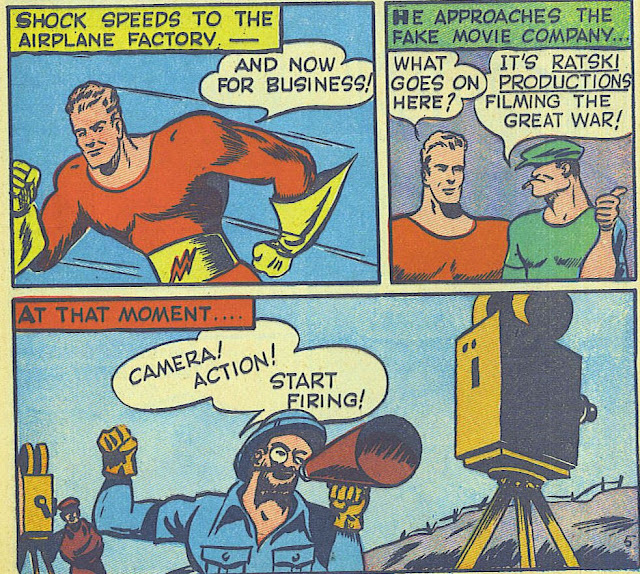
    Comrade Ratski’s first appearance is fairly undistinguished as far as comic book spymasters go. Sent to subvert US war preparations, Ratski targets an airplane factory operating out of Hollywood, California (for some damn reason) and sensibly decides to do so under the guise of a war movie shoot next door, though at the point that you have all of the equipment required for such an attack in place, why bother going through with the “we’re just filming a movie” deception? For the love of the game, of course.

    Ratski’s major distinguishing feature in this appearance is the fact that he is a pseudo-Soviet rather than the usual pseudo-Nazis who are the mainstay of the spy plot at this time. 

    Shock Gibson of course does not like all of this factory bombing, and Comrade Ratski, like Baron von Kampf before him, ends up stranded in the middle of the ocean. And he’s even more pessimistic about his chances at rescue!

    Ratski returns in Speed Comics 010 and immediately starts to collect top scientists from top universities: Dr Bronson from Yarvard, Prof Capchek from Rinceton, and… somebody from Hale. His goal? Force them to invent at gunpoint so that he can use their creations to destroy America

    Dr Bronson creates an earthquake machine which Ratski uses to attack democratic hub Western City. Ratski then makes the bizarre decision to send his men out to loot and plunder in the chaos, which is how Shock Gibson learns the location of Ratski’s base after using the tried-and-true method of capturing a henchman and threatening to kill them unless they talk.

    But even if Gibson hadn’t done so, Ratski just can’t stop signposting his location: after Prof Capchek develops an arthropod-enlarging serum Ratski just starts releasing giant beetles and flies from his front door in a way that I would call “highly visible.”

    Though Gibson does fight his way through various flies and spiders to make his way to Ratski’s mountain fastness, the Comrade’s ultimate undoing comes at the jaws of a freshly enlarged (and adorable!) cockroach with no sense of loyalty. He survives the encounter, but only with the help of a very ambitious mountain lion.

    Shock Gibson rescues Capchek and some guy we’ve never seen before, possibly the Hale man. Bronson is unaccounted for.

    Like Baron von Kampf before him, Comrade Ratski’s final appearance is in Speed Comics 011 when the two team up in a version of the Soviet/Nazi manouvres in Poland and Eastern Europe, though I don’t know quite enough about contemporary opinions on WWII to say if the fact that Ratski is clearly just exploiting von Kampf for cheap labour courtesy of his Zombie minions is further extrapolation of this relationship or just the writer favouring one villain over the other as the real heel.

    For an epic team-up between two men sworn to conquer and/or destroy the United States of America, the stakes on the Ratski/von Kampf plan are pretty minimal – essentially it’s just some run-of-the-mill piracy, only done by one-eyed green guys made of animal parts and flying a dirigible.

    More than anything this issue is an exercise in making the zombies look cool while also making Shock Gibson look cool: the Zombies are parachuting! The Zombies are firing a machine gun! Shock Gibson is posing on top of a whale! Shock Gibson is protecting the whale!

    Zombies in keen gas masks wielding cool gas guns! Zombies setting up a guillotine! Shock Gibson looking smug as hell while the guillotine blade smashes on his neck!

    After the guillotine fails to do its job, things go very wrong for Comrade Ratski and Baron von Kampf, culminating in the destruction of their base, the foiling of their plans and they themselves becoming a meal for at least nine alligators. Who presumably represent the Allied Forces.

  • MINOR SUPER-VILLAIN 650: RANGO OF SLAVONIA/ MINOR SUPER-HERO: THE MASTER MYSTIC

    (Green Giant Comics 001, 1940)

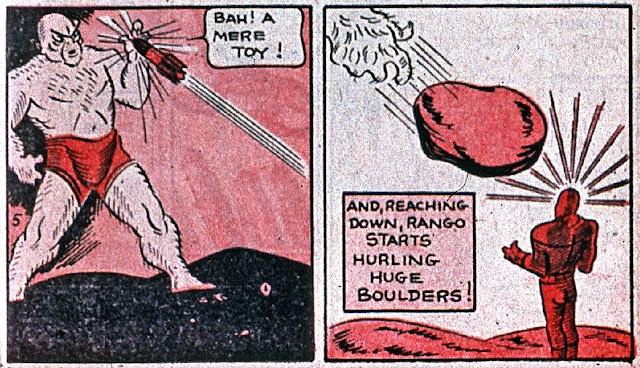
    We join Rango, a science villain of some description, after he has failed to conquer Europe. His next move: total destruction.

    After absolutely devastating a city in what is probably Slavonia, Rango heads for the United States by the simple expedient of swimming across the Atlantic.

    And now we encounter the main attraction, Master Mystic! What a character! Master Mystic is very much ahead of his time, both in his art style and degree of superhuman omnipotence.

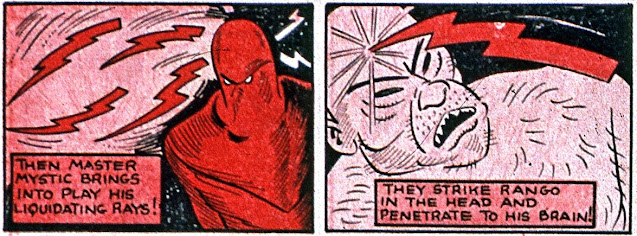
    Master Mystic’s entire battle with Rango feels like something out of a 60s underground comic, slightly unreal and rubbery and full of visual excess. Appropriately, Master Mystic was created by Victor E. Pazmino, whose other credits tended more toward the funny animal content that informed so much of the underground comix scene.

    (see also Pazmino’s other super-heroic creation, TNT Todd, for some fun costume compare-and-contrast)

    It really is a shame that Pazmino didn’t do more work along these lines, assuming that he wanted to. Stuff like this visualization of the Master Mystic’s telekinesis stands out as innovative by any era’s standards.

    Master Mystic eventually melts Rango into horrible goo and then returns to his Arctic stronghold to resume his protective watch over humanity North America, and if the super-powered one-upsmanship of their battle felt like something out of 60s counterculture comics then this detached, omnipotent man routine feels very 1980s post-Watchmen, or at least one step away from that. Should some entrepeneur BRING BACK the Master Mystic the next time metatextual super-hero analysis characters like Miracleman come into vogue? It’s worth a shot!