The Curse of Skeleton Munroe

Category: new power

  • MINOR SUPER-HERO ROUND-UP 080

    It’s a sidekick-heavy brew this time, chums.

    the Silver Streak **UPDATE**:

    It’s been a gradual thing but the Silver Streak has been getting closer and closer to not just going real fast and jumping far but actually flying. I don’t know if you can actually pinpoint the moment he made the transition but he is definitely on the “is flying” side of the equation by Silver Streak Comics 010, 1941. 

    Mercury:

    Although Whiz, King of Falcons is an exemplary sidekick to the Silver Streak, comic books are nothing if not prone to trends, and the trend for 1941 was for super-heroes to get kid sidekicks. And although there is only so much you can do to stand out among an army of gee-whillikering blonde boys, Mercury, aka the Boy Streak, aka Mickey O’Toole, does have a couple of aspects worth highlighting:

    The first of these things is his origin story. Mickey O’Toole is the appropriately hard-hitting son of the late boxer Slugger O’Toole, who was murdered mid-match because he wouldn’t take a dive. Mickey now shines shoes in order to provide for his widowed mother and disabled sister Mary. A sad tale indeed.

    The remarkable thing about Mickey’s sad backstory and struggling family the fact that it and they never come up again. Mickey starts hanging out with the Silver Streak and his family woes go right out the window. There’s even a hint at the end of his debut appearance that he will get the chance to bring the man who killed his father to justice, but writing duties on “Silver Streak” transfer from Bob Wood to Don Rico with the probably-pseudonymous Rex Richards in between and Mercury’s backstory gets lost in the shuffle.

    The second thing to note about Mercury is the origin of his powers: Silver Streak gives him a shot of secret super juice. Not anything to write home about in and of itself – every third super-hero is on some sort of serum or powder or elixir, after all – but because the common knowledge about this kid is that he got his powers from a Silver Streak blood transfusion. I myself asserted this in my entry on the guy! I mean, it’s not like we’re out there getting the origin of the Flash wrong or something but it is an interesting example of how misinformation can become more prevalent than fact (also this kind of clears up the mysterious origin of the Silver Streak’s own powers: he took the juice!) (Silver Streak Comics 011, 1941)

    Meteor:

    The third thing about Mercury is the fact that after two issues he is replaced by Meteor, the Boy Speed-King and no two of the half dozen nerds who care about this kind of thing can agree on whether Mercury and Meteor are the same kid with two different names or two different kids with no explanation of where the first one went or the second one came from, with the argument fr the second position boiling down to the fact that they never say that the two are the same. 

    Personally, I lean toward the “one kid, two names” hypothesis, as it’s slightly cleaner. Why invent a whole new kid? (Silver Streak Comics 013, 1941)

    Categorized in: Elements (Mercury), Locations (Space Places), Origins (Sidekicks) 

    Whiz, King of Falcons **UPDATE**: 

    Whiz, King of Falcons, the Silver Streak’s original sidekick, in perhaps his final appearance before he is supplanted by one or more flying kids, demonstrates the heretofore-unseen ability to talk. And to be an annoying smartass, if I’m honest. Whiz returns later on in Silver Streak’s career, so it’ll be interesting to see if he retains this ability. (Daredevil Comics 001, 1941) 

    Captain Battle:

    Captain Battle: patriotic hero, scientist, former soldier and in fact World War One veteran, in which conflict he lost his left eye. Lest we think him too old, the text is at pains to reassure us that he was in fact the youngest person to fight in the Great War, which I think is supposed to make him seem tough but mostly instills a deep horror in my being. Particularly after I looked it up and found that that would make him something like seven years old, at least until a few issues later when they clarify that he was the youngest member of the American Expeditionary Forces, making him a comparatively venerable 12 or so.

    Like many patriotic heroes there isn’t a lot going on with Captain Battle beyond his love of country, but here are all of the interesting trappings of his character:

    1. His assistant, Jane Lorrain: she’s got a rhyming name and she’ll push back on sexist language. Like many potentially interesting female supporting cast members she is pretty thoroughly sidelined once Battle gets a sidekick.

    2. His patriotism. Not only is he dedicated to the defense of the US but he has sworn to only defend the US. He helps save a British fleet in his first appearance explicitly because they act as a buffer between the Axis Axian Powers and America. Presumably he would otherwise let them be destroyed. Every once in a while when he is not directly helping an American he gets kind of huffy about it.

    3. His gadgets, while not unique, have very cool names, including the Curvoscope (remote viewer), the Dissolvo (death ray pistol) and the Luceflyer (jetpack). The Dissolvo is also really disgusting, as it melts its target into a quivering pile of goo. (Silver Streak Comics 010, 1941)

    Captain Battle gets a couple of issues of his own comic in 1941 and for precisely one story he makes an extremely feeble attempt at having a secret identity with no consideration for the fact that a) there aren’t a lot of guys running around with eye patches in any given area, which makes the usual secret id excuses appear even more ridiculous and b) Captain Battle’s real name is in fact Captain Battle. “You know, I never see Captain Battle and Captain Battle in the same room together…” Ridiculous.

    If I’m honest the story in question has a couple of indications that it originally starred another character and Captain Battle was a late addition, and if that is the case then the secret identity stuff is just a holdover from that. (Captain Battle Comics 001, 1941)

    Categorized in: Accessories (Various), Origins (Patriotic Heroes), Origins (WWI Vets)

    Hale Battle:

    The prevailing trend in 1941 was for super-heroes to have sidekicks and so Captain Battle eventually gets a sidekick. But just how does he acquire a boy? Very simply! See, Battle’s recurring foe the Black Dragon (tune in tomorrow for that jerk) had a thing where he turned people into giant bird-man minions called Deaglos, and the final Captain Battle/Black Dragon confrontation the surviving Deaglos were all restored to their human forms. Most of them were adult men who had lives to return to, but among them was one unclaimed boy.

    Note that the boy gives his name as “Nathan Hale” and Captain Battle immediately renames him “Hale Battle.” This is weird. It’s a weird thing to do. Particularly as “Nathan Hale” is a very patriotic American name, which Battle should totally be into! Also note just how small this kid is. This doesn’t last long, as he is definitely around the thirteen to fifteen year-old range that most Golden Age sidekicks fall into and is drawn to look more like it as time passes.

    Hale Battle is among the minority of Golden Age sidekicks who aren’t recruited as sidekicks but who insist upon becoming them. Not that Captain Battle puts up much resistance – once Hale gets this poor war refugee to sew him a uniform he’s got the job.

    Aside from these small points of interest, Hale Battle is one of the most generic sidekicks in comics. He does have a minor obsession with collecting souvenirs of his adventures, which is something I in turn enjoy writing about, but if I’m honest he approaches it without joy. It feels like an attempt to have more of a personality than a hobby. (Silver Streak Comics 012, 1941)

    Categorized in: Origins (Amnesiacs), Origins (Sidekicks) 

  • MINOR SUPER-HERO ROUND-UP 074

    Some more of those “minor super-heroes” you like so much. 

    the Cat-Man **Update**:

    Hey, it’s the Cat-Man! As you may or may not recall, the Cat Man (sans hyphen) debuted in Crash Comics Adventures in 1940 and was the only survivor of that comics short run. The most obvious change to his character is his costume, which goes from its former jungle chic look through a blue-and-orange phase  before settling on the orange-and-darker orange look that he will stick with for the rest of his career.

    In addition to the costumes and the hyphen, Cat-Man got a slight tweak to his origin: rather than being orphaned by a hostile tribe in India, David Merrywether’s parents are now said to have been killed by bandits in Burma. David also has a job now: he’s a private detective for the first four issues of Cat-Man Comics, after which he enlists and becomes a lieutenant in the US Army.

    The Cat-Man also gets a couple of new powers in 1941: he is able to see otherwise-invisible radiation and displays some degree of super strength.

    Finally: his nine lives. Though he still has this power, David manages to only die once during the whole of 1941, bringing his total remaining lives down to six.

    the Kitten: 

    Actually, not quite finally, as this is also the year that the Cat-Man gets a sidekick. While en route to investigate a series of train explosions, Lt David “the Cat-Man” Merrywether picks up a hitchhiking man and his niece. The man turns out to be a real scumbag, but the girl, named Katie Conn, turns on her uncle rather than see him rob and possibly murder Merrywether. Once the uncle is tossed in the hoosegow it’s a classic case of a child just entering a super-hero’s orbit and getting auto-adopted.

    Katie turns out to be the orphaned child of a pair of circus acrobats, which as we know is a perfect background for a potential super-hero’s sidekick to have. She also appears to be a few years younger than your typical kid sidekick – if they average in at about 13-15 I’d call her 11 or 12, though as usual the limitations of Golden Age art make estimating the age of kids difficult at best.

    Merrywether does his best to conceal his dual identity from his new ward but doesn’t quite manage it, and her self-assigned new role as the Cat-Man’s sidekick is announced in the final panel of the last Cat-Man story of 1941. More specifics on her in action as a sidekick in 1942. I will say that it’s nice to see a kid sidekick with both a costume and a code name. (Cat-Man Comics 005, 1941)

    Blaze Baylor: 

    Blaze Baylor is the son of the famous fire chief Smoky Baylor, who was killed by arsonists, and who is now a very specific anti-arson crimefighter. Though the name of the strip is “‘Blaze’ Baylor and the Arson Ring,” there is no indication in any of his adventures that the arsonists he battles are connected to one another in any way. (Cat-Man Comics 001 1941)

    Dr Diamond: 

    Dr Drake Gorden is bound for the South Seas when the freighter he is travelling on is sunk by a waterspout. He passes out after washing up on a beach at the base of an unscaleable cliff and is carried off by an eagle that takes him to the home of a frankly weird guy who has dressed him in a generic super-hero costume.

    This never-named man explains that thirty years prior he had come into possession of a legendary black diamond that conferred great physical power to its wielder, and that he had retired to the island to await the arrival of someone worthy enough to receive it. Dr Gorden, a man who he just met and who has spoken all of thirty-three words to him, several of which were to refer to a pair of brown pants as his “American clothes,” is his pick.

    Whatever the opposite of the Refusal of the Call part of the Hero’s Journey is, that’s what Dr Gorden has. He immediately renames himself Dr Diamond and launches into a monologue about just how hard he’s going to bust up crime that is so over the top that it would make me personally reconsider giving him any sort of power whatsoever. Despite my misgivings, Dr Diamond does an adequate job of using the powers conferred by the gem (super strength, enhanced speed, some degree of invincibility) to battle crime for four issues before fading into the mists of obscurity. (Cat-Man Comics 001, 1941) 

  • MINOR SUPER-HERO ROUND-UP 074

    Some more of those “minor super-heroes” you like so much. 

    the Cat-Man **Update**:

    Hey, it’s the Cat-Man! As you may or may not recall, the Cat Man (sans hyphen) debuted in Crash Comics Adventures in 1940 and was the only survivor of that comics short run. The most obvious change to his character is his costume, which goes from its former jungle chic look through a blue-and-orange phase  before settling on the orange-and-darker orange look that he will stick with for the rest of his career.

    In addition to the costumes and the hyphen, Cat-Man got a slight tweak to his origin: rather than being orphaned by a hostile tribe in India, David Merrywether’s parents are now said to have been killed by bandits in Burma. David also has a job now: he’s a private detective for the first four issues of Cat-Man Comics, after which he enlists and becomes a lieutenant in the US Army.

    The Cat-Man also gets a couple of new powers in 1941: he is able to see otherwise-invisible radiation and displays some degree of super strength.

    Finally: his nine lives. Though he still has this power, David manages to only die once during the whole of 1941, bringing his total remaining lives down to six.

    the Kitten: 

    Actually, not quite finally, as this is also the year that the Cat-Man gets a sidekick. While en route to investigate a series of train explosions, Lt David “the Cat-Man” Merrywether picks up a hitchhiking man and his niece. The man turns out to be a real scumbag, but the girl, named Katie Conn, turns on her uncle rather than see him rob and possibly murder Merrywether. Once the uncle is tossed in the hoosegow it’s a classic case of a child just entering a super-hero’s orbit and getting auto-adopted.

    Katie turns out to be the orphaned child of a pair of circus acrobats, which as we know is a perfect background for a potential super-hero’s sidekick to have. She also appears to be a few years younger than your typical kid sidekick – if they average in at about 13-15 I’d call her 11 or 12, though as usual the limitations of Golden Age art make estimating the age of kids difficult at best.

    Merrywether does his best to conceal his dual identity from his new ward but doesn’t quite manage it, and her self-assigned new role as the Cat-Man’s sidekick is announced in the final panel of the last Cat-Man story of 1941. More specifics on her in action as a sidekick in 1942. I will say that it’s nice to see a kid sidekick with both a costume and a code name. (Cat-Man Comics 005, 1941)

    Blaze Baylor: 

    Blaze Baylor is the son of the famous fire chief Smoky Baylor, who was killed by arsonists, and who is now a very specific anti-arson crimefighter. Though the name of the strip is “‘Blaze’ Baylor and the Arson Ring,” there is no indication in any of his adventures that the arsonists he battles are connected to one another in any way. (Cat-Man Comics 001 1941)

    Dr Diamond: 

    Dr Drake Gorden is bound for the South Seas when the freighter he is travelling on is sunk by a waterspout. He passes out after washing up on a beach at the base of an unscaleable cliff and is carried off by an eagle that takes him to the home of a frankly weird guy who has dressed him in a generic super-hero costume.

    This never-named man explains that thirty years prior he had come into possession of a legendary black diamond that conferred great physical power to its wielder, and that he had retired to the island to await the arrival of someone worthy enough to receive it. Dr Gorden, a man who he just met and who has spoken all of thirty-three words to him, several of which were to refer to a pair of brown pants as his “American clothes,” is his pick.

    Whatever the opposite of the Refusal of the Call part of the Hero’s Journey is, that’s what Dr Gorden has. He immediately renames himself Dr Diamond and launches into a monologue about just how hard he’s going to bust up crime that is so over the top that it would make me personally reconsider giving him any sort of power whatsoever. Despite my misgivings, Dr Diamond does an adequate job of using the powers conferred by the gem (super strength, enhanced speed, some degree of invincibility) to battle crime for four issues before fading into the mists of obscurity. (Cat-Man Comics 001, 1941) 

  • SUPER-HERO 001 UPDATE: CAPTAIN MARVEL (1941)

    Just a few notes on developments in the character of Captain Marvel in 1941: 

    In Whiz Comics 014, Captain Marvel contends with a Dr Sivana who has worked out a mathematical formula for passing through solid matter, and thanks to the Wisdom of Solomon is able to replicate this feat. Even more remarkably this power turns up again in Whiz Comics 016 after Captain Marvel is sealed up in a pit by Smasher Spy. It’s virtually unprecedented to see something like this crop up again, even if it only happens once (though with this specific power it’s easy to see why one might refrain from using it too much, as it eventually took such a toll on Sivana’s physical form that he dissipated into a thin mist).

    Whiz Comics 022 introduces the character of Whitey Murphy to Captain Marvel’s supporting cast after making his initial debut in the Adventures of Captain Marvel movie serial, making him the first character to make their way into the comics after being introduced in another media, to my knowledge (the nameless office boy who would become Jimmy Olsen does already exist at this point but doesn’t gain his radio counterpart’s name and attributes for a few months yet).

    More unusually, Whitey is presented as being both the same character as in the movie serial and as having participated in the making of the movie in which that character debuted. I suppose that the events of the movie might have occurred and then been dramatized? Regardless, Whitey here is going to be in Captain Marvel’s orbit for the next year or so.

    Also in Whiz Comics 022, in not so much a new power but a new application of power, Captain Marvel reveals that thanks to the Wisdom of Solomon he is able to speak all languages. 

    And finally, a little name-dropping: Captain Marvel claims to be pals with cowboy stars Buck Jones and Gene Autry. (Whiz Comics 023, 1941)

  • SUPER-VILLAIN 001 UPDATE: DR SIVANA (1941)

    Dr Sivana’s 1941 Whiz Comics appearances! What’s that lil’ scamp up to now?

    Sivana starts 1941 with a bang, by developing a liquid that can reduce someone’s age by up to 30 years. This is a surprisingly useful tool in the super-criminal’s arsenal, as a series of bank messengers, security guards, cops and Billy Batson soon find out.

    Dr Sivan’s ultimate goal is of course another attempt to take over the United States of America. He very reasonably assumes that, having dosed the bulk of the army and turned them into toddlers, he and his army of goons can just waltz in and take over. The flaw in his plan is revealed when Captain Marvel (Billy having found the antidote to the youth formula and escaped) rounds up a bunch of old Civil War vets and de-ages them to defend the country.

    (BONUS: there’s none of that “now return to the quiet dignity of being old” hogwash in this story: all of the youthened veterans stay young at the end and re-enlist to help with national defense in the face of WWII) (Whiz Comics 013, 1941)

    Dr Sivana’s next appearance features him being put on trial for repeatedly attempting to conquer the US. He is of course found guilty and sentenced to 77 consecutive life sentences totalling over 9000 years (and servable with the help of some of that youth serum). Two things happen at this trial: Dr Sivana demonstrates a new breakthrough in intangibility studies as he simply walks through a wall and away from his sentencing, but more importantly this is where we learn that his full name is Thaddeus Bodog Sivana!

    Unlocking the secrets of intangibility really seems to ignite Sivana’s love of the super-villain game. He embarks on a crime spree that includes bombings, espionage, the robbery of the “Fort Gnox” gold reserve and a series of kidnappings of high-level government officials that culminates in the capture of the dang President himself.

    He also kidnaps Billy Batson mid-radio broadcast, and transports him to a room hewn out of living granite, deep under a mountain before he can turn into Captain Marvel. 

    Capturing Captain Marvel turns out to be a classic case of villain’s hubris, as he is able to use the Wisdom of Solomon to work out just exactly how Sivana has been doing his intangibility trick: by mathematically calculating the positions of all of the atoms in a surface and then slipping his own atoms past them. While effective, this method of travel proves to be difficult to do properly when one is being chased by Captain Marvel, as Dr Sivana’s chin soon learns.

    This method of travelling through matter also turn out to have another drawback: every time you use it you end up leaving a little bit of yourself behind, and after an extended chase with Captain Marvel, Dr Sivana has lost so much of himself that he loses all molecular cohesion and dissipates. (Whiz Comics 014, 1941)

    A little thing like being turned into vapour can’t stop a guy like Dr Sivana, however. He returns, dressed in an extremely unfortunate Old Chinese Man outfit, and lures Billy Batson into his lair with the help of an unwitting Beautia. Billy is rendered powerless here by what I consider to be Sivana’s greatest invention: a little box that goes “ozzle ozzle” and drowns him out every time he tries to yell “Shazam.” It’s brilliant in its simplicity, and the kind of thing that only a villain who knows his enemy’s secret identity can come up with.

    Dr Sivana’s lastest scheme involves raising a horde of the froglike Venusian Glompers on Earth and then using them to take over not just the US but the entire planet.

    Billy eventually makes an escape attempt, and though he doesn’t get far the ozzlebox is broken. Dr Sivana attempts to counter Captain Marvel by unleashing his beefy son Magnificus, but this turns out to be a Bad Move, as their battle causes a rockslide and Sivana is beaned by a boulder that is the same size as him.

    Since Dr Sivana appears to be at death’s door, Beautia finally feels free to reveal his origin: he was once an idealistic scientist who wanted to improve the lot of all mankind but found himself hounded by greedy capitalists who benefited more from the current state of things. Bitter and disillusioned, he took his two young children – Beautia and Magnificus – and moved to Venus, where they grew into kind and decent physical paragons and he shrivelled up into the evil little scientist we all know and love.

    Sivana’s kids take him back to Venus, to die, presumably. (Whiz Comics 015, 1941)

    Dr Sivana returns without fanfare in the pages of Captain Marvel Adventures, and then back in his old stomping grounds of Whiz Comics he sets out to get revenge on Billy/Captain Marvel by mysteriously growing a big muscular body. Though he captures Billy without trouble, he again makes the classic villain’s mistake of leaving him tied up to deal with later rather than finishing him off without delay, which of course leaves an opening for a friendly organ grinder’s monkey to scuttle in and free him.

    This is the first instance of Sivana becoming physically as well as mentally powerful and he really gets into it with some local bullies. It’s a pattern that will reoccur throughout the years – becoming a big strong tough guy becomes almost as much of a preoccupation for Sivana as conquering the US is at some points, and he always seems to have a ball once he achieves his goal.

    This time around, Sivana has achieved beefcake status by building himself a robotic exoskeleton, but sadly for him no mere machine is a match for the world’s mightiest mortal. Better luck next time, Thaddeus. (Whiz Comics 020, 1941)

    Dr Sivana makes one more appearance in Whiz Comics in 1941, but since it’s as a part of a team, we will be covering it in a separate entry.

  • MINOR SUPER-HERO ROUND-UP 059

    You thought that I couldn’t keep doing it but I can. MORE SUPER-HEROES 

    the Dart: 

    On the one hand, the Dart is just another guy with cape and a mask who fights crime alongside his kid sidekick, but on the other, he has a few interesting twists on what is already a tried-and-true formula:

    In the first place, the Dart was originally an Ancient Roman named Caius Martius who was magically sealed in a block of stone by his enemies, only to reemerge in the 20th Century. While this is only a moderately unusual origin for a super-hero, what is neat is that Caius Martius was effectively already a super-hero before he got cursed: he had his signature super-power of flight (referred to a “darting through the air,” hence the name) and was using it to fight “Roman racketeers.”

    Basically the first thing that Caius sees when he leaves the museum is a drive-by shooting, as the Ricarno Gang wipes out the Mariotti Gang, and more pertinently to his origin the parents of…

    Ace Barlow, the Amazing Boy: 

    Ace’s tragic orphaning at the hands of the Ricarno Gang leave him free to join up with Caius Martius as a crime-fighting team. Caius teaches Ace how to scrap, Roman-Style, and even more impressively goes to the trouble to teach him to fly rather than simply having an unpowered teenaged boy tagging along on all of his adventures like so many of his peers. (Weird Comics 005, 1940) 

    The Dart later gets a job as a teacher of Ancient Roman history at the school that Ace attends, and while this may seem like a good idea on the face of it, we must keep in mind that he slightly predates Julius Caesar, and so every time a kid asks a question about the Roman Empire, Caius is going to bug out his eyes and say “the Roman WHAT?”

    Also please note that while Caius Martius had the forethought to change his weird Roman name to something more modern to fit in, the change he made was to add “Wheeler” to the end, like having the last name “Martius” was the problem. (Weird Comics 006, 1940) 

    After their initial appearance, the Dart and Ace spend the rest of their 1940 appearances as nonsuper, nonflying vigilantes, but someone must have realized that that was the more boring option because the Dart was back to darting through the air in 1941.

    Finally, the creators of the Dart either vastly over-estimated the cutting power of a Roman short sword or intend for the Dart’s signature weapon to be magical in some way, because he sure does spend a lot of time carving through things that would stymie the vast majority of handheld tools.

    Dynamo **UPDATE**:

    I don’t know if it’s a new power per se, but in his first appearance in Weird Comics Dynamo continues his long habit of really expanding the limits of what you can do via control over electricity by employing it as a long-range listening device. (Weird Comics 008, 1940)

    Similar but unrelated: he can also hear radio broadcasts through his fingertips. (Weird Comics 009, 1940) 

    the Eagle **Update**: 

    The Eagle just can’t resist the lure of a new costume. Or Perhaps it’s the Eagle’s colourist, since as with several of his previous changes in outfit this one could just be some whimsical palette swap action. (Weird Comics 009, 1940)

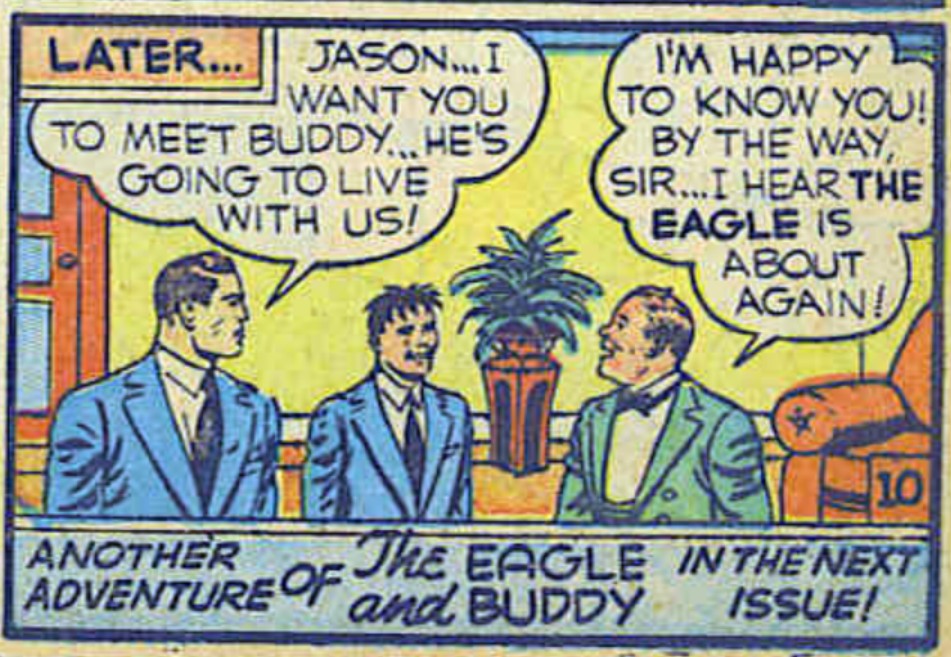
    More importantly, that kid up there is the Eagle’s new sidekick:

    Buddy, the Daredevil Boy: 

    Buddy is a kid who was presumably doing a little track-and-field when he saw the Eagle’s archfoe the Beast about to murder him with a poisoned dart and jumped in to save the day. The Eagle proceeds to adopt Buddy in such an abbreviated and perfunctory fashion that it almost serves as a parody of the idea of the kid sidekick – he doesn’t even bother to establish that he’s an orphan first.

    Buddy might just be the most hard-done-by sidekick in Golden Age comics, at least as far as costumes go, as he’s stuck in that track suit until Weird Comics 017, while the Eagle just keeps on trying new outfits the whole time. I can only imagine how galling that must have been for him. (Weird Comics 009, 1940) 

  • MINOR SUPER-HERO ROUND-UP 059

    MINOR SUPER-HERO ROUND-UP 059

    You thought that I couldn’t keep doing it but I can. MORE SUPER-HEROES 

    the Dart: 

    On the one hand, the Dart is just another guy with cape and a mask who fights crime alongside his kid sidekick, but on the other, he has a few interesting twists on what is already a tried-and-true formula:

    In the first place, the Dart was originally an Ancient Roman named Caius Martius who was magically sealed in a block of stone by his enemies, only to reemerge in the 20th Century. While this is only a moderately unusual origin for a super-hero, what is neat is that Caius Martius was effectively already a super-hero before he got cursed: he had his signature super-power of flight (referred to a “darting through the air,” hence the name) and was using it to fight “Roman racketeers.”

    Basically the first thing that Caius sees when he leaves the museum is a drive-by shooting, as the Ricarno Gang wipes out the Mariotti Gang, and more pertinently to his origin the parents of…

    Ace Barlow, the Amazing Boy: 

    Ace’s tragic orphaning at the hands of the Ricarno Gang leave him free to join up with Caius Martius as a crime-fighting team. Caius teaches Ace how to scrap, Roman-Style, and even more impressively goes to the trouble to teach him to fly rather than simply having an unpowered teenaged boy tagging along on all of his adventures like so many of his peers. (Weird Comics 005, 1940) 

    The Dart later gets a job as a teacher of Ancient Roman history at the school that Ace attends, and while this may seem like a good idea on the face of it, we must keep in mind that he slightly predates Julius Caesar, and so every time a kid asks a question about the Roman Empire, Caius is going to bug out his eyes and say “the Roman WHAT?”

    Also please note that while Caius Martius had the forethought to change his weird Roman name to something more modern to fit in, the change he made was to add “Wheeler” to the end, like having the last name “Martius” was the problem. (Weird Comics 006, 1940) 

    After their initial appearance, the Dart and Ace spend the rest of their 1940 appearances as nonsuper, nonflying vigilantes, but someone must have realized that that was the more boring option because the Dart was back to darting through the air in 1941.

    Finally, the creators of the Dart either vastly over-estimated the cutting power of a Roman short sword or intend for the Dart’s signature weapon to be magical in some way, because he sure does spend a lot of time carving through things that would stymie the vast majority of handheld tools.

    Dynamo **UPDATE**:

    I don’t know if it’s a new power per se, but in his first appearance in Weird Comics Dynamo continues his long habit of really expanding the limits of what you can do via control over electricity by employing it as a long-range listening device. (Weird Comics 008, 1940)

    Similar but unrelated: he can also hear radio broadcasts through his fingertips. (Weird Comics 009, 1940) 

    the Eagle **Update**: 

    The Eagle just can’t resist the lure of a new costume. Or Perhaps it’s the Eagle’s colourist, since as with several of his previous changes in outfit this one could just be some whimsical palette swap action. (Weird Comics 009, 1940)

    More importantly, that kid up there is the Eagle’s new sidekick:

    Buddy, the Daredevil Boy: 

    Buddy is a kid who was presumably doing a little track-and-field when he saw the Eagle’s archfoe the Beast about to murder him with a poisoned dart and jumped in to save the day. The Eagle proceeds to adopt Buddy in such an abbreviated and perfunctory fashion that it almost serves as a parody of the idea of the kid sidekick – he doesn’t even bother to establish that he’s an orphan first.

    Buddy might just be the most hard-done-by sidekick in Golden Age comics, at least as far as costumes go, as he’s stuck in that track suit until Weird Comics 017, while the Eagle just keeps on trying new outfits the whole time. I can only imagine how galling that must have been for him. (Weird Comics 009, 1940) 

  • MINOR SUPER-HERO ROUND-UP 056

    Some hot Archie/MLJ super-hero action. 

    **Hero Update** Bob Phantom:

    Perhaps in honour of his making the jump from Blue Ribbon Comics to Top-Notch Comics, Bob Phantom gets two hitherto-unseen powers: super-breath powerful enough to turn aside oncoming bullets and the ability to summon cyclones by flapping his cape. (Top-Notch Comics 003, 1940) 

    Bob Phantom also demonstrates super strength sufficient to tear an airplane to pieces in mid air. (Top-Notch Comics 004, 1940)

    And not content with three new super powers, in Top-Notch 010, Bob is shown to be completely bulletproof.

    Bob Phantom’s modus operandi, to reveal crimes and taunt both police and criminals in his gossip column as Walt Whitman and then bust things up as Bob Phantom, has never been particularly kind to the police of his corner of MLJ New York, and at this point they openly hate him in both of his identities. (Top-Notch Comics 009, 1940) 

    **Hero Update** the Wizard: 

    The Wizard’s powers also get expanded once 1940 rolls around: not only can he now hypnotically mind control people with a mere glance but he can mentally contact his thralls across distances of at least 500 miles (the above message was broadcast from somewhere in the vicinity of Dallas to somewhere in Mexico). 

    1940 is also the year that the Wizard’s already-formidible strength was rounded up to full-on super, seen here as he is bodily heaving an entire u-boat Bundonian submarine out of the water with only the power of his little kicking feet to hold him up.

    The Wizard’s arsenal of weapons and gadgets also gets a fair few additions this year, including:

    – more rays guns than one would assume could fit in a suit with such clean lines: death rays, two different engine-killing rays (the vibra-ray gun and the neutronic ray gun), an explosive ray (the destructo-ray), a metal-melting ray (the VB-ray gun), a paralysis ray (the electrolysis ray), a rainmaking ray (the H2-VX-0 ray), fire-extinguishing ray (the Hydra Gun), and the dynamagno saw ray projector, a cutting ray which can be tuned to selectively destroy mechanical parts such as the wires that hold a plane together.

    – secret chemicals including: Secret Chemical L-77 (solidifies liquids), Ethyl Formula 2X-Y-BZ (superfuel additive) and Super-Caloric Capsules and Secret Formula Ho Mg 4, which put pep back in a weary Wizard’s step.

    – special vehicles, the greatest of which is the Contra-Gravity Flask, pictured above, which allows the Wizard to float harmlessly to the ground from a height or run through the air, merely by virtue of being in his pocket.

    (Top-Notch Comics 002, 1940) 

    I somehow also failed to note in the original Wizard entry that he is not only a calling card guy but an obnoxiously patriotic one. (Top-Notch Comics 001, 1939) 

    After being blinded by his enemies the Mosconians, the Wizard changes out his tuxedo costume for a more super-heroic one with even less room for ray guns. This is supposedly to protect him from getting acid splashed in his eyes again, but since the Mosconians don’t actually get a chance for a second try the actual mechanism by which the same mask but a different shirt might help in that situation is not explored. (Top-Notch Comics 007, 1940)

    Finally, Blane Whitney abandons the life of the wealthy playboy to become a crusading newspaper publisher with ex-fiance Jane Barlowe as his star reporter, though he of course does not get a break for this. (Top-Notch Comics 008, 1940)

    Roy the Super-Boy: 

    He’s not quite the Sensational Character Find of 1940, but Roy the Super-Boy is the Marvel of 1940 and that has to count for something. He’s also our first Archie/MLJ sidekick (yes, yes, Tommy the Super-Boy, but he was a reference to Roy and we only covered him first because of the alphabet and its tricks). Does he suffer the “just running around without a mask calling yourself by your own name” problem common to a lot of Golden Age sidekicks? Sure he does, but at least he has a partial code name. And I was wrong: he totally wears a mask most of the time! 

    As is often the case, Roy is just a scrappy young orphan making his way in the world as a bootblack, when he ends up in a fight with some grown-ass men and impresses the Wizard with his sweet moves and devotion to justice. He soon finds himself with an invite to a rich man’s private gymnasium!

    Thanks to an intensive training regimen, Roy is quickly developed into an impressive physical specimen. The Wizard claims that they are equivalent barring the Wizard’s mind-powers, but I haven’t seen Roy bench-press a submarine yet. (Top-Notch Comics 008, 1940) 

    Kardak the Mystic: 

    There is a general consensus online that Kardak the Mystic is the same character as the Mystic, who appeared in Top-Notch Comics 001 and 002, but I ain’t buying it. For one, where the Mystic was an ordinary stage magician who used his skills at slight-of-hand to battle crime, Kardak has actual magical power. For another, where the Mystic was already engaged to an unnamed woman in his first adventure, Kardak’s adventures are all set in motion when a girl he just met on a cruise to India is kidnapped by undersea creatures. Certainly, relationships break up all the time, but not the Mystic and Unnamed Woman! Their love is forever!

    Kardak’s adventures take him and his gal-pal Lorna from the bottom of the Indian Ocean to Louisiana, where they enter a series of extra-dimensional lands populated by hostile weirdos. It’s a pretty good setup to showcase the power of a magical hero without having story after story of him just destroying regular gangsters.

    Kardak also acquires the services of Balthar, a huge dude with a magic turban, and he’s just as annoying as Tong and the other members of the Shirtless Broken English Magicians’ Assistants Collective. (Top-Notch Comics 004, 1940) 

  • MINOR SUPER-HERO ROUND-UP 040

    Lev Gleason’s finest!

    Lance Hale:

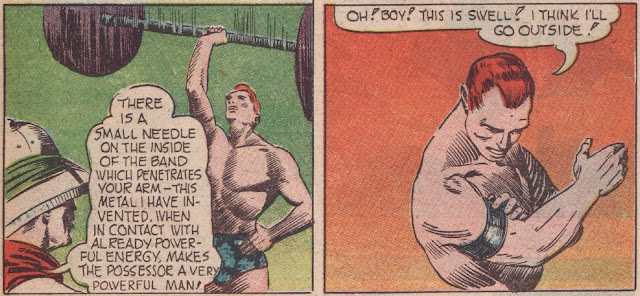
    Lance Hale is a soldier of fortune and jungle adventurer who is notable mainly for the fact that in his first appearance he is given super strength by a fellow with the pleasing name of Dr Grantland Grey so that he can help out on an expedition to the stars, and then after returning to Earth he just… stops using the armband that gives him his enhanced strength. He keeps on adventuring, don’t get me wrong, but as a regular jungle guy, ie, a colonialist race science fantasy figure. 

    Hale is slightly more interesting than his contemporaries in the jungle guy community by virtue of the variety of situations that he gets in: there’s the initial space trip that ends up turning into an interdimensional one and then a battle with invading animal men from a parallel world, a delve into a lost underground kingdom in which he incidentally becomes immortal, cursed demon-summoning gemstone action… I assume that the thrills are eventually going to stop coming but 1940 was almost all hits. (Silver Streak Comics 002, 1940)

    Mister Midnite **HERO UPDATE**:

    As you may or may not recall, Mister Midnite is a hero in the classic formal wear style who has one very specific power, to stop clocks by yelling “time stop!” Well! So we thought! It turns out that in his second appearance, Midnite demonstrates a second power, that of being teleported to a vaguely defined location, and also when he has shouts “time stop!” I really wish that there were more than two Mister Midnite stories so that we would have some more data to use in piecing all this together, but as of now I must assume that he has some sort of vaguely defined wishing power and that “time stop!” is its trigger phrase, like Johnny Thunder and “say you.” (Silver Streak Comics 002, 1940)

    the Silver Streak:

    The Silver Streak! Is notable for two (2) reasons, the first of which is that he is a the-title-of-the-comic-book character who doesn’t show up until issue 3, which is the opposite to how it often works, where the title character goes from proudly front and centre to gone in as many issues.

    The second and more interesting thing about the Silver Streak is his origin, which I have tried and failed to summarize in paragraph form, so here goes as bullet points:

    – the Silver Streak is a race car, or rather a series of race cars because every Silver Streak crashes, killing the driver. Nobody wants to drive for the Silver Streak team. The cars are crashing because they are being attacked by a giant fly.

    – the Silver Streak’s owner is Hindu mystic known only as the Swami. When an unnamed cab driver volunteers to drive the Silver Streak, the Swami hypnotizes him to be a great race car driver.

    – the unnamed driver is immediately killed by a giant fly.

    – BUT! The Swami has a hunch that the man is not in fact dead! He and a pal go to the cemetery and dig up the driver’s unmarked grave, and they are proved right! And what’s more, the prior hypnotic conditioning combined with the near-death experience has made the man (henceforth the Silver Streak) superhuman!

    The first adventure of the Silver Streak concludes with him stealing the latest prototype of his namesake car and using it to destroy the giant fly that “killed” him, and as presented he seems to have been on track to be a car-based super-hero. However, between Silver Streak Comics 003 and 004, the character was handed off from Jack Binder to Jack Cole and the Silver Streak became a guy with super speed, no car required. I don’t know if his origin is ever revised, but I do know that the Silver Streak has several sidekicks over the years and that they all get their powers via a blood transfusion from the man himself, so something’s going on there. Unless his blood was hypnotized too, of course – the Swami never returns, so his deal is never fully explored.

    Like a lot of super speed characters, the Silver Streak ends up being more about cool speed tricks than having a distinct personality, but he’s a fun read nonetheless. (Silver Streak Comics 003, 1940)

    UPDATE 1941 

    Dickie Dean, Boy Inventor:

    We love to see a boy inventor, if only because our brains have been warped enough by the Venture Brothers that we can’t help but imagine their dysfunctional adulthood, and by “we” I mean “I”. Dickie Dean here is particularly good fodder for that little thought experiment, as he is compelled to sign over his inventions to the US government by his misplaced sense of patriotism, so he’s either in for a rude awakening or an increasingly delusional relationship to reality as he gets older. 

    Some inventions that Dickie fails to patent in 1940 include: 

    – a device that can replay sound waves and visualize shadows up to 2-3 weeks old

    – a device designed to stop all war by making air as thick as molasses and thus preventing bullets etc from moving fast enough to do harm (importantly, this air is still breathable)

    – an enclosed, submersible speedboat equipped with a device that abates flood waters via rapid electrolysis

    He does sell a magnetic antigravity device for use as a mid-air brake for airplanes, but only because his father is in dire financial straits.

    Dickie Dean is also interesting for the fact that he is from New Castle, Pennsylvania, a real place with a regular amount of history but not otherwise a big name in city circles. Also I just reread the bit where I roasted Dickie for giving away his patents and I want to make it cleat that the part I think is foolish is giving them to, like, the FBI, not donating them to humanity. (Silver Streak Comics 003, 1940)

    UPDATE 1941 

  • MINOR SUPER-VILLAIN 726: PROFESSOR MEIER

    (Science Comics 005, 1940)

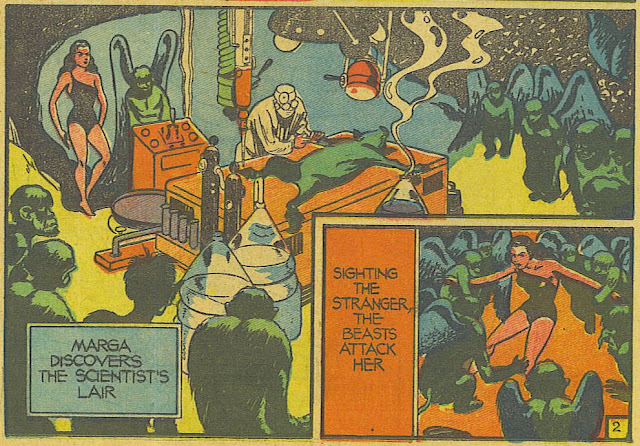
    Professor Meier, a scientist, seeks to conquer the world by unleashing an ever-growing horde of mutated life forms from his jungle HQ. This is all pretty regular stuff and he probably would have been tossed into the regular science round-up, only there are a couple of fun things that Meier brings to the table that I would like to highlight.

    First off, the mutated beasts themselves are a pretty fun design, a sort of lion/monkey/caveman/eagle chimera, plus green. What really sells them for me, though, are the dramatic shadows that they are covered with, and which usually obscure their face like they’re in a 50s horror comic and have visages too terrible for the human mind to comprehend (*CHOKE!*). Plus, they all have fun little bowl cuts.

    Professor Meier also has a fantastic look. Like, yes, most of the characters tagged “scientist” and/or “mad science” here are wearing some sort of labwear, but the whole 1940s surgical outfit complete with head mirror and black rubber gloves is a real banger of a costume. And he wears it to bed in his Safety Bedroom. Armed, of course.

    New Power Alert: Marga the Panther Woman is already too mutated to be turned into a creature by Meier’s janky serum but she does get even stronger than she already was.

    And finally, once Marga and Homer (the one friendly beast) get Meier out of the way, all of his creatures are given an antidote and turn out mainly to be small animals like rabbits and ducks – shades of Sonic the Hedgehog! – which is pretty fun. Homer turns out to be a German Shepherd, and it looks like Marga will have a fun canine companion going forward but sadly he never returns. Professor Meier’s fate is a bit more ambiguous, but I reckon he’s dead.