The Curse of Skeleton Munroe

Category: sidekick

  • MINOR SUPER-HERO ROUND-UP 098

    We’ve got no time for major super-heroes around here. We’re too busy with the minor ones.

    the Black Ace:

    The Black Ace, aka Captain McRae, is yet another American pilot serving in the RAF in advance of the US entrance into WWII. As such, he is not only a highly accomplished pilot and bombardier but fully versed in the arts of prison escape, hand-to-hand combat, impersonating German soldiers and leaping from plane to plane in mid-flight. (Four Favorites 002, 1941)

    Categorized in: Activities (Cards), Colours (Black), Team Memberships (RAF)

    Phantasmo **Update**:

    The thing about Phantasmo is that he does all of his super-heroing while in his super-huge astral form, and I guess that I had somehow gotten the impression that most of his powers were tied to that form, because I while reading his 1941 run of adventures I kept being surprised when he would do something like heal an old man (The Funnies 052) or kill a bunch of guys with a giant fish while in Phil Anson form (The Funnies 051). 

    I guess it’s pretty convenient to have the option of being an invulnerable giant but that getting your mortal hands dirty lends a certain thrill to the crimefighting – that’s probably why he tolerates the poor standard of care that he gets from Whizzer McGee as he guards the unconscious Anson-body, hey?

    In The Funnies 061, Phantasmo and Whizzer witness the murder of a crooked FBI filing clerk named Ted Bart and, partially because they are touched by his dying confession (“I only blackmailed a gang boss-turned politician to help my sister, honest!”) and partially due to this desire for more action in his life (life as an FBI filing clerk v. action packed), Phantasmo takes over his identity. The series ends before this development pays off beyond giving Phantasmo a few crime leads, but it’s still an interesting turn for the character to take.

    Whizzer McGee:

    Phantasmo’s young friend Whizzer McGee does not really qualify as a sidekick most if the time. He’s more of an employee, really, who watches over Phil Anson’s unconscious body while his mind is out terrorizing criminals. And he’s not even good at it! Whizzer and the body are always getting into scrapes because of Whizzer’s incompetence (and also because Phil is very bad at picking a convenient place to leave his mortal coil, in all fairness).

    Despite this, Phantasmo gives Whizzer McGee the opportunity to be a real-deal super-powered guy when he has to go out of town for a few days, in the form of an amulet that gives him invulnerability and super strength. I can only assume that Phil was worried that Whizzer would immediately walk out into traffic if someone wasn’t around to tell him not to and was trying to bump up the likelihood of his survival a bit.  

    Whizzer screws it all up of course – not only does he lose the amulet by trying to capture a smuggling gang single-handed, but he spills Phantasmo’s secrets – including his secret identity and home address! – to the gang boss after he does a low-effort impression of an FBI agent. Surprisingly, this leads to absolutely no consequences going forward: Whizzer keeps his job, the amulet doesn’t end up in the wrong hands… it’s not even a factor in Phantasmo changing secret identities. (The Funnies 056, 1941)

    Categorized in: Accessories (Amulets), Origins (Sidekicks)

    the Black Knight **Update**:

    In our initial look at the Black Knight, we spent a lot of time trying to nail down exactly when the series is supposed to take place, and we are not backing down from that challenge. We have determined that he lived in at least the early 12th Century CE, which the presence of Canterbury Cathedral (looking much as it does today, a form it took after being rebuilt and refurbished in the 11th and 12th Centuries) supports. This is comforting! All of our hard work paid off! Hold on to that feeling for a little while.

    The firmly 12th Century Black Knight’s 1941 adventures continue much as they had in 1940: the Black Knight travels the land slaying villains in the name of Good King Victor. Things get a bit less episodic with the introduction of a mysterious ring that the Knight is given by the King in The Funnies 053, that is then revealed to contain some mysterious drugs in issue 054.

    The Funnies 053 also introduces Peter, an archer who begins travelling with the Black Knight after helping him slay some bandits. He’s very serious about being a sidekick, is Peter.

    So we have: a reasonably firm grasp on the time period, an ongoing plot hook and a new friend. All of which is dumped in the trash as of The Funnies 055-056, when Good King Victor falls victim to an illness with only one known cure, a drug that is only available in Egypt.

    The ring is completely forgotten until the Black Knight need to escape a prison guard and the mysterious drugs turn out to be knockout drops. Peter is technically still around to the end, but he and the other members of the Black Knight’s party are all dressed like desert nomads and usually end up tagging behind him on camelback rather than actually participating in the story. As for the 12th Century… the artist’s vision of what Medieval North Africa looked like was not quite as precisely calibrated as it was for Medieval England, and so we start getting things like hookahs (15th-16th Century and even then in India) almost immediately.

    The transition to Egypt does come with a pretty good alternate costume unlock for the Black Knight, though there are also some weird Jesus overtones. (The Funnies 059)

    The Black Knight’s plan to get the drug involves appealing directly to the Queen of Egypt for aid, which is appropriate, as she is from the same lineage of fictional monarchs as Good King Victor. In actuality, Egypt was in the hands of a series of Muslim dynasties from the 650s through to the 1500s when the Ottomans took it. The plotters above, meanwhile, are all from Sudan, which was Nubian-controlled and matrilineal at the time, so the misogyny is weird.

    Once the Queen actually shows up (The Funnies 061) it is pretty clear that she is based on Cleopatra (died 30 BC), which is fine. One huge anachronism is much easier to deal with than a million mild ones, after all. The Black Knight is clearly set in an alternate timeline or a human zoo built by aliens with poor research skills.

    Finally, the Egyptian odyssey introduces a love interest for the Black Knight in the form of a Persian (?) woman named Zellah who he rescues from a harem in The Funnies 057. There isn’t too much to this relationship – it’s just kind of nice. The Black Knight does get this sick scorpion amulet from her, but it’s just before she and the Queen of Egypt are kidnapped in a cliffhanger ending that is never resolved, so overall, it’s a bummer.

  • MINOR SUPER-HERO ROUND-UP 098

    We’ve got no time for major super-heroes around here. We’re too busy with the minor ones.

    the Black Ace:

    The Black Ace, aka Captain McRae, is yet another American pilot serving in the RAF in advance of the US entrance into WWII. As such, he is not only a highly accomplished pilot and bombardier but fully versed in the arts of prison escape, hand-to-hand combat, impersonating German soldiers and leaping from plane to plane in mid-flight. (Four Favorites 002, 1941)

    Categorized in: Activities (Cards), Colours (Black), Team Memberships (RAF)

    Phantasmo **Update**:

    The thing about Phantasmo is that he does all of his super-heroing while in his super-huge astral form, and I guess that I had somehow gotten the impression that most of his powers were tied to that form, because I while reading his 1941 run of adventures I kept being surprised when he would do something like heal an old man (The Funnies 052) or kill a bunch of guys with a giant fish while in Phil Anson form (The Funnies 051). 

    I guess it’s pretty convenient to have the option of being an invulnerable giant but that getting your mortal hands dirty lends a certain thrill to the crimefighting – that’s probably why he tolerates the poor standard of care that he gets from Whizzer McGee as he guards the unconscious Anson-body, hey?

    In The Funnies 061, Phantasmo and Whizzer witness the murder of a crooked FBI filing clerk named Ted Bart and, partially because they are touched by his dying confession (“I only blackmailed a gang boss-turned politician to help my sister, honest!”) and partially due to this desire for more action in his life (life as an FBI filing clerk v. action packed), Phantasmo takes over his identity. The series ends before this development pays off beyond giving Phantasmo a few crime leads, but it’s still an interesting turn for the character to take.

    Whizzer McGee:

    Phantasmo’s young friend Whizzer McGee does not really qualify as a sidekick most if the time. He’s more of an employee, really, who watches over Phil Anson’s unconscious body while his mind is out terrorizing criminals. And he’s not even good at it! Whizzer and the body are always getting into scrapes because of Whizzer’s incompetence (and also because Phil is very bad at picking a convenient place to leave his mortal coil, in all fairness).

    Despite this, Phantasmo gives Whizzer McGee the opportunity to be a real-deal super-powered guy when he has to go out of town for a few days, in the form of an amulet that gives him invulnerability and super strength. I can only assume that Phil was worried that Whizzer would immediately walk out into traffic if someone wasn’t around to tell him not to and was trying to bump up the likelihood of his survival a bit.  

    Whizzer screws it all up of course – not only does he lose the amulet by trying to capture a smuggling gang single-handed, but he spills Phantasmo’s secrets – including his secret identity and home address! – to the gang boss after he does a low-effort impression of an FBI agent. Surprisingly, this leads to absolutely no consequences going forward: Whizzer keeps his job, the amulet doesn’t end up in the wrong hands… it’s not even a factor in Phantasmo changing secret identities. (The Funnies 056, 1941)

    Categorized in: Accessories (Amulets), Origins (Sidekicks)

    the Black Knight **Update**:

    In our initial look at the Black Knight, we spent a lot of time trying to nail down exactly when the series is supposed to take place, and we are not backing down from that challenge. We have determined that he lived in at least the early 12th Century CE, which the presence of Canterbury Cathedral (looking much as it does today, a form it took after being rebuilt and refurbished in the 11th and 12th Centuries) supports. This is comforting! All of our hard work paid off! Hold on to that feeling for a little while.

    The firmly 12th Century Black Knight’s 1941 adventures continue much as they had in 1940: the Black Knight travels the land slaying villains in the name of Good King Victor. Things get a bit less episodic with the introduction of a mysterious ring that the Knight is given by the King in The Funnies 053, that is then revealed to contain some mysterious drugs in issue 054.

    The Funnies 053 also introduces Peter, an archer who begins travelling with the Black Knight after helping him slay some bandits. He’s very serious about being a sidekick, is Peter.

    So we have: a reasonably firm grasp on the time period, an ongoing plot hook and a new friend. All of which is dumped in the trash as of The Funnies 055-056, when Good King Victor falls victim to an illness with only one known cure, a drug that is only available in Egypt.

    The ring is completely forgotten until the Black Knight need to escape a prison guard and the mysterious drugs turn out to be knockout drops. Peter is technically still around to the end, but he and the other members of the Black Knight’s party are all dressed like desert nomads and usually end up tagging behind him on camelback rather than actually participating in the story. As for the 12th Century… the artist’s vision of what Medieval North Africa looked like was not quite as precisely calibrated as it was for Medieval England, and so we start getting things like hookahs (15th-16th Century and even then in India) almost immediately.

    The transition to Egypt does come with a pretty good alternate costume unlock for the Black Knight, though there are also some weird Jesus overtones. (The Funnies 059)

    The Black Knight’s plan to get the drug involves appealing directly to the Queen of Egypt for aid, which is appropriate, as she is from the same lineage of fictional monarchs as Good King Victor. In actuality, Egypt was in the hands of a series of Muslim dynasties from the 650s through to the 1500s when the Ottomans took it. The plotters above, meanwhile, are all from Sudan, which was Nubian-controlled and matrilineal at the time, so the misogyny is weird.

    Once the Queen actually shows up (The Funnies 061) it is pretty clear that she is based on Cleopatra (died 30 BC), which is fine. One huge anachronism is much easier to deal with than a million mild ones, after all. The Black Knight is clearly set in an alternate timeline or a human zoo built by aliens with poor research skills.

    Finally, the Egyptian odyssey introduces a love interest for the Black Knight in the form of a Persian (?) woman named Zellah who he rescues from a harem in The Funnies 057. There isn’t too much to this relationship – it’s just kind of nice. The Black Knight does get this sick scorpion amulet from her, but it’s just before she and the Queen of Egypt are kidnapped in a cliffhanger ending that is never resolved, so overall, it’s a bummer.

  • SUPER-HERO FILE 004: BUCKY

    (Captain America Comics 001, 1940)

    I probably wouldn’t have thought of this before writing so many entries about Golden Age super-heroes and their hastily shoehorned-in boy companions, but Bucky really is a top-tier sidekick, conceptually. Probably not the top, since Robin really set the gold standard, but close! Consider:

    In terms of the How Does He Acquire the Boy aspect of things, it couldn’t be simpler. There’s no need for some contrived (or ridiculously omitted) adoption process because Bucky is the Camp Lehigh mascot, meaning that he and Steve Rogers are essentially work friends. And since they also basically live together (in the same field of tents as one another, at least) the process of Bucky learning that Steve is Captain America and subsequently becoming his partner is as simple as him not being very careful about barging into other people’s homes without knocking. 

    Not only does Bucky get his own costume (not always guaranteed), but it’s an unusually good one: thematically similar to his partner’s but not derivative of it, and a smart enough look that it’s appeared on various Bucky-inspired characters to this day.

    I thought that Bucky might have been at the forefront of the “sidekicks
    without their own code name” movement but looking at the dates he is
    just a part of a larger trend. Similarly, he is just one of a wave of normal
    teenaged boys who adventure alongside a super-powered adult men. Neither of these are great features for a boy sidekick to have, but the fact that he is a victim of both trends rather than their originator goes a long way.

    (case in point: crypto-fascist crook the Wax Man figures out that the two Buckys he has encountered are the same – it’s a miracle that this doesn’t happen more often) (Captain America Comics 002, 1941)

  • MINOR SUPER-HERO ROUND-UP 092

    MINOR SUPER-HERO ROUND-UP 092

    Who ever thunk that there could be quite so many minor super-heroes?

    Invisible Scarlet O’Neil:

    Young Scarlet O’Neil, being the kind of person who will touch an arc of mysterious energy in her scientist father’s lab, finds herself rendered invisible, a condition that she eventually learns is reversed by touching a certain nerve in her wrist.* She uses this power to fight mid-tier injustice eventually (I am assured) parleys it into a career as a newspaper reporter. Before that, she functions as a very low-level vigilante – she solves some crimes, yes, but also gets mixed up in a lot of people’s personal lives. She is also one of the few invisible characters to regularly suffer any consequences for going out in public without reflecting any light: she is regularly beaned by baseballs, pushed into traffic, etc.
    Sticklers might note that “Invisible Scarlet O’Neil” was a comic strip first and that what I am showing here are images from the comic book reprints of such, and I must confess that I do not have the wherewithal to source comic strip dates every time I want to refer to this character. All references to her will be from the Eastern Color comics. (Famous Funnies 081, 1941)

    *As presented, the timeline is extremely sad: 1) her father accidentally causes her to become invisible by not taking her poor lab safety practices into account 2) he works to find a cure but cannot 3) he dies, presumably in despair over his child’s life of invisible obscurity 4) she figures out the nerve thing

    Categorized in: Body (Invisible), Origin (Mysterious Ray Mutate), Power (Invisibility)

    Fearless Flint, the Famous Flint Man:

    Jack Bradley, a worker on the carving of Mount Rushmore (and let me tell you: every time I think that I’m done being surprised by the real-world events that super-hero origins are being roped into I am dead wrong) is flung down the face of the mountain when his pneumatic drill is sabotaged. Instead of being killed horribly as one might expect, Jack survives because the flint shards that litter the Rushmore debris field merge with his skin rather than shredding it. Now, upon touching any metal, he turns to red hot flint complete with little sparks flying off of him, and becomes super strong and invulnerable. A few things:

    – Flint’s elemental transformation is very on brand for the small stable of Eastern Color super-heroes, cv Hydroman, the upcoming Man o’Metal, etc.

    – Despite the fact that he requires the touch of metal to transform, Flint notably fails to consider carrying any around with him in any of the half dozen of his adventures I have flipped through. He always needs one of his enemies to bop him with a metal weapon or push him into a railing or drop a chandelier on his head, and in later adventures simply turns to flint when he gets angry.

    – Flint’s drill was sabotaged by agents of the Lava Man, his first enemy, whose appearances are serialized across half a dozen issues in 1942 and who we will be covering once that year rolls around. I will give you a spoiler, however: he has absolutely no reason to have sabotaged the construction of Mount Rushmore, so either this was a classic example of the Reel (agents of a super-villain go far afield for no reason other than to draw the hero to a second location and move the plot forward) or the Lava Man is very sympathetic to the plight of the Sioux people.

    – Finally, I looked very hard and while I can’t say this with 100% certainty I can do so at 95%: the Black Hills in general and Mount Rushmore in particular do not seem to be particularly rich in flint. But maybe that’s the secret to Flint’s transformation, that they were magic flint shards that shouldn’t ought to have been there.

    All in all a true oddball of a character as befits a member of the Eastern Color stable. (Famous Funnies 089, 1941)

    Categorized in: Element (Minerals (Flint)), Origin (Material Mutate), Power (Phyiscal Transformation, Super Strength)

    the Sixth Column:

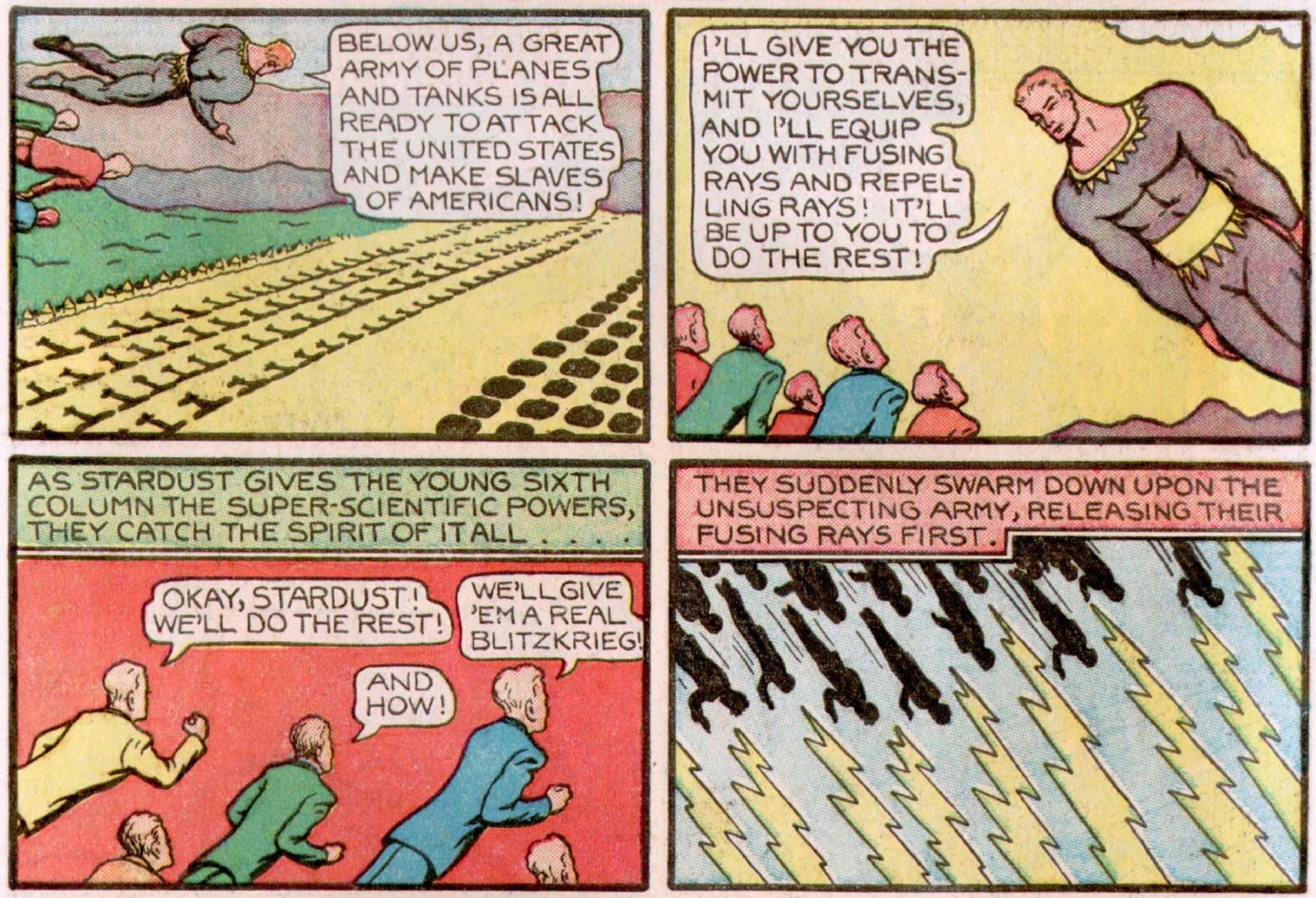
    Nineteen Forty-One: Stardust the Super Wizard, concerned about a mass mobilization of Axis fifth columnists into the Americas, vows to form a sixth column to counter their efforts. As his agents, he chooses the boys of the United States (more on this). Also please note that in between declaring that he would found the Sixth Column and actually getting around to doing so, Stardust roots out and murders every Fifth Columnist in America as part of his defense of Earth against the Martian Sky Demons.

    With no counter-espionage work to do, the Sixth Column is instead given a portion of Stardust’s power (flight, fusing rays to mess up the enemy’s war machines, repelling rays to levitate the enemy troops) and set loose as a super powered child army versus an Axis invasion force that is approaching from South America. (Fantastic Comics 014, 1941)

    The Sixth Column returns in Fantastic Comics 015, and this time they get official Stardust the Super Wizard outfits. In addition to the star-metal costumes (possibly invulnerable), the boys are equipped with mind-reading devices to root out fifth columnists and metal-repelling rays to protect the US from enemy missiles. Curiously, this time they are not given the power of flight.

    The thing that I find myself thinking while reading the two stories featuring the Sixth Column is “why is Stardust doing this?” It’s not for any lack of ability to keep on top of things, that’s for sure, as the boys do not do anything that Stardust hasn’t already done on a bigger scale, and in any case he is monitoring them the entire time as seen here when they lose control of a missile and destroy an ocean liner and he jumps in to take over immediately.

    Is it meant to be some sort of mentoring? Of ensuring that there will be a new stardust? Is he just bored? He’s probably just bored with crime fighting while being so grotesquely overpowered, isn’t he.

    Categorized in: Alphanumeric (Six), Origin (Sidekicks), Powers (Various) 

    Stardust the Super Wizard **UPDATE**:

    And speaking of Stardust the Super Wizard: we’ve seen him shapeshift before and we’ve seen him impossibly grab a man by the torso before but in this, his very last appearance, he combines the two by grabbing the villain “Slant-Eye” with a gross tentacle hand. It truly is an iconic image for the guy to go out on. (Fantastic Comics 016, 1941)

  • MINOR SUPER-HERO ROUND-UP 090

    MINOR SUPER-HERO ROUND-UP 090

    We’re simply up to our eyeballs in minor super-heroes!

    K-9:

    K-9, an injured German Shepherd (they call him a police dog but I think that that’s as an alternate breed name due to the war, like how the British call them Alsatians) nursed back to health and given a terrible name by scrappy teen Tip Starr, is given ample opportunity to fight crime thanks to his association with Tip’s brother, Police Detective Dick Starr. (Dynamic Comics 001, 1941)

    Categorized in: Alphanumeric (K, 9), Animals (Dogs), Origin (Animals)

    Dynamic Boy:

    When orphan Kent Banning is severely injured while rescuing Doctor Brown’s unnamed daughter from a burning schoolhouse, Brown returns the favour by injecting him with a mysterious fluid that he got from a dying Tibetan Lama. This fluid not only saves Kent’s life but endows him with the standard array of super-powers: enhanced speed and agility, super strength and the power of flight. He also adopts the lad, which makes the chaste romance between Kent and “She Seriously Never Gets A Name” Brown just a little bit weird. She does make him a costume, which is nice. And it clearly has room for him to grow into!

    Probably the best thing about Dynamic Boy is just how lanky and awkward he is. Contextually, he’s about the same age as Robin and most of the other sidekicks in Golden Age comics, i.e., somewhere between 12 and 15 years old, but Dynamic Boy really feels like it, particularly in the sequence above, where he learns that he can fly by tripping over his own feet. (Dynamic Comics 002, 1941)

    Categorized in: Generica (Boys), Language (Superlatives – Dynamic), Origin (Mystic Mutates)

    Lady Satan:

    Lady Satan’s career begins after an ocean liner is sank by Nazi bombers and an unnamed woman (there is some impression that she uses Satan as her surname while adventuring, but whether it is her real name is hard to say) is the only survivor. Swearing vengeance, she heads back to Europe to vex the Axis.

    I really like Lady Satan! For one thing, she just kind of relies on the mystery inherent in being a hot lady in a mask and doesn’t even switch to a secret identity to seduce horny Nazis into revealing their secrets. For another, she’s supremely adaptive. Got captured and about to be shot as a spy? No problem, Lady Satan will merely steal the executioner’s pistol, take him hostage, steal a plane, crash into the pursuing planes, parachute into a handy river, steal a car and be in Berlin at the same time as the fellow she was caught trying to rob in the first place. Just a very competent character.

    She also packs a chlorine gas gun, which is horrifying to contemplate firing at another person, let alone firing it in an enclosed space. I suppose that war crimes don’t apply to you if you are a stateless vigilante, but everybody has to breathe. (Dynamic Comics 002, 1941)

    Categorized in: Famous Figures (Satan), Origin (Vengeance Quest), Royalty (Ladies)

    the Green Knight:

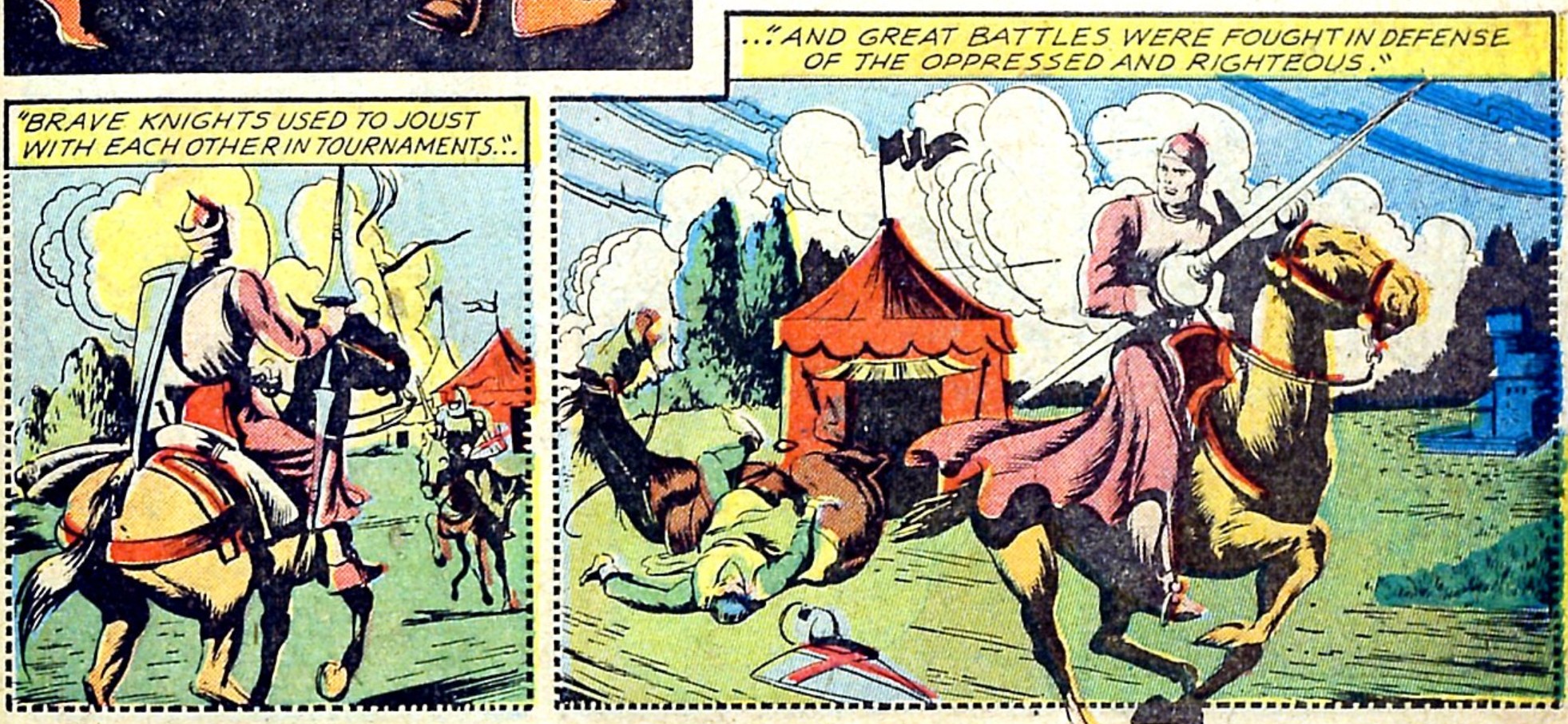
    Contrary to his name, the Green Knight is more of an archer-type hero than some sort of armoured bruiser or dashing cavalier. He is also our first Florida-based super-hero, as far as I can figure (many before him have visited, certainly, but none before have deigned to live there).

    As the Green Knight explains to Lance Cooper, an orphan boy who he rescues from a vampire in the Everglades, he is in actuality Denis Knight, a rich guy who collects Medieval weapons and has a rose-tinted view of knighthood that informs his forays into vigilante justice.

    Speaking of Lance, he abbreviates the usual perfunctory super-hero boy-adoption process even further by just coming out and asking to join up with Knight. He gets a mini version of the Green Knight’s costume (and sadly loses his cheeky little orphan cap in the process) and follows him into battle for the remainder of his two-adventure career as Lance, which is a very annoying name indeed. Is it just using his regular name like so many kid sidekicks do, or are they doing a bit of a winking acknowledgement that his name already fits the knightly theme? Would it kill them to give him a spear? (Dynamic Comics 002, 1941)

    Green Knight Categorized in: Colours (Green), Famous Figures (Arthurian)*, Royalty (Knights)

    Lance Categorized in: Locations (Florida), Objects (Lances), Origins (Sidekicks)

    * the character does not have anything to do with Arthuriana thematically, but the name “the Green Knight” is nonetheless enough of a reference for me

  • MINOR SUPER-HERO ROUND-UP 083

    MINOR SUPER-HERO ROUND-UP 083

    Oh boy! Minor super-heroes!

    13: 

    13 (aka Thirteen, although the numerical version of the name is the official one) is the alias of Harold Higgins, whose life has been haunted by a series of misfortunes related to the number thirteen. A timeline of some of them:

    February 13, 1940: Harold’s brother Bob dies in a plane crash.

    March 13, 1940: Harold loses his life savings in the stock market.

    May 13, 1940: Harold’s sister Margy is paralyzed in a car accident.

    July 13, 1940: Harold’s father is lost at sea.

    September 13, 1940: Harold’s fiance is killed in a hit and run.

    April 13, 1941: Harold loses his job as a reporter to a crooked editor looking to cover up a story. 

    All of this (and more! A text story in Daredevil Comics 005 adds the facts that he was born on Friday the 13th, that minor tragedies like a broken leg or academic failure had frequently befallen him on the 13th of any given month and that at his thirteenth birthday party his childhood sweetheart Helen was killed by a falling chandelier) has clearly preyed on Harold’s mind, to the point that he is finding the number everywhere including his own name.

    Rather than, say, moving to a small shack in the woods to keep others safe from his constant misfortune, Harold decides to weaponize his bad luck by bringing it to criminals via his fists. Does this work, logically? Not really, but it’s a decent enough comic book origin.

    Like many super-heroes and villains, 13 flirts with the idea of leaving a calling card in his first adventure but doesn’t maintain the practice. In this case, it’s a calendar page with the 13th of the month circled. (Daredevil Comics 003, 1941)

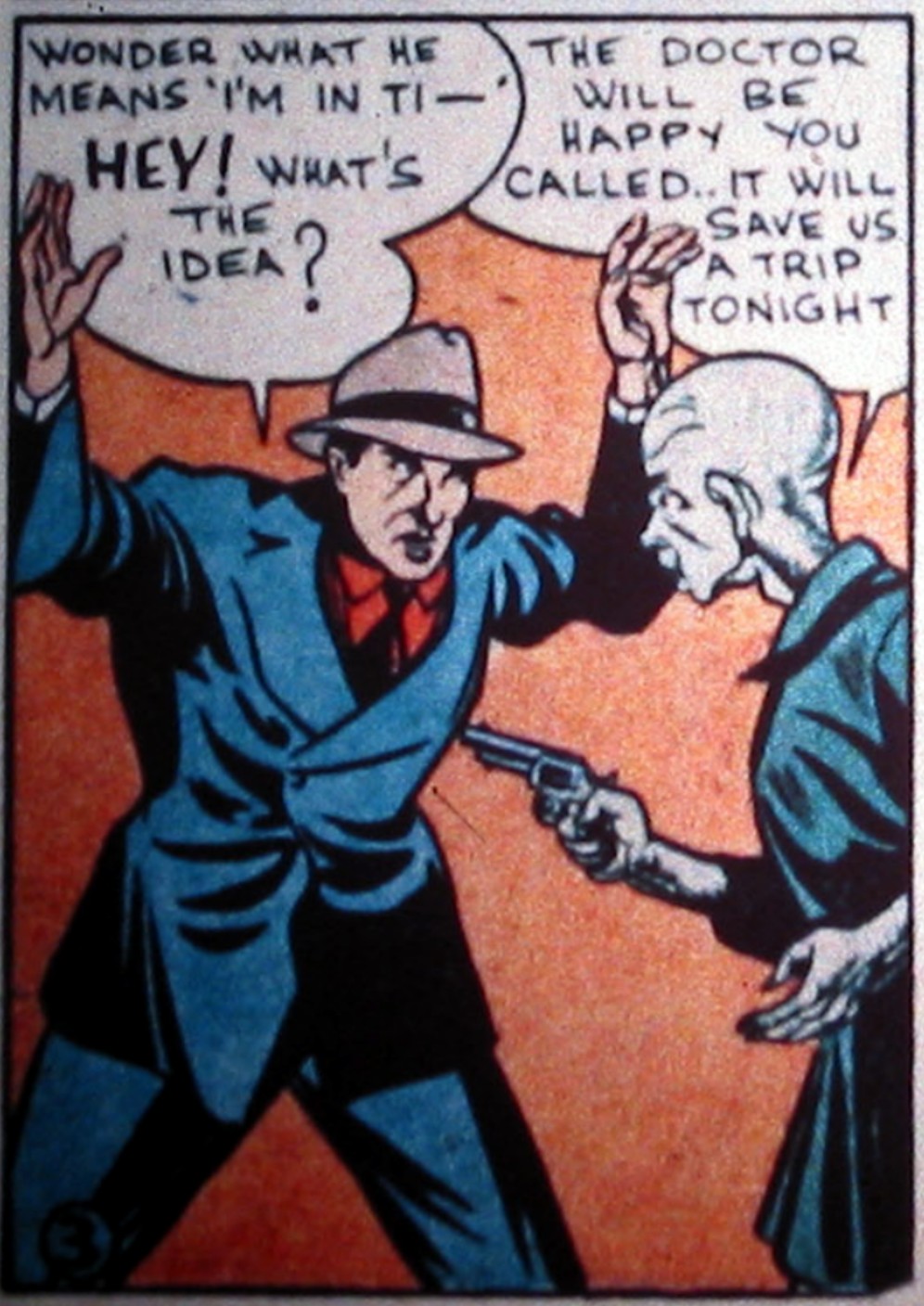
    Finally, a couple of minor things about 13: In Daredevil Comics 004 we learn that like many of his peers he wears his costume under his clothes for quick-change action. Intriguingly, the above panel seems to imply that this includes his mask, which appears to be either acting as a liner for his hat or worn as a kind of bandana under it.

    Finally, in Daredevil Comics 006, 13 moves from the super-hero crammed streets of NYC to the lesser-served Boston.

    Categorized in: Abstract Concepts (Luck), Accessories (Calling Cards), Alphanumeric (Thirteen)

    Jinx: 

    Recently orphaned Darrel Creig has just inherited the family steel fortune, something that rankles his guardian, uncle and the only other potential heir Moldon Creig. Thus, a family outing to the Statue of Liberty, where Moldon and Darrel’s tutor Travers expedite the inheritance process by tossing him off the statue’s torch.

    Luckily for young Darrel, 13 happens to be present to stop an unrelated attempt to bomb the statue, and after saving the lad the two of them beat up Moldon and Travers and hand them over to the authorities.

    As we all know, if a costumed vigilante happens across an orphaned boy who can throw a punch they are allowed to keep them, which is just what happens with 13 and Darrel, and though Darrel’s connection to the bad luck theme is much more tenuous than Higgins (he is an orphan, if a wealthy one, and he is the very spooky age of thirteen years old) he is promptly given a slightly worse costume than 13’s and anointed as his sidekick Jinx. (Daredevil Comics 005, 1941)

    Categorized in: Abstract Concepts (Luck), Day Job (High School Students), Origin (Sidekicks)

    the Ghost: 

    The Ghost is a super-hero who seemingly exists solely to combat the menace of the Claw as he troubles America’s shores once more, Daredevil having moved on to less stressful pursuits.

    Though presented as a normal human man, the Ghost not only has the acrobatic prowess necessary to fight a giant across the rooftops of New York City but enough stamina to do so for seven hours straight. In their first encounter he manages to drive the Claw away by simply punching him thousands of times.

    The Ghost’s origin is unrevealed as of his final 1941 appearance but rest assured: we will learn it in 1942 (spoiler: it is not very interesting). (Daredevil Comics 005, 1941)

    Categorized in: Origin (Unknown), Supranormal Beings (Ghosts)

    the Fiery Mask: 

    The Fiery Mask! A hero whose modern depictions have consistently involved a morning star despite only ever actually wielding on on this cover. I’m not complaining, mind you – it’s just interesting to note where things come from.

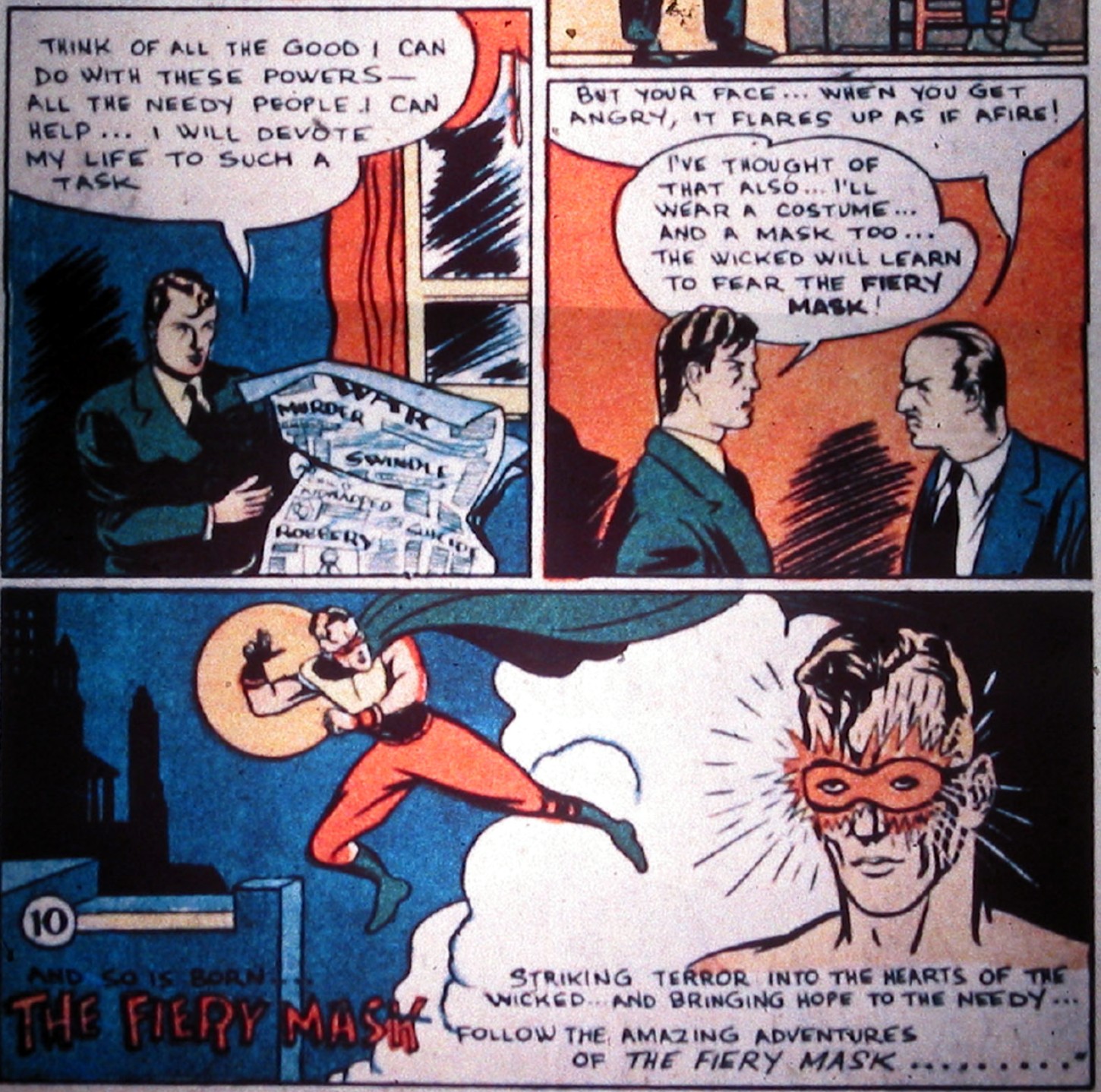
    The Fiery Mask is in reality Jack Castle, a young doctor who accidentally tracks down the lair of the villainous Zombie Master and is in quick order captured and subjected to the fiend’s mind control device. Jack manages to resist the device long enough to enrage the Zombie Master, and in an effort to boost the power and overcome this resistance he causes it to explode.

    The strange energies given off by the device cause Jack to develop strange abilities, the most striking of which is a fiery glow that plays around his face when he is worked up, and which gives him his super moniker. He also has an invulnerability to heat and flame, a fiery touch and a range of non-heat-related powers like super strength, super breath and a hypnotic gaze. Also his origin is later heavily revised, but we can save that for the hundred years or so it will take to get to The Twelve. (Daring Mystery Comics 001, 1940)

    Categorized in: Elements (Fire), Objects (Masks), Origin (Radioactive Mutate)

  • MINOR SUPER-HERO ROUND-UP 083

    MINOR SUPER-HERO ROUND-UP 083

    Oh boy! Minor super-heroes!

    13: 

    13 (aka Thirteen, although the numerical version of the name is the official one) is the alias of Harold Higgins, whose life has been haunted by a series of misfortunes related to the number thirteen. A timeline of some of them:

    February 13, 1940: Harold’s brother Bob dies in a plane crash.

    March 13, 1940: Harold loses his life savings in the stock market.

    May 13, 1940: Harold’s sister Margy is paralyzed in a car accident.

    July 13, 1940: Harold’s father is lost at sea.

    September 13, 1940: Harold’s fiance is killed in a hit and run.

    April 13, 1941: Harold loses his job as a reporter to a crooked editor looking to cover up a story. 

    All of this (and more! A text story in Daredevil Comics 005 adds the facts that he was born on Friday the 13th, that minor tragedies like a broken leg or academic failure had frequently befallen him on the 13th of any given month and that at his thirteenth birthday party his childhood sweetheart Helen was killed by a falling chandelier) has clearly preyed on Harold’s mind, to the point that he is finding the number everywhere including his own name.

    Rather than, say, moving to a small shack in the woods to keep others safe from his constant misfortune, Harold decides to weaponize his bad luck by bringing it to criminals via his fists. Does this work, logically? Not really, but it’s a decent enough comic book origin.

    Like many super-heroes and villains, 13 flirts with the idea of leaving a calling card in his first adventure but doesn’t maintain the practice. In this case, it’s a calendar page with the 13th of the month circled. (Daredevil Comics 003, 1941)

    Finally, a couple of minor things about 13: In Daredevil Comics 004 we learn that like many of his peers he wears his costume under his clothes for quick-change action. Intriguingly, the above panel seems to imply that this includes his mask, which appears to be either acting as a liner for his hat or worn as a kind of bandana under it.

    Finally, in Daredevil Comics 006, 13 moves from the super-hero crammed streets of NYC to the lesser-served Boston.

    Categorized in: Abstract Concepts (Luck), Accessories (Calling Cards), Alphanumeric (Thirteen)

    Jinx: 

    Recently orphaned Darrel Creig has just inherited the family steel fortune, something that rankles his guardian, uncle and the only other potential heir Moldon Creig. Thus, a family outing to the Statue of Liberty, where Moldon and Darrel’s tutor Travers expedite the inheritance process by tossing him off the statue’s torch.

    Luckily for young Darrel, 13 happens to be present to stop an unrelated attempt to bomb the statue, and after saving the lad the two of them beat up Moldon and Travers and hand them over to the authorities.

    As we all know, if a costumed vigilante happens across an orphaned boy who can throw a punch they are allowed to keep them, which is just what happens with 13 and Darrel, and though Darrel’s connection to the bad luck theme is much more tenuous than Higgins (he is an orphan, if a wealthy one, and he is the very spooky age of thirteen years old) he is promptly given a slightly worse costume than 13’s and anointed as his sidekick Jinx. (Daredevil Comics 005, 1941)

    Categorized in: Abstract Concepts (Luck), Day Job (High School Students), Origin (Sidekicks)

    the Ghost: 

    The Ghost is a super-hero who seemingly exists solely to combat the menace of the Claw as he troubles America’s shores once more, Daredevil having moved on to less stressful pursuits.

    Though presented as a normal human man, the Ghost not only has the acrobatic prowess necessary to fight a giant across the rooftops of New York City but enough stamina to do so for seven hours straight. In their first encounter he manages to drive the Claw away by simply punching him thousands of times.

    The Ghost’s origin is unrevealed as of his final 1941 appearance but rest assured: we will learn it in 1942 (spoiler: it is not very interesting). (Daredevil Comics 005, 1941)

    Categorized in: Origin (Unknown), Supranormal Beings (Ghosts)

    the Fiery Mask: 

    The Fiery Mask! A hero whose modern depictions have consistently involved a morning star despite only ever actually wielding on on this cover. I’m not complaining, mind you – it’s just interesting to note where things come from.

    The Fiery Mask is in reality Jack Castle, a young doctor who accidentally tracks down the lair of the villainous Zombie Master and is in quick order captured and subjected to the fiend’s mind control device. Jack manages to resist the device long enough to enrage the Zombie Master, and in an effort to boost the power and overcome this resistance he causes it to explode.

    The strange energies given off by the device cause Jack to develop strange abilities, the most striking of which is a fiery glow that plays around his face when he is worked up, and which gives him his super moniker. He also has an invulnerability to heat and flame, a fiery touch and a range of non-heat-related powers like super strength, super breath and a hypnotic gaze. Also his origin is later heavily revised, but we can save that for the hundred years or so it will take to get to The Twelve. (Daring Mystery Comics 001, 1940)

    Categorized in: Elements (Fire), Objects (Masks), Origin (Radioactive Mutate)

  • MINOR SUPER-HERO ROUND-UP 080

    It’s a sidekick-heavy brew this time, chums.

    the Silver Streak **UPDATE**:

    It’s been a gradual thing but the Silver Streak has been getting closer and closer to not just going real fast and jumping far but actually flying. I don’t know if you can actually pinpoint the moment he made the transition but he is definitely on the “is flying” side of the equation by Silver Streak Comics 010, 1941. 

    Mercury:

    Although Whiz, King of Falcons is an exemplary sidekick to the Silver Streak, comic books are nothing if not prone to trends, and the trend for 1941 was for super-heroes to get kid sidekicks. And although there is only so much you can do to stand out among an army of gee-whillikering blonde boys, Mercury, aka the Boy Streak, aka Mickey O’Toole, does have a couple of aspects worth highlighting:

    The first of these things is his origin story. Mickey O’Toole is the appropriately hard-hitting son of the late boxer Slugger O’Toole, who was murdered mid-match because he wouldn’t take a dive. Mickey now shines shoes in order to provide for his widowed mother and disabled sister Mary. A sad tale indeed.

    The remarkable thing about Mickey’s sad backstory and struggling family the fact that it and they never come up again. Mickey starts hanging out with the Silver Streak and his family woes go right out the window. There’s even a hint at the end of his debut appearance that he will get the chance to bring the man who killed his father to justice, but writing duties on “Silver Streak” transfer from Bob Wood to Don Rico with the probably-pseudonymous Rex Richards in between and Mercury’s backstory gets lost in the shuffle.

    The second thing to note about Mercury is the origin of his powers: Silver Streak gives him a shot of secret super juice. Not anything to write home about in and of itself – every third super-hero is on some sort of serum or powder or elixir, after all – but because the common knowledge about this kid is that he got his powers from a Silver Streak blood transfusion. I myself asserted this in my entry on the guy! I mean, it’s not like we’re out there getting the origin of the Flash wrong or something but it is an interesting example of how misinformation can become more prevalent than fact (also this kind of clears up the mysterious origin of the Silver Streak’s own powers: he took the juice!) (Silver Streak Comics 011, 1941)

    Meteor:

    The third thing about Mercury is the fact that after two issues he is replaced by Meteor, the Boy Speed-King and no two of the half dozen nerds who care about this kind of thing can agree on whether Mercury and Meteor are the same kid with two different names or two different kids with no explanation of where the first one went or the second one came from, with the argument fr the second position boiling down to the fact that they never say that the two are the same. 

    Personally, I lean toward the “one kid, two names” hypothesis, as it’s slightly cleaner. Why invent a whole new kid? (Silver Streak Comics 013, 1941)

    Categorized in: Elements (Mercury), Locations (Space Places), Origins (Sidekicks) 

    Whiz, King of Falcons **UPDATE**: 

    Whiz, King of Falcons, the Silver Streak’s original sidekick, in perhaps his final appearance before he is supplanted by one or more flying kids, demonstrates the heretofore-unseen ability to talk. And to be an annoying smartass, if I’m honest. Whiz returns later on in Silver Streak’s career, so it’ll be interesting to see if he retains this ability. (Daredevil Comics 001, 1941) 

    Captain Battle:

    Captain Battle: patriotic hero, scientist, former soldier and in fact World War One veteran, in which conflict he lost his left eye. Lest we think him too old, the text is at pains to reassure us that he was in fact the youngest person to fight in the Great War, which I think is supposed to make him seem tough but mostly instills a deep horror in my being. Particularly after I looked it up and found that that would make him something like seven years old, at least until a few issues later when they clarify that he was the youngest member of the American Expeditionary Forces, making him a comparatively venerable 12 or so.

    Like many patriotic heroes there isn’t a lot going on with Captain Battle beyond his love of country, but here are all of the interesting trappings of his character:

    1. His assistant, Jane Lorrain: she’s got a rhyming name and she’ll push back on sexist language. Like many potentially interesting female supporting cast members she is pretty thoroughly sidelined once Battle gets a sidekick.

    2. His patriotism. Not only is he dedicated to the defense of the US but he has sworn to only defend the US. He helps save a British fleet in his first appearance explicitly because they act as a buffer between the Axis Axian Powers and America. Presumably he would otherwise let them be destroyed. Every once in a while when he is not directly helping an American he gets kind of huffy about it.

    3. His gadgets, while not unique, have very cool names, including the Curvoscope (remote viewer), the Dissolvo (death ray pistol) and the Luceflyer (jetpack). The Dissolvo is also really disgusting, as it melts its target into a quivering pile of goo. (Silver Streak Comics 010, 1941)

    Captain Battle gets a couple of issues of his own comic in 1941 and for precisely one story he makes an extremely feeble attempt at having a secret identity with no consideration for the fact that a) there aren’t a lot of guys running around with eye patches in any given area, which makes the usual secret id excuses appear even more ridiculous and b) Captain Battle’s real name is in fact Captain Battle. “You know, I never see Captain Battle and Captain Battle in the same room together…” Ridiculous.

    If I’m honest the story in question has a couple of indications that it originally starred another character and Captain Battle was a late addition, and if that is the case then the secret identity stuff is just a holdover from that. (Captain Battle Comics 001, 1941)

    Categorized in: Accessories (Various), Origins (Patriotic Heroes), Origins (WWI Vets)

    Hale Battle:

    The prevailing trend in 1941 was for super-heroes to have sidekicks and so Captain Battle eventually gets a sidekick. But just how does he acquire a boy? Very simply! See, Battle’s recurring foe the Black Dragon (tune in tomorrow for that jerk) had a thing where he turned people into giant bird-man minions called Deaglos, and the final Captain Battle/Black Dragon confrontation the surviving Deaglos were all restored to their human forms. Most of them were adult men who had lives to return to, but among them was one unclaimed boy.

    Note that the boy gives his name as “Nathan Hale” and Captain Battle immediately renames him “Hale Battle.” This is weird. It’s a weird thing to do. Particularly as “Nathan Hale” is a very patriotic American name, which Battle should totally be into! Also note just how small this kid is. This doesn’t last long, as he is definitely around the thirteen to fifteen year-old range that most Golden Age sidekicks fall into and is drawn to look more like it as time passes.

    Hale Battle is among the minority of Golden Age sidekicks who aren’t recruited as sidekicks but who insist upon becoming them. Not that Captain Battle puts up much resistance – once Hale gets this poor war refugee to sew him a uniform he’s got the job.

    Aside from these small points of interest, Hale Battle is one of the most generic sidekicks in comics. He does have a minor obsession with collecting souvenirs of his adventures, which is something I in turn enjoy writing about, but if I’m honest he approaches it without joy. It feels like an attempt to have more of a personality than a hobby. (Silver Streak Comics 012, 1941)

    Categorized in: Origins (Amnesiacs), Origins (Sidekicks) 

  • MINOR SUPER-HERO ROUND-UP 075

    Every hero comes with a free sidekick! 

    the Deacon:

    An otherwise unnamed man headquartered in the disused Marshlands Church that is located in a kind of liminal space just outside of several urban areas (including but not limited to: Coast Town, Midland City and Central City), the Deacon was himself once a young criminal mastermind.

    Two years after his original gang is rounded up by the police, the future Deacon is still on the wrong side of the law as part of another crook’s gang, but he’s starting to have some doubts about the path his life is on, particularly the part where his boss Marty is going to murder a night watchman during their next job. He tips off the police and in return they shoot him in the arm as he runs away

    Making his way to the aforementioned abandoned Marshlands Church, the wounded ex-criminal puts on a suit of priest’s clothes that he finds there, and when Marty and his old gang track him down to extract some revenge for his betrayal he is able to muster up enough righteous vigour to beat them up and deliver them into the hands of the law.

    One thing about the  Deacon that might not be evident from my retelling is that despite the sort of gentle world-weariness that the character is portrayed with, based on the timeline presented in the story of his origin, he is at most about twenty-eight years old, and that is a pretty funny age to have already seen it all. (Cat-Man Comics 001, 1941)

    Mickey Matthews: 

    In common with his mentor, the Deacon’s sidekick Mickey Matthews is a former juvenile crook who decided that a life of crime was not for him and paid the price for it, in his case in the form of being beaten up and tossed out of a speeding car for dead. After the Deacon finds him and patches him up he decides to turn his life around and join his benefactor’s war on crime. (Cat-Man Comics 001, 1941)

    the Ragman:

    Millionaire newspaper columnist Jay Garson Jr has really been stirring up trouble with his column “Crime Does Not Pay,” so much so that he is lured into Central Park and murdered one night. Or so the criminal element think! What actually happens is that a nearby homeless man who looks exactly like Garson is accidentally killed instead of him, and so Garson swaps clothes with the corpse in order to fake his own death.

    Taking inspiration from his new wardrobe, Garson dubs himself the Ragman (also Rag Man and Rag-Man) and sets out to solve his own murder, and then decides to continue fighting crime rather than resuming his old life.

    Though Garson declines to inform his fiance Joan that he is in fact alive, he does continue to send his newspaper column to the Daily Star to get printed, much to the consternation of his editor. (Cat-Man Comics 001, 1941)

    Tiny: 

    Jay “Ragman” Garson might not have thought it necessary to loop in his fiance re: him being alive, but one person who he does make sure to inform is his chauffeur, Tiny, who immediately joins him as a sidekick. 

    Tiny is an annoying character to write about: he is a very good sidekick, especially by the standards of African American characters in 1940s comics, who tend to get assigned all kinds of stereotypes (laziness, superstition, cowardliness, stupidity) in the name of comic relief. Tiny doesn’t have any of those qualities – aside from a bit of understandable nervousness at meeting what he believes to be a dead man – but he certainly talks like a character who does. Various sources assure me that the accent is toned down eventually, but the 1941 version of the character makes it rough for someone (me) trying to find good pictures of him. (Cat-Man Comics 001, 1941)

    Categorized under: Minor Super-Heroes, Origin by Choice (Face Turn, Faking Your Own Death), Profession (Religious)

  • MINOR SUPER-HERO ROUND-UP 074

    Some more of those “minor super-heroes” you like so much. 

    the Cat-Man **Update**:

    Hey, it’s the Cat-Man! As you may or may not recall, the Cat Man (sans hyphen) debuted in Crash Comics Adventures in 1940 and was the only survivor of that comics short run. The most obvious change to his character is his costume, which goes from its former jungle chic look through a blue-and-orange phase  before settling on the orange-and-darker orange look that he will stick with for the rest of his career.

    In addition to the costumes and the hyphen, Cat-Man got a slight tweak to his origin: rather than being orphaned by a hostile tribe in India, David Merrywether’s parents are now said to have been killed by bandits in Burma. David also has a job now: he’s a private detective for the first four issues of Cat-Man Comics, after which he enlists and becomes a lieutenant in the US Army.

    The Cat-Man also gets a couple of new powers in 1941: he is able to see otherwise-invisible radiation and displays some degree of super strength.

    Finally: his nine lives. Though he still has this power, David manages to only die once during the whole of 1941, bringing his total remaining lives down to six.

    the Kitten: 

    Actually, not quite finally, as this is also the year that the Cat-Man gets a sidekick. While en route to investigate a series of train explosions, Lt David “the Cat-Man” Merrywether picks up a hitchhiking man and his niece. The man turns out to be a real scumbag, but the girl, named Katie Conn, turns on her uncle rather than see him rob and possibly murder Merrywether. Once the uncle is tossed in the hoosegow it’s a classic case of a child just entering a super-hero’s orbit and getting auto-adopted.

    Katie turns out to be the orphaned child of a pair of circus acrobats, which as we know is a perfect background for a potential super-hero’s sidekick to have. She also appears to be a few years younger than your typical kid sidekick – if they average in at about 13-15 I’d call her 11 or 12, though as usual the limitations of Golden Age art make estimating the age of kids difficult at best.

    Merrywether does his best to conceal his dual identity from his new ward but doesn’t quite manage it, and her self-assigned new role as the Cat-Man’s sidekick is announced in the final panel of the last Cat-Man story of 1941. More specifics on her in action as a sidekick in 1942. I will say that it’s nice to see a kid sidekick with both a costume and a code name. (Cat-Man Comics 005, 1941)

    Blaze Baylor: 

    Blaze Baylor is the son of the famous fire chief Smoky Baylor, who was killed by arsonists, and who is now a very specific anti-arson crimefighter. Though the name of the strip is “‘Blaze’ Baylor and the Arson Ring,” there is no indication in any of his adventures that the arsonists he battles are connected to one another in any way. (Cat-Man Comics 001 1941)

    Dr Diamond: 

    Dr Drake Gorden is bound for the South Seas when the freighter he is travelling on is sunk by a waterspout. He passes out after washing up on a beach at the base of an unscaleable cliff and is carried off by an eagle that takes him to the home of a frankly weird guy who has dressed him in a generic super-hero costume.

    This never-named man explains that thirty years prior he had come into possession of a legendary black diamond that conferred great physical power to its wielder, and that he had retired to the island to await the arrival of someone worthy enough to receive it. Dr Gorden, a man who he just met and who has spoken all of thirty-three words to him, several of which were to refer to a pair of brown pants as his “American clothes,” is his pick.

    Whatever the opposite of the Refusal of the Call part of the Hero’s Journey is, that’s what Dr Gorden has. He immediately renames himself Dr Diamond and launches into a monologue about just how hard he’s going to bust up crime that is so over the top that it would make me personally reconsider giving him any sort of power whatsoever. Despite my misgivings, Dr Diamond does an adequate job of using the powers conferred by the gem (super strength, enhanced speed, some degree of invincibility) to battle crime for four issues before fading into the mists of obscurity. (Cat-Man Comics 001, 1941)