The Curse of Skeleton Munroe

Category: Meteor

  • PROBLEMATIC ROUND-UP 008

    Once again I must regretfully inform you that some comic books are problematic. Like, racially.

    the Laughing Hyenas: 

    Hey, it’s our first racial hate group, and I think I’m just going to preemptively file these under “problematic” because they’re a) not fun to talk about and b) necessitate talking about hate-crimes even if I, for example, choose not to use the panels with lynchings in them.

    The Laughing Hyenas are actually kind of a hate group by proxy, as they have been hired to keep the Black residents of the geographically-nonspecific town of Souda “in line” by murdering one of them every once in a while, and have been doing so frequently enough and/or long enough that even the local folks willing to volunteer for such a task have gotten sick of it, so boss Bull Karson had to import some Chicago toughguys to do his dirty work for him.

    Oddly, given the sheer volume of murder that the Laughing Hyenas were perpetrating, the Silver Streak doesn’t actually bring them in to the authorities ore even extra-judiciously kill them. Instead, he just dumps them on a slow boat to Rangoon. (Silver Streak Comics 013, 1941)

    the Modern Thief of Bagdad:

    Ali Hassan, aka the Modern Thief of Bagdad, is an Iraqi thief who comes to NYC to steal the Konoor Diamond, and as a result comes into conflict with Captain Battle and his young protege Hale Battle. A simple story that would ordinarily wrap up quite quickly, but this is a book-length yarn, which means that there is an extended chase sequence that occupies the 28 pages between the theft and Hassan’s arrival back in Baghdad. Some highlights:

    Chapter 1, “The Modern Thief of Bagdad!”: Hassan steals the gem, then give Battle and Hale the slip in Chinatown. Olyra, the mysterious guardian of the Konoor Diamond, is kidnapped.

    Chapter 2, “Perils of the Sargasso Sea!”: Hassan’s submarine becomes mired in sargassum and is attacked by a sea monster. Battle and Hale kill the beast. Hassan and his men dress up like ghost pirates. Olyra is rescued and then kidnapped again.

    Chapter 3, “Lost in the Underground World!”: Hassan’s plane crashes in Africa and he and Olyra are captured by cannibals (lil’ bonus racism for you there). Battle and Hale rescue them before being betrayed and dumped in a pit of quicksand. There is a brief interlude in an cave system full of monsters before it suddenly blows up. Hassan and his men dress up like ghosts. Olyra is rescued.

    Chapter 4, “House of Giants”: Battle & co track Hassan to a castle in Tibet, where they are captured and subjected to a shrink ray. They have various adventures as tiny men before resuming their original size. Olyra is kidnapped.

    I would call Hassan himself… an average amount of racist. He’s depicted in much the same generically foreign vein as I’ve seen in a South American president or a Basque fisherman (or indeed a Cape Breton fisherman at least once). As a villain, he’s pretty great: bombastic, treacherous, fond of leaving boastful notes for his enemies. If it was just him I might have skipped making this a Problematic Round-Up entry.

    It’s not just him, however, and once the story hits Chapter 5, “Magic Spell of the Arabian Nights” we get a real dose of Orientalism full in the face, as our heroes touch down in a Baghdad straight out of the Arabian Nights, complete with a wicked ruler (confusingly named Emperor Pasha Golu) who Hassan has been working for the whole time.

    It’s such a pastiche of a city, in fact, that Hale and Olyra just kind of stumble across Aladdin’s lamp and flying carpet while they are escaping from a dungeon. I suppose that all this is at least a little thematically appropriate, as Ali Hassan, the Modern Thief of Bagdad, is a reference to a movie that is a remake of a different movie that is itself a pastiche of the Arabian Nights.

    The Modern Thief of Bagdad meets his end in a pretty underwhelming manner: Captain Battle ducks as he swings a sword at him and he falls off of a balcony. A pretty terrible way to go for a villain who clearly thought that he was very cool, to be honest. The evil Pash Golu also meets his end in the process, leaving Olyra free to reveal that she is actually Olyria, Princess and true ruler of Bagdad. A truly impenetrable alias! 

    Finally, such is Hale Battle’s hunger for souvenirs that he uses his third genie with to acquire a replica of the diamond for his collection, even though for my money the real deal Lamp of Aladdin with one wish left on it would be the ultimate keepsake. (Captain Battle Comics 002, 1941)

    the King:

    The King is a fellow who gains control over a Romani group by showing them a… birthmark? tattoo? that proves his right to rule and that looks so intensely falsifiable that I am shocked there isn’t some sort two-factor authentication, or even a code phrase. And just what is is reason for exerting this control? Why, so that he can turn his new subjects into a child kidnapping ring. You can see how I would consider this problematic.

    The King is of course not the real ruler, that is not a real skull birthmark and he is no match for Dynamic Man. He turns out to be a crooked newspaper publisher named Brower who loves money more than making good plans to acquire it. (Dynamic Comics 002, 1941)

    the Dragon:

    The Dragon is a very ordinary Yellow Peril villain who is after some top secret bomber plans on behalf of an unspecified Asian nation. There are exactly four interesting things about him: 1) he is the first villain faced by Samson and David in their brief New Look era before they disappear along with most of Fox Features’ other characters during their financial trouble. 2) he is a classic calling card leaver in the form of a claw mark on the chests of men he has killed

     3) he works alongside his sister Orchid, which isn’t the rarest arrangement but is always fun to note

     4) he has these stone lions outside of his HQ that grab intruders as they come through. It’s a fun trap but never actually explained: are they some sort of mechanism, or demonic magic like the caption box suggests?

    Much of the issue in questioned is concerned with Samson chasing the Dragon and Orchid around. Once he catches up to them it’s all over. (Fantastic Comics 022, 1941)

  • PROBLEMATIC ROUND-UP 008

    Once again I must regretfully inform you that some comic books are problematic. Like, racially.

    the Laughing Hyenas: 

    Hey, it’s our first racial hate group, and I think I’m just going to preemptively file these under “problematic” because they’re a) not fun to talk about and b) necessitate talking about hate-crimes even if I, for example, choose not to use the panels with lynchings in them.

    The Laughing Hyenas are actually kind of a hate group by proxy, as they have been hired to keep the Black residents of the geographically-nonspecific town of Souda “in line” by murdering one of them every once in a while, and have been doing so frequently enough and/or long enough that even the local folks willing to volunteer for such a task have gotten sick of it, so boss Bull Karson had to import some Chicago toughguys to do his dirty work for him.

    Oddly, given the sheer volume of murder that the Laughing Hyenas were perpetrating, the Silver Streak doesn’t actually bring them in to the authorities ore even extra-judiciously kill them. Instead, he just dumps them on a slow boat to Rangoon. (Silver Streak Comics 013, 1941)

    the Modern Thief of Bagdad:

    Ali Hassan, aka the Modern Thief of Bagdad, is an Iraqi thief who comes to NYC to steal the Konoor Diamond, and as a result comes into conflict with Captain Battle and his young protege Hale Battle. A simple story that would ordinarily wrap up quite quickly, but this is a book-length yarn, which means that there is an extended chase sequence that occupies the 28 pages between the theft and Hassan’s arrival back in Baghdad. Some highlights:

    Chapter 1, “The Modern Thief of Bagdad!”: Hassan steals the gem, then give Battle and Hale the slip in Chinatown. Olyra, the mysterious guardian of the Konoor Diamond, is kidnapped.

    Chapter 2, “Perils of the Sargasso Sea!”: Hassan’s submarine becomes mired in sargassum and is attacked by a sea monster. Battle and Hale kill the beast. Hassan and his men dress up like ghost pirates. Olyra is rescued and then kidnapped again.

    Chapter 3, “Lost in the Underground World!”: Hassan’s plane crashes in Africa and he and Olyra are captured by cannibals (lil’ bonus racism for you there). Battle and Hale rescue them before being betrayed and dumped in a pit of quicksand. There is a brief interlude in an cave system full of monsters before it suddenly blows up. Hassan and his men dress up like ghosts. Olyra is rescued.

    Chapter 4, “House of Giants”: Battle & co track Hassan to a castle in Tibet, where they are captured and subjected to a shrink ray. They have various adventures as tiny men before resuming their original size. Olyra is kidnapped.

    I would call Hassan himself… an average amount of racist. He’s depicted in much the same generically foreign vein as I’ve seen in a South American president or a Basque fisherman (or indeed a Cape Breton fisherman at least once). As a villain, he’s pretty great: bombastic, treacherous, fond of leaving boastful notes for his enemies. If it was just him I might have skipped making this a Problematic Round-Up entry.

    It’s not just him, however, and once the story hits Chapter 5, “Magic Spell of the Arabian Nights” we get a real dose of Orientalism full in the face, as our heroes touch down in a Baghdad straight out of the Arabian Nights, complete with a wicked ruler (confusingly named Emperor Pasha Golu) who Hassan has been working for the whole time.

    It’s such a pastiche of a city, in fact, that Hale and Olyra just kind of stumble across Aladdin’s lamp and flying carpet while they are escaping from a dungeon. I suppose that all this is at least a little thematically appropriate, as Ali Hassan, the Modern Thief of Bagdad, is a reference to a movie that is a remake of a different movie that is itself a pastiche of the Arabian Nights.

    The Modern Thief of Bagdad meets his end in a pretty underwhelming manner: Captain Battle ducks as he swings a sword at him and he falls off of a balcony. A pretty terrible way to go for a villain who clearly thought that he was very cool, to be honest. The evil Pash Golu also meets his end in the process, leaving Olyra free to reveal that she is actually Olyria, Princess and true ruler of Bagdad. A truly impenetrable alias! 

    Finally, such is Hale Battle’s hunger for souvenirs that he uses his third genie with to acquire a replica of the diamond for his collection, even though for my money the real deal Lamp of Aladdin with one wish left on it would be the ultimate keepsake. (Captain Battle Comics 002, 1941)

    the King:

    The King is a fellow who gains control over a Romani group by showing them a… birthmark? tattoo? that proves his right to rule and that looks so intensely falsifiable that I am shocked there isn’t some sort two-factor authentication, or even a code phrase. And just what is is reason for exerting this control? Why, so that he can turn his new subjects into a child kidnapping ring. You can see how I would consider this problematic.

    The King is of course not the real ruler, that is not a real skull birthmark and he is no match for Dynamic Man. He turns out to be a crooked newspaper publisher named Brower who loves money more than making good plans to acquire it. (Dynamic Comics 002, 1941)

    the Dragon:

    The Dragon is a very ordinary Yellow Peril villain who is after some top secret bomber plans on behalf of an unspecified Asian nation. There are exactly four interesting things about him: 1) he is the first villain faced by Samson and David in their brief New Look era before they disappear along with most of Fox Features’ other characters during their financial trouble. 2) he is a classic calling card leaver in the form of a claw mark on the chests of men he has killed

     3) he works alongside his sister Orchid, which isn’t the rarest arrangement but is always fun to note

     4) he has these stone lions outside of his HQ that grab intruders as they come through. It’s a fun trap but never actually explained: are they some sort of mechanism, or demonic magic like the caption box suggests?

    Much of the issue in questioned is concerned with Samson chasing the Dragon and Orchid around. Once he catches up to them it’s all over. (Fantastic Comics 022, 1941)

  • GENERIC COSTUMED VILLAIN ROUND-UP 039

    Those who also ran, we salute you. 

    Karl the Hermit:

    Karl, as his name implies, is a mean ol’ hermit who lives atop a mountain. He has has got himself a critter called the Thing that Walks Like a Man that he uses to act out his misanthropic impulses, such as when he sends it to kill his cousin Rushman. What is his motivation for doing all this? Don’t worry about it – he’s a crazy old hermit!

    Karl’s actions attract the attention of the Silver Streak and Meteor, and both he and the Thing end up doing a header off of a cliff. (Silver Streak Comics 015, 1941)

    Lord Garnett:

    Lord Garnett, English MP, engages in a little pigeon-based espionage on behalf of the Nazis and gets socked by the Silver Streak for his efforts. As can be deduced by his trademark braying laugh, this is the guy who later pivots into propaganda broadcasting as a Lord Haw-Haw analog, but here we are only concerned with his foray into masked spymanship. (Daredevil Comics 001, 1941)

    Anders:

    When a masked arsonist starts burning down all of a company’s buildings in a comic it’s equal odds on whether it’s corporate sabotage, extortion or insurance fraud. I guess those are the main choices in real life as well, now that I think about it. In this case it’s some pretty solvable insurance fraud, as the Anders Warehouse Company is being burned down by Mr Anders for the money. (Dynamic Comics 001, 1941)

    Mr Black:

    Mr Black, Art Supervisor of the Municipal Museum in the undefined city that Lucky Coyne calls home, has happened upon a foolproof scheme: kidnap a painter and force him to create forgeries, then sell those forgeries for beaucoup bucks. There are only two problems with this scheme: 1) Black loses his job immediately for spending museum funds on one of his own forged paintings and 2) both the museum and the painter’s daughter come to Lucky Coyne for help, leading on a severe blow to the head for Mr Black. (Dynamic Comics 002, 1941)

  • REAL PERSON ROUND-UP 022

    REAL PERSON ROUND-UP 022

    What percentage of these people knew that they had ever been portrayed in a comic book, you reckon?

    Adolf Hitler:

    Hitler gets beaten up by the Silver Streak after he captures and attempts to kill Meteor. (Silver Streak Comics 016, 1941)

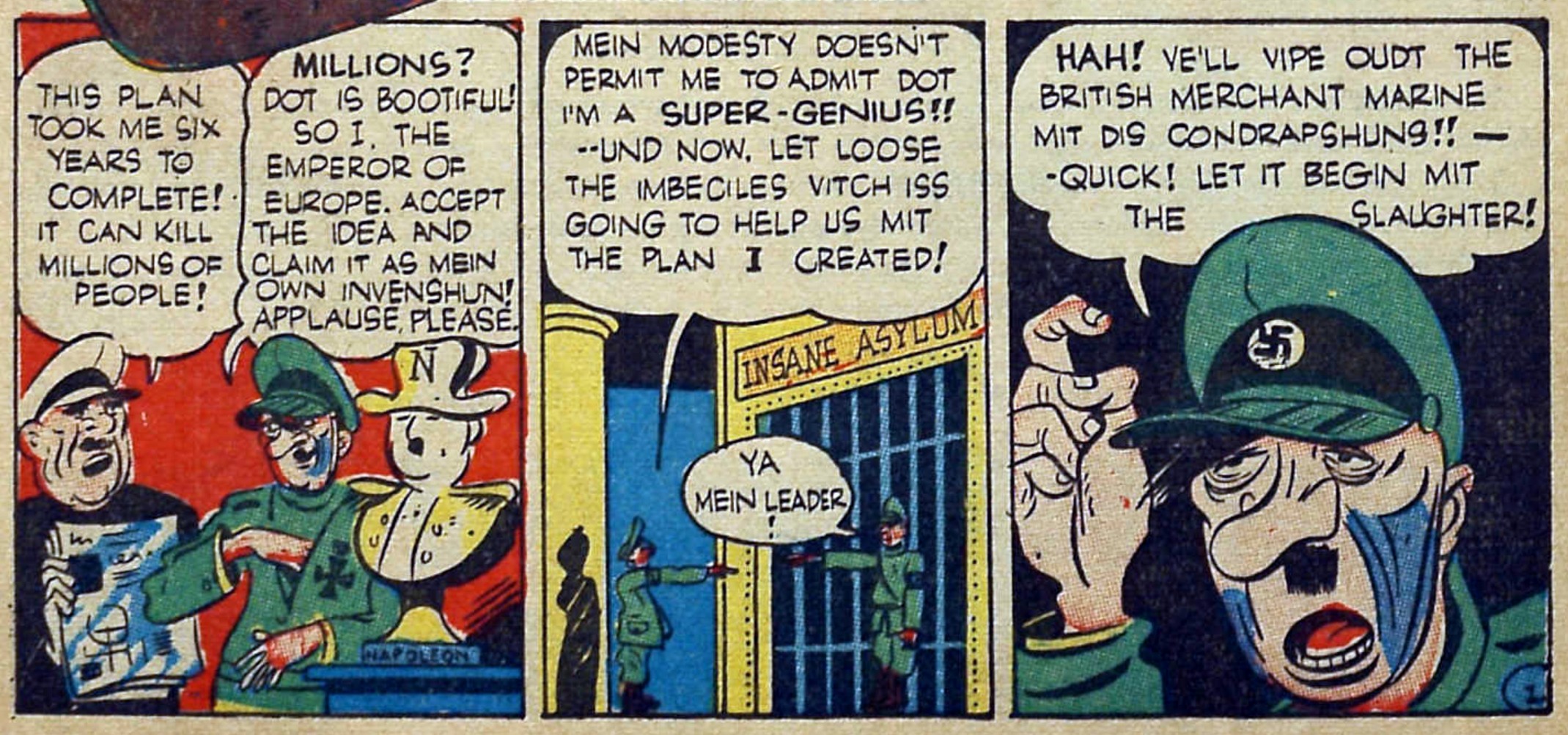
    A particularly parodic version of Hitler deploys a super weapon that is ultimately thwarted by Dickie Dean.  (Silver Streak Comics 017, 1941) 

    Charles Biro:

    Gangster Chick Biro almost gets killed by his boss the Domino but is saved when Presto Martin takes his place. (Silver Streak Comics 009, 1941)

    Genghis Khan:

    The Bingham Boys and their friends hunt down the Sword of Genghis Khan to a Tibetan lamasery, where the Grand Lama claims to be the descendant of the Khan and thus entitled to conquer the world. Our heroes beat up the would-be Khan and spirit the sword away to an American museum. (Silver Streak Comics 016, 1941)

    George Roussos: 

    It’s a classic case of slapping your fellow comic book creator’s name on a background sign as “Presto Martin” scribe Bob Wood uses Roussos’ name on an apartment building. (Silver Streak Comics 010, 1941)

    Next issue of the same strip features the headline “Roussos Does it Again! Famous Cartoonist Meets Second Deadline! I can hardly wait to read Roussos’ work in Daredevil Comics to see if he shoots back. 

    Same issue features Roussos’ Army & Navy Store, with a “Jerry Robinson, Prop.” thrown in for good measure. (Silver Streak Comics 011, 1941)

    George Washington: 

    Deploys his personal agent Dan Dearborn to escort a gunpowder shipment and help protect it from capture by the British. (Silver Streak Comics 008, 1941)

    George Rogers Clark: 

    That gunpowder is transported downriver by Clark, a Revolutionary War hero whom I was unfamiliar with and whose Wikipedia page is predictably fraught. (Silver Streak Comics 008, 1941)

    Captain John Neville: 

    Commander of the Fort Pitt garrison at Pittsburgh, where he briefly meets Dan Dearborn. (Silver Streak Comics 008, 1941)

    Mao Zedong: 

    He doesn’t play a direct role in the story, but Mao Tung here is definitely a stand-in for Mao Zedong, aka Mao Tse-tung. Captain Battle saves him from an assassination attempt by a Japanese spy. (Captain Battle Comics 001, 1941)

    Samuel Goldwyn:

    Goldbyn, head of Paragold Film Studios, is a classic stand-in for Sam Goldwyn of MGM. (Silver Streak Comics 017, 1941)

    Unknown News Broadcaster Jimmie Fidler: 

    As you can see, above, I was initially unable to find the reference point for Jimmy Fiddle here. The problem is that I have been conditioned to think a certain way about these stand-in names, so I spent a lot of effort looking for “James Diffle” and “John Oboe” and so forth, and didn’t even consider that it might be something as simple as “Jimmie Fidler” until I remembered that we had already encountered a Jimmy Fiddle and filed him under Unknown. 

    Sorry for disrespecting your 50+ year media career, Jimmie Fidler. In my defense, you retired when I was three years old. (Silver Streak Comics 009, 1941) 

  • CATALOGUE OF WOUNDS 006

    Why of why do they keep on hurting our boys?

    Meteor:

    Silver Streak’s partner Meteor is shot in the back by a Nazi, but it’s okay: the bullet only “nicked” his back. (Silver Streak Comics 016, 1941)

    Electro:

    Professor Zog, the brains behind Electro, is shot in the left arm. (Marvel Mystery Comics 016, 1941)

    the Sandman:

    The Sandman has a very rough 1940, starting with a shot to the right shoulder… (Adventure Comics 047, 1940)

    … then a shot to the left shoulder… (Adventure Comics 050, 1940) 

    … a second shot to the right shoulder… (Adventure Comics 055, 1940)

    … and the for symmetry’s sake, a second wound to the left shoulder (All-Star Comics 001, 1940)

    To add insult to injury, he has to have gotten at least a little radiation poisoning during his repeated encounters with the Yellow-Faced Terror and his killer radium ball. (All-Star Comics 002, 1940)

    Sargon the Sorcerer:

    Sargon the Sorcerer, shot in the left shoulder while trying to do his damn job. (All-American Comics 032, 1941) 

    Zatara:

    Zatara is shot in the right arm while hanging around a lost city of ape-men. (Action Comics 027, 1940) 

    Then he is shot in the left shoulder by an uncommonly fast-on-the-draw crook. (Action Comics 038, 1941)

    Zatara shot in the left shoulder again thanks to the fact that he overlooks a crook when making himself hypnotically invisible. (Action Comics 040, 1941)

  • MINOR SUPER-HERO ROUND-UP 080

    It’s a sidekick-heavy brew this time, chums.

    the Silver Streak **UPDATE**:

    It’s been a gradual thing but the Silver Streak has been getting closer and closer to not just going real fast and jumping far but actually flying. I don’t know if you can actually pinpoint the moment he made the transition but he is definitely on the “is flying” side of the equation by Silver Streak Comics 010, 1941. 

    Mercury:

    Although Whiz, King of Falcons is an exemplary sidekick to the Silver Streak, comic books are nothing if not prone to trends, and the trend for 1941 was for super-heroes to get kid sidekicks. And although there is only so much you can do to stand out among an army of gee-whillikering blonde boys, Mercury, aka the Boy Streak, aka Mickey O’Toole, does have a couple of aspects worth highlighting:

    The first of these things is his origin story. Mickey O’Toole is the appropriately hard-hitting son of the late boxer Slugger O’Toole, who was murdered mid-match because he wouldn’t take a dive. Mickey now shines shoes in order to provide for his widowed mother and disabled sister Mary. A sad tale indeed.

    The remarkable thing about Mickey’s sad backstory and struggling family the fact that it and they never come up again. Mickey starts hanging out with the Silver Streak and his family woes go right out the window. There’s even a hint at the end of his debut appearance that he will get the chance to bring the man who killed his father to justice, but writing duties on “Silver Streak” transfer from Bob Wood to Don Rico with the probably-pseudonymous Rex Richards in between and Mercury’s backstory gets lost in the shuffle.

    The second thing to note about Mercury is the origin of his powers: Silver Streak gives him a shot of secret super juice. Not anything to write home about in and of itself – every third super-hero is on some sort of serum or powder or elixir, after all – but because the common knowledge about this kid is that he got his powers from a Silver Streak blood transfusion. I myself asserted this in my entry on the guy! I mean, it’s not like we’re out there getting the origin of the Flash wrong or something but it is an interesting example of how misinformation can become more prevalent than fact (also this kind of clears up the mysterious origin of the Silver Streak’s own powers: he took the juice!) (Silver Streak Comics 011, 1941)

    Meteor:

    The third thing about Mercury is the fact that after two issues he is replaced by Meteor, the Boy Speed-King and no two of the half dozen nerds who care about this kind of thing can agree on whether Mercury and Meteor are the same kid with two different names or two different kids with no explanation of where the first one went or the second one came from, with the argument fr the second position boiling down to the fact that they never say that the two are the same. 

    Personally, I lean toward the “one kid, two names” hypothesis, as it’s slightly cleaner. Why invent a whole new kid? (Silver Streak Comics 013, 1941)

    Categorized in: Elements (Mercury), Locations (Space Places), Origins (Sidekicks) 

    Whiz, King of Falcons **UPDATE**: 

    Whiz, King of Falcons, the Silver Streak’s original sidekick, in perhaps his final appearance before he is supplanted by one or more flying kids, demonstrates the heretofore-unseen ability to talk. And to be an annoying smartass, if I’m honest. Whiz returns later on in Silver Streak’s career, so it’ll be interesting to see if he retains this ability. (Daredevil Comics 001, 1941) 

    Captain Battle:

    Captain Battle: patriotic hero, scientist, former soldier and in fact World War One veteran, in which conflict he lost his left eye. Lest we think him too old, the text is at pains to reassure us that he was in fact the youngest person to fight in the Great War, which I think is supposed to make him seem tough but mostly instills a deep horror in my being. Particularly after I looked it up and found that that would make him something like seven years old, at least until a few issues later when they clarify that he was the youngest member of the American Expeditionary Forces, making him a comparatively venerable 12 or so.

    Like many patriotic heroes there isn’t a lot going on with Captain Battle beyond his love of country, but here are all of the interesting trappings of his character:

    1. His assistant, Jane Lorrain: she’s got a rhyming name and she’ll push back on sexist language. Like many potentially interesting female supporting cast members she is pretty thoroughly sidelined once Battle gets a sidekick.

    2. His patriotism. Not only is he dedicated to the defense of the US but he has sworn to only defend the US. He helps save a British fleet in his first appearance explicitly because they act as a buffer between the Axis Axian Powers and America. Presumably he would otherwise let them be destroyed. Every once in a while when he is not directly helping an American he gets kind of huffy about it.

    3. His gadgets, while not unique, have very cool names, including the Curvoscope (remote viewer), the Dissolvo (death ray pistol) and the Luceflyer (jetpack). The Dissolvo is also really disgusting, as it melts its target into a quivering pile of goo. (Silver Streak Comics 010, 1941)

    Captain Battle gets a couple of issues of his own comic in 1941 and for precisely one story he makes an extremely feeble attempt at having a secret identity with no consideration for the fact that a) there aren’t a lot of guys running around with eye patches in any given area, which makes the usual secret id excuses appear even more ridiculous and b) Captain Battle’s real name is in fact Captain Battle. “You know, I never see Captain Battle and Captain Battle in the same room together…” Ridiculous.

    If I’m honest the story in question has a couple of indications that it originally starred another character and Captain Battle was a late addition, and if that is the case then the secret identity stuff is just a holdover from that. (Captain Battle Comics 001, 1941)

    Categorized in: Accessories (Various), Origins (Patriotic Heroes), Origins (WWI Vets)

    Hale Battle:

    The prevailing trend in 1941 was for super-heroes to have sidekicks and so Captain Battle eventually gets a sidekick. But just how does he acquire a boy? Very simply! See, Battle’s recurring foe the Black Dragon (tune in tomorrow for that jerk) had a thing where he turned people into giant bird-man minions called Deaglos, and the final Captain Battle/Black Dragon confrontation the surviving Deaglos were all restored to their human forms. Most of them were adult men who had lives to return to, but among them was one unclaimed boy.

    Note that the boy gives his name as “Nathan Hale” and Captain Battle immediately renames him “Hale Battle.” This is weird. It’s a weird thing to do. Particularly as “Nathan Hale” is a very patriotic American name, which Battle should totally be into! Also note just how small this kid is. This doesn’t last long, as he is definitely around the thirteen to fifteen year-old range that most Golden Age sidekicks fall into and is drawn to look more like it as time passes.

    Hale Battle is among the minority of Golden Age sidekicks who aren’t recruited as sidekicks but who insist upon becoming them. Not that Captain Battle puts up much resistance – once Hale gets this poor war refugee to sew him a uniform he’s got the job.

    Aside from these small points of interest, Hale Battle is one of the most generic sidekicks in comics. He does have a minor obsession with collecting souvenirs of his adventures, which is something I in turn enjoy writing about, but if I’m honest he approaches it without joy. It feels like an attempt to have more of a personality than a hobby. (Silver Streak Comics 012, 1941)

    Categorized in: Origins (Amnesiacs), Origins (Sidekicks)