The Curse of Skeleton Munroe

Category: Eastern Color

  • MINOR SUPER-HERO ROUND-UP 100

    MINOR SUPER-HERO ROUND-UP 100

    You like minor super-heroes? We got more than four hundred of them!

    the Night Bird:

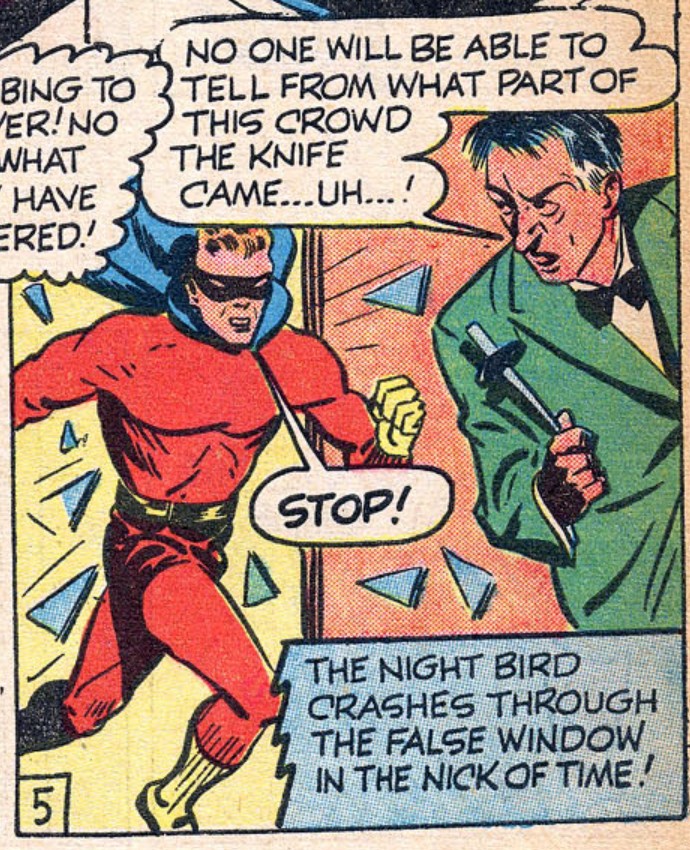
    The Night Bird might just have the simplest origin in the history of super-heroes: when newspaper Dell (just Dell) is captured by gangsters, her photographer Lens Crockett sets out to rescue her. Deciding that he needs a disguise, Crockett looks in the office storeroom and finds a full super-hero outfit stuffed in a bin – if it were about ten years later this might be a joke about Superman changing in the Daily Planet storeroom but he didn’t really get up to that so much yet so it’s just weird and random. Crokett’s costumed outing goes well, so he decides to keep going out there and fighting crime. And that’s the origin.

    The Night Bird (aka the Nightbird) only has a bare handful of appearances, so he doesn’t get a lot of room for character development. There are a couple of interesting things to note about him, however: firstly there isn’t even a hint of romantic feeling between Crockett and Dell which is always nice if only for the change of pace from the typical setup. Secondly, and in common with his fellow newspaper photographer the Fox, Lens Crockett seems to be a legitimate clumsy doofus in his civilian identity rather than a suave coolguy putting on an act. (Green Mask v1 006, 1941)

    The Night Bird also continues the grand Fox Features tradition of changing costume designs between issues with a palette swap between his first and second appearances. His costume continues to change in minor ways as time goes on, but this is the only major one.

    Categorized in: Animals (Birds), Day Jobs (Newspaper Photographers), Locations (Temporal Locations)

    the Tumbler:

    When famous circus acrobat Lee Brothers, known professionally as the Tumbler, goes to visit his old mentor Sockey, he finds him mixed up with a gang of payroll robbers who have decided to use his property as a hideout. Lee and Sockey manage to escape with the loot but Sockey dies in the process and Lee is reported dead.

    As is only sensible, Lee does not immediately clear up this mistake and go on with his life but takes this as an opportunity to adopt a costumed identity and get up to a little vigilante justice. His decision to do so while calling himself the Tumbler and thus inviting connection with the supposedly deceased Brother is a bit suspect, however. (Green Mask v1 007, 1941)

    This is even more in his second (and final) appearance, when he does the traditional costume change and just starts wearing his old acrobat costume again. Does the Tumbler want to have his identity revealed?

    Categorized in: Activities (Acrobatics), Day Jobs (Circus Acrobats), Professions (Acrobats)

    the Mechanized Skeleton:

    This was a surprising one! I really and truly thought that the Mechanized Skeleton was going to be a bad guy. This is mostly because he almost certainly was going to be one when he was first introduced, as can be deduced from the fact that the Skeleton’s creator Chico is ranting an raving about “having power” and “showing them all” as he assembles and tests his creation. As the Mechanized Skeleton had a very minor appearance in the 1940 run of Reg’lar Fellers Heroic Comics with the bulk appearing in the 1941 books I recently read I have been awaiting his return for more than a year, real-time, with the expectation that I would see some science skeleton-on-science zombie battling once it and the Purple Zombie finally met.

    Chico doesn’t do much to dispel my assumptions about him and his creation in his next couple of appearances, as he demonstrates a very loose attitude to law and order: in Reg’lar Fellers Heroic Comics 004 he attempts to steal Purple Zombie creator Kim Hale’s car, only to lose his Skeleton (and inadvertently save Hale’s life) when a car bomb goes off. Then in RFHC 005, Chico attempts to procure a set of clothing for the replacement Mechanized Skeleton he has just completed by driving a car off the road and killing all of the occupants. Was the car full of gangsters who had kidnapped the Purple Zombie in an attempt to recruit him into their gang? Yes it was. Did Chico know this? No he didn’t – the car might have been filled with nuns and orphans as far as he was concerned.

    (please note that issue 005 does feature my anticipated Purple Zombie/ Mechanized Skeleton battle and that the Skeleton is comically outmatched) 

    Despite all of this evidence of Chico’s villainous nature, once Kim Hale and the Purple Zombie get ahold of him he suddenly reveals that he, like Hale has created his scientific version of a Halloween monster not for evil but for the betterment of mankind. Specifically, he made them as a foil to a Nazi death ray that has been giving the Allies a lot of trouble – what better foil to a death ray than the already-dead, after all? Such is the power of Chico’s newly-revealed convictions that the Purple Zombie goes with him when he sneaks off in the night to battle the Hun.

    And it works! The Purple Zombie leads a squad of Mechanized Skeletons (all hilariously decked out in doughboy helmets) to victory in just a couple of pages!

    Chico requests (and receives) a hero’s burial for the Mechanized Skeletons, causing me to wonder for the first time just where he got the base materials for them from. Though they are gone for good, Chico himself stays on as a supporting cast member during the next phase of the Purple Skeleton’s career as he and Kim Hale are basted back in time. (Reg’lar Fellers Heroic Comics 003, 1940)

    Categorized in: Origins (Face Turns), Origins (Robots), Supranormal Beings (Undead (Skeletons))

    Man O’Metal:

    In addition to having on of the more strangely-constructed names in comics, Man O’Metal, aka Pat Dempsey, has a bafflingly straightforward origin on par with his fellow Eastern Color character Fearless Flint: while working in a foundry one day, Dempsey is caught in a flood of an unspecified molten metal, and instead of dying horribly he transforms into a superhuman metal man. It’s a weirdly modern style of origin in that there is absolutely no attempt to introduce an external catalyst for this change – if he were a DC Comics character he would just turn out to have the metagene, for example.

    Man O’Metal is like Fearless Flint in a couple of other ways: firstly, his power switches off after a few minutes, but can be restarted by the touch of metal (including incoming bullets, which proves to be handy). This requirement later changes from metal to heat or electricity, but the bullets are evidently hot enough to qualify. 

    Dempsey’s boss is underwhelmed by the prospect of having a white-hot metal guy running around his foundry and so he just kind of gives him to the FBI without really consulting him on whether this is something he might want to do. The FBI have a bit more vision re: the potential inherent in a superhuman employee and happily accept. He is immediately sent off to Badagero, South America to root out subversives. (Reg’lar Fellers Heroic Comics 007, 1941)

    Categorized in: Elements (Metal), Origins (Material Mutates), Team Memberships (FBI)

    Very Minor Hydroman Updates: Hydroman is confirmed as vulnerable to freezing (Reg’lar Fellers Heroic Comics 004, 1941), is now wanted by the police (Reg’lar Fellers Heroic Comics 007, 1941).
  • MINOR SUPER-HERO ROUND-UP 092

    MINOR SUPER-HERO ROUND-UP 092

    Who ever thunk that there could be quite so many minor super-heroes?

    Invisible Scarlet O’Neil:

    Young Scarlet O’Neil, being the kind of person who will touch an arc of mysterious energy in her scientist father’s lab, finds herself rendered invisible, a condition that she eventually learns is reversed by touching a certain nerve in her wrist.* She uses this power to fight mid-tier injustice eventually (I am assured) parleys it into a career as a newspaper reporter. Before that, she functions as a very low-level vigilante – she solves some crimes, yes, but also gets mixed up in a lot of people’s personal lives. She is also one of the few invisible characters to regularly suffer any consequences for going out in public without reflecting any light: she is regularly beaned by baseballs, pushed into traffic, etc.

    Sticklers might note that “Invisible Scarlet O’Neil” was a comic strip first and that what I am showing here are images from the comic book reprints of such, and I must confess that I do not have the wherewithal to source comic strip dates every time I want to refer to this character. All references to her will be from the Eastern Color comics. (Famous Funnies 081, 1941)

    *As presented, the timeline is extremely sad: 1) her father accidentally causes her to become invisible by not taking her poor lab safety practices into account 2) he works to find a cure but cannot 3) he dies, presumably in despair over his child’s life of invisible obscurity 4) she figures out the nerve thing

    Categorized in: Body (Invisible), Origin (Mysterious Ray Mutate), Power (Invisibility)

    Fearless Flint, the Famous Flint Man:

    Jack Bradley, a worker on the carving of Mount Rushmore (and let me tell you: every time I think that I’m done being surprised by the real-world events that super-hero origins are being roped into I am dead wrong) is flung down the face of the mountain when his pneumatic drill is sabotaged. Instead of being killed horribly as one might expect, Jack survives because the flint shards that litter the Rushmore debris field merge with his skin rather than shredding it. Now, upon touching any metal, he turns to red hot flint complete with little sparks flying off of him, and becomes super strong and invulnerable. A few things:

    – Flint’s elemental transformation is very on brand for the small stable of Eastern Color super-heroes, cv Hydroman, the upcoming Man o’Metal, etc.

    – Despite the fact that he requires the touch of metal to transform, Flint notably fails to consider carrying any around with him in any of the half dozen of his adventures I have flipped through. He always needs one of his enemies to bop him with a metal weapon or push him into a railing or drop a chandelier on his head, and in later adventures simply turns to flint when he gets angry.

    – Flint’s drill was sabotaged by agents of the Lava Man, his first enemy, whose appearances are serialized across half a dozen issues in 1942 and who we will be covering once that year rolls around. I will give you a spoiler, however: he has absolutely no reason to have sabotaged the construction of Mount Rushmore, so either this was a classic example of the Reel (agents of a super-villain go far afield for no reason other than to draw the hero to a second location and move the plot forward) or the Lava Man is very sympathetic to the plight of the Sioux people.

    – Finally, I looked very hard and while I can’t say this with 100% certainty I can do so at 95%: the Black Hills in general and Mount Rushmore in particular do not seem to be particularly rich in flint. But maybe that’s the secret to Flint’s transformation, that they were magic flint shards that shouldn’t ought to have been there.

    All in all a true oddball of a character as befits a member of the Eastern Color stable. (Famous Funnies 089, 1941)

    Categorized in: Element (Minerals (Flint)), Origin (Material Mutate), Power (Phyiscal Transformation, Super Strength)

    the Sixth Column:

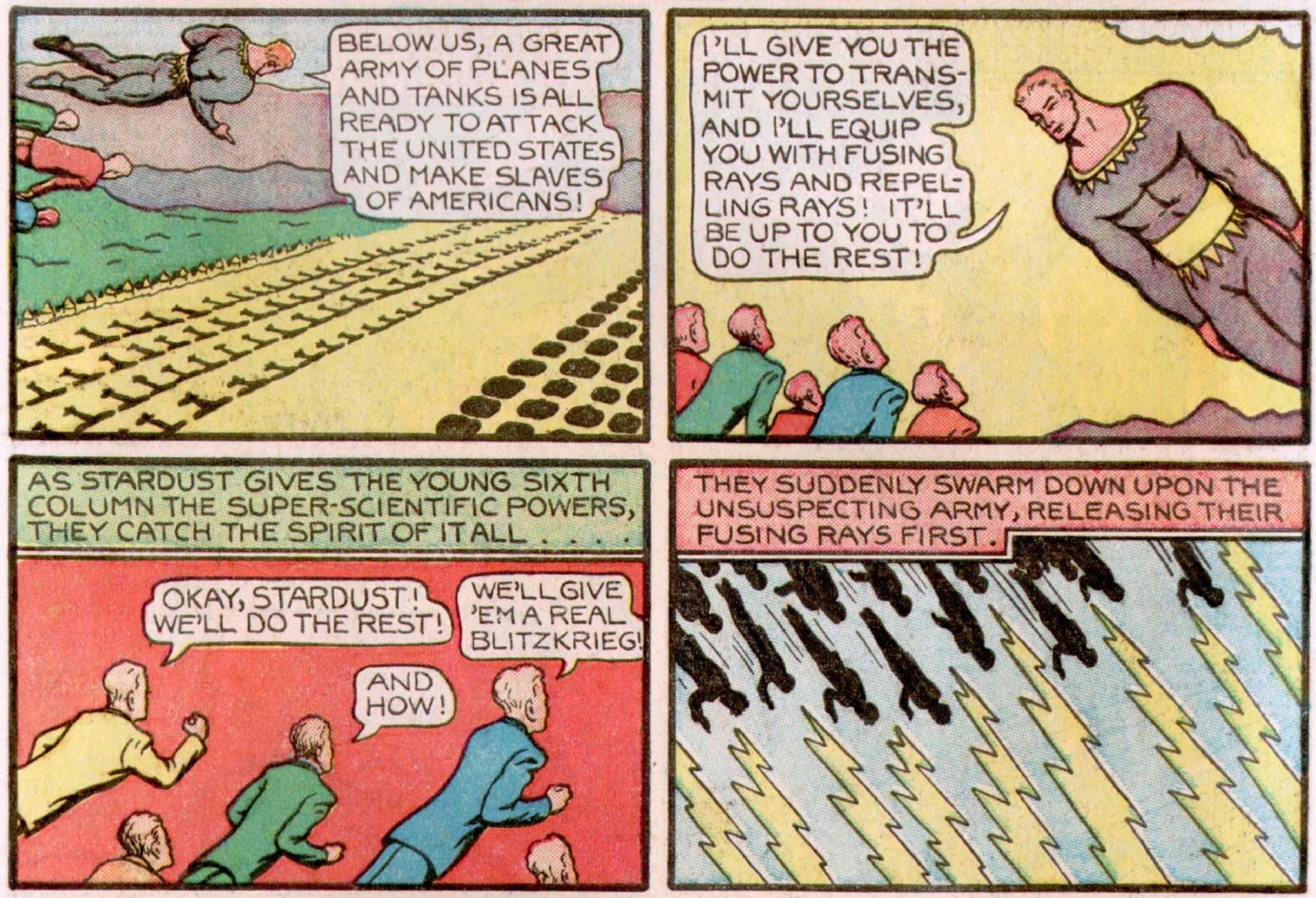
    Nineteen Forty-One: Stardust the Super Wizard, concerned about a mass mobilization of Axis fifth columnists into the Americas, vows to form a sixth column to counter their efforts. As his agents, he chooses the boys of the United States (more on this). Also please note that in between declaring that he would found the Sixth Column and actually getting around to doing so, Stardust roots out and murders every Fifth Columnist in America as part of his defense of Earth against the Martian Sky Demons.

    With no counter-espionage work to do, the Sixth Column is instead given a portion of Stardust’s power (flight, fusing rays to mess up the enemy’s war machines, repelling rays to levitate the enemy troops) and set loose as a super powered child army versus an Axis invasion force that is approaching from South America. (Fantastic Comics 014, 1941)

    The Sixth Column returns in Fantastic Comics 015, and this time they get official Stardust the Super Wizard outfits. In addition to the star-metal costumes (possibly invulnerable), the boys are equipped with mind-reading devices to root out fifth columnists and metal-repelling rays to protect the US from enemy missiles. Curiously, this time they are not given the power of flight.

    The thing that I find myself thinking while reading the two stories featuring the Sixth Column is “why is Stardust doing this?” It’s not for any lack of ability to keep on top of things, that’s for sure, as the boys do not do anything that Stardust hasn’t already done on a bigger scale, and in any case he is monitoring them the entire time as seen here when they lose control of a missile and destroy an ocean liner and he jumps in to take over immediately.

    Is it meant to be some sort of mentoring? Of ensuring that there will be a new stardust? Is he just bored? He’s probably just bored with crime fighting while being so grotesquely overpowered, isn’t he.

    Categorized in: Alphanumeric (Six), Origin (Sidekicks), Powers (Various) 

    Stardust the Super Wizard **UPDATE**:

    And speaking of Stardust the Super Wizard: we’ve seen him shapeshift before and we’ve seen him impossibly grab a man by the torso before but in this, his very last appearance, he combines the two by grabbing the villain “Slant-Eye” with a gross tentacle hand. It truly is an iconic image for the guy to go out on. (Fantastic Comics 016, 1941)

  • REAL PERSON ROUND-UP 018

    World leaders and others. 

    Adolf Hitler: 

    I’m pretty sure that the “Navy Jones” strip is set in an undefined near-future time, which makes the Dictator of Europe here a future analog of Adolf Hitler rather than a stand-in for him. I’m almost certain that that’s the case. Anyway, he tries to invade the US with a fleet of amphibious tanks and gets his ass handed to him by Navy Jones and his fish men. (Weird Comics 008, 1940)

    Chiang Kai-shek and Soong Mei-ling: 

    Styled as Madame and Generalissimo “Kang Shy-check,” the former comes to adventurer Shanghai Sheridan for aid after the latter is captured by Japanese collaborator Wu Fang. (Top-Notch Comics 005, 1940)

    Clyde Beatty: 

    Famous animal trainer and circus mogul Clyde Beatty had a long-running strip across several Dell Comics titles, though given that the supporting cast and premise tended to reset to zero every time the strip changed hands it might be more accurate to say that he had a sequential series of features linked only by his presence. (Crackajack Funnies 001, 1938)

    Franklin Delano Roosevelt:

    A fairly off-model FDR chairs an emergency meeting to discuss what to do about an alien invasion. (War Comics 002, 1940)

    J Edgar Hoover: 

    The Sparkler accepts an assignment from “head G-Man”/his old college roommate’s dad M.L. Roover. (Wham Comics 002, 1940)

    Sténio Vincent: 

    I don’t necessarily trust the creators of the “Voodoo Man” feature to even remember that it is set in Haiti, let alone go to the trouble to accurately represent Haiti’s president on-panel, so I have to give it to them: this is an okay drawing of Sténio Vincent, the President of Haiti c. 1940. Was it done on purpose? Nobody can say. (Weird Comics 004, 1940) 

    Gaius Marius & Sulla: 

    It’s impossible to be certain if Marius and Sulla, the Roman figures associated with the origin of super-hero the Dart, are in fact meant to be Gaius Marius and Sulla, the political figures from the late Roman Republic, but the timeline almost matches up. Plus, there really weren’t that many Sullas running around Rome. (Weird Comics 005, 1940) 

    Mata Hari: 

    Just a notorious spy named Hattie Mary in the comedy melodrama comic strip “Hairbreadth Harry”. (Famous Funnies 074, 1940) 

    Winston Churchill: 

    Inspector Blake of Scotland Yard is called to 10 Downing Street to talk to the Prime Minister, and it sure doesn’t look like he’s Winston Churchill. I do like to roast comics for not getting the appearances of world leaders right, but when it’s somewhere like Madagascar you might at least have the excuse that finding a picture of the current leader of that country might be difficult in the US in 1940, but surely this not so for the Prime Minister of the UK.

    The other possible defense for this, of course, is that this comic came out in June 1940 and Churchill took power in April so Neville Chamberlain might still have been PM when this was drawn, but this is hampered somewhat by the fact that it doesn’t really look like him either. (Whirlwind Comics 001, 1940)

  • REAL PERSON ROUND-UP 018

    World leaders and others. 

    Adolf Hitler: 

    I’m pretty sure that the “Navy Jones” strip is set in an undefined near-future time, which makes the Dictator of Europe here a future analog of Adolf Hitler rather than a stand-in for him. I’m almost certain that that’s the case. Anyway, he tries to invade the US with a fleet of amphibious tanks and gets his ass handed to him by Navy Jones and his fish men. (Weird Comics 008, 1940)

    Chiang Kai-shek and Soong Mei-ling: 

    Styled as Madame and Generalissimo “Kang Shy-check,” the former comes to adventurer Shanghai Sheridan for aid after the latter is captured by Japanese collaborator Wu Fang. (Top-Notch Comics 005, 1940)

    Clyde Beatty: 

    Famous animal trainer and circus mogul Clyde Beatty had a long-running strip across several Dell Comics titles, though given that the supporting cast and premise tended to reset to zero every time the strip changed hands it might be more accurate to say that he had a sequential series of features linked only by his presence. (Crackajack Funnies 001, 1938)

    Franklin Delano Roosevelt:

    A fairly off-model FDR chairs an emergency meeting to discuss what to do about an alien invasion. (War Comics 002, 1940)

    J Edgar Hoover: 

    The Sparkler accepts an assignment from “head G-Man”/his old college roommate’s dad M.L. Roover. (Wham Comics 002, 1940)

    Sténio Vincent: 

    I don’t necessarily trust the creators of the “Voodoo Man” feature to even remember that it is set in Haiti, let alone go to the trouble to accurately represent Haiti’s president on-panel, so I have to give it to them: this is an okay drawing of Sténio Vincent, the President of Haiti c. 1940. Was it done on purpose? Nobody can say. (Weird Comics 004, 1940) 

    Gaius Marius & Sulla: 

    It’s impossible to be certain if Marius and Sulla, the Roman figures associated with the origin of super-hero the Dart, are in fact meant to be Gaius Marius and Sulla, the political figures from the late Roman Republic, but the timeline almost matches up. Plus, there really weren’t that many Sullas running around Rome. (Weird Comics 005, 1940) 

    Mata Hari: 

    Just a notorious spy named Hattie Mary in the comedy melodrama comic strip “Hairbreadth Harry”. (Famous Funnies 074, 1940) 

    Winston Churchill: 

    Inspector Blake of Scotland Yard is called to 10 Downing Street to talk to the Prime Minister, and it sure doesn’t look like he’s Winston Churchill. I do like to roast comics for not getting the appearances of world leaders right, but when it’s somewhere like Madagascar you might at least have the excuse that finding a picture of the current leader of that country might be difficult in the US in 1940, but surely this not so for the Prime Minister of the UK.

    The other possible defense for this, of course, is that this comic came out in June 1940 and Churchill took power in April so Neville Chamberlain might still have been PM when this was drawn, but this is hampered somewhat by the fact that it doesn’t really look like him either. (Whirlwind Comics 001, 1940)

  • MINOR SUPER-VILLAIN 856: THE PANTHER

    (Famous Funnies 067, 1940)

    The Panther is a no-nonsense Western gang boss who actually avoids a lot of the common missteps of the average super-villain by running an extremely tight ship in her munitions-smuggling gang. Is maintaining workplace discipline with a bullwhip the best idea? No, but it is better than workplace explosions.

    The Panther’s downfall starts when she puts a little two much trust in her lieutenants, Luis and Ramon, and they immediately go out and do some unsanctioned train robbing. Trouble is, the robbery was somehow pinned on Lone Rider, who ends up escaping the law and stumbling around in the desert until he passes out on the Panther’s front door. It’s hardly the most efficient way to infiltrate a gang, but it works.

    The Lone Rider (going by the name Lightnin’, which is his horse’s name) proves his worthiness to join the gang by beating all of the Panther’s specialists: he out-shoots Tex the gunhawk and out-fights Santos the strong man and then as a bonus because Santos is a poor loser the Panther gets to show off the fact that she can pick a knife out of the air with her whip.

    Luis and Ramon eventually decide that they could do a better job at running the gang than the Panther (despite all evidence to the contrary) and rally the rest of the men to join them. The Panther proves them all wrong of course, when she deploys the knockout gas system that she had put in place outside of her fortified chambers for this very reason. The only unexpected variable turns out to be Lightnin’, who reveals himself to be the Lone Rider and turns her over to the authorities.

    Ultimately the Panther doesn’t really get enough room to shine – she has sick whip skills, a pet panther, special lieutenants, a secret mountain base and good (criminal) business acumen – the conflict with Luis and Ramon is over expanding their purview to include kidnapping, and she is right to tell them no! They’re running a clandestine smuggling operation, while kidnapping is by its very nature a very attention-getting crime! It’s a hard life out there for a competent villain.

  • MINOR SUPER-HERO ROUND-UP 049

    Pretty diverse bunch this time.

    the Lone Rider: 

    Another masked cowboy hero dispensing justice from the barrel of the gun in the Old Modern West to throw in the pile. The Lone Rider does have the distinction of having been created by Jack Kirby for a very short-lived comic strip and recycled by Eastern Color for comic book content. 

    Having read through a decent chunk of the Lone Rider’s appearances, I’m pretty sure that Texas never actually put in an appearance, and that Pepito had maybe one panel to shine in – those are the risks you run when you start off with a cast of characters entry, I suppose. (Famous Funnies 062, 1939)

    the White Streak: 

    Discovered by archaeologist Simms and his guide Ramon in a temple that is inside of a small mountain that has risen out of a dead volcano (which is in turn in the fictional country of Payan, in  actual South America), the White Streak is an android built by the ancient dead civilization of Utopia, which perished in war and gifted their creation to the future as a way to prevent war from destroying any more civilizations. And by “the White Streak” I mean “Manowar,” which was clearly intended to be his super-hero name but was changed  for some reason – he’s barely even referred to as the White Streak for the first issue. Whatever his name, he took his mission very seriously: if you were in the business of promoting or profiting from war you could expect a very violent visit from the White Streak.

    At first, Manowar’s powers were limited to his electric vision and a bit of enhanced agility, but over time they expanded to include super strength, an electrical force field that still sometimes unnervingly came out of his eyes, and electrical constructs (most frequently a ladder, for some reason). (Target Comics v1 001, 1940)

    UPDATES: 1940 

    Boystate: 

    Okay, so Boystate is an indeterminably large chunk of land somewhere in the US within a few hours drive from NYC, containing a city (Boyville, natch) and founded and run by a fellow known as the Skipper (the Confederate officer-looking fellow, above) and his aide the Captain (the other guy). Boystate is unsurprisingly populated by boys, and has as its charter a dedication to bringing those often troubled boys up to be fine upstanding men.

    Of course this is all taking place in a comic that is written and set in 1940, so the comic’s views on how boys might be guided into that upstanding manhood involve a lot of homemade militia activity and discipline through violence, as seen here as new recruit Speck is smacked down by Boystate Ranger V.Y.

    The other hallmarks of the Boystate comics are 1) a deep love of pointless callsigns – everyone is V.Y. or X-1 and travel from Point 6-A to Tower 2-R and on and on in a way that makes your eyes glaze over, and 2) an absurd variety of cosmic ray-powered sci-fi technology, courtesy of the Skipper’s genius.

    In addition to the identity-stripping numerical designations, Boystate is simply chockablock with pseudo-military ranks and divisions for the boys to aspire to join so that they can spend their time patrolling Boystate airspace and riding her borders and chasing down passing cars to check if they’re stolen… frankly, if they weren’t collectively the protagonists of a comic book series in which they are described a good and true and aspirational Americans I would be tempted to call Boystate a nightmarish authoritarian police state/cult. Did I mention that the Skipper not only has a machine that can take video of anywhere in Boystate but also one that can read minds? (Target Comics v1 001, 1940)

    Spacehawk:

    As a big fan of Basil Wolverton, I wish that he’d had more opportunities to create science fiction comics during the time that he was interested in doing so, but in the absence of that, Spacehawk is pretty great. A mind-reading physical titan of unknown origin who metes out justice to the scum of the Solar System, Spacehawk is much more of a space-based super-hero than his contemporaries, and his alien foes are appropriately Wolvertonian grotesques who reflect their evil nature in their outward appearances.

    Sadly, Novelty Press was The Company Where Whimsy Was Not Welcome, and in 1941 Spacehawk was relocated to Earth to battle the Axis instead of all of those unrealistic aliens. Don’t get me wrong: Basil Wolverton comics about Spacehawk beating up Nazis are still pretty great, just not as great as ones about him beating up aliens. The move to 1940s Earth does introduce the as-far-as-I-know never answered question of just where all of the humans in the earlier Spacehawk comics were from, which is a fun if brief diversion.

    Finally, there’s a very minor bit of suspense in the first few Spacehawk stories over just what he is under that mask of his – an alien? a robot? something weirder? – but it turns out that he’s a hunk. Spoilers, I guess. (Target Comics v1 005, 1940)

  • REAL PERSON ROUND-UP 007

    It’s a bumper crop of real people (and famous fictional ones) showing up in comics!

    Adolf Hitler:

    This is very, very tenuous but this adventure story is concerned with a hunt for mythical man-goat lycanthropes known as “weredolfs” and I’ll be danged if I can think of a reason for them to be called that other than as a very oblique jab at Adolf Hitler. (Hyper Mystery Comics 001, 1940)

    Less tenuous: when Cartho (one of the seemingly limitless number of lost empires dotting the jungles of Africa) attempts to invade Camilla’s Lost Empire, its jerk of a leader is of course named Hitlo. (Jungle Comics 010, 1940)

    Mias here is the leaser of a small Asian country that has set its sights on conquering the Philippines. He’s a pastiche of 40s dictators but his Hitlerian traits shine brightest. (National Comics 003, 1940)

    FDR:

    Minor appearances:

    Congratulates Wonder Boy for helping some farmers (National Comics 005, 1940)

    the Forty Thieves:

    It’s never really explained how, but the Forty Thieves of Arabian Nights fame steal the Ophar Jewel from a lady in modern London and Merlin the Magician heads back in time to get it back with the help of a contemporary Cockney street gang. (National Comics 004, 1940)

    Jack Dempsey:

    Former boxing champ Jack Dempsey and his New York restaurant pop up with a fair frequency in 1940s comics, particularly ones featuring boxers such as Kid Dixon here. Why he and other boxers tended to show up under their own names rather than under flimsy pseudonyms like “Dack Jempsey” is a mystery – although I suppose that the real life boxing community had already proven to be okay with showing up in the “Joe Palooka” comic strip so perhaps comics creators assumed that they would be fair game. (National Comics 003, 1940) 

    John D Rockefeller:

    Minor appearances:

    Never-seen millionaire and target of criminal scientist von Lohfer is by context clues an analog of Rockefeller. (National Comics 005, 1940)

    Michael Malloy:

    The story of Michael Malloy, the seemingly unkillable man targeted by a gang in a life insurance racket, is an evocative one, so it’s unsurprising to see it crop up as a comic book plot here and there. Happily for Malloy’s in-story equivalent Milligan, the gang is rounded up by comic book artist/ detective Pen Miller before they are finally able to overcome his iron constitution. (National Comics 002, 1940)

    Neville Chamberlain:

    The Kid Patrol, a mid-to-low-tier kid gang, encounters this clearly allusive lad, Sir Chamberlain Bumbershoote by name, while they are being pranked and vexed by another gang. Weirdly, though Bumbershoote’s talk of appeasement and attempt to get a signed nonaggression pact with this very Hitlerian gang leader are presented derisively he himself is a formidable figure who routs the entire gang with his trusty umbrella. Neville Chamberlain must have been hovering precisely on the precipice of becoming an historical punchline when this one was published. (National Comics 006, 1940)

    Ruby Keeler:

    Hollywood comic strip ‘Olly of the Movies,’ well into its second year, was overdue for some gratuitous movie star cameos so actress Ruby Keeler just kind of shows up on a beach along with Dick Powell and Busby Berkeley. Everyone says hello and then parts ways. (Famous Funnies 023, 1936)

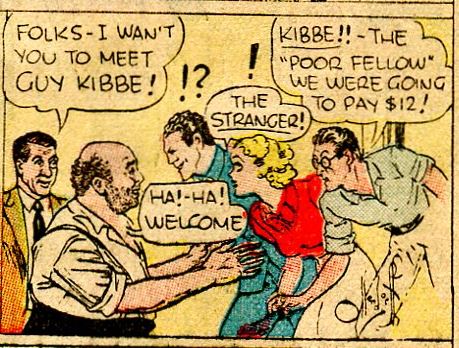
    The gratuity continues in the next issue, with perfunctory appearances by Hugh Herbert, Joan Blondell and Zasu Pitts, and with Guy Kibbee in a very minor role in the actual plot. (Famous Funnies 024, 1936)

    (Famous Funnies 024 also features this crowd of what are presumably supposed to recognizable Hollywood faces but I can only identify Bing Crosby in the yellow sweater vest and then only because someone did an impression of him on the previous page. Bub bub boo!)

    Sherlock Holmes: 

    They may not have given him a parody name, but Dinky Dinkerton here is clearly a Holmes parody comedy character, aided by Doctor Philip Anbust (aka Sniffy) in the Watson role (the third member of the trio, secretary Flossie, is not a Holmes character parody but is the brains of the operation, something that Holmes pastiches often leave out, to their ultimate detriment). (Reg’lar Fellers Heroic Comics 001, 1940)

    Another broad Sherlock Holmes pastiche is the unfortunately-named-to-modern-eyes Fuller Spunk, who is actually an actor known for playing “Herlock Olmes”, so perhaps he is more of a reference to Basil Rathbone. (interesting to note that the character of Marcel was originally bringing “female impersonation” to the group but that that skill was tossed aside in favour of a suite of stage magician tricks) (Hyper Mystery Comics 002, 1940)

    Shoshenq I:

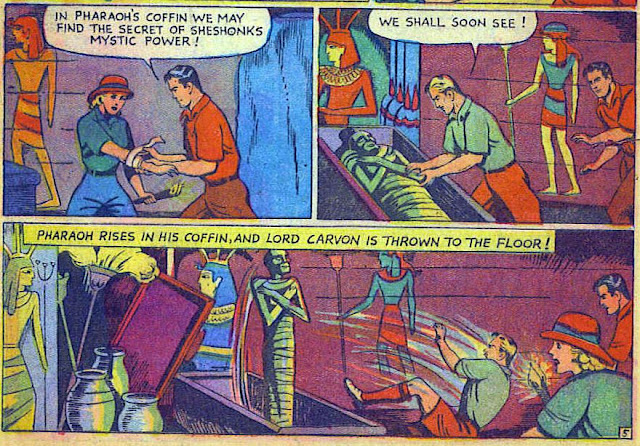
    In Jungle Comics 011, previously straightforward jungle explorer Roy Lance goes nuts for discovering the mystic secrets of the pharaohs* and specifically for finding the genie-controlling power of Sheshonk. Who is Sheshonk, you ask? Why, he is better known as Pharaoh Shoshenq I, more famous than he might otherwise be because he is associated with the Biblical figure Shishak who warred against Solomon and looted the treasures of the Temple – he is mentioned as having been the one to hide away the Ark of the Covenant in Raiders of the Lost Ark, for example. (Shoshenk I is also a candidate to be the father of an Egyptian princess married to Solomon, which the story alludes to by calling him “father-in-law to King Solomon”)

    *based on the fact that both the Roy Lance and Red Panther stories in Jungle 010 were out-of-context sci-fi adventures and that the Simba story in 009 was made up of repurposed panels from earlier Simba stories I suspect that Fiction House had gotten a bit behind and were renaming characters in any old stories they had spare in order to make deadlines.

    This story also features two other possible allusive figures: Lance’s doomed companion Lord Carvon seems likely to be a reference to Lord Carnarvon of the Curse of King Tut fame, while “Tera Bey, Mistress of Mysteries” is a figure as evocative as she is elusive. Literally the only thing I have been able to come up with is the possibility that she is a reference to Queen Tera, mysterious ancient mummy from the Bram Stoker novel The Jewel of Seven Stars, but it’s equally likely that she is a made-up bit of deus ex machina to get our heroes out of a sealed tomb. (Jungle Comics 011, 1940)

  • GENERIC COSTUMED VILLAIN ROUND-UP 016

     Bless ’em, they’re trying.

    The first few adventures of Hydroman, a character I have an inexplicable affection for, are concerned with what at first seems like some real standard Yellow Peril bullplop (“Oriental invaders” and so forth) but then there are gangsters involved and the two factions variously mention a higher-up named “the Great One” and “the Big Boss”, respectively. Still later, the whole operation seems to be run by this collection of pseudo-Nazis on a yacht in New York Harbor. It looks like the bald guy in the monocle might be in charge but the whole issue of just who exactly the Great One is is ultimately rendered moot by Hydroman blowing up the yacht and killing them all before their org chart is fully conveyed. 

    Good costumes on those henchmen, though. (Reg’lar Fellers Heroic Comics 001, 1940)

    I quite like “the Snarl,” the nom de crime that this fellow has chosen for himself, and he gets up to all sorts of classic villainy to boot: bank robbery, deathtraps, sending taunting notes to the police, mass murder, etc, but he gets caught with ease by semi-comedic actor/detective Fuller Spunk in just a couple of pages so there’s not quite enough meat for a full entry. (Hyper Mystery Comics 002, 1940)

    Jungle comics are crawling with guys like Zan Marzov, a crook who murders and pillages with the aid of a gang of men dressed in leopard skins. Few can match his look, however. Between the leopard scar, haunted eyes, shrunken head necklace and horrible goatee, Marzov may have achieved the pinnacle of the Evil Explorer aesthetic. He ultimately gets blown up by virtuous explorer Buck Barton, by the way. (Jungle Comics 001, 1940)

    This guy calls himself Mr X and he has stolen a sacred mask from a temple in the jungle dimension that Fantomah calls home, thus invoking a curse that threatens to flood the entire land with boiling mud. Needless to say, Fantomah does not look kindly on that sort of behaviour and he is rounded up post haste and sent to a weird cavern to “eat mud and fire for the rest of your days.” Tough but fair, Fantomah! (Jungle Comics 008, 1940)

  • GENERIC COSTUMED VILLAIN ROUND-UP 016

     Bless ’em, they’re trying.

    The first few adventures of Hydroman, a character I have an inexplicable affection for, are concerned with what at first seems like some real standard Yellow Peril bullplop (“Oriental invaders” and so forth) but then there are gangsters involved and the two factions variously mention a higher-up named “the Great One” and “the Big Boss”, respectively. Still later, the whole operation seems to be run by this collection of pseudo-Nazis on a yacht in New York Harbor. It looks like the bald guy in the monocle might be in charge but the whole issue of just who exactly the Great One is is ultimately rendered moot by Hydroman blowing up the yacht and killing them all before their org chart is fully conveyed. 

    Good costumes on those henchmen, though. (Reg’lar Fellers Heroic Comics 001, 1940)

    I quite like “the Snarl,” the nom de crime that this fellow has chosen for himself, and he gets up to all sorts of classic villainy to boot: bank robbery, deathtraps, sending taunting notes to the police, mass murder, etc, but he gets caught with ease by semi-comedic actor/detective Fuller Spunk in just a couple of pages so there’s not quite enough meat for a full entry. (Hyper Mystery Comics 002, 1940)

    Jungle comics are crawling with guys like Zan Marzov, a crook who murders and pillages with the aid of a gang of men dressed in leopard skins. Few can match his look, however. Between the leopard scar, haunted eyes, shrunken head necklace and horrible goatee, Marzov may have achieved the pinnacle of the Evil Explorer aesthetic. He ultimately gets blown up by virtuous explorer Buck Barton, by the way. (Jungle Comics 001, 1940)

    This guy calls himself Mr X and he has stolen a sacred mask from a temple in the jungle dimension that Fantomah calls home, thus invoking a curse that threatens to flood the entire land with boiling mud. Needless to say, Fantomah does not look kindly on that sort of behaviour and he is rounded up post haste and sent to a weird cavern to “eat mud and fire for the rest of your days.” Tough but fair, Fantomah! (Jungle Comics 008, 1940)

  • GENERIC COSTUMED VILLAIN ROUND-UP 016

     Bless ’em, they’re trying.

    The first few adventures of Hydroman, a character I have an inexplicable affection for, are concerned with what at first seems like some real standard Yellow Peril bullplop (“Oriental invaders” and so forth) but then there are gangsters involved and the two factions variously mention a higher-up named “the Great One” and “the Big Boss”, respectively. Still later, the whole operation seems to be run by this collection of pseudo-Nazis on a yacht in New York Harbor. It looks like the bald guy in the monocle might be in charge but the whole issue of just who exactly the Great One is is ultimately rendered moot by Hydroman blowing up the yacht and killing them all before their org chart is fully conveyed. 

    Good costumes on those henchmen, though. (Reg’lar Fellers Heroic Comics 001, 1940)

    I quite like “the Snarl,” the nom de crime that this fellow has chosen for himself, and he gets up to all sorts of classic villainy to boot: bank robbery, deathtraps, sending taunting notes to the police, mass murder, etc, but he gets caught with ease by semi-comedic actor/detective Fuller Spunk in just a couple of pages so there’s not quite enough meat for a full entry. (Hyper Mystery Comics 002, 1940)

    Jungle comics are crawling with guys like Zan Marzov, a crook who murders and pillages with the aid of a gang of men dressed in leopard skins. Few can match his look, however. Between the leopard scar, haunted eyes, shrunken head necklace and horrible goatee, Marzov may have achieved the pinnacle of the Evil Explorer aesthetic. He ultimately gets blown up by virtuous explorer Buck Barton, by the way. (Jungle Comics 001, 1940)

    This guy calls himself Mr X and he has stolen a sacred mask from a temple in the jungle dimension that Fantomah calls home, thus invoking a curse that threatens to flood the entire land with boiling mud. Needless to say, Fantomah does not look kindly on that sort of behaviour and he is rounded up post haste and sent to a weird cavern to “eat mud and fire for the rest of your days.” Tough but fair, Fantomah! (Jungle Comics 008, 1940)