The Curse of Skeleton Munroe

Category: treason

  • GENERIC COSTUMED VILLAIN ROUND-UP 039

    Those who also ran, we salute you. 

    Karl the Hermit:

    Karl, as his name implies, is a mean ol’ hermit who lives atop a mountain. He has has got himself a critter called the Thing that Walks Like a Man that he uses to act out his misanthropic impulses, such as when he sends it to kill his cousin Rushman. What is his motivation for doing all this? Don’t worry about it – he’s a crazy old hermit!

    Karl’s actions attract the attention of the Silver Streak and Meteor, and both he and the Thing end up doing a header off of a cliff. (Silver Streak Comics 015, 1941)

    Lord Garnett:

    Lord Garnett, English MP, engages in a little pigeon-based espionage on behalf of the Nazis and gets socked by the Silver Streak for his efforts. As can be deduced by his trademark braying laugh, this is the guy who later pivots into propaganda broadcasting as a Lord Haw-Haw analog, but here we are only concerned with his foray into masked spymanship. (Daredevil Comics 001, 1941)

    Anders:

    When a masked arsonist starts burning down all of a company’s buildings in a comic it’s equal odds on whether it’s corporate sabotage, extortion or insurance fraud. I guess those are the main choices in real life as well, now that I think about it. In this case it’s some pretty solvable insurance fraud, as the Anders Warehouse Company is being burned down by Mr Anders for the money. (Dynamic Comics 001, 1941)

    Mr Black:

    Mr Black, Art Supervisor of the Municipal Museum in the undefined city that Lucky Coyne calls home, has happened upon a foolproof scheme: kidnap a painter and force him to create forgeries, then sell those forgeries for beaucoup bucks. There are only two problems with this scheme: 1) Black loses his job immediately for spending museum funds on one of his own forged paintings and 2) both the museum and the painter’s daughter come to Lucky Coyne for help, leading on a severe blow to the head for Mr Black. (Dynamic Comics 002, 1941)

  • MINOR SUPER-VILLAIN 648: GARR STORM

    (Fight Comics 008, 1940)

    The geopolitics of the future as represented in Spy Fighter stories sure is complicated! At first, the far future world of 1997 contained only three megacountries: Mongo, Russmany and Greater America, but soon enough Greater America was menaced by aggressor nations such as Grotonia, Prussany and Antarctica. Simultaneously, the timeline advanced from 1998 to a more ambiguous “early in the Twenty-First Century.” Is the unspoken background story the fracturing of these enormous countries back into something resembling the world today? If it is, then this adventure certainly ties into that as it is concerned with the succession of the Southwest US from the rest of what looks suspiciously like the United States. Whither Greater America? Has it too become fragmented?

    The leader of what is only ever referred to as “the States” is the fantastically-named Garr Storm, who either has a tremendous gift for persuasion or is tapping into a legitimate rift between the States and the federal government. Don’t start your succession with a war, you guys! It’s a bad idea.

    But Garr Storm doesn’t stop there! He’s not just a traitor but a double traitor, as his interests lie not with the people of (scrolls back up to squint at map) California, Arizona, Nevada, Utah and New Mexico but with an unnamed Asian power, possibly Mongo. Was this whole civil war solely for Garr Storm’s benefit or was he forced to broker the deal to secure the arms he needed to take on the US Army?

    Regardless of his motivations, the revelation that Storm had sold them out is surprisingly effective in cooling the revolutionary spirit of the Southwest and the nation is once again united in harmonious patriotism. What a fantastical future world!

  • MINOR SUPER-VILLAIN 648: GARR STORM

    (Fight Comics 008, 1940)

    The geopolitics of the future as represented in Spy Fighter stories sure is complicated! At first, the far future world of 1997 contained only three megacountries: Mongo, Russmany and Greater America, but soon enough Greater America was menaced by aggressor nations such as Grotonia, Prussany and Antarctica. Simultaneously, the timeline advanced from 1998 to a more ambiguous “early in the Twenty-First Century.” Is the unspoken background story the fracturing of these enormous countries back into something resembling the world today? If it is, then this adventure certainly ties into that as it is concerned with the succession of the Southwest US from the rest of what looks suspiciously like the United States. Whither Greater America? Has it too become fragmented?

    The leader of what is only ever referred to as “the States” is the fantastically-named Garr Storm, who either has a tremendous gift for persuasion or is tapping into a legitimate rift between the States and the federal government. Don’t start your succession with a war, you guys! It’s a bad idea.

    But Garr Storm doesn’t stop there! He’s not just a traitor but a double traitor, as his interests lie not with the people of (scrolls back up to squint at map) California, Arizona, Nevada, Utah and New Mexico but with an unnamed Asian power, possibly Mongo. Was this whole civil war solely for Garr Storm’s benefit or was he forced to broker the deal to secure the arms he needed to take on the US Army?

    Regardless of his motivations, the revelation that Storm had sold them out is surprisingly effective in cooling the revolutionary spirit of the Southwest and the nation is once again united in harmonious patriotism. What a fantastical future world!

  • PROBLEMATIC ROUND-UP 001

    The kinds of character that are a part of comics history so it would be wrong to ignore them but are also pretty racist (usually – I’m sure that eventually I’ll find something else distasteful enough to put here) and unpleasant to dedicate a whole lot of time to. We’re going with a round-up!

    Our first culprit is George Harvard AKA Big Sun, a guy with a way too complicated plan to sell oil to the Axis out of the Florida Everglades under the cover of being a geological surveyor or prospector or something. He comes to the attention of adventurer Clip Carson due to not accounting for his partner maybe poking around looking for samples like their job is supposed to be? It’s a bad plan.

    I’m mad at myself for finding Big Sun’s mask so cool looking, but it’s mitigated by how dumb his gimmick is: he has a shiny breastplate on under his robe and he reveals it flasher-style to blind his foes. Hence the name, I guess. (More Fun Comics 069, 1941) 

    I didn’t even know that Zingaro was an Italian slur for people of Romani descent until I looked up this guy – just why it was used as the name of a fellow trying to take over Mexico I will never know. On the one hand he is stopped by weirdo character the Voice so that’s good. On the other, he gets away so there’s a chance he could appear again, which is bad. It’s okay though: the Voice only ever had two adventures and this is the second one.

    Thankfully there aren’t too many characters whose names are racial slurs. (Amazing-Man Comics 022, 1941)

    I don’t know if you could call it lucky, per se, but it is kind of fortunate for the purposes of this round-up that I’m hitting a lot of the major categories of racist super-villains all in one go. We’ll see if this questionable luck holds for the fourth entry.

    So: Banga the Elephant God is predicated on the old trope that indigenous peoples are so credulous and superstitious that they will believe that anything (eg, a big mean elephant with a guy in a skull mask on it) is a god or other supernatural occurrence – in this case the people of the hidden jungle civilization of Yenya are helped along by the fact that the human part of the Banga gestalt is actually their witch doctor (called a “wizard doctor” in this case, which is kind of a neat linguistic variation if nothing else). Banga is eventually unmasked by jungle hero Morak the Mighty and meets his dual ends.

    As with so many racist characters it is very unfortunate that Banga the Elephant God looks sick as hell. (Super-Magic Comics 001, 1941)

    The very next issue we have more of the same: a bunch of white guys dress up like the very cool looking Lizard-Lion Men of local legend and fleece ivory out of villagers in… Malaysia? If Rex King aka Black Fury stayed put between issues then it’s Malaysia.

    There’s not too much to these guys: one of them hides inside the statue of the Lizard-Lion in the local temple and says for the locals to bring all of their ivory hence and then costumed goons go beat up anyone who refuses. And then Black Fury beats them up. (Super-Magician v1 002, 1941)

    We didn’t hit all the greats in one go – there’s a lot of untapped racism coming up once we hit the comics of 1942 after all – but it’s a good – bad? – sample.

  • PROBLEMATIC ROUND-UP 001

    The kinds of character that are a part of comics history so it would be wrong to ignore them but are also pretty racist (usually – I’m sure that eventually I’ll find something else distasteful enough to put here) and unpleasant to dedicate a whole lot of time to. We’re going with a round-up!

    Our first culprit is George Harvard AKA Big Sun, a guy with a way too complicated plan to sell oil to the Axis out of the Florida Everglades under the cover of being a geological surveyor or prospector or something. He comes to the attention of adventurer Clip Carson due to not accounting for his partner maybe poking around looking for samples like their job is supposed to be? It’s a bad plan.

    I’m mad at myself for finding Big Sun’s mask so cool looking, but it’s mitigated by how dumb his gimmick is: he has a shiny breastplate on under his robe and he reveals it flasher-style to blind his foes. Hence the name, I guess. (More Fun Comics 069, 1941) 

    I didn’t even know that Zingaro was an Italian slur for people of Romani descent until I looked up this guy – just why it was used as the name of a fellow trying to take over Mexico I will never know. On the one hand he is stopped by weirdo character the Voice so that’s good. On the other, he gets away so there’s a chance he could appear again, which is bad. It’s okay though: the Voice only ever had two adventures and this is the second one.

    Thankfully there aren’t too many characters whose names are racial slurs. (Amazing-Man Comics 022, 1941)

    I don’t know if you could call it lucky, per se, but it is kind of fortunate for the purposes of this round-up that I’m hitting a lot of the major categories of racist super-villains all in one go. We’ll see if this questionable luck holds for the fourth entry.

    So: Banga the Elephant God is predicated on the old trope that indigenous peoples are so credulous and superstitious that they will believe that anything (eg, a big mean elephant with a guy in a skull mask on it) is a god or other supernatural occurrence – in this case the people of the hidden jungle civilization of Yenya are helped along by the fact that the human part of the Banga gestalt is actually their witch doctor (called a “wizard doctor” in this case, which is kind of a neat linguistic variation if nothing else). Banga is eventually unmasked by jungle hero Morak the Mighty and meets his dual ends.

    As with so many racist characters it is very unfortunate that Banga the Elephant God looks sick as hell. (Super-Magic Comics 001, 1941)

    The very next issue we have more of the same: a bunch of white guys dress up like the very cool looking Lizard-Lion Men of local legend and fleece ivory out of villagers in… Malaysia? If Rex King aka Black Fury stayed put between issues then it’s Malaysia.

    There’s not too much to these guys: one of them hides inside the statue of the Lizard-Lion in the local temple and says for the locals to bring all of their ivory hence and then costumed goons go beat up anyone who refuses. And then Black Fury beats them up. (Super-Magician v1 002, 1941)

    We didn’t hit all the greats in one go – there’s a lot of untapped racism coming up once we hit the comics of 1942 after all – but it’s a good – bad? – sample.

  • MINOR SUPER-VILLAIN 473: THE HEAD

    (Amazing-Man Comics 019, 1941)

    The Head is a spy chief notable a) because he is also a US Senator but mostly because b) his plan seems to revolve around it being unremarkable for him to be carrying a big ol’ watermelon around. In his defense, it seems to be working pretty well until Minimidget rides in on a carrier pigeon and spoils everything.

  • MINOR SUPER-VILLAIN 456: KING BASCOM

    (Mystic Comics v1 001, 1940)

    King Bascom, the first foe faced by Dynamic Man, is nothing more than a grubby little capitalist pig. I almost forgot to write him and his land-grab scheme up due to disinterest.

    Trouble is, while King Bascom is utterly uninteresting he is cocooned in a dense shell of interesting things: his land grab is aided by a drought that he himself is causing using a rain-prevention machine, he has anti-Dymanic Man weaponry and a deathtrap that involves both a descending ceiling and a flood of liquid nitrogen, he’s a traitor and a scumbag and a sneering pompous ass and yet I can’t bring myself to care about him enough to finish writing this.

  • MINOR SUPER-VILLAIN 403: THE AVENGER

    (More Fun Comics 073, 1941)

    Just a Central American general trying to overthrow his government with crypto-fascist backing, foiled by Clip Carson because he and his men were covered with rice from their rice warehouse HQ. Much more interesting is the fact that this is one of the occasional comics set in a real country but with off-the-cuff, made-up information. In this case, it’s the fact that Clip is in Honduras at the behest of its president, who is a man named Campano, and not the real-life in-office-for-more-than-eight-years Tiburcio Andino.

  • MINOR SUPER-VILLAIN 403: THE AVENGER

    (More Fun Comics 073, 1941)

    Just a Central American general trying to overthrow his government with crypto-fascist backing, foiled by Clip Carson because he and his men were covered with rice from their rice warehouse HQ. Much more interesting is the fact that this is one of the occasional comics set in a real country but with off-the-cuff, made-up information. In this case, it’s the fact that Clip is in Honduras at the behest of its president, who is a man named Campano, and not the real-life in-office-for-more-than-eight-years Tiburcio Andino.

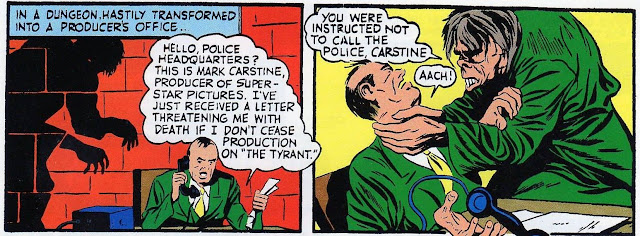
  • MINOR SUPER-VILLAIN 296: THE HUNCHBACK OF HOLLYWOOD

    (Captain America Comics 003, 1941)

    The Hunchback of Hollywood is a villain in the same classic vein as Clayface: dressing up like a horror character and using murder and fear tactics to shut down a movie production. Also like Clayface, the production is within the hero’s range due to the studio taking advantage of the castle-rich landscape of the Eastern US 

    (the castle in question is said to be near Camp Lehigh, home base of Steve “Captain America” Rogers and Bucky “Bucky” Barnes so this isn’t one of the famed castles of New York State. But it might have been originally – Camp Lehigh’s official location is in Virginia, now, but a lot of the stories imply that it’s closer to NYC, with officers commuting to homes in Manhattan, soldiers casually visiting Coney island etc. I have no idea when the location was finalized and it’s very frustrating!)

    Much as Clayface was actually Boris Karloff-adjacent horror star Basil Karlo, the prime Hunchback suspect is the even more on-the-nose Goris Barloff.

    Unlike Clayface, the Hunchback is not Barloff at all, nor any other crazed horror actor. Rather, it’s Craig Talbot, star of the film and dues-paying American Nazi, who objects to the film’s anti-authoritarian allegory, ad that’s why unlike Clayface you’ve never heard of him: because he’s a filthy Nazi.

    Number of Episodes of the “Super-Villains of Hollywood” podcast: A two-part episode structured like a whodunnit, with the first running down the careers of Barloff and Talbot and a few other weakly defended suspects and the second detailing the actual crimes.