The Curse of Skeleton Munroe

Category: rubberoid mask

  • MINOR SUPER-VILLAIN 890: THE BLACK CLOWN

    (Wow Comics 003, 1940)

    The circus is in town! And in what must be a complete coincidence, a circus-themed villain murders a prominent banker using a python! And did I mention that the circus has a big box full of pythons as one of its attractions? 

    As someone who sincerely enjoys clown- and circus-themed villains despite having no particular affection for either in real life I have to say: do a bit better, the Black Clown. Like, try a bit harder to conceal just exactly who you are. Especially don’t leave a note on the body of the banker you just murdered that basically says “I did this because you didn’t give me, a clown-man, a business loan.” Plausible deniability, man.

    He does have a great Evil Clown costume, though.

    I’ll give the Black Clown this: at least he tries to rob the bank after revenge-killing the banker rather than merely exult in the downfall of his enemy. This robbery is also where we learn that the Black Clown has a whole circus of crime thing going on to match his theme, as he employs a sideshow thin man to slip through the bank’s bars and let the rest of the crew in.

    Though Mr Scarlet interrupts the robbery he is unable to prevent the Black Clown and his crew from escaping, as he is being crushed to death by a python at the time. Or is he? No, he is too strong.  

    The Black Clown next attempts to murder Petrie, the partner of the first victim, but at this point we are firmly in the part of the comic where the hero has the villain in his sights and none of his schemes shall profit. The Black Clown escapes with the help of some acrobats and Petrie lives on to deny loans another day.

    Probably the most interesting thing about this sequence is that the Black Clown gains entrance to Petrie’s apartment via a fellow named Tiny Tom who slips through the transom and opens the door. Given the name and the theme of the gang (and the initial shot of his legs as they slip out of sight) one would expect Tiny Tom to perhaps be little person of some kind, perhaps a sideshow performer, but he’s on-hand throughout the fight in Petrie’s apartment (that’s him in the blue suit) and he’s just about half a head shorter than everyone else. Is it just a particularly rough nickname or did the initial Tiny Tom concept get lost in the shuffle?

    Hearkening back to my initial critique of the Black Clown: it is in fact so obvious who this guy is that Mr Scarlet has to be interrupted twice in two different conversations over the course of three panels rather than learn it too early. And he doesn’t bother to ask Mr Petrie to shout it at him on the way out the door.

    After a final battle with a sideshow wild man and a chase through the trapezes the Black Clown is finally captured and OF COURSE it turns out to be Henry Parrish, the circus owner, who is OF COURSE mad about a rejected business loan. CHOOSE YOUR SUPER-VILLAIN THEME MORE WISELY is what I’m trying to get at.

    REVENGE KILLER SCORE: 1/2 

  • MINOR SUPER-HERO ROUND-UP 067

    Something for everyone* in this one.

    *not really. 

    Zambini the Miracle Man: 

    Zambini the Miracle Man, aka Zambini the Great, is your fairly typical comic book magic man, albeit a bit more flamboyantly dressed than even that crowd normally are.

    Though Zambini has a lot of the regular magic abilities of his peer group his signature trick involves his magical Boomerang Amulet, which causes evil to rebound on its sender. This takes forms as diverse as a cobra returning to the one who released it to bombs flying back up to the plane that dropped them to magic spells rebounding on their casters. 

    (please also note the final panel above, in which Zambini is being made a Knight of Ritania, which I here recognize as an honour)

    Finally, while I generally do enjoy when a magic user has a weakness to counter their nigh-omnipotence, Zambini might just have the worst one in comics: the touch of a human hand renders him completely powerless and unable to resist, to the point that this Hundanian spy is able to gently lead him to their headquarters and he is only saved when her boss gets jealous – thank heavens that Hundania doesn’t have a robust anti-workplace romance policy. This weakness kind of falls by the roadside as time goes on but does occasionally crop up now and then in horrible ways. (Zip Comics 001, 1940)

    Perhaps the most interesting thing about Zambini is his magical system: for his first two appearances he casts spells by spouting nonsense words (as far as I can tell), but from Zip Comics 003 onward, he uses a version of Ubbi Dubbi that involves inserting the syllable “ab” instead of “ub”. I don’t know if it’s strictly better than speaking backward, Zatara style, but it certainly is unique.

    Atom Blake, Boy Wizard **UPDATE**:

    I had read the 1940-1941 issues of Wow Comics before embarking on my great comics-reading project, so I already knew going in that Atom Blake would essentially speed-run the process of getting tired of living among mere mortals and heading off into space, Dr Manhattan style, but I had forgotten that he is doing so in order to look for his long-lost father. Also, while I did remember that Blake duplicated himself before setting out I had misremembered it as him leaving behind a non-super version of himself on Earth while the superhuman part set off for adventure. What I’m saying here is that the version of Atom Blake that I had remembered is way more interesting than the actual character. (Wow Comics 002, 1941) 

    the Hunchback: 

    The Hunchback is in actuality wealthy playboy Allan Lanier, who became obsessed with the figure of Quasimodo after seeing the 1939 film version of the Hunchback of Notre Dame (or possibly a literal picture of the character – the text box isn’t 100% clear) and combined that with his interest in wiping out crime to become a weird spectre of the night, Batman-style.

    Lanier is refreshingly up-front about his interest in criminology, to the extent that he is seen droning on and on about it before a date with his fiance Betty Brenton. I don’t know if I’d like every fellow with a secret identity to abandon the “disaffected socialite” act, but it is nice to see the odd one do without it and just be a weird eccentric.

    The Hunchback really leans into two specific aspects of his inspiration: he is absurdly acrobatic, and he metes out insane and terrifying violence to his foes. The latter has git to be one of the better justifications for the dread a masked figure of the night inspires among the criminal fraternity.

    We’re on a bit of a run of characters who share their secret identity with their love interest and Alan Lanier is one of them: his fiance Betty has to be told before she will let the Hunchback help her (this might be the downside of the whole “reputation for insane violence” thing). (Wow Comics 002, 1941)

    In the Hunchback’s second adventure, in Wow Comics 003, Lanier switches to a slightly more conventional super-hero outfit. It’s a generic but not terrible design, and I always appreciate a character making a bold hat choice, but I think that it is perhaps a bit too twee for a character who is supposed to be some sort of rampaging engine of madness and destruction. The old uniform came back out of the closet for the Hunchback’s remaining appearances.

    Pinky the Whiz Kid: 

    Pinky the future Whiz Kid (not technically called that until 1942, but whatever, we’re loose and goosey around here) is already a fan of Mr Scarlet before he is rendered a crime orphan by the villainous Mr Hyde (upcoming), who seemingly randomly murders his mother.

    Pinky ends up at Oaklawn Orphanage, which just so happens to be run by Mr Hyde’s alter ego, Dr Jelke. When Hyde/Jelke and Mr Scarlet inevitably clash, Pinky is right there in his homemade sidekick costume to help out.

    Pinky is adopted by District Attorney Brian Butler, ostensibly to keep him out of trouble, but since Pinky has worked out that Brian is secretly Mr Scarlet he is able to blackmail him into becoming his sidekick. It sounds more sinister than it reads, honestly.

    The real downside to Mr Scarlet getting a sidekick is that Miss Wade, formerly a romantic sparring partner for Brian and occasional daring assistant in her own right, is relegated to the role of scolding caretaker as she sensibly attempts to prevent a teenager from flinging himself into danger. It’s a real loss to the comic.(Wow Comics 004, 1941)

  • MINOR SUPER-VILLAIN 884: DOCTOR DEATH

    MINOR SUPER-VILLAIN 884: DOCTOR DEATH

    (Wow Comics 002, 1941)

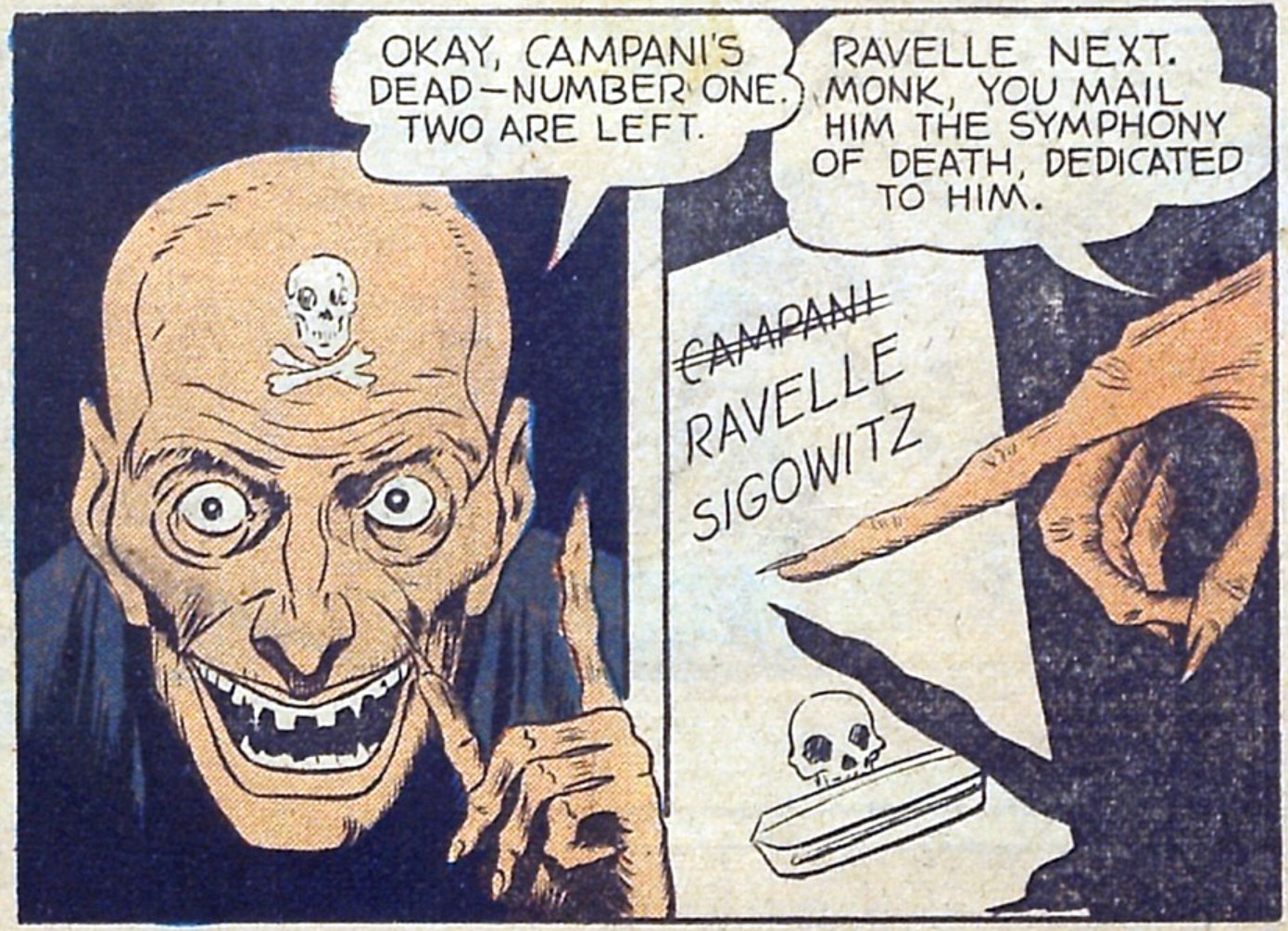
    We open as concert pianist Campani plays the “Symphony of Death,” a piece of music anonymously dedicated to him, only to die at its conclusion. What will eventually become clear is that the sheet music he was reading from was coated in poison and slightly stuck together so that Campani would need to lick his finger in order to turn the pages, thus poisoning himself in the process.

    This is a pretty good plan! If pulled off carefully, it might even be done so anonymously that the perpetrator would be effectively untraceable. There’s no chance of that, however, because said perpetrator is in fact a comic book super-villain who calls himself Doctor Death and who has all of the subtlety of his kind. Not only does he have a goon conspicuously parked outside Campani’s apartment to report back on the whether the scheme has worked, but the day before he sent a threatening note to Campani, complete with signature and little skull and coffin illustrations.

    (as can be seen in the note above, even though Doctor Death does music-based crimes and is kind of dressed like a concert musician his actual theme is that of a medical doctor. It’s a bit of a muddle)

    Doctor Death’s next stated target is another musician, Ravelle, and though Mr Scarlet prevents Ravelle’s copy of the “Symphony of Death” from being mailed to him this doesn’t stop Doctor Death; he just goes to Ravelle’s house, and when Mr Scarlet shows up there he gets captured and slated to die as well.

    Doctor Death of course does not contend with the fact that while Mr Scarlet is technically not a super-human he is nonetheless a super-hero and thus able to, for instance, lift a grand piano over his head and throw it at Doctor Death’s body. Among other things, this splits the Doctor Death mask asunder, revealing that the villain is in fact… Ravelle! 

    It turns out that Ravelle was recently fired and presumably replaced by Campani and his response to this insult was to turn to elaborate murder plots for solace. The attempt on Ravelle’s own life was a bluff designed to draw suspicion away from himself that was repurposed into a trap for Mr Scarlet. But what of Sigowitz, the third name on the revenge list? Alas, we shall never know.

  • MINOR SUPER-VILLAIN 884: DOCTOR DEATH

    (Wow Comics 002, 1941)

    We open as concert pianist Campani plays the “Symphony of Death,” a piece of music anonymously dedicated to him, only to die at its conclusion. What will eventually become clear is that the sheet music he was reading from was coated in poison and slightly stuck together so that Campani would need to lick his finger in order to turn the pages, thus poisoning himself in the process.

    This is a pretty good plan! If pulled off carefully, it might even be done so anonymously that the perpetrator would be effectively untraceable. There’s no chance of that, however, because said perpetrator is in fact a comic book super-villain who calls himself Doctor Death and who has all of the subtlety of his kind. Not only does he have a goon conspicuously parked outside Campani’s apartment to report back on the whether the scheme has worked, but the day before he sent a threatening note to Campani, complete with signature and little skull and coffin illustrations.

    (as can be seen in the note above, even though Doctor Death does music-based crimes and is kind of dressed like a concert musician his actual theme is that of a medical doctor. It’s a bit of a muddle)

    Doctor Death’s next stated target is another musician, Ravelle, and though Mr Scarlet prevents Ravelle’s copy of the “Symphony of Death” from being mailed to him this doesn’t stop Doctor Death; he just goes to Ravelle’s house, and when Mr Scarlet shows up there he gets captured and slated to die as well.

    Doctor Death of course does not contend with the fact that while Mr Scarlet is technically not a super-human he is nonetheless a super-hero and thus able to, for instance, lift a grand piano over his head and throw it at Doctor Death’s body. Among other things, this splits the Doctor Death mask asunder, revealing that the villain is in fact… Ravelle! 

    It turns out that Ravelle was recently fired and presumably replaced by Campani and his response to this insult was to turn to elaborate murder plots for solace. The attempt on Ravelle’s own life was a bluff designed to draw suspicion away from himself that was repurposed into a trap for Mr Scarlet. But what of Sigowitz, the third name on the revenge list? Alas, we shall never know.

  • DIVINE ROUND-UP 015

    Hate and deception abound in this batch of deities.

    Wangwa, God of Hate: 

    Wangwa, God of Hate is the personal god of Okoro, medicine man of the Blancas and enemy of Doctor Voodoo. I’ve never decided if the Evil Medicine Man trope is mere condescension toward native spiritual practices or a porting over of the Evil Vizier archetype to jungle comics, and in all honesty it’s probably both. Anyway, Okoro fits the mould to a T and he worships the god of hate. Sorry he’s so fuzzy.

    God Style: Idol (Whiz Comics 008, 1940) 

    Cheops:

    Adventurer Clip Carson and his archaeologist companion Jim Blake are searching for the fabled lost tomb of Cheops one day when they find themselves in the midst of an entire cult dedicated to the worship of what is apparently the resurrected Pharaoh himself. Carson and Blake are captured by the cult, upon which the supposed Cheops – with very little prompting, mind you – reveals himself to be Sergeant Beatty of the local colonial government, out to seize the treasures of Cheops for himself. Blake and Carson of course escape, and along the way Beatty is exposed as a fraud and torn apart by his former devotees. 

    The deep need for modern Egyptians in adventure fiction to turn to Ancient Egyptian religion, but only in the most secret, cultish, conspiratorial way is another one of those things that you end up wondering about once you read it enough times. Is it merely a fun and easy way to inject some mysterious action into your story? If so, why does it crop up instories set in Egypt so much more than ones set in Greece of Italy? Is it racism again? 

    God Style: Complicated – Cheops/Khufu could be considered to be a deified ruler of Egypt, even though the practice of doing so became common something like a thousand years after his time. Plus this is just some dude posing as him. (Action Comics v1 016, 1939)

    Doolong: 

    Remember Korieg the Sea Devil from a little while ago? Well, the same island people who hate that guy just love to worship Doolong, “god of [their] ancestors”. Not too much detail on Doolong, other than a) his idol is just a little face mounted on the wall and b) he slings a very accurate prophecy – he totally predicts the arrival of Tex Thomson and his party on the island, even if the small matter of Tex being the Princess’ destined mate is inaccurate. 

    God Style: Idol (Real?) (Action Comics v1 011, 1939)

    the Druid God: 

    This is possibly only obvious to someone who lives in the area, but the “group of islands” being indicated in the above image is clearly Cape Breton, Nova Scotia. Was Cape Breton seen as a place just far enough outside of the everyday for things like shipwrecks and secret cults to happen in, or did “Reynolds of the Mounted” scribe and lifelong resident of New York State Art Pinajian just trace a random bit of Canadian coastline and call it a day?

    Speaking of shipwrecks and secret cults, the first of those happens when Sergeant Reynolds heads toward the last known location of missing rich guy Johnny Westlake. Like Johnny, Reynolds washes up on the shore and is found and nursed back to health by local Pierre Dulac.

    Westlake has been on the island long enough to be able to relate the local legend of the Druid Cave, a spooky cave surrounded by spooky rock formations and regarded with fear by the superstitious islanders, who believe that though the cave is full of gold it is also cursed and that anyone venturing inside will die. Reynolds and Westlake venture inside after finding a local fisherman dying on the nearby beach and discover that the cave does in fact contain an ancient treasure and that the curse is probably just plain old asphyxiation thanks to some natural gas deposits.

    Here’s where the cult comes in: the islanders just kind of spontaneously develop it after finding Westlake emerging from the cave shortly before an explosion rocks the countryside. Never trust a group who turn to human sacrifice as a first option, is what I always say.

    In the end, the real culprit behind the murders and explosions turns out to be Pierre Dulac, who, far from being an altruistic soul, has been manipulating the situation to bring maximum chaos as a distraction while he sneaks off with the treasure. He didn’t reckon with Reynolds’ tenacity, of course, and ends up exploding along with the treasure and all evidence of whatever fantastic culture produced the Druid Cave. The islanders just kind of scatter, presumably to keep the worship of the Druid God alive in secret.

    God Style: Invoked (Feature Comics 045, 1941)

  • MINOR SUPER-VILLAIN 841: SIKANDUR, THE ROBOT MASTER

    (War Comics 001, 1940) 

    Sikandur, the Robot Master, is a villain-in-a-starring-role who sadly only appeared once. Any evil roboticist who, for example, makes his robots red-hot as a way of discouraging those who might grapple them is an evil roboticist I want to read about, and I only got the one opportunity to do so.

    Sikandur need gold in order to build more robots, though whether he needs it as a necessary component or as a handy source of cash is unspecified. To that end, he sends his boy Robot X5328B to the United States to rob Fort Knox.

    If Sikandur’s feature had continued to appear then presumably these three dingbats would have been the ones who would be foiling him going forward. As it is, they’re just three… college students? who figure out that Robot X5328B is something more than a simple traveller with jet-black eyes and kind of bumble around trying to figure out what he’s up to.

    Also please not that Sikandur has apparently “conquered half of Europe” at this point.

    Robot X5328B is an advanced robot indeed, because he (?) does some excellent and very menacing threats before being undermined by Sikandur’s caution re: the small-town police missing three local oafs. And that’s a wrap on Sikandur the Robot Master. Presumably the next few issues would have concerned our unlikely trio’s efforts to prevent the robbery of Fort Knox and then ultimately the end of Sikandur and his dreams of world conquest.

  • MINOR SUPER-VILLAIN 841: SIKANDUR, THE ROBOT MASTER

    (War Comics 001, 1940) 

    Sikandur, the Robot Master, is a villain-in-a-starring-role who sadly only appeared once. Any evil roboticist who, for example, makes his robots red-hot as a way of discouraging those who might grapple them is an evil roboticist I want to read about, and I only got the one opportunity to do so.

    Sikandur need gold in order to build more robots, though whether he needs it as a necessary component or as a handy source of cash is unspecified. To that end, he sends his boy Robot X5328B to the United States to rob Fort Knox.

    If Sikandur’s feature had continued to appear then presumably these three dingbats would have been the ones who would be foiling him going forward. As it is, they’re just three… college students? who figure out that Robot X5328B is something more than a simple traveller with jet-black eyes and kind of bumble around trying to figure out what he’s up to.

    Also please not that Sikandur has apparently “conquered half of Europe” at this point.

    Robot X5328B is an advanced robot indeed, because he (?) does some excellent and very menacing threats before being undermined by Sikandur’s caution re: the small-town police missing three local oafs. And that’s a wrap on Sikandur the Robot Master. Presumably the next few issues would have concerned our unlikely trio’s efforts to prevent the robbery of Fort Knox and then ultimately the end of Sikandur and his dreams of world conquest.

  • MINOR SUPER-VILLAIN 837: THE SKULL

    (Top-Notch Comics 009, 1940)


    The Skull is the recurring foe of the Golden Age Black Hood, and as is common for such characters he is a kind of generalist super-villain willing to dabble in everything from theft to kidnapping to espionage to murder as circumstances dictate. He even indulges in a little housebreaking on occasion, and it is while doing so that he is interrupted by police officer Kip Burland, who he frames for the crime and then eventually attempts to have murdered when he refuses to give up on proving himself innocent. 

    This of course is the origin of the Black Hood, as Burland recovers and trains under the tutelage of one of the Skulls other victims. Accidentally creating your own nemesis is one of the occupational hazards of being a successful super criminal, after all, and the Skull is so successful as he kind of did it twice, as Kip Burland’s mentor is a different lawman who the Skull framed and ruined who swore revenge on him but then took too long preparing and had to be content with weaponizing another to do the deed.

    By the time that Kip Burland is prepared to go into action as the Black Hood, the Skull has devised the first of what I now recognize as his signature: an overcomplicated scheme. Specifically, he has targeted the debut/masquerade ball being held for wealthy socialite Barbara Sutton, and has not only informed all of the guests that they must show up in their best jewelry so that he can steal it but has also announced his plans in the papers. I think that the intent is to ensure compliance through fear, but it really seems like he’s just introducing ways that his scheme can go wrong.

    The Skull’s instructions are clear: he will steal the jewels off of the guests during the party and they are to keep quiet about it. None of them manage this, and each victim ends up being killed via a blowgun dart tipped with a poison that turns the human head all green and corpsey. Plus – and this is hard to see but trust me – the dart leaves a little skull-shaped mark at the point of contact.

    The Black Hood eventually works out how the Skull is doing all this: he has disguised himself as hostess Mrs Sutton and has been shooting the darts out of a blowgun shaped like a cigarette holder. One dunk in an oversized decorative vase later, the case is solved!

    (also please note that the Black Hood is in attendance in costume as himself. It still counts even if this is his first public appearance in costume) 

    After the Black Hood turns the Skull in to the police at the end of his first costumed adventure, his ally the Hermit predicts that they will be unable to hold him, and what do you know but he’s right. The Skull dramatically breaks jail and immediately puts another overly complicated scheme into action. Major Quentin Duff has invented the unspecified-but-presumably-valuable Iota Ray, and the Skull wants it, but is not prepared to do anything so simple as to steal the plans. Instead, he implements a simple three-part plan:

    Step One: ambush Major Duff at his house and murder him just after he hands the Iota Ray plans over to Mrs Duff for safekeeping. 

    Step Two: While Mrs Duff and Barbara Sutton are taking the plans from Washington DC via train, kidnap Duff and gaslight Sutton into believing that she was never there. This requires at least a half-dozen confederates as well as an appearance by the Skull as a Dr van Luks, a backward name so annoying that I audibly groaned when I worked it out.

    Step Three: Once the plan falls apart, just try to murder everyone and take the plans off of Mrs Duff’s body. Please note that this step was an option from the start, and that the theft could have been committed using the Major’s gruesome murder as cover.

    As 1940 draws to a close, the Skull is left shaking his fist after a speeding train as the Black Hood escapes with the plans. We will see him again in 1941!

    SKULL SCORE: A very generous 2/5, considering that this particular Skull isn’t actually missing any facial features. The combination of his emaciated face, sunken eyes and perpetual rictus goes a long way nonetheless. Plus he’s green.

  • MINOR SUPER-VILLAIN 822: THE TERROR

    (Thrilling Comics 003, 1940) 

    The Valery family have a problem: they are set to inherit a fortune from their deceased relative John Valery, but on the condition that they all live in the family estate, Valery Grange, for a full year, and danged if a mysterious character called the Terror hasn’t started bumping them off just as they were about to complete the terms of John’s will. Enter undercover police officer Peggy Allen, aka the Woman in Red, once again posing as a nurse. 

    Please note the final panel above in which the Terror appears on-panel with almost every remaining Valery, thus removing them from the suspect list. It’s a dirty thing to do to me, a person who like to try to solve a whodunnit.

    One of the few viable suspects, assuming that the Terror isn’t in cahoots with one of the Valerys, is the disappeared Horace Valery, but the Woman in Red finds his skeleton after chasing the Terror from the scene of the murder of Elton Valery into the unexplored depths of Valery Grange.

    The Woman in Red reveals her identity to Eleanor Valery (terrible infosec) and sets a trap that nets her one (1) the Terror, and wouldn’t you know it, he turns out to be Greeley Butler the family lawyer, who has been fiddling the Valery books to his own benefit and was killing off the family (extremely major crime) to cover for his embezzlement (not that bad, crime-wise). But where would mystery stories be if people didn’t see murder as a handy solution for their problems all the time, hey?

  • PROBLEMATIC ROUND-UP 004

    Sax Rohmer has a lot to answer for.

    the Golden Dragon:

    We’ve seen it before and we’ll see it again – the Golden Dragon is yet another Fu Manchu-style Yellow Peril crimelord bent on bending the world to his will. He messes up by making his campaign of kidnapping and extortion a bit too obvious, which attracts the attention of the Invisible Hood, who in turn rallies various kidnap victims etc into a fighting force to take the Dragon’s organization down from within. (Smash Comics 013, 1940)

    the Key: 

    The Key is a Chinese gang boss operating out of London who specializes in getting his men out of prison almost as soon as they go in, by the simple expedient of faking their deaths with an exotic drug then recovering their “corpses” once they’re trucked off for burial. The twist is that the Key is in fact the very non-Chinese warden of Yorkshire Prison, where all of these guys are escaping from. Two things about the Key: 1. while his mask is presumably just as effective and lifelike as any other rubberoid prosthetic in comics it is also just king of hilariously and obviously strapped onto his face as you can see above, and 2. dovetailing from this, I do not think that the Key was originally going to be the warden. I think that someone took a look at a story about a regular gang boss who was just very good at jailbreaks and decided that it needed something more and so went through and added some extra juice via the addition of the mask and a few lines (“Hmm… That voice is familiar…”) to the already-drawn panels. For what it’s worth, which is not much. (Smash Comics 013, 1940)

    the Scarlet Seal:

    The Scarlet Seal! A character who I absolutely was thinking of when I established the Problematic Round-Up, because he is Very Problematic!

    The basic concept of the Scarlet Seal is fairly innocuous, and in fact is one that creator Harry Campbell returned to again and again: the hero who excels at their first career but then casts that aside to take up scientific pursuits, and then is forced into the role of detective by circumstance. There’s been Wizard Wells (football star to scientist to reluctant detective), Dean Denton (world’s greatest ventriloquist to scientist to detective), John Law, kind of (scientist to lawyer to detective, but really all at once), and now Barry Moore, who leaves a lucrative career as a film star to become a police scientist back in his home town of Center City, and eventually segues into the role of vigilante.

    As far as the problematic aspect of the character goes, there are actually two distinct strains of the stuff going on here. The first involves the Center City Police Commissioner, a namby-pamby former social worker and bleeding heart liberal strawman who doesn’t even believe in torturing confessions out of people (and also bans the use of informants and undercover police officers for unclear reasons). As it turns out, it was only the threat of the rubber hose that was keeping the Center City underworld in check, and the press is having a field day at the expense of  Barry Moore’s dad, Police Chief Moore.

    It’s at this point that Barry decides that what Center City really needs is some sort of vigilante willing to go out and do the hard work that this soft-hearted Commissioner didn’t have the stones for. And you know, if that was it, if he had just put on a costume and set off into the night to beat people up, then it would just be a more extreme version of the authoritarian streak that comic book fans of a more thoughtful nature have always had to reckon with.

    But no, because Barry Moore it turns out was not just any actor, he was a villainous character actor, and the last movie he made was one in which he played a sinister Asian. Thus, he makes the decision to weaponize his skill at yellowface by establishing a secondary identity as Wen au Chung, importer of Chinese goods, who in turn is the sinister Scarlet Seal, bane of the underworld and the police alike. It’s the old classic Green Hornet setup where the Scarlet Seal acts like he’s horning in on various criminal enterprises while actually setting up the crooks to be arrested or (more frequently) killed.

    Two further things: 1. He’s called the Scarlet Seal because he leaves a red stamp on the foreheads of his victims and 2. In the above panels the Scarlet Seal has just allowed the issue’s crooks to kill each other in a gunfight and then arranges things so that one of them, a corrupt cop, is posthumously acclaimed as a hero rather than being held accountable for his crimes. An infuriating character in every respect, that’s our Scarlet Seal. (Smash Comics 016, 1940)

    Dr Feng: 

    Yet another Fu Manchu Yellow Peril villain who is actually a white guy in yellowface. This time we have Dr Feng, head of the Ling Yung Tong aka the Yellow Death Society, but in actuality Blaine Moffat, wealthy real estate mogul. Much of his appearance is taken up with a self-kidnapping scheme to get out of the fact that he has murdered an investigator who got too close, so his actual motivation for becoming a problematic super-villain are left unexplored. (Startling Comics 001, 1940)