The Curse of Skeleton Munroe

Category: rubberoid mask

  • MINOR SUPER-HERO ROUND-UP 037

    MINOR SUPER-HERO ROUND-UP 037

    More cream rises from the milky depths of the Golden Age!

    Red Roberts, the Electro Man:

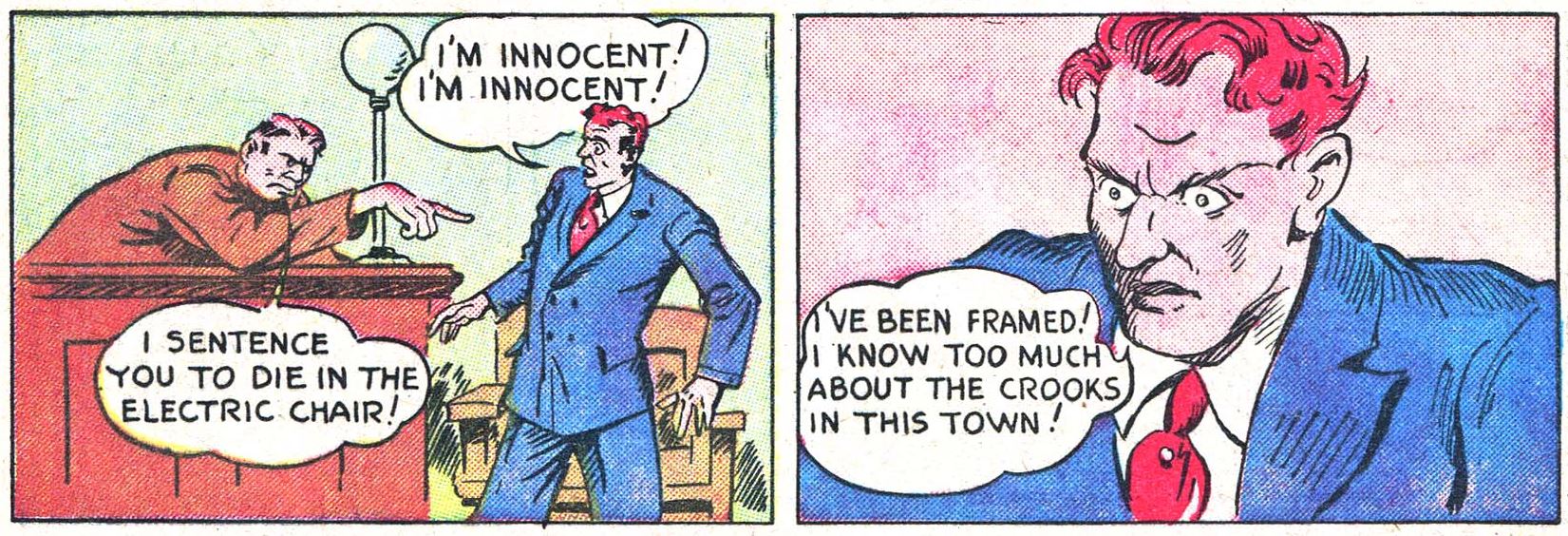
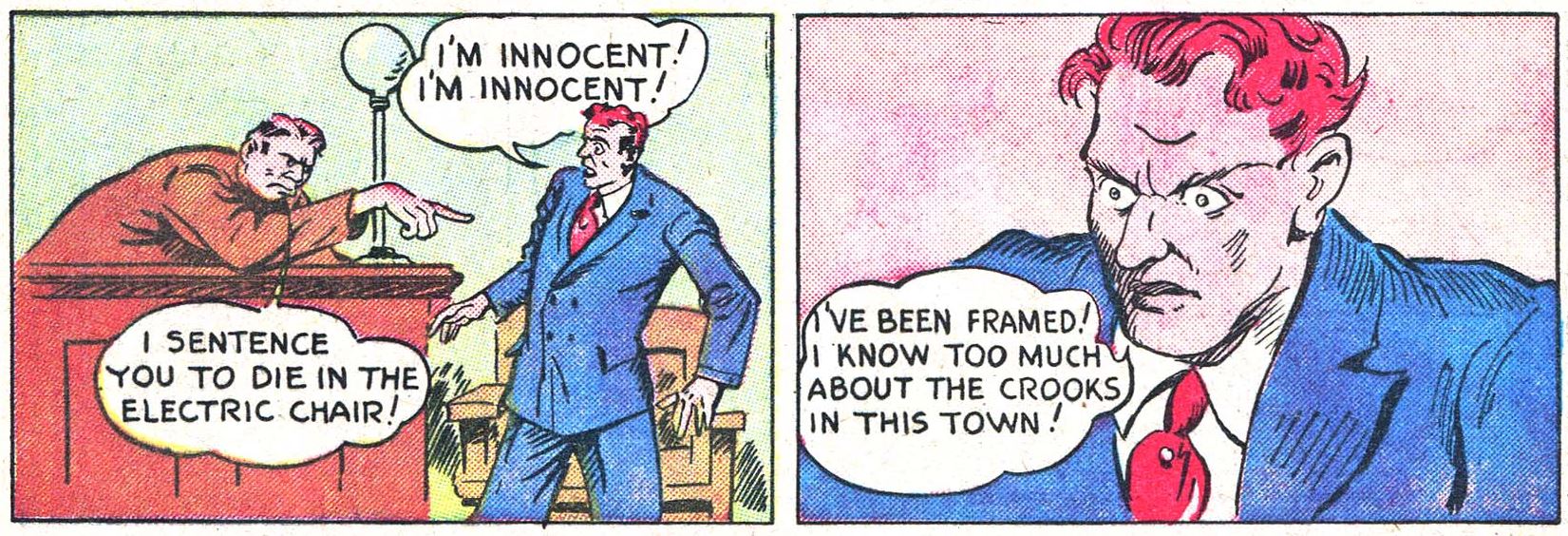
    It’s unclear what Red Roberts’ actual job is, but he is a guy who Knows Too Much about the corruption in the unnamed city he lives in and so he is framed for murder and fast-tracked to the electric chair.

    Luckily for Roberts, this is a comic book universe and being an innocent person sentenced to be executed via the electric chair means that you get sick-ass electricity powers instead of dying like everyone else. Red Roberts quickly parleys these powers into revenge on the city’s crooked mayor and his cronies and then cleans up crime around town for a couple of issues more for good measure. He doesn’t bother with a secret identity because at least half a dozen people were there to witness his origin, which must feel quite freeing. (Rocket Comics 001, 1940)

    the Phantom Ranger:

    There’s not much to distinguish the Phantom Ranger from his contemporaries in the ranks of Mysterious Cowboys Who Stick Around Just Long Enough to Help Out, but here goes: his horse is named Demon and he likes to ride around with his sleeves rolled up, which gives him a business casual look that I appreciate. (Rocket Comics 001, 1940)

    the Defender:

    Is the Defender (Robert Larson, who was scarred facially by criminals as a child and who now fights crime using a malleable rubberoid mask and two dedicated assistants) a take on pulp and comic character the Avenger (Richard Benson, whose face was rendered inhuman by the shock of losing his wife and child to criminals and who now fights crime using his own malleable face and 4-5 dedicated assistants)? I certainly think he is, but I don’t know if you could conclusively prove it. (Rocket Comics 002, 1940)

    Samson UPDATE:

    Samson being descended from the long-haired Biblical figure of the same name is not a new origin for the character, but once he had his own series it was time to explicitly lay it out in the form of his mother telling him in plain English that he is. Frankly, I’d much rather learn how he managed to get away with  having shoulder-length hair as a teenager in the early 1930s, but it’s just left as an exercise for the reader to figure out.

    No such luck for David, however. He remains an orphaned Boy Scout who Samson just found and adopted one day. David is not his actual name and we do not know his actual name. There is some early effort to play up his Boy Scout knowledge as valuable to the crimefighting enterprise but that soon falls by the wayside. (Samson 001, 1940)

  • MINOR SUPER-HERO ROUND-UP 037

    MINOR SUPER-HERO ROUND-UP 037

    More cream rises from the milky depths of the Golden Age!

    Red Roberts, the Electro Man:

    It’s unclear what Red Roberts’ actual job is, but he is a guy who Knows Too Much about the corruption in the unnamed city he lives in and so he is framed for murder and fast-tracked to the electric chair.

    Luckily for Roberts, this is a comic book universe and being an innocent person sentenced to be executed via the electric chair means that you get sick-ass electricity powers instead of dying like everyone else. Red Roberts quickly parleys these powers into revenge on the city’s crooked mayor and his cronies and then cleans up crime around town for a couple of issues more for good measure. He doesn’t bother with a secret identity because at least half a dozen people were there to witness his origin, which must feel quite freeing. (Rocket Comics 001, 1940)

    the Phantom Ranger:

    There’s not much to distinguish the Phantom Ranger from his contemporaries in the ranks of Mysterious Cowboys Who Stick Around Just Long Enough to Help Out, but here goes: his horse is named Demon and he likes to ride around with his sleeves rolled up, which gives him a business casual look that I appreciate. (Rocket Comics 001, 1940)

    the Defender:
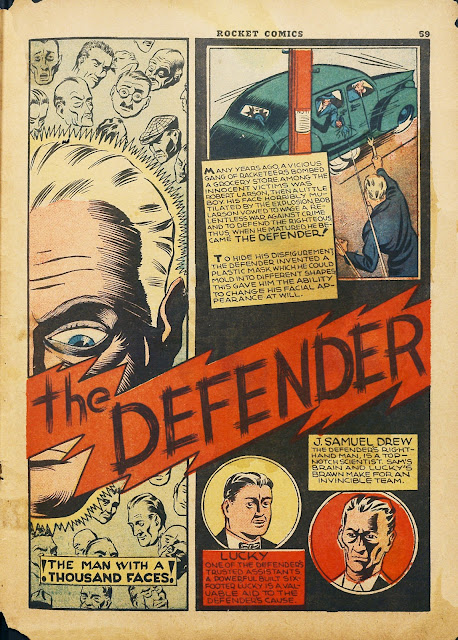
    Is the Defender (Robert Larson, who was scarred facially by criminals as a child and who now fights crime using a malleable rubberoid mask and two dedicated assistants) a take on pulp and comic character the Avenger (Richard Benson, whose face was rendered inhuman by the shock of losing his wife and child to criminals and who now fights crime using his own malleable face and 4-5 dedicated assistants)? I certainly think he is, but I don’t know if you could conclusively prove it. (Rocket Comics 002, 1940)

    Samson UPDATE:

    Samson being descended from the long-haired Biblical figure of the same name is not a new origin for the character, but once he had his own series it was time to explicitly lay it out in the form of his mother telling him in plain English that he is. Frankly, I’d much rather learn how he managed to get away with  having shoulder-length hair as a teenager in the early 1930s, but it’s just left as an exercise for the reader to figure out.

    No such luck for David, however. He remains an orphaned Boy Scout who Samson just found and adopted one day. David is not his actual name and we do not know his actual name. There is some early effort to play up his Boy Scout knowledge as valuable to the crimefighting enterprise but that soon falls by the wayside. (Samson 001, 1940)
  • MINOR SUPER-VILLAIN 563: SCORPIO

    MINOR SUPER-VILLAIN 563: SCORPIO

    (Wonderworld Comics 008, 1939) 

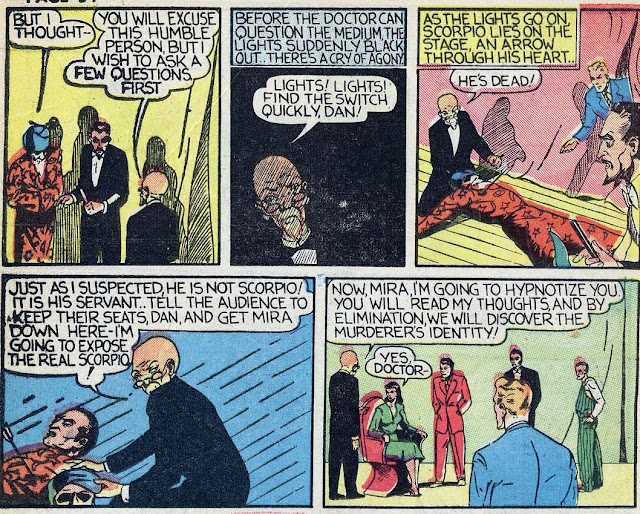
    We open on Dr Fung and his pal Dan making the acquaintance of write Corey Crews on a transcontinental flight. Crews claims that he is about to expose “the biggest phony cult in Frisco” and then is promptly murdered. The telegram that he received just before said murder reads: “you have failed Scorpio… fate is in your hands”.

    Whether there actually is a cult or not is never resolved but seems dubious, as Scorpio turns out to be operating a wholesale blackmail scheme under cover of some generic mysticism. When confronted with… not evidence but the mere hint that he might be under suspicion, Scorpio demonstrates his most prominent character trait, that he has absolutely no chill. He pulls a gun and takes off, not only dumping his costume on the ground and thus demonstrating that he was wearing a costume (versus just being a hollow-eyed seven-foot tall weirdo) but leaving all of his  blackmail material to be destroyed by Dr Fung.

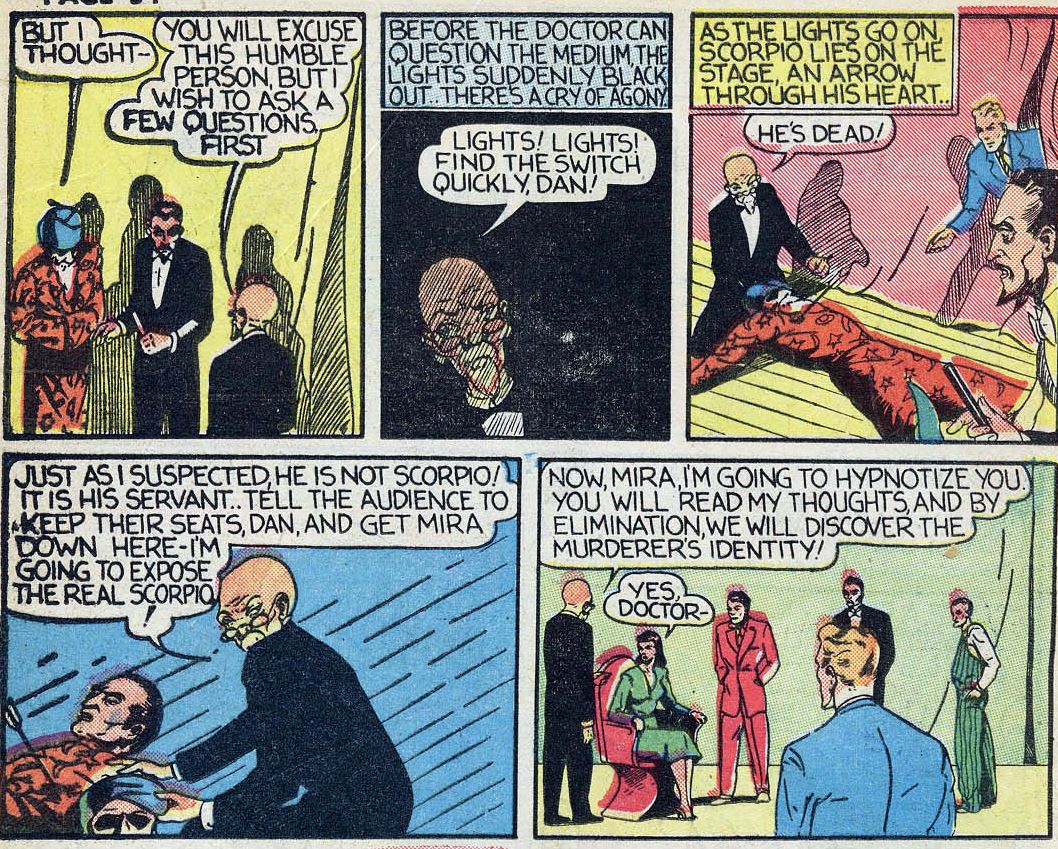
    Dr Fung arranges a challenge of mysticism between Scorpio and sinister stage magician Arno (there’s a plot point involving Mira, a woman who has psychic abilities while under hypnosis but honestly this is an unnecessary level of investigative rigour given Scorpio’s aforementioned lack of chill), during which Scorpio is immediately murdered with a mysterious arrow and just as immediately revealed to in fact be Scorpio’s manservant. 

    So who killed Scorpio/ who is Scorpio? Dr Fung’s assistant Dan? Reporter Ted Collins? Stagehand and brother of former victim Crews? Sinister and satanic magician Arno?

    Of course it’s Arno. Who else could it be? And because Arno is Scorpio, Arno has no chill and tries to kill Dr Fung in front of an audience of hundreds rather than be exposed.

    Questions left unanswered: was there ever an actual cult or was it just a cover for blackmail? Why did Arno/ Scorpio think that killing his servant would solve anything? Where did Arno get that cool arrow-shooting wand?

  • MINOR SUPER-HERO ROUND-UP 005

    All Columbia Comic Corporation edition!

    Skyman: 

    Skyman (properly the Skyman but it just doesn’t scan for me) is a pilot hero, normally a ho-hum sort of character for me. But between his sci-fi super plane (the Wing), his blood-freezing stun ray (the Stasimatic) and his cool on-the-edge-of-being-too-busy costume there’s just enough super-hero peanut butter mixed in with the pilot chocolate to make it appealing (bonus running list of Skyman’s super science: atomic explosives, invisible glass phonograph, disitegrator ray, explosives-detonating ray and a ray that fuses gun barrels shut)

    After a few issues we learn that the Skyman is actually Allan Turner, wealthy good-for-nothing playboy who lost his parents to a plane crash when he was a child. If the Bruce Wayne parallel was 1:1 he would have grown up to become a noted slayer of planes, but that’s a villain’s origin. Instead, Allan Turner dresses up as a plane to fight criminals. It doesn’t make quite as much narrative sense as Batman does but it’s probably more fun to read than the other way around.

    Early Skyman also might just hold the record for the most overinflated torso in comics outside of parody characters. He gets a bit more proportional eventually but for a while there you’re concerned for his ability to live a normal life.

    the Face:

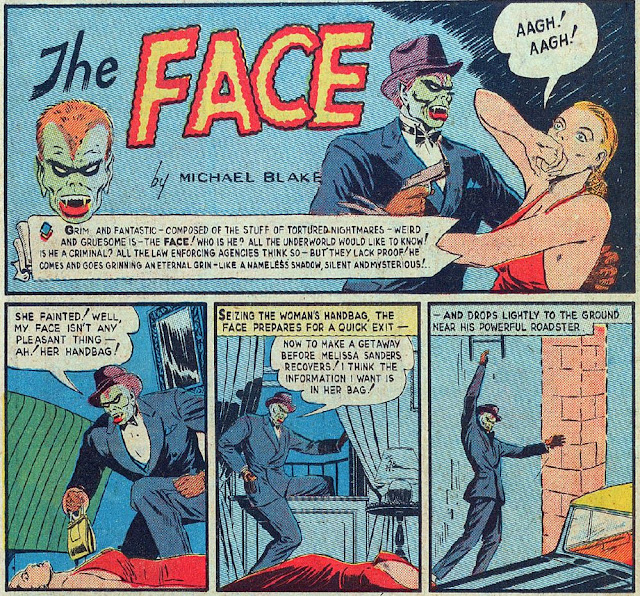
    The Face, like a lot of early comics heroes, draws a lot of elements from the pulps: a tuxedo-clad hero drives around in a souped up roadster fighting crime with his fists and an automatic – a pretty regular early super-guy. Even his secret identity of Tony Trent, radio station owner/ radio announcer is in the pulp-adjacent character wheelhouse.

    It was very exciting to me when I realized that the Face’s face is frequently referred to as a rubberoid mask, my favourite term for the kind of masks that only exist in comic books – perfectly realistic and naturalistic but also very easy to don and doff. This particular mask was made specially for Tony Trent by someone whose other major characteristic is being dead, which is apparently a combination that makes Trent feel quite jolly.

    Weirdly, in Big Shot Comics 006, the Face has a new, slightly less grotesque mask. No word on where he got this one but he goes back to the original pretty quickly.

    Marvelo, Monarch of Magicians:

    Created by Fred Guardineer, who also created Zatara over at DC Comics, Marvelo is… extremely similar to Zatara. Aside from their different approaches to dressing like a stage magician, I’d say that there are two slight differences between the characters: 

    1. Rather than speaking backward to cast spells, Marvelo shouts “Kalora!” as an all-purpose magic word.

    2. Marvelo’s manservant Zee is just a hair more racist than Zatara’s manservant Tong. It’s pretty close but I reckon Zee takes it.

    Big Shot Comics 017 reveals that Marvelo is the son of the ruler of the generically foreign South Pacific island of Brahama (hell on autocorrect). This doesn’t seem to have anything to do with him being a magic man but it’s nice to know. (Big Shot Comics 001, 1940)

    the Cloak:

    Jeff Cardiff, Spy Chief was a feature in Big Shot Comics from issue 1 (well, it was Jeff Cardiff, Spy-Master for the first issue or two but the point stands) with all kinds of foiled plots and plans and spies of both the vaguely fascist and vaguely communist varieties. In Issue 15, however, the spies adopt the reasonable policy of attempting to shoot on sight the man who has foiled so many of their plans and a wounded Jeff Cardiff goes to recuperate at his brother’s house.

    Long story short, Jed Cardiff is a coal magnate with a collection of “adventure curios”, including the namesake cloak of Revolutionary War-era costumed spy the Cloak and it being 1941 and a comic book, Jeff immediately adopts the Cloak identity as his own. It’s a fairly basic costumed hero shtick but I appreciate the effort and it’s always nice to see a more elaborate cape and cowl getup now and then. (Big Shot Comics 015, 1941)

    The original Cloak eventually shows up in a flashback and it turns out that his impact on the history of the American Revolution is only slightly less impactful than Superboy’s in the 1949 story in which he goes back in time and takes part in about half the major events of the war. I must say that I do love a retcon of a historical event. (Big Shot Comics 021, 1942)

  • MINOR SUPER-HERO ROUND-UP 005

    All Columbia Comic Corporation edition!

    Skyman: 

    Skyman (properly the Skyman but it just doesn’t scan for me) is a pilot hero, normally a ho-hum sort of character for me. But between his sci-fi super plane (the Wing), his blood-freezing stun ray (the Stasimatic) and his cool on-the-edge-of-being-too-busy costume there’s just enough super-hero peanut butter mixed in with the pilot chocolate to make it appealing (bonus running list of Skyman’s super science: atomic explosives, invisible glass phonograph, disitegrator ray, explosives-detonating ray and a ray that fuses gun barrels shut)

    After a few issues we learn that the Skyman is actually Allan Turner, wealthy good-for-nothing playboy who lost his parents to a plane crash when he was a child. If the Bruce Wayne parallel was 1:1 he would have grown up to become a noted slayer of planes, but that’s a villain’s origin. Instead, Allan Turner dresses up as a plane to fight criminals. It doesn’t make quite as much narrative sense as Batman does but it’s probably more fun to read than the other way around.

    Early Skyman also might just hold the record for the most overinflated torso in comics outside of parody characters. He gets a bit more proportional eventually but for a while there you’re concerned for his ability to live a normal life.

    the Face:

    The Face, like a lot of early comics heroes, draws a lot of elements from the pulps: a tuxedo-clad hero drives around in a souped up roadster fighting crime with his fists and an automatic – a pretty regular early super-guy. Even his secret identity of Tony Trent, radio station owner/ radio announcer is in the pulp-adjacent character wheelhouse.

    It was very exciting to me when I realized that the Face’s face is frequently referred to as a rubberoid mask, my favourite term for the kind of masks that only exist in comic books – perfectly realistic and naturalistic but also very easy to don and doff. This particular mask was made specially for Tony Trent by someone whose other major characteristic is being dead, which is apparently a combination that makes Trent feel quite jolly.

    Weirdly, in Big Shot Comics 006, the Face has a new, slightly less grotesque mask. No word on where he got this one but he goes back to the original pretty quickly.

    Marvelo, Monarch of Magicians:

    Created by Fred Guardineer, who also created Zatara over at DC Comics, Marvelo is… extremely similar to Zatara. Aside from their different approaches to dressing like a stage magician, I’d say that there are two slight differences between the characters: 

    1. Rather than speaking backward to cast spells, Marvelo shouts “Kalora!” as an all-purpose magic word.

    2. Marvelo’s manservant Zee is just a hair more racist than Zatara’s manservant Tong. It’s pretty close but I reckon Zee takes it.

    Big Shot Comics 017 reveals that Marvelo is the son of the ruler of the generically foreign South Pacific island of Brahama (hell on autocorrect). This doesn’t seem to have anything to do with him being a magic man but it’s nice to know. (Big Shot Comics 001, 1940)

    the Cloak:

    Jeff Cardiff, Spy Chief was a feature in Big Shot Comics from issue 1 (well, it was Jeff Cardiff, Spy-Master for the first issue or two but the point stands) with all kinds of foiled plots and plans and spies of both the vaguely fascist and vaguely communist varieties. In Issue 15, however, the spies adopt the reasonable policy of attempting to shoot on sight the man who has foiled so many of their plans and a wounded Jeff Cardiff goes to recuperate at his brother’s house.

    Long story short, Jed Cardiff is a coal magnate with a collection of “adventure curios”, including the namesake cloak of Revolutionary War-era costumed spy the Cloak and it being 1941 and a comic book, Jeff immediately adopts the Cloak identity as his own. It’s a fairly basic costumed hero shtick but I appreciate the effort and it’s always nice to see a more elaborate cape and cowl getup now and then. (Big Shot Comics 015, 1941)

    The original Cloak eventually shows up in a flashback and it turns out that his impact on the history of the American Revolution is only slightly less impactful than Superboy’s in the 1949 story in which he goes back in time and takes part in about half the major events of the war. I must say that I do love a retcon of a historical event. (Big Shot Comics 021, 1942)

  • MINOR SUPER-VILLAIN 395: THE GREAT CAESAR

    (More Fun Comics 071, 1941)

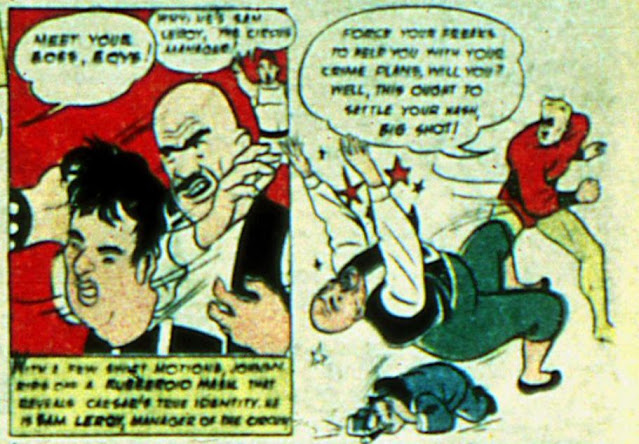
    The Great Caesar is the antagonist of the first published Johnny Quick adventure (though not, of course, the first overall Johnny Quick adventure – as revealed in the last round of Generic Costumed Villains he had a several-year career before this). He’s got the ever-popular array of circus of crime henchmen who he coerces to rob and kill at his pleasure. He also has the much dumber but just as popular “death as consequence of failure” policy which, while motivationally potent, is a staffing and HR nightmare in practise.

    The Great Caesar is eventually unmasked and revealed to be Sam Leroy, the circus manager. Hooray for Johnny Quick!

    More importantly, hooray for this marking one of the few actual uses of the term “rubberoid mask” in comics. I feel so validated!

  • MINOR SUPER-VILLAIN 355: MR MURDER

    (Master Comics 015, 1941) 

    Mr Murder is your “pay or die” style of extortionist and a) has a pretty great name and b) is presumably in an early stage of his career as there is a lot more “die” going on than “pay”.

    Mr Murder also has a great understated costume: tunic, hat, cape, scarf, gloves. Just a bit off of what you might see someone actually wearing – nice and menacing in a Shadow sort of way.

    And of course Mr Murder turns out to be Reilly, the loudmouthed lawyer from the beginning of the story, presumably using his position to determine opportune targets for extortion and employing my fave the rubberoid mask to disguise his identity. It’s a fine outing over all but nothing special. The interesting stuff comes with Mr Murders further appearances:

    Mr Murder reappears in Master Comics 027, 1942 and there are several weird things going on. The least of these is his decision to incorporate the rubberoid mask into his costume despite his identity no longer being a secret, but I guess that’s no weirder than villains who continue to wear regular style masks in such circumstances.

    More interesting is the fact that there seems to have been a Mr Murder/ Bulletman clash some time in between, during which a) Mr Murder found out Bulletman’s secret identity and b) Bulletman was thought to have killed Mr Murder. As far as I can tell, this story was never published (I reckon that it’s equally likely that a story was produced but never published or someone misremembered Mr Murder being in a story he wasn’t), but the upshot of it is that Mr Murder is out for revenge and armed with the knowledge to do the deed. He kidnaps Jim Barr and almost succeds in bumping him off but has seemingly forgotten about the existence of Bulletgirl, leading to him getting his but kicked and dying for real.

    OR DID HE? This marks our first encounter with the CRIME EXCHANGE, an organization run by future Minor Super-Villain the Crime Broker, the details of which are not germane other than the fact that at one point the Exchange members petition the Crime Broker to bump off Bulletman, a petition consisting mostly of deceased Bulletman villains. It’s madness! A huge (dead) portion of Bulletman and Bulletgirl’s rogues gallery, returned to life (or, less incredibly, sprung from prison) in a single panel! Madness!

    Okay, maybe this is more exciting to me than anyone else but it is neat. And as someone whose official stance is that super-villains are more interesting when they’re still alive I heartily approve.

  • MINOR SUPER-VILLAIN 350: THE TERROR

    (Master Comics 012, 1941)

    At first I was fairly unimpressed with the Terror – I regarded him as yet another low-ambition super-crook, a guy with the wherewithal to invent a hypnotic ray belt and mount the output in the villain-standard rubberoid mask but with no greater ambition than to murder his uncle and half sister to get his mitts on the family fortune. But… is there another, non-crime way to get rich off of a hypnotic ray projector? I imagine that it would be quite useful in a psychologist’s practice but that’s a get-somewhat-rich-slowly scheme if I ever heard one. I suppose crime might have been the way to go for a young man in need of money, though speaking as an uncle, avunculicide is never the answer.

    Once I looked at the Terror with fresh eyes I realized something else: as the Terror, young Stephen Barish was completely committed to the bit. He decided to kill his family, adopted an over-the-top cackling movie villain persona and kept that shit up until he was unmasked (and even then he tried to knife Zoro the Mystery Man and got sword caned for his trouble). Just look at this behaviour:

    Just grinning and laughing and gloating and hopping around like a goblin until he is physically skewered. This is the kind of villain I like, even if he has an anti-uncle bias.

  • MINOR SUPER-VILLAIN 346: THE DRAGON

    (Master Comics 011, 1941)

    It’s our second villain named the Dragon and our second Dragon who turns out to be a white dude in yellowface. Will it happen again? Only time will tell.

    The only really interesting thing about this guy is that a key part of his plan was to divert suspicion from himself by repeatedly sending his gang to kill his own secret identity (see above). Whether he was banking on Zoro the Mystery Man to show up and keep him alive is unspoken but if he wasn’t it’s a frankly baffling plan.

  • MINOR SUPER-VILLAIN 346: THE DRAGON

    (Master Comics 011, 1941)

    It’s our second villain named the Dragon and our second Dragon who turns out to be a white dude in yellowface. Will it happen again? Only time will tell.

    The only really interesting thing about this guy is that a key part of his plan was to divert suspicion from himself by repeatedly sending his gang to kill his own secret identity (see above). Whether he was banking on Zoro the Mystery Man to show up and keep him alive is unspoken but if he wasn’t it’s a frankly baffling plan.