The Curse of Skeleton Munroe

Category: Doctor Voodoo

  • GENERIC COSTUMED VILLAIN ROUND-UP 033

    GENERIC COSTUMED VILLAIN ROUND-UP 033

    Just another buncha jerks.

    John Elton: 

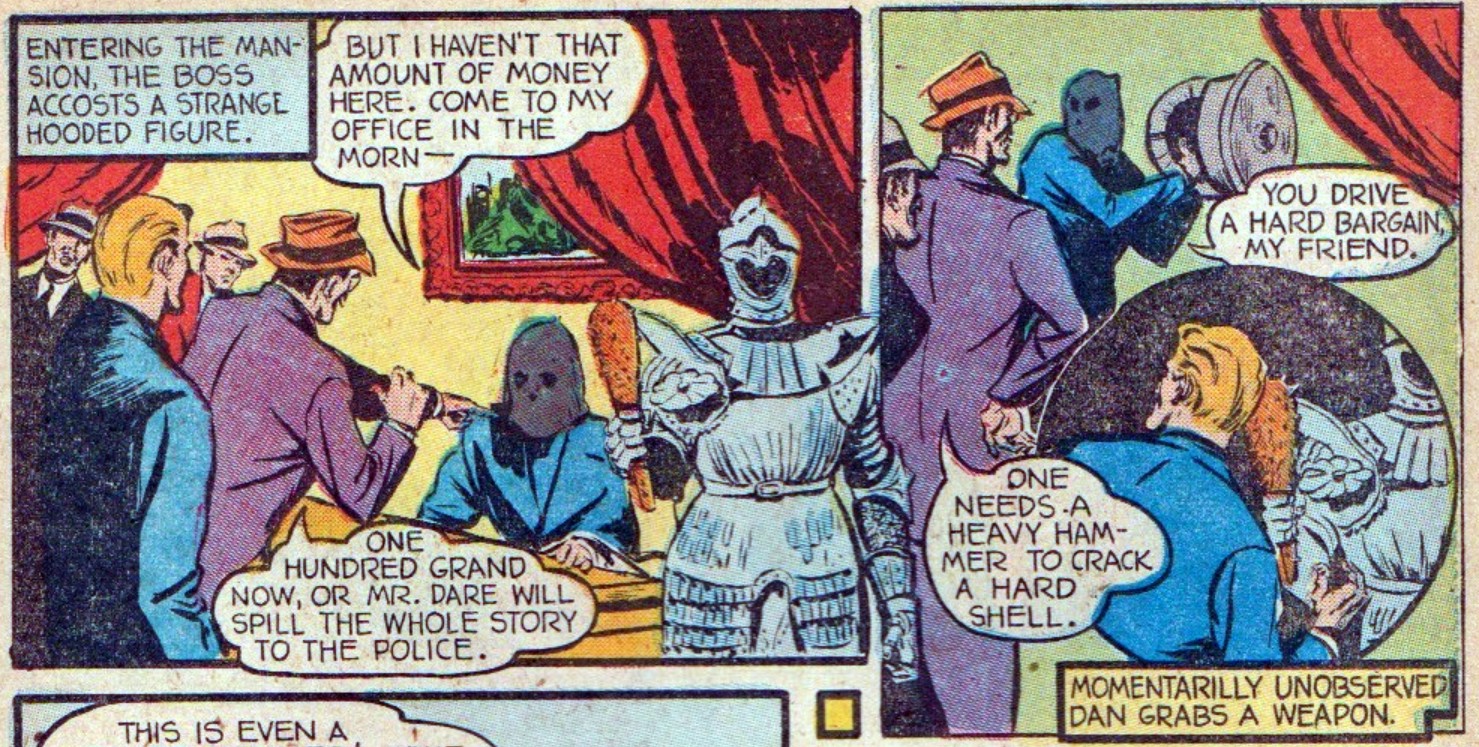
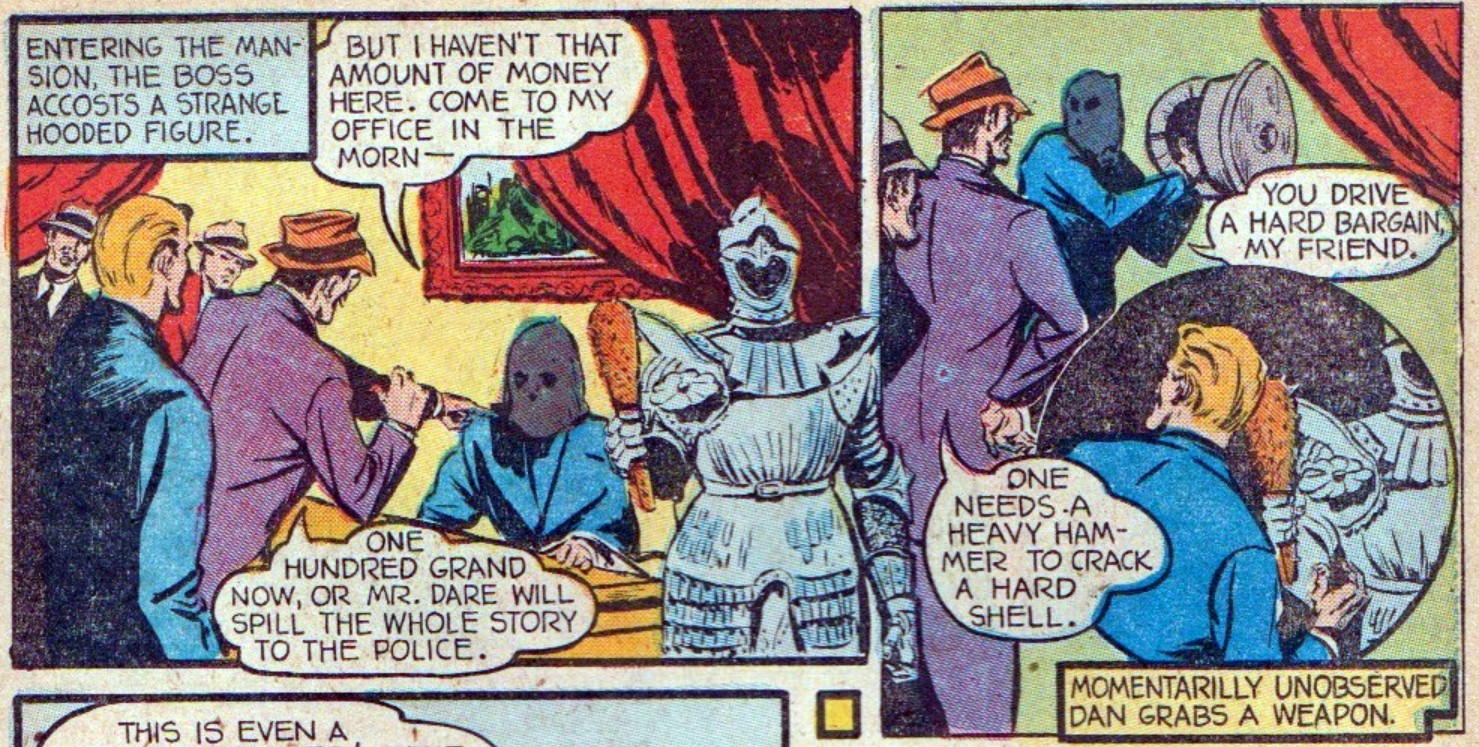
    This fellow brings us right back to the roots of the Generic Costumed Villain Round-Up, being a businessman who puts on a mask to run a gang and kill off the other officers of his company so that he can buy up all their shares and make a fortune. Plus, his name is John Elton, which doesn’t mean anything but is still a fun coincidence. Dan Dare gets ‘im. (Whiz Comics 016, 1941)

    the War Lord:

    Like the War Maniac before him, the War Lord is a generic and unseen stand-in for Adolf Hitler with a good enough villain name that I had to highlight it. A whole passel of his agents feature in the story in which Smasher Spy goes back to being Spy Smasher and get beaten up by Spy Smasher, Smasher Spy and Captain Marvel. 

    It’s not particularly germane to anything but this panel of Spy Smasher flying out a window into the arms of the War Lord’s agents after almost being blown up looks very nice and I had nowhere else to use it. (Whiz Comics 018, 1941)

    The War Lord returns to vex Spy Smasher in Whiz Comics 019, in a rare return appearance for a generic Axis dictator. In fact, he is also the power behind the fascist group the Blitzys and Ibis the Invincible foe Half-Man as well – he’s one of the most prolific Hitler stand-ins of the Golden Age!

    The War Lord finally shows up in person in Whiz Comics 024 and while he is clearly just a straight-up stand-in for Hitler his main character trait seems to be in expressing himself like a disappointed father. He sticks around just long enough to instill a deep sense of despair in the Half-Man, leaving him vulnerable to being turned to the side of good by a bit of kindness from Ibis the Invincible. Once again being a bad boss fails to pay off!

    Puni, God of Fire: 

    The above text box precedes the Lance O’Casey story in Whiz Comics 018 and let me tell you: none of that stuff happened in the prior issue. We are very much dropped in media res on the tropical Antarctic island populated by cannibals and also lost explorer Hiram T. Wallis – I don’t know if this is some remnant of a never-published story or just an attempt to shake things up again (EDIT: it happens, in fact, in Whiz Comics 019. The two-part story was just published in the wrong order).

    Lance and his ever-expanding supporting cast (including Hiram T. Wells, old-timey pirate Dan’l Doom and not one but two monkey sidekicks) are venturing into a volcano to get some gold that Wells had found there when they are confronted and menaced by the self-proclaimed Puni, God of Fire, who is in actuality Marino, a sailor shipwrecked at the same time as Wells and presumably driven insane by ten years of living in a volcanic cave. Puni/Marino never manages to get very close to killing the party but he does try in his way, and by gar can he belt out a villainous pronouncement.

    Everything ends up okay, as Marino has the kind of insanity that can be cured via a solid smack to the jaw and a dunk in the ocean. 

    This adventure also features a giant treasure-guarding parrot, just one of the many cool creatures that do their best to convince me to add the truly life-ending task of chronicling all comic book monsters to my already overloaded to-do pile. (Whiz Comics 018, 1941)

    Herculo Svenson: 

    This is Herculo Svenson, pirate, Doctor Voodoo antagonist for several issues and man in the running for best name in comics certainly for 1941 and possibly for all time. He kills a whole valley full of giants, kidnaps their regular-sized queen and makes off with magical McGuffin the Golden Flask before eventually getting killed by bigger villain Black Marco. (Whiz Comics 022, 1941)

  • GENERIC COSTUMED VILLAIN ROUND-UP 033

    GENERIC COSTUMED VILLAIN ROUND-UP 033

    Just another buncha jerks.

    John Elton: 

    This fellow brings us right back to the roots of the Generic Costumed Villain Round-Up, being a businessman who puts on a mask to run a gang and kill off the other officers of his company so that he can buy up all their shares and make a fortune. Plus, his name is John Elton, which doesn’t mean anything but is still a fun coincidence. Dan Dare gets ‘im. (Whiz Comics 016, 1941)

    the War Lord:

    Like the War Maniac before him, the War Lord is a generic and unseen stand-in for Adolf Hitler with a good enough villain name that I had to highlight it. A whole passel of his agents feature in the story in which Smasher Spy goes back to being Spy Smasher and get beaten up by Spy Smasher, Smasher Spy and Captain Marvel. 

    It’s not particularly germane to anything but this panel of Spy Smasher flying out a window into the arms of the War Lord’s agents after almost being blown up looks very nice and I had nowhere else to use it. (Whiz Comics 018, 1941)

    The War Lord returns to vex Spy Smasher in Whiz Comics 019, in a rare return appearance for a generic Axis dictator. In fact, he is also the power behind the fascist group the Blitzys and Ibis the Invincible foe Half-Man as well – he’s one of the most prolific Hitler stand-ins of the Golden Age!

    The War Lord finally shows up in person in Whiz Comics 024 and while he is clearly just a straight-up stand-in for Hitler his main character trait seems to be in expressing himself like a disappointed father. He sticks around just long enough to instill a deep sense of despair in the Half-Man, leaving him vulnerable to being turned to the side of good by a bit of kindness from Ibis the Invincible. Once again being a bad boss fails to pay off!

    Puni, God of Fire: 

    The above text box precedes the Lance O’Casey story in Whiz Comics 018 and let me tell you: none of that stuff happened in the prior issue. We are very much dropped in media res on the tropical Antarctic island populated by cannibals and also lost explorer Hiram T. Wallis – I don’t know if this is some remnant of a never-published story or just an attempt to shake things up again (EDIT: it happens, in fact, in Whiz Comics 019. The two-part story was just published in the wrong order).

    Lance and his ever-expanding supporting cast (including Hiram T. Wells, old-timey pirate Dan’l Doom and not one but two monkey sidekicks) are venturing into a volcano to get some gold that Wells had found there when they are confronted and menaced by the self-proclaimed Puni, God of Fire, who is in actuality Marino, a sailor shipwrecked at the same time as Wells and presumably driven insane by ten years of living in a volcanic cave. Puni/Marino never manages to get very close to killing the party but he does try in his way, and by gar can he belt out a villainous pronouncement.

    Everything ends up okay, as Marino has the kind of insanity that can be cured via a solid smack to the jaw and a dunk in the ocean. 

    This adventure also features a giant treasure-guarding parrot, just one of the many cool creatures that do their best to convince me to add the truly life-ending task of chronicling all comic book monsters to my already overloaded to-do pile. (Whiz Comics 018, 1941)

    Herculo Svenson: 

    This is Herculo Svenson, pirate, Doctor Voodoo antagonist for several issues and man in the running for best name in comics certainly for 1941 and possibly for all time. He kills a whole valley full of giants, kidnaps their regular-sized queen and makes off with magical McGuffin the Golden Flask before eventually getting killed by bigger villain Black Marco. (Whiz Comics 022, 1941)
  • ALIENS AND SO FORTH ROUND-UP 026

    There is a never-ending supply of aliens (and so forth) in comics, and here are some of them. 

    Giants: 

    When Doctor Voodoo is flung into the past by an old wizard, his only instruction is to find something called the Golden Flask, located somewhere called the Valley of Giants. Astonishingly, it only takes him about two issues worth of privation to get there, whereupon he and his pal Nero are immediately taken captive and frogmarched to the castle of the Queen of the Giants.

    As can be seen in the above panel, these are the less extreme kind of giant, being only ten or so feet tall (based on their sizes compared to Doctor Voodoo – probably a standard length of hero at six feet – and Nero – extra big and tall so at least seven). Hardly as dramatic as a forty-foot titan might be but at least you don’t spend the whole time wondering how their bodies hold together under the strain.

    The Queen of the Giants (Anita to her friends), by contrast, is a regular-sized lady who comes across as quite nice until Doctor Voodoo rejects her romantic advances and she has him thrown to Achilles, who turns out to be a giant python. Despite this, when the Valley of the Giants is depopulated by pirate raids, Docotr Voodoo rescues her and takes her along on the remainder of his adventures in the past. And since he never actually makes it back to the present on-panel, perhaps romance does eventually blossom, who knows? (Whiz Comics 020, 1941)
    Camurians: 

    Space hero Captain Venture and his companion Zyra, aka the Planet Princess, spend a lot of their early adventures just wandering around space and seeing what the cosmos has to offer. On one of these jaunts, they land on Planet Camur, where they find the native Camurians enslaved by another species called the Valhoes, and being righteous hero types they resolve to liberate them from bondage. 

    After being captured and enslaved themselves, Venture and Zyra lead an uprising and free the Camurians from the tyranny of the Valhoes, who were unprepared to face any resistance from their seemingly cowed slaves.

    Just where the Valhoes come from is not expanded upon in the story but just by looking at them we must reasonably assume that they also come from Camur, right? Millions of years ago some sleepy-eyed alien ape species’ population split along nerd/jock lines and the Camuriand and Valhoes were the end results. Nature is grand, really. (Nickel Comics 006, 1940)

    Catskill Dwarfs: 

    Thanks to a plane crash in the Catskill Mountains, super magician El Carim and his assistant/ love interest Gladys find themselves in the underground realm of the Catskill Dwarfs, aka the Little Men of the Mountain of Rip van Winkle fame.  

    It’s all pretty goofy until Galdys swats the Dwarfs’ Scared Flea, at which point the Little Men of the Mountain try to murder both her and El Carim in a fit of righteous ire. All is forgiven, however, by the time they return to the comic two issues later – I suppose sacred fleas are easy to come by. (Master Comics 020, 1941)

    Djungas: 

    Captain Venture and the Planet Princess’ wandering ways come to an end eventually when they crash on the far-off Asteroid Djung and are captured by the local Djunga people on behalf of their tyrannical leader King Leon. 

    The Djungas are that ever-popular combination of a high-tech society with medieval trappings, and Leon is very much a medieval tyrant figure who spends much of his time attempting to wed Zyra against her will while pitting Venture and his Djunga companion Tazon up against a series of deadly situations. These often involve the wide array of other intelligent species endemic to Asteroid Djung and its local system, so more on them later.

    The series eventually had to end, and King Leon with it, with the flick of a giant’s finger. Tazon is installed as the new King of Djung, and peace presumably reigns among the Djungas. (Master Comics 009, 1940)

  • GENERIC COSTUMED VILLAIN ROUND-UP 032

    A more fantastical bunch of genericos than usual! How fun!

    Benjie Frazier: 

    This mysterious cloaked figure hires femme fatale Sonia, aka Princess Cleo, to help him drive all of the inhabitants out of “center of New York society” Formal Park (99% certain that this is a substitution for former real-life society hub Tuxedo Park). To that end, the pair deploy such tools as squads of hooded goons, a mysteriously appearing brand to indicate that their victims have suffered “the Pharaoh’s Curse”, and a drug that drives regular people into a murderous frenzy. 

    Things come to a head when the socially prominent Dudley “Mr Satan” Bradshaw and his scornful love interest Doris O’Day are invited out to a Formal Park event and end up unmasking their host Benjie Frazier as the mastermind behind the scheme. And just why has he been murdering people in such elaborate ways? A damn land grab, the most boring possible motivation for supercrime. He wanted to get rich by selling land to the state for a reservoir, folks. Shaking my damn head over here. (Zip Comics 008, 1940)

    Unnamed Brain-in-Jar Men: 

    Another cover illustration with no bearing on the story inside – very very sad. Are these headless men with their brains in little glass backpacks the creations of a mad scientist? Some sore of weird aliens? A transhumanist mafia? We shall never know. (Zip Comics 009, 1940)

    the Lion-Man: 

    This were-lion is remarkable not only for being in the Amazon (which I can only assume is way out of its natural range if we can apply such concepts to supernatural beings) but also because it only appears in the first half of a six-page story as an unrelated distraction while some crooks to steal diamonds from Doctor Voodoo’s home village. Just tremendous disrespect on the writer’s part for the gravity of a lycanthropic* foe. (Whiz Comics 014, 1941)

    *yes I’m aware that the lycan part of the word is referring specifically to wolves but I’m being lazy about my language, okay? The footnote is still lazy because most of the words in it are short.

    Queen Zoe: 

    Queen Zoe is the ruler of a lost kingdom called El Casa del Oro deep in the Amazon whose culture appears to be a mixture of Inca and Conquistador and who is not overtly evil but who for instance threatens to throw someone into a volcano for interfering in her proposed seduction of Dr Voodoo.

    Queen Zoe’s secret is that she is actually thousands of years old thanks to the fact that she has the Fountain of Youth in her basement. She tries to sweeten her seduction of Dr Voodoo with the promise of eternal life but the Fountain is evidently a big prude because it chooses to stop working the exact second that Zoe makes her pitch and instead of getting some action she instead crumbles to dust. (Whiz Comics 015, 1941)

  • ALIENS AND SO FORTH ROUND-UP 025

    We’re going heavy on the ape-man content this time. 

    Ape-Men: 

    These Ape-Men, like most ape men, are some sort of human offshoot population or remnant of another species of homo living in the isolated depths of, in this case, the Amazon jungle. They come into conflict with Doctor Voodoo after breaking their long-held peace treaty with his allies the Blancas and abducting many of them for human sacrifice. Also they use silver arrows for some unexplained reason. (Whiz Comics 013, 1941)

    Ape-Men: 

    These particularly wooly-looking Ape-Men briefly vex adventurer Cotton Carver in one of the various lands beneath Antarctica before learning about firearms the hard way, as so many of their fellow sub-Antarcticans do during Carver’s travels. (Adventure Comics 048, 1940)

    Apemen:

    More cave- than ape-men in my estimation, these fellows ambush Bill Dale and his guide Dagoo as they traverse the cheerily-named River of Skulls in Africa on their way to find Bill’s long-lost twin Steve. Notably, these are the Apemen who worship the crocodile swam god the Creeping Death. (Nickel Comics 001, 1940)

    Link Men: 

    Encountered by Zatara while searching for a missing biologist in modern-day Tanzania, the Link (for Missing Link, natch) Men are the most ape-like in appearance of all of our entries today. They live in a small city atop a plateau and are generally hostile to strangers.

    For all that they are literal ape-men, the Link Men are just as weirdly obsessed with the nuances of human race as so many other nonhuman intelligences: their leader is the ever-popular Random Blonde Lady, in this case one named Kara whose presence on the plateau is never really explored. They are also weirdly invested not in human sacrifice but in the sacrifice of a white man to their deity, the Sun-God. Zatara’s aide Tong isn’t even considered as a sacrifice.

    The potential sacrifice above is coincidentally also missing biologist Raoul d’Armand, who Kara has fallen in love with and thus reconsidered being the leader of a society of religious apes. Thankfully Zatara is on hand to foster true love by turning an entire intelligent species into marble statues. One would hope that he would turn them back before leaving but as with so many of the occasions in which Zatara transforms someone into an inanimate object the final fate of the Link Men is left to the reader’s imagination. (Action Comics v1 027, 1940)

  • MINOR SUPER-HERO ROUND-UP 068

    MINOR SUPER-HERO ROUND-UP 068

    A few classic minor super-heroes. Bulletman and Bulletgirl in particular have just barely managed not to remain relevant – I suppose the pointy helmet is too much of a hurdle for the modern audience.

    Bulletman: 

    Jim Barr is perhaps the most thoroughly-motivated super-hero of the Golden Age. He is:

    a. from a long line of police officers

    b. the son of a famed police officer who was murdered for being too good a cop and who

    c. told the young Jim that he must become a police officer while on his death bed 

    d. and after all that he was too scrawny and bookish to be a cop and so had to settle for being a forensic scientist

    Jim ends up working in his father’s old station under the command of Sergeant Kent, a pro-torture bully who is often held up as the greatest of all the cops in the city, and who is also the father of love interest Susan Barr. 

    Jim’s personal project is a serum that will destroy “all germs and toxins” in the human body, including that which he believes to be the source of crime and violence. He chooses to test this serum out on himself and his body, freed from a variety of invisible ailments, develops into a physical paragon over the course of a night’s sleep.

    (Sergeant Kent really earns his reputation as a great police officer by failing to notice that his colleague has basically doubled in size over night. In his defense, Jim is wearing big clothes)

    Jim decides that the best way to use this new power is to operate outside of the law, probably due to all of his time hanging around with top cop Kent. He uses his now super intelligence to build the Gravity-Regulator Helmet, which allows him to fly and also generates a force field that augments his natural resilience to make him nigh-invulnerable and able to smash through things head-first (I swear that somewhere I read a story in which it was explained that it made him bulletproof by drawing the bullets to the helmet but danged if I can find it now.). His costume, yellow jodhpurs and all, is assembled out of things that were lying around at the police station, no mention of where. (Nickel Comics 001, 1940)

    If I had to classify Bulletman’s personality, I would go with “extremely no-nonsense” or maybe “wooden, which is why it is important that he is eventually joined by his female counterpart: 

    Bulletgirl: 

    Bulletgirl is the aforementioned Susan Kent, daughter to good cop/bad cop Sergeant Kent and member of Bulletman’s supporting cast from the beginning. For about the first year of Bulletman’s adventures she fills a low-effort version of the Lois Lane role: curious about the hero’s identity but not especially proactive about trying to uncover it. She also gets kidnapped and targeted for death a lot thanks to her father’s skill at making enemies. Then, in Master Comics 012, Bulletman is knocked out in a collision with Triple Threat’s super vehicle and Susan learns that he is actually Jim Barr. Jim obligingly tells Susan the secret of his origin but resolutely refuses to consider teaming up with her.

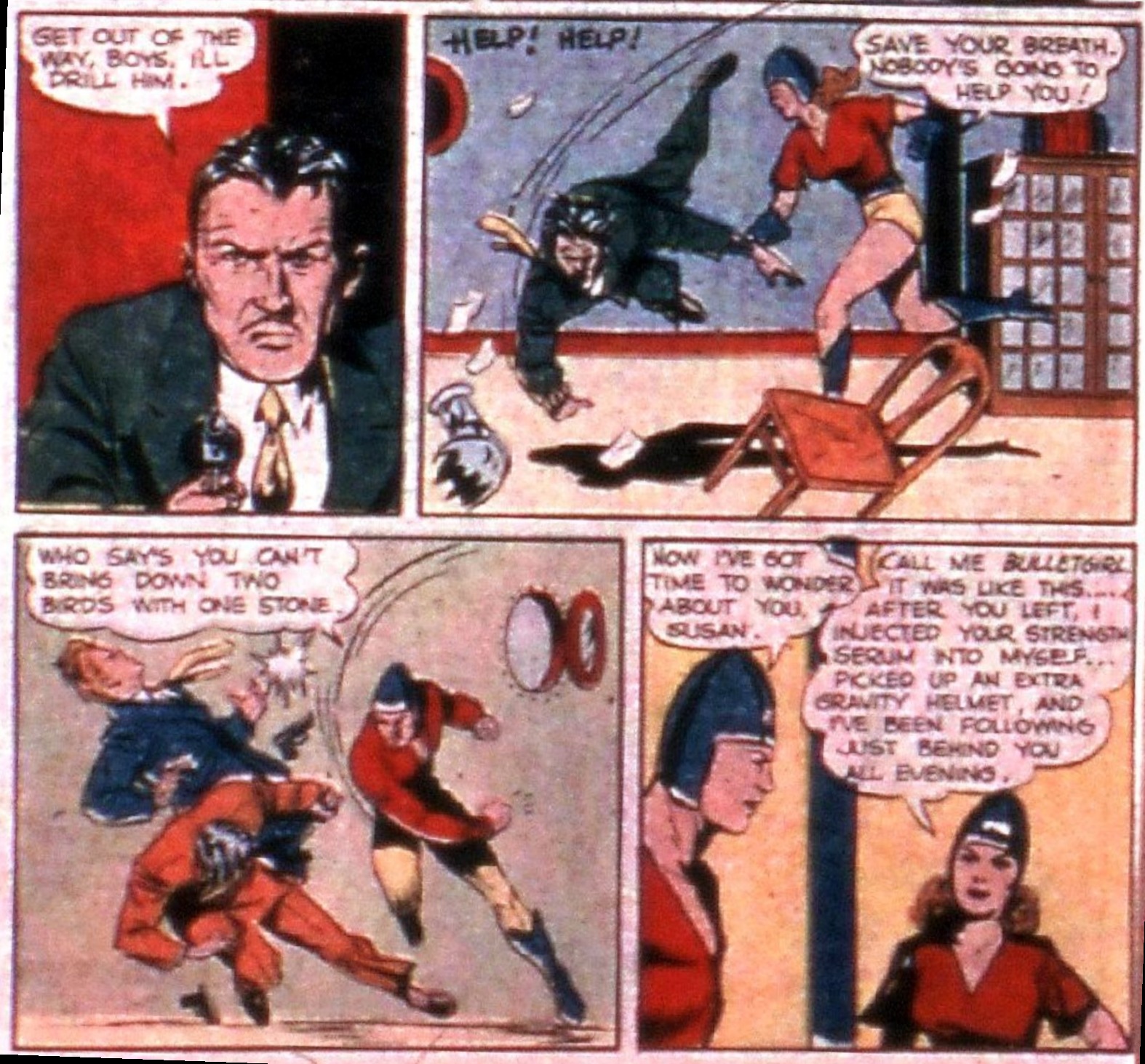
    Susan of course injects herself with the serum and crabs a spare Gravity-Regulator Helmet and costume (though she goes for hot pants over jodhpurs) the instant that Bulletman is out of the room, and This is a very good illustration of why I am so fond of Bulletgirl: she has all of the personality that Bulletman lacks. She’s scrappy and quippy and after an issue or two of “too dangerous for girls” chauvinism from Jim is a full partner in the superheroic exercise. She does get kidnapped and left behind a bit more than I’d like but that’s comic books in a nutshell. 

    In conclusion: Bulletgirl! (Master Comics 013, 1941)

    Minute-Man: 

    Like Jim Barr, Jack Weston is the son of a dead hero, though Jack’s father Robert Weston died during the Battle of Chateau-Thierry in World War I. We don’t get nearly as much background on Jack, other than the fact that he was raised by his father’s friend General Milton, but thanks to Milton, Jack becomes Minute-Man, a patriotic super-hero, in what is kind of presented as a draft.

    Jack is sent to join the Army as a lowly Private so that he can keep an eye out for sabotage and espionage affecting the armed forces. Despite having no super serum or particular special training, he proves to be physically near-superhuman as he engages a variety of costumed and non-costumed foes over the course of his mid-length career.

    Minute-Man also dabbles in leaving calling cards, which I always like to make note of. (Master Comics 011, 1941)

    Doctor Voodoo **UPDATE**: 

    In Whiz Comics 017, Doctor Voodoo returns home to find that Maxinya (the Heaven-Woman, natch) has gone missing. He tracks her abductors through the jungle until he comes across their destination: a European castle, smack in the middle of the Amazon. 

    The mystery deepens as Voodoo enters the castle and finds what seems to be an entire Medieval court, headed by the boorish King Richard, who seeks his aid in conquering the jungle. 

    Doctor Voodoo refuses to help King Richard, and so is forced to meet the knight Sir Ganal in combat. Voodoo prevails and wins Ganal over to his side, complete with a promise to reveal the origin of the castle’s presence in the jungle. Alas, this shall never come to pass, because the story does a hard pivot in the next issue. 

    King Richard plays the whole jungle conquest/attempted murder thing off as if it was some sort of test, and sends Doctor Voodoo off to meet with his court wizard. He. in turn, transports Voodoo back in time to the 1400s or thereabouts to retrieve a magical McGuffin called the Golden Flask, with another promise to explain what this whole affair is about once he returns.

    Unfortunately for all us completionists out there, the explanation never comes because Doctor Voodoo never returns. He bops around the oceans for about a year and actually does manage to get his hands on the Golden Flask but his feature is cancelled before he can return it to the wizard and find out just what the heck is going on. Maxinya is waiting for him still, presumably. (Whiz Comics 018, 1941)

  • DIVINE ROUND-UP 015

    Hate and deception abound in this batch of deities.

    Wangwa, God of Hate: 

    Wangwa, God of Hate is the personal god of Okoro, medicine man of the Blancas and enemy of Doctor Voodoo. I’ve never decided if the Evil Medicine Man trope is mere condescension toward native spiritual practices or a porting over of the Evil Vizier archetype to jungle comics, and in all honesty it’s probably both. Anyway, Okoro fits the mould to a T and he worships the god of hate. Sorry he’s so fuzzy.

    God Style: Idol (Whiz Comics 008, 1940) 

    Cheops:

    Adventurer Clip Carson and his archaeologist companion Jim Blake are searching for the fabled lost tomb of Cheops one day when they find themselves in the midst of an entire cult dedicated to the worship of what is apparently the resurrected Pharaoh himself. Carson and Blake are captured by the cult, upon which the supposed Cheops – with very little prompting, mind you – reveals himself to be Sergeant Beatty of the local colonial government, out to seize the treasures of Cheops for himself. Blake and Carson of course escape, and along the way Beatty is exposed as a fraud and torn apart by his former devotees. 

    The deep need for modern Egyptians in adventure fiction to turn to Ancient Egyptian religion, but only in the most secret, cultish, conspiratorial way is another one of those things that you end up wondering about once you read it enough times. Is it merely a fun and easy way to inject some mysterious action into your story? If so, why does it crop up instories set in Egypt so much more than ones set in Greece of Italy? Is it racism again? 

    God Style: Complicated – Cheops/Khufu could be considered to be a deified ruler of Egypt, even though the practice of doing so became common something like a thousand years after his time. Plus this is just some dude posing as him. (Action Comics v1 016, 1939)

    Doolong: 

    Remember Korieg the Sea Devil from a little while ago? Well, the same island people who hate that guy just love to worship Doolong, “god of [their] ancestors”. Not too much detail on Doolong, other than a) his idol is just a little face mounted on the wall and b) he slings a very accurate prophecy – he totally predicts the arrival of Tex Thomson and his party on the island, even if the small matter of Tex being the Princess’ destined mate is inaccurate. 

    God Style: Idol (Real?) (Action Comics v1 011, 1939)

    the Druid God: 

    This is possibly only obvious to someone who lives in the area, but the “group of islands” being indicated in the above image is clearly Cape Breton, Nova Scotia. Was Cape Breton seen as a place just far enough outside of the everyday for things like shipwrecks and secret cults to happen in, or did “Reynolds of the Mounted” scribe and lifelong resident of New York State Art Pinajian just trace a random bit of Canadian coastline and call it a day?

    Speaking of shipwrecks and secret cults, the first of those happens when Sergeant Reynolds heads toward the last known location of missing rich guy Johnny Westlake. Like Johnny, Reynolds washes up on the shore and is found and nursed back to health by local Pierre Dulac.

    Westlake has been on the island long enough to be able to relate the local legend of the Druid Cave, a spooky cave surrounded by spooky rock formations and regarded with fear by the superstitious islanders, who believe that though the cave is full of gold it is also cursed and that anyone venturing inside will die. Reynolds and Westlake venture inside after finding a local fisherman dying on the nearby beach and discover that the cave does in fact contain an ancient treasure and that the curse is probably just plain old asphyxiation thanks to some natural gas deposits.

    Here’s where the cult comes in: the islanders just kind of spontaneously develop it after finding Westlake emerging from the cave shortly before an explosion rocks the countryside. Never trust a group who turn to human sacrifice as a first option, is what I always say.

    In the end, the real culprit behind the murders and explosions turns out to be Pierre Dulac, who, far from being an altruistic soul, has been manipulating the situation to bring maximum chaos as a distraction while he sneaks off with the treasure. He didn’t reckon with Reynolds’ tenacity, of course, and ends up exploding along with the treasure and all evidence of whatever fantastic culture produced the Druid Cave. The islanders just kind of scatter, presumably to keep the worship of the Druid God alive in secret.

    God Style: Invoked (Feature Comics 045, 1941)

  • MINOR SUPER-HERO ROUND-UP 062

    We’re awash in minor super-heroes! 

    Golden Arrow: 

    Golden Arrow has a more convoluted origin than an Western hero has any right to, but I’ll do my best to summarize it without one million images. He is Roger Parsons, whose father, Professor Paul Parsons, develops advanced ballooning technology just before WWI breaks out and determines to test it out before donating it to the US government. To that end, he bundles his wife and infant son into a balloon and sets out on a cross-country voyage that turns out to have been a bit too well-publicized, because he is shot down by the villainous Brand Braddock while passing over the Western deserts. While Brand squirrels away Parsons’ technology until the day he can safely sell it on, the infant Roger is found by a prospector named Nugget Ned, who raises him as his own son.

    Life in the West suits Roger, and he grows up to be a physical paragon, a crack shot with the bow and arrow (with which he uses impractical but iconic golden-headed arrows, and yes, I do believe there is a story in which a crook goes around committing minor crimes in order to profit from gathering them up afterward) and a superb horseman on his faithful steed White Wind. Nugget Ned eventually dies of being Old, but passes on the truth of Roger’s parentage before he goes. Roger then takes back the ballooning technology from Brand (plus his twin sons Bronk and Brute) and donates it to the US Government. Along the way, he kind of falls into being a Western vigilante.

    Golden Arrow is also one of my classic examples of a character egregiously transitioning from the Modern to the Old West, since he is so firmly established as being in the present from the start. As usual, it’s not easy to pin down exactly when it happens, but it does. (Whiz Comics 002, 1940)

    UPDATE 1941 

    Spy Smasher:

    Spy Smasher is Alan Armstrong, a wealthy Virginia playboy who battles espionage threats to American democracy. He uses both his geographic proximity to Washington DC (via his Virginia estate) and his engagement to Eve Corby (daughter of Naval intelligence officer and eventual Chief of the US Secret Service Admiral Corby) to keep abreast of just what those threats might be and then sally forth to punch them in the face – smashing them, if you will.

    Though this setup might at first seem to be a recipe for a comic about a hero battling an endless series of nondescript men in suits, it is in fact the complete opposite, as Spy Smasher only smashes the most eccentric and flamboyant of spies, starting with the Mask, who does, yes, wear a suit most of the time, but trust me on this. He’s nutty.

    Something that I had forgotten about Spy Smasher is that they were extremely coy about his identity for the first year or so. It’s not a particularly mysterious mystery, as Armstrong is literally the only suspect and there is some allusion to the reader being able to figure it out.. They do make an attempt to imply that Armstrong could be the Mask, but there’s a period where Eve Corby knows the secret while the reader theoretically does not at I gotta assume that she would put 2 and 2 together if Spy Smasher was not Armstrong but Armstrong was still mysteriously sneaking off just before Spy Smasher and the Mask had a scrap. Basically what I’m saying is that this comic needed more white guys.

    Spy Smasher’s main bit of crime espionage-fighting technology is the Gyrosub (also Gyro-sub, Gyro Sub), a compact vehicle that combines the functions of a car, an airplane, a boat and a submarine and has a wide array of deployable weapons and technology as the story demands them. (Whiz Comics 002, 1940)

    UPDATES: 

    Smasher Spy 

    Doctor Voodoo: 

    Jungle heroes are all kind of samey: they fall into a few broad archetypes and have variably racist adventures in an abstract Jungle that frequently feels simultaneously Asian, African and South American (and indeed one of Doctor Voodoo’s own adventures involves Arab slavers raiding the Amazon from a very Sahara-like desert*). What is remarkable about Hal “Doctor Voodoo” Carey here is how he is both a white child who grew up in the jungle and excelled at jungle skills beyond his native peers and also simultaneously a magic white man from far away who brings modern science and medicine to the wilderness. How is this? Why, it is because the comic treats being a white guy as a kind of magical property that Hal has, and so even though he has never left the Amazon and learned all of his medicine from observing his father and reading his old textbooks, Hal identifies as and acts as an American doctor throughout the series.

    Hal practices his medicine among the Blanca, a tribe of “White Indians”, which is a term that I think originated in the pulps and is basically meaningless except to signal to the reader that the Blancas can be viewed as fully human. They are also the ones who give him the name “Doctor Voodoo” after deciding that his medical knowledge is magical in nature. Which I guess that it kind of is, given my earlier assertions. Annoying! (Whiz Comics 007, 1940)

    *this happens in Whiz Comics 017 if you’re interested 

    Maxinya the Heaven-Woman: 

    Doctor Voodoo’s companion/ love interest is Maxinya, the Heaven Woman, who is yet another kind of jungle hero in that she was abandoned when her explorer parents were seemingly killed in the collapse of an ancient temple and subsequently raised by jaguars. She can talk the language of jaguars and has jungle life down but ends up not having a lot to due because the focus is on Hal and he is the kind of misogynistic 40s hero who inists that adventure is no place for a lady.

    Not enough time is spent on the fact that Maxinya’s companion Jappa is a jaguar who is large enough to carry two adult humans on his back, who communicates with Maxinya and later Doctor Voodoo in an actual spoken language, with words. I feel like there’s a story there. (Whiz Comics 007, 1940)

    (it only comes up once, so I wouldn’t necessarily call it an essential part of his character, but here’s Doctor Voodoo engaging in Blanca Death Combat against his arch-foe Okoro)

    UPDATE 1941 – Dr Voodoo is flung back in time.