The Curse of Skeleton Munroe

Category: 1942

  • ALIENS AND SO FORTH ROUND-UP 053

    Aliens. 

    Molemen:

    These green-skinned humanoids live in an underground kingdom somewhere beneath what was then known as the Belgian Congo. They have been sent to the surface to find some white men – and just why they subscribe to the racial categories of surface humanity is left unexplored – and woe betide any non-white guys who they encounter first.

    The Molemen expedition eventually captures jungle adventurer Congo Jack and returns to the underground with him. Alas, we never quite learn what Queen Moletta of the Molemen wants a white guy for, because her interest in Jack inspires a real crisis in the ambitious expedition leader Sir Lugi and he draws most of the comic’s ongoing focus with a series of attempted coups to seize power for himself. (Lightning Comics v2 001, 1941)

    Blue Dwarfs:

    One of Sir Lugi’s schemes involves him teaming up with the Blue Dwarfs, ancient enemies of the Molemen, to seize the Moleman city by sneak attack.

    The Blue Dwarf victory hinges on the fact that Sir Lugi knocks out Congo Jack in the first couple of minutes of battle. Once he comes to, Jack is able to not only retake the city after exactly one inspiring speech to the Moleman troops, but also slay the Blue Dwarf King Bobo to really drive the victory home. He is then granted his freedom by Queen Moletta. (Lightning Comics v2 002, 1941)

    Martians:

    Meteor Martin, one of the many short-lived Basil Wolverton sc-fi adventurers, is an officer of the Moon Patrol who sallies forth to combat an invading Martian space fleet and finds himself blasted into a strange otherworldly realm. 

    The above is the only actual look we get at the Martians. Is their invasion successful? No idea. I do like their weird Wolvertonian tentacle arms, though.

    Luckily for Martin, he finds himself in the company of fellow humans Rana and her father Romrak, who are able to fill him in on what has happened to him. The Martian weapon he was struck with sends its victims to a “negative world,” implicitly another dimension. Further, the specific region that they are stranded in is a densely-packed cluster of planetoids called Gorikon. (Amazing-Man Comics 025, 1941) 

    Bat Men:

    Gorikon is awash with different lifeforms, though just how many of them are native to the place and how many have been sent there from the positive universe (or are the descendants of positive universe exiles) is unknown. When Meteor first encounters Rana, for example, she has been staked out as a sacrifice for Bat Men. (Amazing-Man Comics 025, 1941)

    Desert Dwellers:

    These excellent humanoid camel people (referred to as “savages” throughout, but that’s a pretty rude thing to refer to an entire people as, so I’ll just go with “dwellers”) are the ones who are attempting to sacrifice Rana to the Bat Men, and if any species in Gorikon is going to get my vote for having actually evolved there it’s them, if only because they have the weak muscles of a people who come from a low-gravity environment. Note how easily Meteor Martin beats them up, after all. (Amazing-Man Comics 025, 1941)

    Assorted Gorikons:

    Romrak and Rana have been residing in a village of interdimensional refugees, most of whom seem to be the same kind of near-human alien as series antagonist Groob here.

    The inhabitants of Groob’s village all seem to be the same kind of four-fingered humanoid as he is, though the presence of one little froggy guy with super-vision in Amazing-Man Comics 026 introduces the possibility of a more diverse cast of alien refugees that we sadly never get to see.

    Please also note the fact that the low gravity and close orbits of the planets of Gorikon means that interplanetary travel is achievable by means of a human cannonball-style cannon (though how Groob intends to return is a mystery to me). (Amazing-Man Comics 025, 1941)

    Insects:

    Meteor, Rana, Romrak and Groob all end up in this quicksand-like trap set by a species referred to as the Insects by the other inhabitants of Gorikon, and true to alien monster convention the Insect who comes to check the trap makes off with Rana rather than one of the men.

    Rana’s fate is to be sacrificed in a pit of fire, though it is Meteor who ends up falling to his doom in the issue’s cliffhanger. Sadly, there is no third Meteor Martin adventure and so we never learn a) how he gets out of it or b) whether these little green guys turn into the big green guy as part of their life-cycle or if he is some sort of distinct creature. I prefer the former! (Amazing-Man Comics 026, 1942)

  • ALIENS AND SO FORTH ROUND-UP 053

    Aliens. 

    Molemen:

    These green-skinned humanoids live in an underground kingdom somewhere beneath what was then known as the Belgian Congo. They have been sent to the surface to find some white men – and just why they subscribe to the racial categories of surface humanity is left unexplored – and woe betide any non-white guys who they encounter first.

    The Molemen expedition eventually captures jungle adventurer Congo Jack and returns to the underground with him. Alas, we never quite learn what Queen Moletta of the Molemen wants a white guy for, because her interest in Jack inspires a real crisis in the ambitious expedition leader Sir Lugi and he draws most of the comic’s ongoing focus with a series of attempted coups to seize power for himself. (Lightning Comics v2 001, 1941)

    Blue Dwarfs:

    One of Sir Lugi’s schemes involves him teaming up with the Blue Dwarfs, ancient enemies of the Molemen, to seize the Moleman city by sneak attack.

    The Blue Dwarf victory hinges on the fact that Sir Lugi knocks out Congo Jack in the first couple of minutes of battle. Once he comes to, Jack is able to not only retake the city after exactly one inspiring speech to the Moleman troops, but also slay the Blue Dwarf King Bobo to really drive the victory home. He is then granted his freedom by Queen Moletta. (Lightning Comics v2 002, 1941)

    Martians:

    Meteor Martin, one of the many short-lived Basil Wolverton sc-fi adventurers, is an officer of the Moon Patrol who sallies forth to combat an invading Martian space fleet and finds himself blasted into a strange otherworldly realm. 

    The above is the only actual look we get at the Martians. Is their invasion successful? No idea. I do like their weird Wolvertonian tentacle arms, though.

    Luckily for Martin, he finds himself in the company of fellow humans Rana and her father Romrak, who are able to fill him in on what has happened to him. The Martian weapon he was struck with sends its victims to a “negative world,” implicitly another dimension. Further, the specific region that they are stranded in is a densely-packed cluster of planetoids called Gorikon. (Amazing-Man Comics 025, 1941) 

    Bat Men:

    Gorikon is awash with different lifeforms, though just how many of them are native to the place and how many have been sent there from the positive universe (or are the descendants of positive universe exiles) is unknown. When Meteor first encounters Rana, for example, she has been staked out as a sacrifice for Bat Men. (Amazing-Man Comics 025, 1941)

    Desert Dwellers:

    These excellent humanoid camel people (referred to as “savages” throughout, but that’s a pretty rude thing to refer to an entire people as, so I’ll just go with “dwellers”) are the ones who are attempting to sacrifice Rana to the Bat Men, and if any species in Gorikon is going to get my vote for having actually evolved there it’s them, if only because they have the weak muscles of a people who come from a low-gravity environment. Note how easily Meteor Martin beats them up, after all. (Amazing-Man Comics 025, 1941)

    Assorted Gorikons:

    Romrak and Rana have been residing in a village of interdimensional refugees, most of whom seem to be the same kind of near-human alien as series antagonist Groob here.

    The inhabitants of Groob’s village all seem to be the same kind of four-fingered humanoid as he is, though the presence of one little froggy guy with super-vision in Amazing-Man Comics 026 introduces the possibility of a more diverse cast of alien refugees that we sadly never get to see.

    Please also note the fact that the low gravity and close orbits of the planets of Gorikon means that interplanetary travel is achievable by means of a human cannonball-style cannon (though how Groob intends to return is a mystery to me). (Amazing-Man Comics 025, 1941)

    Insects:

    Meteor, Rana, Romrak and Groob all end up in this quicksand-like trap set by a species referred to as the Insects by the other inhabitants of Gorikon, and true to alien monster convention the Insect who comes to check the trap makes off with Rana rather than one of the men.

    Rana’s fate is to be sacrificed in a pit of fire, though it is Meteor who ends up falling to his doom in the issue’s cliffhanger. Sadly, there is no third Meteor Martin adventure and so we never learn a) how he gets out of it or b) whether these little green guys turn into the big green guy as part of their life-cycle or if he is some sort of distinct creature. I prefer the former! (Amazing-Man Comics 026, 1942)
  • MINOR SUPER-VILLAIN 982: CAPTAIN MARS

    MINOR SUPER-VILLAIN 982: CAPTAIN MARS

    (The Funnies 062, 1941)

    “Rex, King of the Deep” is an adventure strip that ran in The Funnies 037 through to 063, the final issue. It stars titular King of the Deep Rex Withers, a wealthy young man who decides to put his money toward the betterment of humanity by funding the construction of a Super-Submarine designed by his friend Professor Bidoux. Over the next couple of years worth of comics he and his ever-expanding cast of associates (the Professor, second-in-command Tim and his own, less super submarine, former shipwreck victim Nan Barlow, young stowaway Butch, a large and mostly nameless crew of submariners) work to keep the seas safe for innocent travellers, at first independently and later on behalf of the Allied Powers. If you like comics about submarine combat I’m sure it’s perfectly thrilling but I personally find it to be a bit of a slog.

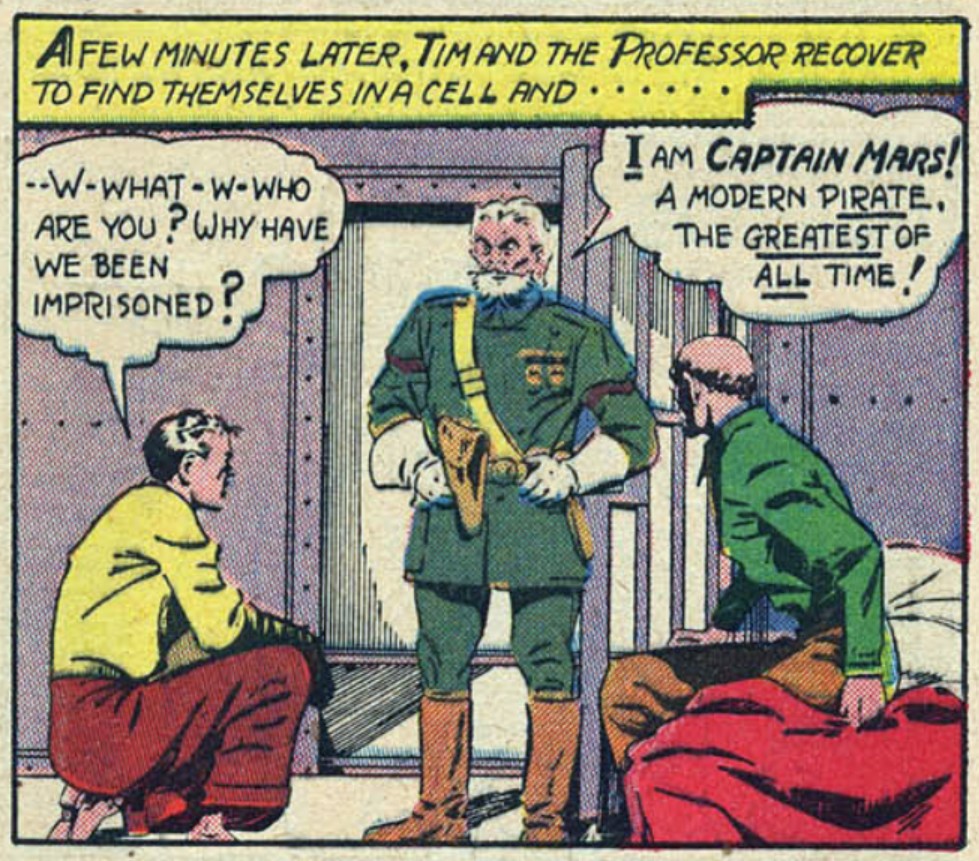
    Until, that is, The Funnies 061, in which Rex and his pals fend off a mysterious submarine attack on a convoy that they have been escorting across the Atlantic. They win handily and then follow the survivors with an eye toward discovering their base of operations, and are very surprised to find that it is an enormous, mobile undersea facility. This is the home of Captain Mars, who is not the commander of some Axis superweapon as they must have initially believed, but a highly ambitious and technologically proficient submarine pirate, which is possibly my second favourite kind of pirate after space!

    The centrepiece of Mars’ operation is his headquarters, which is frankly enormous. Not only can it easily accommodate the already huge Super-Sub in its docking bay, but there are frequent references to buildings and streets, and in The Funnies 063 Rex evades some pursuers by swinging on some vines that are hanging from what appears to be a full-grown oak tree in a courtyard and landing on the other side of a garden wall. They have so much extra space inside of this thing that they’re doing landscaping.

    Captain Mars has the classic Bad Boss and Bombastic Speechifying genes that are common to many super-villains, and which are almost certainly a necessity for anyone looking to set up shop as a submarine pirate. I would still recommend that he reconsider his policy of shooting his subordinates for “failures” such as disengaging from a combat engagement before their vessel was destroyed. If nothing else it must be terrible for morale.

    Despite the might of his base and the fact that he has cool holographic communication technology, Captain Mars is undone by Rex’s Underwater Tank, which was merely a useful tool in the first few of his adventures but which seems to also be an unstoppable war machine capable of defeating all barriers and attacks.

    Sadly, the cancellation of The Funnies brings with it a premature end to “Rex, King of the Deep,” just as Mars managed to bamboozle Rex out of the Underwater Tank and repurpose it as a coastal raider. While the original plan for the comic must have been for Rex to escape and reclaim his property and possibly even take the underwater base for his own, as it stands Captain Mars is forever ascendant. 

    Categorized in: Generica (Captains), Famous Figures (Mars), Theft (Submarine Pirates) 

  • MINOR SUPER-VILLAIN 982: CAPTAIN MARS

    (The Funnies 062, 1941)

    “Rex, King of the Deep” is an adventure strip that ran in The Funnies 037 through to 063, the final issue. It stars titular King of the Deep Rex Withers, a wealthy young man who decides to put his money toward the betterment of humanity by funding the construction of a Super-Submarine designed by his friend Professor Bidoux. Over the next couple of years worth of comics he and his ever-expanding cast of associates (the Professor, second-in-command Tim and his own, less super submarine, former shipwreck victim Nan Barlow, young stowaway Butch, a large and mostly nameless crew of submariners) work to keep the seas safe for innocent travellers, at first independently and later on behalf of the Allied Powers. If you like comics about submarine combat I’m sure it’s perfectly thrilling but I personally find it to be a bit of a slog.

    Until, that is, The Funnies 061, in which Rex and his pals fend off a mysterious submarine attack on a convoy that they have been escorting across the Atlantic. They win handily and then follow the survivors with an eye toward discovering their base of operations, and are very surprised to find that it is an enormous, mobile undersea facility. This is the home of Captain Mars, who is not the commander of some Axis superweapon as they must have initially believed, but a highly ambitious and technologically proficient submarine pirate, which is possibly my second favourite kind of pirate after space!

    The centrepiece of Mars’ operation is his headquarters, which is frankly enormous. Not only can it easily accommodate the already huge Super-Sub in its docking bay, but there are frequent references to buildings and streets, and in The Funnies 063 Rex evades some pursuers by swinging on some vines that are hanging from what appears to be a full-grown oak tree in a courtyard and landing on the other side of a garden wall. They have so much extra space inside of this thing that they’re doing landscaping.

    Captain Mars has the classic Bad Boss and Bombastic Speechifying genes that are common to many super-villains, and which are almost certainly a necessity for anyone looking to set up shop as a submarine pirate. I would still recommend that he reconsider his policy of shooting his subordinates for “failures” such as disengaging from a combat engagement before their vessel was destroyed. If nothing else it must be terrible for morale.

    Despite the might of his base and the fact that he has cool holographic communication technology, Captain Mars is undone by Rex’s Underwater Tank, which was merely a useful tool in the first few of his adventures but which seems to also be an unstoppable war machine capable of defeating all barriers and attacks.

    Sadly, the cancellation of The Funnies brings with it a premature end to “Rex, King of the Deep,” just as Mars managed to bamboozle Rex out of the Underwater Tank and repurpose it as a coastal raider. While the original plan for the comic must have been for Rex to escape and reclaim his property and possibly even take the underwater base for his own, as it stands Captain Mars is forever ascendant. 

    Categorized in: Generica (Captains), Famous Figures (Mars), Theft (Submarine Pirates) 

  • MINOR SUPER-VILLAIN 975: THE SMILER

    (Fight Comics 016, 1941) 

    The Smiler! A grody-looking gang boss with a permanent crooked smile thanks to a facial scar! I can’t actually figure out where this scar is actually supposed to be – I suppose that it must be there, but the Smiler’s face is so covered in seams and divots that it doesn’t stand out.

    The Smiler is such a ruthless and dastardly crook that he accepts a commission from Nazi agent Blitz to steal the engine-killing ray that local inventor Professor Adams is developing for the US government. Any qualms that he might have about betraying his country in this way are smoothed over by the fact that Blitz is paying him a cool one million dollars to do it.

    As is so often the case, the Smiler appearas to have come up with at least three viable plans to steal the ray but rather than committing to any one of them he just does them all at once. The first and second plans are similar in nature: the Smiler disguises himself as a mysterious figure called the Countess and moves into a mansion near Professor Adams’ house, while his gang replaces the entire police force of Freeville, Maryland. Having successfully infiltrated Freeville society (twice!), the gang are now in a perfect position to acquire the ray via subterfuge, perhaps by arresting Professor Adams on trumped-up charges or arranging for the Countess to have a tour of the lab.

    Instead, the fake police round up the entire adult population of Freeville and kill anyone who resists and then threatens to kill everyone if they don’t give up the Professor. In addition to invalidating the effort that was put into the stealth-based aspects of the plan – the Countess part in particular is now just an excuse for a cheap laugh – this gives Adams time to make a fake ray that is in fact a time bomb to hand over and potentially sacrifice himself in the process to save the town.

    It never actually comes to that, however, because Freeville is the home of patriotic super-hero Captain Fight, who teams up with Adams’ son Yank to beat the absolute tar out of both the Smiler and Blitz (and possibly drown the latter?).

    The Smiler returns in 1942’s Fight Comics 017, but thanks to a change of artists has lost his signature crooked grin in favour of a more generic one. This time out he’s stealing British supply ships to sell on to the Axis and gets beaten up for his trouble once more.

    Categorized in: Accessories (Distinctive Scars), Body (Mouth), Misc (Gang Bosses)

  • REAL PERSON ROUND-UP 025

    If comics are reflections of the real world then why should we be surprised to find them so full of real people?

    Adolf Hitler:

    Hiller is the “mad dictator” who inspires Hercules to reincarnate and eventually become Marvel Boy. He’s about as close as you get to putting a Hitler in your comic as you can get without actually saying the name. The whole name. The “t” part. (Daring Mystery Comics 006, 1940)

    This otherwise-unnamed Fuehrer of a likewise nameless underground nation that vexes the America inhabited by Captain Daring in 3051 CE is a clear inspired-by-Hitler type. (Daring Mystery Comics 007, 1941)

    Citizen V takes a break from his propaganda campaign in Occupied Europe to sneak into Germany and become a member of the Punched Hitler in the Nose Club. (Daring Mystery Comics 008, 1942)

    This version of Hitler appears in a long dream sequence in the comedic Army Life strip “Private Rook” that appears to exist solely to make a joke about him being gay (the bit where he is the Princess Tanya’s Fairy Godmother, specifically). This isn’t great, but it is remarkable for being the only time I personally have seen such a thing in a Golden Age comic. (Army and Navy Comics 003, 1941)

    Though Cap punches Hitler on the cover of his very first issue, it is in fact Bucky who lands the first blow on him (and Goering) in the pages of a comic. (Captain America Comics 002, 1941)

    the Borgias:

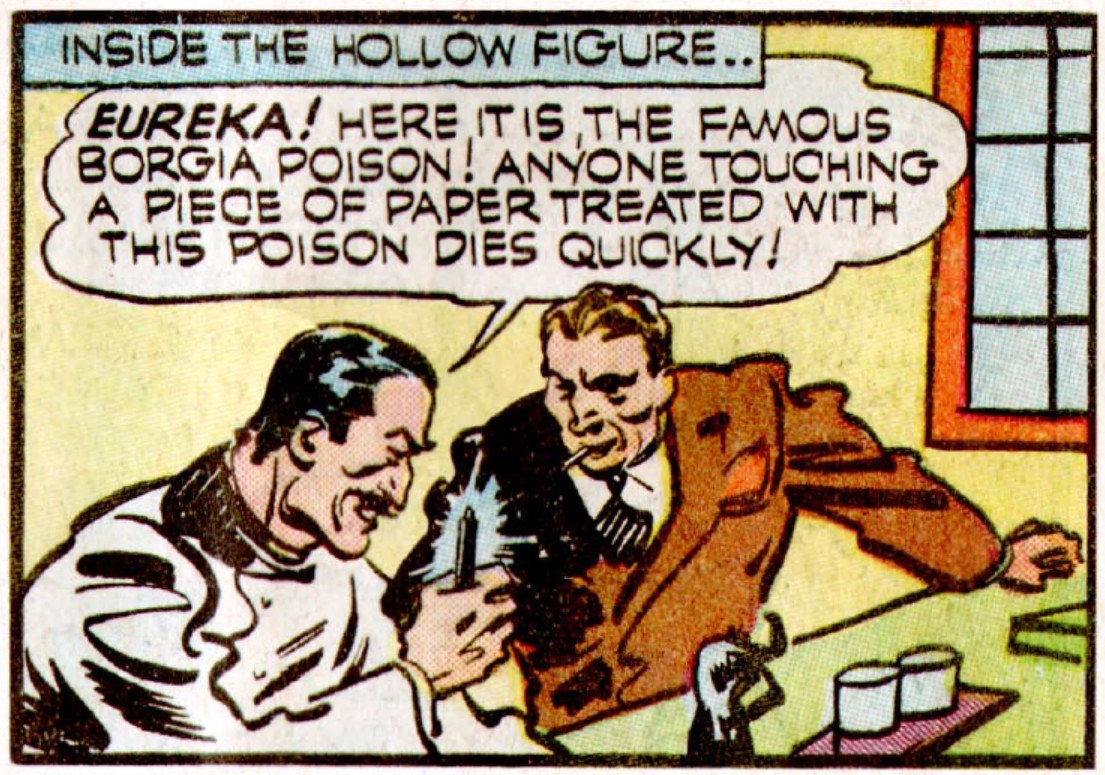
    Cesare, Lucrezia and the rest of the Borgia family might not actually appear in comics all that often, but they certainly do figure into their plots via the absolute piles of poisoned and poison-adjacent artifacts that are attributed to them. Borgia trinkets crop up so frequently, in fact, that I am surprised that it’s taken us this long to encounter one, in the form of a hollow silver statuette that contains a deadly contact poison. (Fantastic Comics 018, 1941)

    Fort Knox:

    Stardust the Super Wizard’s final foe, the unfortunately-named “Slant-Eye,” was a classic comic book Fort Knox robber. (Fantastic Comics 016, 1941)

    Francis Biddle:

    Major Victory has to consult with the US Attorney General in 1941, and in 1941 the US Attorney General was Francis Biddle. The man in the panel above is not Francis Biddle. (Dynamic Comics 002, 1941)

    Franklin D Roosevelt:

    Seen ordering the creation of a super-soldier, i.e. Captain America, to combat domestic espionage. (Captain America Comics 001, 1941)

    Fritz Kuhn:

    Fritz Knoll, purveyor of domestic espionage, is probably a reference to the chief Bundist. (Fantastic Comics 021, 1941)

    Henry L Stimson:

    The US didn’t even have a Secretary of Defense until after WWII, so I am not sure who this guy hanging out with Samson is supposed to be. The analogous position at the time this comic came out was Secretary of War, and that was Henry L Stimson, and this is not him. A true mystery man in all senses. (Fantastic Comics 023, 1941)

    J Edgar Hoover:

    J Arthur Grover, head of the FBI and clear J Edgar Hover stand-in, is also the man in charge of the program that would eventually be known as Project: Rebirth, aka the super-soldier program that produces Captain America later in this same issue. (Captain America Comics 001, 1941)

    Tutankhamen:

    Some of King Tut’s grave goods are among the items stolen by the Butterfly. (Captain America Comics 003 1941)

  • REAL PERSON ROUND-UP 025

    REAL PERSON ROUND-UP 025

    If comics are reflections of the real world then why should we be surprised to find them so full of real people?

    Adolf Hitler:

    Hiller is the “mad dictator” who inspires Hercules to reincarnate and eventually become Marvel Boy. He’s about as close as you get to putting a Hitler in your comic as you can get without actually saying the name. The whole name. The “t” part. (Daring Mystery Comics 006, 1940)

    This otherwise-unnamed Fuehrer of a likewise nameless underground nation that vexes the America inhabited by Captain Daring in 3051 CE is a clear inspired-by-Hitler type. (Daring Mystery Comics 007, 1941)

    Citizen V takes a break from his propaganda campaign in Occupied Europe to sneak into Germany and become a member of the Punched Hitler in the Nose Club. (Daring Mystery Comics 008, 1942)

    This version of Hitler appears in a long dream sequence in the comedic Army Life strip “Private Rook” that appears to exist solely to make a joke about him being gay (the bit where he is the Princess Tanya’s Fairy Godmother, specifically). This isn’t great, but it is remarkable for being the only time I personally have seen such a thing in a Golden Age comic. (Army and Navy Comics 003, 1941)

    Though Cap punches Hitler on the cover of his very first issue, it is in fact Bucky who lands the first blow on him (and Goering) in the pages of a comic. (Captain America Comics 002, 1941)

    the Borgias:

    Cesare, Lucrezia and the rest of the Borgia family might not actually appear in comics all that often, but they certainly do figure into their plots via the absolute piles of poisoned and poison-adjacent artifacts that are attributed to them. Borgia trinkets crop up so frequently, in fact, that I am surprised that it’s taken us this long to encounter one, in the form of a hollow silver statuette that contains a deadly contact poison. (Fantastic Comics 018, 1941)

    Fort Knox:

    Stardust the Super Wizard’s final foe, the unfortunately-named “Slant-Eye,” was a classic comic book Fort Knox robber. (Fantastic Comics 016, 1941)

    Francis Biddle:

    Major Victory has to consult with the US Attorney General in 1941, and in 1941 the US Attorney General was Francis Biddle. The man in the panel above is not Francis Biddle. (Dynamic Comics 002, 1941)

    Franklin D Roosevelt:

    Seen ordering the creation of a super-soldier, i.e. Captain America, to combat domestic espionage. (Captain America Comics 001, 1941)

    Fritz Kuhn:

    Fritz Knoll, purveyor of domestic espionage, is probably a reference to the chief Bundist. (Fantastic Comics 021, 1941)

    Henry L Stimson:

    The US didn’t even have a Secretary of Defense until after WWII, so I am not sure who this guy hanging out with Samson is supposed to be. The analogous position at the time this comic came out was Secretary of War, and that was Henry L Stimson, and this is not him. A true mystery man in all senses. (Fantastic Comics 023, 1941)

    J Edgar Hoover:

    J Arthur Grover, head of the FBI and clear J Edgar Hover stand-in, is also the man in charge of the program that would eventually be known as Project: Rebirth, aka the super-soldier program that produces Captain America later in this same issue. (Captain America Comics 001, 1941)

    Tutankhamen:

    Some of King Tut’s grave goods are among the items stolen by the Butterfly. (Captain America Comics 003 1941)

  • MINOR SUPER-VILLAIN 954: THE GROOM

    (Daring Mystery Comics 008, 1942)

    The Groom is but a simple gang boss who dresses up in a bridegroom’s outfit complete with top hat while doing crimes. While he absolutely gets his ass handed to him by comedy characters Rudy the Robot and his creator the Li’l Professor I simply must hand it to a crook with such commitment to a theme. 

    Categorized in: Accessories (Minions – Gangsters), Family (Grooms), Locations (New York)

  • MINOR SUPER-HERO ROUND-UP 088

    MINOR SUPER-HERO ROUND-UP 088

    To continue my recent trend, 3/4 of these characters are very unlikely to appear in a modern Marvel comic and the fourth is decently likely to.

    Mr Million:

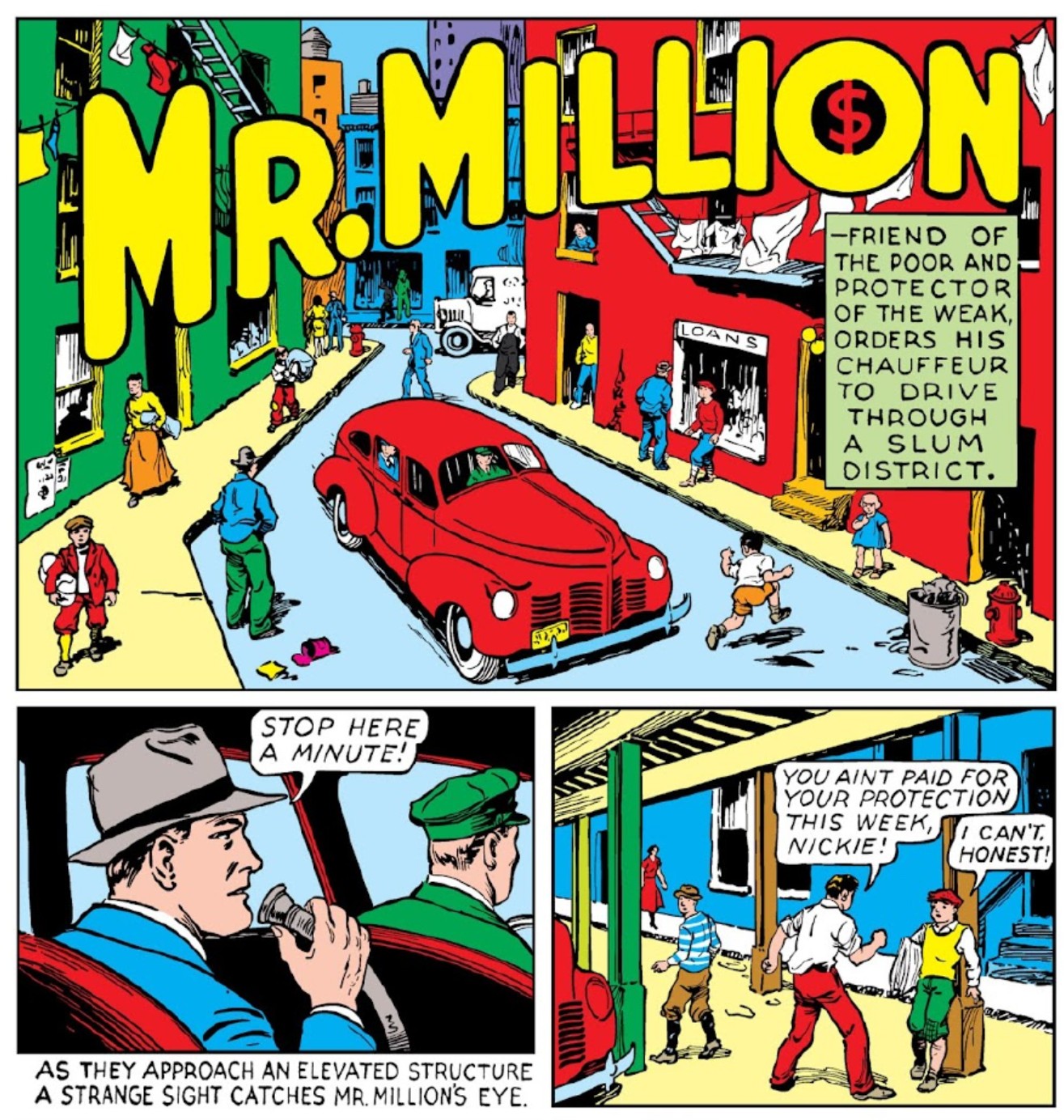
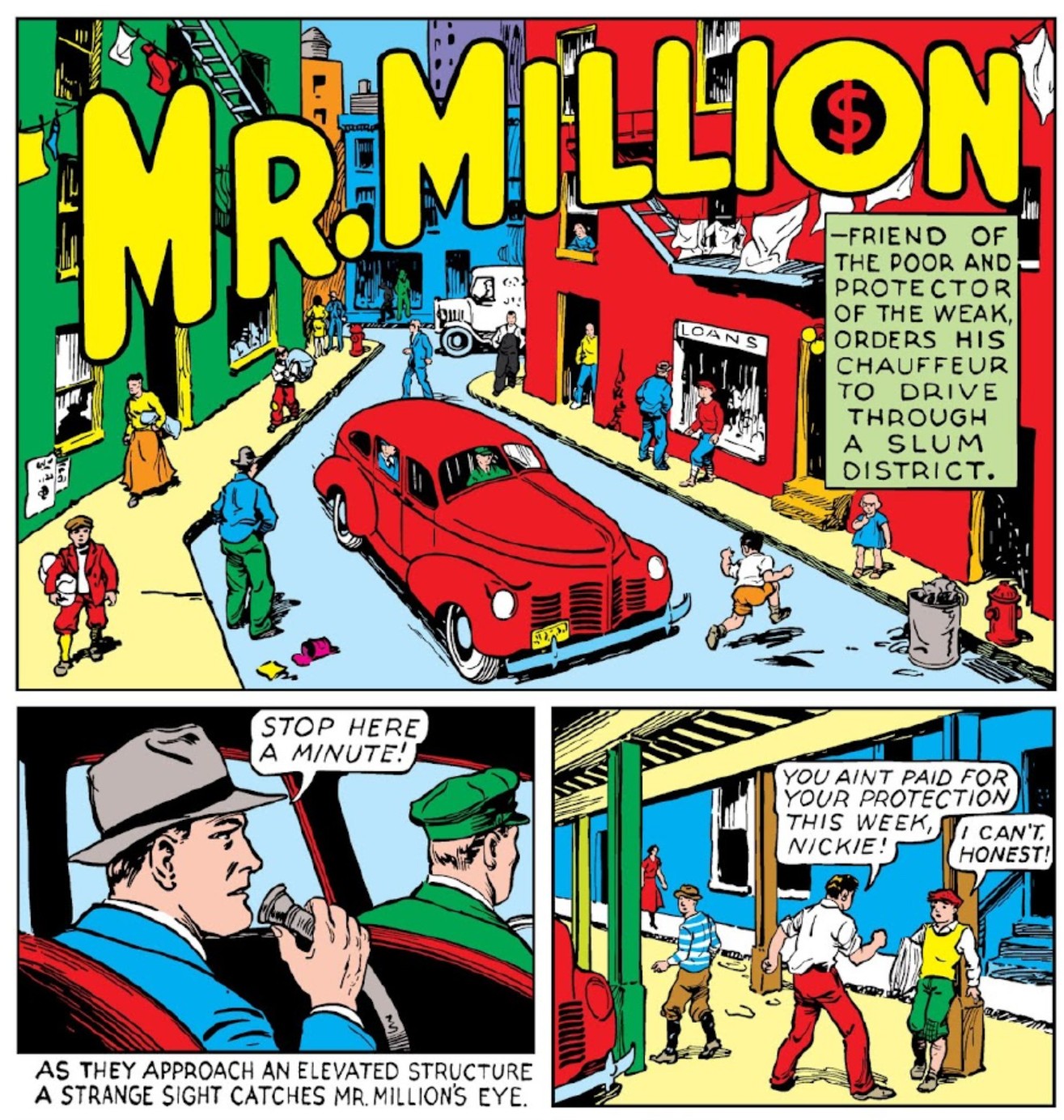
    Mr Million is kind of what everyone yaps about wanting Bruce Wayne to be: a rich guy who uses his money to help people instead of beating people up, and while that might be better for society in this completely fictional version of New York City it’s pretty boring to read about. But this one orphan kid is no longer being bullied and his child labour is netting him enough to support his sick mother, so that’s something, I guess. (Daring Mystery Comics 007, 1941)

    Categorized in: Alphanumeric (a Million), Generica (Misters)

    Captain Daring:

    Captain Daring is the square-jawed hero of America in the year 3051 CE, and while short-lived sci-fi adventurers are so plentiful in both the Golden and Silver Ages that I don’t usually bother with them, this is another early Jack Kirby strip. As such, you get the fun of spotting the first-draft versions of things that he will come back to throughout his career, like the cast of differently-shaped background characters above, or the cool armour that everyone sports.

    The technology isn’t quite as ornate as it will get but you can see the base structures that Kirby will build upon.

    And of course there is Kirby’s love of a tough woman and (less common but still something that he will return to) his fondness for dog cavalry.

    Captain Daring himself is notable for facing both a Hitler-inspired subterranean Fuehrer and Hitler himself, but sadly is dropped from Daring Mystery Comics while he is mind-controlled by the latter. I can’t believe that they made Captain Daring a Nazi, etc. (Daring Mystery Comics 007, 1941)

    Categorized in: Generica (Captains), Language (Superlatives – Daring), Origins (Heroes of the Future)

    the Challenger:

    Bill Waring is a physically-unimposing young law student who is almost killed when his father attempts to expose a city-wide corruption scandal and is gunned down in the street. Swearing vengeance, Bill sets out to learn everything he needs to become a crime fighter.

    Waring travels the world, mastering among many other things the secrets of: jujutsu, chemistry, nerve control, fencing, the rifle, aerial combat, boxing, swimming, baseball, football and most useful of all, polo. He’s the complete crimefighting package!

    Finally prepared, Bill dons a costume that is simultaneously kind of cool- and quite goofy-looking (I thought for sure that that little white dot in the centre of his mask was meant to be his nose poking out but I checked the original art and even there it’s just a weird white dot) and confronts Dram, the gang boss responsible for his father’s death. His name, it turns out, is in reference to his habit of challenging crooks to single combat that is sometimes, as in Dram’s case, to the death. The Challenger moves over to Mystic Comics after his first appearance, so we will be seeing him again in a few months to find out if he keeps this habit up. (Daring Mystery Comics 007, 1941)

    Categorized in: Activities (Duelling), Origins (Crime Orphans), Powers (Martial Artists, Weapons Masters)

    Citizen V:

    Citizen V is in reality British Army Lieutenant John Watkins, who is seemingly killed during the evacuation at Dunkirk but is only mostly dead. After being nursed back to help by a kindly French fisherman, Watkins makes his way back to England and is recruited as an officially sanctioned costumed agent to head back into Axis-occupied territory and incite rebellion.

    Watkins’ Citizen V uniform is interesting for being one of the few super-hero costumes to incorporate Morse code (just above the “V” on his chest) and is also a fine example of how some design choices just don’t work. If there is a super suit out there that looks good with both long sleeves and short shorts, it isn’t this one. More modern depictions of the character lean into the “military uniform” aspect of the look more and give him pants. It’s a bit less super-hero-y but much nicer looking.

    Though Watkins does punch plenty of Nazis (and Hitler himself!) in the snoots, the main focus of his mission is in promoting the “V for Victory” campaign, a real-life thing that actually happened in occupied Europe, and which characters such as the Silver Streak and London were also involved in in their respective comics.

    Citizen V is of course most well-known today for having been murdered by Baron Zemo, who stole the identity for use as the leader of the first Thunderbolts team. He also has a surprisingly extensive collection of successors, all of whom unfortunately seem to prefer the terrible Zemo version of the costume, which I had always assumed was purposefully designed to look like an exercise in patriotic bad taste but which is evidently preferable to wearing a little service cap. (Daring Mystery Comics 008, 1942)

    Categorized in: Alphanumeric (V), Generica (Citizens), Origin (Faked Own Death)

  • MINOR SUPER-HERO ROUND-UP 088

    MINOR SUPER-HERO ROUND-UP 088

    To continue my recent trend, 3/4 of these characters are very unlikely to appear in a modern Marvel comic and the fourth is decently likely to.

    Mr Million:

    Mr Million is kind of what everyone yaps about wanting Bruce Wayne to be: a rich guy who uses his money to help people instead of beating people up, and while that might be better for society in this completely fictional version of New York City it’s pretty boring to read about. But this one orphan kid is no longer being bullied and his child labour is netting him enough to support his sick mother, so that’s something, I guess. (Daring Mystery Comics 007, 1941)

    Categorized in: Alphanumeric (a Million), Generica (Misters)

    Captain Daring:

    Captain Daring is the square-jawed hero of America in the year 3051 CE, and while short-lived sci-fi adventurers are so plentiful in both the Golden and Silver Ages that I don’t usually bother with them, this is another early Jack Kirby strip. As such, you get the fun of spotting the first-draft versions of things that he will come back to throughout his career, like the cast of differently-shaped background characters above, or the cool armour that everyone sports.

    The technology isn’t quite as ornate as it will get but you can see the base structures that Kirby will build upon.

    And of course there is Kirby’s love of a tough woman and (less common but still something that he will return to) his fondness for dog cavalry.

    Captain Daring himself is notable for facing both a Hitler-inspired subterranean Fuehrer and Hitler himself, but sadly is dropped from Daring Mystery Comics while he is mind-controlled by the latter. I can’t believe that they made Captain Daring a Nazi, etc. (Daring Mystery Comics 007, 1941)

    Categorized in: Generica (Captains), Language (Superlatives – Daring), Origins (Heroes of the Future)

    the Challenger:

    Bill Waring is a physically-unimposing young law student who is almost killed when his father attempts to expose a city-wide corruption scandal and is gunned down in the street. Swearing vengeance, Bill sets out to learn everything he needs to become a crime fighter.

    Waring travels the world, mastering among many other things the secrets of: jujutsu, chemistry, nerve control, fencing, the rifle, aerial combat, boxing, swimming, baseball, football and most useful of all, polo. He’s the complete crimefighting package!

    Finally prepared, Bill dons a costume that is simultaneously kind of cool- and quite goofy-looking (I thought for sure that that little white dot in the centre of his mask was meant to be his nose poking out but I checked the original art and even there it’s just a weird white dot) and confronts Dram, the gang boss responsible for his father’s death. His name, it turns out, is in reference to his habit of challenging crooks to single combat that is sometimes, as in Dram’s case, to the death. The Challenger moves over to Mystic Comics after his first appearance, so we will be seeing him again in a few months to find out if he keeps this habit up. (Daring Mystery Comics 007, 1941)

    Categorized in: Activities (Duelling), Origins (Crime Orphans), Powers (Martial Artists, Weapons Masters)

    Citizen V:

    Citizen V is in reality British Army Lieutenant John Watkins, who is seemingly killed during the evacuation at Dunkirk but is only mostly dead. After being nursed back to help by a kindly French fisherman, Watkins makes his way back to England and is recruited as an officially sanctioned costumed agent to head back into Axis-occupied territory and incite rebellion.

    Watkins’ Citizen V uniform is interesting for being one of the few super-hero costumes to incorporate Morse code (just above the “V” on his chest) and is also a fine example of how some design choices just don’t work. If there is a super suit out there that looks good with both long sleeves and short shorts, it isn’t this one. More modern depictions of the character lean into the “military uniform” aspect of the look more and give him pants. It’s a bit less super-hero-y but much nicer looking.

    Though Watkins does punch plenty of Nazis (and Hitler himself!) in the snoots, the main focus of his mission is in promoting the “V for Victory” campaign, a real-life thing that actually happened in occupied Europe, and which characters such as the Silver Streak and London were also involved in in their respective comics.

    Citizen V is of course most well-known today for having been murdered by Baron Zemo, who stole the identity for use as the leader of the first Thunderbolts team. He also has a surprisingly extensive collection of successors, all of whom unfortunately seem to prefer the terrible Zemo version of the costume, which I had always assumed was purposefully designed to look like an exercise in patriotic bad taste but which is evidently preferable to wearing a little service cap. (Daring Mystery Comics 008, 1942)

    Categorized in: Alphanumeric (V), Generica (Citizens), Origin (Faked Own Death)