The Curse of Skeleton Munroe

Category: Camilla Queen of the Lost Empire

  • GENERIC COSTUMED VILLAIN ROUND-UP 046

    Here’s to all the crooks who just didn’t have enough oomph.

    the Despot:

    The Despot (not really his name, but literally the only thing he is called throughout the story) has the magic power to transform himself and others into living plants and animals, a power which he uses to trap Camilla and Sir Champion in his mountain fastness after luring them there on a magical golden road. Thus stripped of its leaders, the Lost Empire proves no match for the Despot’s invading armies (who might be animals that have been turned into humans or might also have the power to turn into animals – it is unclear). 

    The Despot’s reign over the Lost Empire is short, as Camilla and Sir Champion are able to outwit the single, albeit magical, dog that he had left to guard them. Cornered, he makes a real shapeshifter mistake and turns into a potato, whereupon he is trapped in that form forever by Sir Champion’s magic sword. 

    This adventure comes at the very end of Camilla’s time in the original Lost Empire location, which is very sad because I think that knowing that a magical evil potato was stuck to the floor somewhere just off-panel would have really enhanced those stories. (Jungle Comics 014, 1941)

    the Acrobat Bandits:

    The Acrobat Bandits are a trio of rope-swinging jewel thieves who terrorize NYC for a few weeks before they tangle with reporter Dopey Day and are undone by his semi-slapstick ways. They are in fact pretty cool villains but really don’t get a lot of time to shine while Dopey is tripping over himself and dropping things, alas. (Liberty Scouts Comics 003, 1941)

    Jasper Fennel:

    Seemingly mild-mannered jewellery store clerk Jasper Fennel turns out to be the brains behind the notorious Panther Gang in this Marvo the Magician story. He might never have been caught if he hadn’t robbed his own place of employment – a valuable lesson for all would-be criminals not to shit where you eat. He also has one of the more upsetting masks I have seen in a while. (Lightning Comics v2 004, 1941)

    Hook:

    Hook is the leader of a gang who are attempting to run a protection racket on New York’s dry cleaners. He’s just a guy with a hook prosthetic who has decided to go with it and that’s what this lowest level of super-villainy is all about. Plus that nail bomb that he attempts to kill Ferret with is truly gnarly. (Marvel Mystery Comics v1 009, 1940)

  • MINOR SUPER-VILLAIN 991: ZIRA

    (Jungle Comics 013, 1941)

    While searching for her champion Sir Champion (annoying thing to have to write and the main reason I’m happy that he eventually fades into obscurity), who has failed to return from a hunt, Camilla, Queen of the Lost Empire is confronted by the ghostly vision of a blonde lady who rules an ancient lost castle. This is just a kind of person you get in the undefined part of Africa that houses the Lost Empire.

    The lady’s name, by the way, is Zira, Princess of the Palace of the Black Heart. She also refers to herself as a “wizardess,” and while I am generally of the opinion that gendered job titles like that are retrograde and unhelpful I must admit to being charmed. Wizardess!

    This vision leads Camilla back to the aforementioned Palace of the Black Heart, where her mortal form is revealed to be a middle-aged lady, or “old hag” as our hero so tactfully puts it. Zira states that Sir Champion is locked up in her dungeon and she will return him in exchange for all of Camilla’s magic powers. The sum total of these powers, from my notes, being the ability to talk to gorillas and the power to call upon Thor and Baal to freeze someone. Frankly not a bad trade for someone’s life. Do we include her eternal life? She got that from a potion, after all.

    Camilla evidently wishes to continue to speak to apes and so she and her men battle with Zira’s forces until they are ironically defeated by some apes.

    It then turns out that Camilla has more tricks up her sleeve than I had in my notes. She offers to brew up a potion to make Zira good looking in exchange for freedom for her and her men, and since this is the same comic that made a point of calling Zira a wizardess, she is of course very vain by default and takes the deal immediately.

    The thing about taking advantage of a woman’s default vanity in such a comic is of course the fact that the vain woman will also be extremely fickle, as seen when the newly-hot Zira reneges on her deal in favour of keeping Sir Champion for her own horny purposes. Things quickly turn violent and Sir Champion is forced to slay Zira to save Camilla’s life. All in all it’s a real eleventh-hour fumble on Zira’s part.

    Categorized in: Accessories (Castles), Genrica (Ends in -a), Powers (Various Magics)

  • MINOR SUPER-HERO ROUND-UP 101

    It’s a big year for the jungle-based heroes of Fiction House, and also Radior is here.

    Camilla, Queen of the Lost Empire **UPDATE**:

    1941 is the year of change for Camilla. First off, she faces a series of threats to the Lost Empire itself, beginning when an evil magician nearly conquers and partially razes the city. (Jungle Comics 014, 1941)

    Next issue, the otherwise-unremarkable lech Prince Renardo finishes the job and burns the city to the ground as part of an attempt to win Camilla’s hand in marriage. Camilla and her surviving citizens rebuild but it is a far less grand affair, being more of a wooden stockade. (Jungle Comics 015, 1941)

    Perhaps inspired by the radical change in circumstances, Camilla and her subjects adopt a sort of retro-Norse style in keeping with their ancestry. Camilla’s lover Sir Champion disappears from the narrative at this point, never to be seen again. (Jungle Comics 016, 1941)

    The Viking revival among the people of the Lost Empire really takes off, and soon Camilla and her new paramour Erik are sailing around in longships having adventures with the seemingly endless variety of anachronistic societies littering the Central African jungle. This state of affairs continues for the remainder of 1941, as does Camilla’s insistence on wearing one of the most improbable bikini-chestplates in the history of fantasy illustration. How is it held on? (Jungle Comics 018, 1941)

    Fantomah **UPDATE**: 

    Following the departure of Fletcher Hanks, Fantomah too goes through some changes (and will continue to do so for a while yet). The first stage of this sees her lose a fair portion of her magical power, most importantly including her signature skull-faced “this means war” form. She also drops her black nightie look in favour of a more traditional jungle heroine’s one-piece, albeit made of leaves rather than the more typical animal skins. (Jungle Comics 017, 1941)

    By the end of 1941, Fantomah has become a mostly-regular jungle heroine. She has a panther pal named Fury, an orphan boy companion named Ken, and though she still busts out the odd magical ability – about once per adventure on average –  her supernatural power pales in comparison to the Hanks days. 

    Fantomah’s outfit has continued to evolve over the course of the year: from a green costume made of leaves to a pale blue one made of leaves to a more typical jungle one-piece that merely has the outline of something made of leaves. I can only assume that this change was a present from the (unknown!) artist to themself. (Jungle Comics 024, 1941)

    the Red Panther:

    Our final jungle makeover goes to the Red Panther, who adopts a sporty cowl-and-loincloth look to replace his more traditional super-hero outfit. His adventures don’t change as much as Fantomah or Camilla’s due to the fact that (barring the odd jaunt into outer space) he was about two steps away from being a Tarzan clone to begin with. The only real difference between the Old and New Look Red Panthers is in the latter’s increased use of panther companions to do his dirty work. (Jungle Comics 019, 1941)

    Radior:

    Radior, the X-Ray Powerman, is super strong, bulletproof, can fly, can hear radio waves, see through solid matter, and can transmit images directly into the human mind – a pretty thoroughly superhuman fellow. And just how did he get this way? Why, because his father, the famous Professor Kennedy, disappeared from public view when his son was born and spent the next twenty years feeding Radior as much radium as he could get his hands on. And while we might decry this as irresponsible parenting… hey, it worked! The kid grew up into a radiation and radio-themed superman!

    Sadly Radior only made the one appearance, in the oddball Key Ring Comics, a one-off collection of hole-punched and spot-coloured stories that it is very hard to find any real information about. (Key Ring Comics, 1941) 

  • CATALOGUE OF WOUNDS 013

    If I see a wound, I catalogue it.

    Camilla, Queen of the Lost Empire:

    Shot in the back with an arrow. (Jungle Comics 019, 1941)

    Captain Flag:

    Nearly dies of the Black Hand’s horrible hand disease. (Blue Ribbon Comics 016, 1941)

    the Cat-Man:

    Stabbed in the chest, to death (he gets better). (Crash Comics Adventures 004, 1940)

    Killed by a blood-freezing ray. He gets better again. (Crash Comics Adventures 005, 1940)

    Dynamo:

    Dynamo gets his skull creased by a bullet in the classic fashion. (Science Comics 005, 1940)

    the Green Mask:

    Michael Shelby is shot in the chest, prompting pal Professor Lascomb to stick him in the machine that turns him into the Green Mask. (Green Mask v1 001 1940)

    Domino the Miracle Boy:

    Later in the same issue, the boy known only as Don gets seriously exploded and must also be placed in the machine. (Green Mask v1 001, 1940)

    Kaänga: 

    Not even being an off-brand Tarzan can save you from being shot in the left shoulder,, as Kaänga learns here. (Jungle Comics 010, 1940)

    the Mask:

    District Attorney Colby is blinded by acid as part of his journey to becoming the Mask. (Exciting Comics 001, 1940)

    Tabu, Wizard of the Jungle:

    Tabu is shot in the right shoulder by this jerk. (Jungle Comics 019, 1941)

    Just one issue later, Tabu is speared in the right arm by a different jerk. (Jungle Comics 020, 1941)

  • DEMONIC ROUND-UP 002

    DEMONIC ROUND-UP 002

    Look out! Its demons!

    Lucifer: 

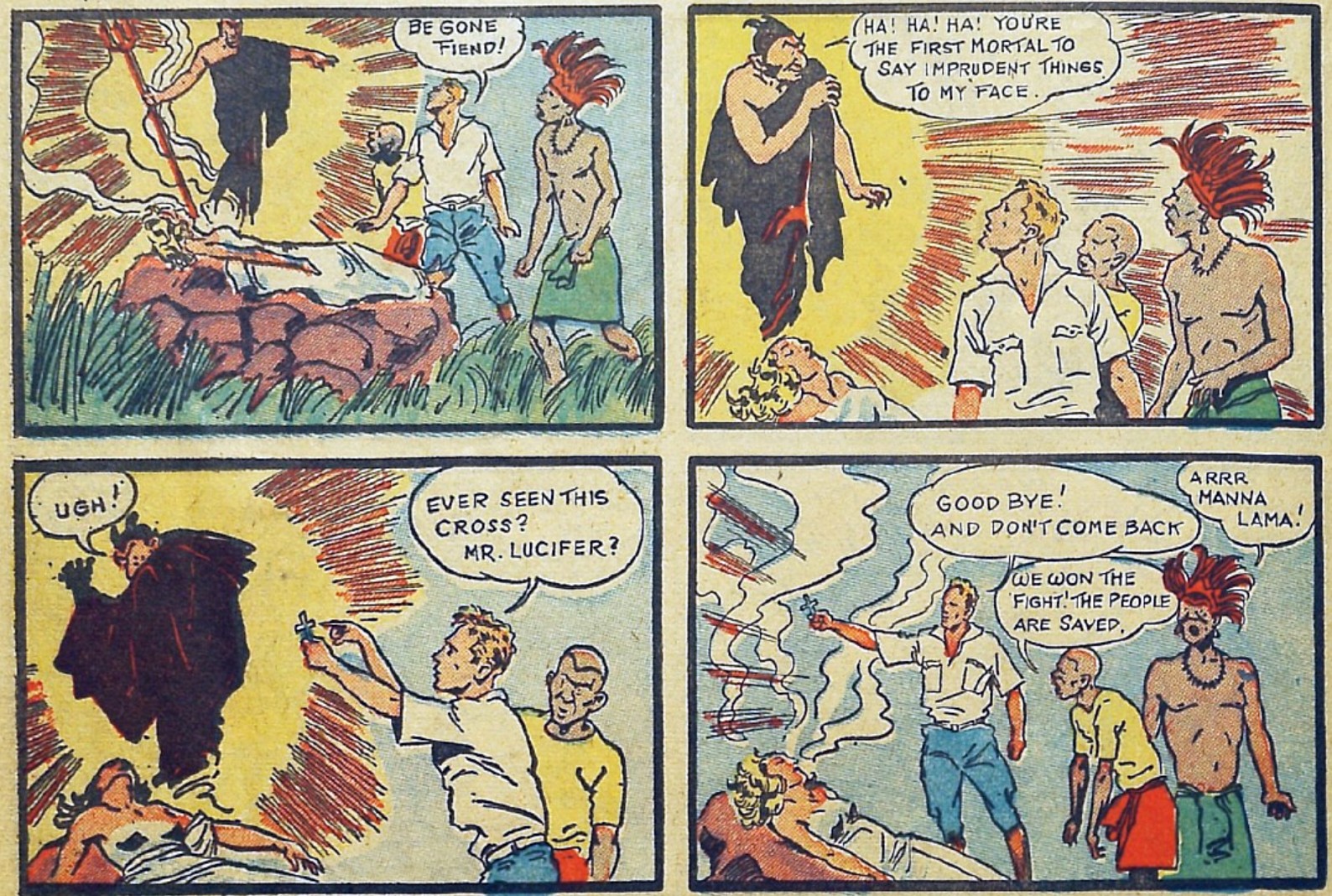
    Dastardly voodoo man the Voodoo Man has this version of Lucifer possess a young woman for some dang reason. He’s got a pretty good look with the sideburns and all, but is surprisingly easy to chase away with an anemically-presented crucifix. (Weird Comics 006, 1940)

    the Unholy One: 

    The Unholy One is an infernal servant of some kind who has been summoned as a sort of demonic search engine by the Green Sorceress. He appears in the early Simon & Kirby days of Blue Bolt, so he gets an appropriate level of gravitas and “this guy’s face is too gross to show you” angles to render him nice and memorable. I like him! (Blue Bolt v1 005, 1940)

    Unnamed Being: 

    If I’m honest I must admit that I have no idea what this guy is. Heroic former uggo Sir Champion encounters him while searching an extradimensional dreamscape for his liege/lover Camilla after she is abducted to there by the wizard Thoth. He is generally helpful, but “capricious, horned extradimensional being” equals “demon” in my eyes. Plus he’s nude! (Jungle Comics 011, 1940)

    the Fire-Devil:

    Perhaps you will recall our old friend the Witch-Master, lord of the witches of Salem. Well, he in turn serves this fellow, who is referred to as the Fire-Devil throughout the adventure due to the fact that he is summoned out of a bonfire. The various titles that the Witch-Master gives him – Great King of Evil, Great King of Inferno, etc – indicate that he is held in some esteem, but the fact that he can’t endure the “level stare” of preteen Mark Kent does diminish this somewhat.

    Also humiliating: the fact that a simple bucket of water is sufficient to banish him back to the underworld. (Slam-Bang Comics 005, 1940) 

  • MAD AND CRIMINAL SCIENTIST ROUND-UP 014

    Don’t bother asking to see their degrees.

    This unnamed scientist has been kidnapping preteens and changing them into hulking brutes via some pretty fantastical brain surgery. He of course gets his ass fatally handed to him by the Red Panther but not before he goes on about producing a new super race and as always I have to question your devotion to science if you think that your physical alterations to these kids are going to be passed on. Who are you, Lamarck? You’re going to be performing brain operations on babies all day every day. (Jungle Comics 009, 1940)

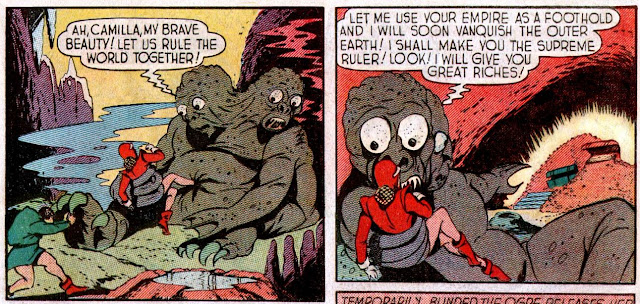
    Von Blumb is a scientist who is saved from death and treated well by Camilla in her Lost Empire, then heads off into the wilderness to further his research. When he doesn’t return after a few weeks, Camilla and Sir Champion head out to check on him and he repays their consideration by capturing them and subjecting them to his reducing serum and adding them to his collection of unwilling subjects. Long story short, they get loose, defeat his pet spider in gladiatorial combat and he gets squashed by a rock. (Jungle Comics 012, 1940)

    Von Lohfer is a scientist with a grudge against John D Rockefeller stand-in J B Rockland, who called him a fake and ruined his life. But if Rockland was claiming that von Lohfer was unable to mind control a bunch of cops into doing his bidding he was dead wrong, because that’s just what he does until he is ultimately stopped by Quicksilver. (National Comics 005, 1940)

    Dr Morbidd has a great name and a really remarkable facial deformity, and he’s been using science to raise people from the dead to do his bidding. This is all solid stuff but it doesn’t amount to much actual super-villainy. There’s some allusion to Morbidd’s science zombies being sent out to do murders but the major thing he seems to be interested in is being a real creep to this one young woman he has captured. It would be quite narratively satisfying if he met his end at the hands of his own creations, but sadly he gets his head blown clean off when Merlin the Magician reflects his own death ray beam back at him. (National Comics 005, 1940)

  • REAL PERSON ROUND-UP 007

    It’s a bumper crop of real people (and famous fictional ones) showing up in comics!

    Adolf Hitler:

    This is very, very tenuous but this adventure story is concerned with a hunt for mythical man-goat lycanthropes known as “weredolfs” and I’ll be danged if I can think of a reason for them to be called that other than as a very oblique jab at Adolf Hitler. (Hyper Mystery Comics 001, 1940)

    Less tenuous: when Cartho (one of the seemingly limitless number of lost empires dotting the jungles of Africa) attempts to invade Camilla’s Lost Empire, its jerk of a leader is of course named Hitlo. (Jungle Comics 010, 1940)

    Mias here is the leaser of a small Asian country that has set its sights on conquering the Philippines. He’s a pastiche of 40s dictators but his Hitlerian traits shine brightest. (National Comics 003, 1940)

    FDR:

    Minor appearances:

    Congratulates Wonder Boy for helping some farmers (National Comics 005, 1940)

    the Forty Thieves:

    It’s never really explained how, but the Forty Thieves of Arabian Nights fame steal the Ophar Jewel from a lady in modern London and Merlin the Magician heads back in time to get it back with the help of a contemporary Cockney street gang. (National Comics 004, 1940)

    Jack Dempsey:

    Former boxing champ Jack Dempsey and his New York restaurant pop up with a fair frequency in 1940s comics, particularly ones featuring boxers such as Kid Dixon here. Why he and other boxers tended to show up under their own names rather than under flimsy pseudonyms like “Dack Jempsey” is a mystery – although I suppose that the real life boxing community had already proven to be okay with showing up in the “Joe Palooka” comic strip so perhaps comics creators assumed that they would be fair game. (National Comics 003, 1940) 

    John D Rockefeller:

    Minor appearances:

    Never-seen millionaire and target of criminal scientist von Lohfer is by context clues an analog of Rockefeller. (National Comics 005, 1940)

    Michael Malloy:

    The story of Michael Malloy, the seemingly unkillable man targeted by a gang in a life insurance racket, is an evocative one, so it’s unsurprising to see it crop up as a comic book plot here and there. Happily for Malloy’s in-story equivalent Milligan, the gang is rounded up by comic book artist/ detective Pen Miller before they are finally able to overcome his iron constitution. (National Comics 002, 1940)

    Neville Chamberlain:

    The Kid Patrol, a mid-to-low-tier kid gang, encounters this clearly allusive lad, Sir Chamberlain Bumbershoote by name, while they are being pranked and vexed by another gang. Weirdly, though Bumbershoote’s talk of appeasement and attempt to get a signed nonaggression pact with this very Hitlerian gang leader are presented derisively he himself is a formidable figure who routs the entire gang with his trusty umbrella. Neville Chamberlain must have been hovering precisely on the precipice of becoming an historical punchline when this one was published. (National Comics 006, 1940)

    Ruby Keeler:

    Hollywood comic strip ‘Olly of the Movies,’ well into its second year, was overdue for some gratuitous movie star cameos so actress Ruby Keeler just kind of shows up on a beach along with Dick Powell and Busby Berkeley. Everyone says hello and then parts ways. (Famous Funnies 023, 1936)

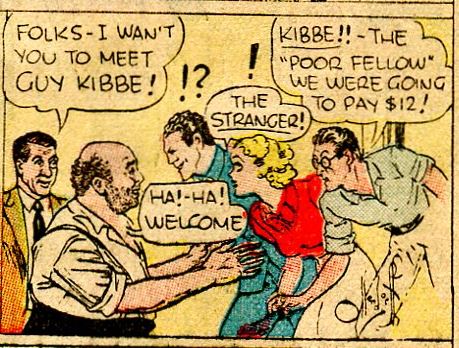
    The gratuity continues in the next issue, with perfunctory appearances by Hugh Herbert, Joan Blondell and Zasu Pitts, and with Guy Kibbee in a very minor role in the actual plot. (Famous Funnies 024, 1936)

    (Famous Funnies 024 also features this crowd of what are presumably supposed to recognizable Hollywood faces but I can only identify Bing Crosby in the yellow sweater vest and then only because someone did an impression of him on the previous page. Bub bub boo!)

    Sherlock Holmes: 

    They may not have given him a parody name, but Dinky Dinkerton here is clearly a Holmes parody comedy character, aided by Doctor Philip Anbust (aka Sniffy) in the Watson role (the third member of the trio, secretary Flossie, is not a Holmes character parody but is the brains of the operation, something that Holmes pastiches often leave out, to their ultimate detriment). (Reg’lar Fellers Heroic Comics 001, 1940)

    Another broad Sherlock Holmes pastiche is the unfortunately-named-to-modern-eyes Fuller Spunk, who is actually an actor known for playing “Herlock Olmes”, so perhaps he is more of a reference to Basil Rathbone. (interesting to note that the character of Marcel was originally bringing “female impersonation” to the group but that that skill was tossed aside in favour of a suite of stage magician tricks) (Hyper Mystery Comics 002, 1940)

    Shoshenq I:

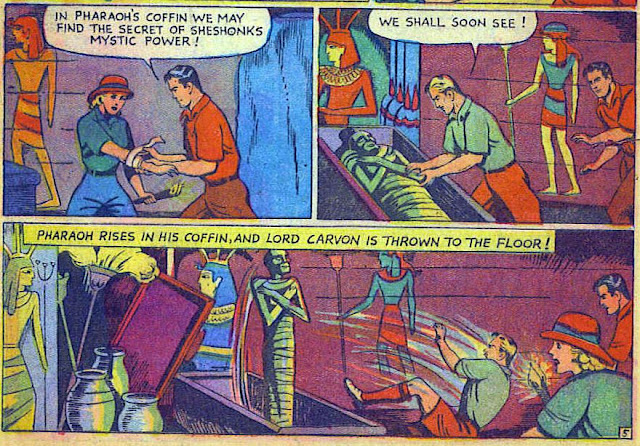
    In Jungle Comics 011, previously straightforward jungle explorer Roy Lance goes nuts for discovering the mystic secrets of the pharaohs* and specifically for finding the genie-controlling power of Sheshonk. Who is Sheshonk, you ask? Why, he is better known as Pharaoh Shoshenq I, more famous than he might otherwise be because he is associated with the Biblical figure Shishak who warred against Solomon and looted the treasures of the Temple – he is mentioned as having been the one to hide away the Ark of the Covenant in Raiders of the Lost Ark, for example. (Shoshenk I is also a candidate to be the father of an Egyptian princess married to Solomon, which the story alludes to by calling him “father-in-law to King Solomon”)

    *based on the fact that both the Roy Lance and Red Panther stories in Jungle 010 were out-of-context sci-fi adventures and that the Simba story in 009 was made up of repurposed panels from earlier Simba stories I suspect that Fiction House had gotten a bit behind and were renaming characters in any old stories they had spare in order to make deadlines.

    This story also features two other possible allusive figures: Lance’s doomed companion Lord Carvon seems likely to be a reference to Lord Carnarvon of the Curse of King Tut fame, while “Tera Bey, Mistress of Mysteries” is a figure as evocative as she is elusive. Literally the only thing I have been able to come up with is the possibility that she is a reference to Queen Tera, mysterious ancient mummy from the Bram Stoker novel The Jewel of Seven Stars, but it’s equally likely that she is a made-up bit of deus ex machina to get our heroes out of a sealed tomb. (Jungle Comics 011, 1940)

  • MINOR SUPER-VILLAIN 668: THOTH

    MINOR SUPER-VILLAIN 668: THOTH

    (Jungle Comics 011, 1940)

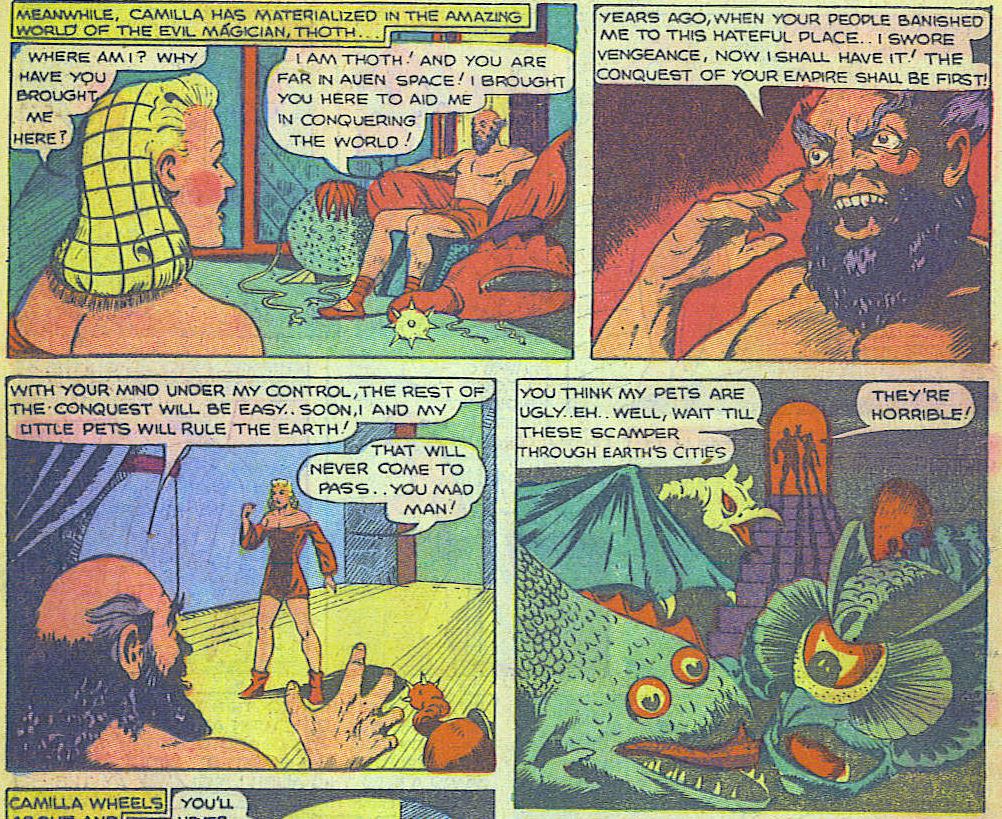
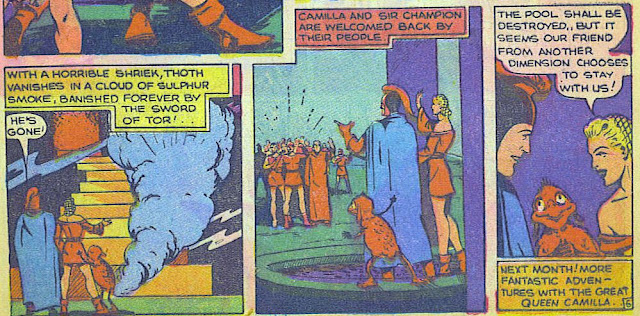
    We begin with a very comic book (or monster-of-the-week TV show) setup. Camilla notices and comments on the ancient Magician’s Pool and then is almost immediately compelled to enter that same pool and disappear from the realms of man.

    Camilla’s aide/paramour Sir Champion turns to local wizard Warlock (not that Warlock the Wizard, but it is wild that there are two of them) for help and learns that the Magician of Magician’s Pool fame is Thoth, an evil jerk who the people of the Lost Empire tossed through the pool to another dimension hundreds of years earlier. Also, it turns out that the pool links to another dimension on nights of the full moon.

    Meanwhile, Camilla has also learned these things from Thoth himself, who has been spending his time in the unnamed dimension taming weird monsters and is now ready to use them to conquer the Earth. Camilla is of course having none of this but her attempts to prevent it using violence are thwarted as Thoth and all others in his presence are immune to mundane weaponry. On an unrelated note, did I mention that Warlock the wizard gave Sir Champion a magic sword and shield?

    This is a pretty Sir Champion heavy episode overall – he encounters a cute girl who turns out to be a less attractive green assassin and so is okay to slay and then is taken to the home of a cool nude giant dude who I wish we knew more about! As it stands, Sir Champion gets directions and a guide from him and we never see him again.

    Sometimes I get a bit lazy and just do a bullet point summary as my first draft of these entries and what I had here was simply “MAGIC SWORD, ASSHOLE” an I think that stands. Thoth (asshole) gets a magic sword to the heart and ceases to become a threat to the world as a whole and the Lost Empire in particular.

    Camilla and Sir Champion make their way home, accompanied by the giant naked laughing guy’s little beaƒt friend, which would be significant to later plots and stories in a different time, but this is the Golden Age and an extradimensional creature of unknown nature and provenance coming to Earth has no further impact.

  • MINOR SUPER-VILLAIN 664: THE DEVIL

    (Jungle Comics 007, 1940)

    Camilla, Queen of the Lost Empire, having made the transition from capricious villain to noble hero and staved off a couple of attempts on her throne and her life, is getting ambitious. She is determined to descend into the Cave of Sighs, a local portal to Hell, and banish the Devil from her lands.

    Together with the reformed assassin Caredodo, Camilla passes the Copper Gates of Hell after a brief encounter with one of my favourite things: an anthropomorphic personification! Specifically, they encounter Temptation, who almost ensnares poor Caredodo with her wiles and mug of delicious-looking potion before Camilla sends her packing.

    Also there to greet them is Mephistopheles of Faust fame in a much more charming turn than comic book demons usually get to be, probably as a deliberate contrast to the main attraction, the Devil himself, in a wildly more grotesque form than one usually sees in comics before the late Sixties. Ordinarily, your Devils and Satans are a lot closer to Mephistopheles there than this soggy lump of flesh and even the more monstrous of the bunch are still red humanoids along the lines of MLJ’s Devil.

    The Devil wants Camilla’s help to escape into the world of man and take over the place. Ambitious, sure, but a bit pedestrian for Satan himself. What use is temporal power to the Lord of Hell?

    In a slightly odd turn of events, Camilla defeats the Devil by hewing a cross out of stone and holding him at bay with it. Since Camilla originally worshipped Thor and the other Norse gods and later restored her empire with the aid of the pantheon-unspecified god Bal, I had assumed that the Lost Empire was established some time before the conversion of the Norse to Christianity. I’d be tempted to blame that pill Jon Dale for converting her but she has engaged in some paganism since his departure from the strip, so I am forced to conclude that Camila subscribes to some sort of syncretic faith that incorporates elements of many religions. Fun!

    (This is also the mission that ends with the Angel of Faith rewarding Camilla by transforming Caredodo from a Nottie to the Hottie Sir Champion, in case you were curious about when that happened)

  • MINOR SUPER-VILLAIN 655: CAMILLA, QUEEN OF THE LOST EMPIRE

    (Jungle Comics 001, 1940)

    Camilla, Queen of the Lost Empire! I love a lost ancient kingdom, especially in a jungle comic as it cuts down on the constant flow of racism. This particular ancient lost kingdom was founded by Norsemen, probably some time between 900 and 1100 CE going by the random dates thrown out at various points in the series.

    We encounter the Lost Empire through the eyes of explorer Jon Dale, who I will tell you now I do not like. Having made his way to an isolated society with different ways and customs, Dale immediately begins judging and decrying them like a jerk. (aside: I just noticed that the Temple of Thor in the above image has a Thor face on its onion dome and that’s just great)

    I suppose I must give Dale some credit for mostly objecting to the human sacrifice aspect of Lost Empire culture (and like me he must have been pretty stuck on working out just how long the rainy season might be in the Lost Empire. A human sacrifice per day for two, maybe three months per year? That’s gotta be a strain on the population, although given that they have access to a fountain of youth perhaps the major purpose is to prevent overpopulation).

    Queen Camilla of course cannot resist the sheer sex appeal of this pasty man in his short and knee-high socks, and when her advances are rebuffed she attempts to make Dale’s love interest (his female equivalent Ruth Birch) the next sacrifice to Thor he springs into action and:

    a) sabotages the sacrifice chamber so that Ruth is spared

    b) I want to say that he causes Camilla’s extended lifespan to catch up with her but really he just stands by and watches her die of old age

    c) blows up the entire damn city in order to effect his and his companions’ escapes

    And after wreaking this untold destruction on the Lost Empire and its people he decides to destroy their secret of eternal life because his pedestrian understanding of the world tell him that God would want him to.

    I know that I just said that Camilla died of old age, but Jungle Comics 003 features her triumphant and inexplicable return, and with the help of an old seer she successfully enlists the aid of the god Bal to restore her city and people to existence and life, respectively.

    When Jon and Ruth have the unmitigated gall to come back to the ruins of the Lost Empire to pick over its shattered remains they are understandably surprised to find it and Camilla alive and un-blown-up, and while the first time Camilla attempted to kill them both was a bit out of order I can completely understand wanting to do so this second time.

    Things go poorly for Camilla once again, though it’s just the Spring of Eternal Youth and not the entire city that gets it this time. Jon Dale, shitty as ever, determines to come back and pillage the place after the march of time kills her off for him.

    Despite the fact that this second lack of access to the waters of eternal life seemed to be causing her to age at regular rather than super-advanced speed, Camilla takes things very poorly and becomes a tyrant (a proper tyrant too! Flayed alive in the torture pit!) and then gets banished. Luckily for her, among the things that Jon thinks that God has an opinion on is the Divine Right of Kings, and he and Ruth help Camilla restore the Spring of Eternal Life and see her welcomed back to her kingdom with open arms once she promises not to have anyone else flayed.

    From this point on, Camilla is a heroic figure who deals with a series of threats to the Lost Empire and her rule thereof from both internal sources and an increasingly unlikely series of other lost kingdoms.

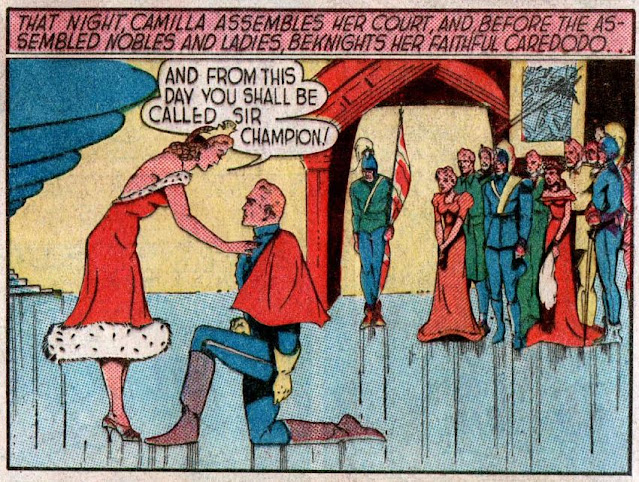
    In one of these adventures, Camilla befriends hunchbacked assassin Caredodo and he becomes her champion/companion, and then about an issue later the comic book “no uggoes on the protagonist’s side” clause comes into effect and the benevolent Angel of Faith transforms him into the handsome Sir Champion. Camilla has a long tenure in Jungle Comics and eventually virtually every aspect of her will change but for now this is the status quo.

    Update 1941