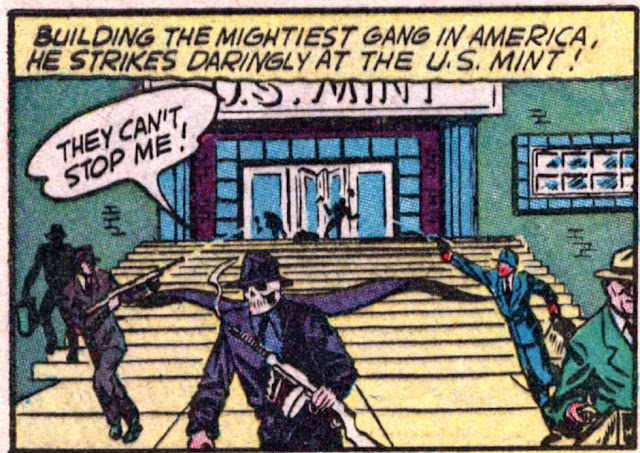
The Curse of Skeleton Munroe

Category: evil equivalent

  • MINOR SUPER-VILLAIN 900: TRUG

    MINOR SUPER-VILLAIN 900: TRUG

    (Whiz Comics 013, 1941) 

    Trug is a student of magic and of Ibis the Invincible specifically who creeps out of the shadows after Ibis and Taia’s ward Tommy has defeated his school’s boxing champion and tempts the despondent youth into stealing the Ibistick for him (the sad boy is then turned into a tree and then never mentioned again – very sad).

    Trug’s Ibis scholarship extends beyond kind of dressing like him and knowing where his extended family hang out into important topics like how not to kill yourself while using the Ibistick. Unlike every poor chump who has gotten their hands on it before him, Trug is aware that it will visit any harm intended for Ibis back on its wielder and so deals exclusively in barriers, crevasses and other nonlethal means of keeping his rival at bay.

    Where Trug fails is in not being a creep and kidnapping Taia as he leaves to enjoy his newfound power. Quite aside from any moral implications, this is a sure way to make Ibis just that much more determined in his quest to defeat his foe.

    Fore reasons of his own, Trug heads north, subjugates the local peoples and builds a palace, and here I notice that he has kidnapped Taia not as a creepy “I will make you my queen” kind of thing but as a hostage, which I would still not call a good idea but which at least has a bit of logic to it.

    One thing that Trug has clearly not considered is that Ibis still has access to magical items that he used the Ibistick to create and that using two of these – the crystal ball and super-plane, specifically – he is able to locate and travel to Trug’s new kingdom in swift order. Trug thus makes the mistake of summoning an air force to deal with whoever might be encroaching on his airspace, only for them to turn on him and cause a piece of his own palace to fall and bonk him unconscious.

    Trug ends his days as a decorative statue as part of the compensation offered by Ibis to his former subjects. (Whiz Comics 014, 1941) 

    Trug isn’t a statue for very long before he is carried off by slavers and worshipped as an idol. When Ibis is then asked for help, he restores Trug to human form as part of a scheme to show that he is a mere mortal.

    Turning Trug back and forth from statue to man to show that he is in fact powerless swiftly convinces his erstwhile worshippers to abandon him, and somehow also that they should give up their warlike ways and make peace with their former enemies. Trug, meanwhile, is left at liberty and feeling vengeful, though he is under-dressed in the Arctic. (Whiz Comics 015, 1941)

    Undaunted by his circumstances, Trug hops on a log and starts paddling his way South, and has the good fortune to encounter a helpful man with a magic bag of wind, who he promptly robs and murders. He makes an opportunistic and unsuccessful attempt to kill Ibis and Taia by summoning a storm demon, then composes himself and… (Whiz Comics 016, 1941)

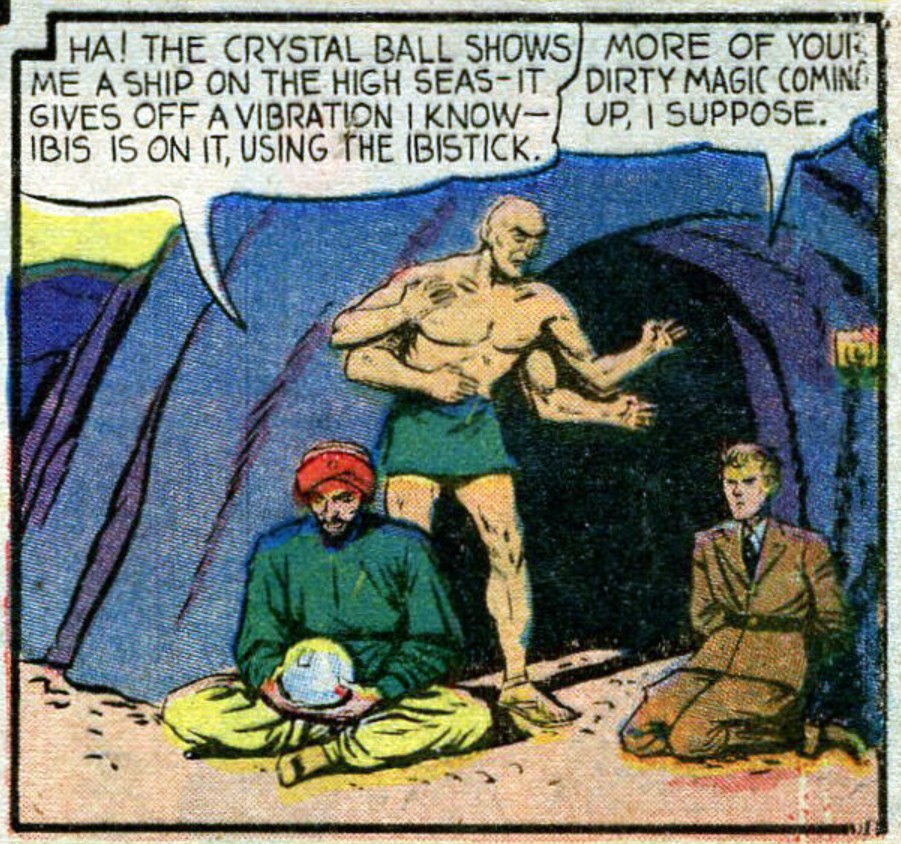
    … kidnaps Ibis and Taia’s ward Tommy and uses him as bait in yet another attempt to kill Ibis, and while the first part of that plan works like a charm, his trapping game is pretty haphazard. His ace in the hole is clearly the god-monster the Man of the Mountain (the four-armed guy above) but he also blows up the ship that Ibis is crossing the Pacific on (ineffective) and places fairly obvious traps like a clearly-carnivorous tree and a demon disguised as a pretty lady on the path leading to his cave hideout. (Whiz Comics 017, 1941) 

    The Man of the Mountain, though imposing, is not too bright and is lured off of a cliff with relative ease, after which Trug just kind of gives up. There is a small amount of tension as the ambient magical energies of the area render the Ibistick powerless and thus Ibis and Taia are trapped on the side of a mountain, but that barely counts as a deathtrap. (Whiz Comics 018, 1941)

    We now enter that phase of any recurring villain’s career in which they go from being a legitimate threat to a bit of a joke, and in Trug’s case this begins when he is rejected by a loser named Mudge who himself is looking to get revenge on Ibis for foiling his plans. Trug might have fallen on hard times but he knows how to size up a fool, and Mudge is exactly the kind of guy to fall for the old Fake Satan trick. Where he was unwilling to team up with an unsuccessful magician he is more than happy to sell his soul for a chance at revenge, the dope.

    Mudge and Satan/Trug attempt to kill Ibis and Taia with a magic bomb, but fail as Ibis saw them coming a mile away and substituted a couple of magical duplicates for them. He afflicts Mudge with donkey ears for his trouble, which only redoubles his commitment to revenge.

    The duo next attempt to harm Ibis by killing Taia and are fooled by the same magical duplicate trick, upon which Ibis reveals that he was not only on to them but that he know that “Satan” was actually Trug the whole time. Mudge and Trug are then sealed up in a wall to die, which is pretty tough justice, but we must remember that Ibis is from another time.

    Though Mudge’s fate is sealed, Trug will return in 1942. (Whiz Comics 020, 1941)

  • MINOR SUPER-VILLAIN 900: TRUG

    (Whiz Comics 013, 1941) 

    Trug is a student of magic and of Ibis the Invincible specifically who creeps out of the shadows after Ibis and Taia’s ward Tommy has defeated his school’s boxing champion and tempts the despondent youth into stealing the Ibistick for him (the sad boy is then turned into a tree and then never mentioned again – very sad).

    Trug’s Ibis scholarship extends beyond kind of dressing like him and knowing where his extended family hang out into important topics like how not to kill yourself while using the Ibistick. Unlike every poor chump who has gotten their hands on it before him, Trug is aware that it will visit any harm intended for Ibis back on its wielder and so deals exclusively in barriers, crevasses and other nonlethal means of keeping his rival at bay.

    Where Trug fails is in not being a creep and kidnapping Taia as he leaves to enjoy his newfound power. Quite aside from any moral implications, this is a sure way to make Ibis just that much more determined in his quest to defeat his foe.

    Fore reasons of his own, Trug heads north, subjugates the local peoples and builds a palace, and here I notice that he has kidnapped Taia not as a creepy “I will make you my queen” kind of thing but as a hostage, which I would still not call a good idea but which at least has a bit of logic to it.

    One thing that Trug has clearly not considered is that Ibis still has access to magical items that he used the Ibistick to create and that using two of these – the crystal ball and super-plane, specifically – he is able to locate and travel to Trug’s new kingdom in swift order. Trug thus makes the mistake of summoning an air force to deal with whoever might be encroaching on his airspace, only for them to turn on him and cause a piece of his own palace to fall and bonk him unconscious.

    Trug ends his days as a decorative statue as part of the compensation offered by Ibis to his former subjects. (Whiz Comics 014, 1941) 

    Trug isn’t a statue for very long before he is carried off by slavers and worshipped as an idol. When Ibis is then asked for help, he restores Trug to human form as part of a scheme to show that he is a mere mortal.

    Turning Trug back and forth from statue to man to show that he is in fact powerless swiftly convinces his erstwhile worshippers to abandon him, and somehow also that they should give up their warlike ways and make peace with their former enemies. Trug, meanwhile, is left at liberty and feeling vengeful, though he is under-dressed in the Arctic. (Whiz Comics 015, 1941)

    Undaunted by his circumstances, Trug hops on a log and starts paddling his way South, and has the good fortune to encounter a helpful man with a magic bag of wind, who he promptly robs and murders. He makes an opportunistic and unsuccessful attempt to kill Ibis and Taia by summoning a storm demon, then composes himself and… (Whiz Comics 016, 1941)

    … kidnaps Ibis and Taia’s ward Tommy and uses him as bait in yet another attempt to kill Ibis, and while the first part of that plan works like a charm, his trapping game is pretty haphazard. His ace in the hole is clearly the god-monster the Man of the Mountain (the four-armed guy above) but he also blows up the ship that Ibis is crossing the Pacific on (ineffective) and places fairly obvious traps like a clearly-carnivorous tree and a demon disguised as a pretty lady on the path leading to his cave hideout. (Whiz Comics 017, 1941) 

    The Man of the Mountain, though imposing, is not too bright and is lured off of a cliff with relative ease, after which Trug just kind of gives up. There is a small amount of tension as the ambient magical energies of the area render the Ibistick powerless and thus Ibis and Taia are trapped on the side of a mountain, but that barely counts as a deathtrap. (Whiz Comics 018, 1941)

    We now enter that phase of any recurring villain’s career in which they go from being a legitimate threat to a bit of a joke, and in Trug’s case this begins when he is rejected by a loser named Mudge who himself is looking to get revenge on Ibis for foiling his plans. Trug might have fallen on hard times but he knows how to size up a fool, and Mudge is exactly the kind of guy to fall for the old Fake Satan trick. Where he was unwilling to team up with an unsuccessful magician he is more than happy to sell his soul for a chance at revenge, the dope.

    Mudge and Satan/Trug attempt to kill Ibis and Taia with a magic bomb, but fail as Ibis saw them coming a mile away and substituted a couple of magical duplicates for them. He afflicts Mudge with donkey ears for his trouble, which only redoubles his commitment to revenge.

    The duo next attempt to harm Ibis by killing Taia and are fooled by the same magical duplicate trick, upon which Ibis reveals that he was not only on to them but that he know that “Satan” was actually Trug the whole time. Mudge and Trug are then sealed up in a wall to die, which is pretty tough justice, but we must remember that Ibis is from another time.

    Though Mudge’s fate is sealed, Trug will return in 1942. (Whiz Comics 020, 1941)

  • MINOR SUPER-VILLAIN 818: THE FACELESS PHANTOM

    (Thrilling Comics 001, 1940) 

    Here’s a nice picture of the Faceless Phantom from his second appearance, before we delve into the muddy fiche images of his first.

    Scientific hero Doc Strange is just walking down the street one day when he hears a cry for help that leads him to an encounter with his first super-villain (the Faceless Phantom) as well as his long-term love interest (Virginia Thompson). The Faceless Phantom, it turns out, has just kidnapped Virginia’s father Professor Thompson in an attempt to get him to reveal the secret of his Delta Ray gun, which is a good old-fashioned sci-fi death ray.

    What follows is an astonishingly long (for a Golden Age story – 37 pages!) chase sequence, as Doc Strange, Virginia and New York Police Commissioner Baxter pursue the Faceless Phantom and Professor Thompson to the Central American republic of San Pedro and back. Along the way both Virginia and Baxter are captured and rescued and captured again, Doc fist fights multiple animals (a shark, a boa constrictor, crocodiles, a tiger, a pit full of cobras, an octopus and a gorilla), and Doc acquires several temporary companions, including:

    -Togo, hired as a bodyguard for Virginia; ultimately revealed to be an agent of (implicitly) the Chinese government looking to acquire the Delta Ray

    -Parker, a seaplane pilot who shuttles Doc around for the middle part of the story until he is almost killed in a plane crash and left behind in Florida

    -Jerry Adams, a newsie who Doc helps with his mortgage during a brief spell of train crash-induced amnesia

    Things eventually come to a head back in NYC where they started, with the Faceless Phantom armed not only with the Delta Ray but a stolen supply of Alosun, the “distillation of sun-atoms” that gives Doc Strange his super powers. Thus equipped, the Phantom and his men have effectively taken over the city.

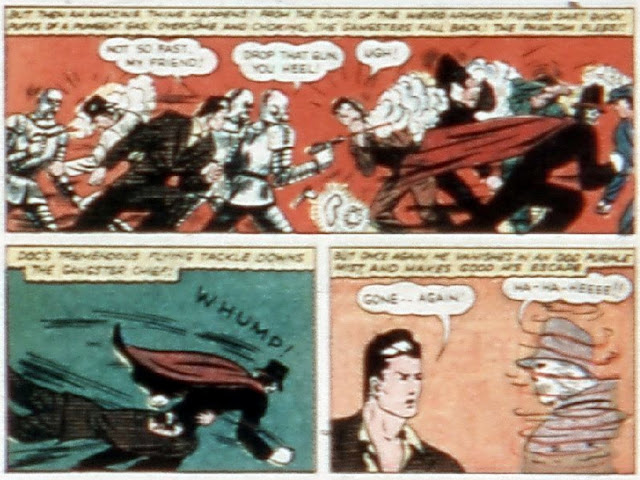
    In order to combat a gang of death ray-wielding gangsters all hopped up on super serum, Doc really hunkers down and gets inventing. He comes up with two key bits of technology: suits of death ray-proof armour for a special detail of police officers to wear and a gas that neutralizes the effects of Alosun (something which one might reasonably expect to crop up to bite him in the ass in the future but not so, as far as I can tell). The subsequent gang round-up is almost 100% effective, with the exception being that the Faceless Phantom pulls his signature trick and disappears in a cloud of purple mist.

    Thanks to his Alosun-enhanced senses, this time when the Faceless Phantom disappears Doc is able to identify that he is doing so using an Ancient Egyptian alchemical preparation called Kalodin, and thanks to his well-stocked library he is then able to find a book that tells him how to counter Kalodin’s effects. Thus, the next time the Phantom tries to do a runner he gets a face full of reagent, followed by a sock to the jaw.

    The Faceless Phantom is unmasked, and surprising no one with any degree of genre savvy he turns out to be Police Commissioner Baxter, the character who tagged along with Doc throughout the adventure and mostly got kidnapped over and over again while the Phantom somehow learned all of Doc’s secrets. But he’s been caught and the long nightmare is finally over.

    OR IS IT? No, it isn’t, because Baxter still had some Alosun hidden away for a rainy day and he gets ahold of it just in time to ruin is own execution, thanks to a crooked prison guard. Side note: Baxter’s tattered clothing in the above panels is not as a result of his escape attempt – he was dressed in them already when he was led in. Was this some sort of attempt to save money on prison uniforms by giving condemned men the worst one or something?

    Baxter resumes his life as the Faceless Phantom, pledging to make the whole country pay. Thanks to his Kalodin-derived invisibility and his residual Alosun strength he is able to form a gang and start up a crime spree with great alacrity.

    As is often the case, a successful crimewave becomes a systematic campaign of terror and looting becomes a plan to take over the US by kidnapping the entire Senate. This is the point at which Doc Strange catches up with the Phantom – that’s him in the lower right in gangster cosplay – and strikes back by packing the Senate galleries with gun-toting lawmen who engage the Faceless Phantom gang in what I would call an irresponsibly large gun battle. No senator catches a stray bullet on panel though, so I guess you could call the operation a success.

    Things come to a head on the wing of a plane in which the Faceless Phantom is escaping with a re-re-re-kidnapped Virginia. Though both hero and villain are juiced up on Alosun, Doc wins out in the end and punches the Phantom clean off of the plane, at which point he dusts off his hands and declares that the Faceless Phantom is finally dead, despite the fact that his own Alosun-powered body has survived similar falls on many occasions. Will this come back to bite Doc Strange in the ass? Only in that he will be more surprised than he should be when the Phantom returns in 1942. 

  • MINOR SUPER-VILLAIN 801: GENERAL Z

    MINOR SUPER-VILLAIN 801: GENERAL Z

    (Target Comics v1 007, 1940)

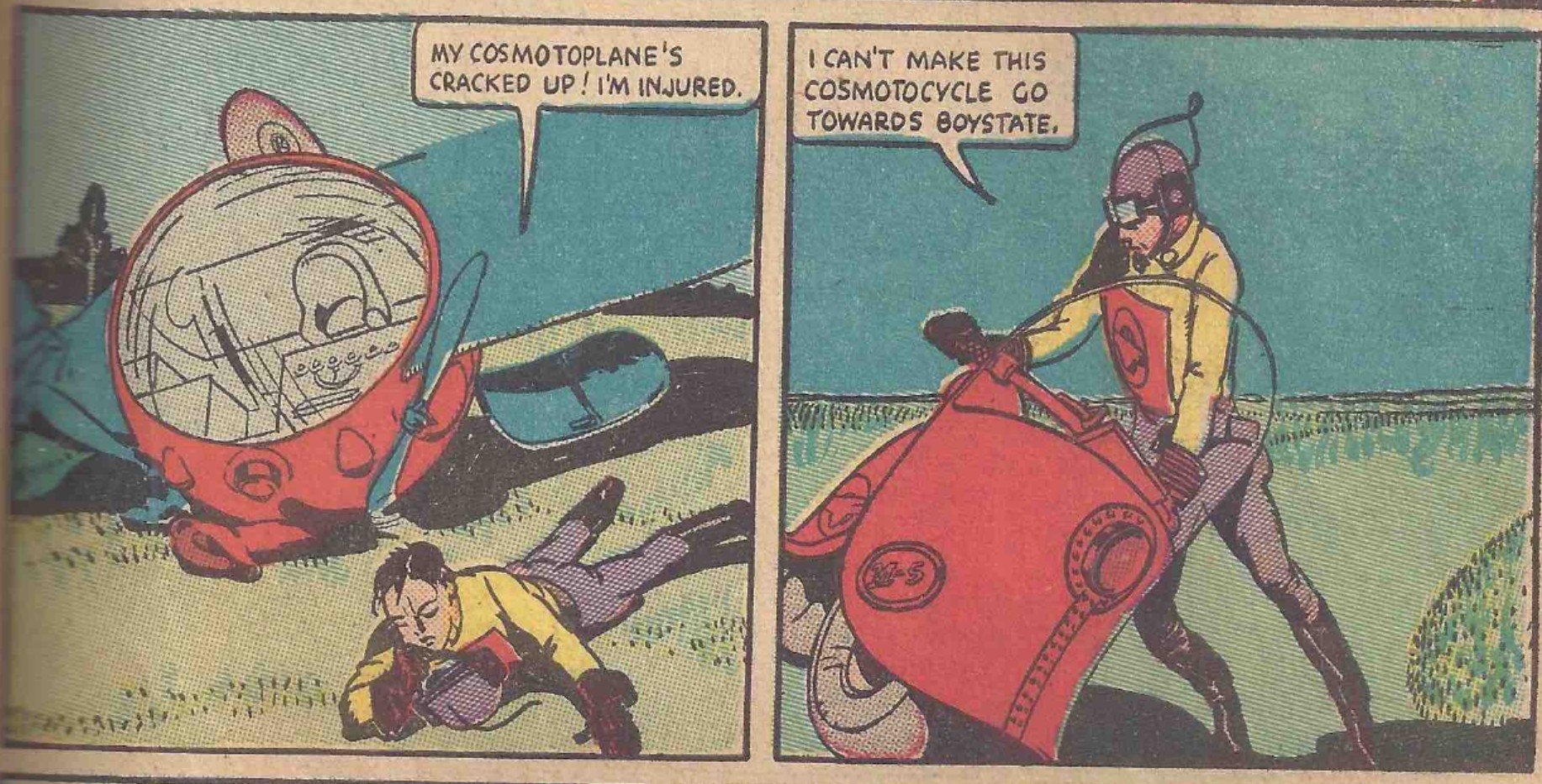
    Boystate is under attack! At first, it’s a relatively innocuous disruption of the power supply, which from what I’ve been able to glean is broadcast power derived from cosmic rays, but it swiftly escalates until all contact with the rangers operating outside of the Boystate boyborders is lost.

    And just in case there’s any confusion, this disruption attack is swiftly followed by a barrage of poison gas missiles, and the Boystate child army must be rolled out to deal with them using flamethrowers.

    The culprit behind these dastardly attacks turns out to be General Z, who in turn is revealed to be the former Captain of Boystate, who was dismissed from his post for selling the Skipper’s inventions on to ne’er-do-wells and is now back for revenge. This is one of those times that something seems like a hoary old trope (the new villain is actually a disgraced former holder of a heroic position) is probably still fairly fresh.

    General Z’s minions are called the Z-Men and I must say that they’re terrific: they have a great name, they are dressed in a kind of junior version of Z’s own outfit, they seem like they’re a little dumb, they’re roughly equivalent to the Boystate Rangers… it’s like a checklist of all the things I want to see in a group of henchmen, plus they have death ray guns. All that’s really missing to really make the experience complete are one or more lieutenants with code names and/or slightly distinctive uniforms.

    I said that the Z-Men are roughly equivalent to the Boystate Rangers, but there is one missed opportunity here: though they do have a kind of slouchy adolescent look the Z-Men appear to be adults, and it would be much more symmetrical and satisfying if they were also troubled youths but instead of the benevolent arms of Boystate they had been taken in by General Z and turned to a life of crime.

    Perhaps the reason for this is that the Skipper’s first plan is to simply blow up General Z’s whole compound, Z-Men and all, and it might not reflect well on him as a saviour of the at-risk youth were he seen to be okay with murdering them en masse. In any case, he is prevented from doing so when General Z kidnaps Jerry, the grandson of the Skipper’s old friend Colonel Richey. Instead, while the Z-Men and the Boystate Rangers engage in deadly hand-to-hand combat, the Captain and M-4 (formerly Pretty Boy, and one of the few Rangers to make even a second appearance) infiltrate Z’s compound in order to rescue Jerry and shut down the signal-damping device that is keeping the Boystate air force grounded.

    Jerry is found in this absolutely awesome looking cryogenic chamber in which General Z freezes his enemies and then sticks them in little oubliettes. Not particularly important to the plot but certainly sick as hell.

    The Captain also manages to trash the power plant, and once the Boystate bugplanes start joining the fight, General Z legs it (knocking his subordinate to the ground in the process just to underscore what a wretch he is).

    Also please note that young Jerry is completely traumatized by the experience, which is a real change of pace from the usual plucky kids in these kinds of stories. 

    General Z returns in Target Comics v1 011, but as the real meat of that story takes place in issue 012, in 1941, I’m going to cover both together once we get to that batch of issues.

  • PROBLEMATIC ROUND-UP 004

    Get ready for a collection of MLJ’s finest racially-problematic villains.

    Yen Fat Sing: 

    Yen Fat Sing’s deal is that he knows about a treasure buried on Fu Chang’s charity farm and, in an effort to grab that treasure for himself, has been murdering the workers using man-eating plants. He’s a pretty standard type of minor super-villain but because he is a Fu Chang foe he is of course a generic Yellow Peril character on top of that. A couple of remarkable things about Yen Fat Sing: 

    1. after all the effort to run everyone off the farm, once Fu Chang is closing in he just sneaks onto the grounds and digs up the treasure, suggesting that he could have done that all along and particularly so because nobody knew about the treasure at all until he ran his mouth about it.

    2. Yen Fat Sing is killed in the course of the story but, unlike virtually every other comic book villain to have anything to do with carnivorous plants, he is not eaten by a tree but rather dies in a car crash.

    I do rally like that the man-eating plants only attack in the dark. That’s a fun detail. (Pep Comics 005, 1940)

    Joodar the Evil:

    Joodar the Evil starts out as an evil equivalent to Fu Chang, only instead of accessing his power via supplication to an ancestral god with a tonsure, Joodar worships the Great Genii of the Water Demons, and instead of a very eclectic set of animated chess figures…

    … Joodar is granted the services of – you guessed it – water demons. Though his stated plans involve world domination, Joodar has a lot of trouble with step 1: destroy Fu Chang, to the extent that both the Great Genii and his Water Demon crew end up destroyed. (Pep Comics 006, 1940)

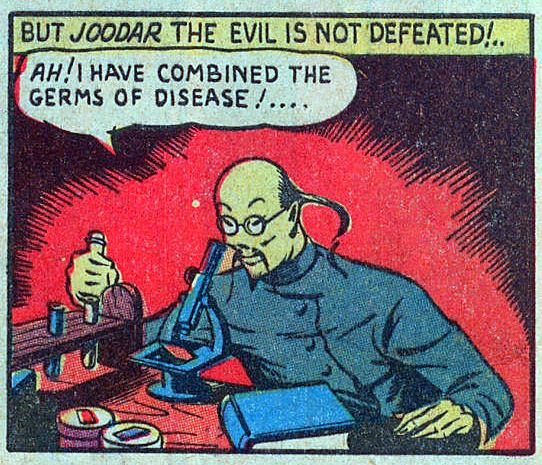
    Joodar returns in the next issue, potentially because “summoning water demons” isn’t a crime in San Francisco. This time he is without his demon pals and so he turns to the next best things: bacteria and mosquitoes! Specifically, he has mixed up a big batch of different harmful bacteria and stuck ’em in some mosquitoes in order to create havoc in San Francisco’s Chinatown. Why does he do this? It’s not entirely clear. Generic revenge? Mass chaos? Joodar doesn’t really deliver a coherent thesis statement I’m afraid.

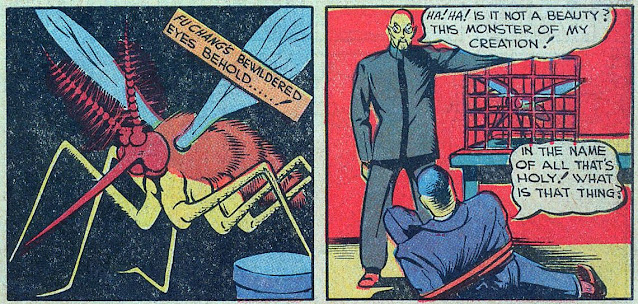
    Joodar’s greatest creation is this enormous mosquito, which almost takes out Fu Chang and his fiance Tay Ming but ultimately cannot contend with those pesky magic chessmen. Joodar, as far as I know, just absconds into the night – perhaps mosquito-crime is also not illegal in San Francisco. (Pep Comics 007, 1940)

    Dr Wang:

    Dr Wang is a Yellow Peril villain in the true Fu Manchu mould, a sinister genius who strikes at the security of the US for no stated reason. It’s possible that we are meant to read Asian villain = Japanese, but if I’m honest an evil mastermind who plots against the United States for the sheer cussed challenge of it it quite a bit more evocative.

    Dr Wang is so threatening to the secuirty of the country, in fact, that we are introduced to him in media res ad the Shield attempts to murder him by dropping a boulder on his car. This is that proactive super-hero action that we al1 wanted in the late aughts!

    Dr Wang has two things going for him: the first is his mask, which looks great. Terrific style of mask, particularly with a hat. The second is his plan to disrupt US war production, by rounding up a bunch of guys who are afflicted with cholera and hypnotizing them into getting jobs in arms factories, thus starting a targeted cholera epidemic. And the very fun thing about this is that cholera is mostly spread by contact with infected feces, so these factories must be disgusting.

    The Shield cannot of course let this stand, and goes back for another try at solving the Dr Wang Problem, and you know what they say: the second time is the charm – plus it’s a bit more narratively satisfying for the Shield not to do a premeditated murder! (Shield-Wizard Comics 002, 1940)

  • MINOR SUPER-VILLAIN 637: CHANG

    MINOR SUPER-VILLAIN 637: CHANG

    (Fantastic Comics 013, 1940)

    It finally happened: Flip Falcon told the world that travel between Earth and the Fourth Dimension was possible (I haven’t been highlighting it because there aren’t super-villains etc but a fair few of his adventures have just been commissions from randos to go back in time and find out where pirates hid some treasure and whatnot. Everyone knows about the Fourth Dimension, Billy.) and someone has finally replicated his findings. Too bad for the world in general and Flip Falcon in particular that that person was Chang.

    Chang is a Tibetan Lama for some reason (the reason is that Tibet is far away and Tibetan Buddhism was exotic so virtually any secret knowledge could be ascribed to them. And also Tibetans are Asians, so racism) and is notably more cautious than Flip. Rather than dive headfirst into what could reasonably be called a Hell Dimension, Chang has chosen to communicate with the various spirits and demonoids who reside there. Details are sparse but it seems that he was attempting to recruit them as an invasion force before Flip Falcon cottoned onto him.

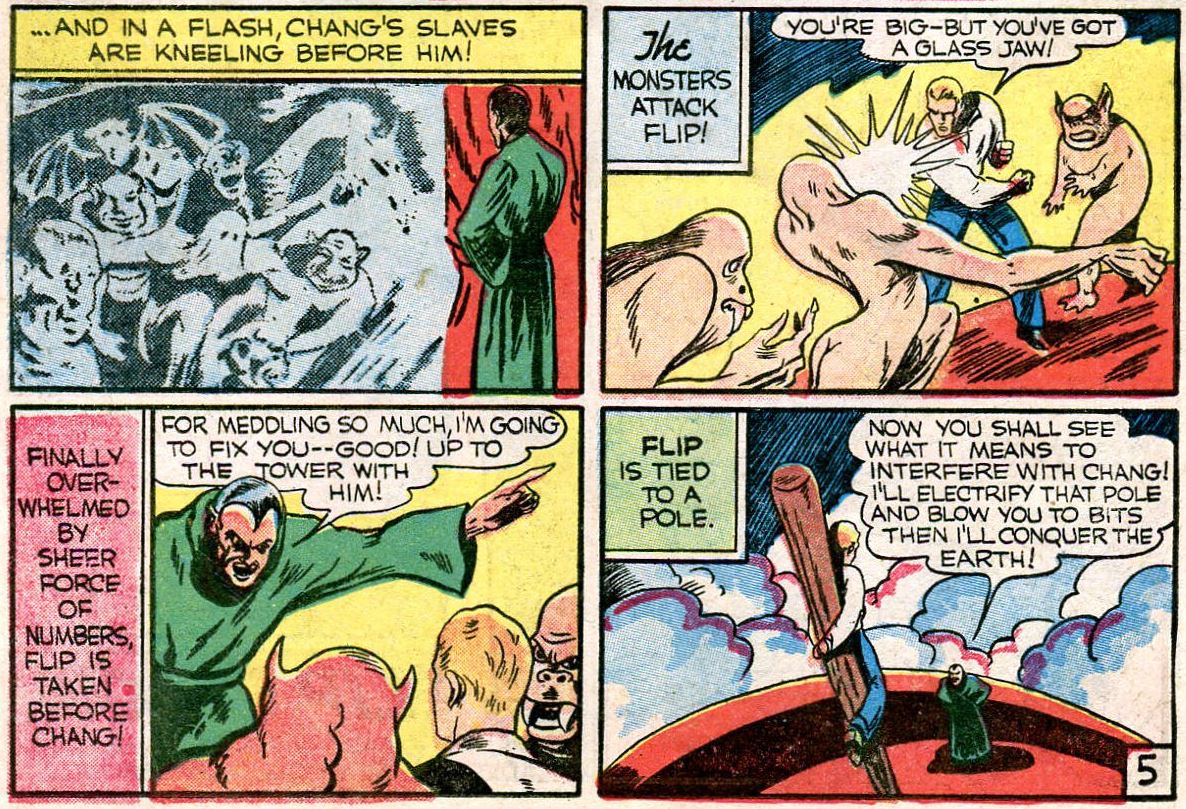
    The real stars of the adventure are the creeps and ghouloids that slither out of the landscape to take Chang up on his offer. For such a fun and diverse collection of creepos they certainly get little enough page time in favour of a guy in a robe and a widow’s peak.

    Chang’s caution proves to be his ultimate undoing, however, as while he has not been placing himself into the same danger as Flip Falcon, he has also not been charged up with the same extradimensional energies that Flip is when he does and which allow him to, for example, easily escape from a deathtrap and then fly off after blowing up Chang and his entire lamasery. A valuable lesson, learned too late.

  • MINOR SUPER-VILLAIN 637: CHANG

    MINOR SUPER-VILLAIN 637: CHANG

    (Fantastic Comics 013, 1940)

    It finally happened: Flip Falcon told the world that travel between Earth and the Fourth Dimension was possible (I haven’t been highlighting it because there aren’t super-villains etc but a fair few of his adventures have just been commissions from randos to go back in time and find out where pirates hid some treasure and whatnot. Everyone knows about the Fourth Dimension, Billy.) and someone has finally replicated his findings. Too bad for the world in general and Flip Falcon in particular that that person was Chang.

    Chang is a Tibetan Lama for some reason (the reason is that Tibet is far away and Tibetan Buddhism was exotic so virtually any secret knowledge could be ascribed to them. And also Tibetans are Asians, so racism) and is notably more cautious than Flip. Rather than dive headfirst into what could reasonably be called a Hell Dimension, Chang has chosen to communicate with the various spirits and demonoids who reside there. Details are sparse but it seems that he was attempting to recruit them as an invasion force before Flip Falcon cottoned onto him.

    The real stars of the adventure are the creeps and ghouloids that slither out of the landscape to take Chang up on his offer. For such a fun and diverse collection of creepos they certainly get little enough page time in favour of a guy in a robe and a widow’s peak.

    Chang’s caution proves to be his ultimate undoing, however, as while he has not been placing himself into the same danger as Flip Falcon, he has also not been charged up with the same extradimensional energies that Flip is when he does and which allow him to, for example, easily escape from a deathtrap and then fly off after blowing up Chang and his entire lamasery. A valuable lesson, learned too late.

  • MINOR SUPER-VILLAIN 555: SHADDIBA

    (Wonder Comics 002, 1939)

    Shaddiba appears in the first adventure of magic hero Yarko the Great as an old enemy of Yarko who has come to the town of Hexville in the Allegheny Mountains of Pennsylvania. His exact reasons for doing so are unstated, so I reckon that it’s equally likely that Hexville is an especially ripe spot for crime as that he was attracted by the old haunted mansion on the hill that he moves into. Comic book expectations aside I reckon that sourcing those has to be a real estate nightmare – I’ve certainly never had the opportunity to rent one.

    Shaddiba’s dumb name also introduces the possibility that perhaps Yarko is not alone, that all magic users in this continuity have made-up nonsense monikers. It’s the only rational explanation!

    Shaddiba does a lot of mouthing off to Yarko about what a great magician he is and how much Yarko sucks and to be fair Yarko is unable to break the mental hold that Shaddiba has on several locals in order to compel them to rob and murder (as well as on a local woman because he is a creep), but this is definitely classified as hubris.

    The fact that Shaddiba lambastes Yarko for intruding on the “sacred arts” of the “magic of the East” and then immediately invokes Lucifer as the source of his power is weird.

    The disagreement between the two magicians comes to a head in an all-out astral smackdown. A lot of the astral battling that we’ve seen so far (e.g., the one in this Mr Justice episode) has been quite quick-and-dirty decisive, so it’s neat to see these fellows really get into it.

    Shaddiba surrenders rather than be flung into the Chasm of Oblivion but if there’s one trait almost universally shared by super-villains it’s being a sore loser and so he blows himself to smithereens rather than live with the consequences of his actions.

  • MINOR SUPER-VILLAIN 513: DOKTOR KARNO AND SIMBA

    (Blue Bolt v2 001, 1941)

    Twelve issues into the story of Dick Cole, Wonder-Boy, a wrinkle is introduced: another Wonder-Boy! And rather than the usual thing where an evil lab assistant etc. steals Professor Blair’s research for his own use, this story introduces the concept of the double-thought wave. This is a theory that all the times in history that two people have had the same idea at the same time are not as a result of coincidence but rather some sort of psychic connection and thus when Professor Blair had his idea to raise a perfect boy the villainous Doktor Karno in Vienna had it too, and while Blair raises Dick to be a paragon of virtue, Karno is raising his Wonder-Boy Simba to be the perfect criminal.

    This would be a parable of nurture over nature if Simba wasn’t also specified to be the orphan child of two convicted murderers by the very chatty nun that Karno gets him from. As it stands we have two Wonder-Boys, ignorant of one another, one min/maxed for physical prowess and one with a more morality-heavy build.

    Eventually, Karno and Simba hit the Big Apple and are immediately made aware of Dick’s exploits. Simba has an immediate hatred for Dick so they hit upon the idea of doing some robberies while dressed as him – frame your rival/ make a few bucks at the same time!

    The first hint of a rift in the Doktor Karno/ Simba team come when Simba is so taken with Dick Cole’s military school uniform that he insists on joining the school himself.

    Meanwhile, Dick is subjected to torture by the local idiot cops until they bother to check his alibi and learn that it is watertight. His initial effort having failed, Simba settles in at Farr Military Academy in what amounts to a bully role with occasional forays into crime with Doktor Karno. In both capacities he regularly gets beaten up by Dick Cole.

    Eventually, one of those beatings must have knocked something loose, because Simba realizes that what he really wants is not to destroy Dick Cole but befriend him. 

    To that end, Simba tries to reform but Karno blackmails him into one last job, with the clear implication that this will continue ad nauseam. Simba confesses to Dick who helps him go straight – he’s put on probation in the school’s care and Karno is arrested. A happy ending for all!

    BUT HOLD ON KARNO GETS OUT and uses brain surgery to return Simba to his former amoral state!

    Simba is almost doomed to be Karno’s criminal tool forever but lucky for him Dick gets word, stops him from stealing a mess of radium and forces Karno reverse the operation. Karno is sent packing and the next time he’s heard from it’s because he’s died. Finally a happy ending for everyone! Except Doktor Karno!

    Going forward in the Dick Cole strip, Simba is just part of the gang – I just checked and he’s in Blue Bolt v10 002, the final issue of the series. Just a second super-powered boy palling around with the first one, though given Novelty Press’ commitment to removing all elements of unreality from their comics Simba is eventually just a regular guy with a very weird backstory. Still, it’s all very wholesome, although my Been On the Internet Too Much sense tells me that if it were a thing today I’ll bet the shippers would have their filthy mitts all over its unintentional homoeroticism.

  • MINOR SUPER-VILLAIN 513: DOKTOR KARNO AND SIMBA

    (Blue Bolt v2 001, 1941)

    Twelve issues into the story of Dick Cole, Wonder-Boy, a wrinkle is introduced: another Wonder-Boy! And rather than the usual thing where an evil lab assistant etc. steals Professor Blair’s research for his own use, this story introduces the concept of the double-thought wave. This is a theory that all the times in history that two people have had the same idea at the same time are not as a result of coincidence but rather some sort of psychic connection and thus when Professor Blair had his idea to raise a perfect boy the villainous Doktor Karno in Vienna had it too, and while Blair raises Dick to be a paragon of virtue, Karno is raising his Wonder-Boy Simba to be the perfect criminal.

    This would be a parable of nurture over nature if Simba wasn’t also specified to be the orphan child of two convicted murderers by the very chatty nun that Karno gets him from. As it stands we have two Wonder-Boys, ignorant of one another, one min/maxed for physical prowess and one with a more morality-heavy build.

    Eventually, Karno and Simba hit the Big Apple and are immediately made aware of Dick’s exploits. Simba has an immediate hatred for Dick so they hit upon the idea of doing some robberies while dressed as him – frame your rival/ make a few bucks at the same time!

    The first hint of a rift in the Doktor Karno/ Simba team come when Simba is so taken with Dick Cole’s military school uniform that he insists on joining the school himself.

    Meanwhile, Dick is subjected to torture by the local idiot cops until they bother to check his alibi and learn that it is watertight. His initial effort having failed, Simba settles in at Farr Military Academy in what amounts to a bully role with occasional forays into crime with Doktor Karno. In both capacities he regularly gets beaten up by Dick Cole.

    Eventually, one of those beatings must have knocked something loose, because Simba realizes that what he really wants is not to destroy Dick Cole but befriend him. 

    To that end, Simba tries to reform but Karno blackmails him into one last job, with the clear implication that this will continue ad nauseam. Simba confesses to Dick who helps him go straight – he’s put on probation in the school’s care and Karno is arrested. A happy ending for all!

    BUT HOLD ON KARNO GETS OUT and uses brain surgery to return Simba to his former amoral state!

    Simba is almost doomed to be Karno’s criminal tool forever but lucky for him Dick gets word, stops him from stealing a mess of radium and forces Karno reverse the operation. Karno is sent packing and the next time he’s heard from it’s because he’s died. Finally a happy ending for everyone! Except Doktor Karno!

    Going forward in the Dick Cole strip, Simba is just part of the gang – I just checked and he’s in Blue Bolt v10 002, the final issue of the series. Just a second super-powered boy palling around with the first one, though given Novelty Press’ commitment to removing all elements of unreality from their comics Simba is eventually just a regular guy with a very weird backstory. Still, it’s all very wholesome, although my Been On the Internet Too Much sense tells me that if it were a thing today I’ll bet the shippers would have their filthy mitts all over its unintentional homoeroticism.