The Curse of Skeleton Munroe

Category: master of disguise

  • MINOR SUPER-HERO ROUND-UP 081

    Lev Gleason characters filling every available ecological niche over here. 

    Thun-Dohr:

    We’ve seen it before and we’ll see it again: Thun-Dohr (Thun-dohr?) is a white guy brought up in the traditions of a Tibetan monastery and he’s just the best dang mystic anyone’s ever seen, much better than all those Tibetan monks could ever be. 

    Like Iron Fist, the 1970s version of this character archetype, Thun-Dohr was orphaned when his parents succumbed to the elements while attempting to reach the fabled monastery. Baby Thun-Dohr (and I can no longer think of new ways to ask why these people brought their baby along on this super dangerous expedition) was found and brought to safety by the monks, who acclaimed him as some sort of prophesied kid. 

    Thanks to his training in “the arts of the Gom-Pa,” Thun-Dohr has a wide variety of mystic powers, including invisibility, teleportation, invulnerability to a variety of environmental conditions, the ability to see the last moments of a person’s life in their corpse’s eyes, astral projection and so on and so forth. He also has a mystical bracelet that allows him to remain in mental contact with the 300+ year-old Dalai Lama (not the one you’re thinking of) who raised him as he goes out into the world to battle evil (i.e., the other guy from the same monastery who is attempting to end the world – could’ve used a prophecy telling them not to let him in, amirite?). (Silver Streak Comics 013, 1941)

    Categorized in: Day Jobs (Lamas), Elements (Thunder), Origin (Mystic Traditions)

    Undercover Man:

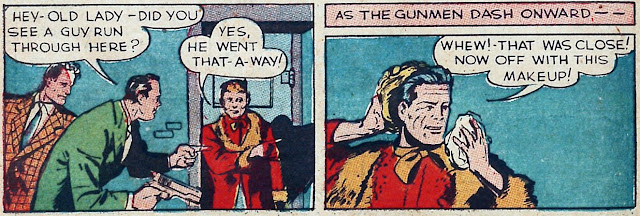
    Police Detective Phil Barrows is unpopular at the Centre Street Homicide Department due to his habit of working alone (I think? Nobody seems to like him and this is the only stated reason why) so what does he do? Create a secondary identity called the Undercover Man so that he can work even more alone while adopting a variety of disguises. During his one published adventure he takes down corrupt politician Eduardo Donati and while I’m not normally one to critique someone’s decision to adopt a costumed identity I think he probably could have done it as a regular cop if he’d tried to. (Captain Battle Comics 001, 1941)

    Categorized in: Day Jobs (Police Detective), Powers (Master of Disguise), Professions (Law Enforcement)

    Blackout: 

    Blackout is the new name adopted by Dr Basil Brusiloff after he is mutated by chemicals randomly mixed together during a Nazi air raid on the hospital in which he is working. Unlike many other super-heroes who undergo physical transformations, Brusiloff’s new, jet-black form appears to be a permanent change and not something that he can switch on and off.

    Blackout is able to fly at speed comparable to a fighter plane, but his main power is the ability to emit a thick black smoke from his pores, the specificity of which somehow makes it seem more gross than a smoke power usually does.

    In addition to being opaque, this smoke is thick enough to suffocate someone in an unventilated environment (this is also gross. Huff my gas, miscreants!). Blackout is able to direct this smoke and even shape it to some degree (such as when he forms a long tunnel out of it to shield fleeing civilians from Nazi eyes), but most remarkably is able to emit it in large enough quantities that at one point he escapes a sealed room by bursting the walls through sheer air pressure.

    Aside from his powers, there are two remarkable things about Blackout: firstly, his origin takes place in Belgrade, which makes him the first in what is sure to be a pretty short list of Yugoslavian superhumans. Secondly, Blackout is the subject of some very minor debate vis-a-vis just how hairy/furry he is, with the two sides boiling down to “the text never says he’s hairy so it must just be something else” versus “he looks very hairy.” I am inclined to side with the latter side. He looks very hairy!

    Related to the hairiness question is a third interesting thing about Blackout: it is quite possible that he is completely nude, aside from that stylish green mask. (Captain Battle Comics 001, 1941)

    Categorized in: Activities (Blackouts), Colours (Black), Origin (Chemical Mutates)

    Nightro: 

    Nightro is Hugh Goddard, a scientist who was betrayed and left to die by his associates after they found a rich radium deposit in Alaska and Goddard expressed his desire to donate it to medical research, and though I do have some sympathy for his partners’ position that as the expedition’s financial backers they should see some profit from the mine they resort to murder a bit too quickly for my tatse. Surely this is a case for the courts!

    If you look Nightro up online, odds are that you will be told that he is blinded by the ambient radiation from the deposit. This is not true! What actually happens is that he wanders around in the snow until he is found by some helpful Inuit fellows and ends up with an extreme case of snow-blindness. Radiation doesn’t even come up.

    Goddard eventually makes his way back to the US, where a Dr Frank Miller (!) discovers that polarized lenses will allow him to see. Unlike his blind super-hero contemporaries the Mask and Dr Mid-Nite, Nightro does not appear to have any kind of enhanced dark vision. Instead, his stated reason for adopting a costumed alias is that his goggles are too ugly for him to be accepted in polite society.

    Goddard continues to live as a blind man as part of maintaining his secret identity as Nightro, meaning that from his second appearance onward he has a seeing eye dog companion named Blackie. He is called the “Streamlined Robinhood,” supposedly because he takes money from crooks and redistributed it to the needy – I reckon that it’s just a way to attach a buzzword to the character – if he had debuted tenyears later he might’ve been “the Jet Age Robinhood.”  (Daredevil Comics 002, 1941)

    Categorized in: Accessories (Dogs), Locations (Temporal), Origins (Blind Characters)

  • MINOR SUPER-HERO ROUND-UP 081

    Lev Gleason characters filling every available ecological niche over here. 

    Thun-Dohr:

    We’ve seen it before and we’ll see it again: Thun-Dohr (Thun-dohr?) is a white guy brought up in the traditions of a Tibetan monastery and he’s just the best dang mystic anyone’s ever seen, much better than all those Tibetan monks could ever be. 

    Like Iron Fist, the 1970s version of this character archetype, Thun-Dohr was orphaned when his parents succumbed to the elements while attempting to reach the fabled monastery. Baby Thun-Dohr (and I can no longer think of new ways to ask why these people brought their baby along on this super dangerous expedition) was found and brought to safety by the monks, who acclaimed him as some sort of prophesied kid. 

    Thanks to his training in “the arts of the Gom-Pa,” Thun-Dohr has a wide variety of mystic powers, including invisibility, teleportation, invulnerability to a variety of environmental conditions, the ability to see the last moments of a person’s life in their corpse’s eyes, astral projection and so on and so forth. He also has a mystical bracelet that allows him to remain in mental contact with the 300+ year-old Dalai Lama (not the one you’re thinking of) who raised him as he goes out into the world to battle evil (i.e., the other guy from the same monastery who is attempting to end the world – could’ve used a prophecy telling them not to let him in, amirite?). (Silver Streak Comics 013, 1941)

    Categorized in: Day Jobs (Lamas), Elements (Thunder), Origin (Mystic Traditions)

    Undercover Man:

    Police Detective Phil Barrows is unpopular at the Centre Street Homicide Department due to his habit of working alone (I think? Nobody seems to like him and this is the only stated reason why) so what does he do? Create a secondary identity called the Undercover Man so that he can work even more alone while adopting a variety of disguises. During his one published adventure he takes down corrupt politician Eduardo Donati and while I’m not normally one to critique someone’s decision to adopt a costumed identity I think he probably could have done it as a regular cop if he’d tried to. (Captain Battle Comics 001, 1941)

    Categorized in: Day Jobs (Police Detective), Powers (Master of Disguise), Professions (Law Enforcement)

    Blackout: 

    Blackout is the new name adopted by Dr Basil Brusiloff after he is mutated by chemicals randomly mixed together during a Nazi air raid on the hospital in which he is working. Unlike many other super-heroes who undergo physical transformations, Brusiloff’s new, jet-black form appears to be a permanent change and not something that he can switch on and off.

    Blackout is able to fly at speed comparable to a fighter plane, but his main power is the ability to emit a thick black smoke from his pores, the specificity of which somehow makes it seem more gross than a smoke power usually does.

    In addition to being opaque, this smoke is thick enough to suffocate someone in an unventilated environment (this is also gross. Huff my gas, miscreants!). Blackout is able to direct this smoke and even shape it to some degree (such as when he forms a long tunnel out of it to shield fleeing civilians from Nazi eyes), but most remarkably is able to emit it in large enough quantities that at one point he escapes a sealed room by bursting the walls through sheer air pressure.

    Aside from his powers, there are two remarkable things about Blackout: firstly, his origin takes place in Belgrade, which makes him the first in what is sure to be a pretty short list of Yugoslavian superhumans. Secondly, Blackout is the subject of some very minor debate vis-a-vis just how hairy/furry he is, with the two sides boiling down to “the text never says he’s hairy so it must just be something else” versus “he looks very hairy.” I am inclined to side with the latter side. He looks very hairy!

    Related to the hairiness question is a third interesting thing about Blackout: it is quite possible that he is completely nude, aside from that stylish green mask. (Captain Battle Comics 001, 1941)

    Categorized in: Activities (Blackouts), Colours (Black), Origin (Chemical Mutates)

    Nightro: 

    Nightro is Hugh Goddard, a scientist who was betrayed and left to die by his associates after they found a rich radium deposit in Alaska and Goddard expressed his desire to donate it to medical research, and though I do have some sympathy for his partners’ position that as the expedition’s financial backers they should see some profit from the mine they resort to murder a bit too quickly for my tatse. Surely this is a case for the courts!

    If you look Nightro up online, odds are that you will be told that he is blinded by the ambient radiation from the deposit. This is not true! What actually happens is that he wanders around in the snow until he is found by some helpful Inuit fellows and ends up with an extreme case of snow-blindness. Radiation doesn’t even come up.

    Goddard eventually makes his way back to the US, where a Dr Frank Miller (!) discovers that polarized lenses will allow him to see. Unlike his blind super-hero contemporaries the Mask and Dr Mid-Nite, Nightro does not appear to have any kind of enhanced dark vision. Instead, his stated reason for adopting a costumed alias is that his goggles are too ugly for him to be accepted in polite society.

    Goddard continues to live as a blind man as part of maintaining his secret identity as Nightro, meaning that from his second appearance onward he has a seeing eye dog companion named Blackie. He is called the “Streamlined Robinhood,” supposedly because he takes money from crooks and redistributed it to the needy – I reckon that it’s just a way to attach a buzzword to the character – if he had debuted tenyears later he might’ve been “the Jet Age Robinhood.”  (Daredevil Comics 002, 1941)

    Categorized in: Accessories (Dogs), Locations (Temporal), Origins (Blind Characters)

  • MINOR SUPER-HERO ROUND-UP 078

    Lev Gleason characters for EVERYONE!

    Daredevil **UPDATE**:

    Daredevil had but one appearance in 1940, so it’s no surprise that the character still had some changes and revisions to go once 1941 rolled around. Firstly, his costume gets an update, with yellow swapped out for red and the complicated “DD” design on the abdomen dropped entirely.

    The most dramatic change, however, is that the Daredevil can now talk. Just how Bart Hill’s traumatic muteness was alleviated is unaddressed – I’m sure that the real answer is that it was inconvenient to write around and so was quietly dropped, but imagining that his successful crimefighting career allowed him to let go of the past is nice.

    Finally, Bart is now a wealthy playboy with a fiance (Tonia Saunders) who isn’t too sure about marrying this manchild after all. Thankfully, Tonia discovers the truth about Bart’s double life in her first appearance, because the Clark/Lois dynamic can get a bit tedious when grafted onto every super-hero’s relationship by default.

    Our final update from Silver Streak Comics 007 is this revelation that the Daredevil’s mastery of the boomerang is so complete that, when thrown by the Claw, he can cause his own body to act like one. This here might just be a new contender for inclusion in lists of obscure and ridiculous super powers, folks.

    In Silver Streak Comics 008 & 009, Daredevil employs a couple of high-tech fighter planes called “the Airdevil,” which a top-notch example of a jokey super-accessory name. Both planes are destroyed during Daredevil’s clashes with the Claw, and he seems to have given up on the idea of the custom plane, at least for the year 1941.

    In Silver Streak Comics 015 Daredevil employs a decoy double named Chester to help in the capture of a villain named the Serpent. Who is Chester? No idea. Will he ever return? Probably not.

    Finally, in Daredevil Comics 002, Daredevil engages in what I would say is some Spider-Man style super-hero quipping as he battles this horde of silent men. Not that super-heroes aren’t constantly mouthing off, mind you, but it doesn’t have this kind of flow. I shall be looking out for more of this kind of patter to see how long it takes to become an established thing.

    Categorized in: Accessories (Airplanes), Day Job (Wealthy Socialite)

    Presto Martin: 

    Presto Martin, though voted “Least Likely to Succeed” in college, is now Captain of Detectives in the NYPD. More importantly for our purposes, he is a master of disguise who is for instance more than willing to take the place of a heavyweight boxer in the ring if it means that he can solve a big case. (Silver Streak Comics 007, 1941)

    Per Silver Streak Comics 008, Presto is aided in his work by a super-moldable plastic putty of his own concoction.

    Categorized in: Day Job (Police Captain), Powers (Master of Disguise), Team Membership (NYPD)

    Zongar, the Miracle Man:

    Zongar, the Miracle Man, is a functionally-omnipotent magical adventurer like so many of his peers, but rather than casting spells per se Zongar uses a mystical amulet to command the spirit Abaraxx to do his bidding. This might have lead to some interesting developments over time if, for example, a nogoodnik were to get ahold of the amulet but alas, Zongar had only one recorded adventure. (Silver Streak Comics 007, 1941)

    Categorized in: Abstract Concepts (Miracles), Accessories (Amulets)

    Cloud Curtis: 

    Dashing young aviator Cloud Curtis has developed the super plane Golden Bullet, which he flies both as a job and against the enemies of the US and which has one of the goofier features of any comic book super plane in the form of that big propeller located halfway down the fuselage. Curtis is assisted by the apelike Crusher McCoy and the avuncular Pop Whistler as he keeps the airways safe from a series of increasingly unlikely airplane-based threats. (Silver Streak Comics 007, 1941)

    Categorized in: Accessories (Airplanes), Day Job (Aviators)

  • MINOR SUPER-HERO ROUND-UP 073

    It’s a fine day for a dose of minor super-heroes. 

    Alias X: 

    Alias, aka just X, is a mysterious master of disguise who has been cleaning up crime in NYC for the better part of a year and who, as of his first appearance, has now deigned to tell his origin story to Police Commissioner Malley and newspaper editor Hunch Armstrong.

    Turns out that X was a small-town taxi company owner who was railroaded and sent to prison for a crime he didn’t commit, and that after two years in prison he managed to escape, became a master of disguise by sheer willpower and set out to battle crime until he could track down the crooks who really committed the crimes he was convicted for and clear his name.

    The police commissioner must be a trusting guy, because he refrains from putting out an APB or whatever on Alias X after he hears this confession. 

    As far as I can tell from a skim of the 1942 portion of Alias X’s dozen or so adventures, he never catches up with the crooks who framed him – just one of the many loose ends of the comics. Please also note that Alias X is a calling card guy. (Captain Fearless Comics 001, 1941)

    Citizen Smith: 

    Citizen Smith! Plain old John Smith, who could be any one of us regular Americans! Just a regular guy! So why are we reading a comic book about him?

    Citizen Smith is in actuality John Smith, an aircraft factory worker in Washington DC and also an orphan consumed with the desire to know just who his parents were. While stewing on this after work one day he wanders up to the Tomb of the Unknown Soldier, where he receives both great news and a great shock as a ghostly figure appears and tells him that he, the Unknown Soldier, is Smith’s father.

    Smith’s new ghost dad charges him to keep America safe, with the promise that he will appear and aid his son if needed (sadly this does not occur in either of the two recorded Citizen Smith adventures). The newly-created Citizen’s Guardian of Liberty and Guardian of the American Way then sallies forth to whale on fifth columnists with his two good all-American fists.

    Now, I try to take comics as they are presented to me and not engage in a lot of “what if they were dead the whole time”-style fan theory nonsense but I will say that if I were writing a gritty early-2000s Citizen Smith reboot… all this ghost stuff would just be a hallucination brought on by his obsessions, right? Just a lonely man giving his life meaning by latching on to a powerful symbol to fill the hole in his life. But of course that is not who we are here. Citizen Smith is as he appears: a divinely ordained champion of the American Way. (Captain Fearless Comics 001, 1941)

    Miss Victory: 

    Miss Victory is Joan Wayne, a woman who works in Washington DC in secretarial and similar roles and who seems to have seen an opening for a two-fisted vigilante and filled it, no further origin necessary. There is some hint that her vigilantism is officially sanctioned in the first couple of panels of her first appearance, but if so she has very little oversight. She is much more willing to resort to violence than a lot of her female contemporaries, which is kind of refreshing.

    Miss Victory does share with our old friend the Eagle the inability to really settle on a costume design, so I’m sure that we’ll be revisiting her in that capacity. 

    Case in point: this revised version of her costume from her second appearance, in Captain Fearless Comics 002. As with most of her costume changes it’s a variation on the theme of her previous look and is probably explained by the fact that she  (Captain Fearless Comics 001, 1941) 

    Mr Miracle: 

    Mr Miracle is of course among the ranks of the obscure Golden Age characters who have the same name as a more well-known modern character, but he is also a member of a much more select fraternity: of characters whose origin involves a suicide attempt, though the precise reason that the unnamed man had for jumping is never given.

    The future Mr Miracle is pulled out of the water by a helpful stranger and brought to the great scientist Professor Rietz, who revives him via a twenty hour session under his “mind-ray,” only to be betrayed and shot by his assistant Sango at the final hour. Sango turns out to have been a foreign agent who was laying in wait for the mind-ray to be perfected, and now the hour has come.

    The still-unnamed man wakes to a ruined laboratory and a dying Rietz, who reveals to him in addition to saving his life, the mind-ray has given him great if unspecified powers. He then extracts a pledge from the man that he will use this power to aid mankind and promptly dies.

    The man creates a costume, renames himself Mr Miracle and sets out to use is vast array of abilities (transmutation, teleportation, telekinesis, intangibility, size control, flight, etc, etc. Though Mr Miracle is technically some sort of psychic mutate he is in effect a nigh-omnipotent comic book magic user) to bring Sango to justice. 

    Mr Miracle gets to honour the promise he made to Prof. Rietz precisely one more time (by sinking a u-boat) before fading into the mists of comic book obscurity. (Captain Fearless Comics 001, 1941)

  • MINOR SUPER-HERO ROUND-UP 050

    Novelty Press character round-up, more like.

    the Chameleon:

    An unnamed master of disguise (throughout his 1940 appearances, at least) who dispenses vigilante justice on an ad hoc basis, the Chameleon’s major distinction is that his name is always written in cursive. Other than that: he’s got a chauffeur/sidekick (Slim) and a bumbling police nemesis (Inspector Parks) and somehow manages to simultaneously be one of those heroes who is wanted by the law and whose identity and address are just kind of common knowledge. (Target Comics v1 006, 1940)

    the Blue Zombie:

    “Fantastic Feature Films” was a strip that ran in the first couple of years of Target Comics, with the same conceit as Ed Wheelan’s Minute Movies: that the stories being presented were films in which the were being portrayed by a pool of fictional actors – the titular Blue Zombie of this feature, for instance, was played by Orson Black, a Boris Karloff-style Man of a Thousand Faces. This is a fantastic fictional conceit and I am surprised that it hasn’t cropped up more over the years.

    In the fictional movie The Blue Zombie, Bolshemanian scientist Igor Zamoisky rebels against his country’s warmongering dictator and heads to the neighbouring country of Coreland in order to put his scientific discoveries to use in thwarting a Bolshemanian invasion. Discovering a lost Bolshemanian battalion that succumbed to the harsh Corelian winter, he attempts to restore one of them, his old friend Nicholas Samousk, to life. Instead of a restored Samousk, his experiment produces a bright blue zombie version of his friend who responds to his mental commands but cannot think for itself. Zamoisky restores the rest of the battalion in a similar fashion and uses them to crush the Bolshemanian invasion of Coreland, then sets off with his zombie army to free his homeland. 

    Obviously describing a one-off like the Blue Zombie as a super-hero is a bit of a stretch, but a) he’s not that far off of the Purple Zombie in his origin and general deal, b) I wanted an excuse to talk about the fictional-actors-in-fictional-film conceit and c) the Blue Zombie is a really good name. (Target Comics v1 006, 1940)

    the Target: 

    It’s always fun when an old-school anthology comic book gets a character to match its name fairly late in the game and to prove my point here’s the Target, showing up in the tenth issue of Target Comics.

    The Target makes his debut with a big advertising push to really get the word out that he is out to crush crime in his version of NYC: full page newspaper ads, messages on the radio, threatening telegrams sent directly to crooks… at one point a lady calls that number that used to tell you the correct time and a recording of the Target tells her to keep her nose clean. It’s really the opposite of the modern Batman as Urban Legend school of superhero mystique.

    The Target’s gimmick is also Batman adjacent: like 50s 60s 70s whichever era’s Batman first justified the yellow circle on his chest as a bulletproof target for crooks to aim at, the Target is running around with a literal target painted on his chest (and back) because he has a bulletproof leotard on underneath. Just why the fact that his legs are unprotected is a) necessary and b) emphasized is never really addressed.

    Finally, the Target has a thematically appropriate calling card, a dart. We’ll see how long he keeps using it for. (Target Comics v1 010, 1940)

    the Targeteers:

    The more astute readers among you might have noticed that I didn’t really go into the actual origin of the Target in his own entry, and that’s because it’s tied in with that of his sidekicks the Targeteers and so we’re covering them all at once.

    So: Niles Reed is a brilliant but aimless metallurgist whose only relative, brother and New York City District Attorney Bill Reed, is framed for murder and scheduled to be executed at Sing Sing.

    Niles dons a domino mask and attempts to bust Bill out during his final prison transfer but the guards manage to hit Bill during their escape. After a heartfelt “why me?” Bill dies and Niles buries him in an unmarked grave, which means that he’s still considered to be at large, an evocative detail that I had hoped would lead to something like Niles hinting that the Target is actually Bill to throw suspicion off of himself and flush out the crooks who framed him, it never really seems to come up again.

    This would ordinarily be the point in an origin story in which the costume would come into play, there’s one more step to the Target’s origin and that’s the Targeteers.

    See, Niles is wandering the streets at night, trying to figure out just what he can do in the face of an uncaring world in which innocent district attorneys are gunned down in the street for merely trying to break jail, when he runs off some thugs who are attempting to kill or at least maim two teenage boys, Dave and Tommy. It turns out that the kids are both orphans who also hate crime because the crooks had already killed their father (well, one father and one unofficial adopted father, but why get technical).

    Having two young wards who love to talk about getting real beefy and wiping out crime is the final catalyst for Niles, who remembers that he has some superscientific bulletproof material and three super-hero costumes just lying around, and since the three were playing darts when they came up with the idea the whole endeavour ends up being dart and target themed (and as this is possibly my favourite style of generic supersuit it’s nice to see three people running around in it at once).

    The two lads collectively go by the Targeteers, which is a nice change of pace from teen sidekicks who just go by their own names. Finally, according to some dialogue later in the comic the jailbreak, ad hoc funeral, befriending of the boys, making costumes and the initial Target adventure in the previous issue (including the entire publicity blitz) all take place in about a week, which is very efficient. (Target Comics v1 011, 1940)

  • MINOR SUPER-HERO ROUND-UP 037

    MINOR SUPER-HERO ROUND-UP 037

    More cream rises from the milky depths of the Golden Age!

    Red Roberts, the Electro Man:

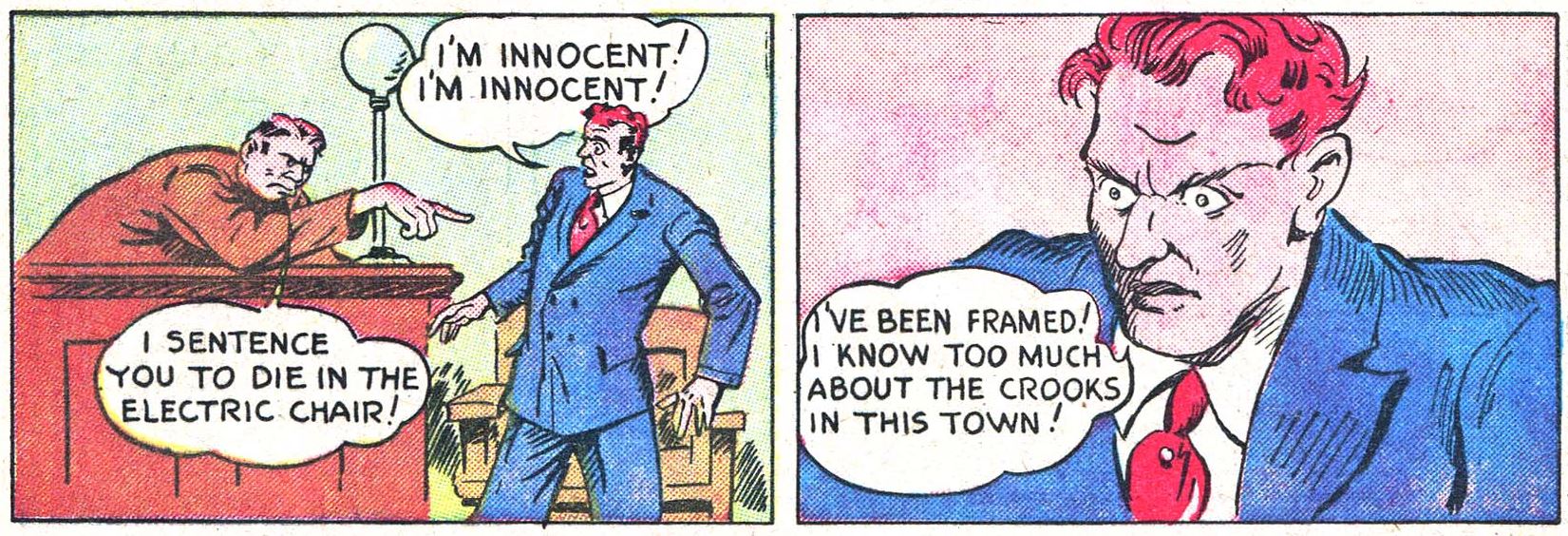
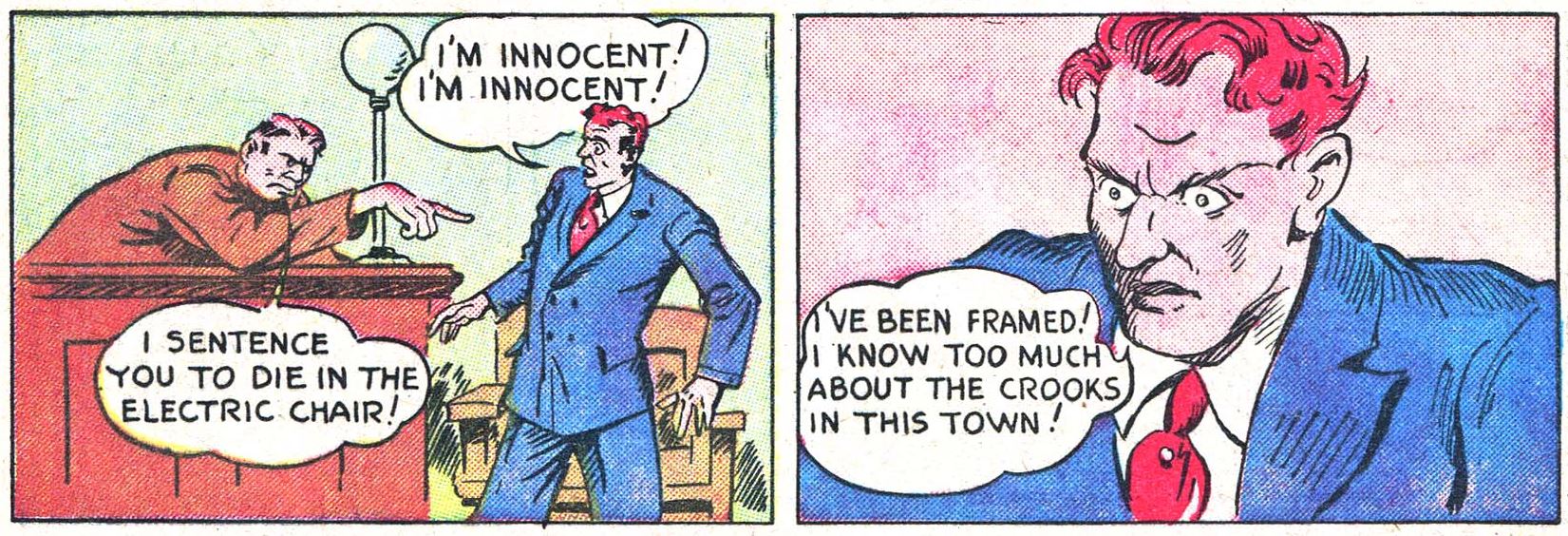
    It’s unclear what Red Roberts’ actual job is, but he is a guy who Knows Too Much about the corruption in the unnamed city he lives in and so he is framed for murder and fast-tracked to the electric chair.

    Luckily for Roberts, this is a comic book universe and being an innocent person sentenced to be executed via the electric chair means that you get sick-ass electricity powers instead of dying like everyone else. Red Roberts quickly parleys these powers into revenge on the city’s crooked mayor and his cronies and then cleans up crime around town for a couple of issues more for good measure. He doesn’t bother with a secret identity because at least half a dozen people were there to witness his origin, which must feel quite freeing. (Rocket Comics 001, 1940)

    the Phantom Ranger:

    There’s not much to distinguish the Phantom Ranger from his contemporaries in the ranks of Mysterious Cowboys Who Stick Around Just Long Enough to Help Out, but here goes: his horse is named Demon and he likes to ride around with his sleeves rolled up, which gives him a business casual look that I appreciate. (Rocket Comics 001, 1940)

    the Defender:

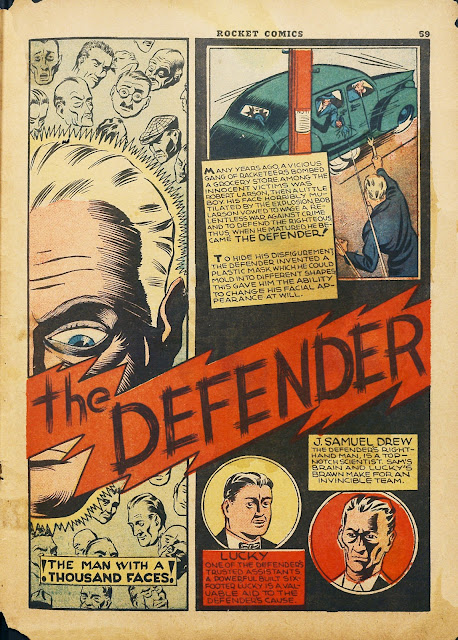
    Is the Defender (Robert Larson, who was scarred facially by criminals as a child and who now fights crime using a malleable rubberoid mask and two dedicated assistants) a take on pulp and comic character the Avenger (Richard Benson, whose face was rendered inhuman by the shock of losing his wife and child to criminals and who now fights crime using his own malleable face and 4-5 dedicated assistants)? I certainly think he is, but I don’t know if you could conclusively prove it. (Rocket Comics 002, 1940)

    Samson UPDATE:

    Samson being descended from the long-haired Biblical figure of the same name is not a new origin for the character, but once he had his own series it was time to explicitly lay it out in the form of his mother telling him in plain English that he is. Frankly, I’d much rather learn how he managed to get away with  having shoulder-length hair as a teenager in the early 1930s, but it’s just left as an exercise for the reader to figure out.

    No such luck for David, however. He remains an orphaned Boy Scout who Samson just found and adopted one day. David is not his actual name and we do not know his actual name. There is some early effort to play up his Boy Scout knowledge as valuable to the crimefighting enterprise but that soon falls by the wayside. (Samson 001, 1940)

  • MINOR SUPER-HERO ROUND-UP 037

    MINOR SUPER-HERO ROUND-UP 037

    More cream rises from the milky depths of the Golden Age!

    Red Roberts, the Electro Man:

    It’s unclear what Red Roberts’ actual job is, but he is a guy who Knows Too Much about the corruption in the unnamed city he lives in and so he is framed for murder and fast-tracked to the electric chair.

    Luckily for Roberts, this is a comic book universe and being an innocent person sentenced to be executed via the electric chair means that you get sick-ass electricity powers instead of dying like everyone else. Red Roberts quickly parleys these powers into revenge on the city’s crooked mayor and his cronies and then cleans up crime around town for a couple of issues more for good measure. He doesn’t bother with a secret identity because at least half a dozen people were there to witness his origin, which must feel quite freeing. (Rocket Comics 001, 1940)

    the Phantom Ranger:

    There’s not much to distinguish the Phantom Ranger from his contemporaries in the ranks of Mysterious Cowboys Who Stick Around Just Long Enough to Help Out, but here goes: his horse is named Demon and he likes to ride around with his sleeves rolled up, which gives him a business casual look that I appreciate. (Rocket Comics 001, 1940)

    the Defender:

    Is the Defender (Robert Larson, who was scarred facially by criminals as a child and who now fights crime using a malleable rubberoid mask and two dedicated assistants) a take on pulp and comic character the Avenger (Richard Benson, whose face was rendered inhuman by the shock of losing his wife and child to criminals and who now fights crime using his own malleable face and 4-5 dedicated assistants)? I certainly think he is, but I don’t know if you could conclusively prove it. (Rocket Comics 002, 1940)

    Samson UPDATE:

    Samson being descended from the long-haired Biblical figure of the same name is not a new origin for the character, but once he had his own series it was time to explicitly lay it out in the form of his mother telling him in plain English that he is. Frankly, I’d much rather learn how he managed to get away with  having shoulder-length hair as a teenager in the early 1930s, but it’s just left as an exercise for the reader to figure out.

    No such luck for David, however. He remains an orphaned Boy Scout who Samson just found and adopted one day. David is not his actual name and we do not know his actual name. There is some early effort to play up his Boy Scout knowledge as valuable to the crimefighting enterprise but that soon falls by the wayside. (Samson 001, 1940)

  • MINOR SUPER-HERO ROUND-UP 021

    They’re just these guys, you know?

    the Solar Legion:

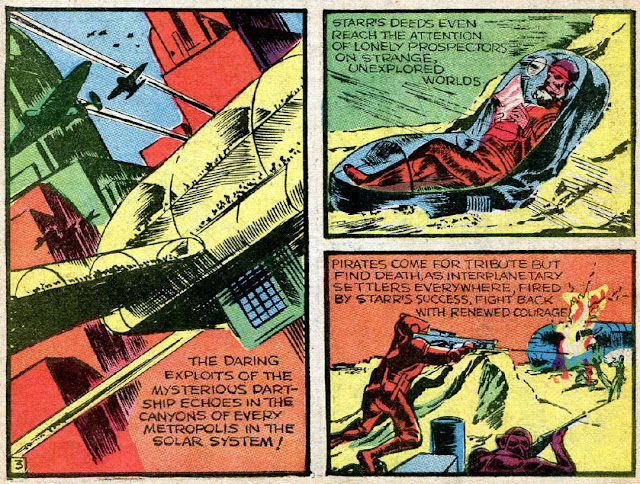
    The Solar Legion is the brainchild of Adam Starr, a 23rd Century man about whom very little is ever revealed. Emerging from a concealed base on Io, he sets out to rid the Solar System of the scourge of space piracy via the most direct route possible: blowing up all of the space pirates.

    Starr’s exploits have their intended effects: 1. many pirates are blown up and 2. the authorities are convinced of the need for an interplanetary peacekeeping force, aka the Solar Legion, with Starr as the head.

    Despite his new position of authority, the remaining four Solar Legion stories feature Adam Starr as a solo operator, hunting down pirates and settling factional disputes with his ray gun and two-fisted attitude. (Crash Comics Adventures 001, 1940)

    the Cat Man:

    The Cat Man is David Merrywether, who is orphaned in India after his father William brings his entire family along on a scientific expedition to collect butterflies and they run afoul of a hostile tribe (no word on whether William did something to draw their ire or if they were universally hostile to intruders – in either case the question of just why he would have his wife and two young children along on such a dangerous endeavour remains unaddressed). David, the only survivor, ends up being adopted by a tiger and spends his youth with her in an expository caption.

    (I really appreciate this “yadda yadda yadda” version of the Raised by Animals origin story. You’ve heard it all before, folks: he lived among the tigers and now he has tiger powers. He’s back in civilization because he saved a tiger’s life and that tiger’s mother owed him a favour. Now let’s get to the costumed antics!)

    Cat Man has all of the expected cat-related superpowers – enhanced dexterity, strength, speed and jumping ability – plus a few less common ones like the ability to speak to tigers and the ability to fall any distance and land on his feet without harm. He also has a cat’s enhanced night vision, which takes the form of literal beams of light that emit from his eyes. Fun!

    The Cat Man’s most striking power is that of having nine lives, bestowed on him by his adoptive tiger mama when he saved her cub. The problem with the “multiple lives” superpower has always been that it’s not interesting if it’s not used, with the result being that after two 1940 appearances Cat Man is down to seven lives. Surely this cannot be sustained going forward.

    Speaking of going forward, we will be hearing more out of Cat Man, one of the minor successes of the Golden Age. Changes are afoot once he has his own title in 1941, starting with a revisions to his much-derided original costume (personally, I like this costume. It very much feels like the sort of thing that someone who had spent their youth alone in a jungle might put together). See you then! (Crash Comics Adventures 004, 1940)

    UPDATE 1941

    Tornado Tom:

    Like the word-box says: Tornado Tom is just some guy who was sucked up by a tornado one day and when he came down again he was inhumanly strong, fast and durable. He also had amnesia, so even though he shares the name Tom Kenny with the famous voice actor of such characters as Spongebob Squarepants, he himself did not know that.

    Tornado Tom’s origin is never really explored and the two hints we get about the nature of his powers are a bit contradictory:

    Possible Mystical Origin: in Cyclone Comics 002, Tom battles some thugs in a stuffy apartment and is drained of vitality by the lack of fresh breezes. In a moment of desperation he calls out to Boreas, “God of Wind” and is revived and re-energized by a gust of air that blasts through the window. Talking points: was it a mystic tornado sent by the gods? Is Tom Kenny a descendant of Boreas or another Greco-Roman figure?

    Possible Biological Origin: In Cyclone Comics 005* Tornado Tom’s blood is asserted to have miraculous healing properties, possibly as  a result of his being some sort of mutant or mutate. Talking points: was it a radioactive tornado?

    This is all ultimately clutching at straws because Tornado Tom is a classic Golden Age cipher, much as I would like to know otherwise. (Cyclone Comics 001, 1940)

    * his blood is reportedly transfused into a dying man in Cyclone Comics 004 but that issue is currently unavailable.

    Mister Q:

    Your typical master of disguise style hero, with a manservant named Ying and a dog named Satan. I quite like Mister Q because I’m pretty sure that his name is derived from the idea of wartime Q-Ships, ie, warships disguised as harmless merchant vessels. It’s a neat name for a disguise-based crimefighter! (Cyclone Comics 001, 1940)

  • MINOR SUPER-HERO ROUND-UP 014

    Some real niche characters this time.

    the Lone Star Rider:

    An Old West hero so generic he only appeared once and never even got to track down the owlhoots who killed his parents in order to steal their land. Good gloves. (Smash Comics 002, 1939)

    Shock Gibson:

    Like Barry Allen after him, Charles (later Robert) Gibson is a young scientist working late into a stormy night when he is simultaneously struck by lightning and bathed in chemicals. Though he is called the Human Dynamo, for the first chunk of his career he functions as more of a Human Battery who stores an electrical charge that can be used to fuel various superhuman feats – super-strength, super-jumping (later full-on flight), and a shocking grasp.

    Shock Gibson goes through more than a few costume changes over the years – sadly this goofy helmet is axed during the first one – but one consistent element in his design is lotsa cool electricity crackle when he uses his powers. (Speed Comics 001, 1939)

    Shock Gibson UPDATE 1940: He loses the hat.

    the Man With 1000 Faces:

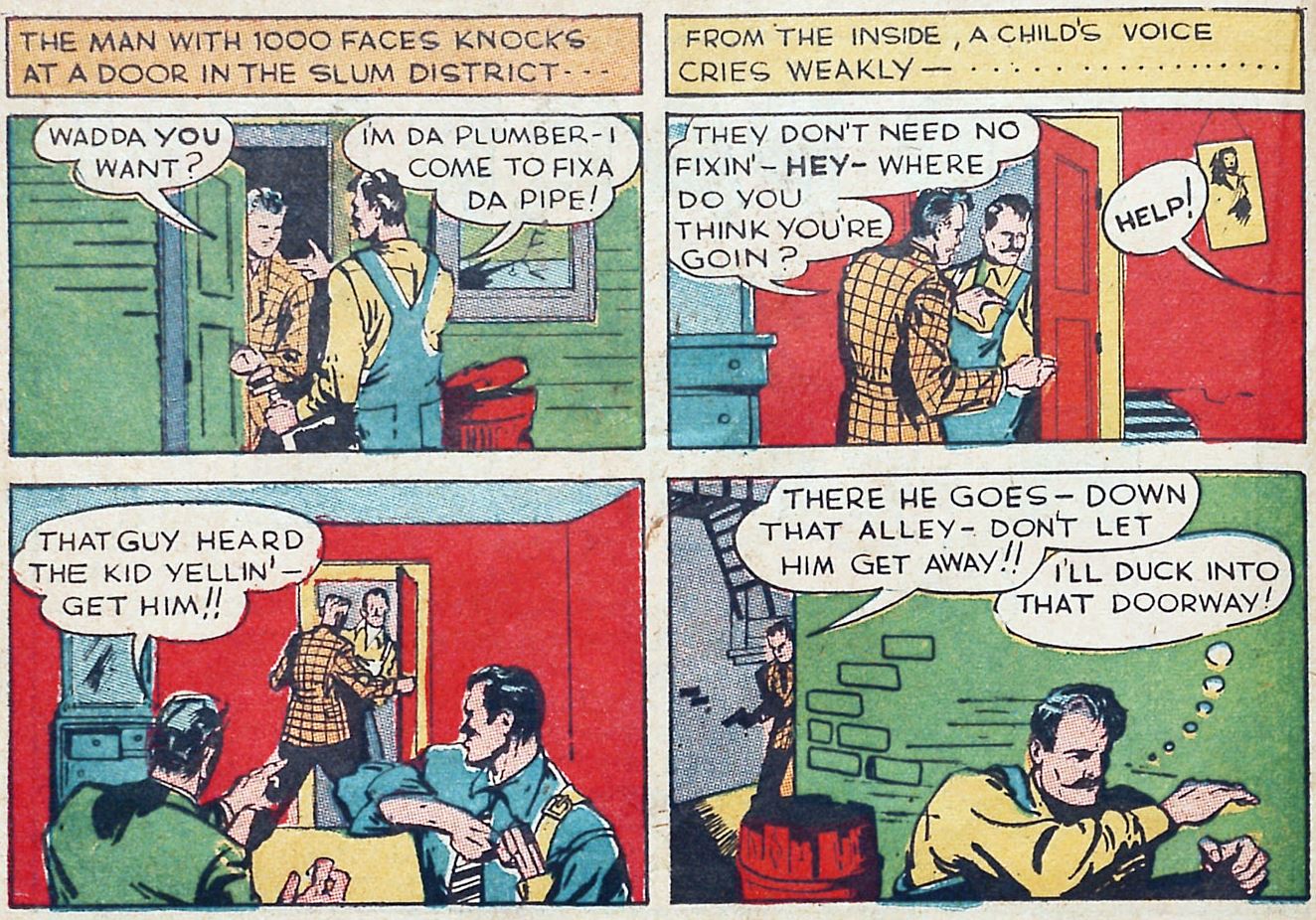
    Ted Parrish, famous film star, is bored with his humdrum life and so turns his considerable talent for quickchange artistry and disguise to the task of crimefighting. Just where he gets all of his accessories from is not elaborated on, so it’s equally likely that he scavenges them from the environment as it is that he just hauls around an enormous hockey bag full of clothing etc everywhere he goes.

    Parrish’s mission is obviously hampered somewhat by the fact that Los Angeles’ criminal fraternity knows that the Man With 1000 Faces exists and they should be on the lookout for him. How did they find out? Did Parrish blab to up the challenge and excitement of it all? (Speed Comics 001, 1939)

    the Wizard:

    Blane Whitney, AKA the Wizard, is the latest in seven generations of Whitneys (some of whom were also called the Wizard) to dedicate their lives in patriotic service to the USA. Plus he was a child prodigy who was charged to use his abilities to better mankind by Woodrow Wilson. Plus he’s an inventive genius in virtually all fields, particularly various forms of engineering. Plus he has nearly superhuman physical abilities and a mind so highly developed that it is superhuman in that he can employ remote viewing to locate dangers and clues.

    The Wizard was a pretty big player at MLJ in the 40s but has largely been abandoned in the various attempts to revive the MLJ characters at Archie and elsewhere – his biggest post-Golden Age appearance that I am aware of was as a super-villain fighting the Mighty Crusaders in the 60s. What does this say about the character – that he’s perfectly serviceable but not very conceptually exciting? Yes, I reckon that sums him up. (Top-Notch Comics 001, 1939)

    UPDATE 1940a

    UPDATE 1940b 

  • MINOR SUPER-HERO ROUND-UP 014

    MINOR SUPER-HERO ROUND-UP 014

    Some real niche characters this time.

    the Lone Star Rider:

    An Old West hero so generic he only appeared once and never even got to track down the owlhoots who killed his parents in order to steal their land. Good gloves. (Smash Comics 002, 1939)

    Shock Gibson:

    Like Barry Allen after him, Charles (later Robert) Gibson is a young scientist working late into a stormy night when he is simultaneously struck by lightning and bathed in chemicals. Though he is called the Human Dynamo, for the first chunk of his career he functions as more of a Human Battery who stores an electrical charge that can be used to fuel various superhuman feats – super-strength, super-jumping (later full-on flight), and a shocking grasp.

    Shock Gibson goes through more than a few costume changes over the years – sadly this goofy helmet is axed during the first one – but one consistent element in his design is lotsa cool electricity crackle when he uses his powers. (Speed Comics 001, 1939)

    Shock Gibson UPDATE 1940: He loses the hat.

    the Man With 1000 Faces:

    Ted Parrish, famous film star, is bored with his humdrum life and so turns his considerable talent for quickchange artistry and disguise to the task of crimefighting. Just where he gets all of his accessories from is not elaborated on, so it’s equally likely that he scavenges them from the environment as it is that he just hauls around an enormous hockey bag full of clothing etc everywhere he goes.

    Parrish’s mission is obviously hampered somewhat by the fact that Los Angeles’ criminal fraternity knows that the Man With 1000 Faces exists and they should be on the lookout for him. How did they find out? Did Parrish blab to up the challenge and excitement of it all? (Speed Comics 001, 1939)

    the Wizard:

    Blane Whitney, AKA the Wizard, is the latest in seven generations of Whitneys (some of whom were also called the Wizard) to dedicate their lives in patriotic service to the USA. Plus he was a child prodigy who was charged to use his abilities to better mankind by Woodrow Wilson. Plus he’s an inventive genius in virtually all fields, particularly various forms of engineering. Plus he has nearly superhuman physical abilities and a mind so highly developed that it is superhuman in that he can employ remote viewing to locate dangers and clues.

    The Wizard was a pretty big player at MLJ in the 40s but has largely been abandoned in the various attempts to revive the MLJ characters at Archie and elsewhere – his biggest post-Golden Age appearance that I am aware of was as a super-villain fighting the Mighty Crusaders in the 60s. What does this say about the character – that he’s perfectly serviceable but not very conceptually exciting? Yes, I reckon that sums him up. (Top-Notch Comics 001, 1939)

    UPDATE 1940a

    UPDATE 1940b