The Curse of Skeleton Munroe

Category: Congo Jack

  • MONSTER, CRITTER AND CREATURE ROUND-UP 004

    Everyone likes a good monster now and then.

    Horned Cat:

    With every one of these round-ups I accrue more evidence that the Slightly Different Big Cat is one of the classic monster types, as seen here when Congo Jack is confronted with this horned green feline in the mystical Valley of Vango in the Congolese jungle.

    As a bonus, a few steps later he has to deal with another classic: the carnivorous plant, or in this case flesh-eating bush. (Lightning Comics v2 004, 1941)

    Croco-Tiger:

    As further evidence, here’s Power Nelson fending off a strangely plush-looking croco-tiger in the wilds of the planet Pluvius in the far-flung year 1982 CE. For those like me who like to see a comic book creature survive now and then, worry not for the yellow pool this beast is being flung into merely shrinks it to kitten size, which is hopefully something that it can adapt to.

    Pluvius also features its own type of carnivorous plant, in this case some sort of tentacle (or possibly tendril?) based predator. (Prize Comics 003, 1940)

    Cannibal Tree:

    Rex Dexter of Mars and gal pal Synde have their own run-in with a carnivorous plant, the so-called cannibal tree, on an unnamed extrasolar planet. (Mystery Men Comics 018 1941)

    Dodman’s Serpent:

    Though the practice is now frowned upon in zoological circles, I can’t help but love the sound of an eponymous species name, and especially when the species in question is some sort of monster. Dodman’s Serpent is great because it has the lovely rhythm of an eponym without actually being named after some guy named Dodman who will later be cancelled and require a lot of textbooks to be reprinted. Instead, it is named after its hunting grounds near Dodman’s Point in Cornwall. Or its former hunting grounds, I suppose, since it made the mistake of attacking a ship containing the Black Knight. (The Funnies 049, 1940)

    Dragon:

    I really like this dragon, which spent its days peacefully eating maidens in an unnamed European kingdom until the Golden Knight showed up and slayed it. It has all the weird goofiness of the dragons that you see in Medieval illustrations from before the concept of what such a beast looks like was really codified. (Fantastic Comics 010, 1940)

    Dragons:

    These dragons, by contrast, are just a bunch of weird lizards that the Green Sorceress keeps in a cave and throws her enemies to. I really like them. (Blue Bolt v1 001, 1940)

    Drazil:

    Here we see Neptina associate Norma Kane be ambushed and nearly killed by a very cool-looking undersea reptile called a drazil. As is often the case with long-necked creatures, the drazil is vulnerable to having its head chopped off.

    Norma really was having a day of it, as immediately before the drazil attack, she was ambushed by this heinous looking crustacean which is referred to only as a “sea-beast.” (Champ Comics 011, 1940)

    Dream Plants:

    During one of the Green Sorceress’ many attempts to conquer the whole of the underground world, she employs dark majicks and weird science to move her armies through the Fourth Dimension. While pursuing her there, Blue Bolt is nearly killed by a Dream Plant, a carnivorous plant with the ability to project sexy illusions to lure its prey closer.

    Later, a second, airborne species of dream plant that forgoes the illusory lures in favour of active hunting almost does for the Green Sorceress herself before Blue Bolt spears it in its conspicuous weak point. (Blue Bolt v1 005, 1940) 

    Jungle Horse:

    Finally we have the jungle horse, potentially the only non-hostile species present on the Gorikon in the Negative Universe, or at least the only one encountered by Meteor Martin during his time there. These peaceful animals just hang around waiting to act as beasts of burden for passing humanoids – a truly selfless species. (Amazing-Man Comics 025, 1941)
  • DIVINE ROUND-UP 035

    DIVINE ROUND-UP 035

    Time to revise the Comparative Religion curriculum again because we found some new gods.

    Adobi:

    Just to what extent these Molemen worship the god Adobi is impossible to say. This particular Moleman hold him in high enough esteem to implore him to sanctify a forced political marriage, if that counts for anything much. I really wish we had a better angle on Adobi’s front side so I could see the big gems in his chest and forehead better.

    God Style: Idol (Lightning Comics v2 002, 1941)

    Vango:

    After escaping the lands of the Adobi-worshipping Molemen, Congo Jack encounters the worshippers of the multi-armed Vango. We don’t learn too much about Vango himself, alas, as the bulk of the narrative is taken up with a religious schism between pro- and anti-human sacrifice Vango worshippers. He looks good!

    God Style: Idol (Lightning Comics v2 004, 1941)

    Fire:

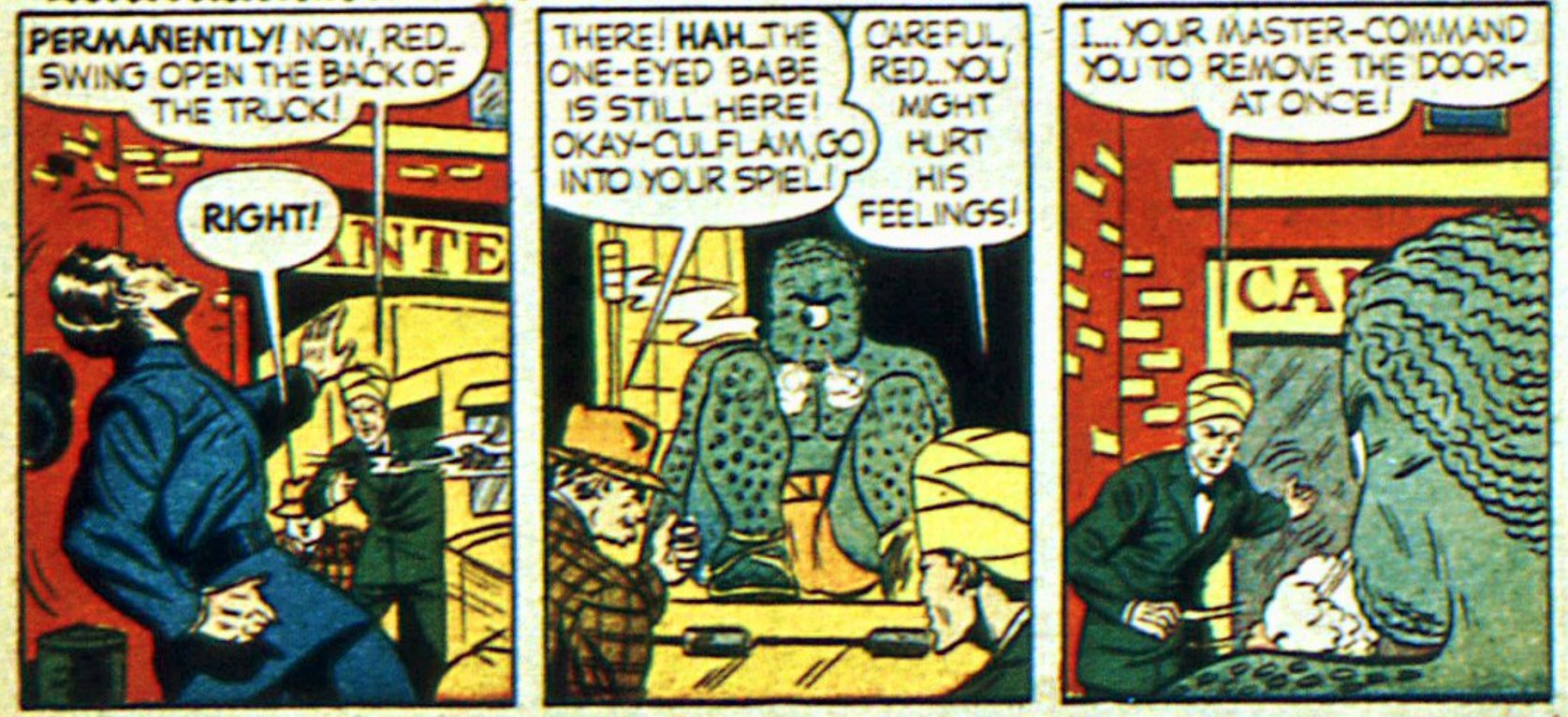
    The Fire-Men (aka the Fire-Cult) are a weird bunch to categorize. They are initially antagonists to the Human Torch, and give him a run for their money with their flame control powers while they hunt down and kill a former member. Then, however, they reveal that he was not merely an apostate but someone who was planning on using the cult’s teachings to profit while causing great destruction, and that he had a partner who is still at large. The Torch is left with to choice but to team up with his former adversaries.

    Though the Fire-Men presumably worship or at least pay fealty to the flame that they control, the real focus of the group is less religious than practical, as they work to contain the rampaging Flame Monsters of Tibet, giant green humanoids who emit flame from their pores. 

    (the second traitor to the cult turns out to be a man named Culflam, who later passes on the Fire-Men’s teachings to the Torch’s enemy the Parrot)

    God Style: Animist (Real?) (Marvel Mystery Comics v1 014, 1940)

    Flamosa the Fire God:

    God of the people of the volcanic Inferno Isle in the Pacific, who appear to have been manipulated into practicing human sacrifice by a group of Nazis in order to dispose of Allied scientists in the area. The Angel semi-accidentally blows up half the island and sets off the volcano, and the worship of Flamosa is abandoned.

    God Style: Idol (Marvel Mystery Comics v1 023, 1941)

  • DIVINE ROUND-UP 035

    Time to revise the Comparative Religion curriculum again because we found some new gods.

    Adobi:

    Just to what extent these Molemen worship the god Adobi is impossible to say. This particular Moleman hold him in high enough esteem to implore him to sanctify a forced political marriage, if that counts for anything much. I really wish we had a better angle on Adobi’s front side so I could see the big gems in his chest and forehead better.

    God Style: Idol (Lightning Comics v2 002, 1941)

    Vango:

    After escaping the lands of the Adobi-worshipping Molemen, Congo Jack encounters the worshippers of the multi-armed Vango. We don’t learn too much about Vango himself, alas, as the bulk of the narrative is taken up with a religious schism between pro- and anti-human sacrifice Vango worshippers. He looks good!

    God Style: Idol (Lightning Comics v2 004, 1941)

    Fire:

    The Fire-Men (aka the Fire-Cult) are a weird bunch to categorize. They are initially antagonists to the Human Torch, and give him a run for their money with their flame control powers while they hunt down and kill a former member. Then, however, they reveal that he was not merely an apostate but someone who was planning on using the cult’s teachings to profit while causing great destruction, and that he had a partner who is still at large. The Torch is left with to choice but to team up with his former adversaries.

    Though the Fire-Men presumably worship or at least pay fealty to the flame that they control, the real focus of the group is less religious than practical, as they work to contain the rampaging Flame Monsters of Tibet, giant green humanoids who emit flame from their pores. 

    (the second traitor to the cult turns out to be a man named Culflam, who later passes on the Fire-Men’s teachings to the Torch’s enemy the Parrot)

    God Style: Animist (Real?) (Marvel Mystery Comics v1 014, 1940)

    Flamosa the Fire God:

    God of the people of the volcanic Inferno Isle in the Pacific, who appear to have been manipulated into practicing human sacrifice by a group of Nazis in order to dispose of Allied scientists in the area. The Angel semi-accidentally blows up half the island and sets off the volcano, and the worship of Flamosa is abandoned.

    God Style: Idol (Marvel Mystery Comics v1 023, 1941)

  • MONSTER, CRITTER AND CREATURE ROUND-UP 003

    I hope everyone likes monsters as much as I do because there are a whole lot of them to cover.

    Beaked Tyros:

    When polar explorer Anthony Conrad gets lost in an Arctic storm and falls through a hole in the pack ice, he reasonably expects to meet his demise. Instead, he falls into the subterranean kingdom of Artica and is chosen by the elderly Artican king – also a stranded former surface explorer – as his successor. 

    As part of the coronation process, Anthony must prove his mettle to his prospective subjects, and step two of that process is Thrilling Arena Combat with the horrible beaked tyros “Lord of Artica’s Jungles,” and I love this thing. Though it looks like just another low-rent carnosaur at first glance, upon closer examination it has many bizarre features, including weird bird legs, thin, unpleasant-looking teeth, radially-symmetrical hands that are possibly equipped with suckers on the palms, and skin that is described as “hairy” in the caption box. Truly this is a strange and wonderful beast that sadly must be chopped up in service to the story. (Cyclone Comics 001, 1940)

    the Beast:

    When asked to prove his worthiness to wed the Princess Ahloo, our hero Abdallah knows exactly what to do: ride directly to a nearby valley full of dinosauroids and slay one of them. Though one of the pteranodon-adjacent flying reptiles that confront him when he enters the valley would probably be sufficient to satisfy Ahloo’s father, Abdallah instead opts to battle a creature referred to only as the Beast, a possibly-fire-breathing, possibly-carnivorous sauropodoid that give him a truly heroic-level challenge. And it works! He gets the girl! (Funny Pages v2 003, 1937)

    the Birds:

    These vulture-monsters come very close to destroying the Blue Bolt on his very first adventure. They are only prevented from doing so, in fact, because they work for the Green Sorceress and she has become infatuated with Our Hero here on sight.

    I’m always a big fan of these kinds of monster birds that up the ante on deadliness by throwing most of the birdliness of the creature out the window and instead give them the body plan of a griffin. Really great stuff and my only note is that some of the tails are very unpleasant to look at. (Blue Bolt v1 001, 1940)

    Bolu:

    Meg and Mickey are two children who have access to a magical time-travel stone and use it to just kind of blunder around throughout history. In this particular instance they have ended up in the Stone Age and are only saved from being eaten by some uncharitable portrayals of our collective ancestors by the appearance of a dinosaur, called Bolu by the cavemen and of course far, far more out of place than two 20th Century kids could ever hope to be. There is some indication that the bolu was summoned by the Spirit of the Stone to save the two from becoming dinner, but if that’s the case then why do the cavemen already know about it? (The Comics 007, 1938)

    Carnicantileia:

    The swamp-dwelling carnicantileia briefly menaces Flip Falcon and his associates during one of his early adventures when he mostly uses his fantastic time-and-space machine to go to Mars. It’s a pretty impressive snake-style beast, and as such it’s a real shame that it is killed in such a goofy way, by having a big rock thrown down its gullet. (Fantastic Comics 003, 1940)

    Carnivoplant:

    The carnivoplant is a classic man-eating plant, subtype seaweed, that almost kills adventurer Kinks Mason before it in turn is preyed upon by a swarm of phosphomites. And just what are phosphomites, you may ask? Contextually, they are small glowing creatures that eat carnivoplants, and that is all the information we get. (Fight Comics 001, 1940)

    Cave Monster:

    Modern day cowboy hero Bull’s-Eye Bill and his companions meet this cave reptile while pursuing an outlaw, and as I previously observed, it was clearly meant to set up an adventure into a prehistoric underground world that subsequent creators chose not to take advantage of. 

    As for the one beast that we do get to see fight some cowboys, I really appreciate how lizardy it looks, as well as how it seems to be posing for maximum dramatic effect in every panel, even when killing a guy or writhing around in its death throes. (Target Comics v1 007, 1940)

    the Ozix:

    Someday
    when I post a picture of a creature that is just a big cat with some extra stuff stapled onto it in one of these round-ups I will be able to refer to it
    as a standard type of creature, but I simply haven’t done the work yet.
    The ozix, then, is a beast with the body of a leopard and the head of a
    crocodile – how novel a concept! Adventurer Congo Jack must slay this
    one during his adventures under the earth. (Lightning Comics v2 002,
    1941) 

    Dakk:

    Returning to the adventures of King Anthony in the sub-Arctic world of Artica, here we see him as he is about to tour his kingdom on the back of a domesticated dakk, and I must say that I like the very beast-of-burden look that they have given to this creature’s head. Sadly, this particular dakk has been poisoned as part of an attempt to assassinate the new king.

    This assassination attempt is only partially successful, as Anthony survives the fall into the jungles of Artica but is then placed in further peril at the claws of the various creatures that live there, such as this amazing giraffe-patterned water lizard.

    Though he escapes the lizard, Anthony is almost immediately attacked by a great horned tigrid, which is is of course a regular tiger with two little horns on its head, and another example of what I was talking about in the ozix entry.

    Finally, after stumbling upon the roots of the conspiracy against him and dealing with them violently, King Anthony makes his way home on a humble unicorn. (Cyclone Comics 003, 1940) 

    the Storm Monster:

    A giant reptilian beast that plagues an African village on a yearly basis (during a huge storm, natch), the Storm Monster meets its end after swallowing KaƤnga whole, upon which he carves his way free of its guts with his trusty knife. (Jungle Comics 021, 1941)

  • ALIENS AND SO FORTH ROUND-UP 053

    Aliens. 

    Molemen:

    These green-skinned humanoids live in an underground kingdom somewhere beneath what was then known as the Belgian Congo. They have been sent to the surface to find some white men – and just why they subscribe to the racial categories of surface humanity is left unexplored – and woe betide any non-white guys who they encounter first.

    The Molemen expedition eventually captures jungle adventurer Congo Jack and returns to the underground with him. Alas, we never quite learn what Queen Moletta of the Molemen wants a white guy for, because her interest in Jack inspires a real crisis in the ambitious expedition leader Sir Lugi and he draws most of the comic’s ongoing focus with a series of attempted coups to seize power for himself. (Lightning Comics v2 001, 1941)

    Blue Dwarfs:

    One of Sir Lugi’s schemes involves him teaming up with the Blue Dwarfs, ancient enemies of the Molemen, to seize the Moleman city by sneak attack.

    The Blue Dwarf victory hinges on the fact that Sir Lugi knocks out Congo Jack in the first couple of minutes of battle. Once he comes to, Jack is able to not only retake the city after exactly one inspiring speech to the Moleman troops, but also slay the Blue Dwarf King Bobo to really drive the victory home. He is then granted his freedom by Queen Moletta. (Lightning Comics v2 002, 1941)

    Martians:

    Meteor Martin, one of the many short-lived Basil Wolverton sc-fi adventurers, is an officer of the Moon Patrol who sallies forth to combat an invading Martian space fleet and finds himself blasted into a strange otherworldly realm. 

    The above is the only actual look we get at the Martians. Is their invasion successful? No idea. I do like their weird Wolvertonian tentacle arms, though.

    Luckily for Martin, he finds himself in the company of fellow humans Rana and her father Romrak, who are able to fill him in on what has happened to him. The Martian weapon he was struck with sends its victims to a “negative world,” implicitly another dimension. Further, the specific region that they are stranded in is a densely-packed cluster of planetoids called Gorikon. (Amazing-Man Comics 025, 1941) 

    Bat Men:

    Gorikon is awash with different lifeforms, though just how many of them are native to the place and how many have been sent there from the positive universe (or are the descendants of positive universe exiles) is unknown. When Meteor first encounters Rana, for example, she has been staked out as a sacrifice for Bat Men. (Amazing-Man Comics 025, 1941)

    Desert Dwellers:

    These excellent humanoid camel people (referred to as “savages” throughout, but that’s a pretty rude thing to refer to an entire people as, so I’ll just go with “dwellers”) are the ones who are attempting to sacrifice Rana to the Bat Men, and if any species in Gorikon is going to get my vote for having actually evolved there it’s them, if only because they have the weak muscles of a people who come from a low-gravity environment. Note how easily Meteor Martin beats them up, after all. (Amazing-Man Comics 025, 1941)

    Assorted Gorikons:

    Romrak and Rana have been residing in a village of interdimensional refugees, most of whom seem to be the same kind of near-human alien as series antagonist Groob here.

    The inhabitants of Groob’s village all seem to be the same kind of four-fingered humanoid as he is, though the presence of one little froggy guy with super-vision in Amazing-Man Comics 026 introduces the possibility of a more diverse cast of alien refugees that we sadly never get to see.

    Please also note the fact that the low gravity and close orbits of the planets of Gorikon means that interplanetary travel is achievable by means of a human cannonball-style cannon (though how Groob intends to return is a mystery to me). (Amazing-Man Comics 025, 1941)

    Insects:

    Meteor, Rana, Romrak and Groob all end up in this quicksand-like trap set by a species referred to as the Insects by the other inhabitants of Gorikon, and true to alien monster convention the Insect who comes to check the trap makes off with Rana rather than one of the men.

    Rana’s fate is to be sacrificed in a pit of fire, though it is Meteor who ends up falling to his doom in the issue’s cliffhanger. Sadly, there is no third Meteor Martin adventure and so we never learn a) how he gets out of it or b) whether these little green guys turn into the big green guy as part of their life-cycle or if he is some sort of distinct creature. I prefer the former! (Amazing-Man Comics 026, 1942)

  • ALIENS AND SO FORTH ROUND-UP 053

    Aliens. 

    Molemen:

    These green-skinned humanoids live in an underground kingdom somewhere beneath what was then known as the Belgian Congo. They have been sent to the surface to find some white men – and just why they subscribe to the racial categories of surface humanity is left unexplored – and woe betide any non-white guys who they encounter first.

    The Molemen expedition eventually captures jungle adventurer Congo Jack and returns to the underground with him. Alas, we never quite learn what Queen Moletta of the Molemen wants a white guy for, because her interest in Jack inspires a real crisis in the ambitious expedition leader Sir Lugi and he draws most of the comic’s ongoing focus with a series of attempted coups to seize power for himself. (Lightning Comics v2 001, 1941)

    Blue Dwarfs:

    One of Sir Lugi’s schemes involves him teaming up with the Blue Dwarfs, ancient enemies of the Molemen, to seize the Moleman city by sneak attack.

    The Blue Dwarf victory hinges on the fact that Sir Lugi knocks out Congo Jack in the first couple of minutes of battle. Once he comes to, Jack is able to not only retake the city after exactly one inspiring speech to the Moleman troops, but also slay the Blue Dwarf King Bobo to really drive the victory home. He is then granted his freedom by Queen Moletta. (Lightning Comics v2 002, 1941)

    Martians:

    Meteor Martin, one of the many short-lived Basil Wolverton sc-fi adventurers, is an officer of the Moon Patrol who sallies forth to combat an invading Martian space fleet and finds himself blasted into a strange otherworldly realm. 

    The above is the only actual look we get at the Martians. Is their invasion successful? No idea. I do like their weird Wolvertonian tentacle arms, though.

    Luckily for Martin, he finds himself in the company of fellow humans Rana and her father Romrak, who are able to fill him in on what has happened to him. The Martian weapon he was struck with sends its victims to a “negative world,” implicitly another dimension. Further, the specific region that they are stranded in is a densely-packed cluster of planetoids called Gorikon. (Amazing-Man Comics 025, 1941) 

    Bat Men:

    Gorikon is awash with different lifeforms, though just how many of them are native to the place and how many have been sent there from the positive universe (or are the descendants of positive universe exiles) is unknown. When Meteor first encounters Rana, for example, she has been staked out as a sacrifice for Bat Men. (Amazing-Man Comics 025, 1941)

    Desert Dwellers:

    These excellent humanoid camel people (referred to as “savages” throughout, but that’s a pretty rude thing to refer to an entire people as, so I’ll just go with “dwellers”) are the ones who are attempting to sacrifice Rana to the Bat Men, and if any species in Gorikon is going to get my vote for having actually evolved there it’s them, if only because they have the weak muscles of a people who come from a low-gravity environment. Note how easily Meteor Martin beats them up, after all. (Amazing-Man Comics 025, 1941)

    Assorted Gorikons:

    Romrak and Rana have been residing in a village of interdimensional refugees, most of whom seem to be the same kind of near-human alien as series antagonist Groob here.

    The inhabitants of Groob’s village all seem to be the same kind of four-fingered humanoid as he is, though the presence of one little froggy guy with super-vision in Amazing-Man Comics 026 introduces the possibility of a more diverse cast of alien refugees that we sadly never get to see.

    Please also note the fact that the low gravity and close orbits of the planets of Gorikon means that interplanetary travel is achievable by means of a human cannonball-style cannon (though how Groob intends to return is a mystery to me). (Amazing-Man Comics 025, 1941)

    Insects:

    Meteor, Rana, Romrak and Groob all end up in this quicksand-like trap set by a species referred to as the Insects by the other inhabitants of Gorikon, and true to alien monster convention the Insect who comes to check the trap makes off with Rana rather than one of the men.

    Rana’s fate is to be sacrificed in a pit of fire, though it is Meteor who ends up falling to his doom in the issue’s cliffhanger. Sadly, there is no third Meteor Martin adventure and so we never learn a) how he gets out of it or b) whether these little green guys turn into the big green guy as part of their life-cycle or if he is some sort of distinct creature. I prefer the former! (Amazing-Man Comics 026, 1942)