The Curse of Skeleton Munroe

Category: Power Nelson

  • MONSTER, CRITTER AND CREATURE ROUND-UP 004

    Everyone likes a good monster now and then.

    Horned Cat:

    With every one of these round-ups I accrue more evidence that the Slightly Different Big Cat is one of the classic monster types, as seen here when Congo Jack is confronted with this horned green feline in the mystical Valley of Vango in the Congolese jungle.

    As a bonus, a few steps later he has to deal with another classic: the carnivorous plant, or in this case flesh-eating bush. (Lightning Comics v2 004, 1941)

    Croco-Tiger:

    As further evidence, here’s Power Nelson fending off a strangely plush-looking croco-tiger in the wilds of the planet Pluvius in the far-flung year 1982 CE. For those like me who like to see a comic book creature survive now and then, worry not for the yellow pool this beast is being flung into merely shrinks it to kitten size, which is hopefully something that it can adapt to.

    Pluvius also features its own type of carnivorous plant, in this case some sort of tentacle (or possibly tendril?) based predator. (Prize Comics 003, 1940)

    Cannibal Tree:

    Rex Dexter of Mars and gal pal Synde have their own run-in with a carnivorous plant, the so-called cannibal tree, on an unnamed extrasolar planet. (Mystery Men Comics 018 1941)

    Dodman’s Serpent:

    Though the practice is now frowned upon in zoological circles, I can’t help but love the sound of an eponymous species name, and especially when the species in question is some sort of monster. Dodman’s Serpent is great because it has the lovely rhythm of an eponym without actually being named after some guy named Dodman who will later be cancelled and require a lot of textbooks to be reprinted. Instead, it is named after its hunting grounds near Dodman’s Point in Cornwall. Or its former hunting grounds, I suppose, since it made the mistake of attacking a ship containing the Black Knight. (The Funnies 049, 1940)

    Dragon:

    I really like this dragon, which spent its days peacefully eating maidens in an unnamed European kingdom until the Golden Knight showed up and slayed it. It has all the weird goofiness of the dragons that you see in Medieval illustrations from before the concept of what such a beast looks like was really codified. (Fantastic Comics 010, 1940)

    Dragons:

    These dragons, by contrast, are just a bunch of weird lizards that the Green Sorceress keeps in a cave and throws her enemies to. I really like them. (Blue Bolt v1 001, 1940)

    Drazil:

    Here we see Neptina associate Norma Kane be ambushed and nearly killed by a very cool-looking undersea reptile called a drazil. As is often the case with long-necked creatures, the drazil is vulnerable to having its head chopped off.

    Norma really was having a day of it, as immediately before the drazil attack, she was ambushed by this heinous looking crustacean which is referred to only as a “sea-beast.” (Champ Comics 011, 1940)

    Dream Plants:

    During one of the Green Sorceress’ many attempts to conquer the whole of the underground world, she employs dark majicks and weird science to move her armies through the Fourth Dimension. While pursuing her there, Blue Bolt is nearly killed by a Dream Plant, a carnivorous plant with the ability to project sexy illusions to lure its prey closer.

    Later, a second, airborne species of dream plant that forgoes the illusory lures in favour of active hunting almost does for the Green Sorceress herself before Blue Bolt spears it in its conspicuous weak point. (Blue Bolt v1 005, 1940) 

    Jungle Horse:

    Finally we have the jungle horse, potentially the only non-hostile species present on the Gorikon in the Negative Universe, or at least the only one encountered by Meteor Martin during his time there. These peaceful animals just hang around waiting to act as beasts of burden for passing humanoids – a truly selfless species. (Amazing-Man Comics 025, 1941)

  • MONSTER, CRITTER AND CREATURE ROUND-UP 002

    It’s time for more monsters! And also critters and creatures!

    Prehistoric Gorilla:

    This carnivorous cave-dwelling ape lives in a hidden valley in Africa and has a pretty sweet deal going with the local pterodactyls, whereby they bring him things to eat and he seemingly doesn’t have to do anything. This arrangement does eventually backfire after the pterodactyls grab Kaänga’s mate Ann and the justifiably miffed jungle lord follows them and slays the gorilla. (Jungle Comics 017, 1941)

    A few bonus dinosaurs from the hidden valley: some generic carnosaurs, the aforementioned pterodactyls, and a mean aquatic sauropod.

    Creatures of Argus:

    When the wicked Sklar, tyrant of the planet Argus, attempts to invade the Earth of the far-off Year 1982, he sends these fairly cool flame-spewing robots to do his dirty work for him. While I always appreciate a good killer robot, these ones are especially satisfying because they conform to the proportions of the people of Argus and it’s always nice to see non-humans adhering to their own aesthetics rather than defaulting to ours. 

    Though the robots are smashed up by champion of the people Power Nelson in short order the risk of invasion remains, so he and his love interest/companion Zora head to Argus to settle things once and for all. During their time there, they are forced to take a detour that leads them through the through the Cave of Terror, a monster-haunted locale containing such beasts as…

    … the beefy, fire-breathing Dreaded Cave Monster! (smashed against a wall)

    The cephalopoid Creatures of the Quicksand! (deprived of their meal but otherwise unharmed)

    The extremely compelling giant rodentoid Saber Tooth Crawler! (punched out) (Prize Comics 006, 1940)

    Morg:

    Adventurer Planet Payson encounters this morg while investigating malfeasance on Mars, and manages to escape its clutches by merely making it sleepy rather than killing it. A true win for xeno-conservation! (Planet Comics 006, 1940)

    Pteridons:

    Analogous to our own woolly mammoths, these pteridons were once native to Pluto but now lie frozen beneath a layer of ice. Though a gang of crooks attempt to exploit these curiously adorable beasts by thawing them out and deploying them as rampaging engines of destruction, they are stopped by Buzz Crandall before things get too out of hand. (Planet Comics 006, 1940)

    Aqua-Scorpio:

    Despite the fact that people in the 40s thought that octopuses were inherently gross, menacing and deadly,  sometimes the comic book people felt the need to up the ante a bit and so we get things like the aqua-scorpio her, as encountered by oceanic adventurer Captain Gallant. I really like this guy’s head, especially the combination of the compound eyes and chinless beak, but the hooked tentacles might be overkill. (Super-Mystery Comics v1 005, 1940)

    Arena Monsters:

    The wicked ‘bdula Khan pits these three beasts against the Golden Knight seemingly purely for the love of being evil. Only one of them, the bat wing monster, gets anything approaching a name, but that doesn’t prevent it from being slain as easily as its companions generic dragon and land kelpie. (Fantastic Comics 006 1940)

    Bat-Serpent:

    The Rocket is confronted with and slays this bat-serpent while he is the captive of a group of Ape-Men, and it’s a good thing that he does so because it moves him out of the category of “prisoner” and into that of “potential leader.” I do feel a little bad for the bat-serpent here, though. Sure, the caption box says that it is a “blood seeking enemy of all animal and human life” but that face says “adorable puppy-cow” and that holds a lot of weight with me.

    As part of his ascent to chiefdom, the Rocket must venture into the Cave of Horrors and face the various horrors therein. He only gets to one of them before being interrupted, but it’s a good one, the fire-breathing, flashlight-headed rayoceros, which look like the kind of creature you’d find in an early Sixties comic set on Krypton. (Pep Comics 005, 1940)

  • ALIENS AND SO FORTH ROUND-UP 033

    Aliens. 

    Fifth Dimensional Beings: 

    These big-headed fellows feature in the origin story of Marvex the Super-Robot, but since we only see Marvex’ creator Bolo and his associates, we can’t really say too much about the culture of these Fifth Dimensional creatures. They have big heads, certainly, and a high enough degree of technology that Bolo is able to whip up a sentient robot on a whim, but whether that’s the sort of thing the population at large is getting up to or Bolo is the local equivalent of Lex Luthor is unknown and unknowable, alas. (Daring Mystery Comics 003, 1940)

    Green Devils:

    When Perisphere Payne seeks out a missing scientific expedition on an unnamed planet circling the star Polaris, he finds that they have come to mischief at the nubby little hands of the Green Devils, the planet’s native inhabitants who probably don’t call themselves that.

    While the Green Devils are just another band of primitives, eager to sacrifice the nearest blonde woman to their gods, they are also the most alien aliens that we have seen in a while and so I have a great deal of affection for them. Just look at their long noodly limbs! Their buggy eyes! Beautiful. (Science Comics 006, 1940)

    Pigwidgeons: 

    The final act of the story of the adventures of the Rocket and the Queen of Diamonds involves him leaving the Diamond Empire in his namesake rocket and her abdicating her throne to stow away and go with him. The Queen’s unexpected presence on the ship causes the Rocket to wreck the steering mechanism, and they crash on a strange planet.

    When they recover, the two find that they have been captured Gulliver-style by a group of tiny, rabbit-riding people called Pigwidgeons, who are melodramatic but ultimately good-hearted, and whose initial hostility is due to them mistaking the duo for… 

    … the Gromans, a species of human-sized fascists with a Roman Empire aesthetic to match their name. Though the Gromans have evidently been attacking the Pigwidgeons with impunity for some time, the arrival of the Rocket and the Queen shifts the balance of power, and over the next couple of issues the duo forge a new era of peace at the barrel of a ray gun. (Pep Comics 010, 1940)

    Pluvians:

    A plague is ravaging Earth in the far future of 1982, and Power Nelson has set aside his antipathy for the despotic government of Seng I to help them acquire the radium that they need to effect a cure. He sets out for the radium-rich planet Pluvius, where he meets the Pluvians, ruled by King Rari, and forget what I said about the Green Devils because these guys are my favourite aliens. Whether they have a smooth orange carapace or are wearing modified onesies is not specified and it doesn’t matter because they look fantastic either way, particularly as the sleek and retro-high-tech look it gives them is contrasted with their apparently Medieval society.

    The Pluvians agree to supply the needed radium in exchange for Nelson’s aid against their rival society, the Hairy Guroos, about whom there isn’t much to say. They’re humanoids with luxuriant hair and beards living in a Medieval monarchy (albeit a matriarchal one, which is fun), and that’s about it. They do use radium boulders as ammunition in their catapults, which is a good indication that Nelson has come to the right planet.

    For once in a Golden Age comic the solution to a problem involving hostile aliens does not involve mass alien casualties. Instead, Power Nelson does a regime change, by kidnapping the warmongering Guroo Queen Wodo and leaving her more amiable sister Queen Leelee in charge. (Prize Comics 003, 1940)

  • MINOR SUPER-VILLAIN 714: SKLAR

    (Prize Comics 006, 1940)

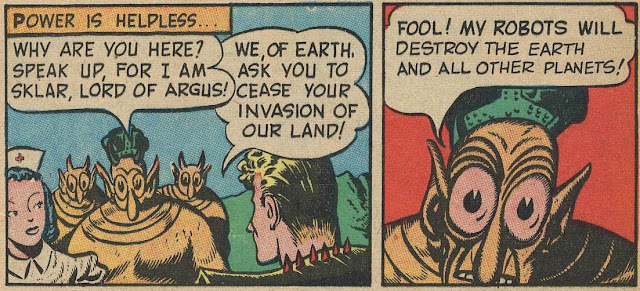
    It’s a regular day in Mongol-dominated New-New York City of the year 1982 CE: the people are oppressed in various ways and Power Nelson is around to help them solve some but not all of their problems. Suddenly! A space capsule lands and disgorges a trio of rampaging robots! This is a perfect task for Power Nelson to handle as it it a short-term solution to an immediate problem but very importantly does not require and attempt to change systemic problems. Smashy smashy!

    Nelson’s ally Zora Doone of the Interplanetary Red Cross soon informs him that the robots were sent to Earth from the planet Argus and he speeds there as past as possible, only to find himself outfoxed: Sklar, Lord of Argus has taken Zora hostage, necessitating an escape through the monster-filled Cave of Terror to remove her from danger and pad the pagecount.

    Power Nelson decides that the best solution to Argus’ and Earth’s problems is to depose the unpopular Sklar by way of a revolution, and let me say that this is a very galling thing for him to do. I’ve been bitching and moaning about how Nelson never gets around to freeing the people of Earth from the despotic reign of Seng I, the thing he was created to do, by the way and here he is, 15 minutes into his stay on Argus and elbow deep in revolution? What a piece of work.

    The revolution doesn’t prove to be strictly necessary, as Nelson ends up confronting Sklar one-on-one and just kind of tips him off of his volcano lair into the fiery depths below. I suppose it’s important for the populace to feel like they helped.

    Inspired by this, Nelson bids farewell to Zora Doone and finally, finally heads off to depose Emperor Seng I, a character who, might I remind you, he could crush with one hand and who he stands within five feet of in every single issue of Prize Comics. FINALLY.

    (this is very frustrating on a non-narrative level because the publicly available portions of Prize Comics 007 and 008 do not include the Power Nelson strip and somewhere in those two issues he goes from being a hero of the 1980s to one of the 1940s. Details are scarce, but it seems as though Nelson is flung back in time somehow, but does he actually depose Seng I first? No idea)

  • MINOR SUPER-VILLAIN 714: SKLAR

    (Prize Comics 006, 1940)

    It’s a regular day in Mongol-dominated New-New York City of the year 1982 CE: the people are oppressed in various ways and Power Nelson is around to help them solve some but not all of their problems. Suddenly! A space capsule lands and disgorges a trio of rampaging robots! This is a perfect task for Power Nelson to handle as it it a short-term solution to an immediate problem but very importantly does not require and attempt to change systemic problems. Smashy smashy!

    Nelson’s ally Zora Doone of the Interplanetary Red Cross soon informs him that the robots were sent to Earth from the planet Argus and he speeds there as past as possible, only to find himself outfoxed: Sklar, Lord of Argus has taken Zora hostage, necessitating an escape through the monster-filled Cave of Terror to remove her from danger and pad the pagecount.

    Power Nelson decides that the best solution to Argus’ and Earth’s problems is to depose the unpopular Sklar by way of a revolution, and let me say that this is a very galling thing for him to do. I’ve been bitching and moaning about how Nelson never gets around to freeing the people of Earth from the despotic reign of Seng I, the thing he was created to do, by the way and here he is, 15 minutes into his stay on Argus and elbow deep in revolution? What a piece of work.

    The revolution doesn’t prove to be strictly necessary, as Nelson ends up confronting Sklar one-on-one and just kind of tips him off of his volcano lair into the fiery depths below. I suppose it’s important for the populace to feel like they helped.

    Inspired by this, Nelson bids farewell to Zora Doone and finally, finally heads off to depose Emperor Seng I, a character who, might I remind you, he could crush with one hand and who he stands within five feet of in every single issue of Prize Comics. FINALLY.

    (this is very frustrating on a non-narrative level because the publicly available portions of Prize Comics 007 and 008 do not include the Power Nelson strip and somewhere in those two issues he goes from being a hero of the 1980s to one of the 1940s. Details are scarce, but it seems as though Nelson is flung back in time somehow, but does he actually depose Seng I first? No idea)

  • MINOR SUPER-VILLAIN 711: MAYTUS, KING OF THE BEASTS

    (Prize Comics 005, 1940)

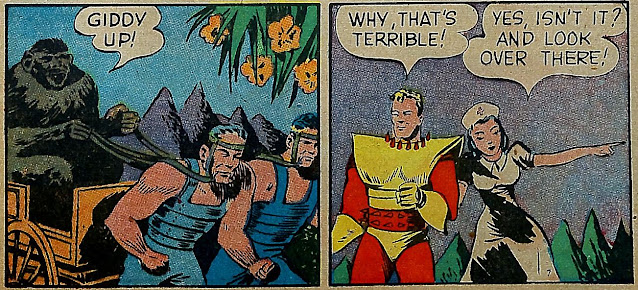
    Late in his first incarnation, Power Nelson makes the acquaintance of Zora Doone, agent of the Interplanetary Red Cross, and the two form a very horny-but-chaste relationship. At her behest, Nelson takes a break from not freeing the people of Earth from the tyrannical rule of Seng I to investigate conditions on planet Ato, where humans are ruled… BY APES!

    Yes, it’s a good old fashioned Planet of the Apes situation on Ato. Humans are treated as animals, act as beast of burden, are fed on garbage, etc, while apes get to be cops and wagon-drivers. It just ain’t fair!

    There isn’t really any exploration of why or how exactly the apes are in charge on Ato – the humans seem to be intelligent and verbal and the apes know it… Is this a race thing? It probably is, isn’t it – whether the writer consciously wrote it that way or not it’s got a lot in common with fantasies of white oppression under the heels of the “lesser” races (oh wait, I forgot that this is a comic set in a future in which the West has been conquered by the evil Mongol, isn’t it) . It’s also an interesting bit of commentary on the treatment of animals – that panel of the ape zookeeper feeding its charges garbage straight out of the can speaks of someone who has felt a pang of empathy for a creature in their time.

    King Maytus isn’t really your typical villain, just the head of an oppressive society, but I like his bluster. I also like seeing Power Nelson get mashed up by an elephant for a few panels before he inevitably comes out on top.

    For all my talk of racist allegories above, the situation on Ato is actually resolved far more peacefully than a similar one on a comic set on a Pacific Island would be. Sure Maytus is beaten up and threatened with death, but the story doesn’t end with, say, all of the apes being killed and/or reduced to servitude and/or stripped of their intelligence. In Golden Age comics terms it’s a triumph of diplomacy!

  • MINOR SUPER-VILLAIN 711: MAYTUS, KING OF THE BEASTS

    (Prize Comics 005, 1940)

    Late in his first incarnation, Power Nelson makes the acquaintance of Zora Doone, agent of the Interplanetary Red Cross, and the two form a very horny-but-chaste relationship. At her behest, Nelson takes a break from not freeing the people of Earth from the tyrannical rule of Seng I to investigate conditions on planet Ato, where humans are ruled… BY APES!

    Yes, it’s a good old fashioned Planet of the Apes situation on Ato. Humans are treated as animals, act as beast of burden, are fed on garbage, etc, while apes get to be cops and wagon-drivers. It just ain’t fair!

    There isn’t really any exploration of why or how exactly the apes are in charge on Ato – the humans seem to be intelligent and verbal and the apes know it… Is this a race thing? It probably is, isn’t it – whether the writer consciously wrote it that way or not it’s got a lot in common with fantasies of white oppression under the heels of the “lesser” races (oh wait, I forgot that this is a comic set in a future in which the West has been conquered by the evil Mongol, isn’t it) . It’s also an interesting bit of commentary on the treatment of animals – that panel of the ape zookeeper feeding its charges garbage straight out of the can speaks of someone who has felt a pang of empathy for a creature in their time.

    King Maytus isn’t really your typical villain, just the head of an oppressive society, but I like his bluster. I also like seeing Power Nelson get mashed up by an elephant for a few panels before he inevitably comes out on top.

    For all my talk of racist allegories above, the situation on Ato is actually resolved far more peacefully than a similar one on a comic set on a Pacific Island would be. Sure Maytus is beaten up and threatened with death, but the story doesn’t end with, say, all of the apes being killed and/or reduced to servitude and/or stripped of their intelligence. In Golden Age comics terms it’s a triumph of diplomacy!

  • MINOR SUPER-VILLAIN 710: BLOOR

    (Prize Comics 004, 1940)

    The year is 1982! The world languishes under the heel of a global dictatorship, and the economy is tanking – presumably the Mongols were running a war economy that failed to stand up to the post-world-conquering peace.

    Emperor Seng I offers nothing but empty promises to his subjects, until Power Nelson, as committed as ever to working within the system, bursts in and strongarms him into making… real promises? Frankly, this is Power Nelson at his worst. He was created to remove the dictator’s yoke from around the neck of the people and he consistently works to make the absolute dictator a better leader rather than, say, destroying him utterly. Like, I know that conflict is the essence of storytelling and if Nelson had just broken Seng I’s neck in Prize Comics 001 there would be less of that but… come on, man. Forcing the Emperor to say he’ll make some jobs isn’t going to do anything.

    In fact, Nelson’s threats probably make Seng I more amenable to the offer he receives when he is visited by Bloor, dictator of Uranus. After all, how can Power Nelson complain after thousands of men are given jobs? And how could the Emperor know that they were actually being sold into slavery, wink, wink?

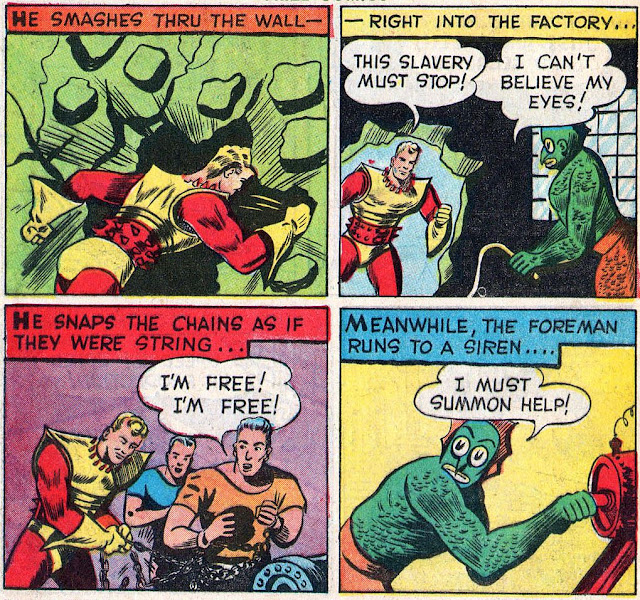
    The men are of course disappointed to learn that they are effectively slaves, to the extent that none of them seem to notice the high-fashion look that their captor is sporting and how much is contrasts with the simple purple pants of the planet’s leader. A bit self-involved, but who am I to judge?

    Power Nelson of course does not abide this, and busts everyone free at the first opportunity. Note also the factory foreman’s look – orange sunburst bonnets must be “in” on Uranus in 1982.

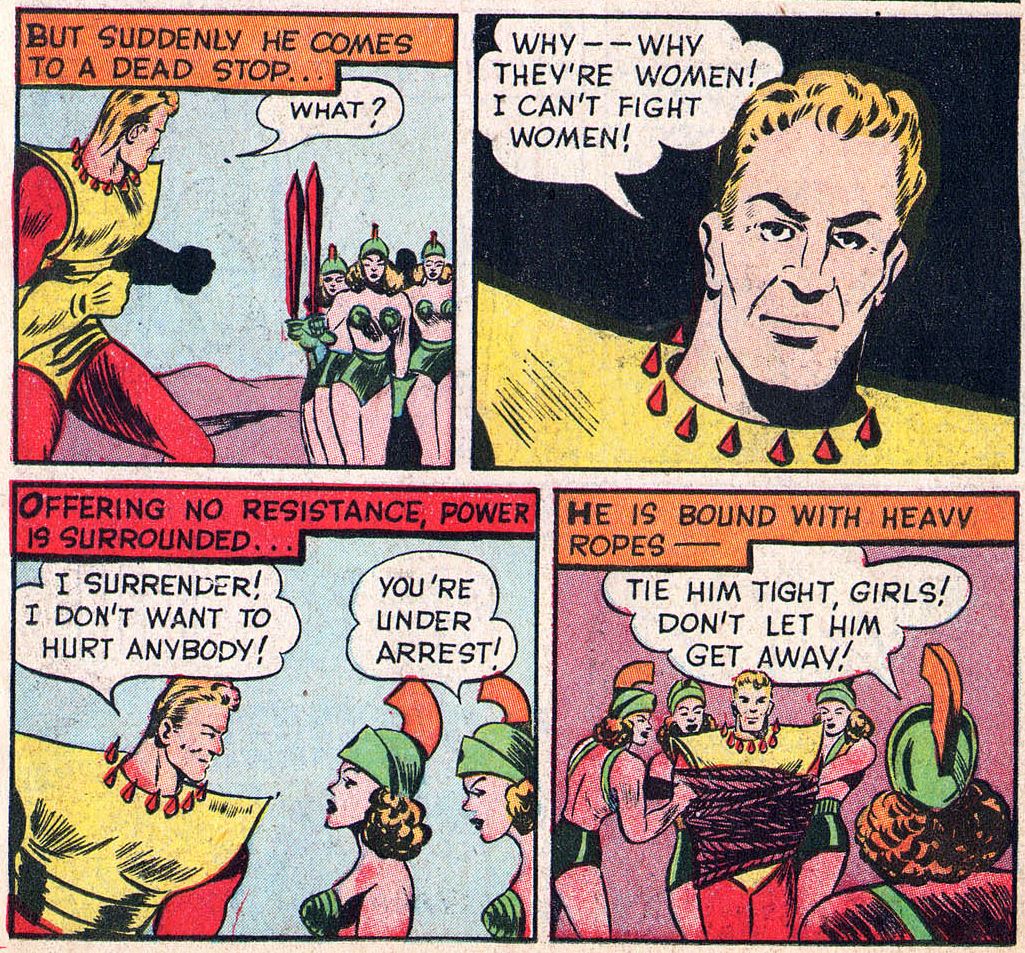
    Power Nelson does not fight women and so Bloor’s strategy to send his Amazon Regiment to capture him really pays off. But who are these Amazons? Is this what female Uranians look like or are they mercenaries from some other planet? Is this a sex thing for Bloor?

    Power Neslon is of course held in place not by ropes but by the power of his own antiquated ideas about gender and he frees himself just in time to get attacked by some really excellent cylindrical robots that, alas, have no visible gender signifiers and are rendered into so much scrap.

    Bloor is forced to release and pay the men, but in keeping with Nelson’s dedication to preserving existing power structures suffers no further consequences. I do really appreciate how committed he is to his role as a manager of Uranus rather than a traditional dictator – he might just be our first villain who operates almost completely from a desk. 

    The men all head home with a week’s wages and I guess that that solves the financial crisis. Everyone is happy under the boot of Seng I. Thanks, Power Nelson!

  • MINOR SUPER-VILLAIN 710: BLOOR

    MINOR SUPER-VILLAIN 710: BLOOR

    (Prize Comics 004, 1940)

    The year is 1982! The world languishes under the heel of a global dictatorship, and the economy is tanking – presumably the Mongols were running a war economy that failed to stand up to the post-world-conquering peace.

    Emperor Seng I offers nothing but empty promises to his subjects, until Power Nelson, as committed as ever to working within the system, bursts in and strongarms him into making… real promises? Frankly, this is Power Nelson at his worst. He was created to remove the dictator’s yoke from around the neck of the people and he consistently works to make the absolute dictator a better leader rather than, say, destroying him utterly. Like, I know that conflict is the essence of storytelling and if Nelson had just broken Seng I’s neck in Prize Comics 001 there would be less of that but… come on, man. Forcing the Emperor to say he’ll make some jobs isn’t going to do anything.

    In fact, Nelson’s threats probably make Seng I more amenable to the offer he receives when he is visited by Bloor, dictator of Uranus. After all, how can Power Nelson complain after thousands of men are given jobs? And how could the Emperor know that they were actually being sold into slavery, wink, wink?

    The men are of course disappointed to learn that they are effectively slaves, to the extent that none of them seem to notice the high-fashion look that their captor is sporting and how much is contrasts with the simple purple pants of the planet’s leader. A bit self-involved, but who am I to judge?

    Power Nelson of course does not abide this, and busts everyone free at the first opportunity. Note also the factory foreman’s look – orange sunburst bonnets must be “in” on Uranus in 1982.

    Power Nelson does not fight women and so Bloor’s strategy to send his Amazon Regiment to capture him really pays off. But who are these Amazons? Is this what female Uranians look like or are they mercenaries from some other planet? Is this a sex thing for Bloor?

    Power Neslon is of course held in place not by ropes but by the power of his own antiquated ideas about gender and he frees himself just in time to get attacked by some really excellent cylindrical robots that, alas, have no visible gender signifiers and are rendered into so much scrap.

    Bloor is forced to release and pay the men, but in keeping with Nelson’s dedication to preserving existing power structures suffers no further consequences. I do really appreciate how committed he is to his role as a manager of Uranus rather than a traditional dictator – he might just be our first villain who operates almost completely from a desk. 

    The men all head home with a week’s wages and I guess that that solves the financial crisis. Everyone is happy under the boot of Seng I. Thanks, Power Nelson!

  • MINOR SUPER-HERO ROUND-UP 036

    Prize Comics time, bay-bee.

    Power Nelson:

    Power Nelson is from the far-off future year of 1982 CE, in which the world has been conquered by the Mongols, but the wink, wink, nudge, nudge kind of Mongols from 1940-1941 where they’re actually supposed to be the Japanese (and for some reason the nation of Mongolia is fair game as far as Explicit Villain Status goes while Japan is still off the table). He has been given super strength by some surprisingly beefy scientists so that he might save civilization from oppression. Three things about Power Nelson:

    1) I think that his first name might actually be Power. So futuristic!

    2) I kind of want to give this series credit for not being too racist but the truth is that it is fairly racist but my senses have been dulled by exposure to the excesses of post Pearl Harbor depictions of the Japanese. 

    3) Power Nelson is very bad at his job? Every issue sees him within striking distance of Emperor Seng I and while assassinating the top man isn’t a guaranteed way to end a regime, it absolutely cannot hurt. Just punch him, man! (Prize Comics 001, 1940)

    Jupiter:

    Jupiter represents two distinct super-hero archetypes: the alien lawman sent to Earth to dispense justice and the magic-user, and as those are two of the more omnipotent origins that a character can have he goes through crooks like a hot knife through butter. The most important question about Jupiter is: was he called Jupiter back on the planet Jupiter or is he adopting a cool new name like a kid at camp? (Prize Comics 001, 1940)

    K the Unknown:

    Douglas Danville, wealthy playboy, takes to the crime-ridden ski slopes as K the Unknown, feared and hunted by ski crooks and ski cops alike. And presumably regular cops and crooks too, but he only had one recorded outing and it took place entirely within the bounds of a ski resort.

    K the Unknown’s one adventure involves embezzlement and murder among the officers of a college alumni group, possibly the perfect case for a wealthy playboy type hero.

    K the Unknown is a great name but perhaps not a great super-hero name, so I can see why he only had on outing. Still, it must be handy to have a calling card that you can piss into the snow. (Prize Comics 001, 1940)

    the Black Owl: 

    It’s hardly unusual for a Golden Age character to make one appearance and then disappear forever, but much more unusually while K the Unknown never had a second adventure his alter ego Doug Danville just kept on trucking under another identity. It’s never explored in the text of the story, so any explanation for why he made the change is an equally valid bit of speculation, from “he wanted a less generic super-hero identity” to “it’s completely different guy named Doug Danville who hangs around with a completely different private eye named Terry Dane.” It turns out that I wrote that last bit prematurely, as in the Black Owl’s second outing his foe is Sigmund Rathko, the crook who was also behind the alumni association shenanigans in the K the Unknown story. I suppose that it could be three completely different people but no, at that point we’re getting silly.

    One thing that you can say for certain is that he didn’t change identities to get the cops off of his back, because they want to get the Black Owl just as much as they did K the Unknown. Moreso, honestly, because K the Unknown was safely carving powder and never even saw a cop. (Prize Comics 002, 1940)