The Curse of Skeleton Munroe

Category: conquest

  • MINOR SUPER-VILLAIN 922: GENGHIS KHAN

    (Champ Comics 015, 1941)

    Okay, Genghis Khan. A lot of guys in comics like to call themselves Genghis Khan or claim to be his successor etc, and importantly they all seem to be into all the old Genghis Khan stuff like horse archers. Absolutely 100% stuff that Genghis was into at the time he was around of course, but I personally think that he would enjoy a machine gun if he had the chance. 

    Duke “the Human Meteor” O’Dowd is getting up to his usual day of driving cabs and palling around with his shoeshine boy pal Toby when suddenly the city is attacked by a mass of cavalry led by a shirtless giant wielding a flaming sword. This is Genghis Khan (a Genghis Khan, at least), and he is probably the Human Meteor’s only recurring foe, appearing in 3 (possibly 4, but Champ Comics 018 is currently AWOL) whole issues.

    A conquering giant cuts an intriguing figure, but the unfortunate thing about Genghis Khan is that the stories he appears in are pretty incoherent. There’s a plot, but everything other than the plot is just shiny bits glued on like sparkles. That said, here are the most interesting and intriguing things about him:

    1. Size and Origins

    Genghis Khan’s size remains fairly consistently enormous during his first two appearances – if anything, he might just be a bit bigger in the second one. His third appearance, however, shows him at a considerably reduced stature, from the third set of panel above in which he’s maybe ten feet tall to perhaps fifteen feet at maximum. Is this an indication that he can control his size or just a general disregard for continuity?

    The unanswered question of just what is up with this guy’s size is a symptom of the fact that he has no real origin. He just shows up one day, stomping around Manhattan. Is he even Mongolian? Not to put too fine a point on it, but I’ve read a lot of 1940s comics and I think that they would have drawn him differently if he was. 

    2. Technology

    The other major unanswered question about Genghis Khan is: just where did he get those wonderful toys? Such as… 

    His giant flaming sword that can also change its atomic structure on the fly, seemingly specifically so that the Human Meteor can’t pick it up.

    His cool dirigible base and its defensive screen of flamethrowers.

    The “sky road,” a transparent walkway that both men and horses can travel to and from the dirigible on, which need no support and must have some sort of crazy friction going on considering the angles that people are climbing it at.

    3. Goals

    Unsurprisingly, the self-declared successor of Genghis Khan, this fellow’s main goal is conquest. The attack on New York in his initial appearance is the first part of an attempted takeover of the US, for example.

    In Genghis Khan’s second appearance (Champ Comics 016, 1941), he is laying siege to the hidden, high-tech city of Bayakura, the place that Duke O’Dowd became the Human Meteor. 

    Though the Human Meteor drops a mountain on him at the end of that second appearance, Genghis Khan survives somehow (perhaps by shedding mass to allow himself to escape his mountain tomb? That’d be an interesting aspect of the character if it ever came up) and allies with the Japanese to harry the US fleet off China. The Human Meteor sinks the Khan’s entire fleet, and since he (probably) never appears again, drowning does what being crushed under a mountain failed to.

    Categorized in: Famous Figures (Genghis Khan), Real Folk (Genghis Khan), Supercrime (Attempted Conquest)
  • MINOR SUPER-VILLAIN 912: COMMANDER DARKE

    MINOR SUPER-VILLAIN 912: COMMANDER DARKE

    (Bang-Up Comics 001, 1941)

    Commander Darke, though ostensibly on a mission to invade the United States with his private military, is the arch-foe of scientist-adventurer Cosmo Mann and as such spends his entire career trying to Steal Those Gizmos. Perhaps things would be different if there had been more than three issues of Bang-Up Comics for Darke and Mann to clash, but as it stands all we get are the opening moves of their epic struggle.

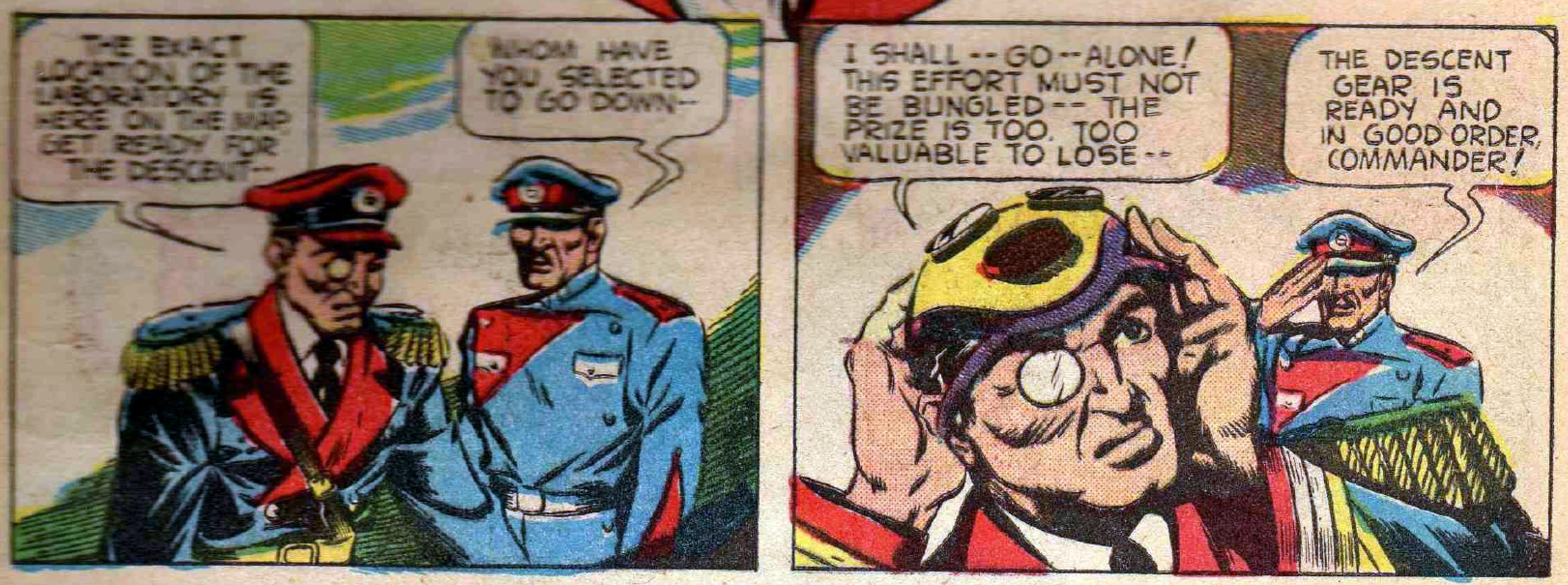
    You probably already took note of the extreme ostentation on display in Commander Darke’s (almost certainly self-designed) uniform, but the seriousness with which he takes his wardrobe is really underscored in the above panels in which we can not only see that he took the care to screw in his monocle even when waking up in the middle of the night to take a call but that even his double-breasted pyjamas have epaulettes on them. 

    I was all ready to give Darke a bit of credit for undertaking the mission to secure Cosmo Mann’s Sun Ray Gun himself, but once he left his captured underlings behind to die in a cloud of poison gas I was forced to reevaluate: going himself is a part of his being a Bad Boss, an expression of his disdain for the ability of his minions to do even this simple task. He does have a cool-looking gas mask though.

    Commander Darke has a lot of villainous presence or potential, but never really gets a chance to show it off: he captures the Sun Ray and a man who he thinks is Cosmo Mann but turns out to be his assistant Archy and then spends his next appearance on the back foot as Mann attempts to recapture them from Darke as he escapes in his dirigible. His particular brand of bombastic villainy was lost to the vagaries of the comic book boom, alas.

  • MINOR SUPER-VILLAIN 911: RAMESES

    MINOR SUPER-VILLAIN 911: RAMESES

    (Whiz Comics 025, 1941)

    We open in Egypt, where a group of partisans led by a fellow with the unlikely name of “Girbo, the Mad Mullah”* are brainstorming ways in which they might expel both the Germans and the British from their country, and Girbo has an innovative solution: he has procured the mummy of the Pharaoh Rameses, along with a vial of mummy-resurrection juice, and is going to bring the ancient king back to life to lead them. And it works!

    The problem that I am faced with here is that Egyptian history features a full eleven different rulers named Ramesses and just which one this was is not specified here. I was all fired up and ready to dig through the history of each one (on Wikipedia, at least), when I realized that there was a clear and obvious front-runner in the person of Ramesses II, ol’ Ozymandias himself, if only because he loomed largest in the public consciousness of the time as the presumed Pharaoh of the story of Exodus. 

    *while I’m not going to claim that the depiction of Egyptian Muslims in this story is good or even particularly sympathetic, you must believe me when I say that (aside from Girbo) these guys get about as sympathetic a depiction as you get in comics the 1940s, or indeed into the 80s. It’s a low bar but they cleared it.

    Rameses begins his campaign on a high note, with a raid on a British fort that establishes both his ruthlessness and complete invulnerability to bullets. One must pity his poor horse, however.

    Things take a turn when a Nazi officer shows up with the intention of allying with this new faction against the common British for, only to be slain at Rameses’ command. This violation of the flag of truce raises some concern amongst his followers but what really gets the talking is his assertion that he should be enough of a god for them and that they should abandon their faith to serve him.

    Having driven away his followers with his evil ways, Rameses drives home his point with magical snakes. 

    The loss of his followers means nothing to the undead Pharaoh, who simply raises an army of the dead to assist him in his next assault on the British forces. Meanwhile, Girbo attempts to slay Ibis the Invincible to prevent his further interference in their plans but is himself killed when Ibis proves his better in swordplay.

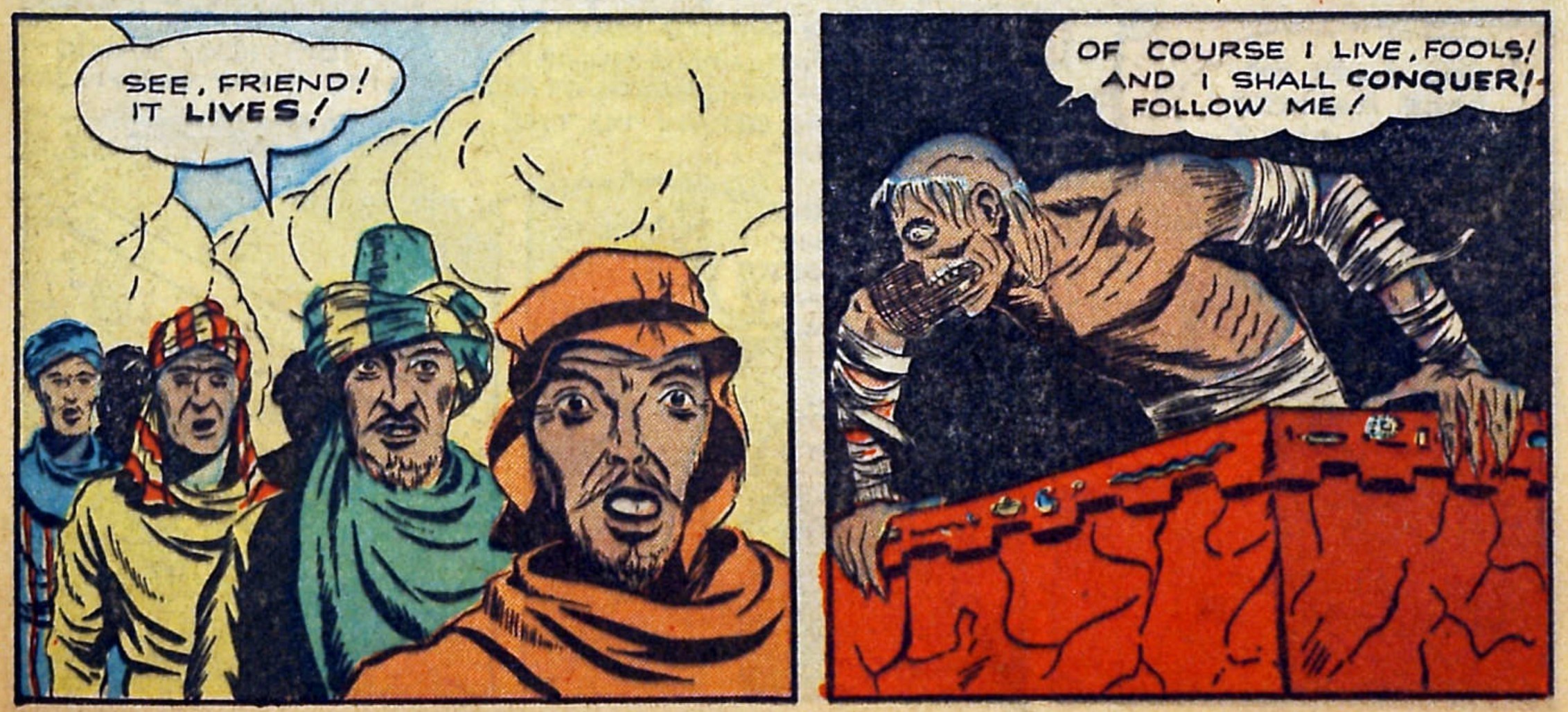
    Rameses’ undead forces, though formidable, are vulnerable to sunlight, something that the Ibistick can easily provide even though the mechanics of how it might have done so are troubling. But what to do with an eight foot tall megalomaniacal mummy-man? Things look hopeless until Rameses himself lets slip the fact that the only thing capable of containing him is his own tomb that Ibis is able to defeat him, by simply moving said tomb over top of the villain.

    Though Rameses is left to stew in the darkness, he is in fact one of Ibis the Invincible’s few recurring villains. We will see his bony face and weird mummy tonsure again.

  • MINOR SUPER-VILLAIN 911: RAMESES

    (Whiz Comics 025, 1941)

    We open in Egypt, where a group of partisans led by a fellow with the unlikely name of “Girbo, the Mad Mullah”* are brainstorming ways in which they might expel both the Germans and the British from their country, and Girbo has an innovative solution: he has procured the mummy of the Pharaoh Rameses, along with a vial of mummy-resurrection juice, and is going to bring the ancient king back to life to lead them. And it works!

    The problem that I am faced with here is that Egyptian history features a full eleven different rulers named Ramesses and just which one this was is not specified here. I was all fired up and ready to dig through the history of each one (on Wikipedia, at least), when I realized that there was a clear and obvious front-runner in the person of Ramesses II, ol’ Ozymandias himself, if only because he loomed largest in the public consciousness of the time as the presumed Pharaoh of the story of Exodus. 

    *while I’m not going to claim that the depiction of Egyptian Muslims in this story is good or even particularly sympathetic, you must believe me when I say that (aside from Girbo) these guys get about as sympathetic a depiction as you get in comics the 1940s, or indeed into the 80s. It’s a low bar but they cleared it.

    Rameses begins his campaign on a high note, with a raid on a British fort that establishes both his ruthlessness and complete invulnerability to bullets. One must pity his poor horse, however.

    Things take a turn when a Nazi officer shows up with the intention of allying with this new faction against the common British for, only to be slain at Rameses’ command. This violation of the flag of truce raises some concern amongst his followers but what really gets the talking is his assertion that he should be enough of a god for them and that they should abandon their faith to serve him.

    Having driven away his followers with his evil ways, Rameses drives home his point with magical snakes. 

    The loss of his followers means nothing to the undead Pharaoh, who simply raises an army of the dead to assist him in his next assault on the British forces. Meanwhile, Girbo attempts to slay Ibis the Invincible to prevent his further interference in their plans but is himself killed when Ibis proves his better in swordplay.

    Rameses’ undead forces, though formidable, are vulnerable to sunlight, something that the Ibistick can easily provide even though the mechanics of how it might have done so are troubling. But what to do with an eight foot tall megalomaniacal mummy-man? Things look hopeless until Rameses himself lets slip the fact that the only thing capable of containing him is his own tomb that Ibis is able to defeat him, by simply moving said tomb over top of the villain.

    Though Rameses is left to stew in the darkness, he is in fact one of Ibis the Invincible’s few recurring villains. We will see his bony face and weird mummy tonsure again.

  • MINOR SUPER-VILLAIN 898: THE DEATH BATTALION

    MINOR SUPER-VILLAIN 898: THE DEATH BATTALION

    (America’s Greatest Comics 001, 1941)

    Like Mr Skeleton before them (and possibly because I first encountered them both in the same comic), the Death Battalion is one of those super-villain concepts that really lodged itself in my brain and which I am glad to have finally appear here. Unfortunately, unlike Mr Skeleton, the Death Battalion isn’t quite as great as I’d remembered. For one thing, I’d long thought that they were a Mr Scarlet revenge squad, but despite the fact that he put them all in jail, they seem to bear him very little ill will. Comparatively.

    Instead, the six members of the Death Battalion are broken out of jail by a seventh fellow, the Brain, and enlisted into his plot to take over the US. Note the Nazi-ness of the Brain’s operation, but also that there is no real connection to the Nazi Party. Instead, the Brain and his Death Battalion appear to be independent Nazis, like your neo-Nazis and so forth will be later on. If it were just a few months later they’d be heiling Hitler, but as it stands we’re dealing with locally sourced indie hipster Nazis.

    Like I said, this isn’t a Mr Scarlet revenge squad – these just happened to be the six highest profile villains available to be broken out of El Catraz Penitentiary. But just what do they bring to the table?

    the Black Clown: Former circus owner. Murderer and bank robber. Circus connections.

    the Black Thorn: Fifth columnist. Murderer. Packs a mummy ray.

    Doctor Death: Former concert pianist. Murderer. Poisons.

    the Ghost: Former charity president. Embezzler. Sheet ghost costume.

    the Horned Hood: Academic. Jewel thief. No special equipment.

    the Laughing Skull: Former banker. Extortionist and murderer. Access to stone-cutting tools and shovels.

    A motley crew indeed. There’s a pretty wide range of skills and success levels on display here – like I said, the Brain seems to have prioritized breaking out the flashiest crooks over the most competent ones.

    The Brain’s plan is simple: murder six key men, thus setting in motion a destabilization of the US government that will allow the Death Battalion to swoop in and conquer the country. Let’s see how that goes. 

    Senator Hiram Dean: 

    Spoilers, but I must lead with the fact that Doctor Death is the only one of the six to successfully kill his target. Specifically, he appears to scare him to death? Regardless of how it was done, this is the event that puts Mr Scarlet onto the Death Battalion’s trail.

    Kudsen: 

    Kudson, head of a government defense program, comes very close to being killed by the Black Clown’s gorilla due to his refusal to turn around and see if the enormous gorilla-shaped shadow that is advancing on him might indicate some sort of danger. It’s only his dumb luck that his assistant is the one who gets aped first, and that Mr Scarlet shows up in time to prevent any further aping.

    FBI Chief Doover: 

    The Ghost is one the real odd men out in the Death Battalion. Consider that he was an embezzler whose main strength was the large group of men in spooky costumes in his employ and ask yourself just what chance he might have at assassinating the head of the FBI. It’s only due to Chief Doover’s nonexistent security that he almost manages to plant a knife in his back and only due to Pinky the Whiz Kid that he fails to do so.

    Secretary of State Simpson:

    The Black Thorn on the other hand, is quite a good choice when it comes to murder, particularly as he has somehow gotten his hands on another mummy ray. He comes pretty close to getting the Secretary of State but spends a bit too much time mummifying random committee members before Mr Scarlet turns up.

    General Dodd:

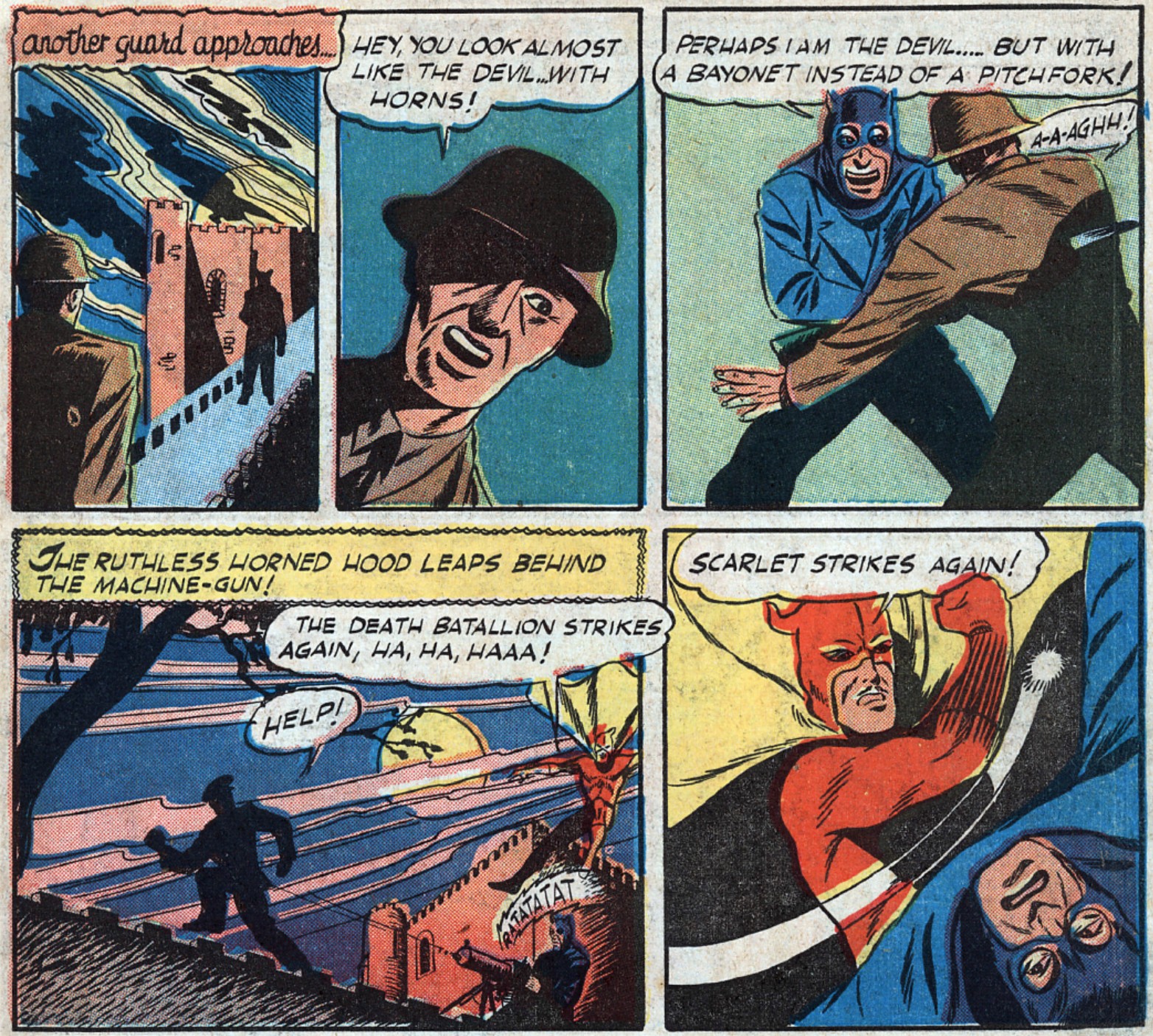
    The Horned Hood manages to screw up a simple murder while armed with a light machine gun from about ten feet away. This is absolutely on-brand for him as the biggest screw-up in the whole Battalion. The Hood’s presence on this team is proof of some sort of super-villain corollary to the Peter Principle.  

    Dollar-a-Year Man Phillips:

    Finally, the Laughing Skull is sent to kill dollar-a-year man Phillips, which leads to the question: what is a dollar-a-year man? Turns out that the term describes a wealthy person who takes a nominal salary in order to be counted as an employee while essentially doing government work for free, and Phillips is one of them. Lucky for him, the Laughing Skull insists that live burial is the only acceptable way to murder someone, which gives Mr Scarlet and Pinky enough time to show up and save the day.

    But what about the brain himself? What’s his deal? Well, aside from being the leader of the whole enterprise, the Brain has precisely two things going on: he has a weird mesh bubble helmet that makes the head inside look enormous, and he “deals in poisons,” which means that he tries to kill Mr Scarlet by dangling a tarantula at him on a stick in a display that is hilariously ineffectual looking even if you, like the creators of this comic, are working from the incorrect belief that the tarantula is massively venomous.

    Having foiled all of the Death Battalion’s attempted murders (but for that one), Mr Scarlet and Pinky make their way back to the group’s HQ by employing a little subterfuge and then beat all five of them (the Horned Hood and Laughing Skull already being in custody) to a pulp. And just who does the Brain turn out to be? Why, none other than ex-Warden Loomis, who so prominently retired after six costumed criminals escaped from his prison. Presumably he now gets to revisit his old workplace!

    The Death Battalion never needs to return, unless perhaps a flashback story needs a team of Nazi super-villains in it to be stomped, but as always I must whoop and cheer for the concept of a bunch of low-grade villains teaming up like this. It’s just fun!

  • MINOR SUPER-VILLAIN 897: MR SKELETON

    (America’s Greatest Comics 001, 1941)

    Mr Skeleton is one of the handful of minor super-villains who are
    foundational to this blog, the true weirdos who my mind turns to
    whenever the subject of obscure comic book characters comes up, and so
    it’s a real relief  to have him finally hsow his face here. This will
    keep happening at least until we reach 1978 and train-themed
    super-villain Casey Jones appears here.

    There are three really important aspects to Mr Skeleton that keep him in my thoughts:

    1. Appearance 

    He’s a chalk-white, twelve to eighteen foot tall man with an emaciated frame, huge hands and feet and a real pumpkin head with the face of a cartoon villain. It’s an extraordinary look, made even more so by his choice to dress in green trunks, a yellow halter top and a green cape. And he has eccentric facial hair!

    It’s a look that works well as both an over-the top campy cartoon villain and as a source of horror – just imagine that face looming out of the shadows at someone. 

    2. Plans and Methods 

    Mr Skeleton’s goal, as far as it is articulated, is to conquer the United States, but he doesn’t really get into the how and why of this because he is busy with step one: recruitment. 

    Specifically, Mr Skeleton needs generals to lead an army against the US, and he has what he seems to think is a surefire method of recruiting them: he kidnaps them and threatens to skeletonize them. This is a tactic that would probably work on me.

    Oddly, Mr Skeleton’s first step in his attempted conquest is to assassinate FDR, a task which he assigns to his most shifty aide. Who fails, by the way, and is skeletonized for his trouble. But why attempt to massively destabilize the US government when you’re still trying to recruit generals for your army of conquest? Honestly, MR Skeleton could probably benefit from a few kidnapped executive assistants. 

    3. DEATH 

    After being foiled by Minute-Man a couple of times, Mr Skeleton decides to get his recruitment program back on track in the most direct manner possible, by marching into the nearest Army camp and grabbing a fresh batch of generals. While he is doing so and simultaneously beating up the entire US Army, he is confronted by Minute-Man once again and ends up being smacked so hard that he turns into a kind of bone explosion. I guess he really was mostly just skeleton, however that works.

    Obviously I believe with all my heart that they should bring back Mr Skeleton – his mixture of goofy and horrifying is always welcome in comics, battling Batman or Wild Dog or somone. You don’t even have to stretch too far to have him come back since he was already some sort of skeleton-man: just put him back together. 

  • MINOR SUPER-VILLAIN 895: THE GHOST OF THE DEEP

    MINOR SUPER-VILLAIN 895: THE GHOST OF THE DEEP

    (America’s Greatest Comics 001, 1941)

    The Ghost of the Deep, a dastardly fellow indeed. As the comic opens, a captive scientist named Hugo has just completed a mysterious formula for him, only to be rewarded with murder.

    In the following days, the Ghost attacks US West Coast shipping, each time leaving behind a calling card in the form of a message in a bottle.

    The Ghost even tries to silence Billy Batson’s fairly routine reporting on the attacks (but why leave a calling card if you don’t want everyone to know you’re responsible?) by taking Billy and his boss Sterling Morris for a proverbial ride. When this is predictably foiled by Captain Marvel, the Ghost of the Deep shows up long enough to demonstrate that he is also a classic comic book Bad Boss by drowning his hapless Teutonic minions.

    There is a bit of radio-based taunting, since Billy is a radio guy. Again, this kind of thing brings into question just why the Ghost of the Deep wants to shut Billy up.

    So just what is the Ghost of the Deep’s plan? And what is this mysterious formula that poor Hugo died for? Why, it’s the recipe for making a transparent, invulnerable alloy called Z-Metal, and using a fleet of tank-submarines composed of the stuff, the Ghost intends on conquering the United States. First stop: blowing up the Panama Canal.

    As for the Ghost’s real identity, well, it’s not revealed until later, but any cagey comics reader will immediately peg this smarmy rival radio man named Spriggins as the top suspect the instant that he walks on-panel. Presumably his cover serves the same purpose as Billy Batson’s: as a way of gathering information and justifying a lot of globetrotting as being in pursuit of a story.

    Ultimately, Spriggins’ plan has one fatal flaw: it fails to account for the presence of a magically super-strong fellow like Captain Marvel, who succeeds where the might of the US Navy cannot and smashes the Z-Metal fleet to smithereens. And then does the same to the Ghost of the Deep’s cool Z-Metal chainmail.

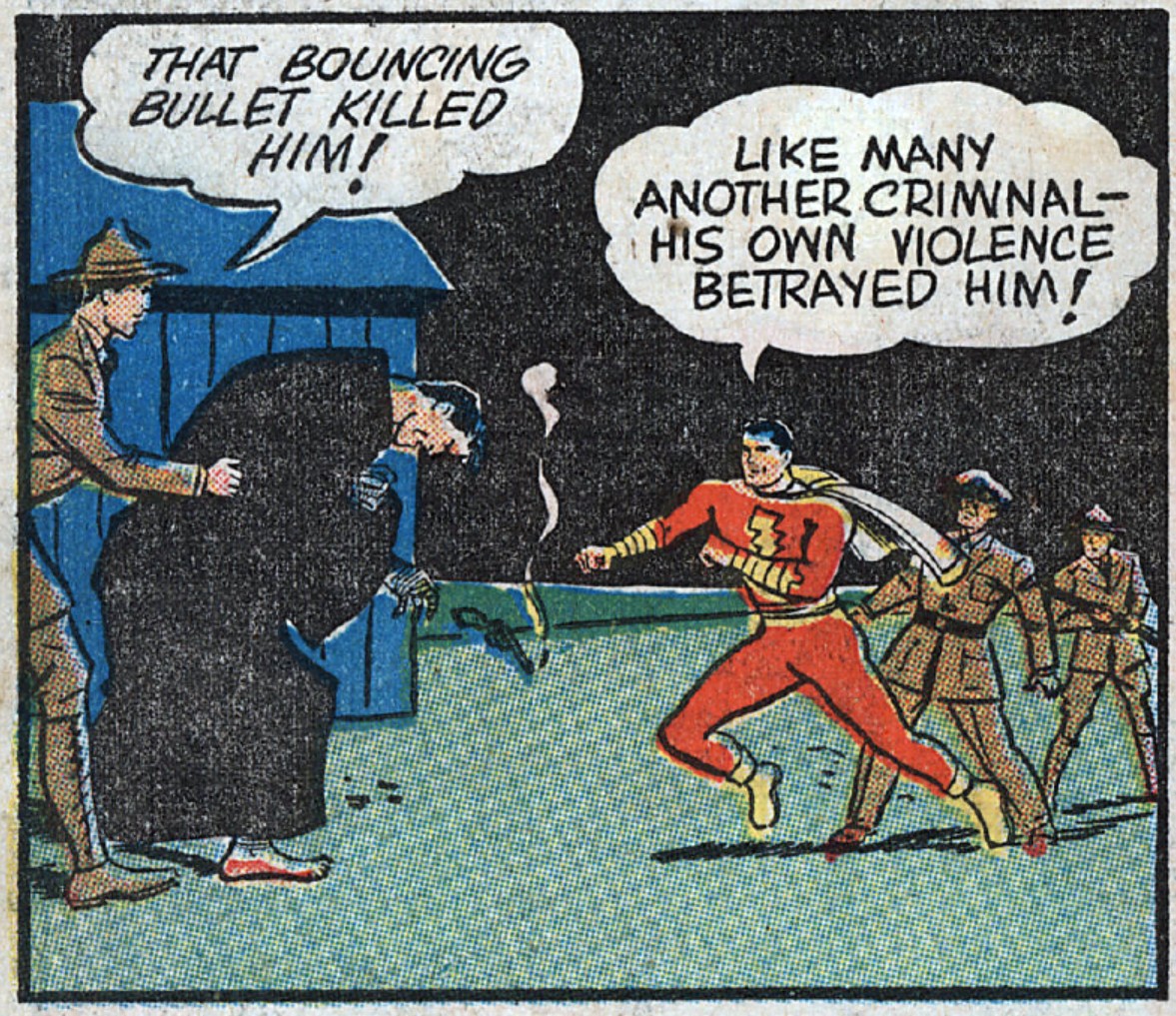
    The captured Spriggins makes one last attempt at striking out at the US by stealing an MP’s gun and taking out a nearby General, only to be intercepted by Captain Marvel and suffer the oft-joked-about but seldom-seen fate of the person who fires a bullet into an invulnerable super-hero’s chest only to have it bounce back and kill them instead. 

  • MINOR SUPER-VILLAIN 881: THE TIGRESS

    (Spy Smasher 002, 1941)

    After the heady times of having an actual Nazi agent in the person of the Red Death last time, we are back in the realms of plausible deniability and no-name fascism in the person of the Tigress.

    Though the Tigress does indulge in some activities relating to her chosen theme, including somewhat gruesomely using her two trained tigers for corpse-disposal duties, her main line is in murdering US officials such as Senator Whitney here and then substituting her own disguised men for them.

    The Tigress’ latest plot involves replacing influential politicians such as  the aforementioned Senator Whitney and his co-Senator Burke here in order to influence the vote on something called the “South American Fortification Bill” and presumably then arrange an invasion of the US from the South. Luckily for Senator Burke, Spy Smasher was on hand for the assassination of Senator Whitney and where he failed to prevent that he is able to keep Burke from dying to an exploding cigar and having “Died due to Prank” engraved on his tombstone.

    Despite being prevented from murdering Senator Burke, the Tigress is still one step ahead of Spy Smasher, having had the foresight to station a couple of fake cops at the hotel where the assassination was to take place. They “take him into custody” right into the Tigress’ clutches, where she reveals that the next stage of her plan is to make up one of her guys into a fake Spy Smasher and use him to kidnap Admiral Corby, who will in turn be impersonated as part of the larger plot.

    Long-time readers may recognize where the Tigress’ plan goes awry: locking the hero in a supposedly inescapable deathtrap – in this case a room containing two tigers – and then failing to confirm that it worked is a sure-fire recipe for an alive hero.

    Having successfully escaped, Spy Smasher shows up in his Gyro-Sub just in time to save Admiral and Eve Corby from being flung to their dooms from a high cliff in what looks like a more public area than I personally would choose to murder someone who I hoped to replace with a double, but then again who am I to argue with the future… Dictatoress of America?

    Everything wraps up fairly quickly after this: the fake Spy Smasher meets the hero imposter’s frequent end as he is shot by mistake in the melee and the Tigress and her remaining men are rounded up (the Tigress’ vest also comes open in the scuffle and I have to assume that someone at Fawcett HQ declared the sight of her bare sternum to be too sexy, because that is clearly a retroactively-applied yellow shirt).

  • MINOR SUPER-VILLAIN 881: THE TIGRESS

    (Spy Smasher 002, 1941)

    After the heady times of having an actual Nazi agent in the person of the Red Death last time, we are back in the realms of plausible deniability and no-name fascism in the person of the Tigress.

    Though the Tigress does indulge in some activities relating to her chosen theme, including somewhat gruesomely using her two trained tigers for corpse-disposal duties, her main line is in murdering US officials such as Senator Whitney here and then substituting her own disguised men for them.

    The Tigress’ latest plot involves replacing influential politicians such as  the aforementioned Senator Whitney and his co-Senator Burke here in order to influence the vote on something called the “South American Fortification Bill” and presumably then arrange an invasion of the US from the South. Luckily for Senator Burke, Spy Smasher was on hand for the assassination of Senator Whitney and where he failed to prevent that he is able to keep Burke from dying to an exploding cigar and having “Died due to Prank” engraved on his tombstone.

    Despite being prevented from murdering Senator Burke, the Tigress is still one step ahead of Spy Smasher, having had the foresight to station a couple of fake cops at the hotel where the assassination was to take place. They “take him into custody” right into the Tigress’ clutches, where she reveals that the next stage of her plan is to make up one of her guys into a fake Spy Smasher and use him to kidnap Admiral Corby, who will in turn be impersonated as part of the larger plot.

    Long-time readers may recognize where the Tigress’ plan goes awry: locking the hero in a supposedly inescapable deathtrap – in this case a room containing two tigers – and then failing to confirm that it worked is a sure-fire recipe for an alive hero.

    Having successfully escaped, Spy Smasher shows up in his Gyro-Sub just in time to save Admiral and Eve Corby from being flung to their dooms from a high cliff in what looks like a more public area than I personally would choose to murder someone who I hoped to replace with a double, but then again who am I to argue with the future… Dictatoress of America?

    Everything wraps up fairly quickly after this: the fake Spy Smasher meets the hero imposter’s frequent end as he is shot by mistake in the melee and the Tigress and her remaining men are rounded up (the Tigress’ vest also comes open in the scuffle and I have to assume that someone at Fawcett HQ declared the sight of her bare sternum to be too sexy, because that is clearly a retroactively-applied yellow shirt).

  • MINOR SUPER-VILLAIN 869: THE BLACK KNIGHT

    (Zip Comics 001, 1940)

    Shortly after giving himself super powers, Steel Sterling gets word of a brutal bank robbery in the town of Beeville and sets out to bring the culprits to justice. Determining that the crooks must have been guided by a mastermind of some sort, he trails their plane to a mountaintop fortress.

    The bow-wielding guards outside the Black Knight’s fortress (spoiler: it’s the Black Knight’s fortress, but what were you expecting) are notable for being the one time that he has anything related to his chosen theme around, and even they are supposedly only there to prevent… mountain cops?… from hearing the sound of gunfire. Inside, it’s plain old gangsters.

    Gangsters armed with ordinary machine guns are of course no match for a man with all the properties of steel, and Steel Sterling quickly makes his way to the Black Knight’s throne room, where he is immediately dropped into a deep pit full of rats.

    I’d just like to take a second here to appreciate the fact that the Black Knight’s costume is a) 100% brown and yellow with no black at all and b) a pretty conventional super-person getup aside from what appears to be a leather jerkin or similar. Historical, yes, but not particularly knightly. 

    A pit full of rats is also not enough to stop Steel Sterling, and he makes his way out, causes the Black Knight himself to fall in, and sets out after the fleeing gangsters just in time to avoid a secondary deathtrap as the fortress explodes behind him. The Black Knight is finished, it seems.

    The Black Knight is not, in fact, finished, and is soon (Zip Comics 002) hard at work robbing gold and fur shipments coming out of Alaska. Though he manages to capture Steel Sterling when he infiltrates the villain’s fake iceberg base he does a bad job of coming up with a suitable deathtrap for the hero and ends up in the hands of the US Navy.

    Steel Sterling’s next case brings him to the South American nation of Brazonia, where a man called Dr Yar has taken the famous scientist Walter Cummings in order to force him to develop weapons of war and help conquer the gold-rich country. 

    Dr Yar is of course eventually revealed to be an alias (or possibly the real identity?) of the Black Knight. Just why he has abandoned his old moniker is unstated but perhaps it is as simple as a desire not to attract the attention of Steel Sterling again. His new look is at least still visually interesting – particularly the periscopiscopes, which are of course goggles which allow 360 degree vision.

    Dr Yar really leans into the scientist aspect of his new identity, and deploys gadgets such as: flying tanks, oil bombs, electric rays and various viewscreens and visualizers.

    Plus: he not only has Alligator Men at his disposal but also a swarm of giant mosquitoes straight out of an ad for a pest control company (being big does not help them bate through steel skin, alas). 

    Once again the Black Knight/Dr Yar apparently meets his end, and this time it’s explicitly at the hands of Steel Sterling, who stuffs him into the barrel of his own super-howitzer before it fires. A truly brutal end, even for a dedicated super-villain. (Zip Comics 003, 1940)

    Steel doesn’t have to live with any guilt he might feel for long, however, as the Black Knight returns in the next issue, this time climbing the rungs of the aristocracy from mere knighthood to become the Radium King. His new plan is simple: steal the entire US radium supply and then ransom it back for 30 million dollars.

    The Radium King has appropriately impressive digs: an underwater base in Lake Superior that would probably be pretty hard to find if one of his minions hadn’t blabbed under threat of a beating from Steel Sterling.

    The Radium King costume turns out to borrow heavily from the original Black Knight getup, although without a lot of the yellow elements. I’d say that it’s better than the Dr Yar outfit but not as composed as the original, and that the half-mask/mustache combo is particularly unpleasant. Speaking of Dr Yar, the Radium King reveals that he survived Steel’s attempted cannon execution by simply crawling back out of the cannon.

    Not to be robbed of a kill, Steel Sterling uses the Radium King’s own submarine to blow him and his base to high heaven. Surely he’s dead this time! (Zip Comics 004, 1940)

    Not quite! The Black Knight’s fifth and final appearance (under the original name, this time) is probably his most ignominious, though it does feature his cool underground city headquarters, seen above. In it, he engages in a campaign of sabotage, kidnapping and extortion against his former kidnap victim/current minor member of Steel Sterling’s supporting cast Walter Cummings, who has gone into the munitions manufacturing game and has gotten the contract to produce the mysterious Zeta Ray for the US government. Somehow, if the Black Knight can delay production of the US Zeta Ray for long enough then his own scientists can produce one for him and that will be good, and if that description seems vague to you then I must assure you that it is 100% accurate to the comic. I don’t even know what the Zeta Ray does, for heaven’s sake.

    Though Cummings’ first factory is destroyed and his second collapses due to some sabotaged cement, Steel Sterling steps in and has almost completed a third when the Black Knight decides to take a personal hand and ram a tanker truck full of TNT into it. Now here’s the embarrassing part: not only does Steel Sterling handily prevent the truck from destroying the factory, but the first time that he is even aware that the Black Knight is involved in the plot against Dr Cummings is when he spots him just one fraction of a second before he is atomized in the explosion. It’s not even as dignified an end as being shot out of your own cannon would have been. (Zip Comics 005, 1940)