The Curse of Skeleton Munroe

Category: conquest

  • MINOR SUPER-VILLAIN 818: THE FACELESS PHANTOM

    (Thrilling Comics 001, 1940) 

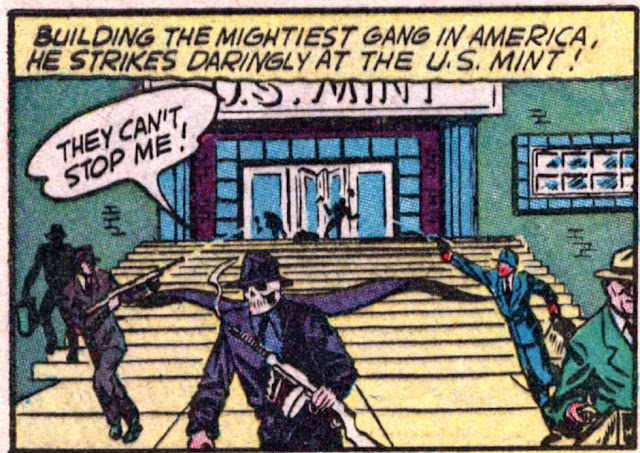
    Here’s a nice picture of the Faceless Phantom from his second appearance, before we delve into the muddy fiche images of his first.

    Scientific hero Doc Strange is just walking down the street one day when he hears a cry for help that leads him to an encounter with his first super-villain (the Faceless Phantom) as well as his long-term love interest (Virginia Thompson). The Faceless Phantom, it turns out, has just kidnapped Virginia’s father Professor Thompson in an attempt to get him to reveal the secret of his Delta Ray gun, which is a good old-fashioned sci-fi death ray.

    What follows is an astonishingly long (for a Golden Age story – 37 pages!) chase sequence, as Doc Strange, Virginia and New York Police Commissioner Baxter pursue the Faceless Phantom and Professor Thompson to the Central American republic of San Pedro and back. Along the way both Virginia and Baxter are captured and rescued and captured again, Doc fist fights multiple animals (a shark, a boa constrictor, crocodiles, a tiger, a pit full of cobras, an octopus and a gorilla), and Doc acquires several temporary companions, including:

    -Togo, hired as a bodyguard for Virginia; ultimately revealed to be an agent of (implicitly) the Chinese government looking to acquire the Delta Ray

    -Parker, a seaplane pilot who shuttles Doc around for the middle part of the story until he is almost killed in a plane crash and left behind in Florida

    -Jerry Adams, a newsie who Doc helps with his mortgage during a brief spell of train crash-induced amnesia

    Things eventually come to a head back in NYC where they started, with the Faceless Phantom armed not only with the Delta Ray but a stolen supply of Alosun, the “distillation of sun-atoms” that gives Doc Strange his super powers. Thus equipped, the Phantom and his men have effectively taken over the city.

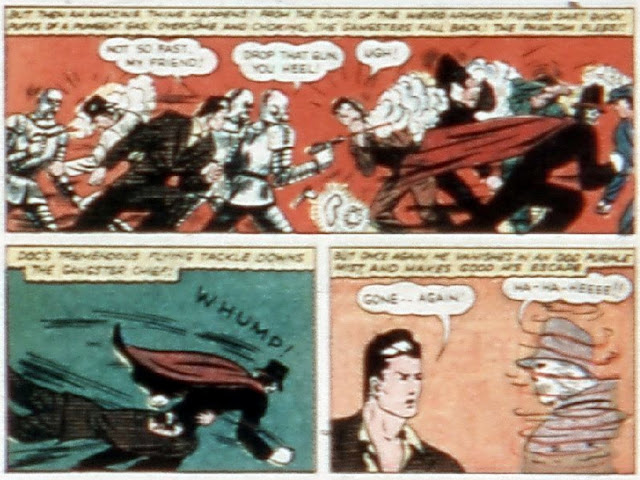
    In order to combat a gang of death ray-wielding gangsters all hopped up on super serum, Doc really hunkers down and gets inventing. He comes up with two key bits of technology: suits of death ray-proof armour for a special detail of police officers to wear and a gas that neutralizes the effects of Alosun (something which one might reasonably expect to crop up to bite him in the ass in the future but not so, as far as I can tell). The subsequent gang round-up is almost 100% effective, with the exception being that the Faceless Phantom pulls his signature trick and disappears in a cloud of purple mist.

    Thanks to his Alosun-enhanced senses, this time when the Faceless Phantom disappears Doc is able to identify that he is doing so using an Ancient Egyptian alchemical preparation called Kalodin, and thanks to his well-stocked library he is then able to find a book that tells him how to counter Kalodin’s effects. Thus, the next time the Phantom tries to do a runner he gets a face full of reagent, followed by a sock to the jaw.

    The Faceless Phantom is unmasked, and surprising no one with any degree of genre savvy he turns out to be Police Commissioner Baxter, the character who tagged along with Doc throughout the adventure and mostly got kidnapped over and over again while the Phantom somehow learned all of Doc’s secrets. But he’s been caught and the long nightmare is finally over.

    OR IS IT? No, it isn’t, because Baxter still had some Alosun hidden away for a rainy day and he gets ahold of it just in time to ruin is own execution, thanks to a crooked prison guard. Side note: Baxter’s tattered clothing in the above panels is not as a result of his escape attempt – he was dressed in them already when he was led in. Was this some sort of attempt to save money on prison uniforms by giving condemned men the worst one or something?

    Baxter resumes his life as the Faceless Phantom, pledging to make the whole country pay. Thanks to his Kalodin-derived invisibility and his residual Alosun strength he is able to form a gang and start up a crime spree with great alacrity.

    As is often the case, a successful crimewave becomes a systematic campaign of terror and looting becomes a plan to take over the US by kidnapping the entire Senate. This is the point at which Doc Strange catches up with the Phantom – that’s him in the lower right in gangster cosplay – and strikes back by packing the Senate galleries with gun-toting lawmen who engage the Faceless Phantom gang in what I would call an irresponsibly large gun battle. No senator catches a stray bullet on panel though, so I guess you could call the operation a success.

    Things come to a head on the wing of a plane in which the Faceless Phantom is escaping with a re-re-re-kidnapped Virginia. Though both hero and villain are juiced up on Alosun, Doc wins out in the end and punches the Phantom clean off of the plane, at which point he dusts off his hands and declares that the Faceless Phantom is finally dead, despite the fact that his own Alosun-powered body has survived similar falls on many occasions. Will this come back to bite Doc Strange in the ass? Only in that he will be more surprised than he should be when the Phantom returns in 1942. 

  • MINOR SUPER-VILLAIN 789: THE GRAND DICTATOR

    (Sure-Fire Comics 003a, 1940)

    The Grand Dictator, aka Miko, is on a mission to conquer the US, and he’s doing it from a cool flying fortress. Miko and his men are probably intended to be at least Nazi-adjacent, but they don’t really come off that way, at least as compared with their contemporaries. I mean, sure, they’ve got the uniforms and the attitude, but where are the dimwitted goons named Hans and Franz shouting “Jah, jah!” as they scuttle off to commit civilian atrocities?
    The Grand Dictator’s forces really stand out in the coolness of their military tech, including these very imposing flame guns…

    The aforementioned flying fortress (including the terrific detail that the GD’s forces have solved the problem of how to make something huge in the sky look like a cloud by stapling cotton batting to the bottom like it’s a prop in an elementary school play)…

    And in a bit of a combination of the first two, some fairly impractical-looking flame throwing planes.

    We’re still quite early in the career of Flash Lightning, and so he’s still kind of finding his level with regards to the relative power of he and his opponents. Case in point: the main challenge that Lightning faces in this issue is in getting his companion on the lower right to safety, after which he destroys the Grand Dictator’s entire operation with one big lightning bolt.

  • MINOR SUPER-VILLAIN 783: PHATSO

    (Superworld Comics 003, 1940)

    Buzz “the Invisible Avenger” Allen and Will “also invisible but has no special name” Lawrence are taking an Alaskan vacation with some of the reward money they have earned via vigilantism (and it’s nice to see a variation on super-hero morality now and then – someone has to be accepting awards when offered, surely) when they, hard-core radio amateurs that they are, pick up a panicked broadcast from nearby. Making their way to the location, they find the man who sent the distress call dead and surrounded by weird ribbons of light.

    Finding that the light ribbons are solid, Buzz and Will make the amazing and completely understandable decision to grab onto them as they fly off, and end up being whisked even further North to a hidden city in the ancient Greek style.

    The lads attempt to bluff the city’s ruler, Phatso, with a bit of the old “cower before us for we are wizards” gag, but it turns out that this isn’t a primitive hidden city but a technologically advanced one, and a little bit of invisibility tech isn’t going to get so much as a shiver out of them. They also learn that Phatso is using the light ribbons to kill people and siphon the information from their minds in preparation for a full-scale Atlantean (did I mention that the city represents the remnants of sunken Atlantis?) invasion of the United States. The boys are unceremoniously paralysis-rayed and tossed in the clink.

    I really like Phatso’s villain patter, by the by. “I am Phatso, great, clever ruler of Atlantis. I can speak in any tongue and I am 212 years old!” is a terrific introduction. I just with his name wasn’t an as-far-as-I-can-tell purposeless pun, because it is annoying.

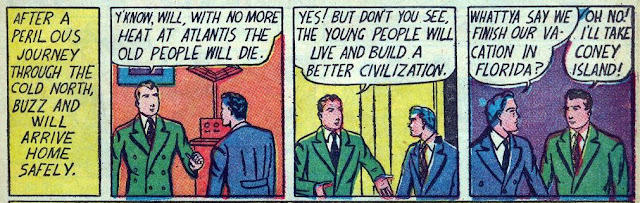
    Buzz and Will escape of course, and immediately blow up the machines that make Arctic Atlantis habitable by humans, with the wild justification that only the old people will die off and thus Atlantean civilization will be improved. Is this the morality of a hero who takes the reward cheques? Is this what I was asking for!!??

    (this is also part of a bit of a recurring theme in stories from Superworld Comics of “inflicting mass casualties” as a standard part of the heroic arsenal – the other examples are all from human vs alien stories that fall a bit outside of my self-imposed purview and so won’t be showing up here, but I assure you that it is there and it leaves a bit of a bad taste in your mouth once you recognize it)

  • FASCIST GOON CLEARING HOUSE 009

    Buncha Smash Comics fascists I lost behind the couch for a while.

    Just why this German-American Bund equivalent is called the Groups is a real mystery for the ages – it’s possible that these people are protesting, like, all bundist-style organizations at once and calling them “the Groups” collectively, though why they would do so at one specific group’s meeting is beyond me. Whatever the truth of their name, the leadership of the Groups meet their ends after an attempt to steal American defense plans is foiled by Wings Wendall. (Smash Comics 007, 1940)

    The Batzi Tribe is really just a stand-in for the Nazi party and Hugh Hazzard and his pal Bozo the Iron Man only have to contend with the espionage wing of the group, but it’s such a weird wild name that I feel compelled to highlight it here along with the information that their New York headquarters was located in a neighbourhood known as Krautville. (Smash Comics 008, 1940)

    The Metallic Army is a very cool-looking bunch who invade the US out of nowhere from the Southwest one day. Almost nothing of their origin or motivation is revealed in favour of hard-core battle action, but based on the names of its officers (Hardt, Zergoff) the Army is a communo-fascist Central-to-Eastern European pastiche.

    Wherever the Metallic Army came from I can tell you one thing: those uniforms are not metallic because of any kind of armour or even bullet-resistant cloth – once Wings Wendall gets going he mows them down like grass. (Smash Comics 012, 1940)

    The Black Troops are yet another bundist group faced by Wings Wendall, albeit an unusually successful one – they manage to capture a number of large East Coast cities and are beginning to ship American weapons and supplies to their unspecified Axis home country when Wendall manages to bring down the whole operation by throwing its leader out of a plane. (Smash Comics 016, 1940)

  • FASCIST GOON CLEARING HOUSE 009

    Buncha Smash Comics fascists I lost behind the couch for a while.

    Just why this German-American Bund equivalent is called the Groups is a real mystery for the ages – it’s possible that these people are protesting, like, all bundist-style organizations at once and calling them “the Groups” collectively, though why they would do so at one specific group’s meeting is beyond me. Whatever the truth of their name, the leadership of the Groups meet their ends after an attempt to steal American defense plans is foiled by Wings Wendall. (Smash Comics 007, 1940)

    The Batzi Tribe is really just a stand-in for the Nazi party and Hugh Hazzard and his pal Bozo the Iron Man only have to contend with the espionage wing of the group, but it’s such a weird wild name that I feel compelled to highlight it here along with the information that their New York headquarters was located in a neighbourhood known as Krautville. (Smash Comics 008, 1940)

    The Metallic Army is a very cool-looking bunch who invade the US out of nowhere from the Southwest one day. Almost nothing of their origin or motivation is revealed in favour of hard-core battle action, but based on the names of its officers (Hardt, Zergoff) the Army is a communo-fascist Central-to-Eastern European pastiche.

    Wherever the Metallic Army came from I can tell you one thing: those uniforms are not metallic because of any kind of armour or even bullet-resistant cloth – once Wings Wendall gets going he mows them down like grass. (Smash Comics 012, 1940)

    The Black Troops are yet another bundist group faced by Wings Wendall, albeit an unusually successful one – they manage to capture a number of large East Coast cities and are beginning to ship American weapons and supplies to their unspecified Axis home country when Wendall manages to bring down the whole operation by throwing its leader out of a plane. (Smash Comics 016, 1940)

  • MINOR SUPER-VILLAIN 548 UPDATE: MADAME DOOM (1940)

    When we last saw Madame Doom, she had been bested at the game of espionage by the Black X and was fleeing the US for friendlier shores at the end of Smash Comics 004.

    Madame Doom returns with a fresh new attitude for 1940 in Smash Comics 008, as now she is not just working for an analog of the Axis powers but explicitly for the Nazis. It’s a lateral move at best but an important one nonetheless. She only actually appears for a page or so and acts as an obstacle to Black X’s escape from Germany rather than a full-fledged villain, and is then left in his dust as he takes off into France.

    In Smash Comics 012, Black X accompanies US Ambassador Blank to Paris as part of an attempt to initiate peace talks in Europe. Madame Doom is there too, attempting to disrupt the process by manipulating the Hunchback of Notre Dame into assassinating Blank. It’s not explicit that she is still working for the Nazis on this, but c’mon. 

    This issue also marks the zenith of Madame Doom’s investment in the will they/won’t they relationship with Black X, but her plea to him to run away with her is an interrupted first by the Hunchback and then by the French authorities and so it is not to be.

    Madame Doom returns in Smash Comics 014 with some snappy new henchmen, the Legion of Living Bombs, who have: a. very cool costumes (that they don’t actually wear while they’re outside of the house), b. a very cool name (as long as you don’t think too hard about it in any context other than aesthetic).

    More importantly, this story features the zenith of Black X’s investment in the relationship between himself and Madame Doom, to the extent that he resigns from the Espionage for her.

    This proves to be what’s known as a Bad Decision, as Black X soon learns that while Madame Doom is not working for the Nazis this time around (that’s good), that is because she has teamed up with a fellow named Count Mirov in a bid to conquer South America (that’s bad), and that to that end she is dosing her fanatical minions with a fluid that eventually causes them to explode and sending them out to disrupt the Pan-American diplomatic talks (that’s even worse). If there’s a positive to this dastardly plot, it’s that it seems to kill the romantic tension between the two once and for all.

    (Madame Doom’s height, hair colour and general appearance are fairly mutable during these appearances, as is not unusual for reoccurring female villains. I mention that here because in order to say that her height had fluctuated I felt compelled to comb through this issue like a foot pervert to see if she was wearing anachronistic 90s stiletto heels, but as you can see above she is not)

    After some hijinks involving Black X’s aide Batu stealing back his letter of resignation so that his boss can get back on the case, Black X returns to Madame Doom’s underground HQ and proceeds to beat ass, and the ease with which he does so to an entire roomful of guys might just be another indictment of selecting your minions for their willingness to die over any other useful quality.

    Defeated, Madame Doom decides to take what I would call “the cool way out” and guzzles some of her own explosive brew rather than be captured. It’s a heck of a way to leave a final impression.

    SPOILER: Madame Doom will return!

  • MINOR SUPER-VILLAIN 548 UPDATE: MADAME DOOM (1940)

    When we last saw Madame Doom, she had been bested at the game of espionage by the Black X and was fleeing the US for friendlier shores at the end of Smash Comics 004.

    Madame Doom returns with a fresh new attitude for 1940 in Smash Comics 008, as now she is not just working for an analog of the Axis powers but explicitly for the Nazis. It’s a lateral move at best but an important one nonetheless. She only actually appears for a page or so and acts as an obstacle to Black X’s escape from Germany rather than a full-fledged villain, and is then left in his dust as he takes off into France.

    In Smash Comics 012, Black X accompanies US Ambassador Blank to Paris as part of an attempt to initiate peace talks in Europe. Madame Doom is there too, attempting to disrupt the process by manipulating the Hunchback of Notre Dame into assassinating Blank. It’s not explicit that she is still working for the Nazis on this, but c’mon. 

    This issue also marks the zenith of Madame Doom’s investment in the will they/won’t they relationship with Black X, but her plea to him to run away with her is an interrupted first by the Hunchback and then by the French authorities and so it is not to be.

    Madame Doom returns in Smash Comics 014 with some snappy new henchmen, the Legion of Living Bombs, who have: a. very cool costumes (that they don’t actually wear while they’re outside of the house), b. a very cool name (as long as you don’t think too hard about it in any context other than aesthetic).

    More importantly, this story features the zenith of Black X’s investment in the relationship between himself and Madame Doom, to the extent that he resigns from the Espionage for her.

    This proves to be what’s known as a Bad Decision, as Black X soon learns that while Madame Doom is not working for the Nazis this time around (that’s good), that is because she has teamed up with a fellow named Count Mirov in a bid to conquer South America (that’s bad), and that to that end she is dosing her fanatical minions with a fluid that eventually causes them to explode and sending them out to disrupt the Pan-American diplomatic talks (that’s even worse). If there’s a positive to this dastardly plot, it’s that it seems to kill the romantic tension between the two once and for all.

    (Madame Doom’s height, hair colour and general appearance are fairly mutable during these appearances, as is not unusual for reoccurring female villains. I mention that here because in order to say that her height had fluctuated I felt compelled to comb through this issue like a foot pervert to see if she was wearing anachronistic 90s stiletto heels, but as you can see above she is not)

    After some hijinks involving Black X’s aide Batu stealing back his letter of resignation so that his boss can get back on the case, Black X returns to Madame Doom’s underground HQ and proceeds to beat ass, and the ease with which he does so to an entire roomful of guys might just be another indictment of selecting your minions for their willingness to die over any other useful quality.

    Defeated, Madame Doom decides to take what I would call “the cool way out” and guzzles some of her own explosive brew rather than be captured. It’s a heck of a way to leave a final impression.

    SPOILER: Madame Doom will return!

  • MINOR SUPER-VILLAIN 743: THE VOODOO MASTER

    MINOR SUPER-VILLAIN 743: THE VOODOO MASTER

    (Smash Comics 008, 1940)

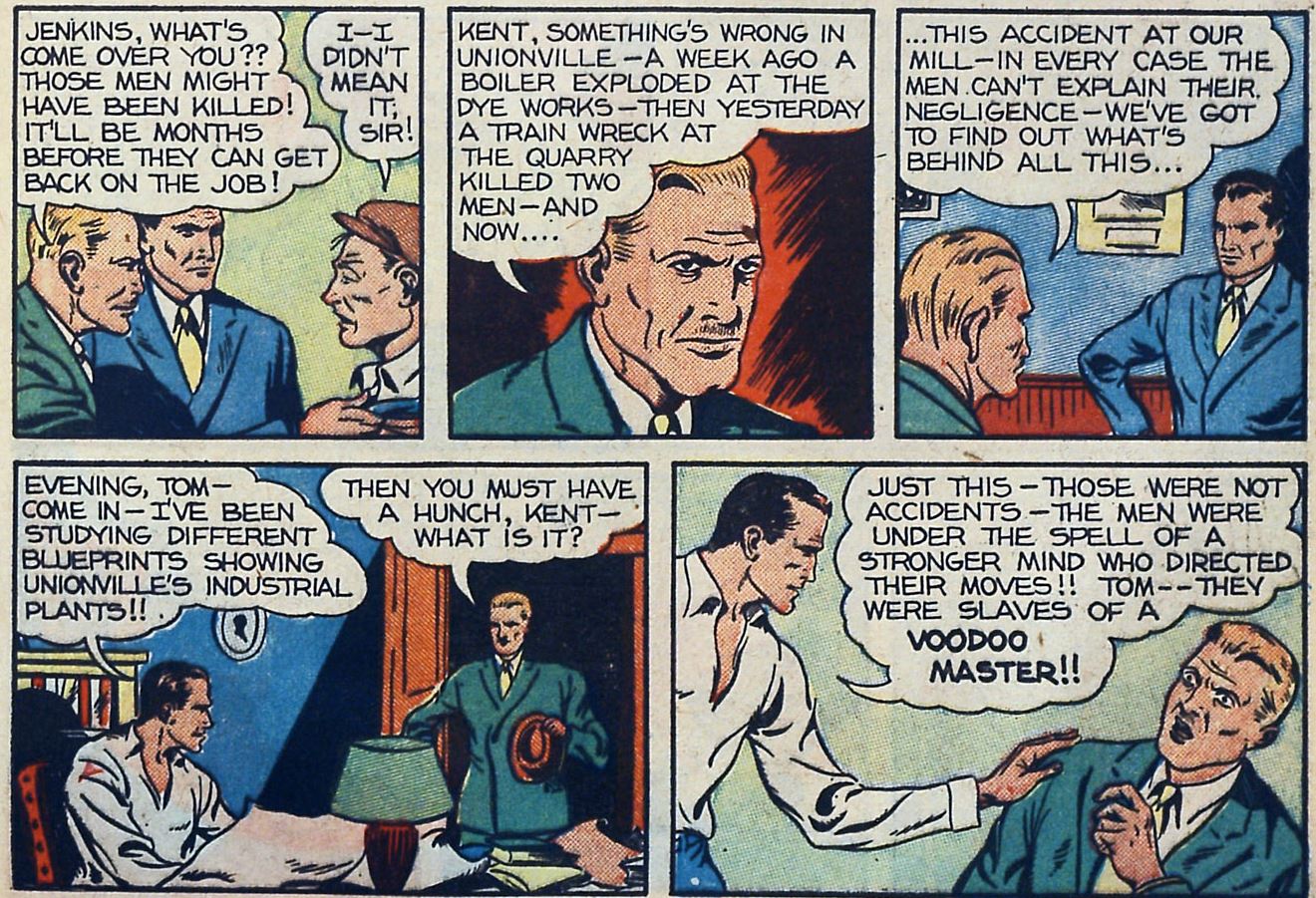
    Times are tough in Unionville: the local factories are all suffering accidents which appear to be due to systemic worker negligence but which add up to a campaign of sabotage, and since it’s a factory town, if things continue as they are then everyone is completely screwed.

    Luckily for the good folk of Unionville, the steel mill that the latest incident occurred at is managed by a guy named Tom, and Tom is friends with a fellow named Kent Thurston, and Kent Thurston is also known as the Invisible Hood, who immediately works out that the obvious culprit must be… a voodoo master!

    The Invisible Hood’s theories are vindicated when the next incident of sabotage triggers an explosion that knocks loose a couple of memories in the unwitting steelworker who set it in motion. Turns out that the mysterious villain is hiding out in the nearby abandoned castle, which is a new one on me.

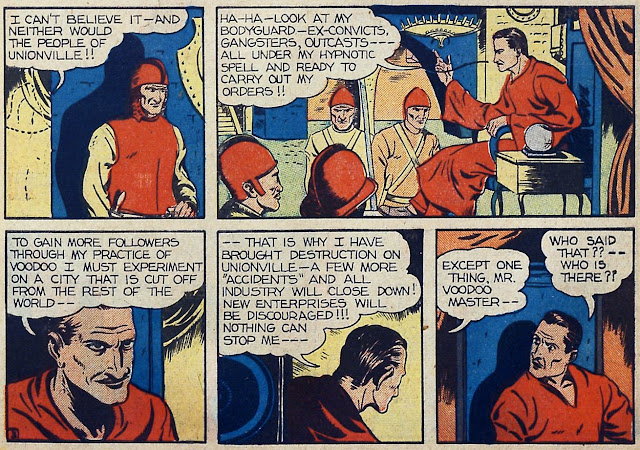
    Inside, the Hood does indeed discover the Voodoo Master (and whether this is a name he had for himself is rendered irrelevant by the fact that he accepts it as his when it is used by others – a real relief after a month or so heavy in unofficial names). The Voodoo Master has surrounded himself with crooks in faux-Medieval garb, and the goofiness of this aesthetic almost overshadows just how sinister and creepy the man’s actual scheme is: he plans to ruin Unionville financially and so isolate it from the rest of the country so that he can use its population as fodder to test out the extent of his powers. That’s some twisted 90s psychothriller shit, the sort of thing that can get very dark, very quickly.

    Invisible Hood stories aren’t very long, so there are only two further points of interest vis-a-vis the Voodoo Master. The first is that he does seem to have some credible magical acumen, as he whips up a quick anti-invisibility spell once he becomes aware of the Hood’s presence in his lair. This is honestly a lot more flexible than non-heroic comic book magic users usually are – the Voodoo Master seems to be the rare one not working off of AD&D Magic User rules.

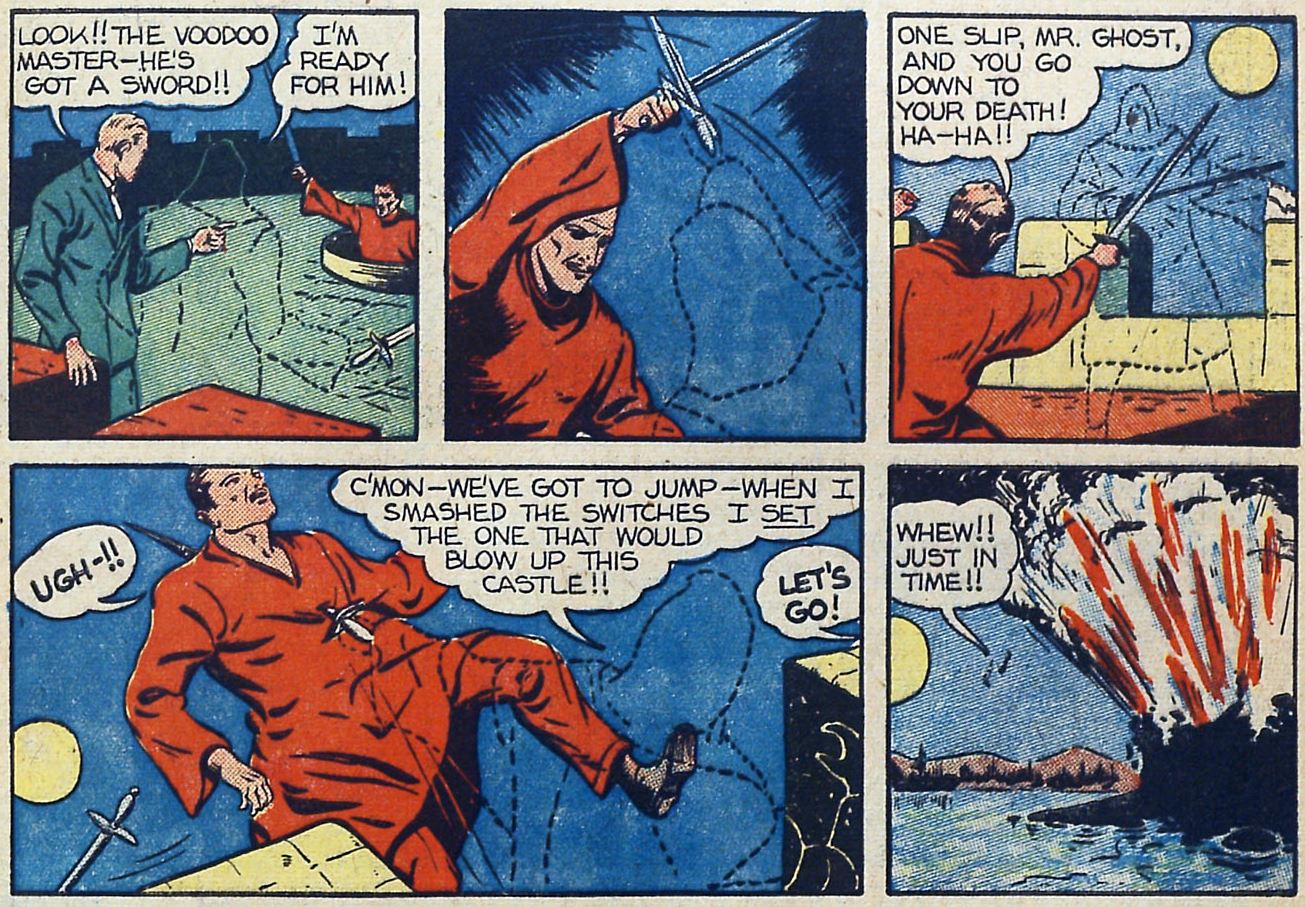
    There’s such a thing as getting too confident, however, as the Voodoo Master proves when, brimming over with hubris, he challenges an invisible man to a sword fight on his castle parapet. This ends predictably, and Unionville is saved!

  • MINOR SUPER-VILLAIN 743: THE VOODOO MASTER

    MINOR SUPER-VILLAIN 743: THE VOODOO MASTER

    (Smash Comics 008, 1940)

    Times are tough in Unionville: the local factories are all suffering accidents which appear to be due to systemic worker negligence but which add up to a campaign of sabotage, and since it’s a factory town, if things continue as they are then everyone is completely screwed.

    Luckily for the good folk of Unionville, the steel mill that the latest incident occurred at is managed by a guy named Tom, and Tom is friends with a fellow named Kent Thurston, and Kent Thurston is also known as the Invisible Hood, who immediately works out that the obvious culprit must be… a voodoo master!

    The Invisible Hood’s theories are vindicated when the next incident of sabotage triggers an explosion that knocks loose a couple of memories in the unwitting steelworker who set it in motion. Turns out that the mysterious villain is hiding out in the nearby abandoned castle, which is a new one on me.

    Inside, the Hood does indeed discover the Voodoo Master (and whether this is a name he had for himself is rendered irrelevant by the fact that he accepts it as his when it is used by others – a real relief after a month or so heavy in unofficial names). The Voodoo Master has surrounded himself with crooks in faux-Medieval garb, and the goofiness of this aesthetic almost overshadows just how sinister and creepy the man’s actual scheme is: he plans to ruin Unionville financially and so isolate it from the rest of the country so that he can use its population as fodder to test out the extent of his powers. That’s some twisted 90s psychothriller shit, the sort of thing that can get very dark, very quickly.

    Invisible Hood stories aren’t very long, so there are only two further points of interest vis-a-vis the Voodoo Master. The first is that he does seem to have some credible magical acumen, as he whips up a quick anti-invisibility spell once he becomes aware of the Hood’s presence in his lair. This is honestly a lot more flexible than non-heroic comic book magic users usually are – the Voodoo Master seems to be the rare one not working off of AD&D Magic User rules.

    There’s such a thing as getting too confident, however, as the Voodoo Master proves when, brimming over with hubris, he challenges an invisible man to a sword fight on his castle parapet. This ends predictably, and Unionville is saved!

  • MINOR SUPER-VILLAIN 728: THE GREAT BRAIN

    (Science Comics 007, 1940)

    Perisphere Payne, futureman of the year 2000, has his work cut out for him when six Earth battle rockets go missing and then subsequently attack their home planet! And upon defeating their seemingly traitorous crews, Payne discovers that they are being remotely mind controlled via a chunky black box stuck to each of their backs in a place that looks like it would be pretty annoying to live with. Good thing they’re mind controlled and presumably not capable of being annoyed, I guess.

    Following the mind control carrier wave to an unnamed planet, Perisphere Payne and his associate Doyle (and here I was going to make a joke about Doyle also being named after a defunct bit of architecture but in trying to find one starting with D I discovered that it’s surprisingly hard to do that. Therefore, we’re gonna call him Trylon Doyle and be done with this whole tangent) are attacked by what are clearly centaurs but are consistently called satyrs, which is about as annoying as being unable to find a list of defunct symbolic architecture.

    Payne and Doyle are eventually captured by the centaurs satyrs centaurs and ushered into the presence of the Great Master, aka the Great Brain, a human brain in a glass ball who wants to conquer the human race for unclear reasons.

    Luckily for Payne, Doyle, humanity and basically everyone except for centaurs and centaur-lovers, though the Great Brain was savvy enough to make their dome ray gun proof, they forgot about the ballistic properties of the humble Oscar statuette. Once released, the Brain’s energies start a chain reaction that destroys the whole planet, centaurs and all.