The Curse of Skeleton Munroe

Category: conquest

  • MINOR SUPER-VILLAIN 648: GARR STORM

    (Fight Comics 008, 1940)

    The geopolitics of the future as represented in Spy Fighter stories sure is complicated! At first, the far future world of 1997 contained only three megacountries: Mongo, Russmany and Greater America, but soon enough Greater America was menaced by aggressor nations such as Grotonia, Prussany and Antarctica. Simultaneously, the timeline advanced from 1998 to a more ambiguous “early in the Twenty-First Century.” Is the unspoken background story the fracturing of these enormous countries back into something resembling the world today? If it is, then this adventure certainly ties into that as it is concerned with the succession of the Southwest US from the rest of what looks suspiciously like the United States. Whither Greater America? Has it too become fragmented?

    The leader of what is only ever referred to as “the States” is the fantastically-named Garr Storm, who either has a tremendous gift for persuasion or is tapping into a legitimate rift between the States and the federal government. Don’t start your succession with a war, you guys! It’s a bad idea.

    But Garr Storm doesn’t stop there! He’s not just a traitor but a double traitor, as his interests lie not with the people of (scrolls back up to squint at map) California, Arizona, Nevada, Utah and New Mexico but with an unnamed Asian power, possibly Mongo. Was this whole civil war solely for Garr Storm’s benefit or was he forced to broker the deal to secure the arms he needed to take on the US Army?

    Regardless of his motivations, the revelation that Storm had sold them out is surprisingly effective in cooling the revolutionary spirit of the Southwest and the nation is once again united in harmonious patriotism. What a fantastical future world!

  • MINOR SUPER-VILLAIN 648: GARR STORM

    (Fight Comics 008, 1940)

    The geopolitics of the future as represented in Spy Fighter stories sure is complicated! At first, the far future world of 1997 contained only three megacountries: Mongo, Russmany and Greater America, but soon enough Greater America was menaced by aggressor nations such as Grotonia, Prussany and Antarctica. Simultaneously, the timeline advanced from 1998 to a more ambiguous “early in the Twenty-First Century.” Is the unspoken background story the fracturing of these enormous countries back into something resembling the world today? If it is, then this adventure certainly ties into that as it is concerned with the succession of the Southwest US from the rest of what looks suspiciously like the United States. Whither Greater America? Has it too become fragmented?

    The leader of what is only ever referred to as “the States” is the fantastically-named Garr Storm, who either has a tremendous gift for persuasion or is tapping into a legitimate rift between the States and the federal government. Don’t start your succession with a war, you guys! It’s a bad idea.

    But Garr Storm doesn’t stop there! He’s not just a traitor but a double traitor, as his interests lie not with the people of (scrolls back up to squint at map) California, Arizona, Nevada, Utah and New Mexico but with an unnamed Asian power, possibly Mongo. Was this whole civil war solely for Garr Storm’s benefit or was he forced to broker the deal to secure the arms he needed to take on the US Army?

    Regardless of his motivations, the revelation that Storm had sold them out is surprisingly effective in cooling the revolutionary spirit of the Southwest and the nation is once again united in harmonious patriotism. What a fantastical future world!

  • MINOR SUPER-VILLAIN 631: DABLO, LAST OF THE RAY MEN AND THE HOOD

    (Fantastic Comics 011, 1940)

    THIS. IS. GREAT. We open on the trial of Dablo, Last of the Ray Men, and immediately we must ask: who are the Ray Men? And let me tell you that there is no answer beyond “guys who could shoot rays.” Dablo here shoots rays out of a big hole in his forehead but did they all do that? No clue! This is the kind of worldbuilding that people like Alan Moore will eventually get up to in the 80s – implying that there are weird and wonderful things all around by reference and allusion. It’s really neat!

    Whatever the Ray Men were, there are only one of them left and he, Dablo has just been sentenced to death by Judge Ord.

    On the eve of Dablo’s execution (via guillotine, by the way. Nobody’s thought up a cool futuristic execution method by the Year 10 000. Also there is capital punishment in the Year 10 000) a mysterious figure who we will later learn is called the Hood appears and restores the Last Ray Man’s ray powers, to the delight of all.

    The Hood is pretty generic, but he meets the criteria for a minor super-villain. Obviously he must take a back seat to the Last of the Ray Men.

    Come the morning of the execution and we finally get to see this famous ray that everyone’s been talking about. It does not disappoint! Dablo blasts fools left and right before making off with Judge Ord!

    This is a Sub Saunders story so of course Dablo has an undersea lair. Just who was this red-haired unfortunate? No idea, but I have a hunch that they met their end at the wrong end of a ray.

    The back half of the story is unfortunately much more concerned with the Hood (who turns out to be Judge Ord, crooked and looking to take control of the unnamed future city the trial of Dablo took place in. Will future society reexamine their relationship to capital punishment once the corruption present at the very highest echelons of their legal system comes to light? Probably not), who does a header off of a cliff after revealing his plans to Sub Saunders. The far more dynamic and interesting Dablo survives, presumably to be re-sentenced to death by another judge. There ain’t no justice.

  • MINOR SUPER-VILLAIN 624: MOLOKA

    (Fantastic Comics 009, 1940)

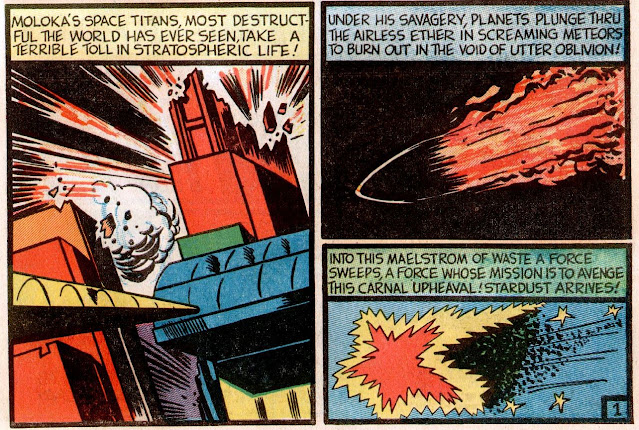
    Moloka is our second Stardust the Super Wizard foe from a story not penned by Fletcher Hanks and I’d say that our unknown scribe gets things mostly right: there’s certainly enough wanton destruction for this to be a Hanks comic. Moloka is a humanoid alien who has developed world-wrecking super weapons and as the comic opens is using them to blast away at various inhabited planets.

    Where exactly this is happening is a little unclear. If Fletcher Hanks’ idea of how outer space is structured is a little fuzzy then his stand-in is even more vague on the particulars. It’s equally possible that Moloka is based in another star system and using weapons with an interstellar range as it is that he’s in our own Solar System and there are just a heap of extra planets to blow up.

    Moloka’s goal is also a bit unclear. I think that he’s looking to become some sort of Galactic or Solar Dictator but he spends an awful lot of time just blasting away at inhabited planets without really asking to be put in charge. It’s possible that the power is an excuse and the blasting is the point.

    Moloka is based on Pluton, which is either an alternate spelling of Pluto (that I have seen before to be honest) or as mentioned above a completely extrasolar one. There’s no way of working out which it is though I will say that none of Pluto’s satellites were discovered before 1978 so I have no idea where Nemus is supposed to be.

    Moloka does give some hints as to his mental state when he mistakes a vengeful Stardust for some sort of elemental being created by the hellish energies at his command. It’s kind of charming! It’s also wildly out of character for Stardust “the shortest distance between two lines is a punch” the Super Wizard. Stardust’s goal with this little ruse is to goad Moloka into firing his weapon at Earth, then using his own patented ray-reversal technology to redirect it back to its source.

    As to whyhe bothers to do this when he’s perfectly capable of blowing the whole of Pluton to hell and gone? I guess it’s a bit more of an ironic punishment to leave a warmonger stranded on a planet that they themself have devastated? Sure, we’ll go with that.

  • MINOR SUPER-VILLAIN 620: PRINCE FERNANDO DIABLO

    (Fantastic Comics 008, 1940)

    Prince Fernando Diablo, scion of an unnamed European royal family (though given his name, style of dress and headquarters in the Pyrenees I think it’s safe to say that he’s heavily implied to be Spanish), has a plan: take advantage of the wars raging in 1940 to violently reinstate monarchy across the continent! Specifically, he and his scientists have developed a horrible plague that they plan on releasing throughout Europe to reduce the population to manageable Feudal levels. He’s a real stinker, Prince Fernando Diablo.

    The thing about this plan is that it’s predicated on the idea that people could get too tired of war to keep going after only a couple of years. It’s weirdly optimistic for a story that also includes wholesale germ warfare on the streets of Paris. Also, this is a wild start to your return to monarchical rule: “yes, we killed most of you with disease-spewing tanks, now acknowledge our god-given right to lord over the remaining population.” 

    I do always love to see a drill-tank.

    Luckily for the remaining people of Paris, Samson’s pal Professor Brun is a true comic book polymath as capable of whipping up a cure for a new super-disease as he is at designing a teleportation machine. Pretty soon they’re being sprayed with a good gas to counteract the bad plague gas. Parisians are going to have a very complicated relationship with mists and fogs going forward, I reckon.

    There are quite a lot of hoops to jump through, minions to smash and war machines to destroy but Samson eventually makes his way to Diablo’s mountain fastness to beat him up and chuck him off a cliff. No monarchist, he!

  • MINOR SUPER-VILLAIN 602: THE TALKING APE

    (Fantastic Comics 004, 1940)

    Pilot/ adventurer/ confusing-name-haver Captain Kidd has heard some disturbing rumours about a cult of beast-men planning an attempt to take over the Sahara region and so he sets out to investigate. After bribing a local man to show him the way (and then carelessly letting the local man get captured by the cult), Kidd finds a weird bunch of things all at once:

    -the cult is indeed made up of beast-men, hoofed humanoids with pig or wolf features who take their orders from:

    -the Talking Ape, a talking ape who derives its authority from:

    -the Ibkar Oracles, a quartet of young women who sit around huffing volcanic gasses and making prophecies all day, Oracle of Delphi-style.

    It’s an impressive setup for a local tyrant who wants to extort some nearby communities but hardly a threat to the larger North African populace – Captain Kidd runs off the entire beast-man force with a single strafing run in his plane!

    If the beast-men are a bit of a bust, that doesn’t change the fact that there is an ape and it is talking and about to murder the guide that Captain Kidd failed so thoroughly without even learning his name. Clearly it’s ape-fighting time.

    A short tussle reveals the shocking truth: the Talking Ape is in actuality a young woman! A young woman with extremely elastic limbs, seemingly, or possibly an extremely advanced ape suit with both robotic arm extensions and some sort of tesseract technology to fit those super-long lady legs into about half the space they require.

    Unfortunately for us, the unveiled Ape flings herself into a pool of lava rather than be captured, so we will never really have an inkling as to her motivations beyond Captain Kidd’s half-baked musings about her “conceiv[ing] the gorilla as a symbol of strength,” whatever that means. Stay in your lane, Captain Kidd: punching things.

  • MINOR SUPER-VILLAIN 591: THE CULT OF DEATH

    (Exciting Comics 006, 1940)

    The Cult of Death comes into conflict with adventurer Ted Crane and his pals as they look for their associate, Egyptologist Dr Turner, in Luxor. Despite its very evocative name, the Cult of Death seems to sort of broadly worship the concept of Ancient Egypt and resent those who would pry into its secrets – Dr Turner has in fact been killed by them for seeking the lost tomb of King Mephtet.

    Does the cult’s leader Phator shares his followers’ beliefs? It’s up for debate, but whether it is for the glory of the Cult of Death or that of himself he seeks to drive the colonial forces out of Egypt and assume control.

    For unclear reasons the keystone of Phator’s plane is the destruction of the Aswan Dam (or “Assuan Dam” as it is called here), which, granted, would flood part of Egypt. How exactly that would lead to the Cult of Death’s ascension to power is never spelled out.

    It’s a moot point anyway, as Phator has sent his two most clownish dunces to place the bomb on the dam and they end up not only blowing themselves up but only flooding the region that the Temple of Death is located in. The entire Cult is wiped out save fore Phator himself, who must face colonial justice on his own.

  • MINOR SUPER-VILLAIN 586: THE RED BLIGHT

    (Exciting Comics 003, 1940)

    Technically, the Red Blight is a ray weapon developed by mad scientist Dr Hodl on behalf of ideologically nonspecific aggressor General Pasko in order to facilitate the conquest of Europe, but just like when a guy with a regular name is tooling around in a vehicle with a cool codename I reckon that the good name should take precedence, particularly as 1) Dr Hodl never returns and 2) people make reference to the Red Blight as an entity more than once during the course of the story.

    Besides, the Red Blight is a super-weapon worth being named after: a ray that rapidly corrodes inorganic matter with a range of at least 2000 kilometres (Hodl’s Transylvanian castle to the North Sea) – why sleep on that, Hodl? Be the Red Blight!

    Dr Hodl spends most of his time attempting to eliminate John “Son of the Gods” Thesson, who he correctly views as his only real opposition. Why, before Thesson shows up, none of the authorities concerned with the Red Blight’s attacks even thought about discovering his location by triangulation. Clearly this is a case where the villain is right: the hero is the only thing standing between him and complete victory.

    Ultimately, Hodl and the Red Blight come up against the real problem with the weapon of mass destruction as an all-purpose tool: it’s very hard to select your targets. Despite an army of spies attempting to stymie him at every turn, the Son of the Gods makes his way to Hodl’s castle and chucks him off a wall.

  • MINOR SUPER-VILLAIN 586: THE RED BLIGHT

    (Exciting Comics 003, 1940)

    Technically, the Red Blight is a ray weapon developed by mad scientist Dr Hodl on behalf of ideologically nonspecific aggressor General Pasko in order to facilitate the conquest of Europe, but just like when a guy with a regular name is tooling around in a vehicle with a cool codename I reckon that the good name should take precedence, particularly as 1) Dr Hodl never returns and 2) people make reference to the Red Blight as an entity more than once during the course of the story.

    Besides, the Red Blight is a super-weapon worth being named after: a ray that rapidly corrodes inorganic matter with a range of at least 2000 kilometres (Hodl’s Transylvanian castle to the North Sea) – why sleep on that, Hodl? Be the Red Blight!

    Dr Hodl spends most of his time attempting to eliminate John “Son of the Gods” Thesson, who he correctly views as his only real opposition. Why, before Thesson shows up, none of the authorities concerned with the Red Blight’s attacks even thought about discovering his location by triangulation. Clearly this is a case where the villain is right: the hero is the only thing standing between him and complete victory.

    Ultimately, Hodl and the Red Blight come up against the real problem with the weapon of mass destruction as an all-purpose tool: it’s very hard to select your targets. Despite an army of spies attempting to stymie him at every turn, the Son of the Gods makes his way to Hodl’s castle and chucks him off a wall.

  • MINOR SUPER-VILLAIN 583: THE SPACE EMPEROR

    (Exciting Comics 001, 1940) 

    The Space Emperor first makes himself known to the solar authorities of 3964 AC (and no, I do not know what the C stands for) by either sending or allowing to escape an intelligence agent named Sperling who was investigating trouble on Jupiter for the President of Earth. Sperling has been transformed into a beast-man so horrible to behold that the President’s assistant kills him on sight but not before he can get the word out. Clearly, this is a job for Major Mars.

    Major Mars beards the Space Emperor in his lair via the classic “pretend to be captured” gag but immediately loses him. It seems that this villain has a few tricks up his sleeve! Specifically, he has acquired “the Magic Belt of the Ancients,” an artifact of some long-vanished Jovian race which allows him to become invisible and/or intangible and is presumably also what allows him to turn humans into ape men.

    Per his name, the Space Emperor has big big plans for these powers. His first step toward universal domination is to take over Jupiter by both turning the Earth colonists into apes and forging a cult/revolutionary force out of the native Jovians (who absolutely should revolt, let’s be clear – the Earth colonists use them as mine labour and limit their rights in some very historically familiar ways). 

    While he seems on track to take over Jupiter, the Space Emperor absolutely suffers from a classic excess of ambition. With a movement based on personal appearances and frequent demonstrations of power (not to mention the Jovians’ preexisting devotion to the Ancients), he is going to have a heck of a time scaling up even to a conquest of the Solar System without some significant changes.

    The Space Emperor is ultimately defeated when Major Mars gets him with a surprise attack and manages to wrest the Belt of the Ancients from him (and this is why you don’t advertise the source of your power, folks). He of course turns out to be Vice-Governor Kells, the only extraneous named character in the story, and the day is saved!