The Curse of Skeleton Munroe

Category: great costumes

  • GENERIC COSTUMED VILLAIN ROUND-UP 018

    The hits flops just keep coming.

    This gang doesn’t bother to give themself a proper name even though their scheme is extremely big and loud: they have access to a magnetic ray device and have employed it to pull down multiple large buildings in scenic Midtown City, thus killing between one and four thousand people (a printing error obscures the exact number), all so that their demands for protection money from the owners of other buildings will be paid without question. It’s just as well that the Comet eye-beams them all.

    I really am stuck on the fact that they haven’t bothered to give themselves a name, when they have such attention to detail that the hostages they grabbed in order to stymie the Comet were literally Mr & Mrs John Q. Public Priorities differ, I suppose. (Pep Comics 009, 1940)

    Buck Brady of the FBI is investigating a gang that is smuggling Malaysians across the Canada/ US border (because nobody would expect them to, that’s why) and the ringleader, when he shows up, is dressed fantastically. I cannot believe that more super-villains aren’t wearing big fur coats when they look so great when paired with a cowl mask. Anyway, he turns out to be Lieutenant Thomas of the US Border Patrol. (Prize Comics 003, 1940)

    Move over pre-2000s Wolverine, because this guy right here is possibly the most mysterious figure in comics. Samson and David track him to the hidden City of Erde after he initiates a series of attacks against the US, presumably with an eye on conquering it. But who is he? How did he become king of Erde and its population of cavemen? Where did he get the weaponry his cavemen are using in their attacks? Just how the heck did a whole city full of cavemen go unnoticed smack in the middle of the US, secret valley or no? (Samson 002, 1940)
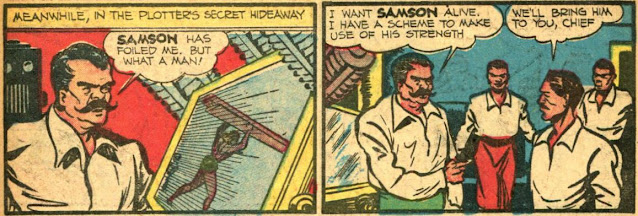
    This unnamed mustachioed man is remarkable mostly for the number of pivots that he manages to pull off over the course of a 13-page story. He first attracts Samsons’s attention with a scheme to pit the presumably South American country of Ecuazil against its neighbour (sadly unnamed but probably something like Perile or Aregentuay) and then conquer both once they were both sufficiently weakened by the fighting. Once Samson and David put an end to that he hypnotically enslaved Samson for a while, then launched into a full-fledged invasion of the US. Pretty good range, I’d say.

    The US invasion plan also featured this amazing spindly-legged flamethrower tank. Bask in its pleasing aesthetics and questionable strategic value! Please also note David in these panels as this is a good representation of his role in the comic: all enthusiasm, willing to lasso absolutely anything, very low actual impact on events as they unfold but clearly Samson enjoys having him around.

    Finally, I don’t quite know why but I feel that I must highlight this sequence in which Samson hurls a man into a pit and then his lifeless body is just there for the next two panels. I want to frame this and hang it on my wall. (Samson 002, 1940)

  • MINOR SUPER-VILLAIN 437: THE GHOST RIDERS

    (Star Ranger 001, 1937)

    The Ghost Riders are just another gang of bank robbers but I just can’t resist a good outfit, and a trio of hooded cowboys with tommy guns is a great visual if I ever saw one.

  • MINOR SUPER-VILLAIN 378: THE THING

    (More Fun Comics 064, 1941)

    This is not a complicated one: Congo Bill is asked for help by his friend Jack Brent. Brent is trying to sell his plantation, one of the assets of which is his good relationship with the local labour pool. Just as he had found a buyer, a skull-headed goon called the Thing started murdering workers. It’s about par for course re: jungle comics portrayal of nonwhite folks and fairly standard otherwise and of course the Thing turns out to be Mr Tate the prospective buyer attempting to get a better price via wholesale slaughter. The one redeeming feature of the story is this:

    The Thing looks sick as hell. You’ll be hard pressed to find a better look than a skull in a hood and the cool dagger is a real bonus. The bulletproof vest is of course not visible but speaks to a thoughtfulness that is shamefully wasted in this grubby little scheme.

    And yes that is Congo Bill in blackface.

  • MINOR SUPER-VILLAIN 358: THE BLACK HOOD

    (Master Comics 018, 1941) 

    Okay, I am a big fan of the Black Hood. Let’s count down the reasons:

    One: very exciting to see the classic super-suit being worn in the early days of suits and robes. This look won’t take long to become ubiquitous once it catches on but it’s still pretty rare in 1941.

    Two: not only is he a fashion pioneer but he is a thought leader in the field of henchman couture. Dressing your guys in a slightly worse version of your own costume (in this case bright rather than dark blue) is a surefire move in the villain game and it’s going to be a while before we see it with any kind of regularity.

    Three: The Black Hood is introduced as El Carim’s arch-enemy, despite never having appeared before’ and there are allusions to El Carim having broken up “four of his best rackets” etc. Implied lore is admittedly an easy way to build up a story’s interest but I guess I’m a sucker for it.

    About the only real criticism I have for the Black Hood is for all that he has experience battling El Carim (potentially years of experience, depending on the rate at which he sets up rackets) he is entirely unprepared to deal with Carim’s dank majiks. His approach is a completely straightforward trap and kill attempt and it goes very badly. A real shame.

    Nonetheless. regular costumed crooks like the Black Hood are the backbone any supercrime economy and he or his heirs should be BRUNG BACK post haste.

  • MINOR SUPER-VILLAIN 355: MR MURDER

    (Master Comics 015, 1941) 

    Mr Murder is your “pay or die” style of extortionist and a) has a pretty great name and b) is presumably in an early stage of his career as there is a lot more “die” going on than “pay”.

    Mr Murder also has a great understated costume: tunic, hat, cape, scarf, gloves. Just a bit off of what you might see someone actually wearing – nice and menacing in a Shadow sort of way.

    And of course Mr Murder turns out to be Reilly, the loudmouthed lawyer from the beginning of the story, presumably using his position to determine opportune targets for extortion and employing my fave the rubberoid mask to disguise his identity. It’s a fine outing over all but nothing special. The interesting stuff comes with Mr Murders further appearances:

    Mr Murder reappears in Master Comics 027, 1942 and there are several weird things going on. The least of these is his decision to incorporate the rubberoid mask into his costume despite his identity no longer being a secret, but I guess that’s no weirder than villains who continue to wear regular style masks in such circumstances.

    More interesting is the fact that there seems to have been a Mr Murder/ Bulletman clash some time in between, during which a) Mr Murder found out Bulletman’s secret identity and b) Bulletman was thought to have killed Mr Murder. As far as I can tell, this story was never published (I reckon that it’s equally likely that a story was produced but never published or someone misremembered Mr Murder being in a story he wasn’t), but the upshot of it is that Mr Murder is out for revenge and armed with the knowledge to do the deed. He kidnaps Jim Barr and almost succeds in bumping him off but has seemingly forgotten about the existence of Bulletgirl, leading to him getting his but kicked and dying for real.

    OR DID HE? This marks our first encounter with the CRIME EXCHANGE, an organization run by future Minor Super-Villain the Crime Broker, the details of which are not germane other than the fact that at one point the Exchange members petition the Crime Broker to bump off Bulletman, a petition consisting mostly of deceased Bulletman villains. It’s madness! A huge (dead) portion of Bulletman and Bulletgirl’s rogues gallery, returned to life (or, less incredibly, sprung from prison) in a single panel! Madness!

    Okay, maybe this is more exciting to me than anyone else but it is neat. And as someone whose official stance is that super-villains are more interesting when they’re still alive I heartily approve.

  • MINOR SUPER-VILLAIN 353: THE PURPLE HOODS

    (Master Comics 013-014, 1941) 

    I’m not going to lie: when I started reading this story I got excited for one of the more niche reasons I ever have. See, the prior Buck Jones story – the one with the Ghost Killer gang – was still wrapping up and I had a moment where I thought there would be some very exciting gang continuity if any of the former Ghost Killers, already relict of the White Arrow gang, had joined up with the Purple Hoods. That’s an unprecedented three gangs! Alas, Snake and Cope were sent to jail and the counter reset.

    Ephemeral hopes and dreams aside, the Purple Hoods are crass capitalist crooks: their big scheme involves kidnapping Mexican farm labourers and pressing them into slavery in a secret oil refinery. Ah, the romance of the Old West!

    And speaking of the Old West, this story is a perfect illustration of the weird liminal space that the West occupied in the 40s imagination: is Buck Jones an Old West marshal or a contemporary one? Does this issue offer any clues? The ascent of oil as a valuable resource does overlap with the Old West, and steel oil barrels of the kind pictured above are a 20th Century invention, but one of the major conflicts of the story is a business rivalry between two competing stagecoach lines and while I can find evidence of stagecoaches being used into the early 20th Century I doubt that they were such a going concern as that.

    What I’m getting at here is that I don’t know which way the anachronisms are going: is Buck Jones an Old West marshal with forward-thinking villains or a modern marshal in an overly romanticized setting? Who knows!

    (I must note that I do appreciate the Purple Hood leader getting his own special version of the gang costume)

    ADDENDUM:

    Two issues later (Master Comics 016, 1941), the story is clearly set in the Old West! Answers have been forthcoming at last!

  • MINOR SUPER-VILLAIN 352: THE CRYSTAL

    (Whiz Comics 015/ Master Comics 014, 1941)

    Basics first: the Crystal is nothing particularly special. He’s a businessman or something named Mr James who has a wealthy ward named Ronnie Keller and covets the money that he is charged with administering. It’s a pretty common turn of events in comics and Mr James is part of the significant minority of greedy guardians who decide to skip the simple embezzlement and advance straight to costumed thuggery. He’s got goons and everything!

    There are two other things about the Crystal, an annoying one and a tragic one. The annoying one is that due to the way that early anthology comics were shuffled around fairly frequently, the first of the two-part Companions Three story he appears in is in Whiz Comics 015 and the second is in Master Comics 014. Thus, 80-odd years later and reading books in a collated way rather than as they arrive on the shelves of your local newsagent you never ever end up reading them concurrently. It’s maddening! For me! About once every ten years!

    The tragic one is simply that the Crystal has a pretty great costume! Just look at that dome! But ten years later the Red Hood would really just blow this costume out of the water. It’s not even close! The Crystal’s good costume was doomed to obscurity in that moment.

  • MINOR SUPER-VILLAIN 348: THE SEVEN MASTERS

    (Master Comics 012, 1941)

    The Seven Masters are just your regular drug smuggling/ opium dealing gang operating out of San Francisco’s Chinatown. They don’t get up to anything too spectacular – El Carim gets in on the action because the head of the gang is using his criminal might to try to get a woman to marry him instead of her boyfriend – and they trade on some pulp-era Yellow Peril tropes, but despite all of that I must admit to liking their style. The name! The robes! The custom sword-lowering engine! If only they all hadn’t been wasted on low-tier chumps!

  • MINOR SUPER-VILLAIN 348: THE SEVEN MASTERS

    (Master Comics 012, 1941)

    The Seven Masters are just your regular drug smuggling/ opium dealing gang operating out of San Francisco’s Chinatown. They don’t get up to anything too spectacular – El Carim gets in on the action because the head of the gang is using his criminal might to try to get a woman to marry him instead of her boyfriend – and they trade on some pulp-era Yellow Peril tropes, but despite all of that I must admit to liking their style. The name! The robes! The custom sword-lowering engine! If only they all hadn’t been wasted on low-tier chumps!

  • MINOR SUPER-HERO 041: ZORO THE MYSTERY MAN

    (Slam-Bang Comics 006-007, Master Comics 007-022, 1940-1942)

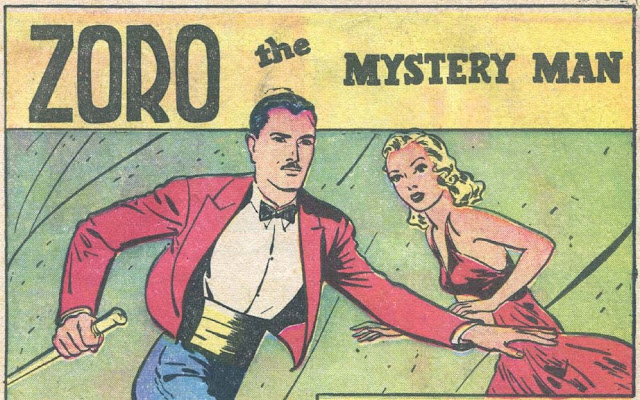
    It’s easy to quantify Zoro because his name says it all: he is a Mystery Man – nobody knows anything about him: nation of origin, real name, nothing. He has an amazing outfit and a sword cane and a pet cheetah named Cheeta. 

    Zoro hangs out a swanky clubs and parties and visits his swanky friends and occasionally gets involved in the mysteries that crop up in such circles. Does he have super powers? Maybe! Or maybe he’s just a gifted illusionist – who knows? He’s a MYSTERY MAN.

    (Zoro should absolutely be BRUNG BACK with absolutely no explanation of what he’s been doing for the last 80 years. I HAVE SPOKEN)