The Curse of Skeleton Munroe

Category: gang boss

  • MINOR SUPER-VILLAIN 916: THE STINGER

    (Cat-Man Comics 003, 1941)

    The Stinger is in most respects an extremely generic masked gang boss of the kind that we have seen so frequently before, right down to the fact that he is wearing one of those hanging cloth face masks, an item only worn by generic masked gang bosses of the 1940s. The real difference between all those other guys and the Stinger is that the Stinger’s very first move was to send out some goons to ambush and murder local vigilante and only credible threat to his operations the Ragman. 

    This important step having been completed, the Stinger launches a massive crimewave, that includes four simultaneous bank robberies and the kidnapping of the police commissioner. Mayor Not La Guardia is not happy about all this, as he expresses to conspicuous named character police Lieutenant Burns.

    The only major flaw in the Stinger’s plan is that his gang is made up of 1940s comic book gangsters who don’t think to check for a pulse when they are sent to murder someone. This is important because it turns out that the Ragman was wearing a bulletproof vest the whole time and was just playing dead when he was dumped in the river. 

    Having beaten up the Stinger’s entire operation, the Ragman is able to track him down and unmask him as, you might have guessed it, Lt, Burns, the only new named character in the story. It’s the old classic “crooked cop becomes masked crimelord” story again, though this is the first crooked police lieutenant we’ve seen. 

    Categorized under: Body (Nonhuman Body Parts), Location (NYC), Profession (Law Enforcement)

  • MINOR SUPER-VILLAIN 901: XYZ

    (Whiz Comics 014, 1941) 

    Dan Dare exists in a world rife with crime in which he is seemingly the only person capable of solving an moderate-to-difficult mystery. Thus, he and his assistant/lover Carol Clews constantly fly from city to city capturing crooks, while Carol fruitlessly attempts to steal Dan away for a much-needed vacation.

    In this particular installment, Dan and Carol have been summoned to Chicago by TL Thornton, Publisher of the Daily Clarion and subject of a terror campaign by the city’s mysterious crimelord, known only as XYZ. 

    XYZ’s reach is such that a minion captured during an attempt to blow up Dare, Clews and Thornton is assassinated under the very nose of Thornton’s secretary Miss Holmes. Is there no crime too audacious for this mastermind?

    Upon walking Miss Holmes home, Dare learns the truth: though he and Thornton had been looking for a male crime boss, XYZ is in fact a woman. Yes, Miss Holmes was conducting her criminal enterprise out of the front office of one of the men trying to expose her and that audacity, plus preconceived notions of the masculine nature of criminality, helped her do it.

    Just kidding: Dare cottoned on to the possibility that Miss Holmes was XYZ when she killed that captured henchman. He arranged for Carol to follow them and call the police to their location after a suitable interval – Dan Dare is a feminist after all!

  • MINOR SUPER-VILLAIN 899: THE BIG SHOT

    (Whiz Comics 012, 1941)

    The city of Watertown is under the thumb of a mysterious crime lord known only as the Big Shot, and Edward Lucas, the Special Prosecutor in charge of tracking the Big Shot down, has been shot and killed just before a meeting with Watertown District Attorney Harper. Enter super sleuth Dan Dare and his associate Carol Clews to pick up the trail and finish Lucas’ last case.

    The most obvious suspect is of course DA Harper, and since Dan Dare stories are a little too short for red herrings that is exactly who it turns out to be. I wouldn’t call the Big Shot the criminal mastermind of the century or even the week, but he does have the good (fashion) sense to have his minions dress in little domino masks so I must give him a small amount of credit.

  • MINOR SUPER-VILLAIN 896: THE INVISIBLE MAN

    (America’s Greatest Comics 001, 1941)

    An invisible killer is on the loose in New York City, robbing banks and hijacking gold shipments and murdering bank clerks, and while an invisible killer is a very scary thing to contemplate we must as ourselves: is armed robbery the best criminal use of the power of invisibility? If nothing else, a stealthier approach would have kept the involvement of an invisible man a secret for longer, since as it stands the poor gunned-down bank clerk in the above panels managed to survive long enough to tell the police about him.

    All of this criminal activity draws the attention of Bulletman and Bulletgirl, of course, and soon enough they are face to nothing with the Invisible Man in a deserted street. Sadly for the crime statistics, the Invisible Man seems to have the kind of invisibility that renders him completely uncatchable, even during a long conversation with Bulletman, a man wearing a hat that allows him to fly and who, crucially, can see him for part of the time. 

    Though the Invisible Man’s reign of terror continues for some time after this confrontation, his downfall comes after Bulletman realizes that invisibility is only a useful superpower in lighted areas and that battling him in darkness will level the playing field. Just why this is a more effective approach that simply flailing wildly at the sound of his voice is a mystery to me but I guess we must acknowledge success when it happens.

  • MINOR SUPER-VILLAIN 888: THE SCORPION

    (Wow Comics 002, 1940)

    The Scorpion is mostly a regular gang boss, but with just enough extra oomph to take him over the edge into super-villainy. First thing: he is a very Bad Boss in that particular “execute under-performing employees as an example to the others” kind of way that all corporate overlords wish that HR would let them be.

    Secondly, he is perhaps the closest thing to a super-villain was faced by Allan Lanier, aka the Hunchback, seen here in his civilian guise rushing to investigate the defenestration of the Scorpion’s poor minion and inadvertently getting his fiance Betty kidnapped in the process.

    The Scorpion also has a true super-villain’s lack of subtlety, seen here as he successfully fools Lanier into believing that Betty has gone to visit her uncle by means of a simple telegram but then is unable to resist sending a more explicit threat (signed with a cute lil’ scorpion!) and undoing his previous work. 

    Finally, the Scorpion has a cool hideout: just like the Ninja Turtles he lives in an abandoned subway station, to which he is tracked by the vengeful Hunchback.

    After that, it’s all over. The Hunchback doesn’t play around, he just breaks the Scorpion’s neck. I would say that this is a case of someone choosing their enemies poorly, but the Scorpion didn’t actually know he was dealing with the Hunchback until it was too late. I guess the lesson is “don’t kidnap women.”

  • MINOR SUPER-VILLAIN 886: THE HORNED HOOD

    MINOR SUPER-VILLAIN 886: THE HORNED HOOD

    (Wow Comics 002, 1941) 

    If a comic story opens on a description of a gem or art object like the Maharajah Jewel here the you can be sure that that item is about to be stolen by a nefarious individual. It’s just science!

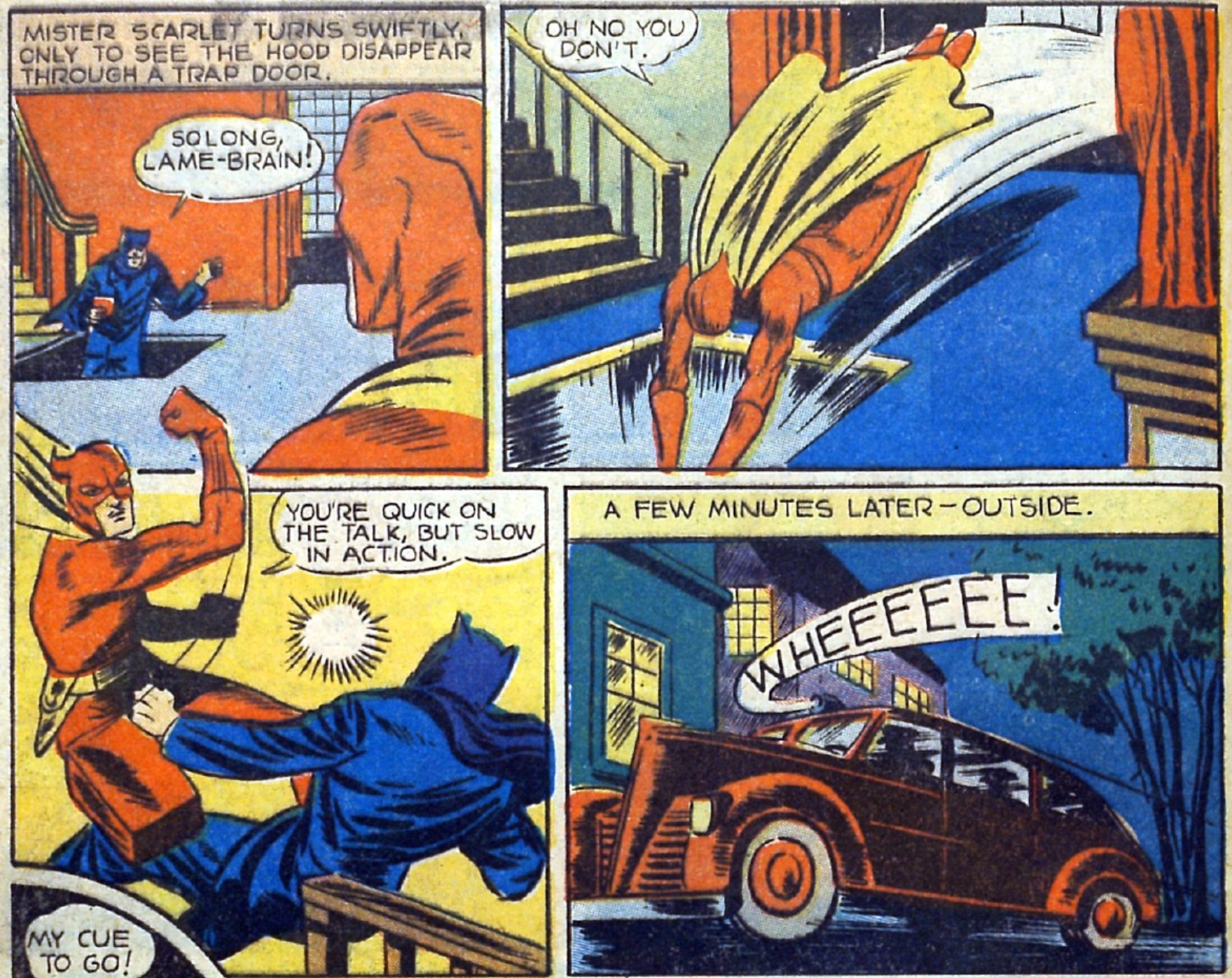
    Sure enough, no sooner does Professor Cadiz finish his lecture on the gem and its provenance than rictus grin-sporting gang boss the Horned Hood is sending two of his top men into the Upstate Museum to grab the swag, and even though Mr Scarlet intervenes, the Horned Hood manages to scuttle out a side door with the jewel in the commotion.

    Ultimately, the Horned Hood might be the greatest degree of style over substance that we’ve encountered in a while, as seen in the extreme brevity of his battle with Mr Scarlet. And no wonder, because the Horned Hood turns out to be Professor Cadiz, the only possible suspect (because he his the only named character who doesn’t already work for the Horned Hood) and a real power nerd. 

  • MINOR SUPER-VILLAIN 869: THE BLACK KNIGHT

    (Zip Comics 001, 1940)

    Shortly after giving himself super powers, Steel Sterling gets word of a brutal bank robbery in the town of Beeville and sets out to bring the culprits to justice. Determining that the crooks must have been guided by a mastermind of some sort, he trails their plane to a mountaintop fortress.

    The bow-wielding guards outside the Black Knight’s fortress (spoiler: it’s the Black Knight’s fortress, but what were you expecting) are notable for being the one time that he has anything related to his chosen theme around, and even they are supposedly only there to prevent… mountain cops?… from hearing the sound of gunfire. Inside, it’s plain old gangsters.

    Gangsters armed with ordinary machine guns are of course no match for a man with all the properties of steel, and Steel Sterling quickly makes his way to the Black Knight’s throne room, where he is immediately dropped into a deep pit full of rats.

    I’d just like to take a second here to appreciate the fact that the Black Knight’s costume is a) 100% brown and yellow with no black at all and b) a pretty conventional super-person getup aside from what appears to be a leather jerkin or similar. Historical, yes, but not particularly knightly. 

    A pit full of rats is also not enough to stop Steel Sterling, and he makes his way out, causes the Black Knight himself to fall in, and sets out after the fleeing gangsters just in time to avoid a secondary deathtrap as the fortress explodes behind him. The Black Knight is finished, it seems.

    The Black Knight is not, in fact, finished, and is soon (Zip Comics 002) hard at work robbing gold and fur shipments coming out of Alaska. Though he manages to capture Steel Sterling when he infiltrates the villain’s fake iceberg base he does a bad job of coming up with a suitable deathtrap for the hero and ends up in the hands of the US Navy.

    Steel Sterling’s next case brings him to the South American nation of Brazonia, where a man called Dr Yar has taken the famous scientist Walter Cummings in order to force him to develop weapons of war and help conquer the gold-rich country. 

    Dr Yar is of course eventually revealed to be an alias (or possibly the real identity?) of the Black Knight. Just why he has abandoned his old moniker is unstated but perhaps it is as simple as a desire not to attract the attention of Steel Sterling again. His new look is at least still visually interesting – particularly the periscopiscopes, which are of course goggles which allow 360 degree vision.

    Dr Yar really leans into the scientist aspect of his new identity, and deploys gadgets such as: flying tanks, oil bombs, electric rays and various viewscreens and visualizers.

    Plus: he not only has Alligator Men at his disposal but also a swarm of giant mosquitoes straight out of an ad for a pest control company (being big does not help them bate through steel skin, alas). 

    Once again the Black Knight/Dr Yar apparently meets his end, and this time it’s explicitly at the hands of Steel Sterling, who stuffs him into the barrel of his own super-howitzer before it fires. A truly brutal end, even for a dedicated super-villain. (Zip Comics 003, 1940)

    Steel doesn’t have to live with any guilt he might feel for long, however, as the Black Knight returns in the next issue, this time climbing the rungs of the aristocracy from mere knighthood to become the Radium King. His new plan is simple: steal the entire US radium supply and then ransom it back for 30 million dollars.

    The Radium King has appropriately impressive digs: an underwater base in Lake Superior that would probably be pretty hard to find if one of his minions hadn’t blabbed under threat of a beating from Steel Sterling.

    The Radium King costume turns out to borrow heavily from the original Black Knight getup, although without a lot of the yellow elements. I’d say that it’s better than the Dr Yar outfit but not as composed as the original, and that the half-mask/mustache combo is particularly unpleasant. Speaking of Dr Yar, the Radium King reveals that he survived Steel’s attempted cannon execution by simply crawling back out of the cannon.

    Not to be robbed of a kill, Steel Sterling uses the Radium King’s own submarine to blow him and his base to high heaven. Surely he’s dead this time! (Zip Comics 004, 1940)

    Not quite! The Black Knight’s fifth and final appearance (under the original name, this time) is probably his most ignominious, though it does feature his cool underground city headquarters, seen above. In it, he engages in a campaign of sabotage, kidnapping and extortion against his former kidnap victim/current minor member of Steel Sterling’s supporting cast Walter Cummings, who has gone into the munitions manufacturing game and has gotten the contract to produce the mysterious Zeta Ray for the US government. Somehow, if the Black Knight can delay production of the US Zeta Ray for long enough then his own scientists can produce one for him and that will be good, and if that description seems vague to you then I must assure you that it is 100% accurate to the comic. I don’t even know what the Zeta Ray does, for heaven’s sake.

    Though Cummings’ first factory is destroyed and his second collapses due to some sabotaged cement, Steel Sterling steps in and has almost completed a third when the Black Knight decides to take a personal hand and ram a tanker truck full of TNT into it. Now here’s the embarrassing part: not only does Steel Sterling handily prevent the truck from destroying the factory, but the first time that he is even aware that the Black Knight is involved in the plot against Dr Cummings is when he spots him just one fraction of a second before he is atomized in the explosion. It’s not even as dignified an end as being shot out of your own cannon would have been. (Zip Comics 005, 1940) 

  • GENERIC COSTUMED VILLAIN ROUND-UP 026

    A wretched and motley crew for ye this day. 

    Mikal, leader of the undersea pirates, is an evocative figure who exists only to pad out the Typhon story that he appears in by a couple of pages. In an attempt to aid his ally, the king of the Sea Demons, he gets off one good hydro-jet blast at Typhon’s submarine before he and his entire undersea fortress are annihilated by the sub’s hydro-ray. (Weird Comics 005, 1940)

    Friends, I am 100% sure that “the War Maniac” is just being used as a standard 1939-1941 paper-thin obfuscation of the fact that they’re talking about Hitler, and yet it’s such an excellent villain name that I am compelled to make note of it as if it were describing an armoured giant from a 60s Jack Kirby comic. (Weird Comics 007, 1940)

    The Boss, leader of a gang that targets the members of a private club that the Eagle belongs to in his secret identity of Bill Powers, turns out to be Rider, the club secretary, who might have been a great gang boss but really should have thought to keep his huge and distinctive wrist scar covered up in at least one of his identities. (Weird Comics 008, 1940)

    Queen Marie is a gang boss who styles herself as royalty, which just barely lines up with her diamond-smuggling concerns. I would call it a 100% charming affectation if her definition of queendom didn’t include having a throne room dotted with African slaves. Queen or not, her gang beat up by the Sparkler and she gets shipped off the the hoosegow. (Wham Comics 002, 1940)

  • GENERIC COSTUMED VILLAIN ROUND-UP 026

    A wretched and motley crew for ye this day. 

    Mikal, leader of the undersea pirates, is an evocative figure who exists only to pad out the Typhon story that he appears in by a couple of pages. In an attempt to aid his ally, the king of the Sea Demons, he gets off one good hydro-jet blast at Typhon’s submarine before he and his entire undersea fortress are annihilated by the sub’s hydro-ray. (Weird Comics 005, 1940)

    Friends, I am 100% sure that “the War Maniac” is just being used as a standard 1939-1941 paper-thin obfuscation of the fact that they’re talking about Hitler, and yet it’s such an excellent villain name that I am compelled to make note of it as if it were describing an armoured giant from a 60s Jack Kirby comic. (Weird Comics 007, 1940)

    The Boss, leader of a gang that targets the members of a private club that the Eagle belongs to in his secret identity of Bill Powers, turns out to be Rider, the club secretary, who might have been a great gang boss but really should have thought to keep his huge and distinctive wrist scar covered up in at least one of his identities. (Weird Comics 008, 1940)

    Queen Marie is a gang boss who styles herself as royalty, which just barely lines up with her diamond-smuggling concerns. I would call it a 100% charming affectation if her definition of queendom didn’t include having a throne room dotted with African slaves. Queen or not, her gang beat up by the Sparkler and she gets shipped off the the hoosegow. (Wham Comics 002, 1940)

  • MINOR SUPER-VILLAIN 808: THE BLACK QUEEN

    (The Spirit, “The Black Queen”, June 16, 1940)

    We first meet the Black Queen as the otherwise-unnamed defense lawyer in the murder trial of gangster Slot Gorgan. She already has a reputation for being brilliant, and that reputation proves to be accurate, as Gorgan is acquitted despite the evidence against him.

    Upon returning to the Black Queen’s penthouse, we learn that she is in fact the very first in the Spirit’s long line of female villains, as it turns out that she is the brains behind Gorgan’s gang. Unfortunately for Gorgan and the Black Queen, the Spirit has been engaging in the long-standing comic book tradition of getting mad about not-guilty trial results, and so has preceded them to the apartment. Now he knows about about the Black Queen’s crime ties and that Slot was actually guilty.

    The Spirit manages to wrangle a confession out of Slot in the presence of the District Attorney, which results in a retrial for the same murder he was originally accused of (and while I am not even remotely a lawyer I reckon that this is exactly what double jeopardy is supposed to be about? Or is it one of those things where he was tried for second degree murder the first time and first degree the second?). This time, the Black Queen’s brilliant legal mind is merely able to get his sentenced reduced from death to life imprisonment, but importantly she herself is still running the gang when the episode concludes.

    The Black Queen returns a few weeks later having made the astonishing decision to move from being the secret head of her gang (smart, secure) to personally leading them in a raid on the New York Sub-Treasury building* (dumb, risky). Why do this when her prior setup was so good that she got to the end of a “crime doesn’t pay” comic with her crime career still intact? Since she talks about taking 25 million dollars for herself and splitting town, I can only assume that she has grown tired of the admin of running a gang while being a successful attorney and just wants to retire.

    *this might be the fifth time I have read a story in which crooks try to rob the New York Sub-Treasury, and having looked it up to see if it was a thing I have found that a) it was – the US used to keep stores of cash and gold in a few major cities, presumably due to longer travel times in the past and b) the sub-treasury system was phased out in the 1920s. The Black Queen and her fellows are actually trying to break into a building now known as Federal Hall, administered by the National Park Service, and in 1940 occupied by exhibits relating to the New York World’s Fair. This raises the question: is the major divergence of the various super-hero universes from our own in fact the passing of the Independent Treasury Act of 1920?

    Though the Black Queen’s gang are captured before they can get away with either fifty million dollars or some dioramas about the history of finance, she alone manages to escape in her private yacht. Thanks to a timely intervention by the Governor’s island defense batteries, the yacht is disabled (a very rare artillery-based entry in my collection of cops shooting fleeing suspects), but the Black Queen herself remains at large for a second appearance in a row thanks to a frankly amazing hand grenade throw that disables the Spirit’s flying car. 

    The Black Queen’s third and final appearance is also the one in which she makes the jump to being a full-fledged femme fatale in the (eventual) grand Spirit tradition, and I say that not just because she has started wearing hot pants and a bustier as her everyday outfit.

    No, what really puts the fatale into this femme is the fact that she is going around giving men the literal kiss of death via some poisoned lip gloss. I’m not even sure why she kills this guy – just for the hell of it, I suppose, as he seems to be totally okay with working for her.

    But just what was that guy killed for? Why a formula for creating artificial diamonds, which means that along with the sub-treasury thing from earlier, the Black Queen has engaged in two of the biggest non-crimes in comics history!

    The Black Queen has also seduced a jeweller named Abner Ames into acting as a fence for her. The Spirit goes pretty far out of his way to rescue this guy from getting the Kiss of Death and make sure that he isn’t held criminally responsible, and while I commend him for being nice to Ames’ poor wife in this way I would humbly suggest that she would be better off without him.

    (the above panels also reveal that the Black Queen’s calling card is the queen of spades, and as someone who loves categorizing things I am just pleased as punch to have confirmation on exactly which black queen she was going for with than name) 

    Ames having been saved, there is a thrilling chase that culminates in a fight on the superstructure of a bridge. Though the Black Queen almost gets him, the Spirit manages to take her in. Sadly for those of us who enjoy her style, the Black Queen chooses to take her own life rather than face trial, even though she might have been the first person in history for whom self-representation was a good idea.