The Curse of Skeleton Munroe

Category: gang boss

  • MINOR SUPER-VILLAIN 395: THE GREAT CAESAR

    (More Fun Comics 071, 1941)

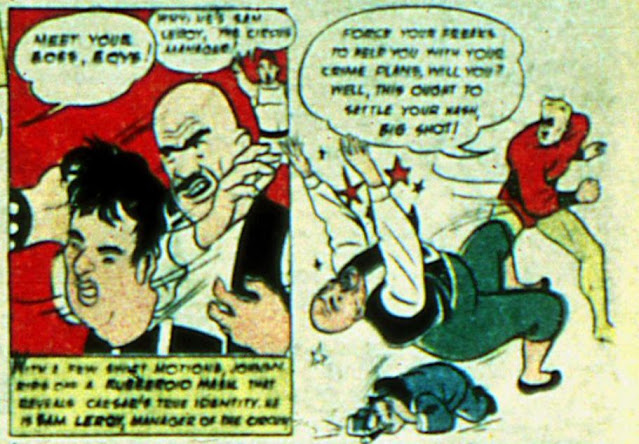
    The Great Caesar is the antagonist of the first published Johnny Quick adventure (though not, of course, the first overall Johnny Quick adventure – as revealed in the last round of Generic Costumed Villains he had a several-year career before this). He’s got the ever-popular array of circus of crime henchmen who he coerces to rob and kill at his pleasure. He also has the much dumber but just as popular “death as consequence of failure” policy which, while motivationally potent, is a staffing and HR nightmare in practise.

    The Great Caesar is eventually unmasked and revealed to be Sam Leroy, the circus manager. Hooray for Johnny Quick!

    More importantly, hooray for this marking one of the few actual uses of the term “rubberoid mask” in comics. I feel so validated!

  • GENERIC COSTUMED VILLAIN ROUND-UP 007

    The hits keep on coming:

    This Fellow’s name is Becker and he and his wife run a gang while pretending to be among its victims. An okay scheme, but not really up to foiling Bulletman and Bulletgirl. (Master Comics 014, 1941)

    This guy here is why I have such a hard time relegating masked Western bandits to the dregs of the generic costumed villains: he’s as by-the-numbers a bandit as they come, he robs one stagecoach total, he ends up dying because he falls off his horse… but he is frequently and consistently referred to a “Alkali, the Scourge of the Plains” which is as endearing as it is possible to be. (Master Comics 019, 1941)

    I’m overlooking the fact that this bundist-style not-exactly-German spy encountered by Miss America doesn’t actually wear a costume because a) he’s called the Leader, b) he lives in a wax museum and c) he has a pet gorilla named Gargo. (Military Comics 002, 1941)

    Captain Rajah, AKA the Master, was a jewel thief who ran up against Captain Desmo, in a story even more weirdly pro-colonial than Captain Desmo stories usually are – Captain Rajah is immediately suspicious for being an Indian officer in the Bengal Lancers, continued to be suspected throughout and then turned out to be the Master. The story is from before the invention of “defying expectations”. (More Fun Comics 065, 1941)

  • GENERIC COSTUMED VILLAIN ROUND-UP 007

    The hits keep on coming:

    This Fellow’s name is Becker and he and his wife run a gang while pretending to be among its victims. An okay scheme, but not really up to foiling Bulletman and Bulletgirl. (Master Comics 014, 1941)

    This guy here is why I have such a hard time relegating masked Western bandits to the dregs of the generic costumed villains: he’s as by-the-numbers a bandit as they come, he robs one stagecoach total, he ends up dying because he falls off his horse… but he is frequently and consistently referred to a “Alkali, the Scourge of the Plains” which is as endearing as it is possible to be. (Master Comics 019, 1941)

    I’m overlooking the fact that this bundist-style not-exactly-German spy encountered by Miss America doesn’t actually wear a costume because a) he’s called the Leader, b) he lives in a wax museum and c) he has a pet gorilla named Gargo. (Military Comics 002, 1941)

    Captain Rajah, AKA the Master, was a jewel thief who ran up against Captain Desmo, in a story even more weirdly pro-colonial than Captain Desmo stories usually are – Captain Rajah is immediately suspicious for being an Indian officer in the Bengal Lancers, continued to be suspected throughout and then turned out to be the Master. The story is from before the invention of “defying expectations”. (More Fun Comics 065, 1941)

  • MINOR SUPER-VILLAIN 363: MR H

    (Master Comics 001 (behind the scenes) or Master Comics 007 (first mentioned) or Master Comics 008 (first appearance on-panel)-Master Comics 020, 1940-1941)


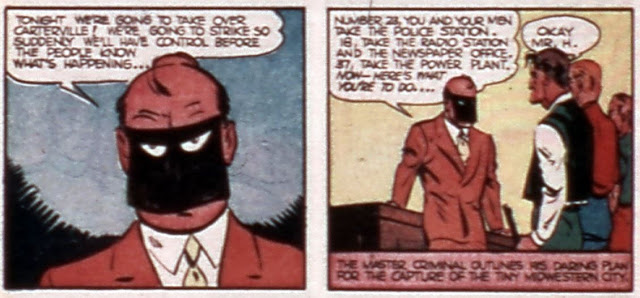
    Mr H, the mastermind behind all crime in the city of Carterville and its unnamed state, gets up to all kinds of schemes through his proxies. For example:

    -running an illegal casino in a hard-to-catch gambling blimp

    -robbing a munitions plant in order to outfit a small army of gangsters and enact a criminal takeover of Carterville

    -stealing an experimental bomber from the US Army and attempting to sell it to crypto-Nazis

    -having his gang murder random Carterville citizens in order to drive down confidence in the police

    -stealing an experimental paralysis gas in order to disable and rob the entire population of Carterville 

    -attempting to destroy all public transit in Carterville for unclear reasons

    -attempting to blow up the Carterville Dam for unclear reasons

    -sundry murders and robberies

    At first, Carterville’s major crime figure and the inspiration for regional super-hero the Devil’s Dagger is a guy by the name of Jeff Marlowe, but he falls off of a roof in Master Comics 007, necessitating the introduction of his boss, Mr H. Over the course of his 12-odd appearances Mr H has a variable amount of hair and a selection of different cloth masks. The consistent aspect of his adventures (aside from his orange suit) is his habit of getting away in some sort of motor vehicle at the last second.

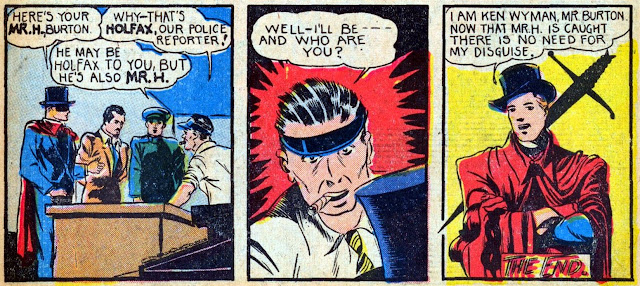
    Then, in Master Comics 018, Ken “Devil’s Dagger” Wyman gets a new coworker, police reporter Holfax. I won’t beat around the bush: Holfax is Mr H – introduced, I suspect, because the feature was coming to an end and they needed somebody to be the villain. The great thing about this is that Holfax/ Mr H thus becomes an evil equivalent to Wyman/ the Devil’s Dagger, something that I’m always excited to see.

    And the piece de resistance is of course the capture of Mr H and the subsequent retirement of the Devil’s Dagger in Master Comics 020, a rare ending not just for a Golden Age super-hero but for any super-hero ever.

    Mr H might not be terribly exciting in and of himself but I would still love to see a legacy Devil’s Dagger BRUNG BACK and who better to act as his foil than an ancient Holfax, out of prison and running Carterville once again.

    ADDENDUM: I almost forgot to highlight the fact that Mr H employs one of my favourite costume elements: the mask with attached bald cap.

    ADDENDUM II: I just read the long-unavailable Master Comics 006 and in it Mr H, through his proxy Jeff Marlowe, kidnaps the President of the United States for ransom. This is a very big crime not to have been aware of!

  • MINOR SUPER-VILLAIN 352: THE CRYSTAL

    (Whiz Comics 015/ Master Comics 014, 1941)

    Basics first: the Crystal is nothing particularly special. He’s a businessman or something named Mr James who has a wealthy ward named Ronnie Keller and covets the money that he is charged with administering. It’s a pretty common turn of events in comics and Mr James is part of the significant minority of greedy guardians who decide to skip the simple embezzlement and advance straight to costumed thuggery. He’s got goons and everything!

    There are two other things about the Crystal, an annoying one and a tragic one. The annoying one is that due to the way that early anthology comics were shuffled around fairly frequently, the first of the two-part Companions Three story he appears in is in Whiz Comics 015 and the second is in Master Comics 014. Thus, 80-odd years later and reading books in a collated way rather than as they arrive on the shelves of your local newsagent you never ever end up reading them concurrently. It’s maddening! For me! About once every ten years!

    The tragic one is simply that the Crystal has a pretty great costume! Just look at that dome! But ten years later the Red Hood would really just blow this costume out of the water. It’s not even close! The Crystal’s good costume was doomed to obscurity in that moment.

  • MINOR SUPER-VILLAIN 346: THE DRAGON

    (Master Comics 011, 1941)

    It’s our second villain named the Dragon and our second Dragon who turns out to be a white dude in yellowface. Will it happen again? Only time will tell.

    The only really interesting thing about this guy is that a key part of his plan was to divert suspicion from himself by repeatedly sending his gang to kill his own secret identity (see above). Whether he was banking on Zoro the Mystery Man to show up and keep him alive is unspoken but if he wasn’t it’s a frankly baffling plan.

  • MINOR SUPER-VILLAIN 346: THE DRAGON

    (Master Comics 011, 1941)

    It’s our second villain named the Dragon and our second Dragon who turns out to be a white dude in yellowface. Will it happen again? Only time will tell.

    The only really interesting thing about this guy is that a key part of his plan was to divert suspicion from himself by repeatedly sending his gang to kill his own secret identity (see above). Whether he was banking on Zoro the Mystery Man to show up and keep him alive is unspoken but if he wasn’t it’s a frankly baffling plan.

  • MINOR SUPER-VILLAIN 345: THE WHITE ARROW

    (Master Comics 008-011, 1940-1941)

    A regular-style Old West outlaw chief with the somewhat lyrical name of Santos Figaro, the White Arrow’s main distinction is that he was a multi-issue rather than one-off foe of Marshal Buck Jones.  

    Jones himself is far more interesting than poor Santos Figaro, being a real-life cowboy actor cast as an Old West lawman (probably – I think I’ve mentioned before that the media of the 1930s-40s doesn’t draw a lot of distinction between the Old West and the contemporary West and that sometimes the only way you find out that a series is one or the other is 50 instalments in when the protagonist hops a plane to Chicago). Jones replaced former marshal Bill Crane in Master Comics 006 in a sadly lost-to-history adventure that might contain clues as to whether he was the Buck Jones or just a Buck Jones. 

    Regardless, the “Buck Jones, Frontier Marshal” feature closed its doors after the real Buck Jones died in 1942. Given that, it is somewhat ironic that Master Comics was one of the books to eventually carry the adventures of Old West cowboy Tom Mix based on the Western actor who had died in 1940.

    UPDATE: I finally got to read Master Comics 006, in which Buck Jones takes over for Bill Crane, and it’s almost but not quite as unclear about the time period as the issues I already had access to. Buck Jones is a famous actor moving to what is effectively the past for a bit of a break from modern life and when Crane is wounded he is sworn in as the new marshal. Jones is simultaneously a recognizable celebrity and living in a place with no technology more modern than the steam engine. Baffling!

  • MINOR SUPER-VILLAIN 343: THE TWISTER

    (Master Comics 008, 1940)

    Not a particularly distinguished entry today: the Twister is a gang boss who employs child pickpockets and keeps them in line with the threat of some semi-eponymous neck-twisting. No idea why he bothers with the robe and cowl – El Carim doesn’t even bother to unmask him.

    More fun than the Twister himself, in fact, is that his old gang is loyal enough to try to take revenge on El Carim in the next issue – a rare bit of continuity for the Golden Age.

  • MINOR SUPER-VILLAIN 335: THE THREAT

    (All-Flash 002, 1941) 

    The Threat is an example of a type of morality tale that was very popular in 40s and 50s comic books but never really went out of style: a tale of promise squandered in service to a life of crime. In this case, the subject is a crook named Tough Joe Connor, who swears revenge on Jim Kelley, the prosecutor who sent him to jail for ten years. 

    My summarizing powers are not up to this task, ergo, a timeline:

    1911 CE:

    -Jim Kelley sends Tough Joe Connor to jail. Connor swears revenge.

    -believing that Kelley got the better of him because he was more clever, Connor devotes himself to study.

    1917 CE:

    -Connor has become a model prisoner. He is a qualified lawyer, doctor and research scientist specializing in chemistry and physics. He is paroled 4 years early. On the outside, he is already wealthy due to research he did in prison.

    -Connor goes to visit Kelley. Ostensibly a good will visit, it is actually in order to provide an alibi: when thugs he has hired burst in and steal Kelley’s newborn baby, Connor takes a carefully choreographed bullet to the arm while “attempting to stop them”.

    -Connor meets and falls in love with a woman named Annie Crowley. They marry and he briefly goes straight (but keeps the baby).

    1923 CE:

    -Annie dies (possibly in childbirth, as they have a daughter). Connor resumes his quest for revenge and begins telling the boy, Roy, that Kelley killed his mother in order to turn him into a weapon against his own father.

    1937 CE:

    -Connor has consolidated underworld power in the region, becoming the Threat. He makes his first attempt on the life of now-Mayor Jim Kelley but both his criminal activities and his murder attempt are disrupted by the Flash. Roy heads to the family farm to lie low with his step-sister Ann.

    1941 CE:

    -The Threats’s power continues to grow. A second attempt on Mayor Kelley’s life ends with Joe Connor back in prison as one of his own henchmen.

    -Connor escapes in an old lye barrel. Severely burned, missing an eye, he adopts a series of new identities: an unnamed garage owner, plastic surgeon Doctor Cravath, mechanic Jake Boles. He finds Roy hiding out in the country and together they make an attempt on gubernatorial candidate Kelley’s life but once more the Flash steps in.

    -Connor makes one last push to kill now-Governor Kelley: he breaks Roy out of prison and arranges a big confrontation. All is for naught, as the Flash, Joan Williams and Ann Connor have pieced together the clues and revealed to Roy his real parentage. Faced with this and the futility of his life of revenge, Connor smokes a poisoned cigarette and dies.

    -Roy and Ann are now in love, which happens in these kinds of Secret Step-Sibling situations an unsettling amount.

    There are several interesting things about this sequence of events. The first, as seen above, is that young Roy, at age 5, chooses the name Roy Revenge for himself as part of his vendetta and keeps using it into his mid-twenties. It is, frankly, great – it’s exactly the kind of henchman name that a villain called the Threat would assign in a campy 60s comic, but earnestly, in the 40s.

    The second involves the fact that at this point Keystone City is not a thing and the Flash explicitly lives in New York City, which means that Jim Kelley was presumably Mayor of NYC (eroding La Guardia’s term by about four years) and Governor of New York (impacting Herbert H. Lehman).

    Meanwhile, the chronology of the story is fairly tentative – the actual timeframes are correct, but the dates are speculative. The crucial point is that four-year gap between Roy Revenge”s first attempt on Kelley’s life and the remainder of the story: as presented the bulk of the story is set in 1941, the year of publication, but the Flash is running around three years earlier than previously established. BUT! if we start the story in 1941 the bulk of the action takes place in 1945, which is even more temporally messy. Fun stuff for the old timeline!

    The Threat, ultimately, is a bit of a nothing villain but I like him nonetheless. Too bad about the wasted life, better luck next time, Joe.

    JUDGE AND JURY REVENGE KILLER SCORE: 0/1 

    (I know, he’s focused on the lawyer, but “judge and jury and prosecutor revenge killer” is just too long and even then someone is going to go after the witnesses and bailiffs. Better to be succinct)