The Curse of Skeleton Munroe

Category: Captain Marvel

  • MEDIA IN COMICS 014

    Forget lost media, here are some media that only exist in comic books

    Movies: 

    A Modern Macbeth is one of innumerable in-comic movies that we never really learn anything about. Is it a musical? Is that why a singer is speaking at the premiere? Is it a reference to another movie? The only pre-1941 movie with a similar title that I can find is 1917’s A Modern Monte Cristo and that seems a bit of a stretch. (More Fun Comics 072, 1941)

    Captain Marvel stars in a film called Crusher of Crime in one of our earliest examples of a super-hero starring in a film as themselves. No clue what it’s about but we can probably assume that it’s standard 40s super-hero fare. (Whiz Comics 020, 1941)

    More intriguingly, the character of Whitey Murphy joins the Captain Marvel cast just two issues later, and dialogue between him and Billy Batson implies that not only does the real-world film The Adventures of Captain Marvel exist in the comics universe, but that both Captain Marvel and Billy Batson appeared in it and also that some or all the events of the film actually happened.

    This is reinforced by the fact that Billy goes to see “The Guillotine”, the second chapter of the serial, in Captain Marvel Adventures 003 (Whiz Comics 022, 1941)

    The costume party held for the premiere of The Phantom Duelist (film) held in the castle of the Phantom Duelist (ghost) provides the opportunity for the Phantom Duelist (super-villain) to murder Reynolds (film producer, universally-hated). (Doll Man Quarterly 001, 1941)

    One of the minor recurring tropes of comics is “tough guy goes to Hollywood and finds it exhausting,” seen here as the super-hero Hercules is talked into making a sadly unnamed jungle movie and it almost kills him. (Hit Comics 010, 1941)

    Music:

    The song “Icy Igloo Blues” is the key to District Attorney Steve Malone solving a major jewel robbery case. (Detective Comics v1 053, 1941)

    The “Symphony of Death” was employed by the nefarious Doctor Death in his murders. Do music nerds in comic book universes hold Nights of Evil concerts where they play pieces like this? (Wow Comics 002, 1941)

    Speaking of which, here are six extremely on-the-nose songs composed by the Murder Maestro as part of his own efforts in the field of killing: “A Message to My Heart” (victim shot in the heart), “I’m Drowning My Sorrows” (drowned), “I’m Burning Up Over You” (set on fire), “My Sleepy-Time Pal” (poisoned, weirdly), “I’m Walking on Air” (dropped from a plane) and “I’m Getting Up in the World” (fake attempt on own life). (More Fun Comics 072, 1941)

    Newspaper Columns:

    “Walter Winkle on Broadway” is of course yet another take on the gossip column of Walter Winchell. (Feature Comics 049, 1941)

    Television:

    There are in fact Martian invaders in this Human Torch story, but since they don’t get up to any NYC-destroying I must conclude that this is an unnamed and very coincidental television program. (Marvel Mystery Comics v1 003 1940) 

  • MEDIA IN COMICS 012

    It’s a very literary day here in Media in Comics Land.

    Books:

    There are many potential reasons to get into super-science and super-crime, but “reading a get-rich-quick scheme in a book” is one of the better ones, as demonstrated by Wizard Wells foe Mota here and his copy of Cash in Chemistry. (Crack Comics 010, 1941) 

    Crime in the Afternoon (A J.J. van Snyde Detective Novel), enjoyed here by Nickolas, henchman to Black Condor foe the Sophisticated Lady. (Crack Comics 010, 1941)

    This book, The Ritual, has the cover of a murder mystery or other popular bit of fiction, but seeing as the man reading it is a fanatical leopard-worshipper we must allow for it being something a bit more sinister, such as instructions of conducting a human sacrifice. (Jungle Comics 020, 1941)

    As covered in the Bram Thirla entry, Billy Batson learns about the dos and don’ts of vampire hunting from a book called The Vampire Legend, written by HP Lovecraft. A different Lovecraft, perhaps, or did the regular one go in for a bit more of a reference works-based career in the Fawcett Reality? (Captain Marvel Adventures 001, 1941)

    This particular comic adventure involves Darrell “Doll Man” Dane taking exception with the fact that some roughneck are using his local library. While I must decry the classism on display here, I must also begrudgingly acknowledge that Doll Man was right: these guys were learning for all the wrong reasons, specifically as part of a school of crime that the diminutive super-hero later breaks up. 

    Titles on display include: The Art of Murder, Famous Crimes, How to Win Friends, Jiu-Jitsu, Right and Wrong and The Way of All Flesh. (Feature Comics 047, 1941)

    Comics:


    Golden Age comics companies loved to depict their characters reading their own comics, which is why it is not at all unusual that Doiby Dickles here is reading a copy of Flash Comics in an issue of All-American. What is unusual is that rather than describing one of the actual features in Flash, Doiby has apparently been reading some alternate version of the book that exists in the DCU and involves a character named “Colosso.” (All-American Comics 032, 1941)

    Magazines:

    Though modern depictions of the original Dr Mid-Nite tend to categorize him as a crime novelist, his original job post-blindness was in writing for the crime pulps, and more precisely for Crime and Detective Tales. (All-American Comics 025, 1941)

    Freedom Magazine is one of those patriotically-named publications that any good citizen of the 21st Century must immediately suspect of being a cynical way to whitewash fascism, but no, this one seems to be on the up-and-up. They give Les Watts, Radio Amateur a prize for being a cool teen!. (Flash Comics 023, 1941)

    Peep Magazine, on the other hand, is merely concerned with the news, and is willing to help out patriotic hero Don Glory to get it. (Hit Comics 011, 1941)

    It’s possible that Scoop Magazine is entertainment-focused, as they send a photographer to cover this publicity-stunt party in support of a play by a new writer. A party that inspires the Masked Man’s murder spree! (Batman Comics 008, 1941)

    Movie Mag and Screen Stars are just two of the publications covering the meteoric rise of movie star Portia Storme, aka Julie Madison, the former fiance of Bruce Wayne. (Detective Comics 049, 1941)

  • MEDIA IN COMICS 012

    It’s a very literary day here in Media in Comics Land.

    Books:

    There are many potential reasons to get into super-science and super-crime, but “reading a get-rich-quick scheme in a book” is one of the better ones, as demonstrated by Wizard Wells foe Mota here and his copy of Cash in Chemistry. (Crack Comics 010, 1941) 

    Crime in the Afternoon (A J.J. van Snyde Detective Novel), enjoyed here by Nickolas, henchman to Black Condor foe the Sophisticated Lady. (Crack Comics 010, 1941)

    This book, The Ritual, has the cover of a murder mystery or other popular bit of fiction, but seeing as the man reading it is a fanatical leopard-worshipper we must allow for it being something a bit more sinister, such as instructions of conducting a human sacrifice. (Jungle Comics 020, 1941)

    As covered in the Bram Thirla entry, Billy Batson learns about the dos and don’ts of vampire hunting from a book called The Vampire Legend, written by HP Lovecraft. A different Lovecraft, perhaps, or did the regular one go in for a bit more of a reference works-based career in the Fawcett Reality? (Captain Marvel Adventures 001, 1941)

    This particular comic adventure involves Darrell “Doll Man” Dane taking exception with the fact that some roughneck are using his local library. While I must decry the classism on display here, I must also begrudgingly acknowledge that Doll Man was right: these guys were learning for all the wrong reasons, specifically as part of a school of crime that the diminutive super-hero later breaks up. 

    Titles on display include: The Art of Murder, Famous Crimes, How to Win Friends, Jiu-Jitsu, Right and Wrong and The Way of All Flesh. (Feature Comics 047, 1941)

    Comics:


    Golden Age comics companies loved to depict their characters reading their own comics, which is why it is not at all unusual that Doiby Dickles here is reading a copy of Flash Comics in an issue of All-American. What is unusual is that rather than describing one of the actual features in Flash, Doiby has apparently been reading some alternate version of the book that exists in the DCU and involves a character named “Colosso.” (All-American Comics 032, 1941)

    Magazines:

    Though modern depictions of the original Dr Mid-Nite tend to categorize him as a crime novelist, his original job post-blindness was in writing for the crime pulps, and more precisely for Crime and Detective Tales. (All-American Comics 025, 1941)

    Freedom Magazine is one of those patriotically-named publications that any good citizen of the 21st Century must immediately suspect of being a cynical way to whitewash fascism, but no, this one seems to be on the up-and-up. They give Les Watts, Radio Amateur a prize for being a cool teen!. (Flash Comics 023, 1941)

    Peep Magazine, on the other hand, is merely concerned with the news, and is willing to help out patriotic hero Don Glory to get it. (Hit Comics 011, 1941)

    It’s possible that Scoop Magazine is entertainment-focused, as they send a photographer to cover this publicity-stunt party in support of a play by a new writer. A party that inspires the Masked Man’s murder spree! (Batman Comics 008, 1941)

    Movie Mag and Screen Stars are just two of the publications covering the meteoric rise of movie star Portia Storme, aka Julie Madison, the former fiance of Bruce Wayne. (Detective Comics 049, 1941)

  • MEDIA IN COMICS 010

    Is the media in comics any good, do you think? Do super-heroes get to watch good movies?

    Movies:

    Arizona Nights is a Western being produced by King Studios when a climactic gunfight scene is used as cover for a real-life murder. Detective Sergeant Carey clears up the mystery (it was the cameraman) but we never learn if the footage of a man dying in real life was used for the added verisimilitude. (More Fun Comics 052, 1940)

    Call of the North, a Mounted Police picture by Pioneer Films, is not marred by murder, but if the Quality Universe IMDb userbase is on the ball the trivia section for the movie includes the fact that several of the mountie actors were used as backup by RCMP Sergeant Reynolds in the apprehension of a kidnapper. (Feature Comics 037, 1940)

    Dread Castle has a place in comic book history as the film that drove Basil Karlo over the edge and into the persona of Clayface, as he saw the attempt to remake a movie that he saw as one of his greatest roles as an insult to him personally. Both Dread Castles are medieval films about a murderous hunchback called the Terror – not a terribly exciting prospect without the excitement of all the real-life murder that went on during production of the second one. (Detective Comics v1 040, 1940)

    The other Basil Karlo role that we learn about in his initial appearance is the one that he takes his criminal moniker and appearance from, a movie seemingly also called Clayface. (Detective Comics v1 040, 1940)

    Music:

    Is “Star Dust” Clark Kent’s favourite song as he claims it is while big-dogging this club maître d’? I sure hope so. No idea what kind of song it is, but you can slow dance to it. (Superman Comics v1 007, 1940)
    Newspaper Columns:

    “Town Talk” is the kind of snotty gossip column that inspired a thousand murder mystery plots. In this case, columnist Walt Willard turns up dead and Steel Sterling has to comb through the wealth of suspects to figure out whodunnit. (Jackpot Comics 004, 1941)

    “Around the Town with Joe E. Brown” is your standard gossip column-as-exposition-vector, though why the writer has the same name as an old-time film comedian is unknown to me. (Special Edition Comics 001, 1940)

    Paul Pryer, writer of the imaginatively-titled “Paul Pryer’s Column” is one of those comic book celebrities who I am certain is based on a real person, but whether it’s just someone like Walt Winchell or there’s a Paul Prowler out there just waiting for me to learn about him is up to chance. (All-Star Comics 003, 1940) 

    Meanwhile: “Society,” the most pragmatically-named society column of all time. (Batman Comics v1 001, 1940)

    We don’t get to actually see “Tom Peeping’s Column” in this Minute Movies strip, but I like to imagine that it features a cheeky little cartoon of the writer with big binoculars at the top. (Flash Comics 004, 1940)

    Newsreels:

    I don’t know enough about newsreels to know if they normally had titles, but the Ace Films company is trying to capitalize on their beautiful camerawoman “Dot Daring,” aka Beautia Sivana and so chooses to call this one Flirting with Death. (Whiz Comics 010, 1940)

  • MEDIA IN COMICS 008

    MEDIA IN COMICS 008

    We’re not out of the extremely crusty scan woods yet, but the media of comics must be recorded, folks. Hang in there.

    Books:

    When Diamond Jack defeats his early foe the Witch and transforms her book of magic into 1000 Ways to Cook Spinach, there is one big unanswered question: did this spinach cookbook already exist or did his ring magically compile 1000 recipes on its own? (Slam-Bang Comics 001, 1940)

    Early Batman foe the Wolf, meanwhile, got his start after suffering a head trauma and fixating on the crime thriller he was reading, titled The Crime Master. (Batman Comics v1 002, 1940)

    Human Knowledge, a book compiled by the sinister Professor Universe that contains “every fact known to man” is used by Slaughter Slade to imbue his assistant Dr Allirog with the mind of a human genius. (Special Edition Comics 001, 1940)

    Usually when you hear about a reclusive scholar writing a book about how “sinister persons or forces plan to deliberately stave off the return of national prosperity” you’re in for some paranoid fascist rantings, but in this case it’s the early 40s, so the sinister forces discussed in Prosperity’s Foe *are* the fascists. (Superman Comics 004, 1940)

    Wretched Marine character Strut Warren attempts to peddle a book called The Jolly Homemakers’ Manual around Bali in an attempt to win a prize, a typically tiresome adventure for the character. (Fight Comics 016, 1941)

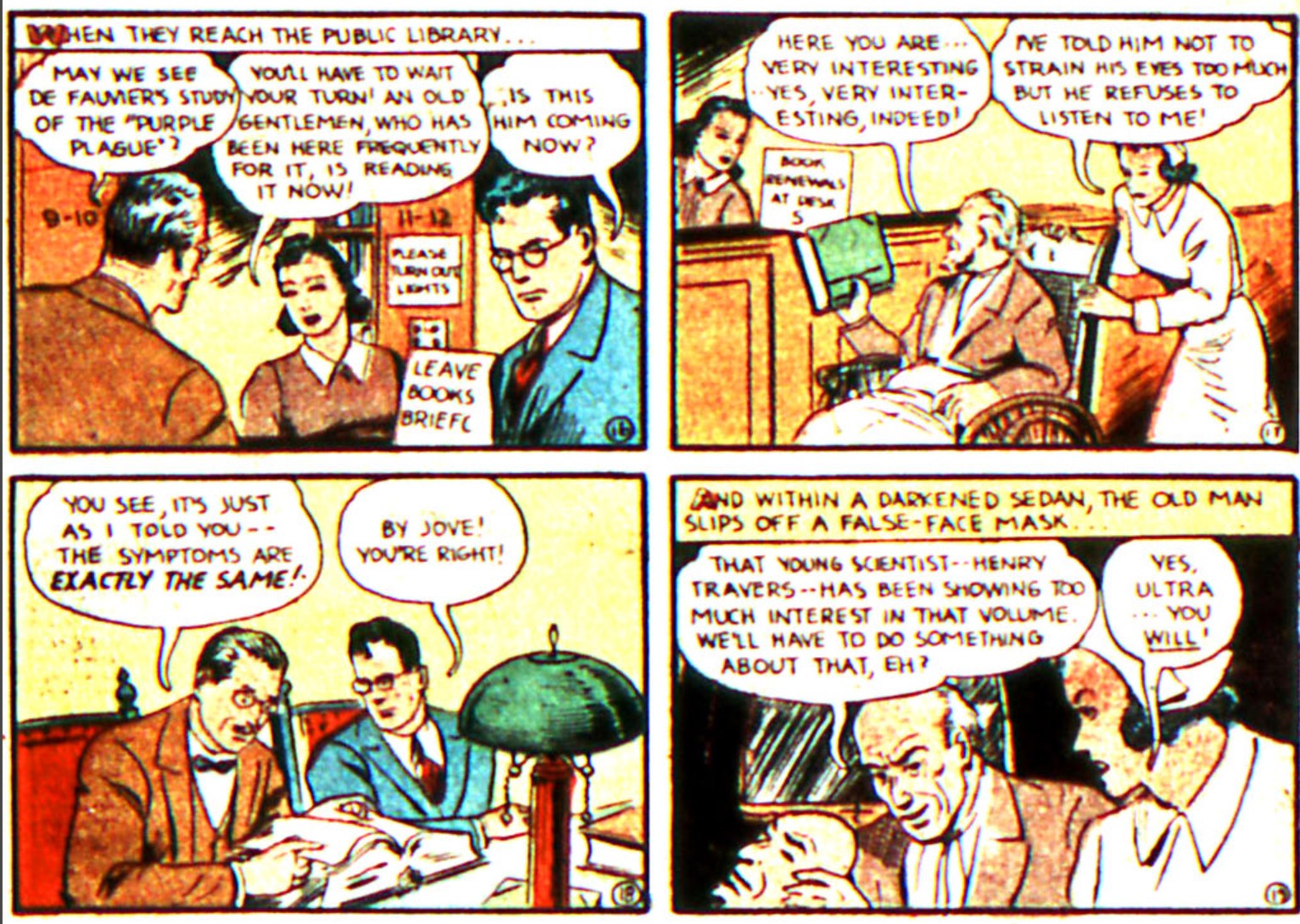
    When a mysterious virus called the Purple Plague starts ravaging Metropolis, Clark Kent and his pal Professor Henry Travers his the library to research a historical instance of the same disease, in a book also called The Purple Plague. It turns out that the Ultra Humanite had also checked out the same book and that it had given him the idea to unleash the modern plague in imitation of the original. (Action Comics v1 019, 1939)

    Movies:

    Air Circus is a airplane stunt-heavy film that is plagued by accidents while filming until pilot Gary Hawkes gets involved and exposes the scheming director’s plot to scuttle the production and then turn a quick buck by buying up the incomplete footage. (More Fun Comics 039, 1939)

    Its the same old story: a film called The General’s Daughter shoots some scenes at the Army installation where Skip Schuyler works, there’s a series of incidents and then Skip has to save the day. Not too sure what the movie is supposed to be about. (Adventure Comics 043, 1939)

    It may be the crustiest and crunchiest lowest quality scan here, but Public Enemy #13 is a pretty fun name for a movie and I think that that makes up for it, at least a little. (More Fun Comics 040, 1939)

    Newspaper Columns:

    “Around the Avenue” is one of those old-school society gossip columns that they used to have in papers, and while Rennie McCavoy here is playing into Wesley Dodds’ hands by writing him up as a wild party dude/ potential victim for the story’s villain, it’s hard to respect the journalistic effort involved in seeing a guy being quietly drunk at a nightclub and pouncing on him like this. (Adventure Comics 044, 1939)

  • REAL PERSON ROUND-UP 021

    REAL PERSON ROUND-UP 021

    They just love putting real folks and versions of real folks in comics and I just love finding them and putting them on my blog. 

    Adolf Hitler:

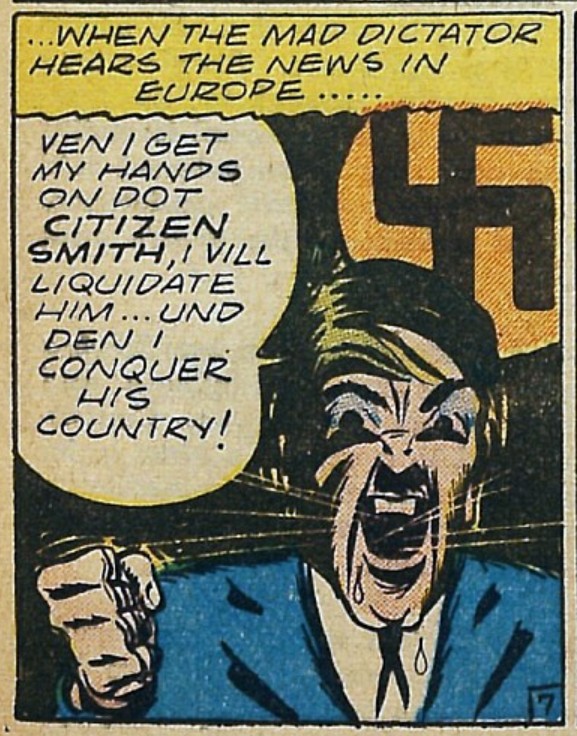
    An in-all-but-name version of Hitler gets mad at Citizen Smith for foiling his plans and plots. (Captain Fearless Comics 002, 1941)

    Gang boss and Deacon foe Duke Adare’s little toothbrush mustache is what initially drew my attention, even though that wasn’t nearly as glaring a signpost of a character being a Hitler stand-in in the 1940s. As the story wore on it became clear that my instincts were correct, as Adare used overwhelming military force to overwhelm the lawmen of Midland City and loot its treasury. And then of course you get to the end of the story, where they’re referring to him as a “would-be Crime Fuehrer”. (Cat-Man Comics 005, 1941)

    Minor appearances: 

    Captain Fearless Comics 001, 1941 

    Al Capone: 

    Lou Pacone, gang boss and murderer of the Secret Circle’s father, is yet another example of Al Capone’s name being remixed to give someone a gangstery sounding moniker. (Choice Comics 001, 1941)

    Axis & Allied Figures: 

    “America’s Air Army” was an extremely patriotic feature that was essentially US Army Air Force fan fiction about what would happen if and when the United States entered WWII, published just before they did. It’s the tale of the US forces (with a little help from the Brits) curb stomping the Axis for about half an hour before we get this little scene, with Hitler surrendering while Goering, Walther von Brauchitch (recently relieved of duty when this comic was published), Cordell Hull (I think) and Churchill observe. (Air Fighters v1 001, 1941) 

    FDR: 

    The President gets kidnapped by Dr Sivana! And Rescued by Captain Marvel! (Whiz Comics 014, 1941)

    Minor Appearances: Captain Aero Comics 001, 1941

    Lord Haw-Haw: 

    In his final Golden Age adventure, the Arrow aka intelligence agent Ralph Payne heads into Germany to apprehend the traitorous broadcaster “Lord Hawford.” (The Arrow 003, 1941) 

    Manuel Prado Ugarteche: 

    Lance O’Casey and his pal Dan’l Doom wash up on the shores of Peru and get mixed up in a scheme to overthrow the country by the wicked El Tigre. They foil him and restore power to the rightful president, Alfredo Blanco, who is extremely not Manuel Prado Ugarteche, the Peruvian president in our version of 1941. (Whiz Comics 015, 1941)

    Rudolph Hess: 

    “Deputy-Dictator Brinker” lands in a farmer’s field near Washington in what is certainly a reference to Hess’ flight to Scotland but is in fact revealed to be part of a plan to invade the US. The whole thing is nearly undone by the fact that the FBI doesn’t even bother to check on this seeming defection and just tells the poor farmer to deal with it. (Captain Fearless Comics 002, 1941)

    Sherlock Holmes:

    Dr Miracle is on the trail of a mystery, and who better to help than the summoned spirit of Sherlock Holmes Herlock Sholmes? Per the conceit of the story I guess this means that Sholmes was a real living guy at some point. (Champ Comics 012, 1941)

    Unknown Dancers: 

    Yet again we have an example of “this seems like a reference to something but I can’t find specifics,” in this case a dance team known as Velox & Costanza. The concept of a duo performing cultural dances from exotic locales crops up now and then as entertainment in comics but I’m never sure if the references to them are general or specific, and brief fads in live entertainment are among the trickiest things to casually research on the internet – it’s more of a “comb through several years’ worth of newspapers” kind of thing. (Whiz Comics 023, 1941)

    Walter Winchell: 

    As an example of why I include the Unknown entries in these round-ups: I had Walter Chinwell here listed as “Unknown Reporter” for something like two weeks before I came across Walter Winchell’s name in a list of 1940s radio announcers. And Winchell is someone I had already heard of! (Silver Streak Comics 008, 1941) 

  • SUPER-HERO FILE 002: CAPTAIN MARVEL JUNIOR

    SUPER-HERO FILE 002: CAPTAIN MARVEL JUNIOR

    (Whiz Comics 025, 1941)

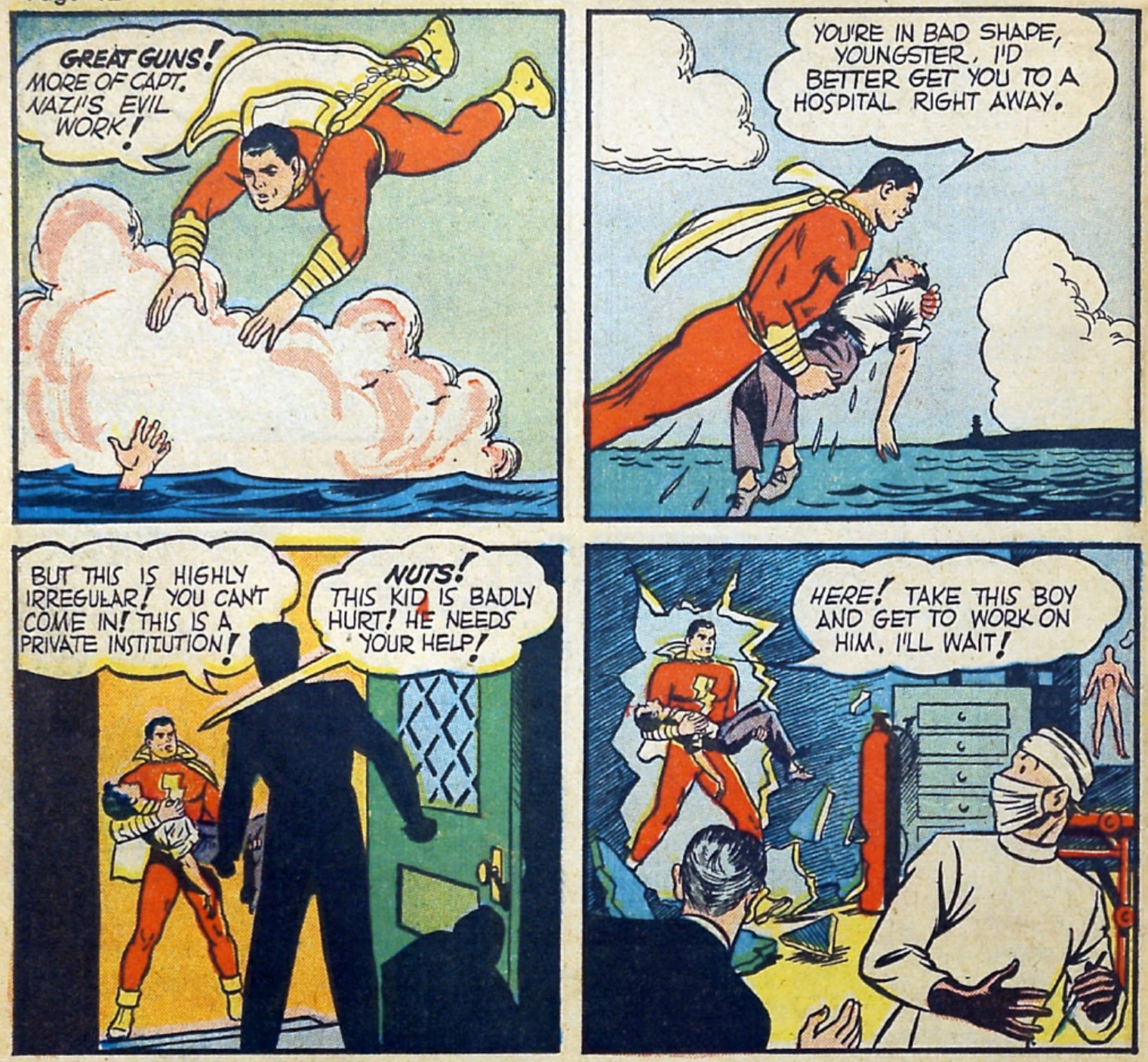
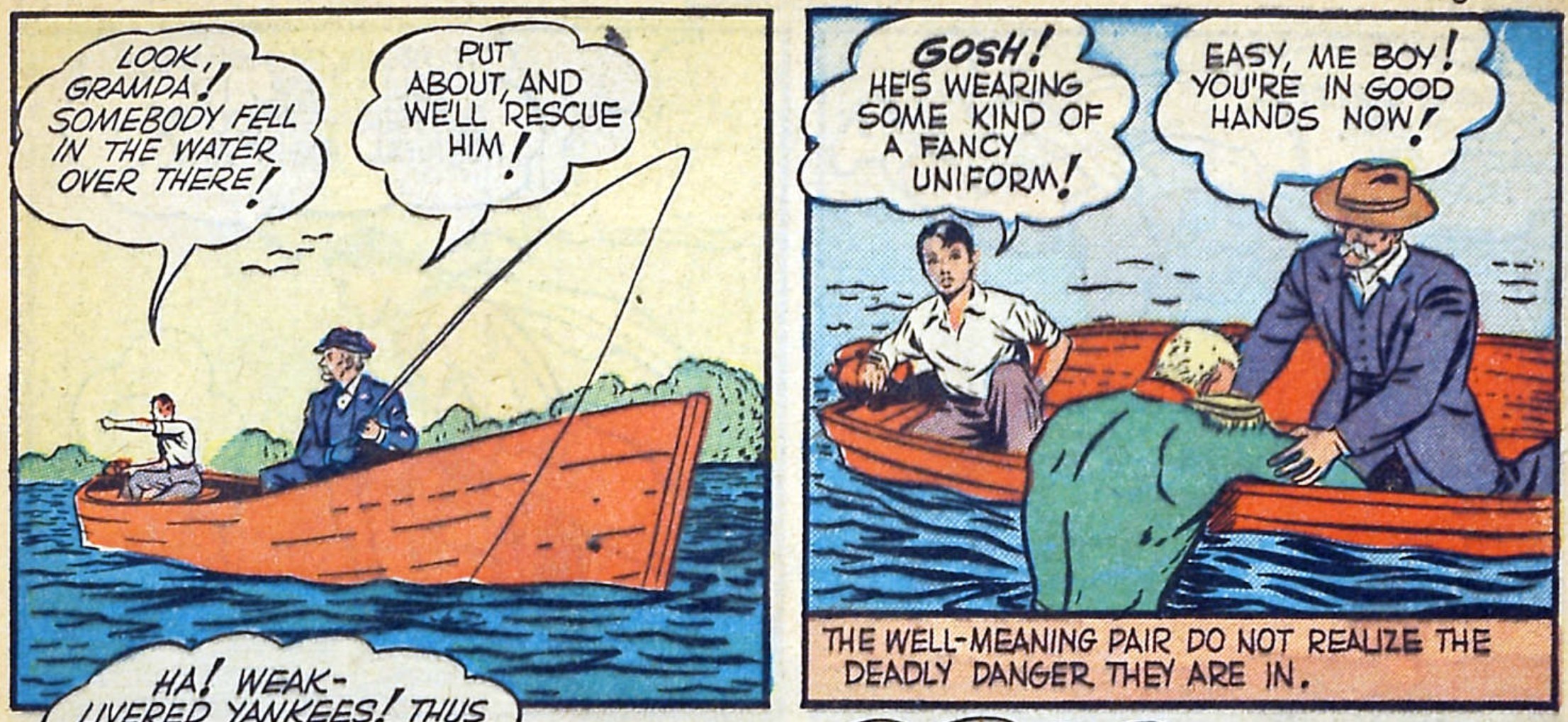
    After the vile Captain Nazi is knocked into New York Fawcett City Harbor during a battle with Captain Marvel, he is pulled from the water by young Freddy Freeman and his grandfather and immediately rewards their good deed by murdering them both. Or so he thinks! It turns out that Freddy is merely grievously injured, and Captain Marvel is able to bring him to a hospital for care.

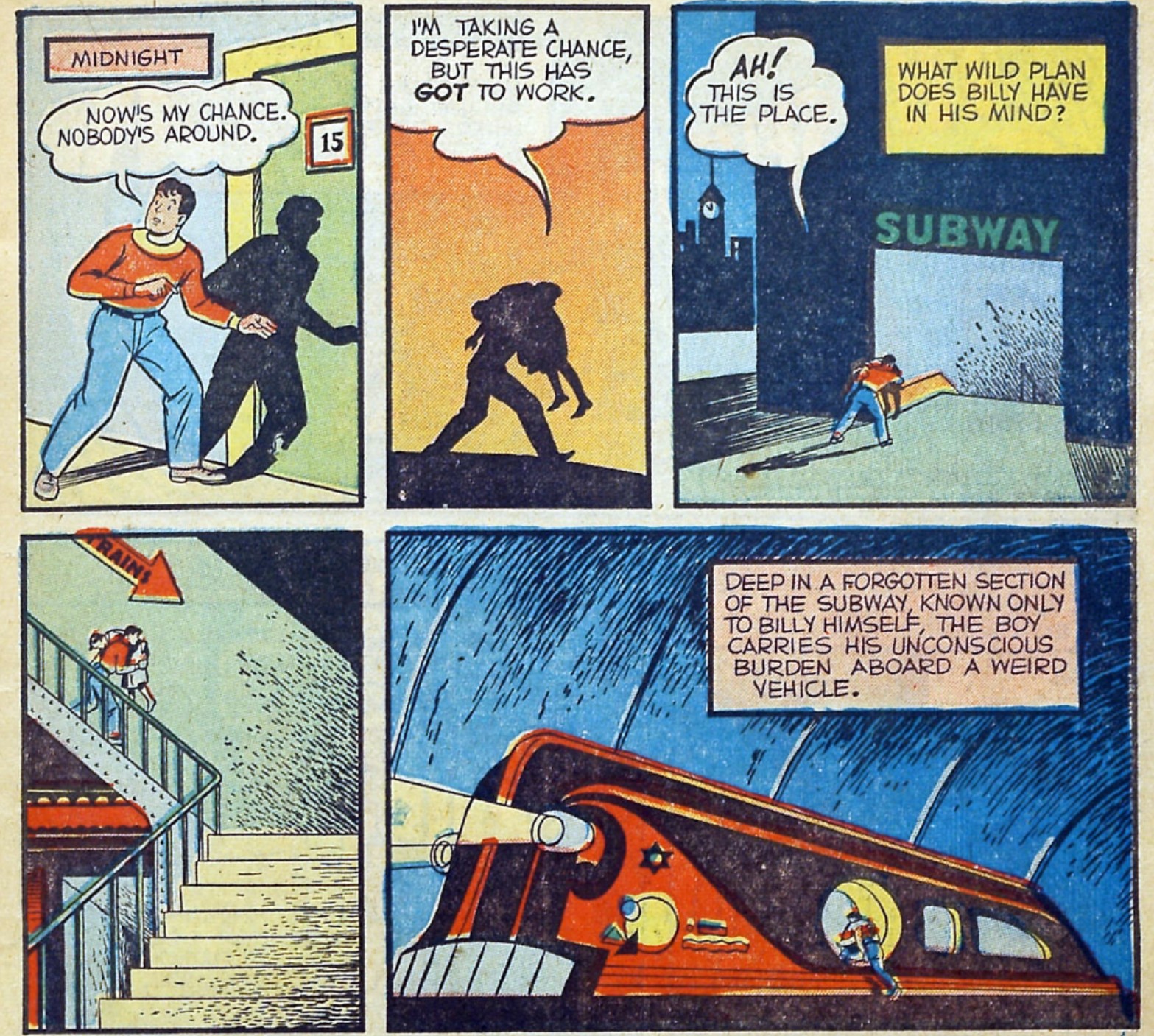
    Informed that Freddy is not expected to live through the night, Billy Batson makes the decision to bring him to the secret underground realm of the wizard Shazam in hopes that he might be able to do something for him. The wizard’s shade is summoned via an apparently mystical brazier (and hey, I think that this is Shazam’s first appearance since he was squashed by that huge block of stone during Billy’s origin!) but rather than help Freddy, Shazam places the onus of doing so on Captain Marvel’s shoulders.

    In practical terms, this means that rather than SHAZAM, the newly-minted Captain Marvel Junior says “Captain Marvel” to transform, which as many have pointed out before me means that he cannot actually say his own name without changing identities. Does the fact that Captain Marvel can do this ever come up again? Perhaps it ties in to the more modern conception of him as a sort of larval being who will eventually evolve into a new wizard, but I’m not sure if it come up in the intervening decades.

    Perhaps my favourite thing about Captain Marvel Junior is that since his comics were not drawn by CC Beck they have a different style to them and that when the Marvel Family are all together they emphatically do not adjust this. Everyone else (except perhaps Mary Marvel) is running around with that clean art style with those little black eyes and Cap Jr just keeps on looking like a young Elvis. It’s always fun!

    UPDATES: 

  • SUPER-HERO FILE 002: CAPTAIN MARVEL JUNIOR

    SUPER-HERO FILE 002: CAPTAIN MARVEL JUNIOR

    (Whiz Comics 025, 1941)

    After the vile Captain Nazi is knocked into New York Fawcett City Harbor during a battle with Captain Marvel, he is pulled from the water by young Freddy Freeman and his grandfather and immediately rewards their good deed by murdering them both. Or so he thinks! It turns out that Freddy is merely grievously injured, and Captain Marvel is able to bring him to a hospital for care.

    Informed that Freddy is not expected to live through the night, Billy Batson makes the decision to bring him to the secret underground realm of the wizard Shazam in hopes that he might be able to do something for him. The wizard’s shade is summoned via an apparently mystical brazier (and hey, I think that this is Shazam’s first appearance since he was squashed by that huge block of stone during Billy’s origin!) but rather than help Freddy, Shazam places the onus of doing so on Captain Marvel’s shoulders.

    In practical terms, this means that rather than SHAZAM, the newly-minted Captain Marvel Junior says “Captain Marvel” to transform, which as many have pointed out before me means that he cannot actually say his own name without changing identities. Does the fact that Captain Marvel can do this ever come up again? Perhaps it ties in to the more modern conception of him as a sort of larval being who will eventually evolve into a new wizard, but I’m not sure if it come up in the intervening decades.

    Perhaps my favourite thing about Captain Marvel Junior is that since his comics were not drawn by CC Beck they have a different style to them and that when the Marvel Family are all together they emphatically do not adjust this. Everyone else (except perhaps Mary Marvel) is running around with that clean art style with those little black eyes and Cap Jr just keeps on looking like a young Elvis. It’s always fun!

    UPDATES: 

  • SUPER-VILLAIN 002 UPDATE: CAPTAIN NAZI (1941)

    SUPER-VILLAIN 002 UPDATE: CAPTAIN NAZI (1941)

    Our second full-fledged super-villain is the odious Captain Nazi, and he had a short but busy run in 1941:

    After being deployed by Adolf Hitler himself as a foil to the threat of the American super-hero, Captain Nazi makes a very public appearance in Times Square in order to issue a challenge to Bulletman. This also attracts the attention of Captain Marvel, leading to the second Fawcett Comics character meetup of 1941 as they decide to team up and kick his ass together.

    In contrast to the bluster of his challenge, Captain Nazis’ activities in NYC are more sneaky sabotage than high-stakes public super-combat. Specifically, an attempt to derail a subway car is foiled by Captain Marvel, while an attempted Ferris Wheel disaster is effectively countered by Bulletman.

    Loathe as I am to praise Captain Nazi  I must admit that he is an effectively ruthless villain – if he didn’t have the misfortune of being pitted against two of the more powerful superhumans available he would be riding roughshod over US infrastructure instead of taking child-hostages and escaping into the shadows.

    After attempt to blow up the Brooklyn Naval Yards – foiled by Captain Marvel, natch – Captain Nazi demonstrates the trademark Fawcett character semi-awareness that he is in a comic book and leaves a note declaring his intent to come over to Whiz Comics to make life difficult there. (Master Comics 021, 1941)

    Sure enough, Captain Nazi returns as promised and continues his campaign of sabotage against a dam and an experimental aircraft.

    After being hurled into the ocean by Captain Marvel, Captain Nazi commits the act that he is most well known for as he repays the kindness of young Freddy Freeman’s grandfather by murdering him and making off with his boat, leaving Freddy himself for dead. This of course is the origin of Captain Marvel Junior, as the only way that Freddy survives is by being imbued with a fraction of Captain Marvel’s own power.

    Thus, the villain once again creates his own nemesis.

    (Whiz Comics 025, 1941)

    BODY COUNT: 3+

    END-OF-YEAR STATUS: At Large 

  • SUPER-VILLAIN 002 UPDATE: CAPTAIN NAZI (1941)

    Our second full-fledged super-villain is the odious Captain Nazi, and he had a short but busy run in 1941:

    After being deployed by Adolf Hitler himself as a foil to the threat of the American super-hero, Captain Nazi makes a very public appearance in Times Square in order to issue a challenge to Bulletman. This also attracts the attention of Captain Marvel, leading to the second Fawcett Comics character meetup of 1941 as they decide to team up and kick his ass together.

    In contrast to the bluster of his challenge, Captain Nazis’ activities in NYC are more sneaky sabotage than high-stakes public super-combat. Specifically, an attempt to derail a subway car is foiled by Captain Marvel, while an attempted Ferris Wheel disaster is effectively countered by Bulletman.

    Loathe as I am to praise Captain Nazi  I must admit that he is an effectively ruthless villain – if he didn’t have the misfortune of being pitted against two of the more powerful superhumans available he would be riding roughshod over US infrastructure instead of taking child-hostages and escaping into the shadows.

    After attempt to blow up the Brooklyn Naval Yards – foiled by Captain Marvel, natch – Captain Nazi demonstrates the trademark Fawcett character semi-awareness that he is in a comic book and leaves a note declaring his intent to come over to Whiz Comics to make life difficult there. (Master Comics 021, 1941)

    Sure enough, Captain Nazi returns as promised and continues his campaign of sabotage against a dam and an experimental aircraft.

    After being hurled into the ocean by Captain Marvel, Captain Nazi commits the act that he is most well known for as he repays the kindness of young Freddy Freeman’s grandfather by murdering him and making off with his boat, leaving Freddy himself for dead. This of course is the origin of Captain Marvel Junior, as the only way that Freddy survives is by being imbued with a fraction of Captain Marvel’s own power.

    Thus, the villain once again creates his own nemesis.

    (Whiz Comics 025, 1941)

    BODY COUNT: 3+

    END-OF-YEAR STATUS: At Large