The Curse of Skeleton Munroe

Category: MLJ

  • NOTES: JULY 2025

    The Fates of Various Nazi Warships: 

    Given the penchant for featuring even quite famous and obvious things under false names in comics, I always end up noticing when something or someone shows up under their own moniker, which is why I was very surprised when Royal Navy submarine captain Tom Niles, aka the Undersea Raider, is responsible for sinking several real Nazi warships in this 1940 comic. The casualties include the cruiser Admiral Scheer (sunk in 1945 in our world) and the battleships Bismarck (scuttled in 1941), and Scharnhorst (sunk in 1943). I had thought that the Admiral Graf Spee was another of these anachronistically early kills, but this depiction of it’s scuttling off of Montevideo, Uruguay is broadly accurate, except that it happened in 1939. A wild time for naval combat. (Thrilling Comics 004, 1940)

    The Fate of Rome:

    Specifically, the fate of Rome during the Great Fire of 64 CE. There are a lot of theories about how and why the fire was started, but very few of them revolve around it accidentally being started by magician/adventurer the Ghost and his companions while attempting to escape Emperor Nero’s soldiers with the help of an electric ray projector. (Thrilling Comics 008, 1940) 

    Honours – Doc Strange: 

    Doc Strange is given an unspecified medal by FDR for foiling a plot to bomb Washington DC. (Thrilling Comics 010, 1940) 

    The next issue, Doc gets a parade for saving NYC from being bombed into dust. (Thrilling Comics 011, 1940) 

    Honours – the Firefly: 

    Harley “the Firefly” Hudson was Intercollegiate Pole Vault Champion during his time at NYU – plus he went to NYU! Very exciting to know exactly where a super-hero got his education. (Top-Notch Comics 009, 1940) 

    Honours – Fran Frazer: 

    Magazine photographer Fran Frazer receives a medal from the country of Murania for preventing a Nazi invasion. (Top-Notch Comics 010, 1940) 

    Alternate Identity: 

    Doc Strange, while suffering from amnesia, boxes world heavyweight champion Bull Gallagher under the identity of the Unknown. (Thrilling Comics 001, 1940) 

  • REAL PERSON ROUND-UP 011

    I hope you like the War of 1812 and its wacky cast of characters, because here they come!

    Dolley Madison:

    Seen saving the portrait of George Washington from the soon-to-be-burned White House. (Shield-Wizard Comics 002, 1940)

    Francis Scott Key:

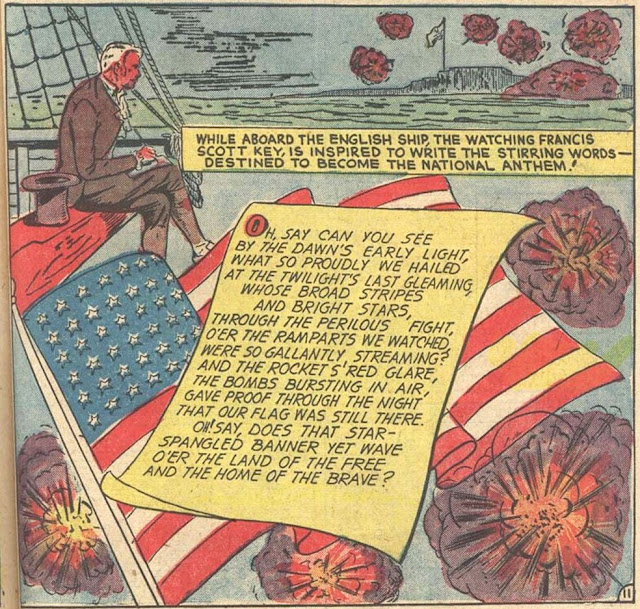
    Meets Tommy the Super-Boy while both are imprisoned by the British, then is freed by the second Wizard in time to be inspired to write a national anthem. (Shield-Wizard Comics 002, 1940)

    James Madison: 

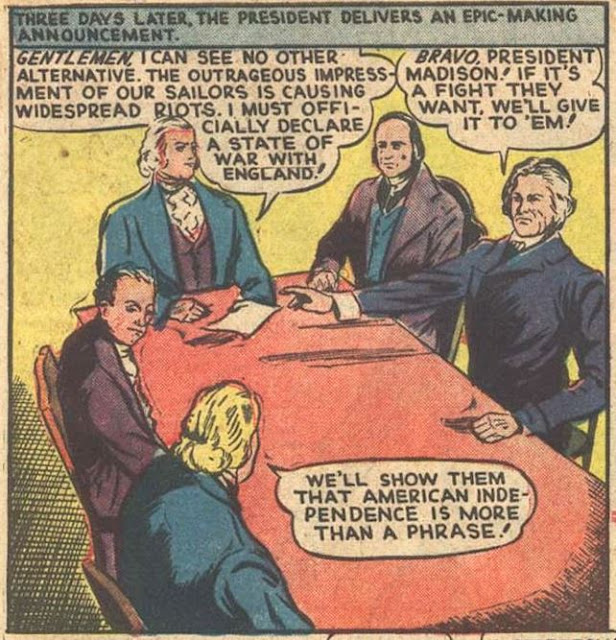
    Seen periodically in the lead-up and progress of the War of 1812. (Shield-Wizard Comics 002, 1940)

    Oliver Hazard Perry:

    Captain Perry, of “we have met the enemy and they are ours” fame, is aided in his greatest naval victory by the intervention of the second Wizard. (Shield-Wizard Comics 002, 1940)

    Tecumseh:

    The historical Wizard adventures in Shield-Wizard Comics 001 and 002 are on the whole very kind to even the more derided figures in American history (see William Hull, below), but Tecumseh here, who was held in pretty high esteem by his historical contemporaries as well as historians, is instead portrayed as a bloodthirsty creep. I WONDER WHY 

    This version of Tecumseh also meets his end at the hands of the second Wizard while attempting to murder General William Henry Harrison, rather than in battle. (Shield-Wizard Comics 002, 1940)

    William Henry Harrison:

    The future president is seen during his military days as he retakes Detroit from the British with the aid of the second Wizard. (Shield-Wizard Comics 002, 1940)

    William Hull:

    William Hull, governor of Michigan Territory at the beginning of the War of 1812, caught a lot of flak both in his own time and going forward for surrendering Detroit to the British. More recent evaluations of him have been kinder, including in his appearance in the story of the second Wizard. I’m not sure what the general opinion of him was in 1940 but the people at MLJ have added a kidnapped daughter as a major reason for his actions instead of blaming them on his general incompetence as seems to have been the norm for quite a while there. (Shield-Wizard Comics 002, 1940)

    Betsy Hull:

    Speaking of William Hull’s kidnapped daughter, this is her, and I would love to tell you if she was based on a real historical figure or not but a) I can’t find a biography of William Hull that lists his children’s names and b) I can’t seem to parse online genealogies – they have gone down some sort of structural route that has really obfuscated just how the people in the family trees actually relate to each other. In short, William Hull might or might not have had a daughter named Elizabeth but if he did she did not marry Blane Whitney, the second Wizard, like this young lady eventually does. (Shield-Wizard Comics 002, 1940)

  • REAL PERSON ROUND-UP 010

    The wartime exploits of the original Wizard, expressed as a series of encounters with famous figures from US history. 

    Benedict Arnold:

    Very nearly captured by the original Wizard. (Shield-Wizard Comics 001, 1940) 

    General Charles Cornwallis:

    Defeated by a coalition of the Americans, French and the original Wizard. (Shield-Wizard Comics 001, 1940)

    Admiral François-Joseph de Grasse:

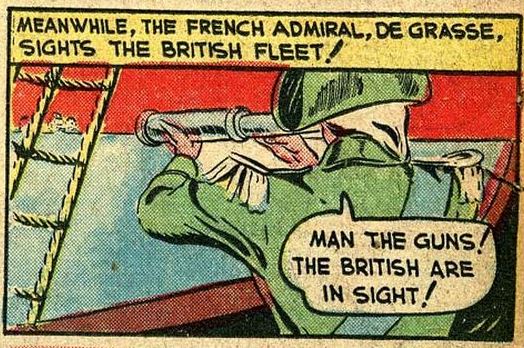
    Helps defeat the British fleet at Chesapeake Bay but of course he couldn’t have done it without the original Wizard. (Shield-Wizard Comics 001, 1940)

    George Washington:

    Wins the American Revolutiion with the help of the original Wizard. (Shield-Wizard Comics 001, 1940) 

    General Horatio Gates:

    Aided by the original Wizard at the Battle of Saratoga. (Shield-Wizard Comics 001, 1940)

    Colonel Johann Rall:

    The commanding officer in charge of the Hessian mercenaries famously defeated by Washington after the crossing of the Delaware, Rall (or Rahl, as here) supposedly did really ignore news of the impending attack to drink and play cards. (Shield-Wizard Comics 001, 1940)

    Major John André:

    Major André, head of British military intelligence in the Revolutionary War, captured thanks to the original Wizard. (Shield-Wizard Comics 001, 1940)

    Mad Anthony Wayne:

    Slightly less mad than in out timeline due to having the original Wizard with him when he charged the British (Shield-Wizard Comics 001, 1940)

    the Mayflower:

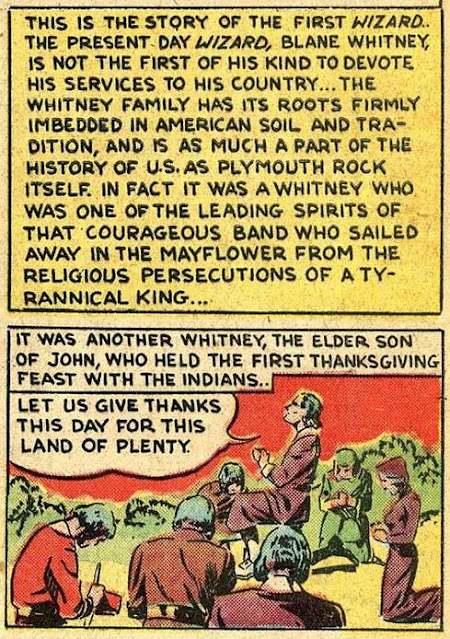
    I’m willing to bet that if I track the fictional ancestors of comic book characters who are said to have come over on the Mayflower then I will probably end up with a passenger list larger than the actual one. Our first entrants are two ancestors of Blane Whitney, aka the Wizard, and both named John. The younger of the two also organized the mythical first Thanksgiving, to boot! (Shield-Wizard Comics 001, 1940)

    Nathan Hale:

    In maybe the dumbest bit of American myth-making in the whole saga of the original Wizard, he frees Nathan Hale from his pre-execution imprisonment only for him to choose to stay behind and die because he can presumably somehow see all of the stupid patriotism that people load him down with in the future. Like of course his final words of defiance mean so much less if he’s essentially saying them and then blowing his own head off. Gah! (Shield-Wizard Comics 001, 1940)

    Paul Revere:

    Informed that the British are coming by the original Wizard (Shield-Wizard Comics 001, 1940)

    Thomas Jefferson:

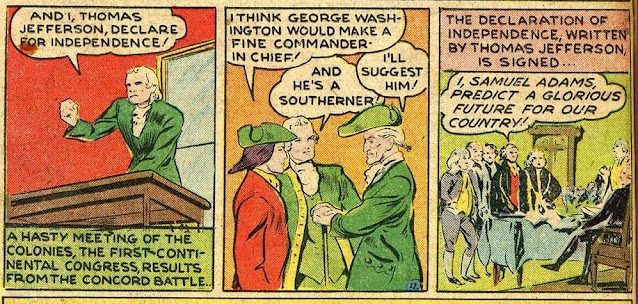
    Knocks out the Declaration of Independence after the original Wizard intervenes in the battle of Concord. Also Samuel Adams is there shouting his own name. (Shield-Wizard Comics 001, 1940)

  • REAL PERSON ROUND-UP 010

    The wartime exploits of the original Wizard, expressed as a series of encounters with famous figures from US history. 

    Benedict Arnold:

    Very nearly captured by the original Wizard. (Shield-Wizard Comics 001, 1940) 

    General Charles Cornwallis:

    Defeated by a coalition of the Americans, French and the original Wizard. (Shield-Wizard Comics 001, 1940)

    Admiral François-Joseph de Grasse:

    Helps defeat the British fleet at Chesapeake Bay but of course he couldn’t have done it without the original Wizard. (Shield-Wizard Comics 001, 1940)

    George Washington:

    Wins the American Revolutiion with the help of the original Wizard. (Shield-Wizard Comics 001, 1940) 

    General Horatio Gates:

    Aided by the original Wizard at the Battle of Saratoga. (Shield-Wizard Comics 001, 1940)

    Colonel Johann Rall:

    The commanding officer in charge of the Hessian mercenaries famously defeated by Washington after the crossing of the Delaware, Rall (or Rahl, as here) supposedly did really ignore news of the impending attack to drink and play cards. (Shield-Wizard Comics 001, 1940)

    Major John André:

    Major André, head of British military intelligence in the Revolutionary War, captured thanks to the original Wizard. (Shield-Wizard Comics 001, 1940)

    Mad Anthony Wayne:

    Slightly less mad than in out timeline due to having the original Wizard with him when he charged the British (Shield-Wizard Comics 001, 1940)

    the Mayflower:

    I’m willing to bet that if I track the fictional ancestors of comic book characters who are said to have come over on the Mayflower then I will probably end up with a passenger list larger than the actual one. Our first entrants are two ancestors of Blane Whitney, aka the Wizard, and both named John. The younger of the two also organized the mythical first Thanksgiving, to boot! (Shield-Wizard Comics 001, 1940)

    Nathan Hale:

    In maybe the dumbest bit of American myth-making in the whole saga of the original Wizard, he frees Nathan Hale from his pre-execution imprisonment only for him to choose to stay behind and die because he can presumably somehow see all of the stupid patriotism that people load him down with in the future. Like of course his final words of defiance mean so much less if he’s essentially saying them and then blowing his own head off. Gah! (Shield-Wizard Comics 001, 1940)

    Paul Revere:

    Informed that the British are coming by the original Wizard (Shield-Wizard Comics 001, 1940)

    Thomas Jefferson:

    Knocks out the Declaration of Independence after the original Wizard intervenes in the battle of Concord. Also Samuel Adams is there shouting his own name. (Shield-Wizard Comics 001, 1940)

  • MINOR SUPER-HERO ROUND-UP 039

    MINOR SUPER-HERO ROUND-UP 039

    We’re reading Shield-Wizard Comics, bay-bee, so here’s some stuff about the Shield and the Wizard.

    the Shield UPDATE:

    In our original write-up of the Shield, we noted that the origin of his powers shifted from being solely down to his super-suit to being more of an ingrained thing over time, and the time is now! Yes, Shield-Wizard Comics 001 provides a slightly tweaked version of the Shield’s origin, in which Joe Higgins’ father Tom was not just a US Army Intelligence agent but a gifted scientist who discovered the secret of inducing superpowers but died juuuust before being able to tell Joe the full secret.

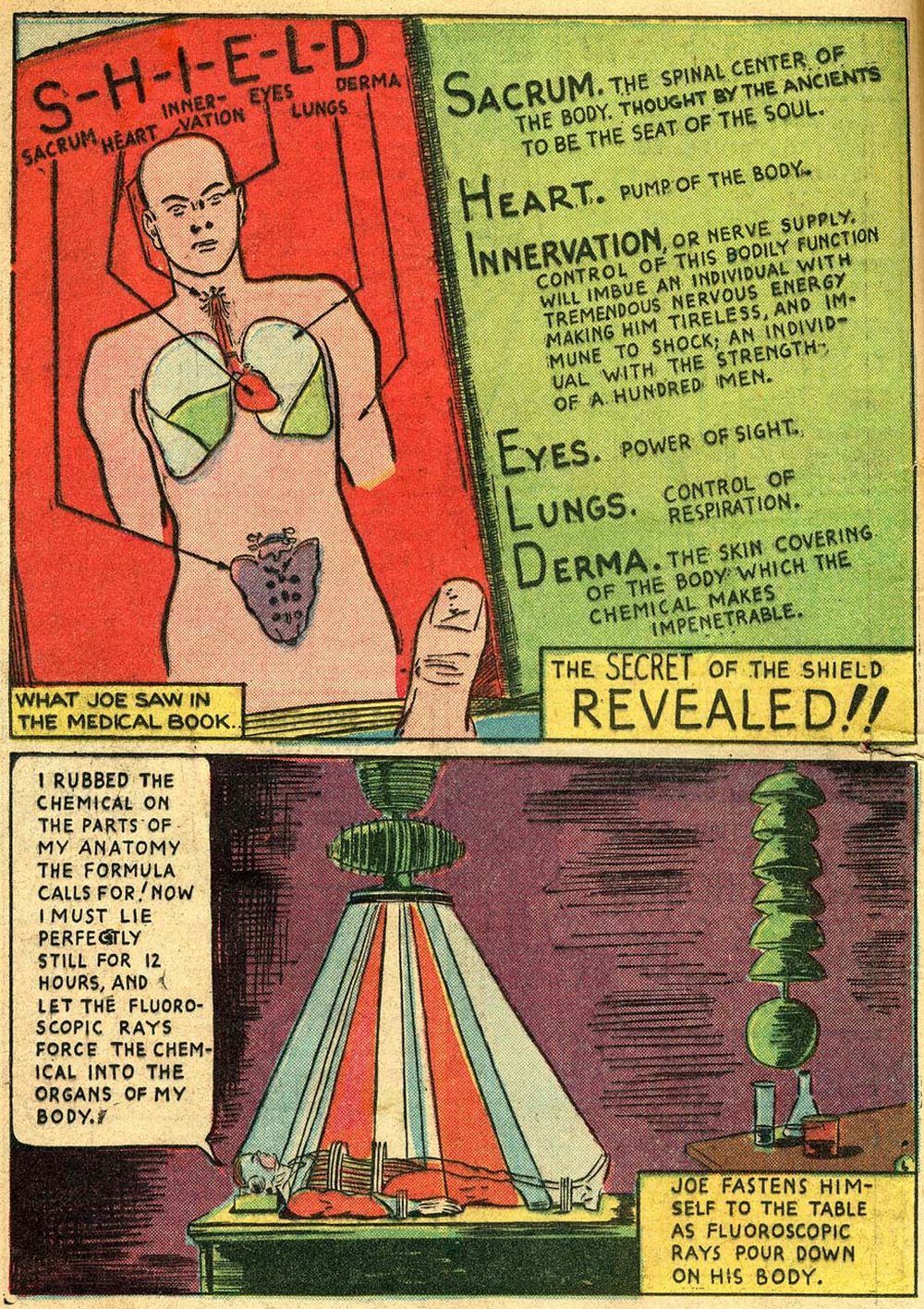
    Joe grows up to become a chemist himself but remains puzzled by his father’s last instructions to remember “anatomy formula S•H•I•E•L•D,” and with good reason, because it’s a nonsense jumble of anatomical parts that must have been put together only in the specific medical textbook that Joe eventually finds it in. But hey, he needed to find out where exactly to rub the chemical formula, and how would he otherwise know that it boiled down to “your eyes and skin, but especially the skin over your chest and groin” without that handy mnemonic device?

    The all-white costume that Joe is sporting before he settles down for a 12-hour session under the fluoroscopic ray shows up in at least a few retellings of the Shield’s origin going forward and I always thought that it was a pretty snappy look. Unfortunately, the rays dye his suit (and possibly his limbs?) in patriotic colours and so we get a red-white-and-blue Shield rather than merely a white one.

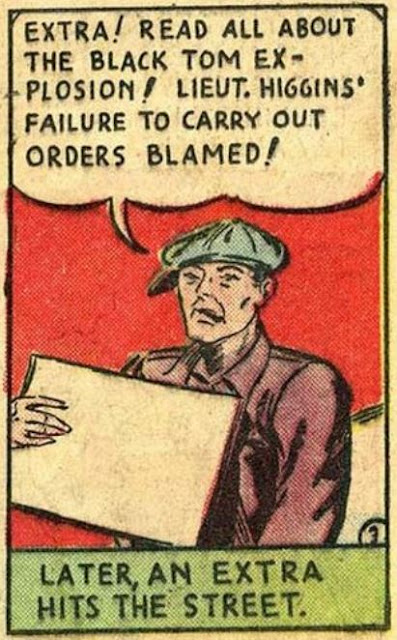
    The other tweak to the Shield’s origin is that rather than merely dying in the Black Tom Explosion of 1916, Tom Higgins is blamed for it, so the Shield now not only has a Batman-style motivation (spies killed my dad and now I must battle espionage) but also a Geoff Johns-Barry Allen-Flash one (I fight crime as part of my attempt to clear my father’s name). Thankfully, his first case involves rounding up the very German Hans Fritz and forcing him to confess, thus clearing Tom Higgins’ name without it becoming a whole thing. (Shield-Wizard Comics 001, 1940)

    the Wizard I:

    In the original account of the Wizard’s origin in Top-Notch Comics 001, the Whitney family’s close connection to American history is pretty thoroughly emphasized, with Whitneys present and getting things done at all major American wartimes. Well, Shield-Wizard Comics took up that gauntlet and ran with it: John Whitney organized the Mayflower expedition, and his son John Whitney organized the first Thanksgiving, and his son or grandson John Whitney thought up the idea of uniting the colonies. 

    But that wasn’t all: the third John Whitney’s son Blane (the main line of Whitneys only have time for three male names: John, Blane and Grover. All other named Whitneys are from dead end branches of the family tree, it seems) is just as super-human as his descendant, and in fact was the first of a line of Whitney family superhumans to call themself the Wizard (adopted as an ironic name after John Whitney was burned at the stake for witchcraft after acting on his son’s extrasensory visions to protect the colonies).

    The Wizard ends up making quite a big difference in the tides of the American Revolution, including:

    – informing Paul Revere that the British were approaching Concord and lighting the “one if by land, two if by sea” lanterns

    – showing up to participate in the fighting at Concord and turning the tide

    – wielding a cannon as a sidearm in the Battle of Bunker Hill and again at the Battle of Saratoga

    – saving Nathan Hale from being executed as a spy only not really because he chooses to die and be an inspiration instead

    – orchestrating the crossing of the Delaware and the surprise attack on the Hessian forces

    -very nearly getting Benedict Arnold before he gets away to join the British forces

    – proving instrumental in the capture of Major André

    – participating in several key battles, including the charge of Mad Anthony Wayne and the defeat of Cornwallis

    – orchestrating the support of the French for the revolution

     This original Wizard also creates a number of anachronistic inventions, including:

    – a glider that seems to function a bit more like a full-fledged airplane

    – a steam powered speedboat

    – something in between a deep sea diving rig and a scuba suit

    – a machine gun

    – radio communication

    – an electrified, battery-powered suit

    – a self-propelled sled

    – a tiny high-powered cannon

    All in all, the tale of the original Wizard holds up as a classic of the form, with the form being “super-heroes added to historical events.” Comics love to showcase the great moments of US history in particular, but as a comic book must prioritize action, any super-heroic character who is present must have an extraordinary amount of influence on history. It’s great! (Shield-Wizard Comics 001, 1940)

    the Wizard II:

    The second Wizard, like his father the original Wizard, is essentially a carbon copy of the modern character in appearance, name (Blane Whitney, natch) and abilities. Blane Whitney II also takes after his father in his commitment to inserting himself into important US historical events, including:

    – participating in various military engagements, including the defeat of the HMS Gurrierre, the Battle of Lake Erie, the Battle of the Thames (I think?) and the Battle of Bladensburg

    – saving William Henry Harrison from an assassination attempt

    – almost preventing the burning of the White House by the British

    – planning the defense of Fort McHenry and then participating in it

    – accidentally enabling Francis Scott Key to get inspired to write the Star-Spangled Banner

    This Wizard also has a lot of ahead of its time technology, including:

    – a version of his father’s glider

    – smoke (possibly tear gas) grenades

    – a dang tank

    The second Wizard obviously has less of a direct impact on the events of US history, if only because the War of 1812 has fewer Stand Up and Cheer moments than its predecessor. Still, he’s in there, and there’s every indication that we’d continue on to see a Civil War Wizard and a World War I Wizard and so forth, and the stated reason that we don’t see them is that as of Shield-Wizard Comics 003, the Wizard’s sidekick Roy the Super-Boy was too popular to not feature and so it was contemporary Wizard from then on out. (Shield-Wizard Comics 002, 1940)

    And speaking of Roy the Super-Boy:

    Tommy the Super-Boy:

    A part of any big project is choosing a methodology and then sticking to it and as my project is “reading all comics, in order” I had to figure out what “in order” meant. And while doing things in a month by month basis might be more true to the spirit of the experience, for my own sanity I opted to go alphabetical by year instead – the prep work alone for that other method hurts my head a bit to contemplate.

    All that is by way of explaining that Tommy, “the Original Super-Boy of History” (aka the original wonder-boy according to that one panel) is a retroactively created predecessor of the Wizard’s sidekick Roy the Super-Boy, who we will not meet until I have read the around 180 other comics between Shield-Wizard Comics 002 and Top-Notch Comics 008. He’s your classic orphan kid who gets to hang around a super-hero because he’s scrappy, and it turns out that that’s not unheard-of in historical youths.

    This particular scrappy kid, Tommy by name, is peeling potatoes when he meets an incognito Blane Whitney II and ends up discovering his secret identity after the Wizard participates in a sea battle and Tommy runs off afterward to berate Blane for cowardice, like a normal person does. And once you have discovered a super-hero’s identity, you get to become a super-hero! If you are a scrappy kid, of course. (Shield-Wizard Comics 002, 1940)

  • PROBLEMATIC ROUND-UP 004

    Get ready for a collection of MLJ’s finest racially-problematic villains.

    Yen Fat Sing: 

    Yen Fat Sing’s deal is that he knows about a treasure buried on Fu Chang’s charity farm and, in an effort to grab that treasure for himself, has been murdering the workers using man-eating plants. He’s a pretty standard type of minor super-villain but because he is a Fu Chang foe he is of course a generic Yellow Peril character on top of that. A couple of remarkable things about Yen Fat Sing: 

    1. after all the effort to run everyone off the farm, once Fu Chang is closing in he just sneaks onto the grounds and digs up the treasure, suggesting that he could have done that all along and particularly so because nobody knew about the treasure at all until he ran his mouth about it.

    2. Yen Fat Sing is killed in the course of the story but, unlike virtually every other comic book villain to have anything to do with carnivorous plants, he is not eaten by a tree but rather dies in a car crash.

    I do rally like that the man-eating plants only attack in the dark. That’s a fun detail. (Pep Comics 005, 1940)

    Joodar the Evil:

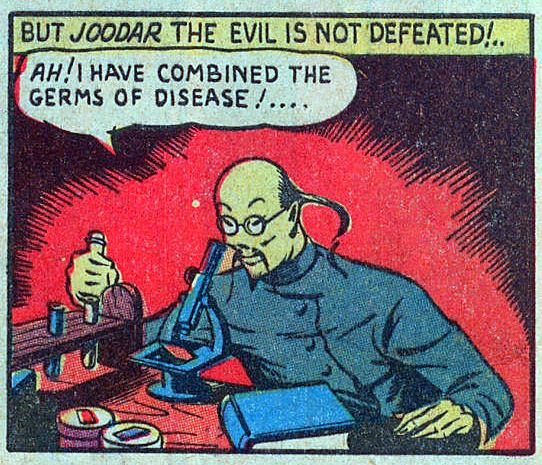
    Joodar the Evil starts out as an evil equivalent to Fu Chang, only instead of accessing his power via supplication to an ancestral god with a tonsure, Joodar worships the Great Genii of the Water Demons, and instead of a very eclectic set of animated chess figures…

    … Joodar is granted the services of – you guessed it – water demons. Though his stated plans involve world domination, Joodar has a lot of trouble with step 1: destroy Fu Chang, to the extent that both the Great Genii and his Water Demon crew end up destroyed. (Pep Comics 006, 1940)

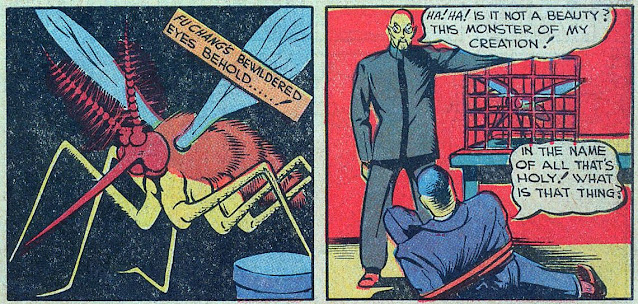
    Joodar returns in the next issue, potentially because “summoning water demons” isn’t a crime in San Francisco. This time he is without his demon pals and so he turns to the next best things: bacteria and mosquitoes! Specifically, he has mixed up a big batch of different harmful bacteria and stuck ’em in some mosquitoes in order to create havoc in San Francisco’s Chinatown. Why does he do this? It’s not entirely clear. Generic revenge? Mass chaos? Joodar doesn’t really deliver a coherent thesis statement I’m afraid.

    Joodar’s greatest creation is this enormous mosquito, which almost takes out Fu Chang and his fiance Tay Ming but ultimately cannot contend with those pesky magic chessmen. Joodar, as far as I know, just absconds into the night – perhaps mosquito-crime is also not illegal in San Francisco. (Pep Comics 007, 1940)

    Dr Wang:

    Dr Wang is a Yellow Peril villain in the true Fu Manchu mould, a sinister genius who strikes at the security of the US for no stated reason. It’s possible that we are meant to read Asian villain = Japanese, but if I’m honest an evil mastermind who plots against the United States for the sheer cussed challenge of it it quite a bit more evocative.

    Dr Wang is so threatening to the secuirty of the country, in fact, that we are introduced to him in media res ad the Shield attempts to murder him by dropping a boulder on his car. This is that proactive super-hero action that we al1 wanted in the late aughts!

    Dr Wang has two things going for him: the first is his mask, which looks great. Terrific style of mask, particularly with a hat. The second is his plan to disrupt US war production, by rounding up a bunch of guys who are afflicted with cholera and hypnotizing them into getting jobs in arms factories, thus starting a targeted cholera epidemic. And the very fun thing about this is that cholera is mostly spread by contact with infected feces, so these factories must be disgusting.

    The Shield cannot of course let this stand, and goes back for another try at solving the Dr Wang Problem, and you know what they say: the second time is the charm – plus it’s a bit more narratively satisfying for the Shield not to do a premeditated murder! (Shield-Wizard Comics 002, 1940)

  • REAL PERSON ROUND-UP 009

    Some day these won’t inevitably start with Hitler. Some day.

    Adolf Hitler:

    Rix, a human living on Venus in the peaceful year 3090 CE, learns about dictators thanks to the time capsule from the 1939 New York World’s Fair and immediately sets out to make himself into the Hitler of the future. Beat down by interplanetary troubleshooter Planet Payson. (Planet Comics 008, 1940)

    Aviator Ted O’Neil is brought down in the warlike nation of Gestapia (one of the more on-the-nose Nazi Germany stand-ins I have encountered), ruled over by dictator “Schnitzler.” (Prize Comics 004, 1940)

    Al Capone:

    It’s just a shorthand reference for “bigtime gangster” but Scarface Marone here is absolutely an Al Capone pastiche for the one and a half panels he appears in before jumping out a window to avoid capture. (Rocket Comics 002, 1940)

    Anna Roosevelt:

    She’s referred to only as “the President’s daughter” throughout this adventure which sees her being kidnapped and almost killed by Gerlandian spies before being rescued by Electro here, but it’s 1940 and the US has had precisely one President’s Daughter for nearly eight years at this point and it’s Anna Roosevelt. (Science Comics 001, 1940)

    Captain Nemo:

    It shouldn’t have surprised me when Navy Jones, established in the previous issue to be descended from the legendary Davy Jones, encounters not-just-fictional-but-fictional-from-about-seventy-years-earlier figure Captain Nemo while noodling around under the sea with his paramour Princess Coral, but I’m afraid that it did. And not only do they team up to battle octopus men and recover an ancient Roman map to Atlantis together but Nemo basically joins the “Navy Jones” cast going forward! (Science Comics 005, 1940)

    FDR:

    Minor Appearances:

    Science Comics 003, 1940

    Genghis Khan:

    Obvious allusion to Genghis Khan in Khangiz, the warlike master of Mars in the year 40 000 CE. (Planet Comics 002, 1940)

    J Edgar Hoover:

    You have a comic book character who works for the FBI and eventually an unnamed J Edgar Hoover is going to show up and congratulate them for doing their job, as happens to FBI agent Buck Brady here. (Prize Comics 005, 1940)

    J Edgar Hoover is not only Joe “the Shield” Higgins’ boss at the FBI but he was the best friend of Tom Higgins, Joe’s father. (Shield-Wizard Comics 001, 1940)

    Minor appearances:

    Science Comics 003, 1940

    Oak Island:

    Even though Fu Chang operates out of San Francisco and thus Money Pit Island is located somewhere in the Pacific, its name alone twigs it as at least inspired by the legend of Oak Island, which (I checked) was indeed going strong as of 1940 (Pep Comics 009, 1940)

  • GENERIC COSTUMED VILLAIN ROUND-UP 018

    The hits flops just keep coming.

    This gang doesn’t bother to give themself a proper name even though their scheme is extremely big and loud: they have access to a magnetic ray device and have employed it to pull down multiple large buildings in scenic Midtown City, thus killing between one and four thousand people (a printing error obscures the exact number), all so that their demands for protection money from the owners of other buildings will be paid without question. It’s just as well that the Comet eye-beams them all.

    I really am stuck on the fact that they haven’t bothered to give themselves a name, when they have such attention to detail that the hostages they grabbed in order to stymie the Comet were literally Mr & Mrs John Q. Public Priorities differ, I suppose. (Pep Comics 009, 1940)

    Buck Brady of the FBI is investigating a gang that is smuggling Malaysians across the Canada/ US border (because nobody would expect them to, that’s why) and the ringleader, when he shows up, is dressed fantastically. I cannot believe that more super-villains aren’t wearing big fur coats when they look so great when paired with a cowl mask. Anyway, he turns out to be Lieutenant Thomas of the US Border Patrol. (Prize Comics 003, 1940)

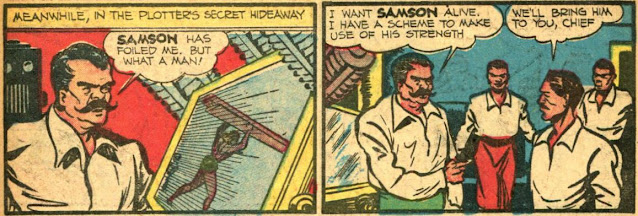
    Move over pre-2000s Wolverine, because this guy right here is possibly the most mysterious figure in comics. Samson and David track him to the hidden City of Erde after he initiates a series of attacks against the US, presumably with an eye on conquering it. But who is he? How did he become king of Erde and its population of cavemen? Where did he get the weaponry his cavemen are using in their attacks? Just how the heck did a whole city full of cavemen go unnoticed smack in the middle of the US, secret valley or no? (Samson 002, 1940)

    This unnamed mustachioed man is remarkable mostly for the number of pivots that he manages to pull off over the course of a 13-page story. He first attracts Samsons’s attention with a scheme to pit the presumably South American country of Ecuazil against its neighbour (sadly unnamed but probably something like Perile or Aregentuay) and then conquer both once they were both sufficiently weakened by the fighting. Once Samson and David put an end to that he hypnotically enslaved Samson for a while, then launched into a full-fledged invasion of the US. Pretty good range, I’d say.

    The US invasion plan also featured this amazing spindly-legged flamethrower tank. Bask in its pleasing aesthetics and questionable strategic value! Please also note David in these panels as this is a good representation of his role in the comic: all enthusiasm, willing to lasso absolutely anything, very low actual impact on events as they unfold but clearly Samson enjoys having him around.

    Finally, I don’t quite know why but I feel that I must highlight this sequence in which Samson hurls a man into a pit and then his lifeless body is just there for the next two panels. I want to frame this and hang it on my wall. (Samson 002, 1940)

  • MINOR SUPER-HERO ROUND-UP 034

    Here they are! Some guys you’ve never heard of!

    the Press Guardian: 

    In the Press Guardian’s first outing he is known as the Falcon, but he has the same core mission as he will throughout his career: to clean up crime in Central City via the free press, even if he must do so in a pretty bad costume. A fair few places online list reporter Flash Calvert as the Falcon’s secret identity but this is one of your classic reading comprehension/ research tests: it certainly seems like Calvert is the Falcon right up to the last third of the story, in which they start appearing in the same panels as one another. Thus, a claim that Calvert is the Falcon means that the claimant either skimmed the story in question or is taking the word of another who did so.

    By Pep Comics 002, the Falcon has officially changed his name to the Press Guardian and traded in his Victorian daredevil costume for a classic suit-and-mask combo. His identity is also revealed as Perry Chase, society columnist and universally derided failson of the publisher of the Daily Express. As with a lot of Golden Age heroes the necessity for your secret identity to be the subject of scorn is not really explained – surely the same effect could be achieved by faking a limp or something and then people wouldn’t constantly be insulting you to your face.

    But the papes must go through, and the majority of the Press Guardians adventures have a hand in ensuring that they do, if only tangentially. (Pep Comics 001, 1940)

    Auro, Lord of Jupiter:

    Before Auro was lord of anything he was just some kid with the last name Hardwich who was out on a Sunday space drive with his family when all of a sudden things went wrong and the family space car crashed into the solid, non-gaseous, habitable surface of the planet Jupiter. There, the now-orphaned boy is raised by a Jovian tiger, becomes extra beefy in the high gravity environment, and rises to a position of leadership in the nearby tribe of “Jupiter Brutes,” who name him Auro, meaning “Unconquerable”.

    All this is pretty standard jungle orphan, white guy exceptionalism stuff and I’m sure that one could make a pretty good case for it being just as unpleasant a series of tropes even when divorced from any real-world peoples etc, but what I must focus on is the fact that when you put a jungle guy in space he becomes a space barbarian and is actually pretty entertaining to read. (Planet Comics 001, 1940)

    the Red Comet:

    Speaking of taking character tropes from one comic genre and putting them in another, here’s the Red Comet! Like his fellow Fiction House hero the Red Panther, the Red Comet brings super-hero style to a non-super-heroic world, or worlds in this case, as he beetles around the cosmos righting wrongs.

    The Red Comet’s main trick involves shrinking and growing at will, but over time he demonstrates a wide range of situationally useful abilities including but not limited to: a crime-in-progress sense, insect communication, invisibility, super strength, the ability to survive in space without PPE, flight and the ability to change the size of others.

    The Red Comet’s ability to change size is initially attributed to advanced technology (an “intra-atomic space adjuster,” natch), while his expanded ability set is generally described as “magic.” Then, in Planet Comics 009, he is on a dinner date and explains that he got his size control abilities when he was struck by “some outer space force,” which gives him a more traditional super-hero origin. No word on whether his ability to talk to termites is still magic or as a result of another jolt of cosmic energy. (Planet Comics 001, 1940)

    Tiger Hart of Crossbone Castle:

    Tiger Hart is one of the more obscure Fletcher Hanks characters, a medieval warrior who spends his sole recorded adventure seeking the Great Solinoor Diamond (time for a Real Folk entry for the Koh-i-noor, I suppose) in order to free Queen Hilda from the clutches of the bandit chieftain Turk-the-Terrible. 

    All pretty standard sword and sorcery stuff but, presumably in deference to the fact that the story was being published in Planet Comics, it all takes place on the planet Saturn. This raises many questions! Are Tiger Hart et al Saturnians? Are they from a far enough future that humans have colonized Saturn (and the habitability of Saturn must be taken as a given, alas) and then gone through a societal collapse of some kind, a Dark Age and now a medieval-style era? Or, as the only real reference to Saturn is that the Solinoor is from Saturn, is the story set on a far-future retromedieval Earth? Many things to ponder. (Planet Comics 002, 1940)

  • REAL PERSON ROUND-UP 008

    If they’re real then why are they in a comic book?

    Anastacio Somoza García:

    The Shield meets with the President of Nicaragua and as per usual the artist did not bother to check what the President of Nicaragua actually looked like. (Pep Comics 006, 1940)
    Clark Gable:

    Boxer Kayo Ward stars in a movie (“Hot Lips and Hot Fists,” a riff on 1933’s “The Prizefighter and the Lady” starring real-life boxers Primo Carnera, Max Baer and Jack Dempsey) and the opening night crowd includes not only Clark Gable but Edgar Bergen and Charlie McCarthy, all under their real names in a wild break from comics custom. (Pep Comics 008, 1940)

    FDR:

    Misc minor appearances: 

    Meets with the Shield (Pep Comics 006, 1940)

    Shown blowing off a cabinet meeting to watch a boxing match (Pep Comics 007, 1940)

    J Edgar Hoover:

    He’s never actually named but “the Chief of the FBI” and only person who knows the secret identity of Joe Higgins, aka the Shield, is clearly supposed to be J Edgar Hoover, and they do occasionally refer to him by his surname. (Pep Comics 001-004, 006-009, 1940)

    Joe DiMaggio:

    Famed baseball player Slugger Madaggio (or possibly MaDaggio) is murdered mid-game for failing to pay protection money. Two other players, Wheezy Seen and Cal Bubble, as well as a manager named Terrier are mentioned in the story but I simply do not know enough about baseball to know who they are references to, if anyone. Also, the lady in the above picture is Madaggio’s wife and thus an oblique reference to actress Dorothy Arnold. (Pep Comics 007, 1940)

    Joe Louis:

    Boxer Kayo Ward is signed to fight Joe Louis for the heavyweight boxing championship, only Kayo is then kidnapped and replaced with a double by gamblers looking to fix the match, and when he manages to get free and fight for real the kidnapping has had enough of a negative effect on him that Louis sportingly calls the fight off rather than beat Ward to a pulp. They’re supposed to reconvene in six months – will it happen in 1941? (Pep Comics 006-007, 1940)

    Mata Hari:

    Sent to Antwerp to extract a British general’s daughter before the Nazi invasion, army hero Sergeant Boyle engages in some classic comedy of errors shtick as he accidentally brings back the wrong woman, only to find out that he has inadvertently captured the famed spy “Hatter Mary.” (Pep Comics 008, 1940)

    PT Barnum:

    There are a lot of comic book circus mans who are some sort of version of PT Barnum but this guy, Barnham by name, really captures the spirit of the man with his exploitation of Paul Bunyan’s ape-man friend. (National Comics 006, 1940)

    the Seven Dwarfs:

    The “Prince Buttonhead” feature in Pep Comics is from the school of one-page comic book humour strips that are best described as incoherent, with only the feeblest attempt at jokes or even a structured plot. The Five Dopes here (Block-Head, Lunk-Head, Stupid, Useless and Lame-Brain) are interesting for being so very on-model as a Seven Dwarfs parody. (Pep Comics 005, 1940)

    Various Golden Age Comics Creators:

    During Kayo Ward’s rise to the top he fights a lot of also-rans, and compiling a splash panel of them dovetailed nicely with the grand comic book tradition of using your coworkers’ names for mildly embarrassing purposes. In order (and focusing on MLJ credits because it’s an illustrious group), we have: 

    Butch Blezard – Okay I have no idea who this guy is. Bad start.

    “Canvas-Back” Shorten – Harry Shorten, co-creator of the Shield

    “Chick” Biro – Charles Biro, creator of Steel Sterling

    “Biff” Zoffer – Another mystery character

    “Mush” Meskin – Mort Meskin, prolific MLJ illustrator

    “Flash” Ashe – Edd Ashe, illustrator of the Wizard

    “Nosedive” Novick – Irv Novick, co-creator of the Shield

    “50 Second” Streeter – Lin Streeter, MLJ illustrator

    “Slam” Sundell – Abner Sundell, MLJ editor

    “Socker” Benson – probably not a reference, as he was a boxer faced by Ward in a prior issue. (Pep Comics 005, 1940)

    Pep Comics was a real hotbed of this kind of thing in 1940, as seen in this ad for “Meskin’s Matzhos”  (Pep Comics 007, 1940)

    Here’s Charles Biro ditching work to catch a boxing match. (Pep Comics 007, 1940)

    Handprints outside Grauman’s Chinese Theatre, featuring “Biro W. Mouskin,” “Sundell something (possibly M. Wood? as in Bob Wood, co-creator of Kayo Ward?) as well as “Mickey Looney” and “Joe E. Frown” (Mickey Rooney and Joe E. Brown, natch) (Pep Comics 008, 1940)

    And finally, the movie that Kayo Ward stars in is a Sundell Production. (Pep Comics 008, 1940)

    Unknown:

    The specifics of Jimmie Fiddle here, with his entertainment column in the NY Reflection, and especially the detail of him rating things with orchids, ping my “this is a version of a real guy” sense quite hard, but I can’t find a good thread to grab onto for a search. (Pep Comics 008, 1940)

    EDIT: a list of New York periodicals of the 1930s turned up the NY Review as a possible original of the NY Reflection, but any further investigation is hampered by the popularity of the New York Review of Books. It’s a dead end!

    ACTUAL UPDATE: We found him!