The Curse of Skeleton Munroe

Category: MLJ

  • REAL PERSON ROUND-UP 008

    If they’re real then why are they in a comic book?

    Anastacio Somoza García:

    The Shield meets with the President of Nicaragua and as per usual the artist did not bother to check what the President of Nicaragua actually looked like. (Pep Comics 006, 1940)

    Clark Gable:

    Boxer Kayo Ward stars in a movie (“Hot Lips and Hot Fists,” a riff on 1933’s “The Prizefighter and the Lady” starring real-life boxers Primo Carnera, Max Baer and Jack Dempsey) and the opening night crowd includes not only Clark Gable but Edgar Bergen and Charlie McCarthy, all under their real names in a wild break from comics custom. (Pep Comics 008, 1940)

    FDR:

    Misc minor appearances: 

    Meets with the Shield (Pep Comics 006, 1940)

    Shown blowing off a cabinet meeting to watch a boxing match (Pep Comics 007, 1940)

    J Edgar Hoover:

    He’s never actually named but “the Chief of the FBI” and only person who knows the secret identity of Joe Higgins, aka the Shield, is clearly supposed to be J Edgar Hoover, and they do occasionally refer to him by his surname. (Pep Comics 001-004, 006-009, 1940)

    Joe DiMaggio:

    Famed baseball player Slugger Madaggio (or possibly MaDaggio) is murdered mid-game for failing to pay protection money. Two other players, Wheezy Seen and Cal Bubble, as well as a manager named Terrier are mentioned in the story but I simply do not know enough about baseball to know who they are references to, if anyone. Also, the lady in the above picture is Madaggio’s wife and thus an oblique reference to actress Dorothy Arnold. (Pep Comics 007, 1940)

    Joe Louis:

    Boxer Kayo Ward is signed to fight Joe Louis for the heavyweight boxing championship, only Kayo is then kidnapped and replaced with a double by gamblers looking to fix the match, and when he manages to get free and fight for real the kidnapping has had enough of a negative effect on him that Louis sportingly calls the fight off rather than beat Ward to a pulp. They’re supposed to reconvene in six months – will it happen in 1941? (Pep Comics 006-007, 1940)

    Mata Hari:

    Sent to Antwerp to extract a British general’s daughter before the Nazi invasion, army hero Sergeant Boyle engages in some classic comedy of errors shtick as he accidentally brings back the wrong woman, only to find out that he has inadvertently captured the famed spy “Hatter Mary.” (Pep Comics 008, 1940)

    PT Barnum:

    There are a lot of comic book circus mans who are some sort of version of PT Barnum but this guy, Barnham by name, really captures the spirit of the man with his exploitation of Paul Bunyan’s ape-man friend. (National Comics 006, 1940)

    the Seven Dwarfs:

    The “Prince Buttonhead” feature in Pep Comics is from the school of one-page comic book humour strips that are best described as incoherent, with only the feeblest attempt at jokes or even a structured plot. The Five Dopes here (Block-Head, Lunk-Head, Stupid, Useless and Lame-Brain) are interesting for being so very on-model as a Seven Dwarfs parody. (Pep Comics 005, 1940)

    Various Golden Age Comics Creators:

    During Kayo Ward’s rise to the top he fights a lot of also-rans, and compiling a splash panel of them dovetailed nicely with the grand comic book tradition of using your coworkers’ names for mildly embarrassing purposes. In order (and focusing on MLJ credits because it’s an illustrious group), we have: 

    Butch Blezard – Okay I have no idea who this guy is. Bad start.

    “Canvas-Back” Shorten – Harry Shorten, co-creator of the Shield

    “Chick” Biro – Charles Biro, creator of Steel Sterling

    “Biff” Zoffer – Another mystery character

    “Mush” Meskin – Mort Meskin, prolific MLJ illustrator

    “Flash” Ashe – Edd Ashe, illustrator of the Wizard

    “Nosedive” Novick – Irv Novick, co-creator of the Shield

    “50 Second” Streeter – Lin Streeter, MLJ illustrator

    “Slam” Sundell – Abner Sundell, MLJ editor

    “Socker” Benson – probably not a reference, as he was a boxer faced by Ward in a prior issue. (Pep Comics 005, 1940)

    Pep Comics was a real hotbed of this kind of thing in 1940, as seen in this ad for “Meskin’s Matzhos”  (Pep Comics 007, 1940)

    Here’s Charles Biro ditching work to catch a boxing match. (Pep Comics 007, 1940)

    Handprints outside Grauman’s Chinese Theatre, featuring “Biro W. Mouskin,” “Sundell something (possibly M. Wood? as in Bob Wood, co-creator of Kayo Ward?) as well as “Mickey Looney” and “Joe E. Frown” (Mickey Rooney and Joe E. Brown, natch) (Pep Comics 008, 1940)

    And finally, the movie that Kayo Ward stars in is a Sundell Production. (Pep Comics 008, 1940)

    Unknown:

    The specifics of Jimmie Fiddle here, with his entertainment column in the NY Reflection, and especially the detail of him rating things with orchids, ping my “this is a version of a real guy” sense quite hard, but I can’t find a good thread to grab onto for a search. (Pep Comics 008, 1940)

    EDIT: a list of New York periodicals of the 1930s turned up the NY Review as a possible original of the NY Reflection, but any further investigation is hampered by the popularity of the New York Review of Books. It’s a dead end!

    ACTUAL UPDATE: We found him!

  • MINOR SUPER-VILLAIN 693: THE TARANTULA

    (Pep Comics 010, 1940)

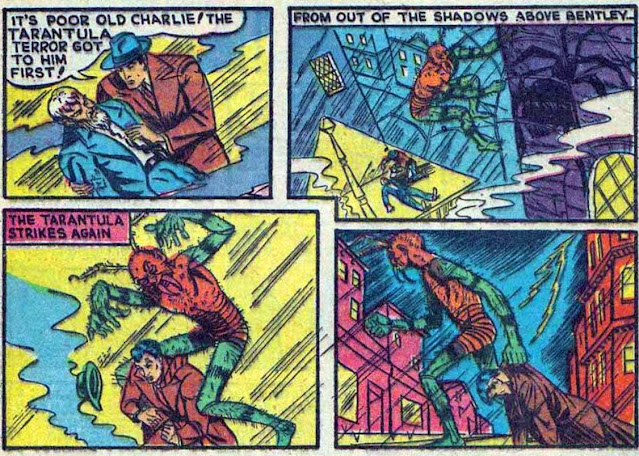
    A vile villain known as the Tarantula is extorting the young wealthy women of London and then murdering the ones who don’t pay up, and Inspector Bentley is on the case after two significant pieces of evidence fall into his lap: the latest body is left on the steps of Scotland Yard and then the latest extortion attempt is made against Deborah Morgan, whose father went to school with Bentley’s boss and you can’t beat the old boys’ club when it comes to swinging the forces of law into action.

    The usual parade of suspects that fills the pages of an Inspector Bentley story is a bit thin on the ground in this one. Don’t get me wrong, the numbers are there, but at least two of them are clearly padding – they don’t even say anything. The only credible suspects are BJ Morgan, his daughter Deborah (assuming some real 4D chess moves on her part), her fiance Bill Barnes and, in a big reach that the comic is not afraid to make, Bentley’s boss. I’ll say right now that the boss is a complete red herring set up by a walking stick.

    (please take note of the Tarantula’s little spider signature, which I love)

    Bentley goes to meet a potential witness, at which point w get the most important revelation of the episode: the Tarantula is not just some murderer but a proper super-villain, with a proper costume and everything! Sure, some spider fans might quibble about the inclusion of antennae (not to mention the use of fairly mild tarantula venom as the murder vehicle) but it’s been so long since I’ve seen a villain who wasn’t just wearing a mask that I literally cheered when I saw this dude.

    The Tarantula turns out to have about the right constitution for a basement dwelling spider breeder and goes down under the attacks of a heavily tied up Bentley. He’s smashed into his case of tarantula containment orbs in a way that would usually signal a villain’s ironic end via their own murder method, but I’ve reread the ending of this story a couple of times now and I have no clue whether the Tarantula is dead or alive at the end.

    The Tarantula turns out to be Deborah’s fiance Bill Barnes, who did it all because he was insecure about marrying a wealthy woman while not having much money himself. Moderately sweet, until you remember that he expressed this insecurity by extorting and murdering other young women. Wotta creep, am I right?

    More importantly is the question of exactly why Bentley was suspicious of Deborah’s circle: because when he went to interview his acquaintance Charlie about a possible Tarantula sighting he found him murdered and the only ones who knew about the potential witness were Deborah and her intimates. But did Bentley set a trap using the life of an innocent beggar or is he just so bad at infosec that he got a man murdered by accident?

  • GENERIC COSTUMED VILLAIN ROUND-UP 017

    GENERIC COSTUMED VILLAIN ROUND-UP 017

    Buncha mooks this time.

    The ship that picked up scientist-adventurer Dean Denton and his pals from the island of Baron Blood just so happened to have a pseudo-Nazi spy (fake name Lieutenant James, code name K-192, real name unknown) committing murders on it for unclear reasons. Despite composing a crime scene to contain nothing but clues pointing to other members of the crew Denton rounds him up pretty quickly. (Masked Marvel 003, 1940)

    Pilot Prop Powers has to defend his ship and his cargo of gold bullion from this air pirate and his scurvy crew, and the story ends up glossing over his huge flying aerodrome a bit. Well, I think it’s cool, unnamed air pirate captain. I’m sorry they blew it up. (National Comics 001, 1940)

    Klotz, aka the Master Spy, has the distinction of being the first foe to battle the Shield. His greatest moment is pictured above, as the Shield is so absorbed in reading spy files that he doesn’t notice approximately fifty boxes of TNT being piled up behind him. Klotz also returns in the 1984 series The Original Shield because there’s nothing like battling an extremely old man to make for an exciting comic experience. (Pep Comics 001, 1940)

    This bunch of clowns work for a mysterious figure who has been murdering Hollywood stars in connection with a jewel-smuggling ring. They’re not in the story for very long before their employer murders them all with mustard gas – the henchman’s greatest occupational hazard is, as always, the boss. Why do all these murders over some simple smuggled jewelry? Because the mastermind is Biff Crossley, himself a famous actor, and he wants nobody who can possibly tie him to the crime left alive, that’s why. (Pep Comics 008, 1940)

    THE SUPER-VILLAINS OF HOLLYWOOD PODCAST: The super-villainy might be a bit generic but this story is fodder for a whole season of tSVoHpod: Crossley murders two other stars (one of them inside Grauman’s Chinese Theatre, using a bullet-firing compact) and tries to frame a third by pretending to be a target himself, he bumps off his own men, the Shield is there, and the whole thing ends with Crossley’s defiant suicide. Sensational! This is podcasting, baby!

  • MINOR SUPER-VILLAIN 692: THE MASTER

    (Pep Comics 008, 1940) 

    It’s an old story, even this early in the history of comics: someone has developed a method for mass murdering people and is attempting to use it to extort money from a city, or else. In this case that person calls himself the Master and that method is some sort of electrical wave.

    The Comet of course is not cool with this kind of blatant super-villainy, particularly as he is still trying to rebuild his reputation after murdering dozens of people while hypnotized that one time. Lucky for him, the Master’s electric wave is vulnerable to the Comet’s disintegration ray for some reason – maybe it’s a Rock Paper Scissors situation and there’s a third form of energy that counters the Comet but can be defeated by the Master.

    Not content to admit defeat, the Master tries another classic gambit: he captures newswoman Thelma Gordon after correctly surmising that her repeated Comet-related front page scoops might indicate that she has some sort of connection to the man himself. And it works! The Comet is lured to a selected location and trapped in a glass net (because glass is the only material left unharmed by the Comet’s deadly eye beam and the Comet has had zero success in keeping that information under wraps). Unfortunately for the Master, catching someone in a glass net is not quite the checkmate move he assumed it was and he ends up on the wrong end of a death ray blast.

  • MINOR SUPER-VILLAIN 691: THE CLAW

    (Pep Comics 007, 1940) 

    The Press Guardian’s only recurring villain, the Claw has what can only be described as an eclectic career: In his first appearance he’s a sort of freelance spy chief working to aid the I-assume-European country of Shironia in its attempt to conquer neighbouring Lanfia by committing acts of sabotage in the US and framing Lanfia as the perpetrator so that America will withdraw its support of Lanfia. The Press Guardian exposes the scheme and sends the Claw and his henchmen to a presumed watery grave.

    Pep 008 drops a bombshell: the Claw could, in fact, swim. Instead of drowning, he made his way to the Central City docks and set up an insurance scam whereby he and his crew of rowdy sea dogs sunk their own ships for a tidy profit. The only flaw in the plan: the Claw kept on murdering nosy reporters who got too interested in all the shipwrecks going on, and you know that the Press Guardian is going to show up to check something like that out. The Claw ended up in the drink again, presumed dead but with more of a question mark than before.

    And that question mark was justified! Pep 009’s Press Guardian adventure begins with he and his aide Cynthia Blake investigating an extremely suspicious want ad for “young, healthy women with no living relatives” and wouldn’t you know it, it’s the Claw again. He’s been turning people into beast-men using animal hormone injections and he’s decided to finally branch out into making beast-women. The Press Guardian is even less into this scenario than the others and wastes little time in beating everyone up and forcing the Claw to reveal the antidote to beast-manism. When last seen the one-handed villain is being chased down by a mob of former beast-men, with murderous intent. Surely the Claw has finally met his end?

    No dice. The Claw returns one last time, in Pep Comics 010, with a knife-wielding green-skinned weirdo named the Goon in tow. The Goon and the Claw have been kidnapping women from a bit of cottage country called Rocky Point – has he gone back to making beast-women? Is he trying to ruin the Press Guardian’s home paper, the Daily Express, who are involved in the development of the region somehow? No, he’s trying to drive people off so that he can steal a radium deposit that’s located on the land.

    The Claw suffers a fairly ignominious defeat in the face of what can’t have been a very hard kick from Cynthia Blake. For all that he’s been tenacious, he’s also always been very easily defeated and while in a real-world way I know that that is because the Press Guardian was a second-tier character with a smaller pagecount than a headliner like the Shield, in my heart of hearts I prefer to believe that he’s just a scrawny little wiener. Or maybe it’s because he hangs out in radium-filled caves all the time, who can say.

    Though the Goon is captured, the Claw just scampers away, and since he isn’t in what turns out to be the Press Guardian’s final outing in Pep Comics 011, he’s just… at large when all is said and done (though again: radium cave. The Claw might not have been troubling humanity for much longer after this particular escapade).

  • MINOR SUPER-VILLAIN 690: VULCAN

    (Pep Comics 006, 1940)

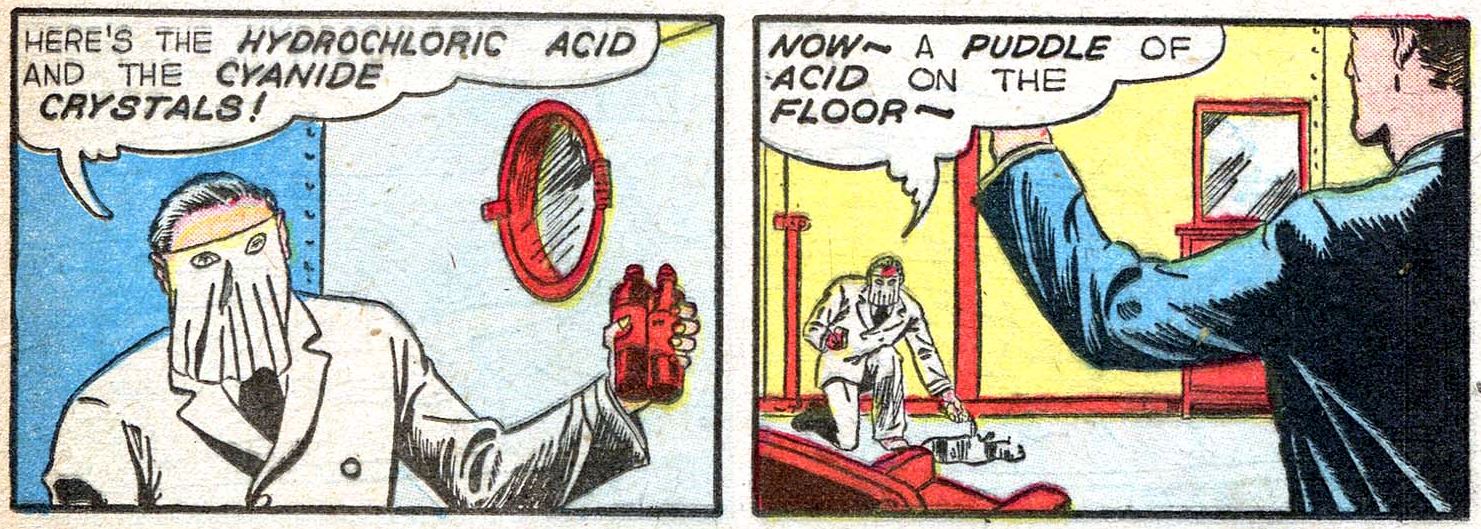
    A man working in a London steam plant dies by falling into an industrial furnace. A horrible thing to happen! Why am I showing you this horrible thing?

    I am showing it to you because it is not in fact a horrible accident but a horrible murder, and we know that because the murderer left a horrible little bit of doggerel in order to crow about what he did, and he signed it “Vulcan.”

    Our old pal Inspector Bentley of Scotland Yard is brought in on this case, and it’s a lucky day for him because there are only four possible suspects: the four men who were in the immediate area when John Baker was killed, including his father, his brothers Rex and Bob and his romantic rival Barney Reyman. Like I said: lucky for Inspector Bentley because I’m beginning to suspect that he isn’t a particularly astute detective when he doesn’t have a guy in a rubber mask to hit with his cane.

    Am I saying this because Bentley’s only idea is to have everyone go back to where they were when the murder took place with the foreman standing in for his son and Pa Baker is basically instantly murdered too? Kind of, but it’s more of an observation that his investigations are a bit brute force. For instance, once this second member of the Baker clan is bumped off, Bentley arranges for another one to stand in front of the open furnace.

    Did Bentley know what he was doing? Was he calling Bob Baker’s bluff in order to force him to confess by dodging the deathtrap he had set up for his family members (a button-activated swinging pipe, fyi)? It’s possible, but I personally think that the “Vulcan = hatred for father and brothers” clue is some bullshit. Does Vulcan have more than his share of family drama? Absolutely, but no more than any other Greco-Roman god and frankly I would peg a guy named Vulcan as a potential matricide, if anything.

    So was he right or just trying to winnow down the suspect list a bit? Inspector Bentley will never tell.

  • MINOR SUPER-VILLAIN 689: THE MAN-MONSTER OF LONDON

    (Pep Comics 005, 1940) 

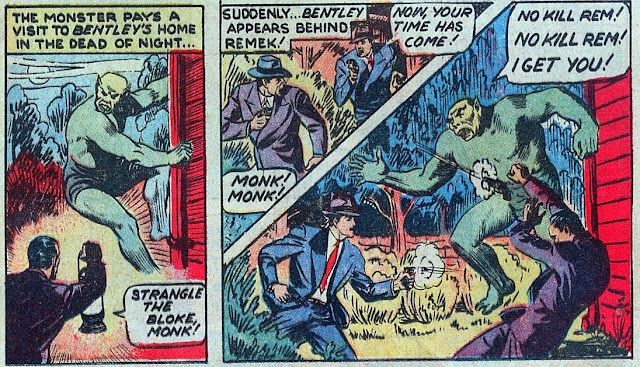
    The Man-Monster of London, aka Monk, doesn’t actually play that big a part in the plot of this Bentley of Scotland Yard story. I mean, he’s in a lot of it, but he doesn’t have a lot of volition of his own. In brief, the Rajah of Inrak (which is probably meant to be an Indian province or kingdom and not a whole country of its own) is in London to discuss some sort of treaty with the government of the UK and a fellow named Remek has been hired to prevent this meeting from taking place and the Man-Monster works for him. He’s very much the most spectacular part of the whole affair but he’s not really driving the action.

    The Man-Monster and Remek both end up being gunned down in self defense by Inspector Bentley and it’s honestly more sad than anything else – we never really get any idea of what Monk is exactly (some sort of mutant? a member of some isolated community of superhumans? just a big strong guy dyed green?), but whatever he is he clearly cares for Remek and doesn’t seem like he really chose to be a superhuman goon.

    ADDENDUM: If you bothered to read that text panel above you might have noticed that one of the potential suspects was the Prime Minister, as in the Prime Minister of England, who I assume was included purely because they were short on named characters for the suspect list this issue. This is him: not precisely Sir Neville Chamberlain (who would’ve just resigned as this issue was being put together) but close enough.

  • MINOR SUPER-VILLAIN 688: THE HUNCHBACK HORROR

    (Pep Comics 004, 1940)

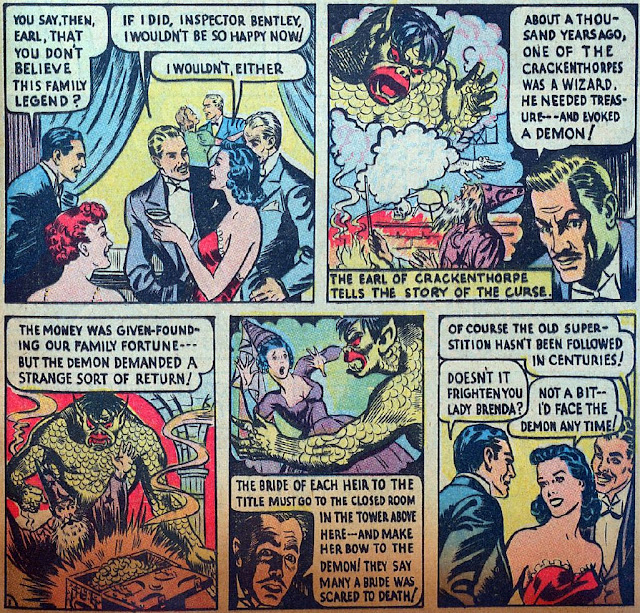
    We open on Inspector Bentley in the midst of a cocktail party to celebrate the engagement of his friend the Earl of Crackenthorpe. By way of entertainment, the Earl recounts the legend of the Crackenthorpe Curse: a thousand years ago, the progenitor of the Crackenthorpe line made his fortune the old-fashioned way, by summoning a demon and asking it for riches. Ever since, the brides-to-be of the heirs to the Crackenthorpe title must present themselves to the demon in a particular room in Crackenthorpe Manor, leading many of them to die of fright.

    All this talk of ancient spooky customs activates fiance Lady Brenda’s plucky nature and she marches upstairs to present herself. Suddenly, a scream! Is the demon real? Lord Crackenthorpe charges to the rescue and when the dust clears, the demon is gone and the Earl is dead. Murder most foul! 

    Inspector Bentley quickly ascertains the major suspects: fiance Lady Brenda, brother and new earl Lionel Crackenthorpe, butler Wiggins and monocled cousin Osbert Beal.

    After a bit of running around, it turns out that Osbert was the culprit all along, despite not being in line for the Earldom. Not in line, that is, unless the only other claimant was executed for the murder of his brother. It wasn’t much of a plan but it came close to working – if only Inspector Bentley hadn’t been on the case. Lady Brenda gets engaged to the newest Earl in a somewhat mercenary move and everyone by Osbert lives happily ever after.

    (burning question: the demon-introduction tradition hadn’t been followed for centuries, according to the Earl. So how did Osbert know that he could take advantage of it as part of his scheme? He wasn’t shown among the collection of upper-class twits haw-hawing and egging Lady Brenda on… was he just improvising?)

  • MINOR SUPER-VILLAIN 687: PRINCESS LING FOY

    (Pep Comics 004, 1940)

    Princess Ling Foy probably belongs in the Problematic Round-Up with all of Fu Chang’s other enemies (and Fu Chang himself, of course) – she’s just as steeped in racist tropes as any of them, right down to her dumb name. But… I have to say that I like her hat.

    I also like her minions, the Warriors of Brass, which strongly resemble robots but which are by all accounts magical creations. Let’s spit the difference and call them automata, and honestly it doesn’t really matter because Fu Chang destroys them all with what must be some wildly powerful acid.

    Fu Chang spares Ling Foy’s life but also rejects her proposal that they rule Chinatown together (and “ruling Chinatown” is just as nebulous a concept as when all those Fantomah villains were attempting to conquer “the Jungle” – are you going to be sending a representative to the San Francisco City Council or is this just a glorified protection racket?) which of course returns her to the path of crime precisely one second after Fu Chang gives her a second chance. Ling Foy heads right home to make a fairly low-effort sympathetic magic effigy out of wax, but regardless of quality it works. The only way Fu Chang is able to keep going is with the help of an infusion of healing juice from his magic chessmen, and even then he’s walking around with his arm in a sling.

    Having failed to gain revenge on Fu Chang by killing him, Ling Foy now summons an imp in an attempt to murder his fiance Tay Ming and once again the chessmen save the day, as tiny man battles tiny demon in a scene much more action-packed than a Fu Chang comic usually gets.

    The imp spills the beans on Ling Foy’s location and since Fu Chang can’t bring himself to harm a lady, Tay Ming takes out the trash.

    (If you read the Fu Chang entry and were wondering about what exactly the mermaid figure was used for, then this is your lucky day! As Ling Foy dies, the wax effigy of Fu Chang falls out the window into San Francisco Bay with a couple of knives still in it. The mermaid swims down and removes them, thus saving Fu Chang from a lifetime of feeling like he had two knives stuck in him)

  • PROBLEMATIC ROUND-UP 003

    This edition of the Problematic Round-Up is devoted to minor MLJ character Fu Chang and his foes.

    Fu Chang:

    Reading Charlie Chan comics has absolutely messed my head up in a specific way: because Charlie Chan is so clearly a project with the set goal of having a Chinese character who is not an overt racist Yellow Peril stereotype (while, yes, being pretty racist in a bunch of other ways) I give it more of the benefit of the doubt than I otherwise would. For instance, I just kind of skim most of what Charlie Chan says because actually parsing it is very painful. 

    The problem is, I keep automatically giving various other series featuring Chinese American detectives the benefit of the doubt, and very few of them are also earnest-but-flawed attempts to avoid the overtly racist tropes of the day. This is all to say Fu Chang and his adventures are pretty racist and it caught me off guard and I had to work through it here.

    So: Fu Chang is an American educated Chinese man (with a more Caucasian skin tone than the bright yellow Evil Chinese such as the Dragon, below) who is very dedicated to his (personal? family?) god and as a result has been gifted a chess set with “all the magic powers of Aladdin’s Lamp” (and this smearing of everything East of the Mediterranean into one big exotic mess is classic Orientalism) which in effect means that he has a bunch of little guys at hand to do his bidding.

    If there’s one fun thing about Fu Chang, it’s trying to figure out exactly what the heck kind of game this chess set could be used for. Here are the known pieces:

    – the Warrior – just a little guy, used to spy on folks

    – unnamed stage magician – has ESP or other way of locating hidden objects

    – the Little Man of Magic – a magician in the Indian mystic vein. More talkative and proactive than many others. Able to paralyze humans via magic 

    – the Doctor – healing plus some hand-to hand. Also has wings in one story

    – the Mermaid – amphibious

    – the Woodsman – tree-chopping action

    – a pilot – can fly a plane but the plane is sold separately

    – group of men in suits plus military officer and a jodhpured adventurer – engage in combat with the Tiger-Devil

    – Seen but never used: the shirtless guy, the blonde lady in the red dress, the policeman, the crook, the fat bald guy

    – winged people – obviously they can fly. As the series goes on the winged figures show up more and more until the last few adventures feature nothing but up to a couple of dozen of them.

    I suppose it’s possible that you could cobble together a complete chess set out of those. Obviously the winged guys would be the pawns, but where would the mermaid come in? Even more concerning than the fact that there might not have been a complete Fu Chang lore bible with detailed breakdowns of all the chess pieces and their powers is the constant slander of Aladdin’s lamp. Unless Fu Chang and his god have a chronic lack of imagination, this is a pretty weak showing from a fabled object. (Pep Comics 001, 1940)

    the Dragon:

    The Dragon is really notable only for his fantastic name as well as to illustrate the weird vibes-based skin-colouring in the Fu Chang comic – the more good and Westernized you are, the pinker your skin. Otherwise he’s a creep and a low-level Yellow Peril gangster. (Pep Comics 001, 1940)

    the Cult of the Tiger-Devil: 

    While I love the Tiger-Devil itself, the Tiger-Devil Cult that serves and has summoned him is some pan-Asian degeneracy nonsense straight out of Lovecraft. Serves them right for summoning a demon to conquer the world with that it gets beaten up by a bunch of little chessmen – though the Tiger-Devil has dominion over all men, the chess pieces are no men. 

    If the MLJ Universe hadn’t stopped being a continuous continuity in the early 90s it might be more significant that the Tiger-Devil ends up sealed in a jar and dropped into San Francisco Bay. Alas. (Pep Comics 002, 1940)

    the Drug-Master:

    It’s a Fu Chang sweep for this instalment of the Problematic Round-Up with Ghor here, aka the Drug-Master, a very hard-core name that I wish I could celebrate a bit more but no: he’s yet another Yellow Peril type with a bit of added spice in that he is also involved in the sinister Asian Drug Trade. Specifically, he’s bringing a powerful new drug into San Francisco’s Chinatown, one so addictive that it makes anyone his slave rather than do without it, even Fu Chang’s fiance Tay Ming. It’s so potent, in fact, that withdrawal induces a suicidal/homicidal frenzy and since the Drug-Master does not seem to be a particularly good boss, he’s letting his drug slaves go into withdrawal all over town. As is usually the case, the skills that make a criminal successful in human circles are of little use against a bunch of Fu Chang’s tiny guys and the Drug-Master ends up blowing himself to kingdom come. (Pep Comics 003, 1940)