The Curse of Skeleton Munroe

Category: MLJ

  • FASCIST GOON CLEARING HOUSE 008

    Will they ever mend their evil ways?

    Like the Purple Shirts before them, the Black Legion exists mainly to represent the Forces of Unamericanism that Uncle Sam stands against, as they seek to win the hearts and minds of in this case the small Midwest community of Glen Valley (by shooting anyone who resists). The only real bit of innovation that they bring to the table are these rad machine gun motorcycles they go into battle on.

    They also have a nose cutout on their masks, which indicates that they prioritize comfort over style. (National Comics 005, 1940)

    The unnamed group that Uncle Sam fights in the next issue has a similar uniform in warm brown tones, and makes the interesting choice to wear it even while operating their submersible aircraft carrier base in the middle of the Pacific Ocean. That’s some real dedication to secrecy. (National Comics 006, 1940)

    The European-American Band, yet another take on the German-American Bund, is deceived and then dismantled in fairly short order by vacationing cartoonist-detective Pen Miller. (National Comics 006, 1940)

    No comic book analog of the German-American Bund is particularly kind in its depiction but the Moronia Bund might just be the most insulting. I’m not sure why all the Moronian Americans are bald – it doesn’t seem to be a requirement for entry as Perry “the Press Guardian” Chase is able to join up as a junior member to spy on them despite his luscious black locks. (Pep Comics 002, 1940)

    (surprisingly, the Moronia Bund – under the slightly more sleek name “the Moroniabund” manages to scrape up another bunch of bald fascists to make a second appearance in Pep Comics 003, but gets its ass just as thoroughly kicked by the Press Guardian as the first time)

  • FASCIST GOON CLEARING HOUSE 008

    Will they ever mend their evil ways?

    Like the Purple Shirts before them, the Black Legion exists mainly to represent the Forces of Unamericanism that Uncle Sam stands against, as they seek to win the hearts and minds of in this case the small Midwest community of Glen Valley (by shooting anyone who resists). The only real bit of innovation that they bring to the table are these rad machine gun motorcycles they go into battle on.

    They also have a nose cutout on their masks, which indicates that they prioritize comfort over style. (National Comics 005, 1940)

    The unnamed group that Uncle Sam fights in the next issue has a similar uniform in warm brown tones, and makes the interesting choice to wear it even while operating their submersible aircraft carrier base in the middle of the Pacific Ocean. That’s some real dedication to secrecy. (National Comics 006, 1940)

    The European-American Band, yet another take on the German-American Bund, is deceived and then dismantled in fairly short order by vacationing cartoonist-detective Pen Miller. (National Comics 006, 1940)

    No comic book analog of the German-American Bund is particularly kind in its depiction but the Moronia Bund might just be the most insulting. I’m not sure why all the Moronian Americans are bald – it doesn’t seem to be a requirement for entry as Perry “the Press Guardian” Chase is able to join up as a junior member to spy on them despite his luscious black locks. (Pep Comics 002, 1940)

    (surprisingly, the Moronia Bund – under the slightly more sleek name “the Moroniabund” manages to scrape up another bunch of bald fascists to make a second appearance in Pep Comics 003, but gets its ass just as thoroughly kicked by the Press Guardian as the first time)

  • MINOR SUPER-VILLAIN 686: COUNT ZONGARR

    (Pep Comics 003, 1940)

    Someone has been using super-fast jet planes to mine New York Harbor and the Shield wants to know why, and not just because he happened to be on one of the ships that was exploded as a result. He manages to grab onto one of the planes the next time they come around and finds out first hand that they are not only super fast but able to convert into submarines as well. And that their home base is a very cool Art Deco-ish city in an underwater cavern!

    The mastermind of this whole scheme turns out to be Count Zagnarr, exiled munitions manufacturer. Just why he has been exiled (and from where) is left unexplored, nor do we learn why he is believed dead. We do however learn the reason for his mining campaign: he is attempting to draw the US into WWII in the hopes of swooping in and taking over once all sides have sufficiently weakened one another. A classic scheme for a reason, even if we in retrospect can see where it would have had a pretty slim chance of working.

    Despite being plausibly dead, Count Zongarr acquits himself well when confronted with a patriotic superhuman and manages to take the Shield down using a poison gas gun. The weakened Shield (this issue marks the first Pep Comics indication that he powers are not all suit-based but internal but we’ll have to wait for my read of Shield-Wizard some time in early 2025 for the full retcon) is then loaded into a huge mine and dropped off near a shipping lane to be blown to high heaven.

    Here is where other technologically -inclined crooks could learn a couple of lessons from Count Zongarr. Lesson 1: Don’t leave even a weakened and bound enemy somewhere where they have access to wires or other delicate components. Or buttons or switches, for that matter.

    Lesson 2 is a bit specific but I reckon you could extrapolate. If your plan hinges on the use of sound-activated explosives then don’t for example keep them in a room where the sound that activates them can reach them, such as an open radio connection to the outside world. This is where the loosey-goosey Libertarian nature of a lot of super-villain operations comes into play – a proper OSHA audit would have those mines disarmed when not in use and stored in a soundproofed area.

  • MINOR SUPER-VILLAIN 686: COUNT ZONGARR

    (Pep Comics 003, 1940)

    Someone has been using super-fast jet planes to mine New York Harbor and the Shield wants to know why, and not just because he happened to be on one of the ships that was exploded as a result. He manages to grab onto one of the planes the next time they come around and finds out first hand that they are not only super fast but able to convert into submarines as well. And that their home base is a very cool Art Deco-ish city in an underwater cavern!

    The mastermind of this whole scheme turns out to be Count Zagnarr, exiled munitions manufacturer. Just why he has been exiled (and from where) is left unexplored, nor do we learn why he is believed dead. We do however learn the reason for his mining campaign: he is attempting to draw the US into WWII in the hopes of swooping in and taking over once all sides have sufficiently weakened one another. A classic scheme for a reason, even if we in retrospect can see where it would have had a pretty slim chance of working.

    Despite being plausibly dead, Count Zongarr acquits himself well when confronted with a patriotic superhuman and manages to take the Shield down using a poison gas gun. The weakened Shield (this issue marks the first Pep Comics indication that he powers are not all suit-based but internal but we’ll have to wait for my read of Shield-Wizard some time in early 2025 for the full retcon) is then loaded into a huge mine and dropped off near a shipping lane to be blown to high heaven.

    Here is where other technologically -inclined crooks could learn a couple of lessons from Count Zongarr. Lesson 1: Don’t leave even a weakened and bound enemy somewhere where they have access to wires or other delicate components. Or buttons or switches, for that matter.

    Lesson 2 is a bit specific but I reckon you could extrapolate. If your plan hinges on the use of sound-activated explosives then don’t for example keep them in a room where the sound that activates them can reach them, such as an open radio connection to the outside world. This is where the loosey-goosey Libertarian nature of a lot of super-villain operations comes into play – a proper OSHA audit would have those mines disarmed when not in use and stored in a soundproofed area.

  • MINOR SUPER-VILLAIN 685: SATAN

    MINOR SUPER-VILLAIN 685: SATAN

    (Pep Comics 002, 1940)

    Dateline: Florida! A huge and monstrous face has begun appearing in the clouds across the state to demand fealty! Coincidentally, armoured cars have been disappearing up and down the peninsula at about the same time as the facial appearances.

    The Comet is of course intrigued by this coincidence and decides to investigate. Plotting out the robberies on a map, he proceeds to the swamp located at the central point, and I’ve just realized that it’s a good thing that he’s right because the first thing he does is kick a man into the water and steal his boat and that would be a very embarrassing thing for a super-hero to have done to ,e.g., an innocent game warden. It’s no problem, though, because the guy was in fact an agent of Satan.

    Satan turns out to be a pretty cagey character: not only does he have a way of dealing with snoopers (dragging their boats through a whirlpool into his sub-swamp lair, as happens to the Comet) but he’s got an impressive level of knowledge of current super-hero news. He knows just who the Comet is and more importantly how to neutralize his major offensive ability, by welding his protective eye mask shut. And this is only the Comet’s second case!

    The mystery of both the monster in the clouds and the disappearing armoured cars, by the way, come down to the same thing: that old favourite, the mighty dirigible. One dirigible equipped with a high-powered projector and loudspeaker and a second with a powerful electromagnet, to be precise – as one is distracting everyone with a big face, the other is making off with the car and the cash (and the unfortunate driver and guards).

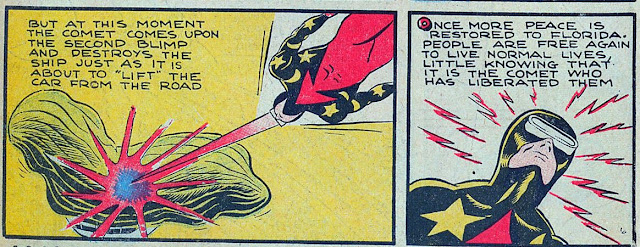
    Back to the Comet: Satan’s anti-super-hero savvy extends only so far. Despite his acumen in capturing the Comet and neutralizing his power, Satan has fallen prey to the super-villain’s hubris by leaving him to die in a deathtrap rather than merely shooting him in the head. You see, the really important thing about the Comet’s visor is that it’s just a sheet of glass and thus easily breakable, which the Comet does by the simple expedient of headbutting a rock. After that, it’s just a matter of utterly obliterating not only both dirigibles but the entire swamp base. Satan is toast.

    OR IS HE? In a shock twist, Satan returns in Pep Comics 003 and manages to capture the Comet again, this time taking the trouble to pop him into a glass tube and thus completely neutralizing his powers! (and also delighting me personally, because the name Satan is very ambiguously used in his first appearance and I really appreciated this confirmation that it really is his nom du crime. For my records).

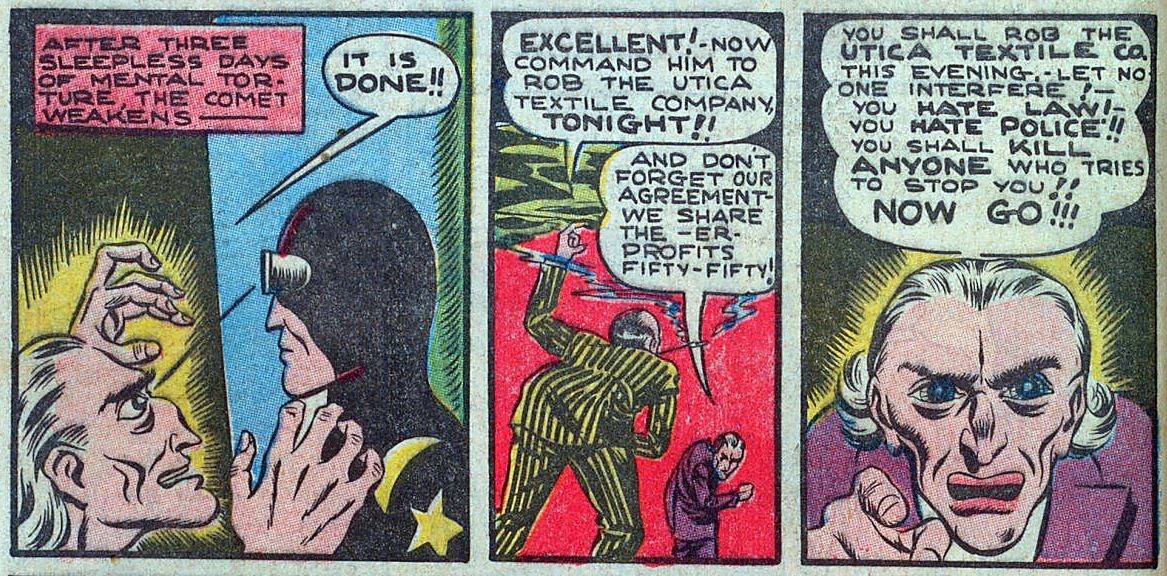
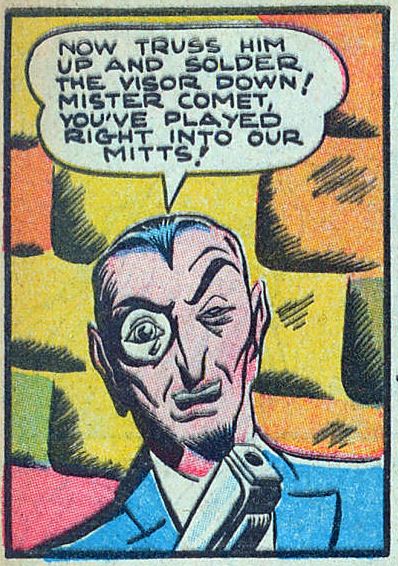
    Satan’s got big plans for the Comet – no cheesy deathtrap this time, no sir. Instead, he brings in put-upon hypnotist Doc Zadar in order to put the Comet to work for him.

    And this isn’t your namby-pamby “can’t be forced to violate your deeply-held morals” hypnotism, this is the real hard-core shit. The Comet goes on a destructive and violent crime spree under Satan and Zagnar’s direction. Notably, this is when he kills a whole bunch of cops, which informs the rest of his Golden Age career by making him one of the few super-heroes who the police have some real justification for constantly trying to gun down (I mean, they still shouldn’t just be trying to execute him in the street, but it’s nice to see them doing it for a reason other than “he’s running away from me even though I’m threatening to kill him!”)

    Once again Satan is undone by his own hubris: this time his failure to see that cheating and abusing the man who controls the actions of a living death ray generator might be a bad idea, and he gets gruesomely dissolved for his mistake. Unfortunately for Zagnar, he forgets the first rule of owning a living death ray generator: always put the safety cap back on. He too is dissolved and the Comet is free to have cops try to gun him down in the street forevermore.

    BONUS: All this Comet talk had me feeling nostalgic and I looked up 1983’s The Comet 001, which I had as a kid. It’s a pretty maudlin book primarily concerned with the Comet castigating himself over what a violent and murderous vigilante he was, and the splash page reflects this via the floating ghosts of the dead who haunt him – note all the cops from Pep Comics 003 at the top there. But just who is that at the lower left?

    I am 75+% certain that this is the monster face that Satan was projecting onto the clouds in Pep 002, which is a pretty hilarious thing to be haunting a depressed 80s super-hero. “I contributed to the death of the airship as a viable mode of transport when I murdered those dirigibles!”

    (the real if boring answer is that it probably is the face from the clouds but, as Satan himself is never actually pictured in the severely abridged version of the story in this comic, the face is being retconned into being his)

  • MINOR SUPER-VILLAIN 684: THE TERROR OF ROCKY POOL

    (Pep Comics 002, 1940)

    Like the Mayfair Monster before him, the Terror of Rocky Pool is interrupted mid-murder by Inspector Bentley of Scotland Yard. Just like last time, his trusty stick has little effect, though instead of breaking over a head of iron it meets no resistance at all. Unlike last time, Bentley is too late to save the victim, who swiftly bleeds to death from a too-small wound. Bentley is informed that the culprit is the Terror of Rocky Pool and that it makes its vampiric lair at the bottom of that same body of water.

    A subsequent interview with the victim’s family introduces a couple of suspects: his adoptive cousin Joan Edmunds and biological cousin John Blake, who are in love, even though Joan was the victim’s fiance. They only marry cousins in Little Rockham it seems. Also the victim’s uncle, a kindly man who raises leeches as a hobby and Joan as his daughter. Can’t be him, obviously.

    After a few vampire chases and a lot of yelling, Bentley gets to the bottom of things and it’s even more unsavoury than all of the cousin-marrying and cousin-cuckolding. It turns out that kindly Uncle Blake was the Terror all along, using in order, a local superstition, anticoagulant leech saliva and an underwater tunnel from the pool to his house in order to kill one nephew and attempt to frame the other because he was in love with his own adopted daughter. We truly are dealing with the most depraved depths of supercrime here.

  • MINOR SUPER-VILLAIN 683: THE MAYFAIR MONSTER

    (Pep Comics 001, 1940)

    Inspector Bentley of Scotland Yard is an investigator with the same case profile as the Scooby-Doo Gang: he regularly encounters the supernatural in the course of his job and day-to-day life and just as regularly exposes them as guys in masks and so forth.

    In this case, Bentley is taking his evening constitutional when he interrupts an honest-to-goodness werewolf attack! He even breaks his signature weapon, his cane on the thing’s head!

    Taking the victim – Brenda Joyce – home, Bentley meets her godfather/guardian, Sir Rupert Napier, and learns from Brenda’s own occult library that the creature he had faced was the fabled Mayfair Monster, a local legend presumably from before Mayfair became an upper class neighbourhood of London.

    Bentley’s suspicious are raised by some squirrely behaviour on Sir Rupert’s part and he engages in a bit of subterfuge whereby the “Brenda Joyce” sent home to convalesce is in fact Bentley in a wig. Sure enough, the Mayfair Monster makes a repeat appearance in Brenda’s bedroom that night and is swiftly subdued and unmasked.

    It’s certainly a convoluted way to murder your own ward for her money – I suppose the idea was to establish the existence of the werewolf with the very public first attack so as to have a ready-made suspect for the eventual murder. But why wear a monocle under an iron wolf mask?

  • MINOR SUPER-HERO ROUND-UP 033

    Minor super-heroes, we got ’em.

    Little Giant: 

    Professor Rednow has some inventions to test and he has secured an orphan boy named Rusty for that purpose. Rusty is first given a serum that is supposed to turn him into a big hunk of beefcake but instead he becomes a kid with super strength. He then gets an outfit with anti-gravity properties that allow him to leap around like a small Hulk and finally is coated in “impurvogen,” a high-tech chemical that renders him invulnerable.

    In case you were having some doubts about Professor Rednow’s devotion to scientific ethics: I don’t think that he has any. It’s just lucky for young Rusty that all of this stuff works or he might end up buried in the Professor’s back yard alongside half a dozen other orphan boys.

    Rusty and the Professor end up moving to NYC and becoming special deputies in the NYPD but, as with the Phantom Knight before him, the Little Giant only really had a couple of adventures and the second one continues to be out of my price range. (OK Comics 001, 1940)

    the Shield:

    The Shield is Joe Higgins, “G-Man Extraordinary,” an FBI agent who battles threats to the US using a super-suit of his own design (a design that supposedly was the reason for Captain America switching from his original shield to the round one so as not to look too much like his patriotic counterpart, by the way). 

    Over the years the Shield’s status is subject to the usual comic drift: his powers go from being solely derived from his suit to involving some sort of super serum or ray or two of those, or all three. We’re talking about the 1940 version of the character, though, and he was all suit, baby. The suit itself did slim down considerably from the first issue to the second, but we can chalk that up to a refinement of the technology (and to the more form-fitting top being a bit more flattering than the big chunky breastplate look).

    One thing about the Shield that I had never known prior to reading his first appearance was that his motivation for becoming a costumed crimefighter was that his father died in the Black Tom Explosion as a result of German sabotage during WWI. Thus, the Shield has the Batman origin but for espionage!  (Pep Comics 001, 1940)

    UPDATE (Shield-Wizard Comics 001, 1940)

    the Comet:

    John Dickering is a scientist who invents a gas that when injected gives him super jumping abilities. Too late he learns the reason that so many scientists do extensive testing before trying out serums etc on themselves, as the gas also gives him disintegrating ray vision that can only be held in check by a glass visor, Cyclops-style. Thus, he becomes the Comet.

    There are a number of remarkable things about the Comet over the years but the only ones relevant to the 1940 version of the character are 1. the fact that he has one of the truly great Golden Age costumes and 2. just how very willing he is to kill his foes. I guess when all you have is a disintegrating ray every problem looks like a disintegratable nail. (Pep Comics 001, 1940)

    the Rocket:

    The Rocket is your classic example of an explorer coming to a lost/hidden/alien world and becoming its greatest champion. The most common example of this is your garden-variety jungle adventurer, with “modern man transported into an effete future” and “guy falls through hole into underground world” being other common examples.

    The Rocket’s adventures, on the other hand, happen… somewhere. He
    arrives via his namesake rocket ship – is the Diamond Empire located in
    the future? on an alien world? on a lost mesa or in a hidden valley? No
    idea, never addressed. He just shows up because he heard there was a hot
    queen running the joint and that’s all we get.

    After a rocky start, the Rocket manages to win over the titular Queen of Diamonds, going from her slave to her bodyguard to eventually becoming her lover/ adventuring companion. And if you read the above panels you might have noticed how very racist the Queen’s origin story is, another thing that is extremely in keeping with this man-in-a-strange-land style comic: white guy exceptionalism. (Pep Comics 001, 1940)

  • FASCIST GOON CLEARING HOUSE 007

    Once again we must discuss the fascists.

    The Black League are a pretty regular-style gang of fifth columnists with two points of distinction: 1) they call one another “Black One”, which is kind of fun and 2) they are trying to steal this completely awesome WWII mech suit and get beat up by Dick Cole, Wonder-Boy for their efforts. (Blue Bolt v1 011, 1941)

    The nation of Bundonia deploys this crack squad of idiots, the Bundsters, to Hollywood to prevent film star Harly Shaplyn from filming the MLJ universe’s version of the Great Dictator but they end up getting beaten up by Rang-a-Tang the Wonder Dog, child actor Richy Waters and a bunch of Boy Scouts. (Blue Ribbon Comics 006, 1940)

    The Young Bundists were just that: a junior version of the German-American Bund. They made the mistake of recruiting naif/ agent of chaos Ty-Gor and the adult leadership ended up jailed while the youths decided to join the Boy Scouts instead. (Blue Ribbon Comics 014, 1941)

    The Purple Shirts are on the one hand a pretty rote version of the American fascist movement working with foreigners of ambiguous origin in order to weaken the US from within and allow leader Angel Cobra and his decidedly Hitlerian lieutenant Scar to take over. On the other hand they have a real place in comics history that their contemporaries never quite manage to match, due to the fact that they are the ones who kill patriot Ezra Smith and trigger his incarnation as the latest version of Uncle Sam. It’s not much of a legacy but it’s better than most of these fascist shitbirds get.

    The Purple Shirts also manage to briefly capture FDR! (National Comics 001, 1940)

  • NOTES – DECEMBER 2024

    Drawn Without Reference: 

    The Rocket and the Queen of Diamonds find themselves facing a very off-model spider in the lad of the Batmen. (Pep Comics 003, 1940)

    Cops Shooting at Fleeing Suspects:

    I was briefly tempted to give the cops of the MLJ universe a pass on shooting at the Comet because he did after all kill a bunch of them while mind controlled but then I remembered that a) that’s still no excuse to gun someone down in the street, and b) it’s still bad that they’re just blazing away at a flying man in the middle of a large city full of other people. (Pep Comics 004, 1940)

     And they do it again… (Pep Comics 005, 1940)

     And again… (Pep Comics 006, 1940)

    … and again (in a crowded state legislature building!) (Pep Comics 008, 1940)

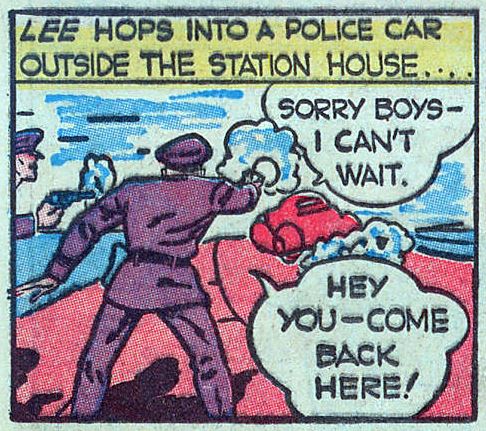
    Louisiana cops try to blow away Naval Academy Midshipman Lee Samson for escaping jail and stealing a police car. (Pep Comics 006, 1940)

    Crossovers:

    Oft touted as the first super-hero crossover in comics, the Shield shares a total of four panels with the Wizard as they both set out to foil some dastardly Mosconian spies. (Pep Comics 004, 1940)

    Less frequently mentioned are the brief encounters between the Wizard and Lee Samson, aka the Midshipman and the Shield and Keith Kornell, aka the West Pointer, two very similar and very dull military academy students from different branches of the military-industrial complex. And they are less interesting, so that makes sense.

    The next issue features another appearance by the Wizard, this one less highly touted as it’s the second time it happened plus he just shows up to loan the Shield a plane. I personally think that that’s remarkable, as Golden Age crossovers tended more toward the one-off. (Pep Comics 005, 1940)

    Minutia: 

    The Shield briefly pitches pro baseball under the name the Masked Marvel, as part of an investigation into a protection racket targeting players. (Pep Comics 007, 1940)