The Curse of Skeleton Munroe

Category: MLJ

  • NOTES – DECEMBER 2024

    Drawn Without Reference: 

    The Rocket and the Queen of Diamonds find themselves facing a very off-model spider in the lad of the Batmen. (Pep Comics 003, 1940)

    Cops Shooting at Fleeing Suspects:

    I was briefly tempted to give the cops of the MLJ universe a pass on shooting at the Comet because he did after all kill a bunch of them while mind controlled but then I remembered that a) that’s still no excuse to gun someone down in the street, and b) it’s still bad that they’re just blazing away at a flying man in the middle of a large city full of other people. (Pep Comics 004, 1940)

     And they do it again… (Pep Comics 005, 1940)

     And again… (Pep Comics 006, 1940)

    … and again (in a crowded state legislature building!) (Pep Comics 008, 1940)
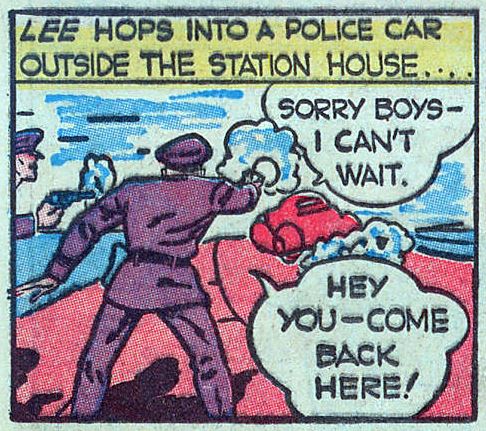
    Louisiana cops try to blow away Naval Academy Midshipman Lee Samson for escaping jail and stealing a police car. (Pep Comics 006, 1940)

    Crossovers:

    Oft touted as the first super-hero crossover in comics, the Shield shares a total of four panels with the Wizard as they both set out to foil some dastardly Mosconian spies. (Pep Comics 004, 1940)

    Less frequently mentioned are the brief encounters between the Wizard and Lee Samson, aka the Midshipman and the Shield and Keith Kornell, aka the West Pointer, two very similar and very dull military academy students from different branches of the military-industrial complex. And they are less interesting, so that makes sense.

    The next issue features another appearance by the Wizard, this one less highly touted as it’s the second time it happened plus he just shows up to loan the Shield a plane. I personally think that that’s remarkable, as Golden Age crossovers tended more toward the one-off. (Pep Comics 005, 1940)

    Minutia: 

    The Shield briefly pitches pro baseball under the name the Masked Marvel, as part of an investigation into a protection racket targeting players. (Pep Comics 007, 1940)

  • REAL PERSON ROUND-UP 004

    More of those pesky real people have gotten into my comic books!

    Andrew Jackson:

    Character Keith Kornell, aka the West Pointer, is a descendant of Andrew Jackson, something you would perhaps be more proud of in 1939 than today. (Top-Notch Comics 001, 1939)

    Benito Mussolini:

    He’s a fairly oblique reference to Benito Mussolini but I reckon that up-and-coming Filipino dictator Remy Mussoni fits the brief. (Wonderworld Comics 008, 1939)

    Billy the Kid:

    Appears in a questionably true story told by character Windy Parks (Western Picture Stories 004, 1937)

    the Dionne Quintuplets:

    “Ad-Ventures at the Circus” was a recurring feature throughout the life of Star Comics (1937-1939), and it’s a fascinating artifact of the time that someone more qualified than me should write about some day. Long story short it was a twee little comic about advertising mascots going to the circus to watch other advertising mascots perform. There’s maybe a 75/25 split between the Surprisingly Familiar and Surprisingly Unfamiliar mascots with regular appearances by Surprisingly Racist ones. It’s a bit like a Neolithic Foodfight!. 

    Everything about this feature is weird, from the slightly uncanny valley illustrations by Raphael Astarita to the fact that it doesn’t really seem to be sponsored content (other than a command appearance by NRG, mascot of heavy Star Comics advertiser Baby Ruth). And then the final extant installment comes around and we get the weirdest advertising mascots of all as the Quaker Oats Man leads the Dionne Quintuplets onto stage – five living humans given the same status as the Crackerjack kid or Mr Peanut or some anthropomorphic orange who used to work for Sunkist. It’s a grim reminder of just how commodified those poor kids were, right down to their “act” being a pantomime of them going about their day, just like they did in the weird zoo they grew up in. (Star Comics v2 007, 1939)

    Gene Autry:

    An adventuring version of the singing cowboy in modern times (the Funnies 030, 1939)

    George VI of England:

    This here visit by King Arnold and his unnamed Queen is certainly meant to evoke the 1939 tour of Canada and the US by King George VI of England and Queen Elizabeth, the future Queen Mother. (Wonderworld Comics 005, 1939)

    George Washington:

    Not quite an appearance by Washington as adjacent to him, but the fact that one of the Wizard’s ancestors is given credit for a key part of the history of the American Revolution is worth noting. (Top-Notch Comics 001, 1939)

    FDR:

    Misc Minor Appearances: Thanks secret agent K-51 for saving foreign royals (Wonderworld Comics 005, 1939) 

    the Mona Lisa:

    As the “Lona Dizzi”, painted by “Lombardo da Ginki” (“Dixie Dugan” strip, 1931)

    Paul Revere:

    Ride witnessed – and hide saved – by American Revolution-era child-patriots the Liberty Lads. (Champion Comics 008, 1940)

    Robert E. Lee:

    Wizard ancestor Thomas Whitney accepts the surrender of Robert E Lee at Appomattox, whether in place of Grant or prior to his showing up cannot be said. (Top-Notch Comics 001, 1939)

    Tom Mix:

    Like Gene Autry, Tom Mix was a movie cowboy who starred in adventure comics as a larger-than-life version of himself having rootin’ tootin’ Wild West adventures. Unlike Autry, Tom Mix generally starred in stories set in the Old West, as himself but in the past. Tom Mix also holds the special distinction of appearing in comics from this earliest example (that I have found, at least) to at least the early 50s, long after he had died in October, 1940. (The Comics 001, 1937)

  • REAL PERSON ROUND-UP 004

    More of those pesky real people have gotten into my comic books!

    Andrew Jackson:

    Character Keith Kornell, aka the West Pointer, is a descendant of Andrew Jackson, something you would perhaps be more proud of in 1939 than today. (Top-Notch Comics 001, 1939)

    Benito Mussolini:

    He’s a fairly oblique reference to Benito Mussolini but I reckon that up-and-coming Filipino dictator Remy Mussoni fits the brief. (Wonderworld Comics 008, 1939)

    Billy the Kid:

    Appears in a questionably true story told by character Windy Parks (Western Picture Stories 004, 1937)

    the Dionne Quintuplets:

    “Ad-Ventures at the Circus” was a recurring feature throughout the life of Star Comics (1937-1939), and it’s a fascinating artifact of the time that someone more qualified than me should write about some day. Long story short it was a twee little comic about advertising mascots going to the circus to watch other advertising mascots perform. There’s maybe a 75/25 split between the Surprisingly Familiar and Surprisingly Unfamiliar mascots with regular appearances by Surprisingly Racist ones. It’s a bit like a Neolithic Foodfight!. 

    Everything about this feature is weird, from the slightly uncanny valley illustrations by Raphael Astarita to the fact that it doesn’t really seem to be sponsored content (other than a command appearance by NRG, mascot of heavy Star Comics advertiser Baby Ruth). And then the final extant installment comes around and we get the weirdest advertising mascots of all as the Quaker Oats Man leads the Dionne Quintuplets onto stage – five living humans given the same status as the Crackerjack kid or Mr Peanut or some anthropomorphic orange who used to work for Sunkist. It’s a grim reminder of just how commodified those poor kids were, right down to their “act” being a pantomime of them going about their day, just like they did in the weird zoo they grew up in. (Star Comics v2 007, 1939)

    Gene Autry:

    An adventuring version of the singing cowboy in modern times (the Funnies 030, 1939)

    George VI of England:

    This here visit by King Arnold and his unnamed Queen is certainly meant to evoke the 1939 tour of Canada and the US by King George VI of England and Queen Elizabeth, the future Queen Mother. (Wonderworld Comics 005, 1939)

    George Washington:

    Not quite an appearance by Washington as adjacent to him, but the fact that one of the Wizard’s ancestors is given credit for a key part of the history of the American Revolution is worth noting. (Top-Notch Comics 001, 1939)

    FDR:

    Misc Minor Appearances: Thanks secret agent K-51 for saving foreign royals (Wonderworld Comics 005, 1939) 

    the Mona Lisa:

    As the “Lona Dizzi”, painted by “Lombardo da Ginki” (“Dixie Dugan” strip, 1931)

    Paul Revere:

    Ride witnessed – and hide saved – by American Revolution-era child-patriots the Liberty Lads. (Champion Comics 008, 1940)

    Robert E. Lee:

    Wizard ancestor Thomas Whitney accepts the surrender of Robert E Lee at Appomattox, whether in place of Grant or prior to his showing up cannot be said. (Top-Notch Comics 001, 1939)

    Tom Mix:

    Like Gene Autry, Tom Mix was a movie cowboy who starred in adventure comics as a larger-than-life version of himself having rootin’ tootin’ Wild West adventures. Unlike Autry, Tom Mix generally starred in stories set in the Old West, as himself but in the past. Tom Mix also holds the special distinction of appearing in comics from this earliest example (that I have found, at least) to at least the early 50s, long after he had died in October, 1940. (The Comics 001, 1937)

  • GENERIC COSTUMED VILLAIN ROUND-UP 012

    Management not responsible if some of the villains are not technically costumed.

    This fellow, known as the Boss, was the masked publisher of a newspaper known as the Weekly Tattler which functioned as a vehicle for his blackmail business: pay up or get your secrets printed in the next edition. He turned out to be the husband of one of the paper’s victims, which makes little enough sense that I reckon that they got to the end of the story without adding any good suspects so went with the only possibility. Also he gets shot by his very gullible underling after the Fox barely implies that there’s a double cross on. (Blue Ribbon Comics 011, 1941)

    Inferno tangles with crook Jake the Fake and his henchmen as they make a break for the Mexican border disguised as a shipment of mummies, a top tier thing to pretend to be. (Blue Ribbon Comics 017, 1941)

    If you have to be a very generic pirate so hard up you have to kidnap guys from the US Navy to run your radio equipment in a mid-level (by Golden Age standards) racist adventure well then you’d better have a great name like the Scourge because that’s really all you have going for you. (Wonderworld Comics 003, 1939)

    Like the Scourge, the Obermaster here is a real waste of a good villain name on a real damp squib of a character. He is Samson Gorth, a criminal mastermind with no real plan. No, that’s not accurate. He has a plan to incite war between the US and Japan by attacking their respective shipping using planes with false insignia but beyond that his goals are a mystery. Is he hoping for plunder? A chance for war profiteering? No clue and thanks to special agent Bruce McKay, Sky Master, we’ll never find out. Because the Obermaster is dead. In case that wasn’t clear. (The Funnies 035, 1939)

  • MINOR SUPER-HERO ROUND-UP 015

    Once again we take you to the world of the minor super-hero. See them dance for your amusement. 

    the Mystic: 

    Later known as Kardak the Mystic, the Mystic is a stage magician who uses stage magic to battle crime, specializing in fraudulent mediums etc. His stage magic eventually gets rounded up to real magic, of course. (Top-Notch Comics 001, 1939)

    the Phantom o’ the Hills:

    The Phantom o’ the Hills is an otherwise unnamed masked cowboy who rights wrongs in the Old West. In his first adventure he avenges the death of his younger brother but whether that’s what got him into the vigilante game is not elaborated on. The only real thing that sets him apart from the ranks of other similar characters is his better-than-average name. (Western Picture Stories 001, 1937)

    Wonder Man:

    For all that (by some accounts) Will Eisner was explicitly told to make a Superman clone when he made him for Fox Features (and that DC successfully sued Fox into canning him), Wonder Man is only kind of like Superman. Maybe it’s my modern image of what Superman is like but he’s just a strong guy who jumps around catching artillery shells and beating up warmongers. Plus he gets his powers from a magic Tibetan ring! Plus he’s blonde! (Wonder Comics 001, 1939)

    Yarko the Great:

    There are three major things to know about Yarko the Great: 

    1. He’s a magic-slinging hero in the classic mold, i.e., an American who has learned the secrets of the Far East and turned them to a career in stage magic/ crimefighting.

    2. Like a lot of early Fox Features characters he was created by Will Eisner so his adventures tend to look pretty great.

    3. “Yarko the Great” is – and this is an informed opinion – categorically the worst name that any magic-using Golden Age hero was saddled with. 

    (Wonder Comics 002, 1939)

    Yarko UPDATE 1940

    *UPDATE* the Flame *UPDATE*:

    Just wish to draw everyone’s attentions to the really boss custom-painted boat that the Flame was tooling around in during his first adventure. Plus he had a butler named Jarvis! (Wonderworld Comics 003, 1939)

    **DOUBLE UPDATE**

    And he has a plane! (Wonderworld Comics 004, 1939)

  • MINOR SUPER-HERO ROUND-UP 014

    Some real niche characters this time.

    the Lone Star Rider:

    An Old West hero so generic he only appeared once and never even got to track down the owlhoots who killed his parents in order to steal their land. Good gloves. (Smash Comics 002, 1939)

    Shock Gibson:

    Like Barry Allen after him, Charles (later Robert) Gibson is a young scientist working late into a stormy night when he is simultaneously struck by lightning and bathed in chemicals. Though he is called the Human Dynamo, for the first chunk of his career he functions as more of a Human Battery who stores an electrical charge that can be used to fuel various superhuman feats – super-strength, super-jumping (later full-on flight), and a shocking grasp.

    Shock Gibson goes through more than a few costume changes over the years – sadly this goofy helmet is axed during the first one – but one consistent element in his design is lotsa cool electricity crackle when he uses his powers. (Speed Comics 001, 1939)

    Shock Gibson UPDATE 1940: He loses the hat.

    the Man With 1000 Faces:

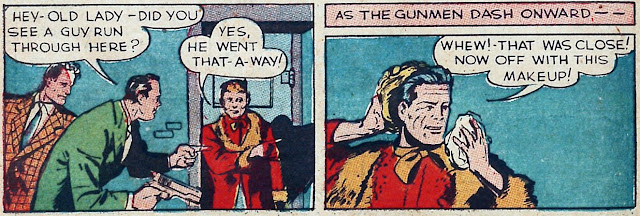
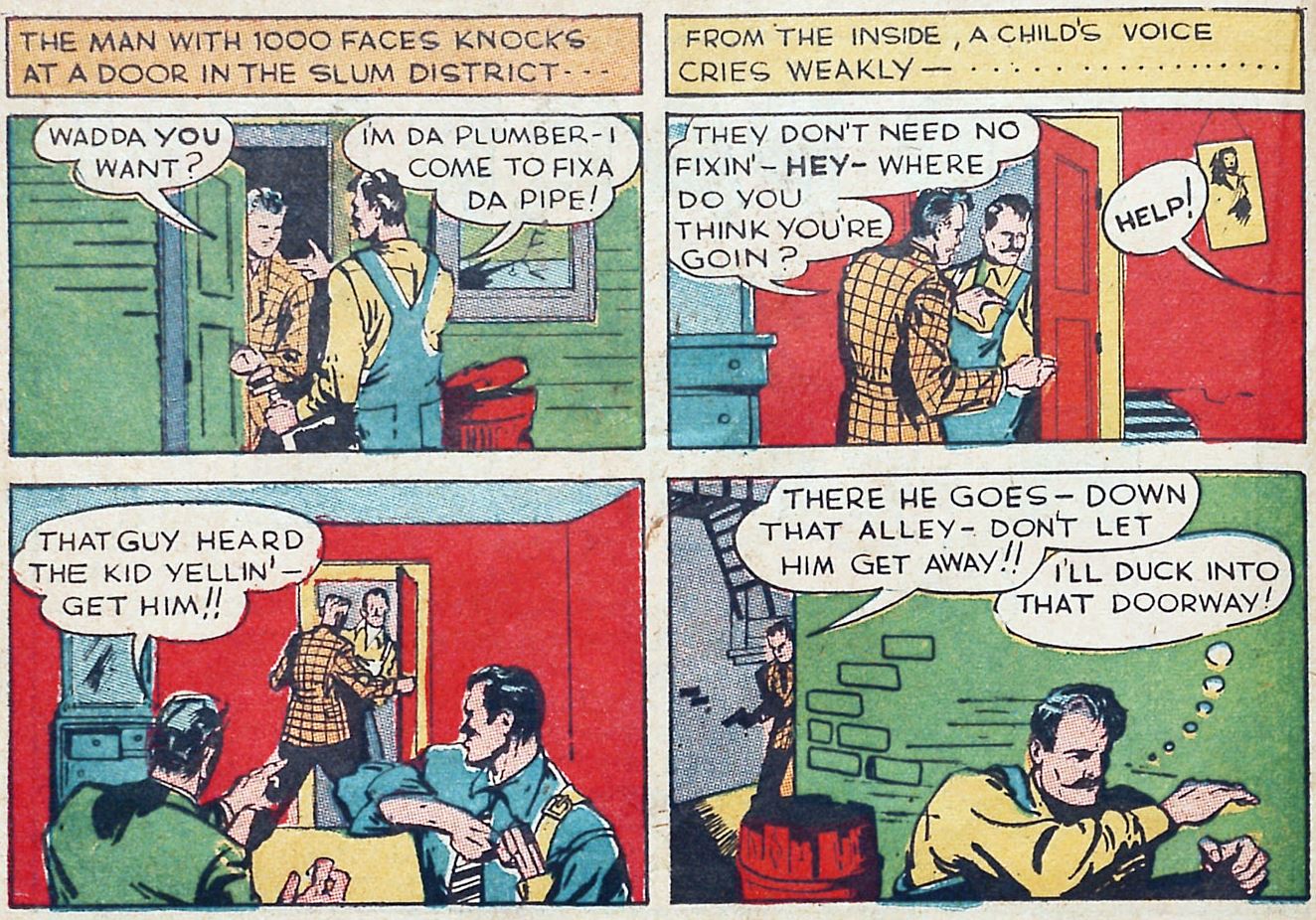
    Ted Parrish, famous film star, is bored with his humdrum life and so turns his considerable talent for quickchange artistry and disguise to the task of crimefighting. Just where he gets all of his accessories from is not elaborated on, so it’s equally likely that he scavenges them from the environment as it is that he just hauls around an enormous hockey bag full of clothing etc everywhere he goes.

    Parrish’s mission is obviously hampered somewhat by the fact that Los Angeles’ criminal fraternity knows that the Man With 1000 Faces exists and they should be on the lookout for him. How did they find out? Did Parrish blab to up the challenge and excitement of it all? (Speed Comics 001, 1939)

    the Wizard:

    Blane Whitney, AKA the Wizard, is the latest in seven generations of Whitneys (some of whom were also called the Wizard) to dedicate their lives in patriotic service to the USA. Plus he was a child prodigy who was charged to use his abilities to better mankind by Woodrow Wilson. Plus he’s an inventive genius in virtually all fields, particularly various forms of engineering. Plus he has nearly superhuman physical abilities and a mind so highly developed that it is superhuman in that he can employ remote viewing to locate dangers and clues.

    The Wizard was a pretty big player at MLJ in the 40s but has largely been abandoned in the various attempts to revive the MLJ characters at Archie and elsewhere – his biggest post-Golden Age appearance that I am aware of was as a super-villain fighting the Mighty Crusaders in the 60s. What does this say about the character – that he’s perfectly serviceable but not very conceptually exciting? Yes, I reckon that sums him up. (Top-Notch Comics 001, 1939)

    UPDATE 1940a

    UPDATE 1940b 

  • MINOR SUPER-HERO ROUND-UP 014

    MINOR SUPER-HERO ROUND-UP 014

    Some real niche characters this time.

    the Lone Star Rider:

    An Old West hero so generic he only appeared once and never even got to track down the owlhoots who killed his parents in order to steal their land. Good gloves. (Smash Comics 002, 1939)

    Shock Gibson:

    Like Barry Allen after him, Charles (later Robert) Gibson is a young scientist working late into a stormy night when he is simultaneously struck by lightning and bathed in chemicals. Though he is called the Human Dynamo, for the first chunk of his career he functions as more of a Human Battery who stores an electrical charge that can be used to fuel various superhuman feats – super-strength, super-jumping (later full-on flight), and a shocking grasp.

    Shock Gibson goes through more than a few costume changes over the years – sadly this goofy helmet is axed during the first one – but one consistent element in his design is lotsa cool electricity crackle when he uses his powers. (Speed Comics 001, 1939)

    Shock Gibson UPDATE 1940: He loses the hat.

    the Man With 1000 Faces:

    Ted Parrish, famous film star, is bored with his humdrum life and so turns his considerable talent for quickchange artistry and disguise to the task of crimefighting. Just where he gets all of his accessories from is not elaborated on, so it’s equally likely that he scavenges them from the environment as it is that he just hauls around an enormous hockey bag full of clothing etc everywhere he goes.

    Parrish’s mission is obviously hampered somewhat by the fact that Los Angeles’ criminal fraternity knows that the Man With 1000 Faces exists and they should be on the lookout for him. How did they find out? Did Parrish blab to up the challenge and excitement of it all? (Speed Comics 001, 1939)

    the Wizard:

    Blane Whitney, AKA the Wizard, is the latest in seven generations of Whitneys (some of whom were also called the Wizard) to dedicate their lives in patriotic service to the USA. Plus he was a child prodigy who was charged to use his abilities to better mankind by Woodrow Wilson. Plus he’s an inventive genius in virtually all fields, particularly various forms of engineering. Plus he has nearly superhuman physical abilities and a mind so highly developed that it is superhuman in that he can employ remote viewing to locate dangers and clues.

    The Wizard was a pretty big player at MLJ in the 40s but has largely been abandoned in the various attempts to revive the MLJ characters at Archie and elsewhere – his biggest post-Golden Age appearance that I am aware of was as a super-villain fighting the Mighty Crusaders in the 60s. What does this say about the character – that he’s perfectly serviceable but not very conceptually exciting? Yes, I reckon that sums him up. (Top-Notch Comics 001, 1939)

    UPDATE 1940a

    UPDATE 1940b 

  • REAL PERSON ROUND-UP 003

    Once more they ride: the REAL PEOPLE OF COMICS

    Abraham Lincoln:

    Lincoln’s shadow is used to symbolize the power of the US exerting a calming effect on the European belligerents. (Smash Comics 005, 1939)

    Adolf Hitler:

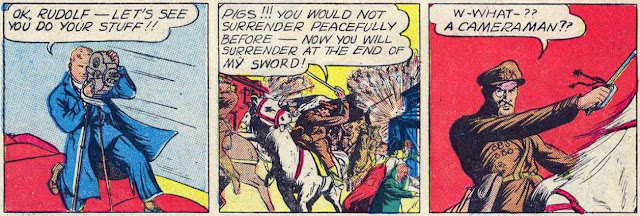
    Chancellor Rudolf of Wurtberg here is a more dynamic than usual Hitler analog (Smash Comics 004, 1939)

    Misc minor appearances:

    Getting some bad news about Nazi operations in Yugoslavia (Blue Ribbon Comics 015, 1941)

    Captain Kidd:

    For no particular reason this aviator/ adventurer is named after him. (Fantastic Comics 001, 1939)

    Franklin Delano Roosevelt:

    Discusses the threat of the Black Hand With J. Edgar Hoover (Blue Ribbon Comics 016, 1941)

    Misc Minor Appearances: appraised of the danger of invasion by Vlamir Koran (Smash Comics 001, 1939) 

    Seen ordering Americans in Europe to return home; meets Black Ace/X after he saves the transports that are returning them. (Smash Comics 003, 1939)

    Determines to defensively arm the US (Smash Comics 005, 1939)

    H.V. Kaltenborn:

    Radio commentator, appears as “H.V. Baltenhorn” (Blue Ribbon Comics 017, 1941)

    John Dillinger:

    Gangster “Jack Dilger” is vexed by Ty-Gor. (Blue Ribbon Comics 015, 1941) 

    Joseph Stalin:

    The same 3/4 perspective shot always used for FDR, now in Stalin form! (Smash Comics 002, 1939)

    Mahatma Gandhi:

    Aside from the pun name “Mohlasos Candhi”, this version of Gandhi is hitting a lot of the overt and casually racist checkmarks of the 1940s, including a disregard for the difference between India and the Middle East and a complete indifference for the distinction between Hindus and Muslims. Oh and also it’s another classic adventure based on propping up colonial rule. (Blue Ribbon Comics 017, 1941)

    Shirley Temple:

    As “Curley Semple” (“Dixie Dugan” comic strip, 1935)

    Sherlock Holmes:

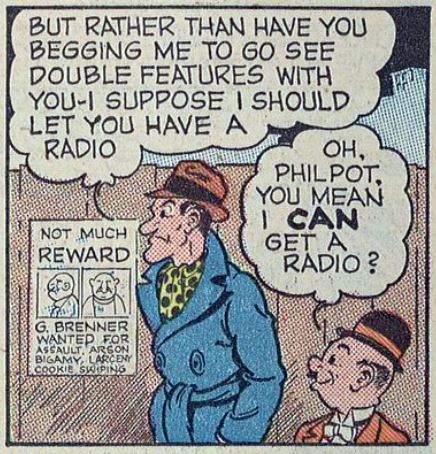
    Philpot Veep (along with his sidekick Waldo) was one of many humourous takes on Sherlock Holmes in Golden Age comics. Note also the wanted poster for G. Brenner, almost certainly referring to George Brenner, creator of the Clock. (Smash Comics 001, 1939)

    BONUS PHILPOT VEEP, DRUG FIEND

    COMIC BOOK DRAMA: in Smash Comics 005, George Brenner strikes back! Here’s Philpot Veep scribe Joe Devlin depicted AS A CLOWN! EPIC GOLDEN AGE BEEF SPOTTED

    Woodrow Wilson:

    Meets and gives sage advice to young Blane Whitney, who would grow up to become MLJ hero the Wizard. I am legitimately flabbergasted to see Wilson show up in this capacity. (Top-Notch Comics 001, 1939)

  • MINOR SUPER-VILLAIN 532: THE DEVIL

    (Blue Ribbon Comics 019, 1941)

    This is the same guy as the Dictator but on his time off, I guess? Mr Justice kind of gave up on him after the Green Ghoul incident – maybe he just couldn’t get up the energy to keep running a Nazi Germany analog.

    I think he continues to pop up and empower Mr Justice foes but more importantly he has some very cute little trident-wielding imp goons. No hell-dimension is complete without them!

  • MINOR SUPER-VILLAIN 531: THE EVIL EYE

    (Blue Ribbon Comics 019, 1941) 

    I wonder if high schools in comic book universes hold some sort of assembly to teach kids not to yell about selling their souls to the Devil when life has them down? Because as far as I can tell it’s got a pretty high chance of working, like it does for weird little scientist Ribo here.

    Ribo does indeed get to see again but he also gets a demonic makeover – he’s even more of a little creep than before! This is because the devil who he made a deal with is the same guy as the Dictator and Ribo/ the Evil Eye is being set up to take out Mr Justice.

    This is probably why the Evil Eye sets out to bet on a boxing match and fix the outcome rather than stay at home and work on his “great invention” with his new power of sight, right? Or was he a degenerate gambler to begin with and the Devil knew that he couldn’t resist using his new power this way – his invention is never defined, so perhaps it was just some sort of odds-calculator or a device for hypnotizing athletes over the phone.

    The Evil Eye gives Mr Justice a run for his money when they do eventually meet up but too bad for him that he has eye-based powers and that the counter to eye-based powers has been a mirror since Ancient Greece.

    In one of the harsher punishments in comic books (particularly when the only crime has been a bit of crooked sports betting) Mr Justice immediately drags the Evil Eye down to Hell, where we get some more of that sweet sweet LORE: not only are minor demons powerless to affect an immortal such as Mr Justice but the souls of what I can only assume are the creme de la creme of the evil dead are chained up next to their own bodies. It’s a fun visual if a slightly underwhelming punishment, but it’s where we must leave Ribo AKA the Evil Eye.