The Curse of Skeleton Munroe

Category: MLJ

  • MINOR SUPER-VILLAIN 524: THE KING OF THE VAMPIRES

    MINOR SUPER-VILLAIN 524: THE KING OF THE VAMPIRES

    (Blue Ribbon Comics 011, 1941) 

    We open not on the King of the Vampires but on a different vampire, one with a monocle. This is Carlos Hubbello, a diplomatic envoy from South America who has been sent to discuss a trade deal with the US that would leave the Nazis in the cold. The two gentlemen with him are no gentlemen at all but rather Nazi spies who are controlling Hubbello by the simple expedient of having turned him into a vampire, which is certainly harder to get out of than say kidnapping his loved ones but comes with a whole lot of extra risk for his handlers.

    This story is rife with lore. To whit:

    LORE: Vampires are easily cowed with a cross, even when wielded by evil men.

    Hubbello comes very close to vampiring Mr Justice’s love interest Pat Clark while they watch a performance of the very weird and cool “Waltz of the Vampire”. A ghost/ vampire brawl ensues.

    LORE: A vampire can lose control when exposed to great art.

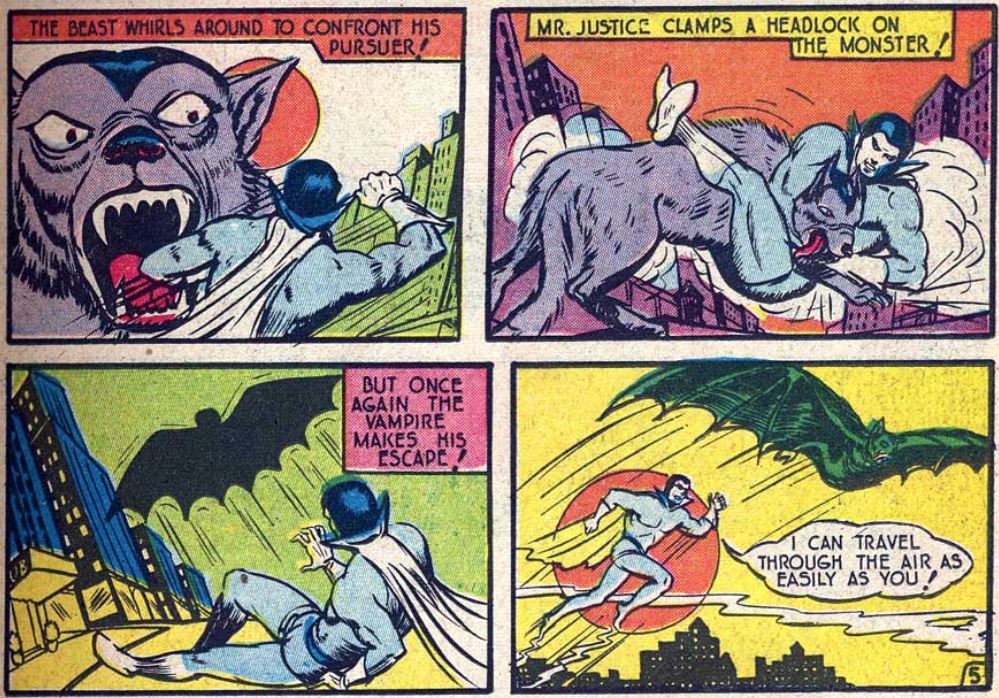
    LORE: vampires can transform into wolves and bats and retain their special vampire haircut in both forms (you can just make out a teeny tiny widow’s peak on the bat if you squint).

    Hubbello, defeated, spills the beans. The Nazis imported the King of the Vampires from Transylvania as part of their scheme to control the trade negotiations. Is the King of the Vampires a Nazi or merely using them to his own ends? This is not explored. Is the King of the Vampires supposed to be Dracula or is Transylvania just a good place for a vampire to come from? We can never know.

    LORE: Kill the head vampire in time and its under-vampires can be saved. What is “in time”? Not sure but it isn’t “before the under-vampire takes a life/ drinks human blood” as in a lot of vampire media, because Hubbello has already done both.

    Enter the King of the Vampires, freshly gorged on the blood of the innocent and battle commences. And I sure hope that Mr Justice knew the LORE that vampire cannot fight vampire because it means that he is on his own.

    LORE: this is the kind of vampire that seemingly isn’t harmed by light so much as by not physically being in his coffin at dawn. And he isn’t, so he dies.
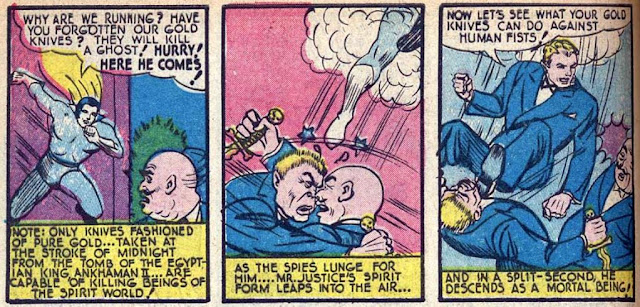
    Hubbello is saved! The trade deal can go forward! And back in the US we are reacquainted with the Nazi vampire-handlers, who come with one last piece of LORE: that knives fashioned of pure gold taken from the tomb of the Egyptian King Ankhaman II are capable – possibly the only things capable – of killing a ghost. A potent weapon against Mr Justice, if only they were any good at knifing. But they aren’t so they get captured immediately and the knives are presumably never seen again.

  • MINOR SUPER-VILLAIN 524: THE KING OF THE VAMPIRES

    MINOR SUPER-VILLAIN 524: THE KING OF THE VAMPIRES

    (Blue Ribbon Comics 011, 1941) 

    We open not on the King of the Vampires but on a different vampire, one with a monocle. This is Carlos Hubbello, a diplomatic envoy from South America who has been sent to discuss a trade deal with the US that would leave the Nazis in the cold. The two gentlemen with him are no gentlemen at all but rather Nazi spies who are controlling Hubbello by the simple expedient of having turned him into a vampire, which is certainly harder to get out of than say kidnapping his loved ones but comes with a whole lot of extra risk for his handlers.

    This story is rife with lore. To whit:

    LORE: Vampires are easily cowed with a cross, even when wielded by evil men.

    Hubbello comes very close to vampiring Mr Justice’s love interest Pat Clark while they watch a performance of the very weird and cool “Waltz of the Vampire”. A ghost/ vampire brawl ensues.

    LORE: A vampire can lose control when exposed to great art.

    LORE: vampires can transform into wolves and bats and retain their special vampire haircut in both forms (you can just make out a teeny tiny widow’s peak on the bat if you squint).

    Hubbello, defeated, spills the beans. The Nazis imported the King of the Vampires from Transylvania as part of their scheme to control the trade negotiations. Is the King of the Vampires a Nazi or merely using them to his own ends? This is not explored. Is the King of the Vampires supposed to be Dracula or is Transylvania just a good place for a vampire to come from? We can never know.

    LORE: Kill the head vampire in time and its under-vampires can be saved. What is “in time”? Not sure but it isn’t “before the under-vampire takes a life/ drinks human blood” as in a lot of vampire media, because Hubbello has already done both.

    Enter the King of the Vampires, freshly gorged on the blood of the innocent and battle commences. And I sure hope that Mr Justice knew the LORE that vampire cannot fight vampire because it means that he is on his own.

    LORE: this is the kind of vampire that seemingly isn’t harmed by light so much as by not physically being in his coffin at dawn. And he isn’t, so he dies.

    Hubbello is saved! The trade deal can go forward! And back in the US we are reacquainted with the Nazi vampire-handlers, who come with one last piece of LORE: that knives fashioned of pure gold taken from the tomb of the Egyptian King Ankhaman II are capable – possibly the only things capable – of killing a ghost. A potent weapon against Mr Justice, if only they were any good at knifing. But they aren’t so they get captured immediately and the knives are presumably never seen again.

  • GENERIC COSTUMED VILLAIN ROUND-UP 011

    Some say they’re not generic enough but I think they’re trying their best.

    This fellow is part of a gang looking to hijack a shipment of railway guns from train engineer Runaway Ronson. I really enjoy the look of the padded suit they use to help survive crashing a car into a high-speed train but I really really enjoy the fact that they immediately scramble off into the woods and are never seen again, as if they were completely unrelated to the criminal plot. (Blue Bolt v1 007, 1940)

    This fellow’s a pseudo-Nazi spy named Ketler who goes up against Sub-Zero in an attempt to influence the very specific Torpedo Workers Union into striking and hindering part of the US defense program. I feel like he overestimates the usefulness of the mask as he doesn’t change anything else about his appearance when not murdering people but that’s not what gets him caught so I guess I’m the fool here.(Blue Bolt v2 002, 1941)

    Colourful enemy aces are the best/ only tolerable part of the absurd number of Golden Age comics about pilot-adventurers, so my little ears pricked up when American-flying-for-the-French Loop Logan was challenged to a dogfight by a Nazi called the Blue Duke but… there’s nothing to him. He’s just a guy with a name who’s been sabotaging French planes and shooting them down. Waste of a good name, if you ask me. (several days later note: it took me an embarrassingly long time to realize that this guy’s name was a play on the Red Baron) (Blue Ribbon Comics 004, 1940)

    These guys briefly terrorize New York (possibly – we have another instance of a city that is Clearly New York City But the Mayor is Wrong) with a futuristic tank mounted with a death ray. If they a) had a name and b) weren’t completely demolished by Mr Justice in about three panels they might have made the leap to full Minor Super-Villain status but as it stands they’re an object lesson in why ultra-powerful ghosts need a tougher class of enemy to be really entertaining. (Blue Ribbon Comics 010, 1941)

  • REAL PERSON ROUND-UP 001

    REAL PERSON ROUND-UP 001

    I have a lot of these in a spreadsheet somewhere but we’ll get to those later. For now it’s as we encounter them: real people and versions of real people and analogs of real people and also the same but famous fictional people in comics.

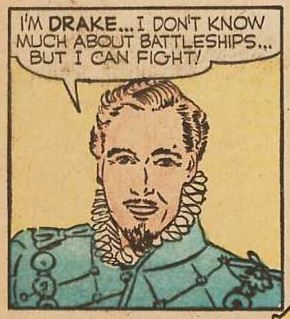
    Admiral Dewey, John Paul Jones, Sir Francis Drake:

     Their ghosts all volunteer to help Sergeant Spook go pirate hunting (Blue Bolt v1 008, 1941)

    Adolf Hitler: 

    “Gustave Ritter” isn’t really very close to “Adolf Hitler” but I have a finely-honed sense for when someone is making a Hitler analog and this world-conquering barbarian from the year 2041 is just that. I think. (Blue Ribbon Comics 004, 1940)

    Clark Gable:

    As “Stark Brable” in Rang-a-Tang the Wonder Dog’s trip to Hollywood (Blue Ribbon Comics 005, 1940)

    Lana Turner:

    It’s a classic first letter switcheroo as actress Lana Turner shows up as “Tana Lurner” in a Rang-a-Tang the Wonder Dog comic. (Blue Ribbon Comics 005, 1940)

    Maid Marion:

    The “Green Falcon” feature, as far as I can tell, takes place in a Robin-Hood era England with no Robin Hood but with Lady Marion here occupying the Maid Marion role. (Blue Ribbon Comics 004, 1940)

    Orson Welles:

    “Nawson Swelles” is a troublesome “Boy Wonder” and the villain of Rang-a-Tang the Wonder Dog’s visit to Hollywood. (Blue Ribbon Comics 005, 1940)

    Prince John:

    Essentially playing the same part as he does in the Robin Hood stories in the Green Falcon’s adventures. (Blue Ribbon Comics 004, 1940)

    Richard the Lionheart:

    The key to Prince John’s villainry is that the good king is off being a dipshit in the Holy Land and this version of Richard I does not fail in that. (Blue Ribbon Comics 004, 1940)

  • MINOR SUPER-VILLAIN 523: NATCHA

    MINOR SUPER-VILLAIN 523: NATCHA

    (Blue Ribbon Comics 008, 1941) 

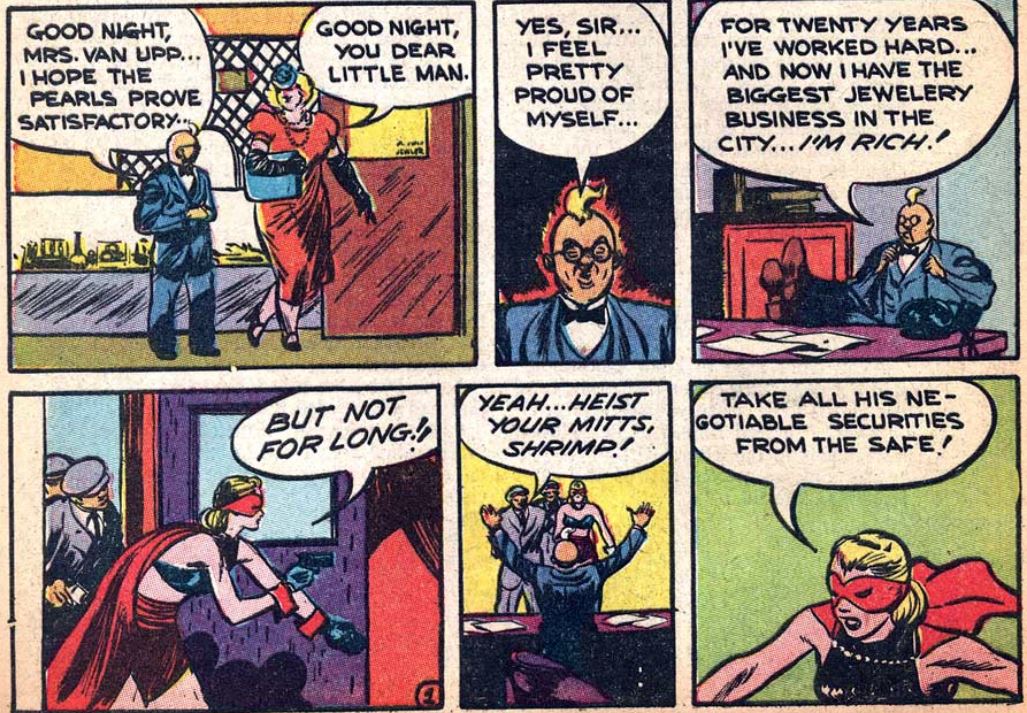
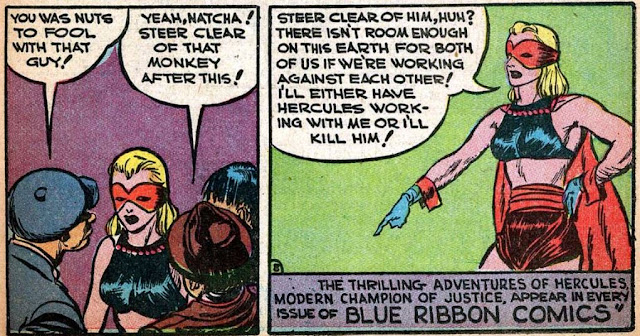
    Technically, Natcha is just another costumed gang boss, but she has a lot more style than you usually get with those.

    This being MLJ’s Hercules, Natcha is thematically linked to one of his iconic Twelve Labours, in this case the theft of the Girdle of Hippolyta. Of course, this version of Hercules was ridding the ancient world of evil rather than atoning for his own crimes via arbitrarily hard tasks, so the girdle doesn’t come into it and Hippolyta is implied to have been a villain of some sort whom Hercules reformed.

    Natcha’s victim here ends up as an ad hoc sidekick to Hercules for this adventure and gets saddled with the name “Little Zooey” for no apparent reason, despite his vigorous protests.

    I really like Natcha! She’s much more of a bruiser than most lady crooks of the Golden Age! Sure she’s a crook but she’s a crook with panache. Not that that helps her when a literal demigod shows up on her doorstep, even if he does have to take care of Little Zooey.

    Both Natcha and Little Zooey are set to reappear in future Hercules adventures but are instead banished to comic book limbo thanks to the Hercules feature never appearing again, a sad end for about one and a half good characters. Natcha in particular should absolutely be BRUNG BACK the next time someone takes a pass at reviving the Archie super-heroes even if Hercules is left in the big pile of also-rans with Lancelot Strong and the Wizard.

  • MINOR SUPER-HERO ROUND-UP 010

    MINOR SUPER-HERO ROUND-UP 010

    MORE MLJ ACTION

    Doc Strong:

    Doc Strong is a famous scientist living in the year 2041, in a world where WWII dragged on for an entire century and a new Mongol Horde has swept in and conquered the battered remnants of civilization. The strangely Doc Savage-like Doc Strong gathers a group of like-minded scientists and starts a new civilization called the Isle of Right from which to strike back at the invaders with such inventions as a ray gun that solidifies shadows. (Blue Ribbon Comics 004, 1940)

    the Fox:

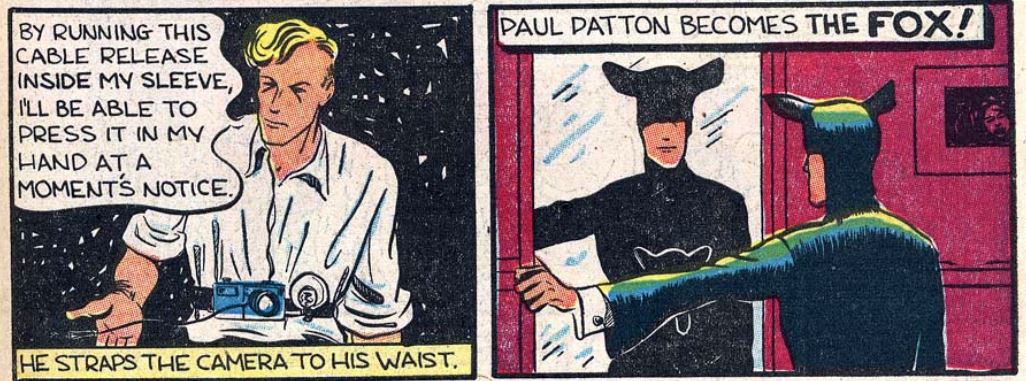
    Paul Patton, photographer for the Daily Globe, gets the tar beaten out of him by some fellows called the Night Riders and comes up with a plan:

    That’s right, he’s about halfway between Spider-Man and Batman. Okay, he’s mostly Batman but his wearable camera scheme anticipates Perter Parker’s epic work hack by about twenty years. The Fox’s first attempt at a costume is a bit rough, but eventually…

    … he adopts one of the top costumes of the Golden Age! His adventures may be a bit regular but he looks great doing it.

    BONUS FOX FACT: his “bat flies through the window” moment comes when he hears a song on the radio. (Blue Ribbon Comics 004, 1940)

    the Green Falcon: 

    The Green Falcon feature is essentially a Robin Hood Elseworlds story in which Robin is a knight instead of a forest outlaw and his pals Tiny Tuck and Jolly Roundfellow kind of encapsulate a few Merry Men each. Prince John is still there, and Maid Marion, but there are more swordfights than arrow tricks. Hey, I never said it was a particularly compelling Elseworlds story. It is more high concept than you usually get in a Golden Age comic, though. (Blue Ribbon Comics 004-015, 1940-1941)

    Ty-Gor:

    Ty-Gor is MLJ’s answer to Mowgli: a British child orphaned in the jungles of Malaysia and raised by tigers. Ty-Gor is a shortened form of his birth name, Tyrone Gorman, which he learns thanks to an absurd series of events pictured above.

    I don’t usually have a lot of time for jungle adventures but Ty-Gor does have a pretty fun twist in that after a half dozen issues he is brought to New York by explorer Dr Davis and his daughter Joan and Does Not Adapt. He’s just a wild kid who knows about five word maximum thrust into the public school system and causing havoc. It’s fun! (Blue Ribbon Comics 004, 1940)

    BONUS TY-GOR AS A BABY EATING GRAPES

  • MINOR SUPER-VILLAIN 522: THE NIGHT RIDERS

    (Blue Ribbon Comics 004, 1940) 

    There are plenty of Ku Klux Klan- inspired groups in comics and thusfar we’ve encountered a few: the Blue Devils, the Horned Masks, even the Purple‘s gang of idiots. All of those examples share one thing: they’re just gangs that operate in the country using the intimidation tactics of the KKK but without the goals of reinforcing white supremacy – they’re just regular comic book gangs, only in the country.

    There’s a part of me that wants to say that the Night Riders are closer to being the KKK than the rest of these groups but if I’m honest that’s because they have no clear goals – they just go around the countryside abducting, beating and killing people for getting into their business without any clear indication of what that business is. It could just as easily be organized insurance fraud as domestic racial terrorism, because the real reason the Night Riders are doing all this is so that they can beat up newspaper photographer Paul Patton and inspire him to become the Fox.

  • MINOR SUPER-HERO ROUND-UP 009

    All Archie/MLJ edition!

    Rang-a-Tang the Wonder Dog:

    The Wonder Dog is an uncommon but distinct type of comic book hero and Rang-a-Tang here is typical of the breed: essentially a dog with human intelligence. Rang-a-Tang escaped from a cruel but evidently very talented circus dog trainer and almost immediately teamed up with police Detective Hy Speed, who was perhaps lashing out at the world for his own moniker when he gave his new dog one of the all-time worst names. I mean, I get that it’s a knockoff of Rin-Tin-Tin but he also had a very bad name. 

    By issue seven of Blue Ribbon Comics Rang and Hy had moved to Hollywood and acquired a third companion in Richy Waters, aka Richy the Amazing Boy, and apparently free-range child actor with no adult supervision to speak of. Richy gradually usurps Rang-a-Tang’s place as the strip’s protagonist over the next year or so, which is disappointing to those of us who enjoy dogs more than child actors. (Blue Ribbon Comics 001-022, 1939-1942)

    Bob Phantom:

    As far as his super-hero identity goes, Bob Phantom is fairly regular: he shares with many other Golden Age heroes the power to suddenly appear – in a cloud of smoke in his case (though crucially he is generating the smoke as opposed to appearing in a preexisting cloud like the Vision. Or preexisting fire like the Flame, preexisting water like the Shark, etc. You get it) – and also has some degree of intangibility – definitely enough that bullets don’t affect him. Per his name, he’s very into spooking crooks out via psychological torment.

    Bob Phantom’s civilian identity is that of Walt Whitney, writer of the newspaper gossip column “On Broadway” which he uses to taunt both criminals and the New York District Attorney for some reason. Possibly just to be a scamp. (Blue Ribbon Comics 002, 1939)

    (between Bob Phantom, Top Ten character Jack Phantom and cartoon character Danny Phantom there are just enough characters with “Phantom” as a last name to make me think I’m missing some sort of very obvious pun)

    UPDATE

    UPDATE 1940 

    Corporal Collins, Infantryman:

    An American serving in the French Army (and later the British Army after the Nazis conquer France), Corporal Collins is for no apparent reason a super soldier with crack reflexes,  a danger sense that allows him to dodge enemy bullets and a “fabri-steel flexible repeller” that allows him to effectively deflect incoming bullets back to their source. The more overtly super-heroic aspects of  Collins get toned down after a couple of issues and he becomes just another comic book military paragon with a comic relief sidekick named Slapsie and a rivalry with fellow MLJ military hero Sergeant Boyle and his sidekick Twerp. (Blue Ribbon Comics 002, 1939)

    Hercules:

    It’s time for another Hercules! This Hercules is the real deal Olympian, sent to Earth by Zeus to combat evil (and possibly also as a prank? He seems to be completely unprepared when he pops up in the middle of a New York City analog). Functionally, he’s exactly the same as the other two Herculeses we’ve seen so far: a great big shirtless blonde guy with super strength. He even gets a job as a sideshow strongman like the both of them.

    The real innovation in this version of Hercules is the assertion that his famous Twelve Labours were in fact “wiping out the evils of Ancient Greece” and then drawing parallels between them and his adventures in the modern day, including:

    – the Slaying of the Nemean Lion -> killing gang boss Leo Nymia, the Lion of the Underworld (Hercules also steals Nymia’s suit as a version of wearing the lion’s hide)

    – the Slaying of the Lernean Hydra ->  deposing political fixer Hy Dralerny and his “Nameless Nine” organization

    – the Cleaning of the Augean Stables -> cleaning up crooked gambling at the local racetrack – very tortured and involves both a gambler named Augie King, and two jockeys named Tom and Dick Rivers who had to be “set in the right channels”

    – the Capture of the Erymanthian Boar -> very disappointing. Hercules captures a fat pseudo-Nazi General (who isn’t even named Hairy Man Ian) and because he shoots down a bunch of planes while doing it shoehorns in the Slaying of the Stymphalian Birds. Absolutely the worst of the bunch.

    – Stealing the girdle of Hippolyta -> Contending with the villainess Natch, about whom we shall speak anon.

    Sadly for the mythological completionists out there, Hercules stopped appearing after just six labours, so we’ll never get to see him take on Mary Diomedes the Cannibal Equestrian or twin cattle rustlers Gary and Gerry Young. (Blue Ribbon Comics 004, 1940)

  • MINOR SUPER-HERO ROUND-UP 009

    All Archie/MLJ edition!

    Rang-a-Tang the Wonder Dog:

    The Wonder Dog is an uncommon but distinct type of comic book hero and Rang-a-Tang here is typical of the breed: essentially a dog with human intelligence. Rang-a-Tang escaped from a cruel but evidently very talented circus dog trainer and almost immediately teamed up with police Detective Hy Speed, who was perhaps lashing out at the world for his own moniker when he gave his new dog one of the all-time worst names. I mean, I get that it’s a knockoff of Rin-Tin-Tin but he also had a very bad name. 

    By issue seven of Blue Ribbon Comics Rang and Hy had moved to Hollywood and acquired a third companion in Richy Waters, aka Richy the Amazing Boy, and apparently free-range child actor with no adult supervision to speak of. Richy gradually usurps Rang-a-Tang’s place as the strip’s protagonist over the next year or so, which is disappointing to those of us who enjoy dogs more than child actors. (Blue Ribbon Comics 001-022, 1939-1942)

    Bob Phantom:

    As far as his super-hero identity goes, Bob Phantom is fairly regular: he shares with many other Golden Age heroes the power to suddenly appear – in a cloud of smoke in his case (though crucially he is generating the smoke as opposed to appearing in a preexisting cloud like the Vision. Or preexisting fire like the Flame, preexisting water like the Shark, etc. You get it) – and also has some degree of intangibility – definitely enough that bullets don’t affect him. Per his name, he’s very into spooking crooks out via psychological torment.

    Bob Phantom’s civilian identity is that of Walt Whitney, writer of the newspaper gossip column “On Broadway” which he uses to taunt both criminals and the New York District Attorney for some reason. Possibly just to be a scamp. (Blue Ribbon Comics 002, 1939)

    (between Bob Phantom, Top Ten character Jack Phantom and cartoon character Danny Phantom there are just enough characters with “Phantom” as a last name to make me think I’m missing some sort of very obvious pun)

    UPDATE

    UPDATE 1940 

    Corporal Collins, Infantryman:

    An American serving in the French Army (and later the British Army after the Nazis conquer France), Corporal Collins is for no apparent reason a super soldier with crack reflexes,  a danger sense that allows him to dodge enemy bullets and a “fabri-steel flexible repeller” that allows him to effectively deflect incoming bullets back to their source. The more overtly super-heroic aspects of  Collins get toned down after a couple of issues and he becomes just another comic book military paragon with a comic relief sidekick named Slapsie and a rivalry with fellow MLJ military hero Sergeant Boyle and his sidekick Twerp. (Blue Ribbon Comics 002, 1939)

    Hercules:

    It’s time for another Hercules! This Hercules is the real deal Olympian, sent to Earth by Zeus to combat evil (and possibly also as a prank? He seems to be completely unprepared when he pops up in the middle of a New York City analog). Functionally, he’s exactly the same as the other two Herculeses we’ve seen so far: a great big shirtless blonde guy with super strength. He even gets a job as a sideshow strongman like the both of them.

    The real innovation in this version of Hercules is the assertion that his famous Twelve Labours were in fact “wiping out the evils of Ancient Greece” and then drawing parallels between them and his adventures in the modern day, including:

    – the Slaying of the Nemean Lion -> killing gang boss Leo Nymia, the Lion of the Underworld (Hercules also steals Nymia’s suit as a version of wearing the lion’s hide)

    – the Slaying of the Lernean Hydra ->  deposing political fixer Hy Dralerny and his “Nameless Nine” organization

    – the Cleaning of the Augean Stables -> cleaning up crooked gambling at the local racetrack – very tortured and involves both a gambler named Augie King, and two jockeys named Tom and Dick Rivers who had to be “set in the right channels”

    – the Capture of the Erymanthian Boar -> very disappointing. Hercules captures a fat pseudo-Nazi General (who isn’t even named Hairy Man Ian) and because he shoots down a bunch of planes while doing it shoehorns in the Slaying of the Stymphalian Birds. Absolutely the worst of the bunch.

    – Stealing the girdle of Hippolyta -> Contending with the villainess Natch, about whom we shall speak anon.

    Sadly for the mythological completionists out there, Hercules stopped appearing after just six labours, so we’ll never get to see him take on Mary Diomedes the Cannibal Equestrian or twin cattle rustlers Gary and Gerry Young. (Blue Ribbon Comics 004, 1940)

  • MINOR SUPER-VILLAIN 521: RED DUGAN

    (Blue Ribbon Comics 003, 1940) 

    Red Dugan is a down-on-his-luck gang boss who turns to what will be a classic crime method in the Silver Age particularly: he kidnaps a scientist and forces him to science up a weapon for him to smite his enemies with. In this case, the scientist in question is one Dr Cardo, who seems oddly prepared for the task of making a Seafood Platter Man. Was he kidnapped just before embarking on his own reign of terror? We can only speculate.

    Dugan sends his new monster to plant a bomb on the ship they are based out of, allowing it to show off its might via a cool underwater octopus battle. FEATURING: two very charmingly rascally fish enjoying a free buffet.

    The story ends with a triumphant Red Dugan in full control of his monster, having disposed of his enemies and Dr Cardo (he thinks. In reality the monster was conditioned to be unable to harm its creator) and presumably ready to loot and pillage all water-accessible riches he can. We can speculate that he would have met his comeuppance in the next issue and that it would have been at the hands of nautical adventure trio the Devils of the Deep because their name was the title of the adventure but neither they, Red Dugan, Dr Cardo or the monster ever appeared again.

    Bonus: One more look at those great fish. And they have some crustacean friends!